Content Management and
The Research Librarian
    Richard Higgs
   17 October 2011


                     COPYRIGHT: Attribution-
                     NonCommercial-NoDerivs 2.5
                     South Africa (CC BY-NC-ND 2.5)
Outline
• What is Enterprise Content Management?
• 2 approaches
• Where does the Librarian fit in?
• Implications for the Research Librarian


    Information and Communication Technology Services   -2-
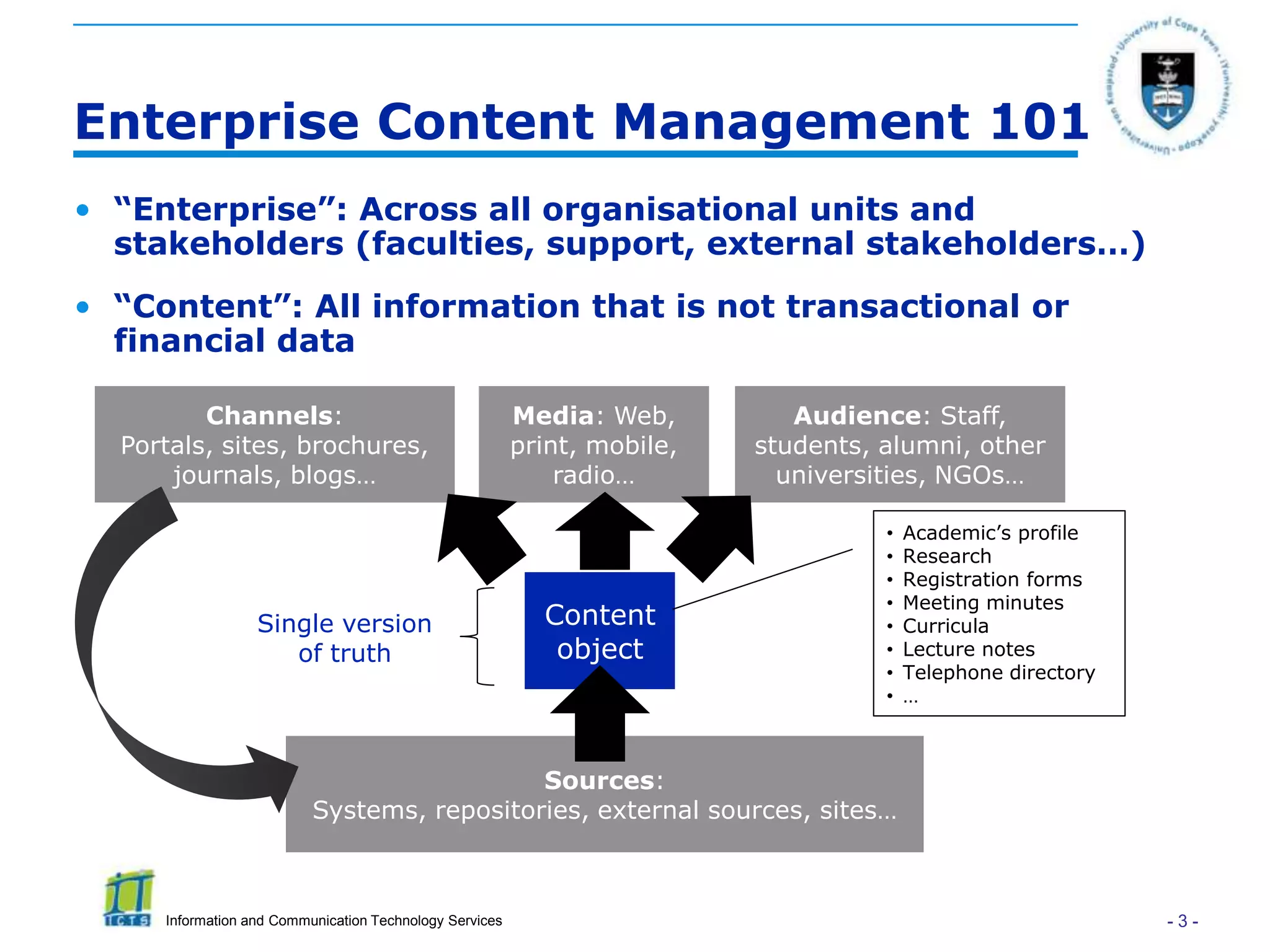
Enterprise Content Management 101
• “Enterprise”: Across all organisational units and
  stakeholders (faculties, support, external stakeholders…)
• “Content”: All information that is not transactional or
  financial data

         Channels:                                       Media: Web,         Audience: Staff,
  Portals, sites, brochures,                             print, mobile,   students, alumni, other
      journals, blogs…                                       radio…         universities, NGOs…

                                                                                    •   Academic’s profile
                                                                                    •   Research
                                                                                    •   Registration forms
                                                                                    •   Meeting minutes
                  Single version                           Content                  •   Curricula
                     of truth                               object                  •   Lecture notes
                                                                                    •   Telephone directory
                                                                                    •   …


                                            Sources:
                          Systems, repositories, external sources, sites…


     Information and Communication Technology Services                                                        -3-
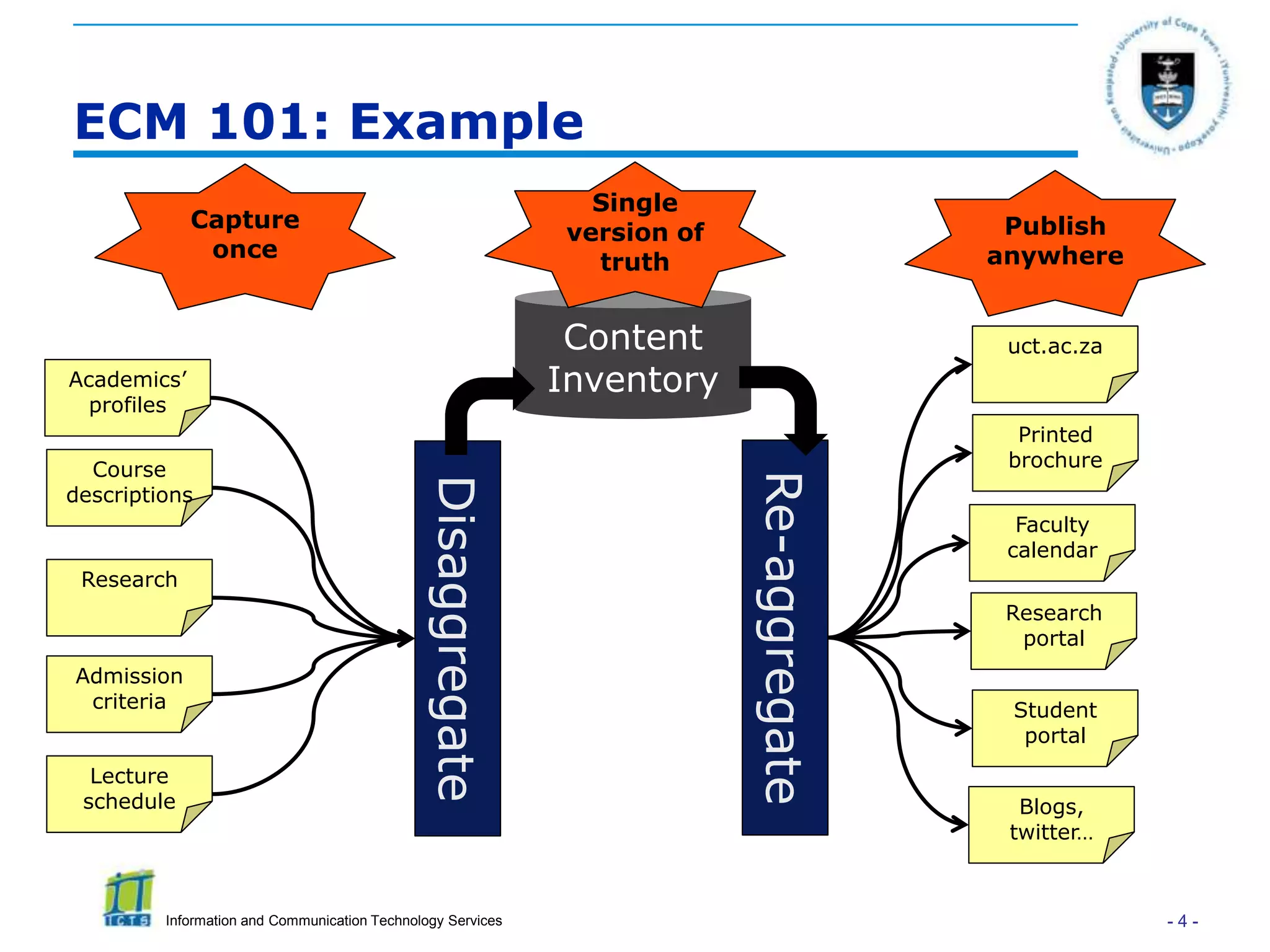
ECM 101: Example
                                                                 Single
             Capture                                                                        Publish
                                                               version of
              once                                                                         anywhere
                                                                 truth


                                                               Content                      uct.ac.za
Academics’                                                    Inventory
  profiles
                                                                                             Printed
  Course                                                                                    brochure


                                                                            Re-aggregate
                                               Disaggregate
descriptions
                                                                                             Faculty
                                                                                            calendar
 Research
                                                                                            Research
                                                                                             portal
Admission
 criteria                                                                                   Student
                                                                                             portal
  Lecture
 schedule                                                                                    Blogs,
                                                                                            twitter…


         Information and Communication Technology Services                                              -4-
Best Practice ECM Principles

• Single source (Store once, Publish anywhere, Single
  Version of the Truth)
• Centralise metadata management for maximum re-
  use and interoperability
• Separate content from format for maximum re-
  usability
• Consumer-centric: Structure content the way
  consumers want to access it, not according to
  organisational silos
• Decoupled architecture – Avoid being locked in by
  proprietary functionalities: There is no single end-to-
  end solution out there


    Information and Communication Technology Services   -5-
Approaches to ECM
• Functionality/software-driven
• Information/governance-driven


    Information and Communication Technology Services   -6-
Content Management Systems
• Document Management
• Web Content Management
• Records Management
• Imaging
• Digital Asset Management
• Brand Asset Management
• Groupware/Collaboration
• DTP
• Workflow/BPM
• Component Content Management

     Information and Communication Technology Services   -7-
The Evolving Imperative

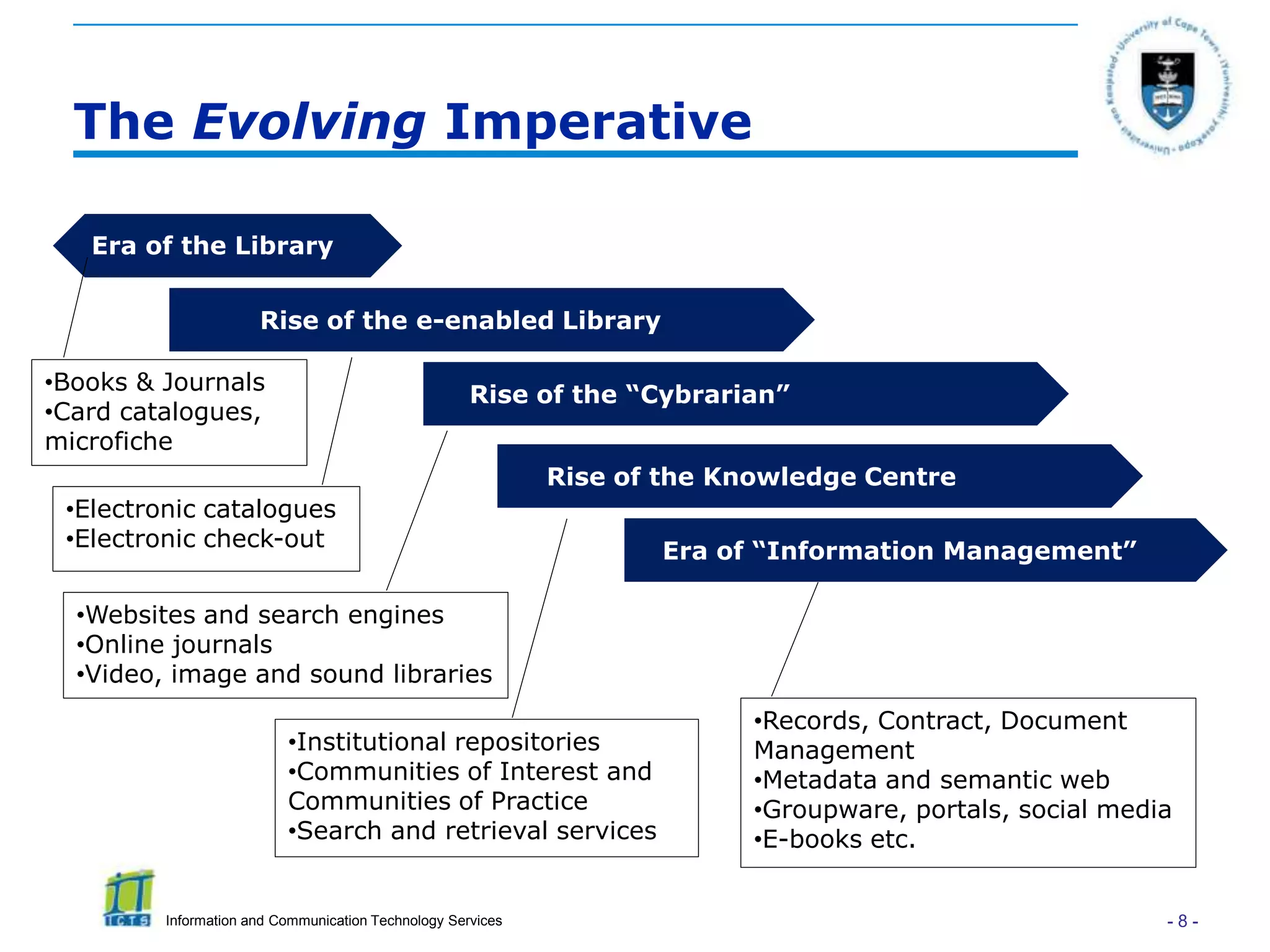
   Era of the Library


                      Rise of the e-enabled Library

•Books & Journals
                                                     Rise of the “Cybrarian”
•Card catalogues,
microfiche
                                                             Rise of the Knowledge Centre
 •Electronic catalogues
 •Electronic check-out                                              Era of “Information Management”

  •Websites and search engines
  •Online journals
  •Video, image and sound libraries
                                                                           •Records, Contract, Document
                          •Institutional repositories                      Management
                          •Communities of Interest and                     •Metadata and semantic web
                          Communities of Practice                          •Groupware, portals, social media
                          •Search and retrieval services                   •E-books etc.


         Information and Communication Technology Services                                                 -8-
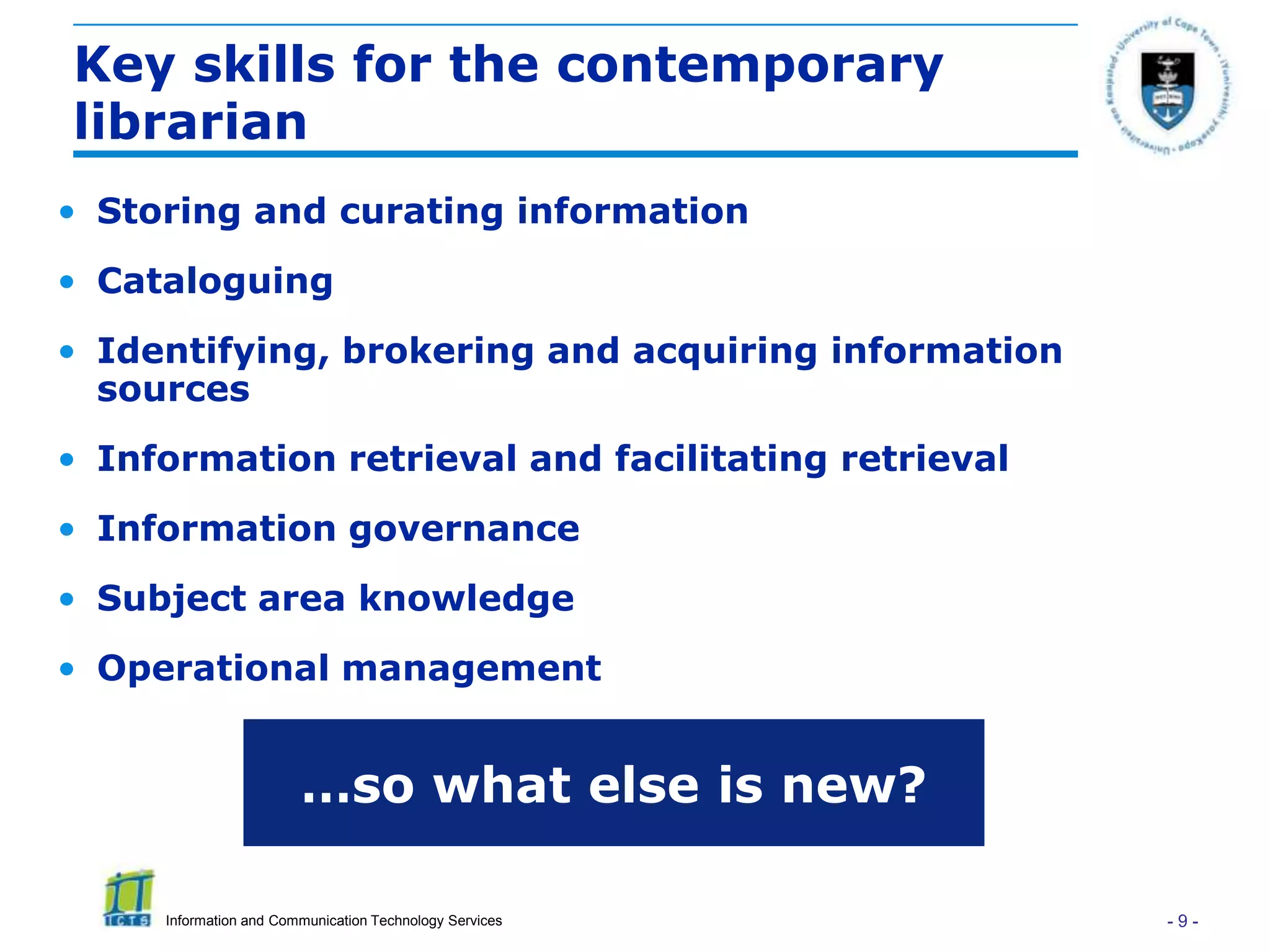
Key skills for the contemporary
librarian
• Storing and curating information
• Cataloguing
• Identifying, brokering and acquiring information
  sources
• Information retrieval and facilitating retrieval
• Information governance
• Subject area knowledge
• Operational management


                        …so what else is new?

     Information and Communication Technology Services   -9-
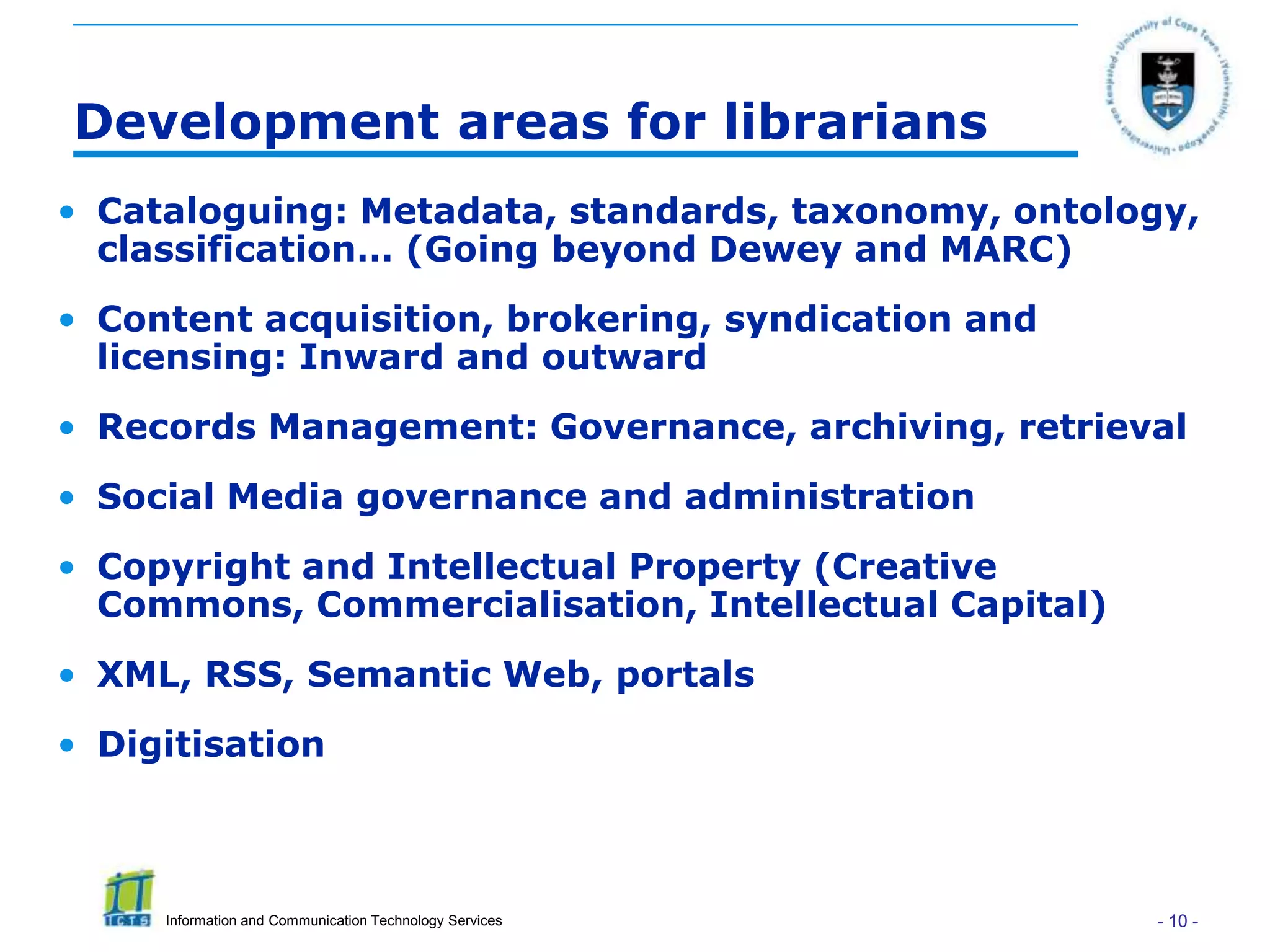
Development areas for librarians
• Cataloguing: Metadata, standards, taxonomy, ontology,
  classification… (Going beyond Dewey and MARC)
• Content acquisition, brokering, syndication and
  licensing: Inward and outward
• Records Management: Governance, archiving, retrieval
• Social Media governance and administration
• Copyright and Intellectual Property (Creative
  Commons, Commercialisation, Intellectual Capital)
• XML, RSS, Semantic Web, portals
• Digitisation


     Information and Communication Technology Services   - 10 -
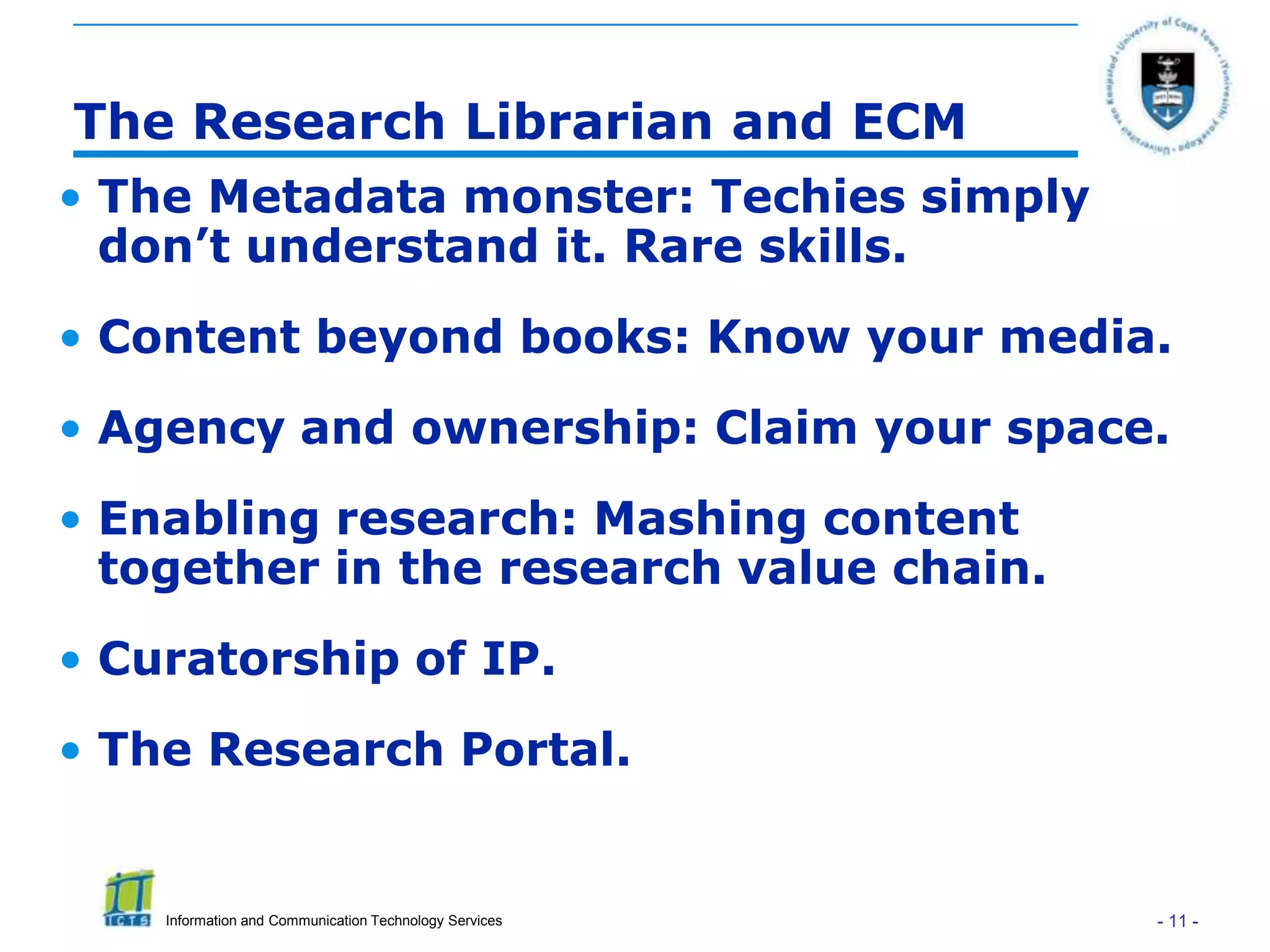
The Research Librarian and ECM
• The Metadata monster: Techies simply
  don’t understand it. Rare skills.
• Content beyond books: Know your media.
• Agency and ownership: Claim your space.
• Enabling research: Mashing content
  together in the research value chain.
• Curatorship of IP.
• The Research Portal.


    Information and Communication Technology Services   - 11 -
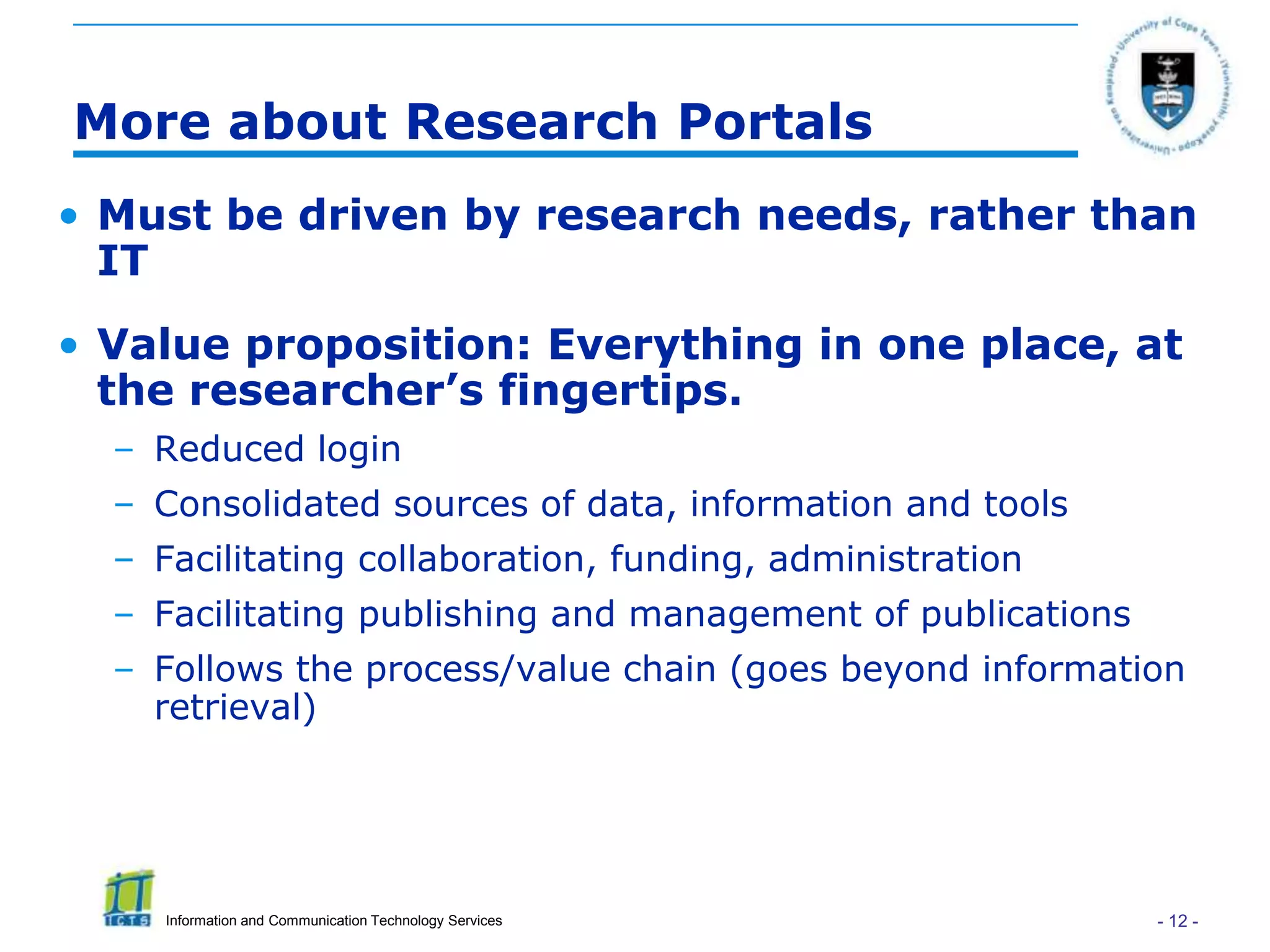
More about Research Portals
• Must be driven by research needs, rather than
  IT
• Value proposition: Everything in one place, at
  the researcher’s fingertips.
  – Reduced login
  – Consolidated sources of data, information and tools
  – Facilitating collaboration, funding, administration
  – Facilitating publishing and management of publications
  – Follows the process/value chain (goes beyond information
    retrieval)


     Information and Communication Technology Services       - 12 -
Questions?


   Information and Communication Technology Services   - 13 -

Enterprise Content Management and the Librarian

  • 1.
    Content Management and TheResearch Librarian Richard Higgs 17 October 2011 COPYRIGHT: Attribution- NonCommercial-NoDerivs 2.5 South Africa (CC BY-NC-ND 2.5)
  • 2.
    Outline • What isEnterprise Content Management? • 2 approaches • Where does the Librarian fit in? • Implications for the Research Librarian Information and Communication Technology Services -2-
  • 3.
    Enterprise Content Management101 • “Enterprise”: Across all organisational units and stakeholders (faculties, support, external stakeholders…) • “Content”: All information that is not transactional or financial data Channels: Media: Web, Audience: Staff, Portals, sites, brochures, print, mobile, students, alumni, other journals, blogs… radio… universities, NGOs… • Academic’s profile • Research • Registration forms • Meeting minutes Single version Content • Curricula of truth object • Lecture notes • Telephone directory • … Sources: Systems, repositories, external sources, sites… Information and Communication Technology Services -3-
  • 4.
    ECM 101: Example Single Capture Publish version of once anywhere truth Content uct.ac.za Academics’ Inventory profiles Printed Course brochure Re-aggregate Disaggregate descriptions Faculty calendar Research Research portal Admission criteria Student portal Lecture schedule Blogs, twitter… Information and Communication Technology Services -4-
  • 5.
    Best Practice ECMPrinciples • Single source (Store once, Publish anywhere, Single Version of the Truth) • Centralise metadata management for maximum re- use and interoperability • Separate content from format for maximum re- usability • Consumer-centric: Structure content the way consumers want to access it, not according to organisational silos • Decoupled architecture – Avoid being locked in by proprietary functionalities: There is no single end-to- end solution out there Information and Communication Technology Services -5-
  • 6.
    Approaches to ECM •Functionality/software-driven • Information/governance-driven Information and Communication Technology Services -6-
  • 7.
    Content Management Systems •Document Management • Web Content Management • Records Management • Imaging • Digital Asset Management • Brand Asset Management • Groupware/Collaboration • DTP • Workflow/BPM • Component Content Management Information and Communication Technology Services -7-
  • 8.
    The Evolving Imperative Era of the Library Rise of the e-enabled Library •Books & Journals Rise of the “Cybrarian” •Card catalogues, microfiche Rise of the Knowledge Centre •Electronic catalogues •Electronic check-out Era of “Information Management” •Websites and search engines •Online journals •Video, image and sound libraries •Records, Contract, Document •Institutional repositories Management •Communities of Interest and •Metadata and semantic web Communities of Practice •Groupware, portals, social media •Search and retrieval services •E-books etc. Information and Communication Technology Services -8-
  • 9.
    Key skills forthe contemporary librarian • Storing and curating information • Cataloguing • Identifying, brokering and acquiring information sources • Information retrieval and facilitating retrieval • Information governance • Subject area knowledge • Operational management …so what else is new? Information and Communication Technology Services -9-
  • 10.
    Development areas forlibrarians • Cataloguing: Metadata, standards, taxonomy, ontology, classification… (Going beyond Dewey and MARC) • Content acquisition, brokering, syndication and licensing: Inward and outward • Records Management: Governance, archiving, retrieval • Social Media governance and administration • Copyright and Intellectual Property (Creative Commons, Commercialisation, Intellectual Capital) • XML, RSS, Semantic Web, portals • Digitisation Information and Communication Technology Services - 10 -
  • 11.
    The Research Librarianand ECM • The Metadata monster: Techies simply don’t understand it. Rare skills. • Content beyond books: Know your media. • Agency and ownership: Claim your space. • Enabling research: Mashing content together in the research value chain. • Curatorship of IP. • The Research Portal. Information and Communication Technology Services - 11 -
  • 12.
    More about ResearchPortals • Must be driven by research needs, rather than IT • Value proposition: Everything in one place, at the researcher’s fingertips. – Reduced login – Consolidated sources of data, information and tools – Facilitating collaboration, funding, administration – Facilitating publishing and management of publications – Follows the process/value chain (goes beyond information retrieval) Information and Communication Technology Services - 12 -
  • 13.
    Questions? Information and Communication Technology Services - 13 -