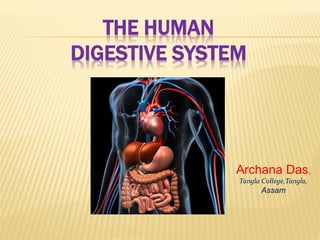
THE HUMAN 
DIGESTIVE SYSTEM 
Archana Das, 
Tangla College,Tangla, 
Assam
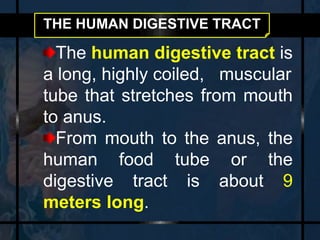
THE HUMAN DIGESTIVE TRACT 
The human digestive tract is 
a long, highly coiled, muscular 
tube that stretches from mouth 
to anus. 
From mouth to the anus, the 
human food tube or the 
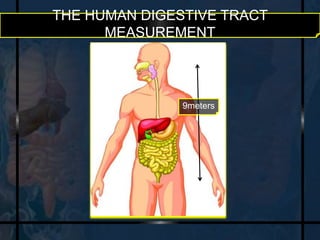
digestive tract is about 9 
meters long.
THE HUMAN DIGESTIVE TRACT 
MEASUREMENT 
9meters
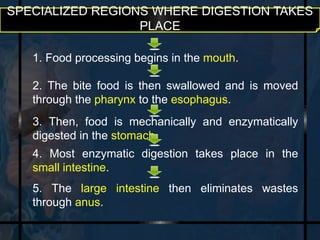
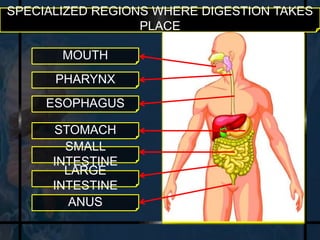
SPECIALIZED REGIONS WHERE DIGESTION TAKES 
PLACE 
1. Food processing begins in the mouth. 
2. The bite food is then swallowed and is moved 
through the pharynx to the esophagus. 
3. Then, food is mechanically and enzymatically 
digested in the stomach. 
4. Most enzymatic digestion takes place in the 
small intestine. 
5. The large intestine then eliminates wastes 
through anus.
SPECIALIZED REGIONS WHERE DIGESTION TAKES 
PLACE 
MOUTH 
PHARYNX 
ESOPHAGUS 
STOMACH 
SMALL 
INTESTINE 
LARGE 
INTESTINE 
ANUS
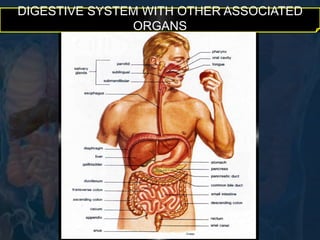
DIGESTIVE SYSTEM WITH OTHER ASSOCIATED 
ORGANS
DIGESTION AS IT OCCURS…. 
1. Food processing begins in the mouth. 
2. The bite food is then swallowed and is moved 
through the pharynx into the esophagus. 
3. Then, food is mechanically and enzymatically 
digested in the stomach. 
4. The liver secretes bile. 
5. The pancreas secretes digestive enzymes.
DIGESTION AS IT OCCURS…. 
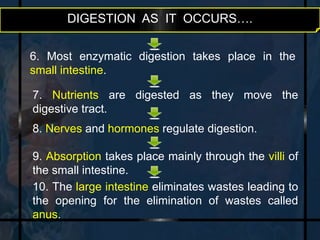
6. Most enzymatic digestion takes place in the 
small intestine. 
7. Nutrients are digested as they move the 
digestive tract. 
8. Nerves and hormones regulate digestion. 
9. Absorption takes place mainly through the villi of 
the small intestine. 
10. The large intestine eliminates wastes leading to 
the opening for the elimination of wastes called 
anus.
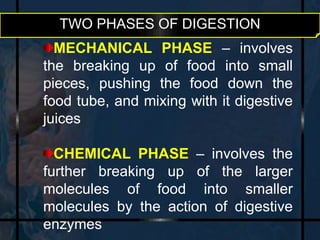
TWO PHASES OF DIGESTION 
MECHANICAL PHASE – involves 
the breaking up of food into small 
pieces, pushing the food down the 
food tube, and mixing with it digestive 
juices 
CHEMICAL PHASE – involves the 
further breaking up of the larger 
molecules of food into smaller 
molecules by the action of digestive 
enzymes
DIGESTION IN THE MOUTH 
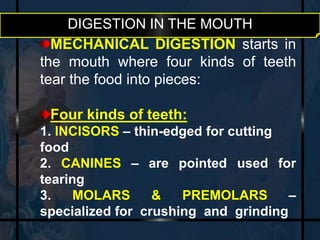
MECHANICAL DIGESTION starts in 
the mouth where four kinds of teeth 
tear the food into pieces: 
Four kinds of teeth: 
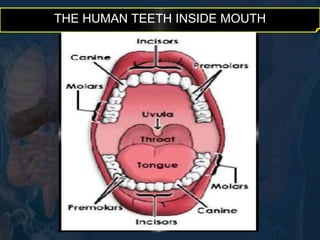
1. INCISORS – thin-edged for cutting 
food 
2. CANINES – are pointed used for 
tearing 
3. MOLARS & PREMOLARS – 
specialized for crushing and grinding
THE HUMAN TEETH INSIDE MOUTH
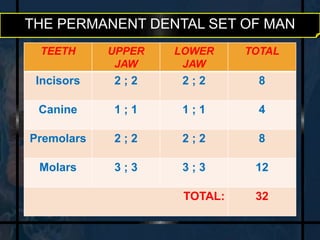
THE PERMANENT DENTAL SET OF MAN 
TEETH UPPER 
JAW 
LOWER 
JAW 
TOTAL 
Incisors 2 ; 2 2 ; 2 8 
Canine 1 ; 1 1 ; 1 4 
Premolars 2 ; 2 2 ; 2 8 
Molars 3 ; 3 3 ; 3 12 
TOTAL: 32
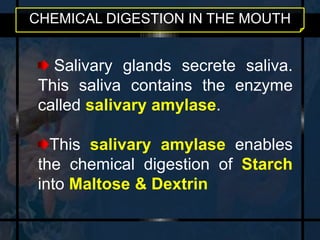
CHEMICAL DIGESTION IN THE MOUTH 
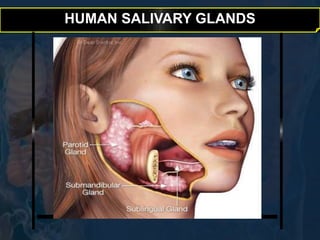
Salivary glands secrete saliva. 
This saliva contains the enzyme 
called salivary amylase. 
This salivary amylase enables 
the chemical digestion of Starch 
into Maltose & Dextrin
HUMAN SALIVARY GLANDS
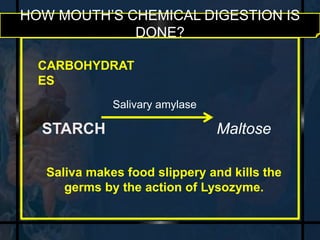
HOW MOUTH’S CHEMICAL DIGESTION IS 
DONE? 
CARBOHYDRAT 
ES 
Salivary amylase 
STARCH Maltose 
Saliva makes food slippery and kills the 
germs by the action of Lysozyme.
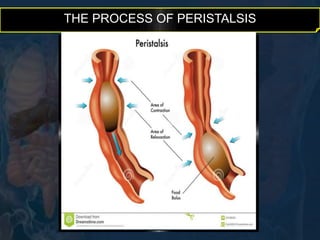
THE PROCESS OF PERISTALSIS
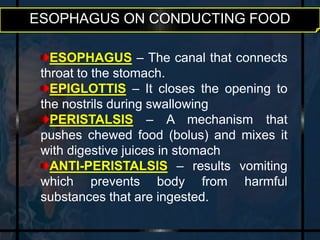
ESOPHAGUS ON CONDUCTING FOOD 
ESOPHAGUS – The canal that connects 
throat to the stomach. 
EPIGLOTTIS – It closes the opening to 
the nostrils during swallowing 
PERISTALSIS – A mechanism that 
pushes chewed food (bolus) and mixes it 
with digestive juices in stomach 
ANTI-PERISTALSIS – results vomiting 
which prevents body from harmful 
substances that are ingested.
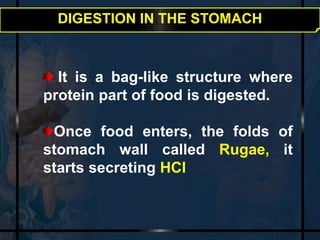
DIGESTION IN THE STOMACH 
It is a bag-like structure where 
protein part of food is digested. 
Once food enters, the folds of 
stomach wall called Rugae, it 
starts secreting HCl
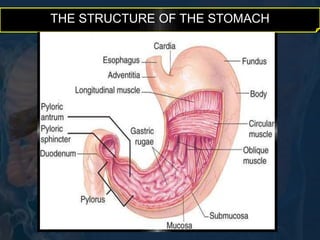
THE STRUCTURE OF THE STOMACH
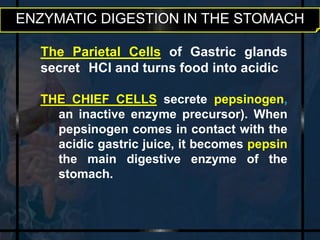
ENZYMATIC DIGESTION IN THE STOMACH 
The Parietal Cells of Gastric glands 
secret HCl and turns food into acidic 
THE CHIEF CELLS secrete pepsinogen, 
an inactive enzyme precursor). When 
pepsinogen comes in contact with the 
acidic gastric juice, it becomes pepsin 
the main digestive enzyme of the 
stomach.
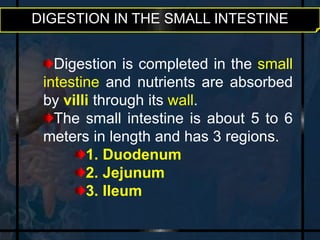
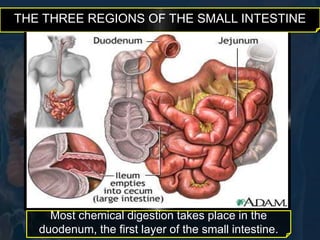
DIGESTION IN THE SMALL INTESTINE 
Digestion is completed in the small 
intestine and nutrients are absorbed 
by villi through its wall. 
The small intestine is about 5 to 6 
meters in length and has 3 regions. 
1. Duodenum 
2. Jejunum 
3. Ileum
THE THREE REGIONS OF THE SMALL INTESTINE 
Most chemical digestion takes place in the 
duodenum, the first layer of the small intestine.
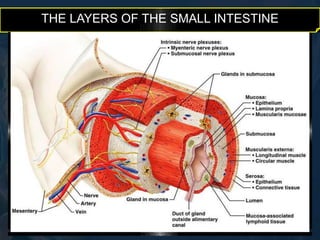
THE LAYERS OF THE SMALL INTESTINE
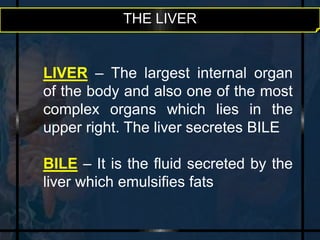
THE LIVER 
LIVER – The largest internal organ 
of the body and also one of the most 
complex organs which lies in the 
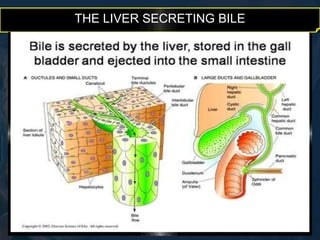
upper right. The liver secretes BILE 
BILE – It is the fluid secreted by the 
liver which emulsifies fats
THE LIVER SECRETING BILE
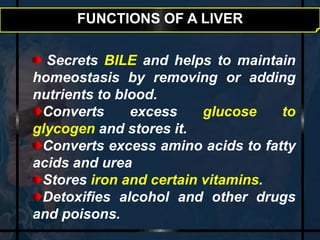
FUNCTIONS OF A LIVER 
Secrets BILE and helps to maintain 
homeostasis by removing or adding 
nutrients to blood. 
Converts excess glucose to 
glycogen and stores it. 
Converts excess amino acids to fatty 
acids and urea 
Stores iron and certain vitamins. 
Detoxifies alcohol and other drugs 
and poisons.
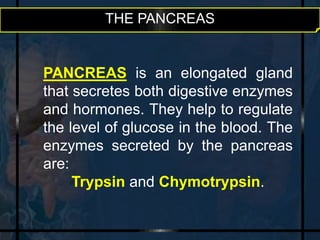
THE PANCREAS 
PANCREAS is an elongated gland 
that secretes both digestive enzymes 
and hormones. They help to regulate 
the level of glucose in the blood. The 
enzymes secreted by the pancreas 
are: 
Trypsin and Chymotrypsin.
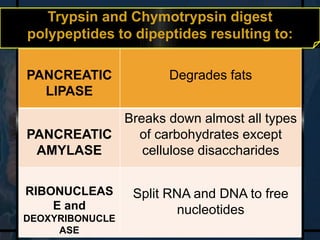
Trypsin and Chymotrypsin digest 
polypeptides to dipeptides resulting to: 
PANCREATIC 
LIPASE 
Degrades fats 
PANCREATIC 
AMYLASE 
Breaks down almost all types 
of carbohydrates except 
cellulose disaccharides 
RIBONUCLEAS 
E and 
DEOXYRIBONUCLE 
ASE 
Split RNA and DNA to free 
nucleotides
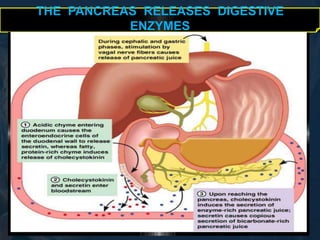
THE PANCREAS RELEASES DIGESTIVE 
ENZYMES
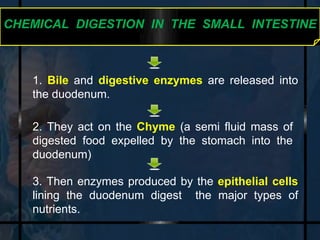
CHEMICAL DIGESTION IN THE SMALL INTESTINE 
1. Bile and digestive enzymes are released into 
the duodenum. 
2. They act on the Chyme (a semi fluid mass of 
digested food expelled by the stomach into the 
duodenum) 
3. Then enzymes produced by the epithelial cells 
lining the duodenum digest the major types of 
nutrients.
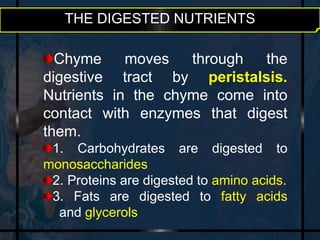
THE DIGESTED NUTRIENTS 
Chyme moves through the 
digestive tract by peristalsis. 
Nutrients in the chyme come into 
contact with enzymes that digest 
them. 
1. Carbohydrates are digested to 
monosaccharides 
2. Proteins are digested to amino acids. 
3. Fats are digested to fatty acids 
and glycerols
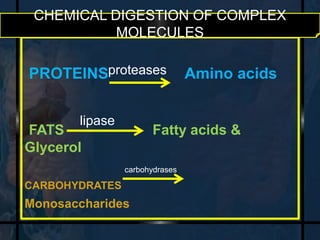
CHEMICAL DIGESTION OF COMPLEX 
MOLECULES 
proteases 
PROTEINS Amino acids 
lipase 
FATS Fatty acids & 
Glycerol 
carbohydrases 
CARBOHYDRATES 
Monosaccharides
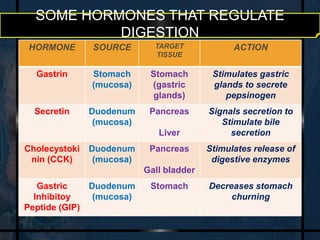
SOME HORMONES THAT REGULATE 
DIGESTION 
HORMONE SOURCE TARGET 
TISSUE 
ACTION 
Gastrin Stomach 
(mucosa) 
Stomach 
(gastric 
glands) 
Stimulates gastric 
glands to secrete 
pepsinogen 
Secretin Duodenum 
(mucosa) 
Pancreas 
Liver 
Signals secretion to 
Stimulate bile 
secretion 
Cholecystoki 
nin (CCK) 
Duodenum 
(mucosa) 
Pancreas 
Gall bladder 
Stimulates release of 
digestive enzymes 
Gastric 
Inhibitoy 
Peptide (GIP) 
Duodenum 
(mucosa) 
Stomach Decreases stomach 
churning
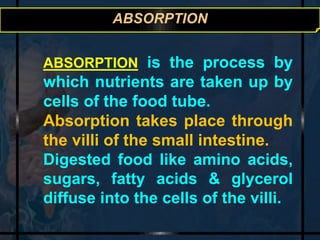
ABSORPTION 
ABSORPTION is the process by 
which nutrients are taken up by 
cells of the food tube. 
Absorption takes place through 
the villi of the small intestine. 
Digested food like amino acids, 
sugars, fatty acids & glycerol 
diffuse into the cells of the villi.
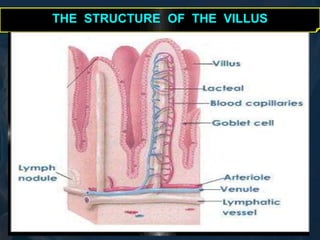
THE STRUCTURE OF THE VILLUS
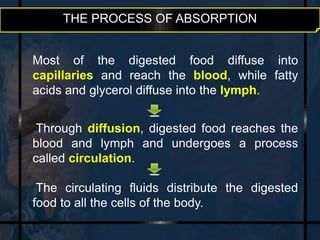
THE PROCESS OF ABSORPTION 
Most of the digested food diffuse into 
capillaries and reach the blood, while fatty 
acids and glycerol diffuse into the lymph. 
Through diffusion, digested food reaches the 
blood and lymph and undergoes a process 
called circulation. 
The circulating fluids distribute the digested 
food to all the cells of the body.
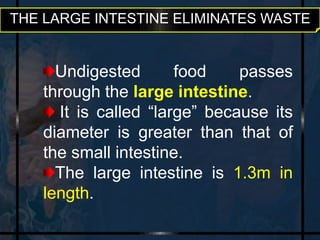
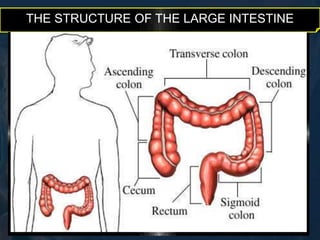
THE LARGE INTESTINE ELIMINATES WASTE 
Undigested food passes 
through the large intestine. 
It is called “large” because its 
diameter is greater than that of 
the small intestine. 
The large intestine is 1.3m in 
length.
THE STRUCTURE OF THE LARGE INTESTINE
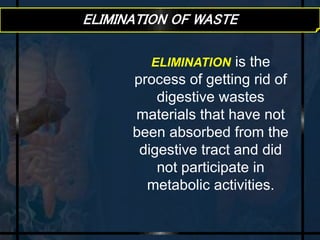
ELIMINATION OF WASTE 
ELIMINATION is the 
process of getting rid of 
digestive wastes 
materials that have not 
been absorbed from the 
digestive tract and did 
not participate in 
metabolic activities.
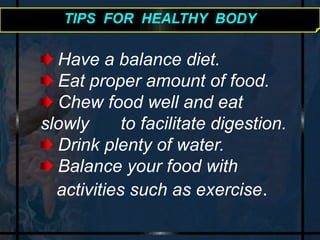
TIPS FOR HEALTHY BODY 
Have a balance diet. 
Eat proper amount of food. 
Chew food well and eat 
slowly to facilitate digestion. 
Drink plenty of water. 
Balance your food with 
activities such as exercise.
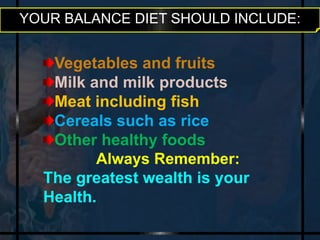
YOUR BALANCE DIET SHOULD INCLUDE: 
Vegetables and fruits 
Milk and milk products 
Meat including fish 
Cereals such as rice 
Other healthy foods 
Always Remember: 
The greatest wealth is your 
Health.
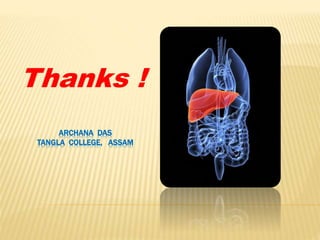
Thanks ! 
ARCHANA DAS 
TANGLA COLLEGE, ASSAM

THE HUMAN DIGESTIVE SYSTEM

  • 1.
    THE HUMAN DIGESTIVESYSTEM Archana Das, Tangla College,Tangla, Assam
  • 2.
    THE HUMAN DIGESTIVETRACT The human digestive tract is a long, highly coiled, muscular tube that stretches from mouth to anus. From mouth to the anus, the human food tube or the digestive tract is about 9 meters long.
  • 3.
    THE HUMAN DIGESTIVETRACT MEASUREMENT 9meters
  • 4.
    SPECIALIZED REGIONS WHEREDIGESTION TAKES PLACE 1. Food processing begins in the mouth. 2. The bite food is then swallowed and is moved through the pharynx to the esophagus. 3. Then, food is mechanically and enzymatically digested in the stomach. 4. Most enzymatic digestion takes place in the small intestine. 5. The large intestine then eliminates wastes through anus.
  • 5.
    SPECIALIZED REGIONS WHEREDIGESTION TAKES PLACE MOUTH PHARYNX ESOPHAGUS STOMACH SMALL INTESTINE LARGE INTESTINE ANUS
  • 6.
    DIGESTIVE SYSTEM WITHOTHER ASSOCIATED ORGANS
  • 7.
    DIGESTION AS ITOCCURS…. 1. Food processing begins in the mouth. 2. The bite food is then swallowed and is moved through the pharynx into the esophagus. 3. Then, food is mechanically and enzymatically digested in the stomach. 4. The liver secretes bile. 5. The pancreas secretes digestive enzymes.
  • 8.
    DIGESTION AS ITOCCURS…. 6. Most enzymatic digestion takes place in the small intestine. 7. Nutrients are digested as they move the digestive tract. 8. Nerves and hormones regulate digestion. 9. Absorption takes place mainly through the villi of the small intestine. 10. The large intestine eliminates wastes leading to the opening for the elimination of wastes called anus.
  • 9.
    TWO PHASES OFDIGESTION MECHANICAL PHASE – involves the breaking up of food into small pieces, pushing the food down the food tube, and mixing with it digestive juices CHEMICAL PHASE – involves the further breaking up of the larger molecules of food into smaller molecules by the action of digestive enzymes
  • 10.
    DIGESTION IN THEMOUTH MECHANICAL DIGESTION starts in the mouth where four kinds of teeth tear the food into pieces: Four kinds of teeth: 1. INCISORS – thin-edged for cutting food 2. CANINES – are pointed used for tearing 3. MOLARS & PREMOLARS – specialized for crushing and grinding
  • 11.
    THE HUMAN TEETHINSIDE MOUTH
  • 12.
    THE PERMANENT DENTALSET OF MAN TEETH UPPER JAW LOWER JAW TOTAL Incisors 2 ; 2 2 ; 2 8 Canine 1 ; 1 1 ; 1 4 Premolars 2 ; 2 2 ; 2 8 Molars 3 ; 3 3 ; 3 12 TOTAL: 32
  • 13.
    CHEMICAL DIGESTION INTHE MOUTH Salivary glands secrete saliva. This saliva contains the enzyme called salivary amylase. This salivary amylase enables the chemical digestion of Starch into Maltose & Dextrin
  • 14.
  • 15.
    HOW MOUTH’S CHEMICALDIGESTION IS DONE? CARBOHYDRAT ES Salivary amylase STARCH Maltose Saliva makes food slippery and kills the germs by the action of Lysozyme.
  • 16.
    THE PROCESS OFPERISTALSIS
  • 17.
    ESOPHAGUS ON CONDUCTINGFOOD ESOPHAGUS – The canal that connects throat to the stomach. EPIGLOTTIS – It closes the opening to the nostrils during swallowing PERISTALSIS – A mechanism that pushes chewed food (bolus) and mixes it with digestive juices in stomach ANTI-PERISTALSIS – results vomiting which prevents body from harmful substances that are ingested.
  • 18.
    DIGESTION IN THESTOMACH It is a bag-like structure where protein part of food is digested. Once food enters, the folds of stomach wall called Rugae, it starts secreting HCl
  • 19.
    THE STRUCTURE OFTHE STOMACH
  • 20.
    ENZYMATIC DIGESTION INTHE STOMACH The Parietal Cells of Gastric glands secret HCl and turns food into acidic THE CHIEF CELLS secrete pepsinogen, an inactive enzyme precursor). When pepsinogen comes in contact with the acidic gastric juice, it becomes pepsin the main digestive enzyme of the stomach.
  • 21.
    DIGESTION IN THESMALL INTESTINE Digestion is completed in the small intestine and nutrients are absorbed by villi through its wall. The small intestine is about 5 to 6 meters in length and has 3 regions. 1. Duodenum 2. Jejunum 3. Ileum
  • 22.
    THE THREE REGIONSOF THE SMALL INTESTINE Most chemical digestion takes place in the duodenum, the first layer of the small intestine.
  • 23.
    THE LAYERS OFTHE SMALL INTESTINE
  • 24.
    THE LIVER LIVER– The largest internal organ of the body and also one of the most complex organs which lies in the upper right. The liver secretes BILE BILE – It is the fluid secreted by the liver which emulsifies fats
  • 25.
  • 26.
    FUNCTIONS OF ALIVER Secrets BILE and helps to maintain homeostasis by removing or adding nutrients to blood. Converts excess glucose to glycogen and stores it. Converts excess amino acids to fatty acids and urea Stores iron and certain vitamins. Detoxifies alcohol and other drugs and poisons.
  • 27.
    THE PANCREAS PANCREASis an elongated gland that secretes both digestive enzymes and hormones. They help to regulate the level of glucose in the blood. The enzymes secreted by the pancreas are: Trypsin and Chymotrypsin.
  • 28.
    Trypsin and Chymotrypsindigest polypeptides to dipeptides resulting to: PANCREATIC LIPASE Degrades fats PANCREATIC AMYLASE Breaks down almost all types of carbohydrates except cellulose disaccharides RIBONUCLEAS E and DEOXYRIBONUCLE ASE Split RNA and DNA to free nucleotides
  • 29.
    THE PANCREAS RELEASESDIGESTIVE ENZYMES
  • 30.
    CHEMICAL DIGESTION INTHE SMALL INTESTINE 1. Bile and digestive enzymes are released into the duodenum. 2. They act on the Chyme (a semi fluid mass of digested food expelled by the stomach into the duodenum) 3. Then enzymes produced by the epithelial cells lining the duodenum digest the major types of nutrients.
  • 31.
    THE DIGESTED NUTRIENTS Chyme moves through the digestive tract by peristalsis. Nutrients in the chyme come into contact with enzymes that digest them. 1. Carbohydrates are digested to monosaccharides 2. Proteins are digested to amino acids. 3. Fats are digested to fatty acids and glycerols
  • 32.
    CHEMICAL DIGESTION OFCOMPLEX MOLECULES proteases PROTEINS Amino acids lipase FATS Fatty acids & Glycerol carbohydrases CARBOHYDRATES Monosaccharides
  • 33.
    SOME HORMONES THATREGULATE DIGESTION HORMONE SOURCE TARGET TISSUE ACTION Gastrin Stomach (mucosa) Stomach (gastric glands) Stimulates gastric glands to secrete pepsinogen Secretin Duodenum (mucosa) Pancreas Liver Signals secretion to Stimulate bile secretion Cholecystoki nin (CCK) Duodenum (mucosa) Pancreas Gall bladder Stimulates release of digestive enzymes Gastric Inhibitoy Peptide (GIP) Duodenum (mucosa) Stomach Decreases stomach churning
  • 34.
    ABSORPTION ABSORPTION isthe process by which nutrients are taken up by cells of the food tube. Absorption takes place through the villi of the small intestine. Digested food like amino acids, sugars, fatty acids & glycerol diffuse into the cells of the villi.
  • 35.
    THE STRUCTURE OFTHE VILLUS
  • 36.
    THE PROCESS OFABSORPTION Most of the digested food diffuse into capillaries and reach the blood, while fatty acids and glycerol diffuse into the lymph. Through diffusion, digested food reaches the blood and lymph and undergoes a process called circulation. The circulating fluids distribute the digested food to all the cells of the body.
  • 37.
    THE LARGE INTESTINEELIMINATES WASTE Undigested food passes through the large intestine. It is called “large” because its diameter is greater than that of the small intestine. The large intestine is 1.3m in length.
  • 38.
    THE STRUCTURE OFTHE LARGE INTESTINE
  • 39.
    ELIMINATION OF WASTE ELIMINATION is the process of getting rid of digestive wastes materials that have not been absorbed from the digestive tract and did not participate in metabolic activities.
  • 40.
    TIPS FOR HEALTHYBODY Have a balance diet. Eat proper amount of food. Chew food well and eat slowly to facilitate digestion. Drink plenty of water. Balance your food with activities such as exercise.
  • 41.
    YOUR BALANCE DIETSHOULD INCLUDE: Vegetables and fruits Milk and milk products Meat including fish Cereals such as rice Other healthy foods Always Remember: The greatest wealth is your Health.
  • 42.
    Thanks ! ARCHANADAS TANGLA COLLEGE, ASSAM