Digestion - Introduction
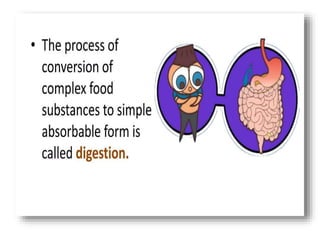
• Digestion of food is a form of catabolism, in which
the food is broken down into small molecules that the
body can absorb and use for energy, growth, and repair.
• Digestion occurs when food is moved through
the digestive system.
• It begins in the mouth and ends in the small intestine.
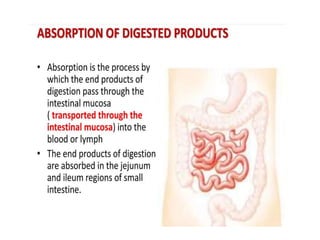
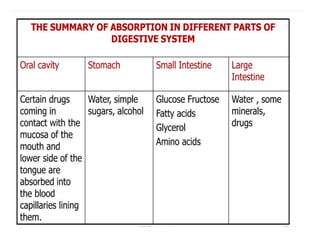
• The final products of digestion are absorbed from the
digestive tract, primarily in the small intestine.
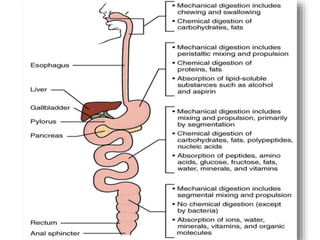
Organ Major functions Other functions
Mouth
•Ingests food
•Chews and mixes food
•Begins chemical breakdown of
carbohydrates
•Moves food into the pharynx
•Begins breakdown of lipids via
lingual lipase
•Moistens and dissolves food, allowing
you to taste it
•Cleans and lubricates the teeth and oral
cavity
•Has some antimicrobial activity
Pharynx
•Propels food from the oral cavity to
the esophagus
•Lubricates food and passageways
Esophagus •Propels food to the stomach •Lubricates food and passageways
Stomach
•Mixes and churns food with gastric
juices to form chyme
•Begins chemical breakdown of
proteins
•Releases food into the duodenum
as chyme
•Absorbs some fat-soluble
substances (for example, alcohol,
aspirin)
•Possesses antimicrobial functions
•Stimulates protein-digesting enzymes
•Secretes intrinsic factor required for
vitamin B12 absorption in small intestine
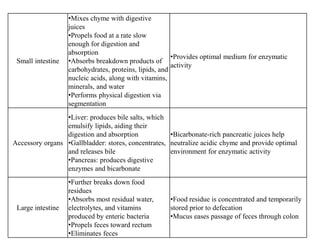
Small intestine
•Mixes chyme with digestive
juices
•Propels food at a rate slow
enough for digestion and
absorption
•Absorbs breakdown products of
carbohydrates, proteins, lipids, and
nucleic acids, along with vitamins,
minerals, and water
•Performs physical digestion via
segmentation
•Provides optimal medium for enzymatic
activity
Accessory organs
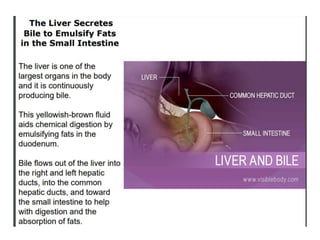
•Liver: produces bile salts, which
emulsify lipids, aiding their
digestion and absorption
•Gallbladder: stores, concentrates,
and releases bile
•Pancreas: produces digestive
enzymes and bicarbonate
•Bicarbonate-rich pancreatic juices help
neutralize acidic chyme and provide optimal
environment for enzymatic activity
Large intestine
•Further breaks down food
residues
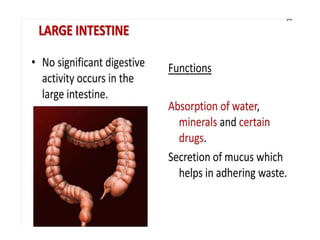
•Absorbs most residual water,
electrolytes, and vitamins
produced by enteric bacteria
•Propels feces toward rectum
•Eliminates feces
•Food residue is concentrated and temporarily
stored prior to defecation
•Mucus eases passage of feces through colon
Digestion - Introduction
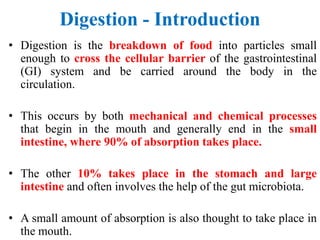
• Digestion is the breakdown of food into particles small
enough to cross the cellular barrier of the gastrointestinal
(GI) system and be carried around the body in the
circulation.
• This occurs by both mechanical and chemical processes
that begin in the mouth and generally end in the small
intestine, where 90% of absorption takes place.
• The other 10% takes place in the stomach and large
intestine and often involves the help of the gut microbiota.
• A small amount of absorption is also thought to take place in
the mouth.
Digestion
• Mechanical digestion begins in the mouth
with chewing and continues with segmental
muscle contractions in the stomach and
intestines.
• Chemical digestion is primarily mediated by
enzymes present in the secretions of the
salivary glands, stomach and pancreas, and on
the epithelial lining of the small intestine
Mechanical Digestion
• Mechanical digestion is physical process in
which food is broken into smaller pieces without
chemically.
• It begins with our first bite of food and continues as
we chew food with our teeth into smaller pieces.
• The process of mechanical digestion continues in
the stomach. This muscular organ churns and
mixes the food it contains, an action that breaks any
solid food into still smaller pieces.
Mechanical Digestion
• Although some mechanical digestion also occurs in the
intestines, it is mostly completed by the
time food leaves the stomach.
• At that stage, food in the GI tract has been changed to
the thick semi-fluid called chyme.
• Mechanical digestion is necessary so that chemical
digestion can be effective.
• Mechanical digestion tremendously increases the
surface area of food particles so they can be acted upon
more effectively by digestive enzymes.
Chemical Digestion
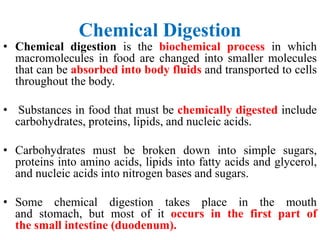
• Chemical digestion is the biochemical process in which
macromolecules in food are changed into smaller molecules
that can be absorbed into body fluids and transported to cells
throughout the body.
• Substances in food that must be chemically digested include
carbohydrates, proteins, lipids, and nucleic acids.
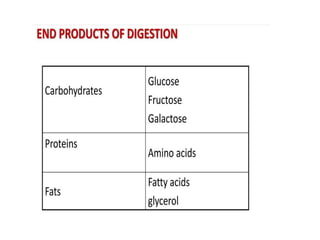
• Carbohydrates must be broken down into simple sugars,
proteins into amino acids, lipids into fatty acids and glycerol,
and nucleic acids into nitrogen bases and sugars.
• Some chemical digestion takes place in the mouth
and stomach, but most of it occurs in the first part of
the small intestine (duodenum).
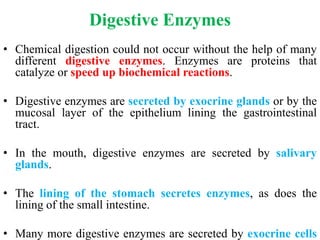
Digestive Enzymes
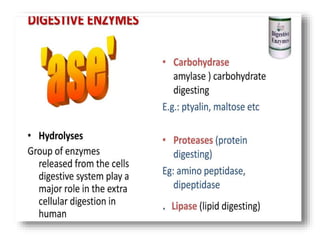
• Chemical digestion could not occur without the help of many
different digestive enzymes. Enzymes are proteins that
catalyze or speed up biochemical reactions.
• Digestive enzymes are secreted by exocrine glands or by the
mucosal layer of the epithelium lining the gastrointestinal
tract.
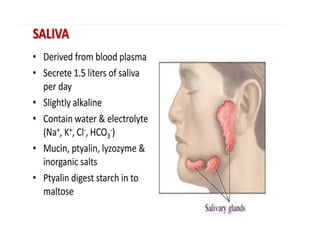
• In the mouth, digestive enzymes are secreted by salivary
glands.
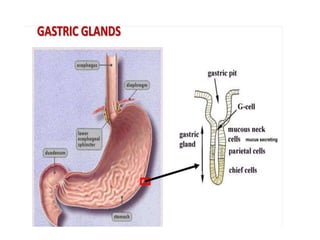
• The lining of the stomach secretes enzymes, as does the
lining of the small intestine.
• Many more digestive enzymes are secreted by exocrine cells
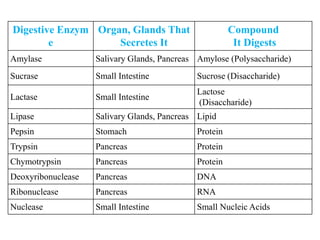
Digestive Enzym
e
Organ, Glands That
Secretes It
Compound
It Digests
Amylase Salivary Glands, Pancreas Amylose (Polysaccharide)
Sucrase Small Intestine Sucrose (Disaccharide)
Lactase Small Intestine
Lactose
(Disaccharide)
Lipase Salivary Glands, Pancreas Lipid
Pepsin Stomach Protein
Trypsin Pancreas Protein
Chymotrypsin Pancreas Protein
Deoxyribonuclease Pancreas DNA
Ribonuclease Pancreas RNA
Nuclease Small Intestine Small Nucleic Acids
Digestion
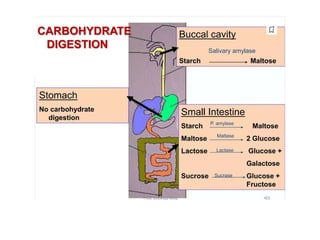
• About 80 percent of digestible carbohydrates in a typical Western diet are
in the form of the plant polysaccharide amylose, which consists mainly of
long chains of glucose and is one of two major components of starch.
• Additional dietary carbohydrates include
the animal polysaccharide glycogen, along with some sugars, which are
mainly disaccharides.
• To chemically digest amylose and glycogen, the enzyme amylase is
required. The chemical digestion of these polysaccharides begins in the
mouth, aided by amylase in saliva.
• Saliva also contains mucus, which lubricates the food, and hydrogen
carbonate, which provides the ideal alkaline conditions for amylase to work.
• Carbohydrate digestion is completed in the small intestine, with the help of
amylase secreted by the pancreas.
Digestion
• In the digestive process, polysaccharides are reduced in length
by the breaking of bonds between glucose monomers.
• The macromolecules are broken down to shorter
polysaccharides and disaccharides, resulting in progressively
shorter chains of glucose.
• The end result is molecules of the simple sugars glucose and
maltose (which consists of two glucose molecules), both of
which can be absorbed by the small intestine.
• Other sugars are digested with the help of different enzymes
produced by the small intestine.
Digestion
• For example, sucrose, or table sugar, is
a disaccharide that is broken down by
the enzyme sucrase to form glucose and fructose,
which are readily absorbed by the small intestine.
• Digestion of the sugar lactose, which is found in milk,
requires the enzyme lactase, which breaks
down lactose into glucose and galactose, which are
then absorbed by the small intestine. Fewer than half of
all adults produce sufficient lactase to be able to
digest lactose. Those who cannot are said to
be lactose intolerant.
Chemical Digestion by Gut Flora
• The human gastrointestinal tract is normally inhabited by
trillions of bacteria, some of which contribute to digestion.
• The most common carbohydrate in plants, which is cellulose,
cannot be digested by the human digestive system. However,
tiny amounts of cellulose are digested by bacteria in the large
intestine.
• Certain bacteria in the small intestine help digest lactose,
which many adults cannot otherwise digest. As a byproduct of
this process, the bacteria produce lactic acid, which increases
the release of digestive enzymes and the absorption of
minerals such as calcium and iron.
Secretions
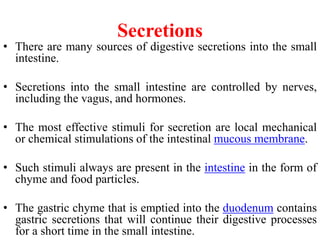
• There are many sources of digestive secretions into the small
intestine.
• Secretions into the small intestine are controlled by nerves,
including the vagus, and hormones.
• The most effective stimuli for secretion are local mechanical
or chemical stimulations of the intestinal mucous membrane.
• Such stimuli always are present in the intestine in the form of
chyme and food particles.
• The gastric chyme that is emptied into the duodenum contains
gastric secretions that will continue their digestive processes
for a short time in the small intestine.
Secretions
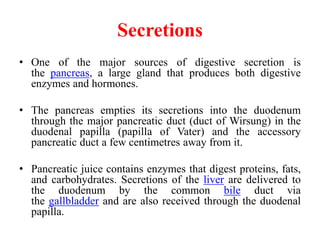
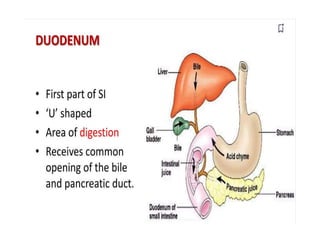
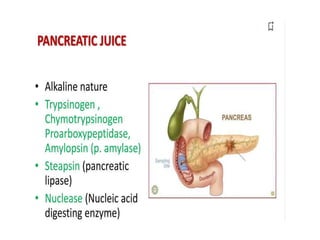
• One of the major sources of digestive secretion is
the pancreas, a large gland that produces both digestive
enzymes and hormones.
• The pancreas empties its secretions into the duodenum
through the major pancreatic duct (duct of Wirsung) in the
duodenal papilla (papilla of Vater) and the accessory
pancreatic duct a few centimetres away from it.
• Pancreatic juice contains enzymes that digest proteins, fats,
and carbohydrates. Secretions of the liver are delivered to
the duodenum by the common bile duct via
the gallbladder and are also received through the duodenal
papilla.
Secretions
• The composition of the succus entericus, the mixture of
substances secreted into the small intestine, varies
somewhat in different parts of the intestine.
• Except in the duodenum, the quantity of the fluid
secreted is minimal, even under conditions of
stimulation.
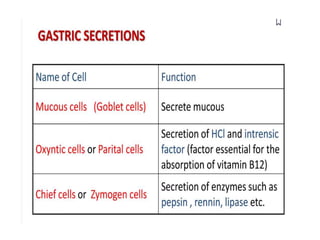
• In the duodenum, for example, where the Brunner’s
glands are located, the secretion contains more mucus.
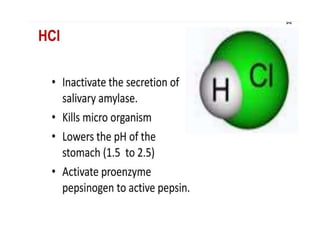
• .
Secretions
• In general, the secretion of the small intestine is a thin,
colourless or slightly straw-coloured fluid, containing flecks
of mucus, water, inorganic salts, and organic material.
• The inorganic salts are those commonly present in other body
fluids, with the bicarbonate concentration higher than it is in
blood.
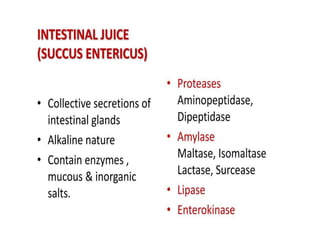
• Aside from mucus, the organic matter consists of
cellular debris and enzymes, including a pepsin
like protease (from the duodenum only), an amylase, a lipase,
at least two peptidases, sucrase,
maltase, enterokinase, alkaline phosphatase,
nucleophosphatases, and nucleocytases
• https://www.sciencelearn.org.nz/videos/814-
digestion-of-food

Digestion absorptiondigestive secretions

  • 2.
    Digestion - Introduction •Digestion of food is a form of catabolism, in which the food is broken down into small molecules that the body can absorb and use for energy, growth, and repair. • Digestion occurs when food is moved through the digestive system. • It begins in the mouth and ends in the small intestine. • The final products of digestion are absorbed from the digestive tract, primarily in the small intestine.
  • 4.
    Organ Major functionsOther functions Mouth •Ingests food •Chews and mixes food •Begins chemical breakdown of carbohydrates •Moves food into the pharynx •Begins breakdown of lipids via lingual lipase •Moistens and dissolves food, allowing you to taste it •Cleans and lubricates the teeth and oral cavity •Has some antimicrobial activity Pharynx •Propels food from the oral cavity to the esophagus •Lubricates food and passageways Esophagus •Propels food to the stomach •Lubricates food and passageways Stomach •Mixes and churns food with gastric juices to form chyme •Begins chemical breakdown of proteins •Releases food into the duodenum as chyme •Absorbs some fat-soluble substances (for example, alcohol, aspirin) •Possesses antimicrobial functions •Stimulates protein-digesting enzymes •Secretes intrinsic factor required for vitamin B12 absorption in small intestine
  • 5.
    Small intestine •Mixes chymewith digestive juices •Propels food at a rate slow enough for digestion and absorption •Absorbs breakdown products of carbohydrates, proteins, lipids, and nucleic acids, along with vitamins, minerals, and water •Performs physical digestion via segmentation •Provides optimal medium for enzymatic activity Accessory organs •Liver: produces bile salts, which emulsify lipids, aiding their digestion and absorption •Gallbladder: stores, concentrates, and releases bile •Pancreas: produces digestive enzymes and bicarbonate •Bicarbonate-rich pancreatic juices help neutralize acidic chyme and provide optimal environment for enzymatic activity Large intestine •Further breaks down food residues •Absorbs most residual water, electrolytes, and vitamins produced by enteric bacteria •Propels feces toward rectum •Eliminates feces •Food residue is concentrated and temporarily stored prior to defecation •Mucus eases passage of feces through colon
  • 6.
    Digestion - Introduction •Digestion is the breakdown of food into particles small enough to cross the cellular barrier of the gastrointestinal (GI) system and be carried around the body in the circulation. • This occurs by both mechanical and chemical processes that begin in the mouth and generally end in the small intestine, where 90% of absorption takes place. • The other 10% takes place in the stomach and large intestine and often involves the help of the gut microbiota. • A small amount of absorption is also thought to take place in the mouth.
  • 8.
    Digestion • Mechanical digestionbegins in the mouth with chewing and continues with segmental muscle contractions in the stomach and intestines. • Chemical digestion is primarily mediated by enzymes present in the secretions of the salivary glands, stomach and pancreas, and on the epithelial lining of the small intestine
  • 10.
    Mechanical Digestion • Mechanicaldigestion is physical process in which food is broken into smaller pieces without chemically. • It begins with our first bite of food and continues as we chew food with our teeth into smaller pieces. • The process of mechanical digestion continues in the stomach. This muscular organ churns and mixes the food it contains, an action that breaks any solid food into still smaller pieces.
  • 11.
    Mechanical Digestion • Althoughsome mechanical digestion also occurs in the intestines, it is mostly completed by the time food leaves the stomach. • At that stage, food in the GI tract has been changed to the thick semi-fluid called chyme. • Mechanical digestion is necessary so that chemical digestion can be effective. • Mechanical digestion tremendously increases the surface area of food particles so they can be acted upon more effectively by digestive enzymes.
  • 12.
    Chemical Digestion • Chemicaldigestion is the biochemical process in which macromolecules in food are changed into smaller molecules that can be absorbed into body fluids and transported to cells throughout the body. • Substances in food that must be chemically digested include carbohydrates, proteins, lipids, and nucleic acids. • Carbohydrates must be broken down into simple sugars, proteins into amino acids, lipids into fatty acids and glycerol, and nucleic acids into nitrogen bases and sugars. • Some chemical digestion takes place in the mouth and stomach, but most of it occurs in the first part of the small intestine (duodenum).
  • 16.
    Digestive Enzymes • Chemicaldigestion could not occur without the help of many different digestive enzymes. Enzymes are proteins that catalyze or speed up biochemical reactions. • Digestive enzymes are secreted by exocrine glands or by the mucosal layer of the epithelium lining the gastrointestinal tract. • In the mouth, digestive enzymes are secreted by salivary glands. • The lining of the stomach secretes enzymes, as does the lining of the small intestine. • Many more digestive enzymes are secreted by exocrine cells
  • 17.
    Digestive Enzym e Organ, GlandsThat Secretes It Compound It Digests Amylase Salivary Glands, Pancreas Amylose (Polysaccharide) Sucrase Small Intestine Sucrose (Disaccharide) Lactase Small Intestine Lactose (Disaccharide) Lipase Salivary Glands, Pancreas Lipid Pepsin Stomach Protein Trypsin Pancreas Protein Chymotrypsin Pancreas Protein Deoxyribonuclease Pancreas DNA Ribonuclease Pancreas RNA Nuclease Small Intestine Small Nucleic Acids
  • 19.
    Digestion • About 80percent of digestible carbohydrates in a typical Western diet are in the form of the plant polysaccharide amylose, which consists mainly of long chains of glucose and is one of two major components of starch. • Additional dietary carbohydrates include the animal polysaccharide glycogen, along with some sugars, which are mainly disaccharides. • To chemically digest amylose and glycogen, the enzyme amylase is required. The chemical digestion of these polysaccharides begins in the mouth, aided by amylase in saliva. • Saliva also contains mucus, which lubricates the food, and hydrogen carbonate, which provides the ideal alkaline conditions for amylase to work. • Carbohydrate digestion is completed in the small intestine, with the help of amylase secreted by the pancreas.
  • 20.
    Digestion • In thedigestive process, polysaccharides are reduced in length by the breaking of bonds between glucose monomers. • The macromolecules are broken down to shorter polysaccharides and disaccharides, resulting in progressively shorter chains of glucose. • The end result is molecules of the simple sugars glucose and maltose (which consists of two glucose molecules), both of which can be absorbed by the small intestine. • Other sugars are digested with the help of different enzymes produced by the small intestine.
  • 21.
    Digestion • For example,sucrose, or table sugar, is a disaccharide that is broken down by the enzyme sucrase to form glucose and fructose, which are readily absorbed by the small intestine. • Digestion of the sugar lactose, which is found in milk, requires the enzyme lactase, which breaks down lactose into glucose and galactose, which are then absorbed by the small intestine. Fewer than half of all adults produce sufficient lactase to be able to digest lactose. Those who cannot are said to be lactose intolerant.
  • 22.
    Chemical Digestion byGut Flora • The human gastrointestinal tract is normally inhabited by trillions of bacteria, some of which contribute to digestion. • The most common carbohydrate in plants, which is cellulose, cannot be digested by the human digestive system. However, tiny amounts of cellulose are digested by bacteria in the large intestine. • Certain bacteria in the small intestine help digest lactose, which many adults cannot otherwise digest. As a byproduct of this process, the bacteria produce lactic acid, which increases the release of digestive enzymes and the absorption of minerals such as calcium and iron.
  • 30.
    Secretions • There aremany sources of digestive secretions into the small intestine. • Secretions into the small intestine are controlled by nerves, including the vagus, and hormones. • The most effective stimuli for secretion are local mechanical or chemical stimulations of the intestinal mucous membrane. • Such stimuli always are present in the intestine in the form of chyme and food particles. • The gastric chyme that is emptied into the duodenum contains gastric secretions that will continue their digestive processes for a short time in the small intestine.
  • 31.
    Secretions • One ofthe major sources of digestive secretion is the pancreas, a large gland that produces both digestive enzymes and hormones. • The pancreas empties its secretions into the duodenum through the major pancreatic duct (duct of Wirsung) in the duodenal papilla (papilla of Vater) and the accessory pancreatic duct a few centimetres away from it. • Pancreatic juice contains enzymes that digest proteins, fats, and carbohydrates. Secretions of the liver are delivered to the duodenum by the common bile duct via the gallbladder and are also received through the duodenal papilla.
  • 33.
    Secretions • The compositionof the succus entericus, the mixture of substances secreted into the small intestine, varies somewhat in different parts of the intestine. • Except in the duodenum, the quantity of the fluid secreted is minimal, even under conditions of stimulation. • In the duodenum, for example, where the Brunner’s glands are located, the secretion contains more mucus. • .
  • 34.
    Secretions • In general,the secretion of the small intestine is a thin, colourless or slightly straw-coloured fluid, containing flecks of mucus, water, inorganic salts, and organic material. • The inorganic salts are those commonly present in other body fluids, with the bicarbonate concentration higher than it is in blood. • Aside from mucus, the organic matter consists of cellular debris and enzymes, including a pepsin like protease (from the duodenum only), an amylase, a lipase, at least two peptidases, sucrase, maltase, enterokinase, alkaline phosphatase, nucleophosphatases, and nucleocytases
  • 41.