Made by: Mariyam
 Definition:
The chemical breakdown of complex
biological molecules into their component
parts.
– Lipids to fatty acids
– Proteins to individual amino acids
– Carbohydrates into simple sugars
 Function Produces various chemicals to break
down the food.
 Filters out harmful substances.
 Gets rid of solid wastes.
 Ingestion Movement
 Digestion
 Absorption
 Further digestion
 Defecation
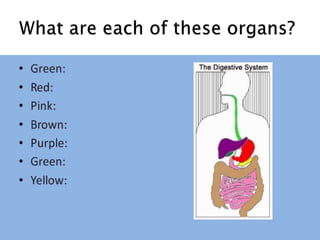
 Main Parts
• Mouth • Esophagus
• Stomach • Small Intestine
• Large Intestine
 Accessory Parts
• Liver • Pancreas
• Gallbladder • Salivary Gland
 Mouth
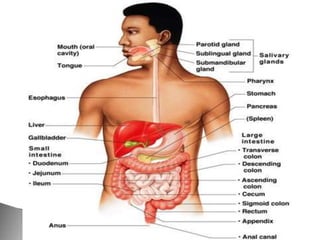
 Pharynx
 Oesophagus
 Stomach
 Small intestine
 Large intestine
 Stomach
 There two major processes which take place:
• Mastication (Chewing):
- Human incisors and canines are adapted for
tearing food, while molars are adapted for
grinding food.
- Breaks down large food molecules.
- Increases surface area of food particles.
• Secretion of Saliva:
- Contains salivary amylase (ptyalin) that
digests starch to maltose.
- Provides an alkaline medium.
- Lubricants and moistens food.
- it is a skeletal muscle and mixes food with
saliva into a compact mass (BOLUS.)
- LINGUAL FRENULUM attaches the tongue to
the floor of the mouth and prevents posterior
movement of the tongue.
– Mixes and rolls food into tiny mashed up bits
(Bolus)
– Pushes the bolus toward the pharynx and
into the esophagus when swallowing.
 produce and secrete saliva into the oral cavity.
– Parotid (beneath the cheeks) This gland produces
SALIVARY AMYLASE (ptyalin), a digestive enzyme.
– Submaxillary/submandibular (below the jaw
bone)
– Sublingual (below the tongue)
 saliva moistens the food and contains enzymes
(salivary amylase) that begins digestion of starch
into smaller polysaccharides.
1. Masseter Muscle
2. Parotid Gland
3. Parotid Duct
4.
Submandibular
Gland
5. Sublingual Gland
6. Lymph Nodes
7. Molar Gland
 Swallowing is a coordinated activity of the
tongue, soft palate, pharynx and esophagus.
 Phases
– Food is pushed into the pharynx by the
tongue. (voluntary)
– Tongue blocks the mouth
– Soft palate closes off the nose
– Larynx (Adam’s Apple) rises so the
Epiglottis (a flap of tissue) can close the
opening of the trachea.
 A straight muscular tube that is about 10
inches (25 cm) long which connects the
mouth with the stomach
 Food takes about 4 to 8 seconds as it passes
through to the stomach.
 Its walls contain smooth muscles that
contracts in wavy motion (Peristalsis).
 It is an involuntary process of muscular
contraction forcing the bolus (food) down to
the stomach.
 Acid digestion occurs in the stomach.
 Gastrin, a hormone, stimulates acid release.
 Pepsin, an enzyme that breaks up proteins,
requires an acidic environment to become
active.
 Churns and grinds together the bolus into
smaller pieces.
 Food is mixed with gastric juices
(hydrochloric acid and enzymes) secreted
by the stomach walls.
 HCL helps break down food and kills
bacteria that came along with the food.
 Pepsin – major enzyme; converts proteins
into peptides in the presence of HCL.
 Mucus – lubricates food and protects the
gastric lining from strong digestive juices.
 Converts the bolus into a liquid (chyme) after
4 hrs of mechanical and chemical digestion
 Chyme passes through the pyloric sphincter
into the small intestine.
 Stomach ulcers cause pain
when the stomach is
empty. These are bacterial
infections that create
ulcerations.
 Acid reflux is often due to
weakness in the sphincter
muscle at the top of the
stomach.
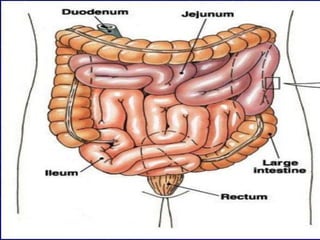
 Long (20 ft), coiled tube beneath the
stomach.
Has three parts:
1. Duodenum – upper part; about 10 in;
connected to the stomach.
– where the digestive juices from the
pancreas and the liver combine with chyme
making it thin and watery.
1. Jejunum – about 8 ft
2. Ileum – about 12 ft
 Takes about 4 – 8 hrs to complete its journey.
 Mucosa (inner wall) – secretes several
enzymes that acts on the food.
 Where the pancreatic enzymes are emptied
into.
 Digested nutrients are absorbed through
intestinal walls.
 Absorbed materials cross the mucosa into the
blood then other parts of the body for
storage or further chemical change.
 Has folded inner walls covered with fingerlike
projections (villi; sing. – villus)
 Each villus has tinier projections called
microvilli that absorbs digested food.
 Villi and microvilli increases the surface area
of the small intestine for greater absorption.
 Peristalsis moves the undigested food to the
large intestine.
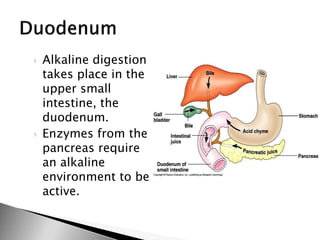
 Alkaline digestion
takes place in the
upper small
intestine, the
duodenum.
 Enzymes from the
pancreas require
an alkaline
environment to be
active.
 Pancreas releases
pancreatic juice,
containing
bicarbonate, lipases,
proteases, and
amylase.
 The liver makes bile,
which emulsifies fats.
Bile is made from
cholesterol, which is
made in the liver
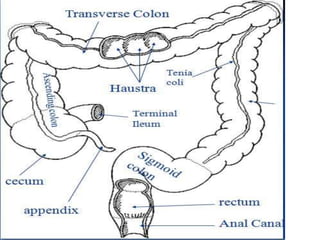
 a.k.a. Colon larger diameter, but shorter (5 ft)
 Water is absorbed from the undigested food
making the waste harder until it becomes
solid.
 Waste stays for 10 – 12 hours.
 Waste is pushed into the expanded portion
(rectum) of the large intestine.
 Solid waste stays in the rectum until it is
excreted through the anus as feces.
 Appendix hangs on the right side of the
large intestine.
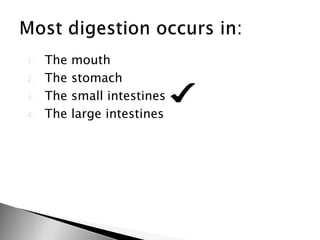
1. The mouth
2. The stomach
3. The small intestines
4. The large intestines
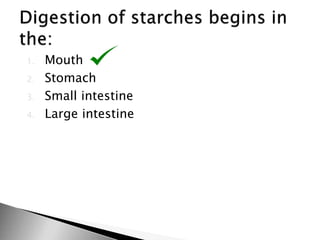
1. Mouth
2. Stomach
3. Small intestine
4. Large intestine
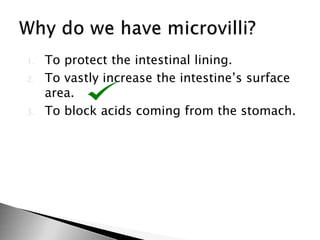
1. To protect the intestinal lining.
2. To vastly increase the intestine’s surface
area.
3. To block acids coming from the stomach.
THANK YOU !

The human digestive system

  • 1.
  • 2.
     Definition: The chemicalbreakdown of complex biological molecules into their component parts. – Lipids to fatty acids – Proteins to individual amino acids – Carbohydrates into simple sugars
  • 3.
     Function Producesvarious chemicals to break down the food.  Filters out harmful substances.  Gets rid of solid wastes.
  • 4.
     Ingestion Movement Digestion  Absorption  Further digestion  Defecation
  • 5.
     Main Parts •Mouth • Esophagus • Stomach • Small Intestine • Large Intestine  Accessory Parts • Liver • Pancreas • Gallbladder • Salivary Gland
  • 7.
     Mouth  Pharynx Oesophagus  Stomach  Small intestine  Large intestine  Stomach
  • 9.
     There twomajor processes which take place: • Mastication (Chewing): - Human incisors and canines are adapted for tearing food, while molars are adapted for grinding food. - Breaks down large food molecules. - Increases surface area of food particles. • Secretion of Saliva: - Contains salivary amylase (ptyalin) that digests starch to maltose. - Provides an alkaline medium. - Lubricants and moistens food.
  • 11.
    - it isa skeletal muscle and mixes food with saliva into a compact mass (BOLUS.) - LINGUAL FRENULUM attaches the tongue to the floor of the mouth and prevents posterior movement of the tongue. – Mixes and rolls food into tiny mashed up bits (Bolus) – Pushes the bolus toward the pharynx and into the esophagus when swallowing.
  • 13.
     produce andsecrete saliva into the oral cavity. – Parotid (beneath the cheeks) This gland produces SALIVARY AMYLASE (ptyalin), a digestive enzyme. – Submaxillary/submandibular (below the jaw bone) – Sublingual (below the tongue)  saliva moistens the food and contains enzymes (salivary amylase) that begins digestion of starch into smaller polysaccharides.
  • 14.
    1. Masseter Muscle 2.Parotid Gland 3. Parotid Duct 4. Submandibular Gland 5. Sublingual Gland 6. Lymph Nodes 7. Molar Gland
  • 16.
     Swallowing isa coordinated activity of the tongue, soft palate, pharynx and esophagus.  Phases – Food is pushed into the pharynx by the tongue. (voluntary) – Tongue blocks the mouth – Soft palate closes off the nose – Larynx (Adam’s Apple) rises so the Epiglottis (a flap of tissue) can close the opening of the trachea.
  • 18.
     A straightmuscular tube that is about 10 inches (25 cm) long which connects the mouth with the stomach  Food takes about 4 to 8 seconds as it passes through to the stomach.  Its walls contain smooth muscles that contracts in wavy motion (Peristalsis).
  • 20.
     It isan involuntary process of muscular contraction forcing the bolus (food) down to the stomach.
  • 21.
     Acid digestionoccurs in the stomach.  Gastrin, a hormone, stimulates acid release.  Pepsin, an enzyme that breaks up proteins, requires an acidic environment to become active.  Churns and grinds together the bolus into smaller pieces.  Food is mixed with gastric juices (hydrochloric acid and enzymes) secreted by the stomach walls.  HCL helps break down food and kills bacteria that came along with the food.
  • 24.
     Pepsin –major enzyme; converts proteins into peptides in the presence of HCL.  Mucus – lubricates food and protects the gastric lining from strong digestive juices.  Converts the bolus into a liquid (chyme) after 4 hrs of mechanical and chemical digestion  Chyme passes through the pyloric sphincter into the small intestine.
  • 25.
     Stomach ulcerscause pain when the stomach is empty. These are bacterial infections that create ulcerations.  Acid reflux is often due to weakness in the sphincter muscle at the top of the stomach.
  • 26.
     Long (20ft), coiled tube beneath the stomach. Has three parts: 1. Duodenum – upper part; about 10 in; connected to the stomach. – where the digestive juices from the pancreas and the liver combine with chyme making it thin and watery. 1. Jejunum – about 8 ft 2. Ileum – about 12 ft
  • 27.
     Takes about4 – 8 hrs to complete its journey.  Mucosa (inner wall) – secretes several enzymes that acts on the food.  Where the pancreatic enzymes are emptied into.  Digested nutrients are absorbed through intestinal walls.  Absorbed materials cross the mucosa into the blood then other parts of the body for storage or further chemical change.
  • 28.
     Has foldedinner walls covered with fingerlike projections (villi; sing. – villus)  Each villus has tinier projections called microvilli that absorbs digested food.  Villi and microvilli increases the surface area of the small intestine for greater absorption.  Peristalsis moves the undigested food to the large intestine.
  • 33.
     Alkaline digestion takesplace in the upper small intestine, the duodenum.  Enzymes from the pancreas require an alkaline environment to be active.
  • 34.
     Pancreas releases pancreaticjuice, containing bicarbonate, lipases, proteases, and amylase.  The liver makes bile, which emulsifies fats. Bile is made from cholesterol, which is made in the liver
  • 37.
     a.k.a. Colonlarger diameter, but shorter (5 ft)  Water is absorbed from the undigested food making the waste harder until it becomes solid.  Waste stays for 10 – 12 hours.  Waste is pushed into the expanded portion (rectum) of the large intestine.  Solid waste stays in the rectum until it is excreted through the anus as feces.  Appendix hangs on the right side of the large intestine.
  • 40.
    1. The mouth 2.The stomach 3. The small intestines 4. The large intestines
  • 41.
    1. Mouth 2. Stomach 3.Small intestine 4. Large intestine
  • 42.
    1. To protectthe intestinal lining. 2. To vastly increase the intestine’s surface area. 3. To block acids coming from the stomach.
  • 45.