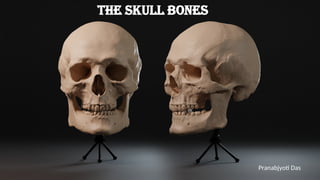
The Skull Bones
Pranabjyoti Das
11/10/2024 Pranabjyoti Das 2
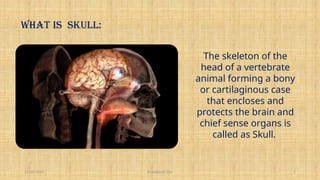
The skeleton of the
head of a vertebrate
animal forming a bony
or cartilaginous case
that encloses and
protects the brain and
chief sense organs is
called as Skull.
What is Skull:
11/10/2024 Pranabjyoti Das 3
Skull Bones:
The human skull consists of 22 bones
(Or 29 bones, including the inner ear bones and hyoid bone)
Skull Bones have two divisions : They are
1. Cranial Bones which protect the brain.
2. Facial Bones: Form the structure of the face.
11/10/2024 4
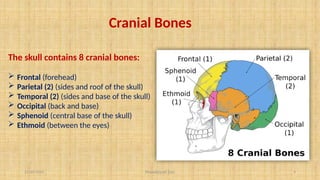
Cranial Bones
The skull contains 8 cranial bones:
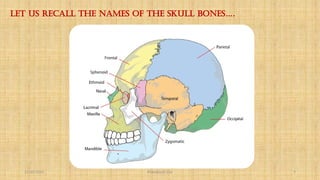
 Frontal (forehead)
 Parietal (2) (sides and roof of the skull)
 Temporal (2) (sides and base of the skull)
 Occipital (back and base)
 Sphenoid (central base of the skull)
 Ethmoid (between the eyes)
Pranabjyoti Das
11/10/2024 Pranabjyoti Das 5
Facial Bones
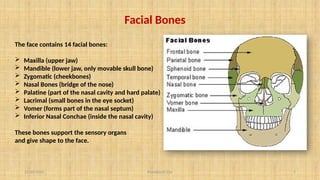
The face contains 14 facial bones:
 Maxilla (upper jaw)
 Mandible (lower jaw, only movable skull bone)
 Zygomatic (cheekbones)
 Nasal Bones (bridge of the nose)
 Palatine (part of the nasal cavity and hard palate)
 Lacrimal (small bones in the eye socket)
 Vomer (forms part of the nasal septum)
 Inferior Nasal Conchae (inside the nasal cavity)
These bones support the sensory organs
and give shape to the face.
11/10/2024 Pranabjyoti Das 6
Frontal and Parietal Bones
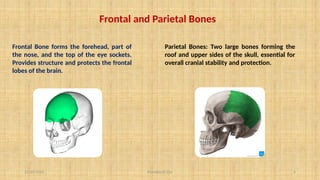
Frontal Bone forms the forehead, part of
the nose, and the top of the eye sockets.
Provides structure and protects the frontal
lobes of the brain.
Parietal Bones: Two large bones forming the
roof and upper sides of the skull, essential for
overall cranial stability and protection.
11/10/2024 Pranabjyoti Das 7
Temporal and Occipital Bones
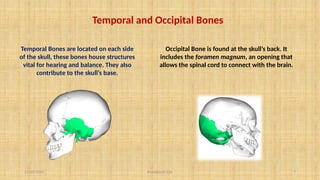
Temporal Bones are located on each side
of the skull, these bones house structures
vital for hearing and balance. They also
contribute to the skull’s base.
Occipital Bone is found at the skull’s back. It
includes the foramen magnum, an opening that
allows the spinal cord to connect with the brain.
11/10/2024 Pranabjyoti Das 8
Sphenoid and Ethmoid Bones
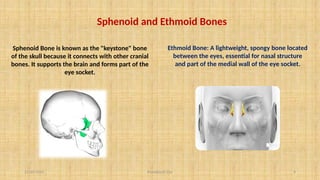
Sphenoid Bone is known as the "keystone" bone
of the skull because it connects with other cranial
bones. It supports the brain and forms part of the
eye socket.
Ethmoid Bone: A lightweight, spongy bone located
between the eyes, essential for nasal structure
and part of the medial wall of the eye socket.
11/10/2024 Pranabjyoti Das 9
Let us recall the names of the skull bones….
11/10/2024 Pranabjyoti Das 10
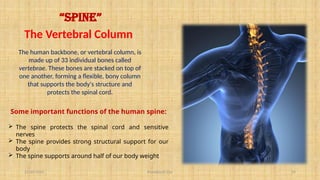
The human backbone, or vertebral column, is
made up of 33 individual bones called
vertebrae. These bones are stacked on top of
one another, forming a flexible, bony column
that supports the body's structure and
protects the spinal cord.
The Vertebral Column
“SPINE”
Some important functions of the human spine:
 The spine protects the spinal cord and sensitive
nerves
 The spine provides strong structural support for our
body
 The spine supports around half of our body weight
11/10/2024 Pranabjyoti Das 11
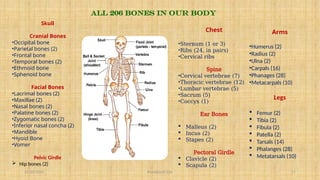
All 206 Bones in our body
Skull
Cranial Bones
•Occipital bone
•Parietal bones (2)
•Frontal bone
•Temporal bones (2)
•Ethmoid bone
•Sphenoid bone
Facial Bones
•Lacrimal bones (2)
•Maxillae (2)
•Nasal bones (2)
•Palatine bones (2)
•Zygomatic bones (2)
•Inferior nasal concha (2)
•Mandible
•Hyoid Bone
•Vomer
Pelvic Girdle
 Hip bones (2)
Chest
•Sternum (1 or 3)
•Ribs (24, in pairs)
•Cervical ribs
Spine
•Cervical vertebrae (7)
•Thoracic vertebrae (12)
•Lumbar vertebrae (5)
•Sacrum (5)
•Coccyx (1)
Ear Bones
 Malleus (2)
 Incus (2)
 Stapes (2)
Pectoral Girdle
 Clavicle (2)
 Scapula (2)
Arms
•Humerus (2)
•Radius (2)
•Ulna (2)
•Carpals (16)
•Phanages (28)
•Metacarpals (10)
Legs
 Femur (2)
 Tibia (2)
 Fibula (2)
 Patella (2)
 Tarsals (14)
 Phalanges (28)
 Metatarsals (10)
11/10/2024 Pranabjyoti Das 12
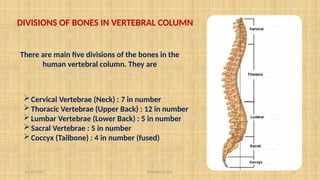
DIVISIONS OF BONES IN VERTEBRAL COLUMN
There are main five divisions of the bones in the
human vertebral column. They are
Cervical Vertebrae (Neck) : 7 in number
Thoracic Vertebrae (Upper Back) : 12 in number
Lumbar Vertebrae (Lower Back) : 5 in number
Sacral Vertebrae : 5 in number
Coccyx (Tailbone) : 4 in number (fused)
11/10/2024 Pranabjyoti Das 13
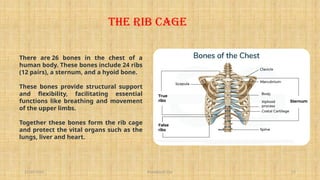
The Rib Cage
There are 26 bones in the chest of a
human body. These bones include 24 ribs
(12 pairs), a sternum, and a hyoid bone.
These bones provide structural support
and flexibility, facilitating essential
functions like breathing and movement
of the upper limbs.
Together these bones form the rib cage
and protect the vital organs such as the
lungs, liver and heart.
11/10/2024 Pranabjyoti Das 14
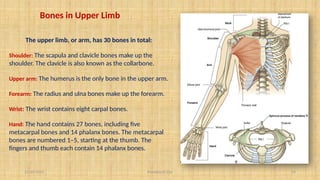
Bones in Upper Limb
The upper limb, or arm, has 30 bones in total:
Shoulder: The scapula and clavicle bones make up the
shoulder. The clavicle is also known as the collarbone.
Upper arm: The humerus is the only bone in the upper arm.
Forearm: The radius and ulna bones make up the forearm.
Wrist: The wrist contains eight carpal bones.
Hand: The hand contains 27 bones, including five
metacarpal bones and 14 phalanx bones. The metacarpal
bones are numbered 1–5, starting at the thumb. The
fingers and thumb each contain 14 phalanx bones.
11/10/2024 Pranabjyoti Das 15
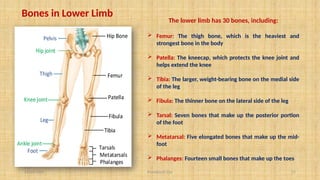
Bones in Lower Limb
The lower limb has 30 bones, including:
 Femur: The thigh bone, which is the heaviest and
strongest bone in the body
 Patella: The kneecap, which protects the knee joint and
helps extend the knee
 Tibia: The larger, weight-bearing bone on the medial side
of the leg
 Fibula: The thinner bone on the lateral side of the leg
 Tarsal: Seven bones that make up the posterior portion
of the foot
 Metatarsal: Five elongated bones that make up the mid-
foot
 Phalanges: Fourteen small bones that make up the toes

Human Skeletal System, Class 11 (Science).pptx

  • 1.
  • 2.
    11/10/2024 Pranabjyoti Das2 The skeleton of the head of a vertebrate animal forming a bony or cartilaginous case that encloses and protects the brain and chief sense organs is called as Skull. What is Skull:
  • 3.
    11/10/2024 Pranabjyoti Das3 Skull Bones: The human skull consists of 22 bones (Or 29 bones, including the inner ear bones and hyoid bone) Skull Bones have two divisions : They are 1. Cranial Bones which protect the brain. 2. Facial Bones: Form the structure of the face.
  • 4.
    11/10/2024 4 Cranial Bones Theskull contains 8 cranial bones:  Frontal (forehead)  Parietal (2) (sides and roof of the skull)  Temporal (2) (sides and base of the skull)  Occipital (back and base)  Sphenoid (central base of the skull)  Ethmoid (between the eyes) Pranabjyoti Das
  • 5.
    11/10/2024 Pranabjyoti Das5 Facial Bones The face contains 14 facial bones:  Maxilla (upper jaw)  Mandible (lower jaw, only movable skull bone)  Zygomatic (cheekbones)  Nasal Bones (bridge of the nose)  Palatine (part of the nasal cavity and hard palate)  Lacrimal (small bones in the eye socket)  Vomer (forms part of the nasal septum)  Inferior Nasal Conchae (inside the nasal cavity) These bones support the sensory organs and give shape to the face.
  • 6.
    11/10/2024 Pranabjyoti Das6 Frontal and Parietal Bones Frontal Bone forms the forehead, part of the nose, and the top of the eye sockets. Provides structure and protects the frontal lobes of the brain. Parietal Bones: Two large bones forming the roof and upper sides of the skull, essential for overall cranial stability and protection.
  • 7.
    11/10/2024 Pranabjyoti Das7 Temporal and Occipital Bones Temporal Bones are located on each side of the skull, these bones house structures vital for hearing and balance. They also contribute to the skull’s base. Occipital Bone is found at the skull’s back. It includes the foramen magnum, an opening that allows the spinal cord to connect with the brain.
  • 8.
    11/10/2024 Pranabjyoti Das8 Sphenoid and Ethmoid Bones Sphenoid Bone is known as the "keystone" bone of the skull because it connects with other cranial bones. It supports the brain and forms part of the eye socket. Ethmoid Bone: A lightweight, spongy bone located between the eyes, essential for nasal structure and part of the medial wall of the eye socket.
  • 9.
    11/10/2024 Pranabjyoti Das9 Let us recall the names of the skull bones….
  • 10.
    11/10/2024 Pranabjyoti Das10 The human backbone, or vertebral column, is made up of 33 individual bones called vertebrae. These bones are stacked on top of one another, forming a flexible, bony column that supports the body's structure and protects the spinal cord. The Vertebral Column “SPINE” Some important functions of the human spine:  The spine protects the spinal cord and sensitive nerves  The spine provides strong structural support for our body  The spine supports around half of our body weight
  • 11.
    11/10/2024 Pranabjyoti Das11 All 206 Bones in our body Skull Cranial Bones •Occipital bone •Parietal bones (2) •Frontal bone •Temporal bones (2) •Ethmoid bone •Sphenoid bone Facial Bones •Lacrimal bones (2) •Maxillae (2) •Nasal bones (2) •Palatine bones (2) •Zygomatic bones (2) •Inferior nasal concha (2) •Mandible •Hyoid Bone •Vomer Pelvic Girdle  Hip bones (2) Chest •Sternum (1 or 3) •Ribs (24, in pairs) •Cervical ribs Spine •Cervical vertebrae (7) •Thoracic vertebrae (12) •Lumbar vertebrae (5) •Sacrum (5) •Coccyx (1) Ear Bones  Malleus (2)  Incus (2)  Stapes (2) Pectoral Girdle  Clavicle (2)  Scapula (2) Arms •Humerus (2) •Radius (2) •Ulna (2) •Carpals (16) •Phanages (28) •Metacarpals (10) Legs  Femur (2)  Tibia (2)  Fibula (2)  Patella (2)  Tarsals (14)  Phalanges (28)  Metatarsals (10)
  • 12.
    11/10/2024 Pranabjyoti Das12 DIVISIONS OF BONES IN VERTEBRAL COLUMN There are main five divisions of the bones in the human vertebral column. They are Cervical Vertebrae (Neck) : 7 in number Thoracic Vertebrae (Upper Back) : 12 in number Lumbar Vertebrae (Lower Back) : 5 in number Sacral Vertebrae : 5 in number Coccyx (Tailbone) : 4 in number (fused)
  • 13.
    11/10/2024 Pranabjyoti Das13 The Rib Cage There are 26 bones in the chest of a human body. These bones include 24 ribs (12 pairs), a sternum, and a hyoid bone. These bones provide structural support and flexibility, facilitating essential functions like breathing and movement of the upper limbs. Together these bones form the rib cage and protect the vital organs such as the lungs, liver and heart.
  • 14.
    11/10/2024 Pranabjyoti Das14 Bones in Upper Limb The upper limb, or arm, has 30 bones in total: Shoulder: The scapula and clavicle bones make up the shoulder. The clavicle is also known as the collarbone. Upper arm: The humerus is the only bone in the upper arm. Forearm: The radius and ulna bones make up the forearm. Wrist: The wrist contains eight carpal bones. Hand: The hand contains 27 bones, including five metacarpal bones and 14 phalanx bones. The metacarpal bones are numbered 1–5, starting at the thumb. The fingers and thumb each contain 14 phalanx bones.
  • 15.
    11/10/2024 Pranabjyoti Das15 Bones in Lower Limb The lower limb has 30 bones, including:  Femur: The thigh bone, which is the heaviest and strongest bone in the body  Patella: The kneecap, which protects the knee joint and helps extend the knee  Tibia: The larger, weight-bearing bone on the medial side of the leg  Fibula: The thinner bone on the lateral side of the leg  Tarsal: Seven bones that make up the posterior portion of the foot  Metatarsal: Five elongated bones that make up the mid- foot  Phalanges: Fourteen small bones that make up the toes