Axel Lau Jerry Tan Noel Kwan Bryan Lim Nigel Tan Pang Yong Ray  Edwin Lim
Brief Description Absorbs nutrients and digests the food we eat The small intestine in an adult human measures on average 6 meters and is 2.5-3 meters wide. It is divided into three structural parts: -Duodenum -Jejunum -Iluem
Digestion Digestive enzymes are secreted from the pancreas which are used to digest food Proteins degrade into amino acids which are then split by enzymes. Fats are degraded into fatty acids and glycerol. Some carbohydrates are degraded into simple sugars while other carbohydrates pass undigested into the large intestine and further handling by intestinal bacterial.
Absorption The digested food come into contact with the many small blood vessels which surround the small intestine. This blood then leaves the small intestine, carrying away nutrients, water electrolytes, vitamins, minerals, fats and medications to the entire body. It can take 3-6 hours for a meal to pass through the small intestine.
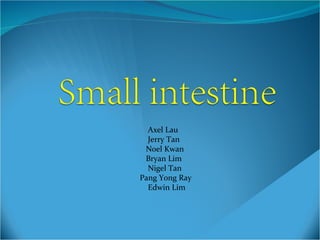
Duodenum A hollow jointed tube about 10–12 inch long connecting the stomach to the jejunum. The duodenum is responsible for the breakdown of food in the small intestine, using enzymes. Brunner's glands, which secrete mucus, are found in here. It also regulates the rate of emptying of the stomach via hormonal pathways.
Jejunum The inner surface of the jejunum is covered with villi, which increase the surface area of tissue available to absorb nutrients from the digested food. Once the food is soaked into the villi, they are transported by the blood stream to the rest of the body. The transport of nutrients includes the transport of sugar fructose, amino acids, small peptides, vitamins and glucose.
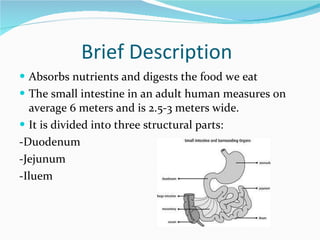
Ileum The function of the ileum is mainly to absorb products of digestion that were not absorbed by the jejunum. The wall of the ileum is made up of folds, each of which has many villi on its surface. The ileum has an extremely large surface area both for the adsorption (attachment) of enzymes and for the absorption of products of digestion. Undigested food are sent to the colon.
Various diseases Intestinal cancer Small intestinal bacterial overgrowth Celliac disease Irritable bowel syndrome
Quiz How long is the small intestine? What do proteins turn into after digestion? What is the function of the ileum? What is the function of Brunner’s glands and where are they found? How long does a meal take to pass through the small intestine?
Thank You!

Small intestine (2)

  • 1.
    Axel Lau JerryTan Noel Kwan Bryan Lim Nigel Tan Pang Yong Ray Edwin Lim
  • 2.
    Brief Description Absorbsnutrients and digests the food we eat The small intestine in an adult human measures on average 6 meters and is 2.5-3 meters wide. It is divided into three structural parts: -Duodenum -Jejunum -Iluem
  • 3.
    Digestion Digestive enzymesare secreted from the pancreas which are used to digest food Proteins degrade into amino acids which are then split by enzymes. Fats are degraded into fatty acids and glycerol. Some carbohydrates are degraded into simple sugars while other carbohydrates pass undigested into the large intestine and further handling by intestinal bacterial.
  • 4.
    Absorption The digestedfood come into contact with the many small blood vessels which surround the small intestine. This blood then leaves the small intestine, carrying away nutrients, water electrolytes, vitamins, minerals, fats and medications to the entire body. It can take 3-6 hours for a meal to pass through the small intestine.
  • 5.
    Duodenum A hollowjointed tube about 10–12 inch long connecting the stomach to the jejunum. The duodenum is responsible for the breakdown of food in the small intestine, using enzymes. Brunner's glands, which secrete mucus, are found in here. It also regulates the rate of emptying of the stomach via hormonal pathways.
  • 6.
    Jejunum The innersurface of the jejunum is covered with villi, which increase the surface area of tissue available to absorb nutrients from the digested food. Once the food is soaked into the villi, they are transported by the blood stream to the rest of the body. The transport of nutrients includes the transport of sugar fructose, amino acids, small peptides, vitamins and glucose.
  • 7.
    Ileum The functionof the ileum is mainly to absorb products of digestion that were not absorbed by the jejunum. The wall of the ileum is made up of folds, each of which has many villi on its surface. The ileum has an extremely large surface area both for the adsorption (attachment) of enzymes and for the absorption of products of digestion. Undigested food are sent to the colon.
  • 8.
    Various diseases Intestinalcancer Small intestinal bacterial overgrowth Celliac disease Irritable bowel syndrome
  • 9.
    Quiz How longis the small intestine? What do proteins turn into after digestion? What is the function of the ileum? What is the function of Brunner’s glands and where are they found? How long does a meal take to pass through the small intestine?
  • 10.