METHODOLOGY
GRAMMAR-
TRANSLATION
The Grammar-Translation Method
Discussion Questions (1)
 The G-T states that students should use translation as a
chief technique to learn languages. How do you view the
use of that technique? Elaborate on it.
 How would you evaluate the interaction between teachers
and students in the G-T method? Do you think it
contributes to learning the language?
 Is the G-T method applicable in Nicaragua? Where do
you think this method may be suitable?
 As you know, there are four main skills in learning
languages: listening, speaking, reading and writing. The
G-T stresses the last two skills. In your opinion, what is
the rationale behind this approach?
The Grammar-Translation Method
Discussion Questions (2)
 The method states that the teacher is the authority in the
classroom? In your opinion, why shouldn’t teachers play
such a role?
 Do you think that comparing languages (THE
GRAMMAR) is a valid teaching technique? Explain.
 Teachers complain that Hispanics tend to memorize a lot.
Which techniques other than memorization contribute to
speeding up the learning process?
 As to form and meaning, which of these should students
focus on first?
Key Features (1)
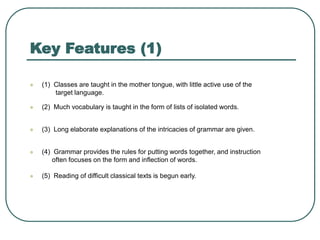
 (1) Classes are taught in the mother tongue, with little active use of the
target language.
 (2) Much vocabulary is taught in the form of lists of isolated words.
 (3) Long elaborate explanations of the intricacies of grammar are given.
 (4) Grammar provides the rules for putting words together, and instruction
often focuses on the form and inflection of words.
 (5) Reading of difficult classical texts is begun early.
Key Features (2)
 (6) Little attention is paid to the content of texts, which are treated as
exercises in grammatical analysis.
 (7) Often the only drills are exercises in translating disconnected
sentences
from the target language into the mother tongue.
 (8) Little or no attention is given to pronunciation.
Typical Techniques (1)
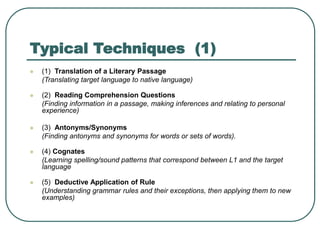
 (1) Translation of a Literary Passage
(Translating target language to native language)
 (2) Reading Comprehension Questions
(Finding information in a passage, making inferences and relating to personal
experience)
 (3) Antonyms/Synonyms
(Finding antonyms and synonyms for words or sets of words).
 (4) Cognates
(Learning spelling/sound patterns that correspond between L1 and the target
language
 (5) Deductive Application of Rule
(Understanding grammar rules and their exceptions, then applying them to new
examples)
Typical Techniques (2)
 (6) Fill-in-the-blanks
(Filling in gaps in sentences with new words or items of a particular
grammar type).
 (7) Memorization
(Memorizing vocabulary lists, grammatical rules and grammatical
paradigms)
 (8) Use Words in Sentences
(Students create sentences to illustrate they know the meaning and
use of new words)
 (9) Composition
(Students write about a topic using the target language)

Grammar translation-A Summary

  • 1.
  • 2.
    The Grammar-Translation Method DiscussionQuestions (1)  The G-T states that students should use translation as a chief technique to learn languages. How do you view the use of that technique? Elaborate on it.  How would you evaluate the interaction between teachers and students in the G-T method? Do you think it contributes to learning the language?  Is the G-T method applicable in Nicaragua? Where do you think this method may be suitable?  As you know, there are four main skills in learning languages: listening, speaking, reading and writing. The G-T stresses the last two skills. In your opinion, what is the rationale behind this approach?
  • 3.
    The Grammar-Translation Method DiscussionQuestions (2)  The method states that the teacher is the authority in the classroom? In your opinion, why shouldn’t teachers play such a role?  Do you think that comparing languages (THE GRAMMAR) is a valid teaching technique? Explain.  Teachers complain that Hispanics tend to memorize a lot. Which techniques other than memorization contribute to speeding up the learning process?  As to form and meaning, which of these should students focus on first?
  • 4.
    Key Features (1) (1) Classes are taught in the mother tongue, with little active use of the target language.  (2) Much vocabulary is taught in the form of lists of isolated words.  (3) Long elaborate explanations of the intricacies of grammar are given.  (4) Grammar provides the rules for putting words together, and instruction often focuses on the form and inflection of words.  (5) Reading of difficult classical texts is begun early.
  • 5.
    Key Features (2) (6) Little attention is paid to the content of texts, which are treated as exercises in grammatical analysis.  (7) Often the only drills are exercises in translating disconnected sentences from the target language into the mother tongue.  (8) Little or no attention is given to pronunciation.
  • 6.
    Typical Techniques (1) (1) Translation of a Literary Passage (Translating target language to native language)  (2) Reading Comprehension Questions (Finding information in a passage, making inferences and relating to personal experience)  (3) Antonyms/Synonyms (Finding antonyms and synonyms for words or sets of words).  (4) Cognates (Learning spelling/sound patterns that correspond between L1 and the target language  (5) Deductive Application of Rule (Understanding grammar rules and their exceptions, then applying them to new examples)
  • 7.
    Typical Techniques (2) (6) Fill-in-the-blanks (Filling in gaps in sentences with new words or items of a particular grammar type).  (7) Memorization (Memorizing vocabulary lists, grammatical rules and grammatical paradigms)  (8) Use Words in Sentences (Students create sentences to illustrate they know the meaning and use of new words)  (9) Composition (Students write about a topic using the target language)