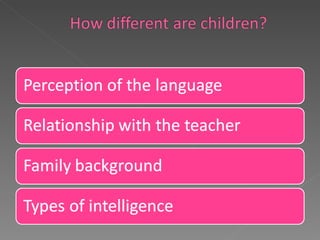
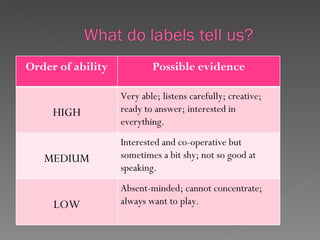
Order of ability           Possible evidence

                   Very able; listens carefully; creative;
     HIGH          ready to answer; interested in
                   everything.
                   Interested and co-operative but
   MEDIUM          sometimes a bit shy; not so good at
                   speaking.
                   Absent-minded; cannot concentrate;
     LOW           always want to play.
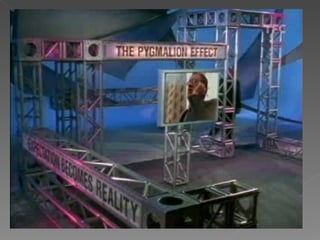
It refers to the phenomenon in which the
greater the 
expectation placed upon people, often
children or students and emploees, the
better they perform.
(Rosenthal-Jacobson)
   Treat each pupil as an individual. Very difficult for a 30-
    student class.

   ADOPT different TEACHING STRATEGIES:

 Differentiating activities.
 Peer tutoring.
 Group teaching.
   Teach core contents for all pupils.

   Reinforce work /more intensive practice for weaker
    students.


   Extension work for faster students.(Fast finishers)
   We can adapt the same activity to suit different
    students’needs. Look and compare activitites pages
    33,34.

   Which one provides more/less support?
   Slower or weaker stduents can be paired with a
    stronger partner for some activities, but they must be
    aware that:
   Buddies are friends.
   They are there to help you.
   They support you, not dominate.
   They help you when you get stuck.
   They help you to do things for yourself.
   They do not tell you the answers.
   When could you use this strategy?


   What are its advantages and disadvantages?


   What changes would you need to make in order to use it in
    your context?
   Students divided into groups according to their
    academic ability.

   Teacher monitors each group’s tasks every twenty
    minutes.

 Africa. Argentina teachers working in rural schools.
 Teacher must produce several different plans for one
  course. Integrated students?
 Mixed ability classes are common in our reality .
 Decide which situations work best according to your
  teaching context.
 Having high expectations from children raises their
  own expectations.
 Being open/flexible to change.
 Assist children in developing more positive self-
  images and higer levels of self-exteem.
Are they the same?

Are they the same?

  • 18.
    Order of ability Possible evidence Very able; listens carefully; creative; HIGH ready to answer; interested in everything. Interested and co-operative but MEDIUM sometimes a bit shy; not so good at speaking. Absent-minded; cannot concentrate; LOW always want to play.
  • 21.
    It refers tothe phenomenon in which the greater the  expectation placed upon people, often children or students and emploees, the better they perform. (Rosenthal-Jacobson)
  • 24.
    Treat each pupil as an individual. Very difficult for a 30- student class.  ADOPT different TEACHING STRATEGIES:  Differentiating activities.  Peer tutoring.  Group teaching.
  • 25.
    Teach core contents for all pupils.  Reinforce work /more intensive practice for weaker students.  Extension work for faster students.(Fast finishers)
  • 26.
    We can adapt the same activity to suit different students’needs. Look and compare activitites pages 33,34.  Which one provides more/less support?
  • 27.
    Slower or weaker stduents can be paired with a stronger partner for some activities, but they must be aware that:  Buddies are friends.  They are there to help you.  They support you, not dominate.  They help you when you get stuck.  They help you to do things for yourself.  They do not tell you the answers.
  • 28.
    When could you use this strategy?  What are its advantages and disadvantages?  What changes would you need to make in order to use it in your context?
  • 29.
    Students divided into groups according to their academic ability.  Teacher monitors each group’s tasks every twenty minutes.  Africa. Argentina teachers working in rural schools.  Teacher must produce several different plans for one course. Integrated students?
  • 30.
     Mixed abilityclasses are common in our reality .  Decide which situations work best according to your teaching context.  Having high expectations from children raises their own expectations.  Being open/flexible to change.  Assist children in developing more positive self- images and higer levels of self-exteem.