Direct and grammar
translation methods
FULFILLED: TOLEWOV A.
Direct method
The direct method of teaching, which is sometimes called the natural
method, and is often used in teaching foreign languages, refrains from using
the learners' native language and uses only the target language. It was
established in Germany and France around 1900 and contrasts with the
grammar–translation method and other traditional approaches, as well as
with C.J.Dodson's bilingual method. It was adopted by key international
language schools such as Berlitz and Inlingua in the 1970s and many of the
language departments of the Foreign Service Institute of the U.S. State
Department in 2012.
Education
In general, teaching focuses on the development of oral skills.Characteristic
features of the direct method are:
teaching concepts and vocabulary through pantomiming, real-life objects
and other visual materials
teaching grammar by using an inductive approach (i.e. having learners find
out rules through the presentation of adequate linguistic forms in the target
language)
centrality of spoken language (including a native-like pronunciation)
focus on question-answer patterns
Definition
Direct method is a method of teaching language directly establishing a
direct or immediate association between experience and expression,
between a word, phrase, or idiom and its meaning through
demonstration and dramatization without the use of the mother tongue
Aims
Direct method aims to build a direct relation between experience and
language, word and idea, thought and expression
This method intends for students to learn how to communicate in the
target language
This method is based on the assumption that the learner should
experience the new language in the same way as he/she experienced
his/her mother tongue
Essentials
No translation
Concepts are taught by means of objects or by natural contexts
Oral training helps in reading and writing
Grammar is taught indirectly
Techniques
Question/answer exercise – the teacher asks questions of any type and the
student answers.
Dictation – the teacher chooses a grade-appropriate passage and reads it aloud.
Reading aloud – the students take turn reading sections of a passage, play or a
dialogue aloud.
Student self-correction – when a student makes a mistake the teacher offers
him/her a second chance by giving a choice.
Conversation practice – the students are given an opportunity to ask their own
questions to the other students or to the teacher. This enables both a teacher-
learner interaction as well as a learner-learner interaction.
Paragraph writing – the students are asked to write a passage in their own
words
Merits
Facilitates understanding of language
Improves fluency of speech
Aids reading
Improves the development of language sense
Full of activities, which make it interesting and exciting
Emphasizes the target language by helping the pupil express their thoughts and feelings directly in target language without using
their mother tongue
Develops listening, speaking,reading and writing
Increase in market for goods and services
Increased employment opportunities
Helps in bringing words from passive vocabulary into active vocabulary
Helps in proceeding the English language from particular to general, it bridges the gap between practice and theory
Makes use of audio-visual aids and also facilitates reading and writing
Facilitates alertness and participation of students
Demerits
Ignores systematic written work and reading activities
May not hold well in higher-level classes where the translation method is more
suitable
Supports only limited vocabulary
LaNeeds skilled teachers; e.g., most of the teachers in Indian schools have a poor
command of English
Does not suit or satisfy the needs of individual students in large classes
Inconvenient in a huge class
Ignores reading and writing aspects of language learning
Does not teach grammar systematically
Time-consuming in creating real life situations
Less suitable for slow learners, who struggle with this methodcks application
Principles
Classroom instructions are conducted exclusively in the target language.
Only everyday vocabulary and sentences are taught during the initial phase; grammar, reading
and writing are introduced in intermediate phase.
Oral communication skills are built up in a carefully graded progression organized around
question-and-answer exchanges between teachers and students in small, intensive classes.
Grammar is taught inductively.
New teaching points are introduced orally.
Concrete vocabulary is taught through demonstration, objects, and pictures; abstract vocabulary
is taught by association of ideas.
Both speech and listening comprehensions are taught.
Correct pronunciation and grammar are emphasized.
Student should be speaking approximately 80% of the time during the lesson.
Students are taught from inception to ask questions as well as answer them.
Grammar–translation method
The grammar–translation method is a method of teaching foreign
languages derived from the classical (sometimes called traditional)
method of teaching Greek and Latin. In grammar–translation classes,
students learn grammatical rules and then apply those rules by
translating sentences between the target language and the native
language. Advanced students may be required to translate whole texts
word-for-word. The method has two main goals: to enable students to
read and translate literature written in the source language, and to
further students' general intellectual development. It originated from
the practice of teaching Latin; in the early 1500s, students learned Latin
for communication, but after the language died out it was studied
purely as an academic discipline. When teachers started teaching other
foreign languages in the 19th century, they used the same translation-
based approach as had been used for teaching Latin. The method has
been rejected by scholars, and has no theoretical basis
Criticism of the term
The overall concept of grammar-translation has been criticized due to a
lack of verifiable sources that supported the existence of such a method
in the nineteenth century, or earlier.
History and philosophy
The grammar–translation method originated from the practice of teaching
Latin. In the early 1500s, Latin was the most widely studied foreign
language due to its prominence in government, academia, and business.
However, during the course of the century the use of Latin dwindled, and it
was gradually replaced by English, French, and Italian. After the decline of
Latin, the purpose of learning it in schools changed. Whereas previously
students had learned Latin for the purpose of communication, it came to be
learned as a purely academic subject
History and philosophy
At first it was believed that teaching modern languages was not useful for
the development of mental discipline and thus they were left out of the
curriculum. When modern languages did begin to appear in school curricula
in the 19th century, teachers taught them with the same grammar–
translation method as was used for classical Latin and Greek. As a result,
textbooks were essentially copied for the modern language classroom. In
the United States of America, the basic foundations of this method were
used in most high school and college foreign language classrooms
Principles and goals
There are two main goals to grammar–translation classes. One is to develop
students' reading ability to a level where they can read literature in the
target language.The other is to develop students' general mental discipline.
The users of foreign language wanted simply to note things of their interest
in the literature of foreign languages. Therefore, this method focuses on
reading and writing and has developed techniques which facilitate more or
less the learning of reading and writing only. As a result, speaking and
listening are overlooked
Method
Grammar–translation classes are usually conducted in the students' native
language. Grammar rules are learned deductively; students learn grammar
rules by rote, and then practice the rules by doing grammar drills and
translating sentences to and from the target language. More attention is
paid to the form of the sentences being translated than to their content.
When students reach more advanced levels of achievement, they may
translate entire texts from the target language. Tests often consist of the
translation of classical texts.
There is not usually any listening or speaking practice, and very little
attention is placed on pronunciation or any communicative aspects of the
language. The skill exercised is reading, and then only in the context of
translation.
Influence
The grammar–translation method was the standard way languages were
taught in schools from the 17th to the 19th century. Despite attempts at
reform from Roger Ascham, Montaigne, Comenius and John Locke, no other
methods gained any significant popularity during this time.
Later, theorists such as Viëtor, Passy, Berlitz, and Jespersen began to talk
about what a new kind of foreign language instruction needed, shedding
light on what the grammar–translation was missing. They supported
teaching the language, not about the language, and teaching in the target
language, emphasizing speech as well as text. Through grammar–
translation, students lacked an active role in the classroom, often correcting
their own work and strictly following the textbook.
Despite all of these drawbacks, the grammar–translation method is still the
most used method all over the world in language teaching. This is not
surprising as most language proficiency books and tests are in the format of
grammar–translation method; and hence the use of the method continues.
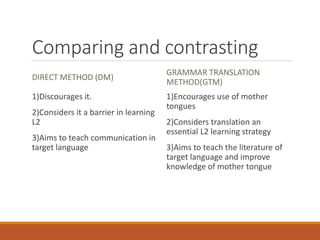
Comparing and contrasting
DIRECT METHOD (DM)
1)Discourages it.
2)Considers it a barrier in learning
L2
3)Aims to teach communication in
target language
GRAMMAR TRANSLATION
METHOD(GTM)
1)Encourages use of mother
tongues
2)Considers translation an
essential L2 learning strategy
3)Aims to teach the literature of
target language and improve
knowledge of mother tongue
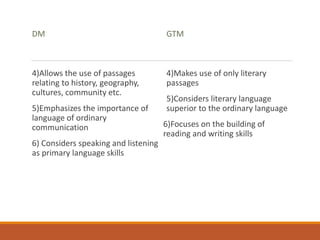
DM
4)Allows the use of passages
relating to history, geography,
cultures, community etc.
5)Emphasizes the importance of
language of ordinary
communication
6) Considers speaking and listening
as primary language skills
GTM
4)Makes use of only literary
passages
5)Considers literary language
superior to the ordinary language
6)Focuses on the building of
reading and writing skills
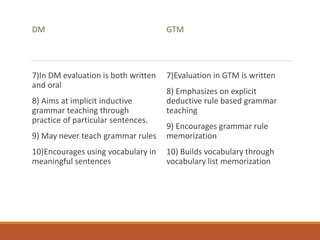
DM
7)In DM evaluation is both written
and oral
8) Aims at implicit inductive
grammar teaching through
practice of particular sentences.
9) May never teach grammar rules
10)Encourages using vocabulary in
meaningful sentences
GTM
7)Evaluation in GTM is written
8) Emphasizes on explicit
deductive rule based grammar
teaching
9) Encourages grammar rule
memorization
10) Builds vocabulary through
vocabulary list memorization
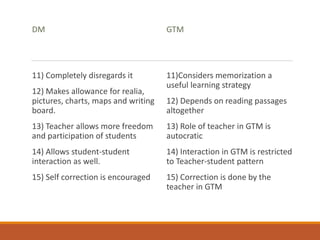
DM
11) Completely disregards it
12) Makes allowance for realia,
pictures, charts, maps and writing
board.
13) Teacher allows more freedom
and participation of students
14) Allows student-student
interaction as well.
15) Self correction is encouraged
GTM
11)Considers memorization a
useful learning strategy
12) Depends on reading passages
altogether
13) Role of teacher in GTM is
autocratic
14) Interaction in GTM is restricted
to Teacher-student pattern
15) Correction is done by the
teacher in GTM
References:
1)Internet resources from sites:
http://slideplayer.com
www.youtube.com/watch?v=MBF1Xs3EwtI
https://busyteacher.org
https://www.britishcouncil.uz
https://www.slideshare.net
https://en.wikipedia.org/wiki
2)Lectures of Yakupova K.
Thank you for
your attention!

Direct and gram

  • 1.
    Direct and grammar translationmethods FULFILLED: TOLEWOV A.
  • 2.
    Direct method The directmethod of teaching, which is sometimes called the natural method, and is often used in teaching foreign languages, refrains from using the learners' native language and uses only the target language. It was established in Germany and France around 1900 and contrasts with the grammar–translation method and other traditional approaches, as well as with C.J.Dodson's bilingual method. It was adopted by key international language schools such as Berlitz and Inlingua in the 1970s and many of the language departments of the Foreign Service Institute of the U.S. State Department in 2012.
  • 3.
    Education In general, teachingfocuses on the development of oral skills.Characteristic features of the direct method are: teaching concepts and vocabulary through pantomiming, real-life objects and other visual materials teaching grammar by using an inductive approach (i.e. having learners find out rules through the presentation of adequate linguistic forms in the target language) centrality of spoken language (including a native-like pronunciation) focus on question-answer patterns
  • 4.
    Definition Direct method isa method of teaching language directly establishing a direct or immediate association between experience and expression, between a word, phrase, or idiom and its meaning through demonstration and dramatization without the use of the mother tongue
  • 5.
    Aims Direct method aimsto build a direct relation between experience and language, word and idea, thought and expression This method intends for students to learn how to communicate in the target language This method is based on the assumption that the learner should experience the new language in the same way as he/she experienced his/her mother tongue
  • 6.
    Essentials No translation Concepts aretaught by means of objects or by natural contexts Oral training helps in reading and writing Grammar is taught indirectly
  • 7.
    Techniques Question/answer exercise –the teacher asks questions of any type and the student answers. Dictation – the teacher chooses a grade-appropriate passage and reads it aloud. Reading aloud – the students take turn reading sections of a passage, play or a dialogue aloud. Student self-correction – when a student makes a mistake the teacher offers him/her a second chance by giving a choice. Conversation practice – the students are given an opportunity to ask their own questions to the other students or to the teacher. This enables both a teacher- learner interaction as well as a learner-learner interaction. Paragraph writing – the students are asked to write a passage in their own words
  • 8.
    Merits Facilitates understanding oflanguage Improves fluency of speech Aids reading Improves the development of language sense Full of activities, which make it interesting and exciting Emphasizes the target language by helping the pupil express their thoughts and feelings directly in target language without using their mother tongue Develops listening, speaking,reading and writing Increase in market for goods and services Increased employment opportunities Helps in bringing words from passive vocabulary into active vocabulary Helps in proceeding the English language from particular to general, it bridges the gap between practice and theory Makes use of audio-visual aids and also facilitates reading and writing Facilitates alertness and participation of students
  • 9.
    Demerits Ignores systematic writtenwork and reading activities May not hold well in higher-level classes where the translation method is more suitable Supports only limited vocabulary LaNeeds skilled teachers; e.g., most of the teachers in Indian schools have a poor command of English Does not suit or satisfy the needs of individual students in large classes Inconvenient in a huge class Ignores reading and writing aspects of language learning Does not teach grammar systematically Time-consuming in creating real life situations Less suitable for slow learners, who struggle with this methodcks application
  • 10.
    Principles Classroom instructions areconducted exclusively in the target language. Only everyday vocabulary and sentences are taught during the initial phase; grammar, reading and writing are introduced in intermediate phase. Oral communication skills are built up in a carefully graded progression organized around question-and-answer exchanges between teachers and students in small, intensive classes. Grammar is taught inductively. New teaching points are introduced orally. Concrete vocabulary is taught through demonstration, objects, and pictures; abstract vocabulary is taught by association of ideas. Both speech and listening comprehensions are taught. Correct pronunciation and grammar are emphasized. Student should be speaking approximately 80% of the time during the lesson. Students are taught from inception to ask questions as well as answer them.
  • 11.
    Grammar–translation method The grammar–translationmethod is a method of teaching foreign languages derived from the classical (sometimes called traditional) method of teaching Greek and Latin. In grammar–translation classes, students learn grammatical rules and then apply those rules by translating sentences between the target language and the native language. Advanced students may be required to translate whole texts word-for-word. The method has two main goals: to enable students to read and translate literature written in the source language, and to further students' general intellectual development. It originated from the practice of teaching Latin; in the early 1500s, students learned Latin for communication, but after the language died out it was studied purely as an academic discipline. When teachers started teaching other foreign languages in the 19th century, they used the same translation- based approach as had been used for teaching Latin. The method has been rejected by scholars, and has no theoretical basis
  • 12.
    Criticism of theterm The overall concept of grammar-translation has been criticized due to a lack of verifiable sources that supported the existence of such a method in the nineteenth century, or earlier.
  • 13.
    History and philosophy Thegrammar–translation method originated from the practice of teaching Latin. In the early 1500s, Latin was the most widely studied foreign language due to its prominence in government, academia, and business. However, during the course of the century the use of Latin dwindled, and it was gradually replaced by English, French, and Italian. After the decline of Latin, the purpose of learning it in schools changed. Whereas previously students had learned Latin for the purpose of communication, it came to be learned as a purely academic subject
  • 14.
    History and philosophy Atfirst it was believed that teaching modern languages was not useful for the development of mental discipline and thus they were left out of the curriculum. When modern languages did begin to appear in school curricula in the 19th century, teachers taught them with the same grammar– translation method as was used for classical Latin and Greek. As a result, textbooks were essentially copied for the modern language classroom. In the United States of America, the basic foundations of this method were used in most high school and college foreign language classrooms
  • 15.
    Principles and goals Thereare two main goals to grammar–translation classes. One is to develop students' reading ability to a level where they can read literature in the target language.The other is to develop students' general mental discipline. The users of foreign language wanted simply to note things of their interest in the literature of foreign languages. Therefore, this method focuses on reading and writing and has developed techniques which facilitate more or less the learning of reading and writing only. As a result, speaking and listening are overlooked
  • 16.
    Method Grammar–translation classes areusually conducted in the students' native language. Grammar rules are learned deductively; students learn grammar rules by rote, and then practice the rules by doing grammar drills and translating sentences to and from the target language. More attention is paid to the form of the sentences being translated than to their content. When students reach more advanced levels of achievement, they may translate entire texts from the target language. Tests often consist of the translation of classical texts. There is not usually any listening or speaking practice, and very little attention is placed on pronunciation or any communicative aspects of the language. The skill exercised is reading, and then only in the context of translation.
  • 17.
    Influence The grammar–translation methodwas the standard way languages were taught in schools from the 17th to the 19th century. Despite attempts at reform from Roger Ascham, Montaigne, Comenius and John Locke, no other methods gained any significant popularity during this time. Later, theorists such as Viëtor, Passy, Berlitz, and Jespersen began to talk about what a new kind of foreign language instruction needed, shedding light on what the grammar–translation was missing. They supported teaching the language, not about the language, and teaching in the target language, emphasizing speech as well as text. Through grammar– translation, students lacked an active role in the classroom, often correcting their own work and strictly following the textbook. Despite all of these drawbacks, the grammar–translation method is still the most used method all over the world in language teaching. This is not surprising as most language proficiency books and tests are in the format of grammar–translation method; and hence the use of the method continues.
  • 18.
    Comparing and contrasting DIRECTMETHOD (DM) 1)Discourages it. 2)Considers it a barrier in learning L2 3)Aims to teach communication in target language GRAMMAR TRANSLATION METHOD(GTM) 1)Encourages use of mother tongues 2)Considers translation an essential L2 learning strategy 3)Aims to teach the literature of target language and improve knowledge of mother tongue
  • 19.
    DM 4)Allows the useof passages relating to history, geography, cultures, community etc. 5)Emphasizes the importance of language of ordinary communication 6) Considers speaking and listening as primary language skills GTM 4)Makes use of only literary passages 5)Considers literary language superior to the ordinary language 6)Focuses on the building of reading and writing skills
  • 20.
    DM 7)In DM evaluationis both written and oral 8) Aims at implicit inductive grammar teaching through practice of particular sentences. 9) May never teach grammar rules 10)Encourages using vocabulary in meaningful sentences GTM 7)Evaluation in GTM is written 8) Emphasizes on explicit deductive rule based grammar teaching 9) Encourages grammar rule memorization 10) Builds vocabulary through vocabulary list memorization
  • 21.
    DM 11) Completely disregardsit 12) Makes allowance for realia, pictures, charts, maps and writing board. 13) Teacher allows more freedom and participation of students 14) Allows student-student interaction as well. 15) Self correction is encouraged GTM 11)Considers memorization a useful learning strategy 12) Depends on reading passages altogether 13) Role of teacher in GTM is autocratic 14) Interaction in GTM is restricted to Teacher-student pattern 15) Correction is done by the teacher in GTM
  • 22.
    References: 1)Internet resources fromsites: http://slideplayer.com www.youtube.com/watch?v=MBF1Xs3EwtI https://busyteacher.org https://www.britishcouncil.uz https://www.slideshare.net https://en.wikipedia.org/wiki 2)Lectures of Yakupova K.
  • 23.