ANATOMY OF THE MIDDLE
EAR
BY:
DR. POOJA SANAL KUMAR
 First pharyngeal pouch:
 Pharyngotympanic tube
 Middle ear cavity
 Mastoid antrum(dorsal expansion of cavity)
 First pharyngeal arch:
 Malleus
 Incus
 Tensor tympani muscle
 Ligament of malleus
 Second pharyngeal arch:
 Stapes
 Stapedius muscle
 First pharyngeal membrane -Tympanic membrane
MECKEL’S
CARTILAGE
REICHERT’S
CARTILAGE
Anomalies
 Malformed ossicles
 Ossicular agenesis
 Malleus incus fusion
 Ossicular mass
 Incudostapedial joint disarticulation
 Facial nerve
 Stapedial artery
Contents of middle ear
 3 Ossicles
 2 Muscles – tensor tympani & stapedius
 Chorda tympani
 Tympanic plexus
 ligaments
 Air
Communication
 Anteriorly:
 Pharyngotympanic tube
nasopharynx
 Posteriorly:
 Aditusmastoid antrum
Divisions of middle ear
• Mesotympanum
• Hypotympanum
• Epitympanum
Walls of middle ear
 Lateral
 Medial
 Floor
 Roof
 Anterior
 Posterior
Lateral wall
 Largely by tympanic membrane
 Lesser extend by bony outer attic wall (SCUTUM)
 Chorda tympani nerve passes across-lateral to long
process of incus & medial to handle of malleus.
Lateral wall
Roof of middle ear
 Formed by Tegmen tympani(both petrous and
squamous portion of temporal bone form it)
 Separates tympanic cavity from middle cranial fossa.
 Also forms roof of aditus and antrum.
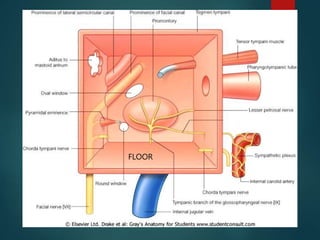
Floor of the middle ear
 Formed by thin plate of bone separates
the hypotympanum from the dome of
jugular bulb.
 Maybe congenitally deficient - jugular
bulb is separated by mucosa.
 Tympanic branch of glossopharyngeal
nerve pierces floor between jugular fossa
and lower opening of carotid canal.
FLOOR
Anterior wall of middle ear
 Thin plate of bone separating from internal carotid
artery.
 2 openings:
 Lower-Eustachian tube
 Upper-Canal of Tensor tympani muscle
ANTERIOR
WALL
Medial wall of middle ear
 Promontory
 Oval window (fenestra vestibuli)
 Sinus tympani
 Round window (fenestra cochleae)
 Facial nerve canal (above oval window)
 Processus cochleariformis (hook-like
projection, housing tensor tympani muscle
tendon)
 Prominence of lateral semicircular canal.
Posterior wall of middle ear
 Pyramid-bony projection; stapedius tendon
appears through its submit, gets attached to neck
of stapes.
 Aditus-opening through which attic
communicates with the antrum.
 Fossa incudus-close to aditus, lodges short
process of incus.
 Vertical part of facial canal behind pyramid.
 Posterior canaliculus- aperture for emergence of
chorda tympani.
Facial recess
 Depression on posterior wall, lateral to pyramid.
 Shallow lower down
 Medially - facial nerve
 Laterally – chorda tympani
 Above – fossa incudis
 Posterior tympanotomy-direct access to middle ear
without disturbing posterior wall.
OSSICLES
Ossicles- malleus
 Largest
 Parts-head, neck, handle, lateral and anterior processes.
 Head and neck in epitympanum.
 Handle in fibrous layer of tympanic membrane.
 Suspended by superior malleal ligament
 Lateral process receives ant and post folds from
tympanic annulus
 Articulates with the incus-a saddle type synovial joint
Incus
 Body
 Two processes
 Short process
 Long process(parallel to handle of
malleus)
 Lenticular process- articulate with
head of stapes.
Stapes
 Parts
 Head
 Neck
 Ant and posterior crura
 Foot plate
Mastoid antrum
 Large air containing space
 Communicates with attic through aditus
 Roof-tegmen antri (cont. of tegmen tympani)
 Lateral part formed by plate of bone marked by
McEwen’s triangle.
 Floor – openings of mastoid air cells.
Mastoid & its air cell system
 Mastoid consists of bone cortex and air cells.
 Develops from squamous & petrous bones
 Petrosquamal suture persists as bony plate
korner’s septum, separating superficial
squamosal and deep petrosal cells
 3 types of mastoid:
 Well-pneumatised or cellular-well developed cells
with thin intervening septa.
 Diploetic- mastoid with marrow spaces & few air cells.
 Sclerotic or acellular- no cells/marrow spaces.
Depending on location, mastoid cells are divided:
 Zygomatic
 Tegmen
 Perisinus
 Retrofacial
 Perilabyrinthine
 Peritubal
 Tip
 Marginal
 Squamosal
Intratympanic muscles
 Tensor tympani
 Origin-cartilaginous part of auditory tube
 Insertion- upper end of handle of malleus
 Nerve supply by- mandibular nerve
 Action- tenses tympanic membrane
 Stapedius
 O-pyramidal eminence
 I-neck of stapes
 N-facial n.
 A-tilts its footplate in oval window
Blood supply
6 ARTERIES
 Anterior tympanic branch of maxillary a.- tympanic
membrane.
 Stylomastoid branch of posterior auricular a.- middle ear
& mastoid cells
 Petrosal branch of middle meningeal a.
 Superior tympanic branch of middle meningeal a.
 Tympanic branch of internal carotid
 Branch of a. of pterygoid canal.
Venous drainage: pterygoid venous plexus & superior
petrosal.
Lymphatic drainage
 Retropharyngeal lymph nodes
 Parotid lymph nodes
 Upper deep cervical lymph nodes
Nerve supply
 Tympanic branch of glossopharyngeal n.-sensory to
lining of middle ear, antrum & auditory tube.
 Superior & inferior carotico-tympanic n.- vasomotor
 Facial n.-
 Chorda tympani-taste sensation & secretomotor fibres
for submandibular & sublingual glands
 Greater petrosal n.-secretomotor lacrimal, nasal glands
 N. to stapedius muscle
 Mandibular n.
Tympanic plexus
 nerves
 Tympanic branch of glossopharyngeal n.
 Superior & inferior carotico-tympanic n.
 Branch from Facial ganglion
 Supplies mucous membrane of middle ear, mastoid air
cells & Eustachian tube.
clinical
 Otitis media- common in infants and children.
 Progression of URTI to middle ear through
pharyngotympanic tube
 Complication:
 acute mastoiditis & mastoid abscess
 Meningitis & temporal lobe abscess
 Labyrinthitis- causing vertigo and vomiting
 Cerebellar abscess
 Hyperacusis – paralysis of stapedius muscle
 Otosclerosis- abnormal ossification of annular
ligament. (m/c cause of conductive deafness in adults)
Thank You
!! hyperlinked
Promontory
 Formed by basal turn of cochlea
 Contains nerves forming tympanic plexus
 Tympanic branch of ninth nerve may be covered by
bone forming a small canal
Oval window
 Behind and above the promontory.
 Connects tympanic cavity with the vestibule.
 Closed by footplate of stapes and annular ligament.
Round window
 Lies below and behind the promontory.
 Separates middle ear from Scala tympani.
 Closed by fibrous secondary tympanic membrane.
 Sinus tympani is a deep recess bounded by subiculum
below & ponticulus above lying between round & oval
window.

Middle ear

  • 1.
    ANATOMY OF THEMIDDLE EAR BY: DR. POOJA SANAL KUMAR
  • 4.
     First pharyngealpouch:  Pharyngotympanic tube  Middle ear cavity  Mastoid antrum(dorsal expansion of cavity)  First pharyngeal arch:  Malleus  Incus  Tensor tympani muscle  Ligament of malleus  Second pharyngeal arch:  Stapes  Stapedius muscle  First pharyngeal membrane -Tympanic membrane
  • 5.
  • 6.
    Anomalies  Malformed ossicles Ossicular agenesis  Malleus incus fusion  Ossicular mass  Incudostapedial joint disarticulation  Facial nerve  Stapedial artery
  • 7.
    Contents of middleear  3 Ossicles  2 Muscles – tensor tympani & stapedius  Chorda tympani  Tympanic plexus  ligaments  Air
  • 8.
    Communication  Anteriorly:  Pharyngotympanictube nasopharynx  Posteriorly:  Aditusmastoid antrum
  • 9.
    Divisions of middleear • Mesotympanum • Hypotympanum • Epitympanum
  • 10.
    Walls of middleear  Lateral  Medial  Floor  Roof  Anterior  Posterior
  • 11.
    Lateral wall  Largelyby tympanic membrane  Lesser extend by bony outer attic wall (SCUTUM)  Chorda tympani nerve passes across-lateral to long process of incus & medial to handle of malleus.
  • 12.
  • 13.
    Roof of middleear  Formed by Tegmen tympani(both petrous and squamous portion of temporal bone form it)  Separates tympanic cavity from middle cranial fossa.  Also forms roof of aditus and antrum.
  • 15.
    Floor of themiddle ear  Formed by thin plate of bone separates the hypotympanum from the dome of jugular bulb.  Maybe congenitally deficient - jugular bulb is separated by mucosa.  Tympanic branch of glossopharyngeal nerve pierces floor between jugular fossa and lower opening of carotid canal.
  • 16.
  • 17.
    Anterior wall ofmiddle ear  Thin plate of bone separating from internal carotid artery.  2 openings:  Lower-Eustachian tube  Upper-Canal of Tensor tympani muscle
  • 18.
  • 19.
    Medial wall ofmiddle ear  Promontory  Oval window (fenestra vestibuli)  Sinus tympani  Round window (fenestra cochleae)  Facial nerve canal (above oval window)  Processus cochleariformis (hook-like projection, housing tensor tympani muscle tendon)  Prominence of lateral semicircular canal.
  • 21.
    Posterior wall ofmiddle ear  Pyramid-bony projection; stapedius tendon appears through its submit, gets attached to neck of stapes.  Aditus-opening through which attic communicates with the antrum.  Fossa incudus-close to aditus, lodges short process of incus.  Vertical part of facial canal behind pyramid.  Posterior canaliculus- aperture for emergence of chorda tympani.
  • 23.
    Facial recess  Depressionon posterior wall, lateral to pyramid.  Shallow lower down  Medially - facial nerve  Laterally – chorda tympani  Above – fossa incudis  Posterior tympanotomy-direct access to middle ear without disturbing posterior wall.
  • 24.
  • 26.
    Ossicles- malleus  Largest Parts-head, neck, handle, lateral and anterior processes.  Head and neck in epitympanum.  Handle in fibrous layer of tympanic membrane.  Suspended by superior malleal ligament  Lateral process receives ant and post folds from tympanic annulus  Articulates with the incus-a saddle type synovial joint
  • 27.
    Incus  Body  Twoprocesses  Short process  Long process(parallel to handle of malleus)  Lenticular process- articulate with head of stapes.
  • 28.
    Stapes  Parts  Head Neck  Ant and posterior crura  Foot plate
  • 29.
    Mastoid antrum  Largeair containing space  Communicates with attic through aditus  Roof-tegmen antri (cont. of tegmen tympani)  Lateral part formed by plate of bone marked by McEwen’s triangle.  Floor – openings of mastoid air cells.
  • 31.
    Mastoid & itsair cell system  Mastoid consists of bone cortex and air cells.  Develops from squamous & petrous bones  Petrosquamal suture persists as bony plate korner’s septum, separating superficial squamosal and deep petrosal cells  3 types of mastoid:  Well-pneumatised or cellular-well developed cells with thin intervening septa.  Diploetic- mastoid with marrow spaces & few air cells.  Sclerotic or acellular- no cells/marrow spaces.
  • 32.
    Depending on location,mastoid cells are divided:  Zygomatic  Tegmen  Perisinus  Retrofacial  Perilabyrinthine  Peritubal  Tip  Marginal  Squamosal
  • 33.
    Intratympanic muscles  Tensortympani  Origin-cartilaginous part of auditory tube  Insertion- upper end of handle of malleus  Nerve supply by- mandibular nerve  Action- tenses tympanic membrane  Stapedius  O-pyramidal eminence  I-neck of stapes  N-facial n.  A-tilts its footplate in oval window
  • 34.
    Blood supply 6 ARTERIES Anterior tympanic branch of maxillary a.- tympanic membrane.  Stylomastoid branch of posterior auricular a.- middle ear & mastoid cells  Petrosal branch of middle meningeal a.  Superior tympanic branch of middle meningeal a.  Tympanic branch of internal carotid  Branch of a. of pterygoid canal. Venous drainage: pterygoid venous plexus & superior petrosal.
  • 35.
    Lymphatic drainage  Retropharyngeallymph nodes  Parotid lymph nodes  Upper deep cervical lymph nodes
  • 36.
    Nerve supply  Tympanicbranch of glossopharyngeal n.-sensory to lining of middle ear, antrum & auditory tube.  Superior & inferior carotico-tympanic n.- vasomotor  Facial n.-  Chorda tympani-taste sensation & secretomotor fibres for submandibular & sublingual glands  Greater petrosal n.-secretomotor lacrimal, nasal glands  N. to stapedius muscle  Mandibular n.
  • 37.
    Tympanic plexus  nerves Tympanic branch of glossopharyngeal n.  Superior & inferior carotico-tympanic n.  Branch from Facial ganglion  Supplies mucous membrane of middle ear, mastoid air cells & Eustachian tube.
  • 38.
    clinical  Otitis media-common in infants and children.  Progression of URTI to middle ear through pharyngotympanic tube  Complication:  acute mastoiditis & mastoid abscess  Meningitis & temporal lobe abscess  Labyrinthitis- causing vertigo and vomiting  Cerebellar abscess
  • 39.
     Hyperacusis –paralysis of stapedius muscle  Otosclerosis- abnormal ossification of annular ligament. (m/c cause of conductive deafness in adults)
  • 40.
  • 41.
  • 43.
    Promontory  Formed bybasal turn of cochlea  Contains nerves forming tympanic plexus  Tympanic branch of ninth nerve may be covered by bone forming a small canal
  • 44.
    Oval window  Behindand above the promontory.  Connects tympanic cavity with the vestibule.  Closed by footplate of stapes and annular ligament.
  • 45.
    Round window  Liesbelow and behind the promontory.  Separates middle ear from Scala tympani.  Closed by fibrous secondary tympanic membrane.  Sinus tympani is a deep recess bounded by subiculum below & ponticulus above lying between round & oval window.