1
THE EAR
Major Rahul Jha
Graded Specialist
Anatomy
ACMS
Introduction
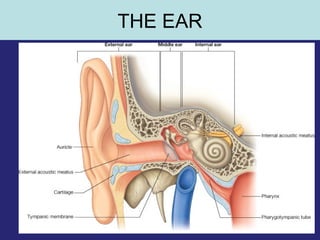
• Organ of hearing and also plays an important role in
equilibrium.
• Divided into three parts:-
– External ear.
– Middle ear.
– Internal ear.
• External ear consists of Pinna/auricle.
• Tympanic membrane at the medial end of EAM.
• Middle ear – an air filled space containing ear ossicles.
• Communicates with the nasopharynx through auditory
tube.
• Internal ear consists of bony labyrinth & fluid filled
labyrinth.
2
3
THE EAR
EXTERNAL EAR
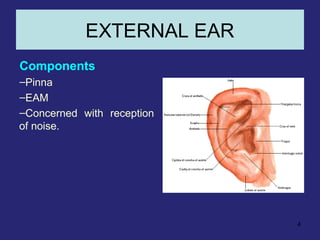
Components
–Pinna
–EAM
–Concerned with reception
of noise.
4
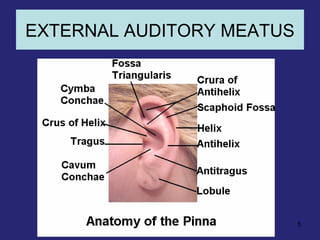
EXTERNAL AUDITORY MEATUS
5
6
EXTERNAL AUDITORY MEATUS
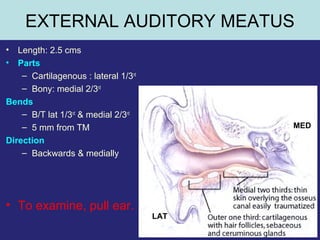
• Length: 2.5 cms
• Parts
– Cartilagenous : lateral 1/3rd
– Bony: medial 2/3rd
Bends
– B/T lat 1/3rd
& medial 2/3rd
– 5 mm from TM
Direction
– Backwards & medially
• To examine, pull ear.
LAT
MED
7
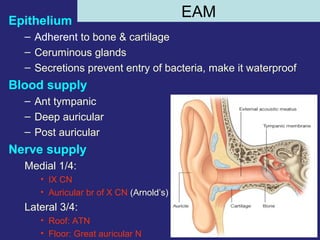
EAMEpithelium
– Adherent to bone & cartilage
– Ceruminous glands
– Secretions prevent entry of bacteria, make it waterproof
Blood supply
– Ant tympanic
– Deep auricular
– Post auricular
Nerve supply
Medial 1/4:
• IX CN
• Auricular br of X CN (Arnold’s)
Lateral 3/4:
• Roof: ATN
• Floor: Great auricular N
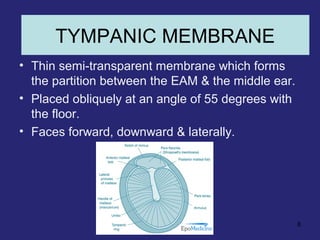
Tympanic membrane
• Thin semi-transparent membrane which forms
the partition between the EAM & the middle ear.
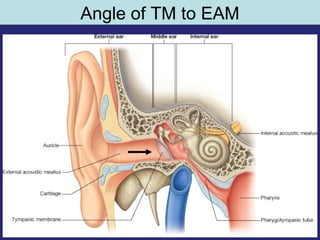
• Placed obliquely at an angle of 55 degrees with
the floor.
• Faces forward, downward & laterally.
8
TYMPANIC MEMBRANE
11
Angle of TM to EAM
12
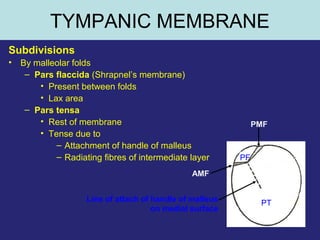
TYMPANIC MEMBRANE
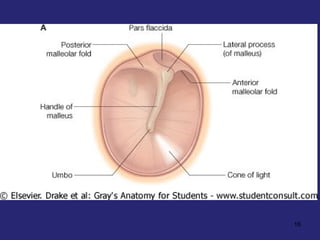
Subdivisions
• By malleolar folds
– Pars flaccida (Shrapnel’s membrane)
• Present between folds
• Lax area
– Pars tensa
• Rest of membrane
• Tense due to
– Attachment of handle of malleus
– Radiating fibres of intermediate layer PF
PT
AMF
PMF
Line of attach of handle of malleus
on medial surface
13
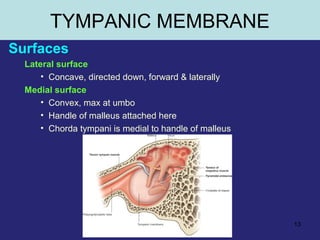
TYMPANIC MEMBRANE
Surfaces
Lateral surface
• Concave, directed down, forward & laterally
Medial surface
• Convex, max at umbo
• Handle of malleus attached here
• Chorda tympani is medial to handle of malleus
14
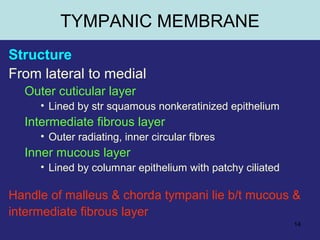
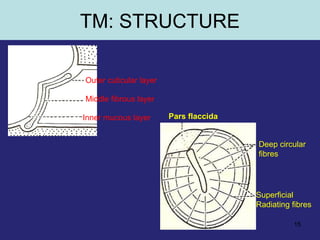
Structure
From lateral to medial
Outer cuticular layer
• Lined by str squamous nonkeratinized epithelium
Intermediate fibrous layer
• Outer radiating, inner circular fibres
Inner mucous layer
• Lined by columnar epithelium with patchy ciliated
Handle of malleus & chorda tympani lie b/t mucous &
intermediate fibrous layer
TYMPANIC MEMBRANE
15
Outer cuticular layer
Middle fibrous layer
Inner mucous layer
Deep circular
fibres
Superficial
Radiating fibres
Pars flaccida
TM: STRUCTURE
16
17
Nerve Supply
– Lateral surface
– ATN
– Vagus N (auricular br)
– Medial surface
• IX CN (tympanic br-Jacobson’s N)
• Chorda tympani
Blood Supply
– Deep auricular br of maxillary (lateral surface)
– Ant tympanic Ar
– Post auricular: stylomastoid br
TYMPANIC MEMBRANE
18
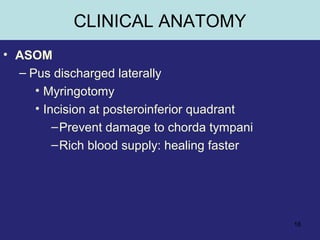
CLINICAL ANATOMY
• ASOM
– Pus discharged laterally
• Myringotomy
• Incision at posteroinferior quadrant
–Prevent damage to chorda tympani
–Rich blood supply: healing faster
19
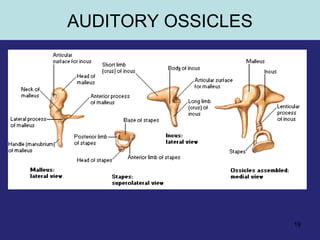
AUDITORY OSSICLES
20
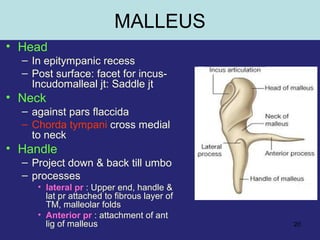
MALLEUS
• Head
– In epitympanic recess
– Post surface: facet for incus-
Incudomalleal jt: Saddle jt
• Neck
– against pars flaccida
– Chorda tympani cross medial
to neck
• Handle
– Project down & back till umbo
– processes
• lateral pr : Upper end, handle &
lat pr attached to fibrous layer of
TM, malleolar folds
• Anterior pr : attachment of ant
lig of malleus
21
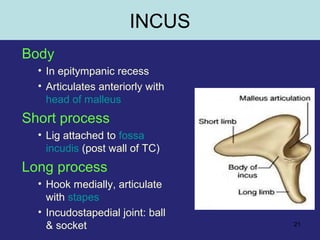
INCUS
Body
• In epitympanic recess
• Articulates anteriorly with
head of malleus
Short process
• Lig attached to fossa
incudis (post wall of TC)
Long process
• Hook medially, articulate
with stapes
• Incudostapedial joint: ball
& socket
22
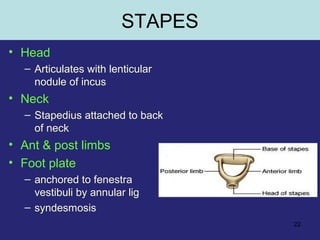
STAPES
• Head
– Articulates with lenticular
nodule of incus
• Neck
– Stapedius attached to back
of neck
• Ant & post limbs
• Foot plate
– anchored to fenestra
vestibuli by annular lig
– syndesmosis
23
MIDDLE EAR
Biconcave box like cavity
Location
– Petrous temporal bone
Parts
– Roof
– Floor
– Walls
• Anterior & Posterior
• Medial & Lateral
24
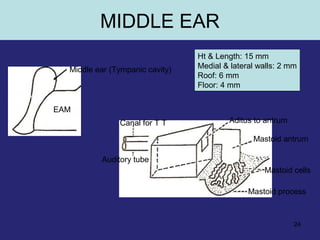
Canal for T T
Auditory tube
Aditus to antrum
Mastoid antrum
Mastoid cells
Mastoid process
EAM
Middle ear (Tympanic cavity)
MIDDLE EAR
Ht & Length: 15 mm
Medial & lateral walls: 2 mm
Roof: 6 mm
Floor: 4 mm
25
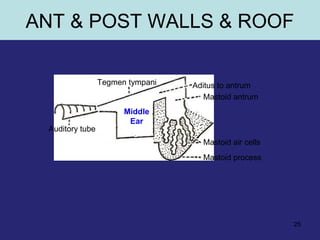
Auditory tube
Tegmen tympani Aditus to antrum
Mastoid antrum
Mastoid air cells
Mastoid process
Middle
Ear
ANT & POST WALLS & ROOF
26
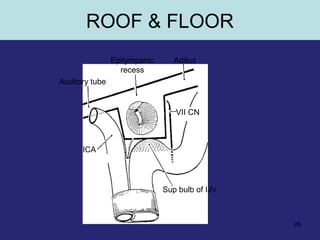
Epitympanic
recess
Aditus
Auditory tube
ICA
Sup bulb of IJV
VII CN
ROOF & FLOOR
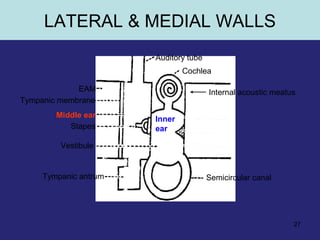
27
Auditory tube
Cochlea
Semicircular canal
Middle ear
Tympanic antrum
Vestibule
Stapes
Tympanic membrane
EAM Internal acoustic meatus
Inner
ear
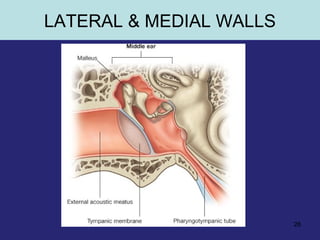
LATERAL & MEDIAL WALLS
28
LATERAL & MEDIAL WALLS
29
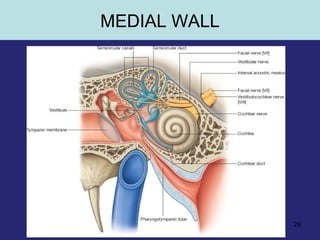
MEDIAL WALL
30
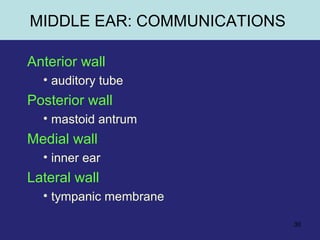
MIDDLE EAR: COMMUNICATIONS
Anterior wall
• auditory tube
Posterior wall
• mastoid antrum
Medial wall
• inner ear
Lateral wall
• tympanic membrane
31
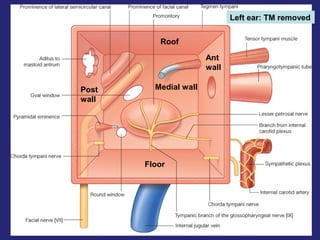
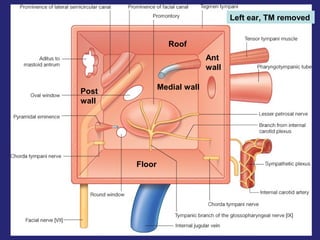
Left ear: TM removed
Roof
Floor
Medial wall
Ant
wall
Post
wall
32
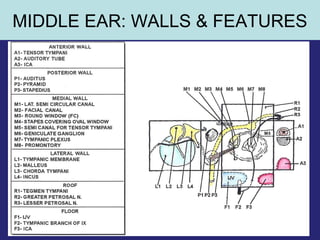
MIDDLE EAR: WALLS & FEATURES
33
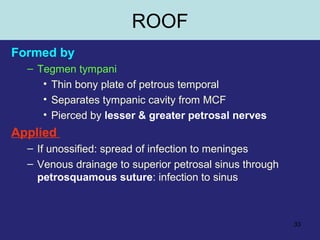
Formed by
– Tegmen tympani
• Thin bony plate of petrous temporal
• Separates tympanic cavity from MCF
• Pierced by lesser & greater petrosal nerves
Applied
– If unossified: spread of infection to meninges
– Venous drainage to superior petrosal sinus through
petrosquamous suture: infection to sinus
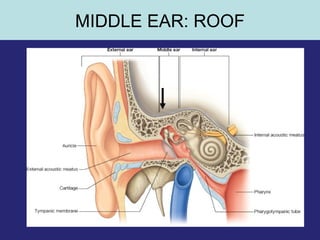
ROOF
34
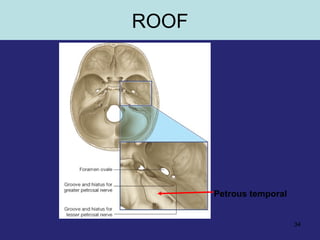
Petrous temporal
ROOF
35
MIDDLE EAR: ROOF
36
FLOOR
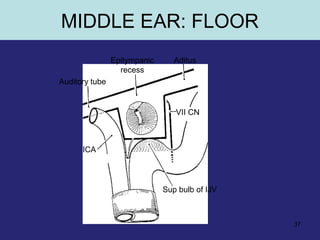
Formed by
– Plate of bone above jugular fossa
Relations
– Anterior
• Carotid canal
– Posterior
• IJV
Tympanic canaliculus - tympanic br of IX CN enters
Applied
– Spread of infection to IJV: thrombosis
37
Epitympanic
recess
Aditus
Auditory tube
ICA
Sup bulb of IJV
VII CN
MIDDLE EAR: FLOOR
38
ANTERIOR WALL
Shortened by approximation of roof & floor
Anteriorly has post wall of carotid canal
Features
– Canal for
• Tensor tympani
• Auditory tube
– Processus trochleariformis
• Bony shelf extends back on medial wall & turns lateral:
provide pulley for tensor tympani to get attached to
handle of malleus
39
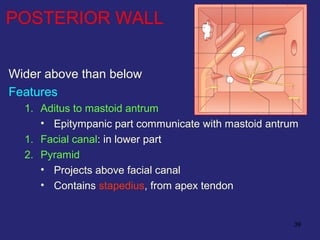
POSTERIOR WALL
Wider above than below
Features
1. Aditus to mastoid antrum
• Epitympanic part communicate with mastoid antrum
1. Facial canal: in lower part
2. Pyramid
• Projects above facial canal
• Contains stapedius, from apex tendon
40
Left ear, TM removed
Roof
Floor
Medial wall
Ant
wall
Post
wall
41
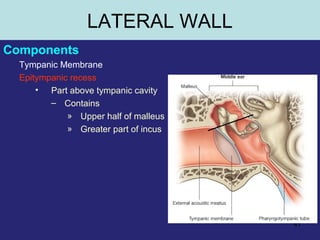
LATERAL WALL
Components
Tympanic Membrane
Epitympanic recess
• Part above tympanic cavity
– Contains
» Upper half of malleus
» Greater part of incus
42
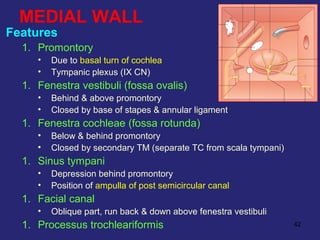
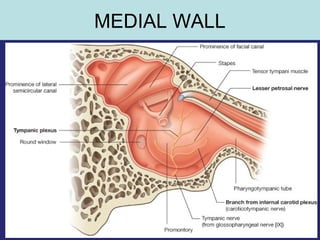
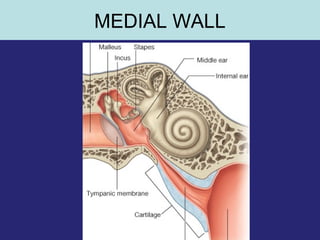
MEDIAL WALL
Features
1. Promontory
• Due to basal turn of cochlea
• Tympanic plexus (IX CN)
1. Fenestra vestibuli (fossa ovalis)
• Behind & above promontory
• Closed by base of stapes & annular ligament
1. Fenestra cochleae (fossa rotunda)
• Below & behind promontory
• Closed by secondary TM (separate TC from scala tympani)
1. Sinus tympani
• Depression behind promontory
• Position of ampulla of post semicircular canal
1. Facial canal
• Oblique part, run back & down above fenestra vestibuli
1. Processus trochleariformis
43
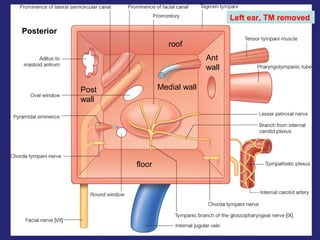
Posterior
Left ear, TM removed
roof
floor
Medial wall
Ant
wall
Post
wall
44
MEDIAL WALL
MEDIAL WALL
46
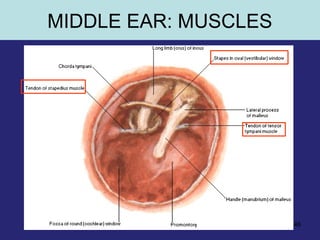
MIDDLE EAR: MUSCLES
47
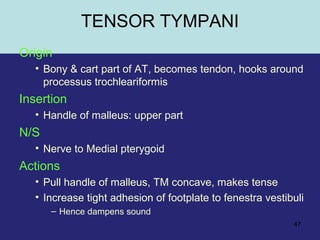
TENSOR TYMPANI
Origin
• Bony & cart part of AT, becomes tendon, hooks around
processus trochleariformis
Insertion
• Handle of malleus: upper part
N/S
• Nerve to Medial pterygoid
Actions
• Pull handle of malleus, TM concave, makes tense
• Increase tight adhesion of footplate to fenestra vestibuli
– Hence dampens sound
48
STAPEDIUS
Origin
• Interior of hollow pyramid
Insertion
• Back of neck of stapes
N/S
• Facial nerve
Actions
• Retract neck of stapes from fenestra vestibuli
• Paralysis: hyperacusis
49
CLINICAL ANATOMY
1. Otitis media
2. Otosclerosis
3. Injury to nerve to stapedius
• Hyperacusis
50
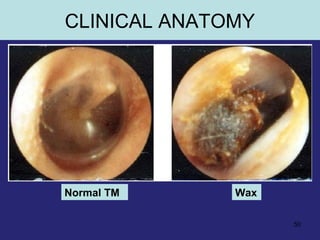
Normal TM Wax
CLINICAL ANATOMY
51
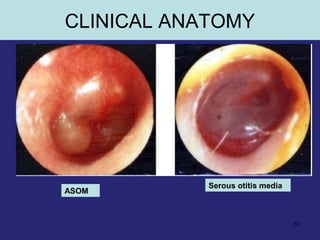
Serous otitis media
ASOM
CLINICAL ANATOMY
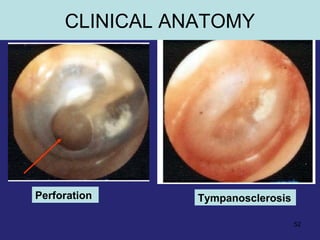
52
Perforation Tympanosclerosis
CLINICAL ANATOMY
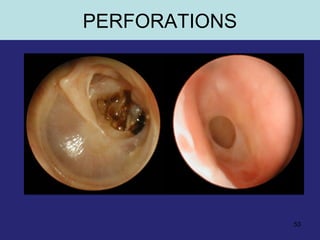
53
PERFORATIONS
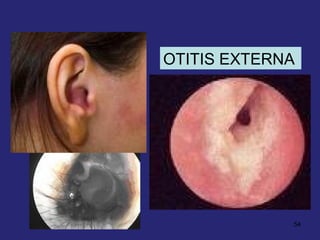
54
OTITIS EXTERNA
55
THANK YOU

Ear

  • 1.
    1 THE EAR Major RahulJha Graded Specialist Anatomy ACMS
  • 2.
    Introduction • Organ ofhearing and also plays an important role in equilibrium. • Divided into three parts:- – External ear. – Middle ear. – Internal ear. • External ear consists of Pinna/auricle. • Tympanic membrane at the medial end of EAM. • Middle ear – an air filled space containing ear ossicles. • Communicates with the nasopharynx through auditory tube. • Internal ear consists of bony labyrinth & fluid filled labyrinth. 2
  • 3.
  • 4.
  • 5.
  • 6.
    6 EXTERNAL AUDITORY MEATUS •Length: 2.5 cms • Parts – Cartilagenous : lateral 1/3rd – Bony: medial 2/3rd Bends – B/T lat 1/3rd & medial 2/3rd – 5 mm from TM Direction – Backwards & medially • To examine, pull ear. LAT MED
  • 7.
    7 EAMEpithelium – Adherent tobone & cartilage – Ceruminous glands – Secretions prevent entry of bacteria, make it waterproof Blood supply – Ant tympanic – Deep auricular – Post auricular Nerve supply Medial 1/4: • IX CN • Auricular br of X CN (Arnold’s) Lateral 3/4: • Roof: ATN • Floor: Great auricular N
  • 8.
    Tympanic membrane • Thinsemi-transparent membrane which forms the partition between the EAM & the middle ear. • Placed obliquely at an angle of 55 degrees with the floor. • Faces forward, downward & laterally. 8 TYMPANIC MEMBRANE
  • 9.
  • 10.
    12 TYMPANIC MEMBRANE Subdivisions • Bymalleolar folds – Pars flaccida (Shrapnel’s membrane) • Present between folds • Lax area – Pars tensa • Rest of membrane • Tense due to – Attachment of handle of malleus – Radiating fibres of intermediate layer PF PT AMF PMF Line of attach of handle of malleus on medial surface
  • 11.
    13 TYMPANIC MEMBRANE Surfaces Lateral surface •Concave, directed down, forward & laterally Medial surface • Convex, max at umbo • Handle of malleus attached here • Chorda tympani is medial to handle of malleus
  • 12.
    14 Structure From lateral tomedial Outer cuticular layer • Lined by str squamous nonkeratinized epithelium Intermediate fibrous layer • Outer radiating, inner circular fibres Inner mucous layer • Lined by columnar epithelium with patchy ciliated Handle of malleus & chorda tympani lie b/t mucous & intermediate fibrous layer TYMPANIC MEMBRANE
  • 13.
    15 Outer cuticular layer Middlefibrous layer Inner mucous layer Deep circular fibres Superficial Radiating fibres Pars flaccida TM: STRUCTURE
  • 14.
  • 15.
    17 Nerve Supply – Lateralsurface – ATN – Vagus N (auricular br) – Medial surface • IX CN (tympanic br-Jacobson’s N) • Chorda tympani Blood Supply – Deep auricular br of maxillary (lateral surface) – Ant tympanic Ar – Post auricular: stylomastoid br TYMPANIC MEMBRANE
  • 16.
    18 CLINICAL ANATOMY • ASOM –Pus discharged laterally • Myringotomy • Incision at posteroinferior quadrant –Prevent damage to chorda tympani –Rich blood supply: healing faster
  • 17.
  • 18.
    20 MALLEUS • Head – Inepitympanic recess – Post surface: facet for incus- Incudomalleal jt: Saddle jt • Neck – against pars flaccida – Chorda tympani cross medial to neck • Handle – Project down & back till umbo – processes • lateral pr : Upper end, handle & lat pr attached to fibrous layer of TM, malleolar folds • Anterior pr : attachment of ant lig of malleus
  • 19.
    21 INCUS Body • In epitympanicrecess • Articulates anteriorly with head of malleus Short process • Lig attached to fossa incudis (post wall of TC) Long process • Hook medially, articulate with stapes • Incudostapedial joint: ball & socket
  • 20.
    22 STAPES • Head – Articulateswith lenticular nodule of incus • Neck – Stapedius attached to back of neck • Ant & post limbs • Foot plate – anchored to fenestra vestibuli by annular lig – syndesmosis
  • 21.
    23 MIDDLE EAR Biconcave boxlike cavity Location – Petrous temporal bone Parts – Roof – Floor – Walls • Anterior & Posterior • Medial & Lateral
  • 22.
    24 Canal for TT Auditory tube Aditus to antrum Mastoid antrum Mastoid cells Mastoid process EAM Middle ear (Tympanic cavity) MIDDLE EAR Ht & Length: 15 mm Medial & lateral walls: 2 mm Roof: 6 mm Floor: 4 mm
  • 23.
    25 Auditory tube Tegmen tympaniAditus to antrum Mastoid antrum Mastoid air cells Mastoid process Middle Ear ANT & POST WALLS & ROOF
  • 24.
  • 25.
    27 Auditory tube Cochlea Semicircular canal Middleear Tympanic antrum Vestibule Stapes Tympanic membrane EAM Internal acoustic meatus Inner ear LATERAL & MEDIAL WALLS
  • 26.
  • 27.
  • 28.
    30 MIDDLE EAR: COMMUNICATIONS Anteriorwall • auditory tube Posterior wall • mastoid antrum Medial wall • inner ear Lateral wall • tympanic membrane
  • 29.
    31 Left ear: TMremoved Roof Floor Medial wall Ant wall Post wall
  • 30.
  • 31.
    33 Formed by – Tegmentympani • Thin bony plate of petrous temporal • Separates tympanic cavity from MCF • Pierced by lesser & greater petrosal nerves Applied – If unossified: spread of infection to meninges – Venous drainage to superior petrosal sinus through petrosquamous suture: infection to sinus ROOF
  • 32.
  • 33.
  • 34.
    36 FLOOR Formed by – Plateof bone above jugular fossa Relations – Anterior • Carotid canal – Posterior • IJV Tympanic canaliculus - tympanic br of IX CN enters Applied – Spread of infection to IJV: thrombosis
  • 35.
  • 36.
    38 ANTERIOR WALL Shortened byapproximation of roof & floor Anteriorly has post wall of carotid canal Features – Canal for • Tensor tympani • Auditory tube – Processus trochleariformis • Bony shelf extends back on medial wall & turns lateral: provide pulley for tensor tympani to get attached to handle of malleus
  • 37.
    39 POSTERIOR WALL Wider abovethan below Features 1. Aditus to mastoid antrum • Epitympanic part communicate with mastoid antrum 1. Facial canal: in lower part 2. Pyramid • Projects above facial canal • Contains stapedius, from apex tendon
  • 38.
    40 Left ear, TMremoved Roof Floor Medial wall Ant wall Post wall
  • 39.
    41 LATERAL WALL Components Tympanic Membrane Epitympanicrecess • Part above tympanic cavity – Contains » Upper half of malleus » Greater part of incus
  • 40.
    42 MEDIAL WALL Features 1. Promontory •Due to basal turn of cochlea • Tympanic plexus (IX CN) 1. Fenestra vestibuli (fossa ovalis) • Behind & above promontory • Closed by base of stapes & annular ligament 1. Fenestra cochleae (fossa rotunda) • Below & behind promontory • Closed by secondary TM (separate TC from scala tympani) 1. Sinus tympani • Depression behind promontory • Position of ampulla of post semicircular canal 1. Facial canal • Oblique part, run back & down above fenestra vestibuli 1. Processus trochleariformis
  • 41.
    43 Posterior Left ear, TMremoved roof floor Medial wall Ant wall Post wall
  • 42.
  • 43.
  • 44.
  • 45.
    47 TENSOR TYMPANI Origin • Bony& cart part of AT, becomes tendon, hooks around processus trochleariformis Insertion • Handle of malleus: upper part N/S • Nerve to Medial pterygoid Actions • Pull handle of malleus, TM concave, makes tense • Increase tight adhesion of footplate to fenestra vestibuli – Hence dampens sound
  • 46.
    48 STAPEDIUS Origin • Interior ofhollow pyramid Insertion • Back of neck of stapes N/S • Facial nerve Actions • Retract neck of stapes from fenestra vestibuli • Paralysis: hyperacusis
  • 47.
    49 CLINICAL ANATOMY 1. Otitismedia 2. Otosclerosis 3. Injury to nerve to stapedius • Hyperacusis
  • 48.
  • 49.
  • 50.
  • 51.
  • 52.
  • 53.