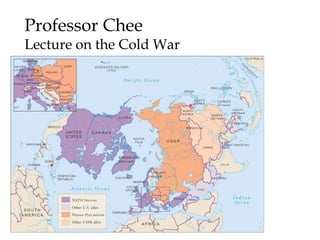
Professor Chee
Lecture on the Cold War
2
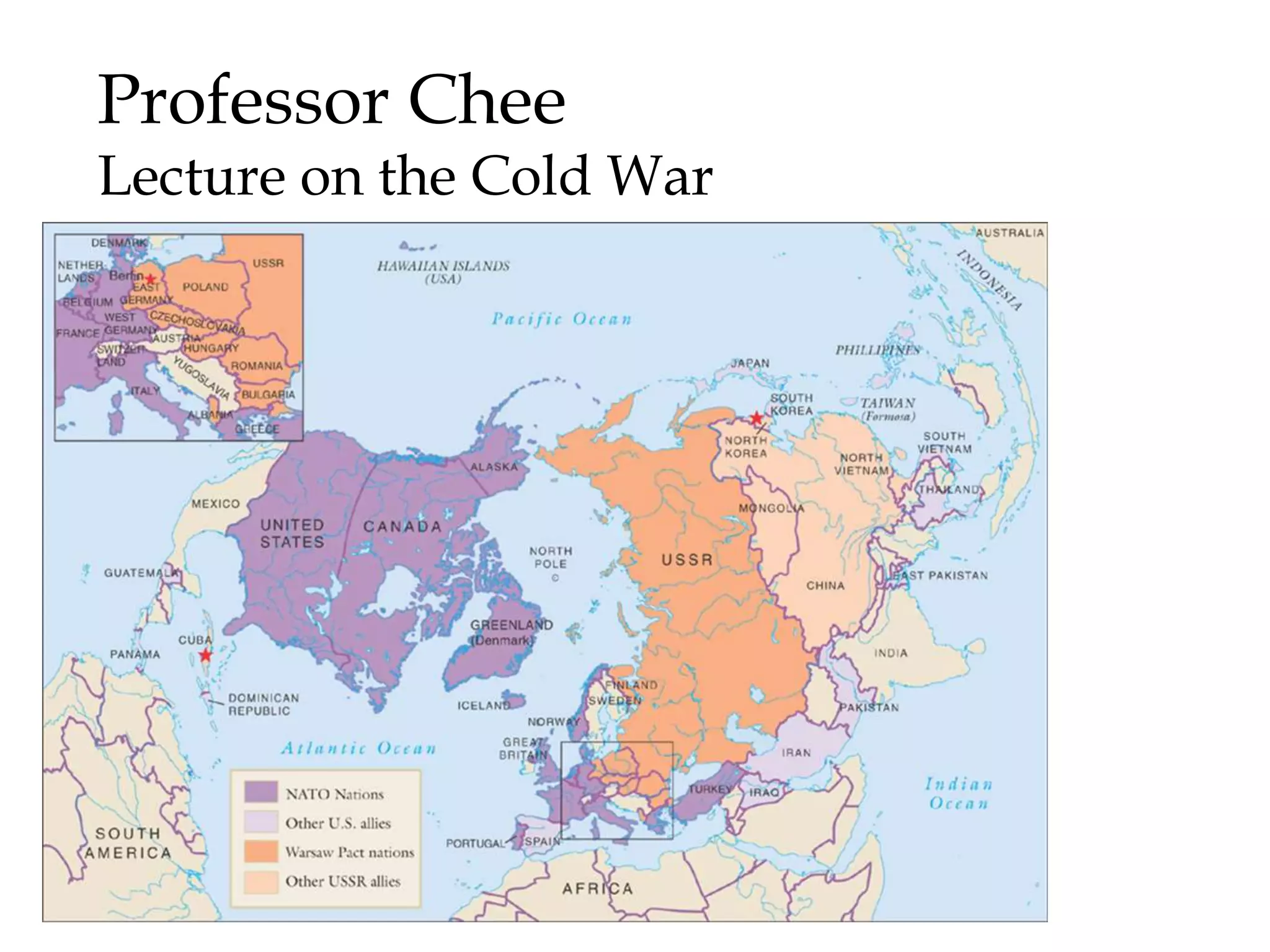
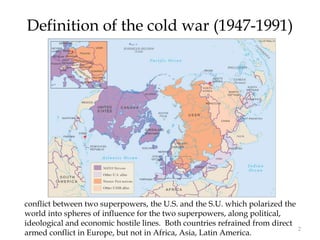
Definition of the cold war (1947-1991)
conflict between two superpowers, the U.S. and the S.U. which polarized the
world into spheres of influence for the two superpowers, along political,
ideological and economic hostile lines. Both countries refrained from direct
armed conflict in Europe, but not in Africa, Asia, Latin America.
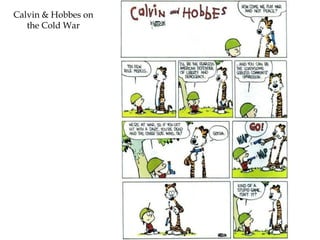
Calvin & Hobbes on
the Cold War
4
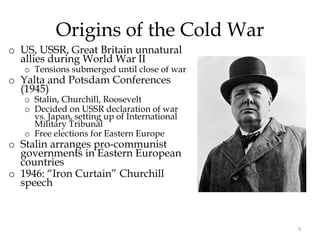
Origins of the Cold War
o US, USSR, Great Britain unnatural
allies during World War II
o Tensions submerged until close of war
o Yalta and Potsdam Conferences
(1945)
o Stalin, Churchill, Roosevelt
o Decided on USSR declaration of war
vs. Japan, setting up of International
Military Tribunal
o Free elections for Eastern Europe
o Stalin arranges pro-communist
governments in Eastern European
countries
o 1946: “Iron Curtain” Churchill
speech
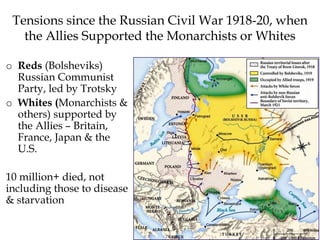
Tensions since the Russian Civil War 1918-20, when
the Allies Supported the Monarchists or Whites
o Reds (Bolsheviks)
Russian Communist
Party, led by Trotsky
o Whites (Monarchists &
others) supported by
the Allies – Britain,
France, Japan & the
U.S.
10 million+ died, not
including those to disease
& starvation
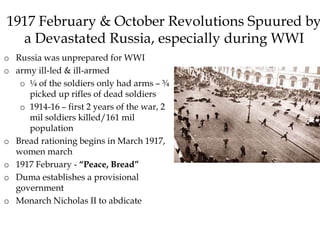
1917 February & October Revolutions Spuured by
a Devastated Russia, especially during WWI
o Russia was unprepared for WWI
o army ill-led & ill-armed
o ¼ of the soldiers only had arms – ¾
picked up rifles of dead soldiers
o 1914-16 – first 2 years of the war, 2
mil soldiers killed/161 mil
population
o Bread rationing begins in March 1917,
women march
o 1917 February - “Peace, Bread”
o Duma establishes a provisional
government
o Monarch Nicholas II to abdicate
7
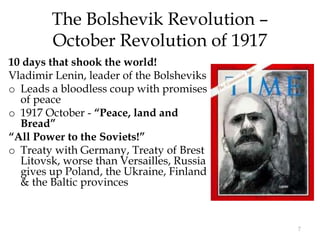
The Bolshevik Revolution –
October Revolution of 1917
10 days that shook the world!
Vladimir Lenin, leader of the Bolsheviks
o Leads a bloodless coup with promises
of peace
o 1917 October - “Peace, land and
Bread”
“All Power to the Soviets!”
o Treaty with Germany, Treaty of Brest
Litovsk, worse than Versailles, Russia
gives up Poland, the Ukraine, Finland
& the Baltic provinces
8
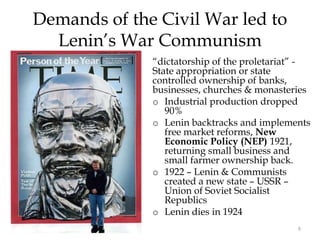
Demands of the Civil War led to
Lenin’s War Communism
“dictatorship of the proletariat” -
State appropriation or state
controlled ownership of banks,
businesses, churches & monasteries
o Industrial production dropped
90%
o Lenin backtracks and implements
free market reforms, New
Economic Policy (NEP) 1921,
returning small business and
small farmer ownership back.
o 1922 – Lenin & Communists
created a new state – USSR –
Union of Soviet Socialist
Republics
o Lenin dies in 1924
9
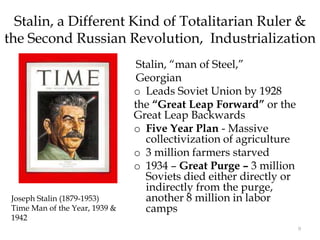
Stalin, a Different Kind of Totalitarian Ruler &
the Second Russian Revolution, Industrialization
Stalin, “man of Steel,”
Georgian
o Leads Soviet Union by 1928
the “Great Leap Forward” or the
Great Leap Backwards
o Five Year Plan - Massive
collectivization of agriculture
o 3 million farmers starved
o 1934 – Great Purge – 3 million
Soviets died either directly or
indirectly from the purge,
another 8 million in labor
camps
Joseph Stalin (1879-1953)
Time Man of the Year, 1939 &
1942
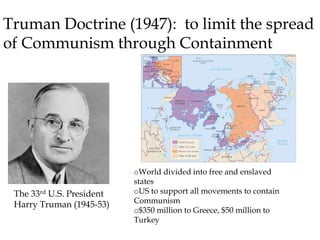
Truman Doctrine (1947): to limit the spread
of Communism through Containment
The 33rd U.S. President
Harry Truman (1945-53)
oWorld divided into free and enslaved
states
oUS to support all movements to contain
Communism
o$350 million to Greece, $50 million to
Turkey
11
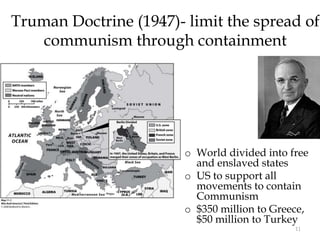
Truman Doctrine (1947)- limit the spread of
communism through containment
o World divided into free
and enslaved states
o US to support all
movements to contain
Communism
o $350 million to Greece,
$50 million to Turkey
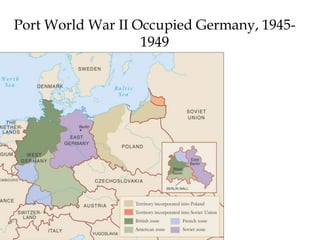
Port World War II Occupied Germany, 1945-
1949
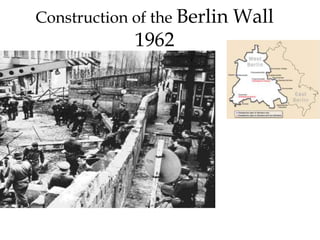
Construction of the Berlin Wall
1962
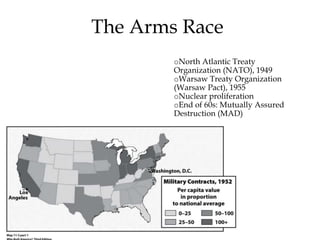
oNorth Atlantic Treaty
Organization (NATO), 1949
oWarsaw Treaty Organization
(Warsaw Pact), 1955
oNuclear proliferation
oEnd of 60s: Mutually Assured
Destruction (MAD)
The Arms Race
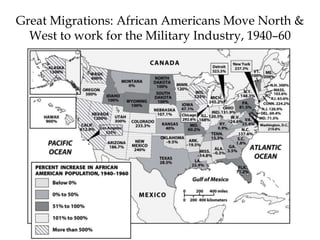
Great Migrations: African Americans Move North &
West to work for the Military Industry, 1940–60
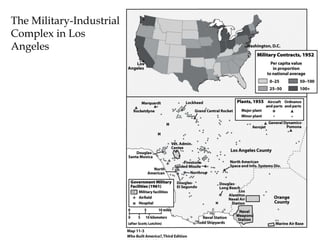
The Military-Industrial
Complex in Los
Angeles
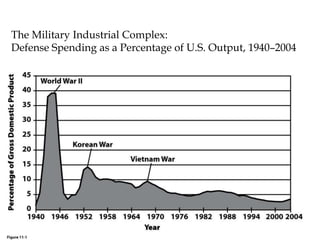
The Military Industrial Complex:
Defense Spending as a Percentage of U.S. Output, 1940–2004
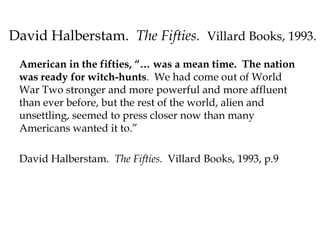
David Halberstam. The Fifties. Villard Books, 1993.
American in the fifties, “… was a mean time. The nation
was ready for witch-hunts. We had come out of World
War Two stronger and more powerful and more affluent
than ever before, but the rest of the world, alien and
unsettling, seemed to press closer now than many
Americans wanted it to.”
David Halberstam. The Fifties. Villard Books, 1993, p.9
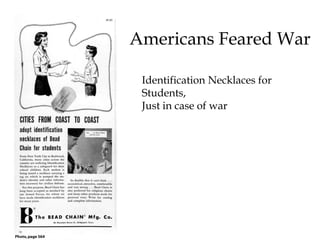
Identification Necklaces for
Students,
Just in case of war
Americans Feared War
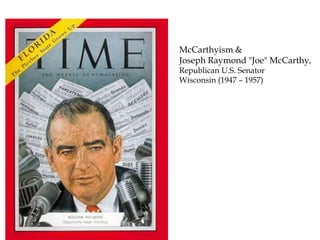
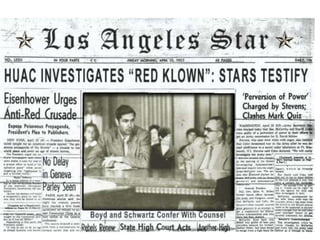
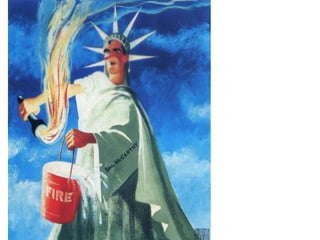
McCarthyism &
Joseph Raymond "Joe" McCarthy,
Republican U.S. Senator
Wisconsin (1947 – 1957)
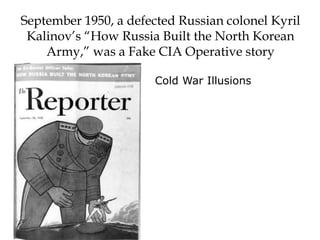
Cold War Illusions
September 1950, a defected Russian colonel Kyril
Kalinov’s “How Russia Built the North Korean
Army,” was a Fake CIA Operative story
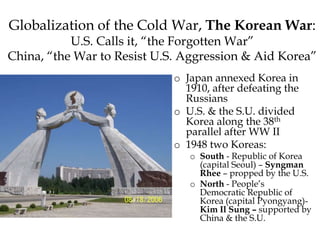
Globalization of the Cold War, The Korean War:
U.S. Calls it, “the Forgotten War”
China, “the War to Resist U.S. Aggression & Aid Korea”
o Japan annexed Korea in
1910, after defeating the
Russians
o U.S. & the S.U. divided
Korea along the 38th
parallel after WW II
o 1948 two Koreas:
o South - Republic of Korea
(capital Seoul) – Syngman
Rhee – propped by the U.S.
o North - People’s
Democratic Republic of
Korea (capital Pyongyang)-
Kim Il Sung – supported by
China & the S.U.
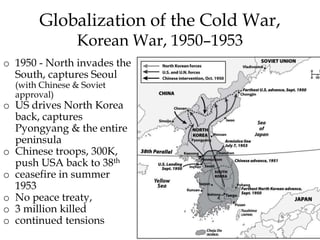
o 1950 - North invades the
South, captures Seoul
(with Chinese & Soviet
approval)
o US drives North Korea
back, captures
Pyongyang & the entire
peninsula
o Chinese troops, 300K,
push USA back to 38th
o ceasefire in summer
1953
o No peace treaty,
o 3 million killed
o continued tensions
Globalization of the Cold War,
Korean War, 1950–1953
26
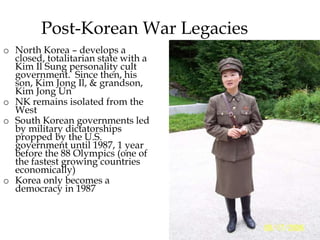
Post-Korean War Legacies
o North Korea – develops a
closed, totalitarian state with a
Kim Il Sung personality cult
government. Since then, his
son, Kim Jong Il, & grandson,
Kim Jong Un
o NK remains isolated from the
West
o South Korean governments led
by military dictatorships
propped by the U.S.
government until 1987, 1 year
before the 88 Olympics (one of
the fastest growing countries
economically)
o Korea only becomes a
democracy in 1987
The Cold War
in Cuba
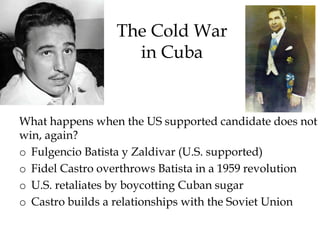
What happens when the US supported candidate does not
win, again?
o Fulgencio Batista y Zaldivar (U.S. supported)
o Fidel Castro overthrows Batista in a 1959 revolution
o U.S. retaliates by boycotting Cuban sugar
o Castro builds a relationships with the Soviet Union
28
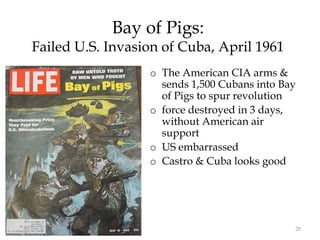
Bay of Pigs:
Failed U.S. Invasion of Cuba, April 1961
o The American CIA arms &
sends 1,500 Cubans into Bay
of Pigs to spur revolution
o force destroyed in 3 days,
without American air
support
o US embarrassed
o Castro & Cuba looks good
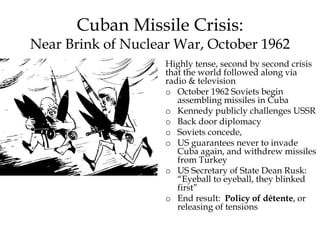
Cuban Missile Crisis:
Near Brink of Nuclear War, October 1962
Highly tense, second by second crisis
that the world followed along via
radio & television
o October 1962 Soviets begin
assembling missiles in Cuba
o Kennedy publicly challenges USSR
o Back door diplomacy
o Soviets concede,
o US guarantees never to invade
Cuba again, and withdrew missiles
from Turkey
o US Secretary of State Dean Rusk:
“Eyeball to eyeball, they blinked
first”
o End result: Policy of détente, or
releasing of tensions
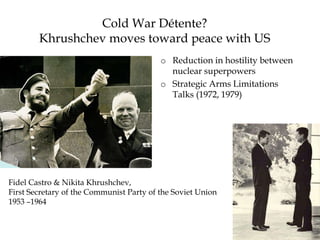
Cold War Détente?
Khrushchev moves toward peace with US
o Reduction in hostility between
nuclear superpowers
o Strategic Arms Limitations
Talks (1972, 1979)
Fidel Castro & Nikita Khrushchev,
First Secretary of the Communist Party of the Soviet Union
1953 –1964
31
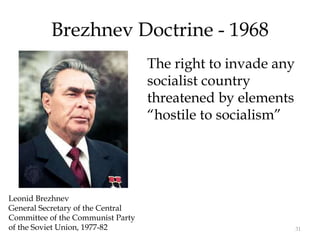
Brezhnev Doctrine - 1968
The right to invade any
socialist country
threatened by elements
“hostile to socialism”
Leonid Brezhnev
General Secretary of the Central
Committee of the Communist Party
of the Soviet Union, 1977-82
32
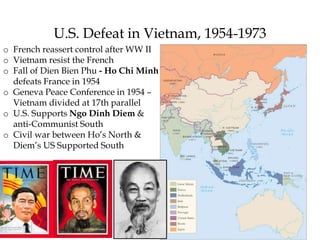
U.S. Defeat in Vietnam, 1954-1973
o French reassert control after WW II
o Vietnam resist the French
o Fall of Dien Bien Phu - Ho Chi Minh
defeats France in 1954
o Geneva Peace Conference in 1954 –
Vietnam divided at 17th parallel
o U.S. Supports Ngo Dinh Diem &
anti-Communist South
o Civil war between Ho’s North &
Diem’s US Supported South
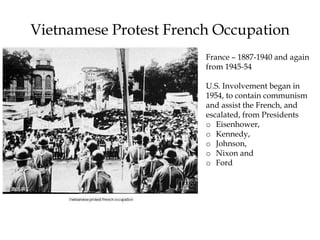
Vietnamese Protest French Occupation
France – 1887-1940 and again
from 1945-54
U.S. Involvement began in
1954, to contain communism
and assist the French, and
escalated, from Presidents
o Eisenhower,
o Kennedy,
o Johnson,
o Nixon and
o Ford
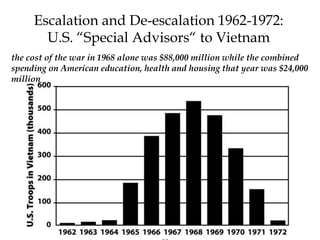
Escalation and De-escalation 1962-1972:
U.S. “Special Advisors“ to Vietnam
the cost of the war in 1968 alone was $88,000 million while the combined
spending on American education, health and housing that year was $24,000
million
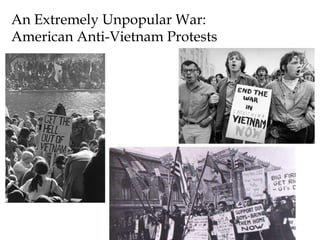
An Extremely Unpopular War:
American Anti-Vietnam Protests
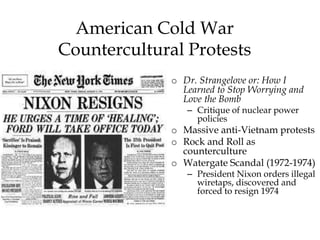
American Cold War
Countercultural Protests
o Dr. Strangelove or: How I
Learned to Stop Worrying and
Love the Bomb
– Critique of nuclear power
policies
o Massive anti-Vietnam protests
o Rock and Roll as
counterculture
o Watergate Scandal (1972-1974)
– President Nixon orders illegal
wiretaps, discovered and
forced to resign 1974
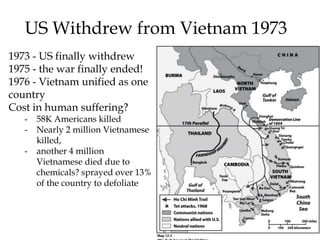
1973 - US finally withdrew
1975 - the war finally ended!
1976 - Vietnam unified as one
country
Cost in human suffering?
- 58K Americans killed
- Nearly 2 million Vietnamese
killed,
- another 4 million
Vietnamese died due to
chemicals? sprayed over 13%
of the country to defoliate
US Withdrew from Vietnam 1973
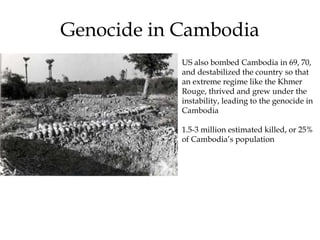
Genocide in Cambodia
US also bombed Cambodia in 69, 70,
and destabilized the country so that
an extreme regime like the Khmer
Rouge, thrived and grew under the
instability, leading to the genocide in
Cambodia
1.5-3 million estimated killed, or 25%
of Cambodia’s population
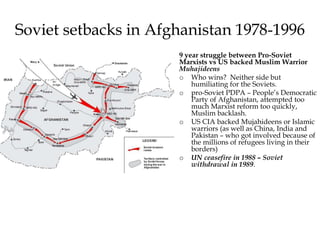
Soviet setbacks in Afghanistan 1978-1996
9 year struggle between Pro-Soviet
Marxists vs US backed Muslim Warrior
Muhajideens
o Who wins? Neither side but
humiliating for the Soviets.
o pro-Soviet PDPA – People’s Democratic
Party of Afghanistan, attempted too
much Marxist reform too quickly,
Muslim backlash.
o US CIA backed Mujahideens or Islamic
warriors (as well as China, India and
Pakistan – who got involved because of
the millions of refugees living in their
borders)
o UN ceasefire in 1988 – Soviet
withdrawal in 1989.
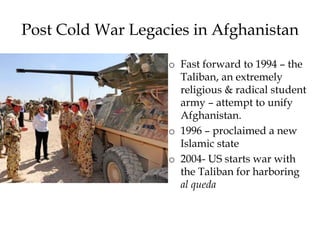
Post Cold War Legacies in Afghanistan
o Fast forward to 1994 – the
Taliban, an extremely
religious & radical student
army – attempt to unify
Afghanistan.
o 1996 – proclaimed a new
Islamic state
o 2004- US starts war with
the Taliban for harboring
al queda
41
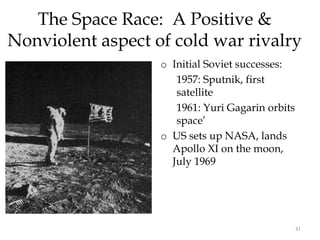
The Space Race: A Positive &
Nonviolent aspect of cold war rivalry
o Initial Soviet successes:
1957: Sputnik, first
satellite
1961: Yuri Gagarin orbits
space’
o US sets up NASA, lands
Apollo XI on the moon,
July 1969
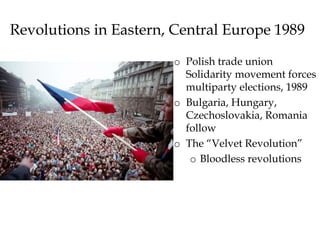
Revolutions in Eastern, Central Europe 1989
o Polish trade union
Solidarity movement forces
multiparty elections, 1989
o Bulgaria, Hungary,
Czechoslovakia, Romania
follow
o The “Velvet Revolution”
o Bloodless revolutions
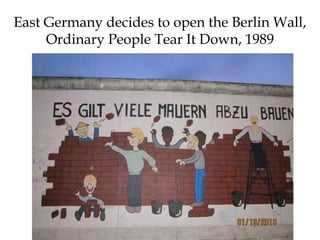
East Germany decides to open the Berlin Wall,
Ordinary People Tear It Down, 1989
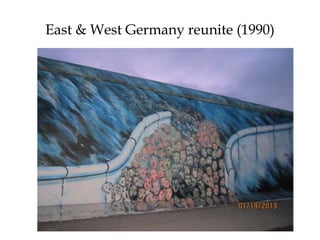
East & West Germany reunite (1990)
45
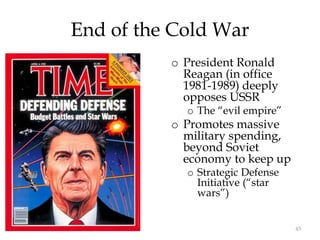
End of the Cold War
o President Ronald
Reagan (in office
1981-1989) deeply
opposes USSR
o The “evil empire”
o Promotes massive
military spending,
beyond Soviet
economy to keep up
o Strategic Defense
Initiative (“star
wars”)
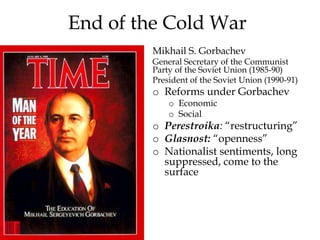
End of the Cold War
Mikhail S. Gorbachev
General Secretary of the Communist
Party of the Soviet Union (1985-90)
President of the Soviet Union (1990-91)
o Reforms under Gorbachev
o Economic
o Social
o Perestroika: “restructuring”
o Glasnost: “openness”
o Nationalist sentiments, long
suppressed, come to the
surface
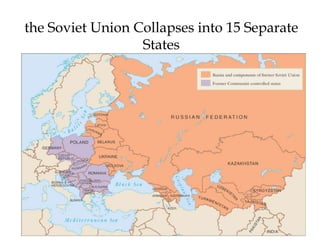
the Soviet Union Collapses into 15 Separate
States
Grace Chee
2015
Message to students:
Professor Chee does not endorse other slideshare
presentations, unless it says, Professor Chee
Please check out the primary sources, text, and other
readings/videos as assigned

Lecture 9 - the cold war

  • 1.
  • 2.
    2 Definition of thecold war (1947-1991) conflict between two superpowers, the U.S. and the S.U. which polarized the world into spheres of influence for the two superpowers, along political, ideological and economic hostile lines. Both countries refrained from direct armed conflict in Europe, but not in Africa, Asia, Latin America.
  • 3.
    Calvin & Hobbeson the Cold War
  • 4.
    4 Origins of theCold War o US, USSR, Great Britain unnatural allies during World War II o Tensions submerged until close of war o Yalta and Potsdam Conferences (1945) o Stalin, Churchill, Roosevelt o Decided on USSR declaration of war vs. Japan, setting up of International Military Tribunal o Free elections for Eastern Europe o Stalin arranges pro-communist governments in Eastern European countries o 1946: “Iron Curtain” Churchill speech
  • 5.
    Tensions since theRussian Civil War 1918-20, when the Allies Supported the Monarchists or Whites o Reds (Bolsheviks) Russian Communist Party, led by Trotsky o Whites (Monarchists & others) supported by the Allies – Britain, France, Japan & the U.S. 10 million+ died, not including those to disease & starvation
  • 6.
    1917 February &October Revolutions Spuured by a Devastated Russia, especially during WWI o Russia was unprepared for WWI o army ill-led & ill-armed o ¼ of the soldiers only had arms – ¾ picked up rifles of dead soldiers o 1914-16 – first 2 years of the war, 2 mil soldiers killed/161 mil population o Bread rationing begins in March 1917, women march o 1917 February - “Peace, Bread” o Duma establishes a provisional government o Monarch Nicholas II to abdicate
  • 7.
    7 The Bolshevik Revolution– October Revolution of 1917 10 days that shook the world! Vladimir Lenin, leader of the Bolsheviks o Leads a bloodless coup with promises of peace o 1917 October - “Peace, land and Bread” “All Power to the Soviets!” o Treaty with Germany, Treaty of Brest Litovsk, worse than Versailles, Russia gives up Poland, the Ukraine, Finland & the Baltic provinces
  • 8.
    8 Demands of theCivil War led to Lenin’s War Communism “dictatorship of the proletariat” - State appropriation or state controlled ownership of banks, businesses, churches & monasteries o Industrial production dropped 90% o Lenin backtracks and implements free market reforms, New Economic Policy (NEP) 1921, returning small business and small farmer ownership back. o 1922 – Lenin & Communists created a new state – USSR – Union of Soviet Socialist Republics o Lenin dies in 1924
  • 9.
    9 Stalin, a DifferentKind of Totalitarian Ruler & the Second Russian Revolution, Industrialization Stalin, “man of Steel,” Georgian o Leads Soviet Union by 1928 the “Great Leap Forward” or the Great Leap Backwards o Five Year Plan - Massive collectivization of agriculture o 3 million farmers starved o 1934 – Great Purge – 3 million Soviets died either directly or indirectly from the purge, another 8 million in labor camps Joseph Stalin (1879-1953) Time Man of the Year, 1939 & 1942
  • 10.
    Truman Doctrine (1947):to limit the spread of Communism through Containment The 33rd U.S. President Harry Truman (1945-53) oWorld divided into free and enslaved states oUS to support all movements to contain Communism o$350 million to Greece, $50 million to Turkey
  • 11.
    11 Truman Doctrine (1947)-limit the spread of communism through containment o World divided into free and enslaved states o US to support all movements to contain Communism o $350 million to Greece, $50 million to Turkey
  • 12.
    Port World WarII Occupied Germany, 1945- 1949
  • 13.
    Construction of theBerlin Wall 1962
  • 14.
    oNorth Atlantic Treaty Organization(NATO), 1949 oWarsaw Treaty Organization (Warsaw Pact), 1955 oNuclear proliferation oEnd of 60s: Mutually Assured Destruction (MAD) The Arms Race
  • 15.
    Great Migrations: AfricanAmericans Move North & West to work for the Military Industry, 1940–60
  • 16.
  • 17.
    The Military IndustrialComplex: Defense Spending as a Percentage of U.S. Output, 1940–2004
  • 18.
    David Halberstam. TheFifties. Villard Books, 1993. American in the fifties, “… was a mean time. The nation was ready for witch-hunts. We had come out of World War Two stronger and more powerful and more affluent than ever before, but the rest of the world, alien and unsettling, seemed to press closer now than many Americans wanted it to.” David Halberstam. The Fifties. Villard Books, 1993, p.9
  • 19.
    Identification Necklaces for Students, Justin case of war Americans Feared War
  • 20.
    McCarthyism & Joseph Raymond"Joe" McCarthy, Republican U.S. Senator Wisconsin (1947 – 1957)
  • 23.
    Cold War Illusions September1950, a defected Russian colonel Kyril Kalinov’s “How Russia Built the North Korean Army,” was a Fake CIA Operative story
  • 24.
    Globalization of theCold War, The Korean War: U.S. Calls it, “the Forgotten War” China, “the War to Resist U.S. Aggression & Aid Korea” o Japan annexed Korea in 1910, after defeating the Russians o U.S. & the S.U. divided Korea along the 38th parallel after WW II o 1948 two Koreas: o South - Republic of Korea (capital Seoul) – Syngman Rhee – propped by the U.S. o North - People’s Democratic Republic of Korea (capital Pyongyang)- Kim Il Sung – supported by China & the S.U.
  • 25.
    o 1950 -North invades the South, captures Seoul (with Chinese & Soviet approval) o US drives North Korea back, captures Pyongyang & the entire peninsula o Chinese troops, 300K, push USA back to 38th o ceasefire in summer 1953 o No peace treaty, o 3 million killed o continued tensions Globalization of the Cold War, Korean War, 1950–1953
  • 26.
    26 Post-Korean War Legacies oNorth Korea – develops a closed, totalitarian state with a Kim Il Sung personality cult government. Since then, his son, Kim Jong Il, & grandson, Kim Jong Un o NK remains isolated from the West o South Korean governments led by military dictatorships propped by the U.S. government until 1987, 1 year before the 88 Olympics (one of the fastest growing countries economically) o Korea only becomes a democracy in 1987
  • 27.
    The Cold War inCuba What happens when the US supported candidate does not win, again? o Fulgencio Batista y Zaldivar (U.S. supported) o Fidel Castro overthrows Batista in a 1959 revolution o U.S. retaliates by boycotting Cuban sugar o Castro builds a relationships with the Soviet Union
  • 28.
    28 Bay of Pigs: FailedU.S. Invasion of Cuba, April 1961 o The American CIA arms & sends 1,500 Cubans into Bay of Pigs to spur revolution o force destroyed in 3 days, without American air support o US embarrassed o Castro & Cuba looks good
  • 29.
    Cuban Missile Crisis: NearBrink of Nuclear War, October 1962 Highly tense, second by second crisis that the world followed along via radio & television o October 1962 Soviets begin assembling missiles in Cuba o Kennedy publicly challenges USSR o Back door diplomacy o Soviets concede, o US guarantees never to invade Cuba again, and withdrew missiles from Turkey o US Secretary of State Dean Rusk: “Eyeball to eyeball, they blinked first” o End result: Policy of détente, or releasing of tensions
  • 30.
    Cold War Détente? Khrushchevmoves toward peace with US o Reduction in hostility between nuclear superpowers o Strategic Arms Limitations Talks (1972, 1979) Fidel Castro & Nikita Khrushchev, First Secretary of the Communist Party of the Soviet Union 1953 –1964
  • 31.
    31 Brezhnev Doctrine -1968 The right to invade any socialist country threatened by elements “hostile to socialism” Leonid Brezhnev General Secretary of the Central Committee of the Communist Party of the Soviet Union, 1977-82
  • 32.
    32 U.S. Defeat inVietnam, 1954-1973 o French reassert control after WW II o Vietnam resist the French o Fall of Dien Bien Phu - Ho Chi Minh defeats France in 1954 o Geneva Peace Conference in 1954 – Vietnam divided at 17th parallel o U.S. Supports Ngo Dinh Diem & anti-Communist South o Civil war between Ho’s North & Diem’s US Supported South
  • 33.
    Vietnamese Protest FrenchOccupation France – 1887-1940 and again from 1945-54 U.S. Involvement began in 1954, to contain communism and assist the French, and escalated, from Presidents o Eisenhower, o Kennedy, o Johnson, o Nixon and o Ford
  • 34.
    Escalation and De-escalation1962-1972: U.S. “Special Advisors“ to Vietnam the cost of the war in 1968 alone was $88,000 million while the combined spending on American education, health and housing that year was $24,000 million
  • 35.
    An Extremely UnpopularWar: American Anti-Vietnam Protests
  • 36.
    American Cold War CounterculturalProtests o Dr. Strangelove or: How I Learned to Stop Worrying and Love the Bomb – Critique of nuclear power policies o Massive anti-Vietnam protests o Rock and Roll as counterculture o Watergate Scandal (1972-1974) – President Nixon orders illegal wiretaps, discovered and forced to resign 1974
  • 37.
    1973 - USfinally withdrew 1975 - the war finally ended! 1976 - Vietnam unified as one country Cost in human suffering? - 58K Americans killed - Nearly 2 million Vietnamese killed, - another 4 million Vietnamese died due to chemicals? sprayed over 13% of the country to defoliate US Withdrew from Vietnam 1973
  • 38.
    Genocide in Cambodia USalso bombed Cambodia in 69, 70, and destabilized the country so that an extreme regime like the Khmer Rouge, thrived and grew under the instability, leading to the genocide in Cambodia 1.5-3 million estimated killed, or 25% of Cambodia’s population
  • 39.
    Soviet setbacks inAfghanistan 1978-1996 9 year struggle between Pro-Soviet Marxists vs US backed Muslim Warrior Muhajideens o Who wins? Neither side but humiliating for the Soviets. o pro-Soviet PDPA – People’s Democratic Party of Afghanistan, attempted too much Marxist reform too quickly, Muslim backlash. o US CIA backed Mujahideens or Islamic warriors (as well as China, India and Pakistan – who got involved because of the millions of refugees living in their borders) o UN ceasefire in 1988 – Soviet withdrawal in 1989.
  • 40.
    Post Cold WarLegacies in Afghanistan o Fast forward to 1994 – the Taliban, an extremely religious & radical student army – attempt to unify Afghanistan. o 1996 – proclaimed a new Islamic state o 2004- US starts war with the Taliban for harboring al queda
  • 41.
    41 The Space Race:A Positive & Nonviolent aspect of cold war rivalry o Initial Soviet successes: 1957: Sputnik, first satellite 1961: Yuri Gagarin orbits space’ o US sets up NASA, lands Apollo XI on the moon, July 1969
  • 42.
    Revolutions in Eastern,Central Europe 1989 o Polish trade union Solidarity movement forces multiparty elections, 1989 o Bulgaria, Hungary, Czechoslovakia, Romania follow o The “Velvet Revolution” o Bloodless revolutions
  • 43.
    East Germany decidesto open the Berlin Wall, Ordinary People Tear It Down, 1989
  • 44.
    East & WestGermany reunite (1990)
  • 45.
    45 End of theCold War o President Ronald Reagan (in office 1981-1989) deeply opposes USSR o The “evil empire” o Promotes massive military spending, beyond Soviet economy to keep up o Strategic Defense Initiative (“star wars”)
  • 46.
    End of theCold War Mikhail S. Gorbachev General Secretary of the Communist Party of the Soviet Union (1985-90) President of the Soviet Union (1990-91) o Reforms under Gorbachev o Economic o Social o Perestroika: “restructuring” o Glasnost: “openness” o Nationalist sentiments, long suppressed, come to the surface
  • 47.
    the Soviet UnionCollapses into 15 Separate States
  • 48.
    Grace Chee 2015 Message tostudents: Professor Chee does not endorse other slideshare presentations, unless it says, Professor Chee Please check out the primary sources, text, and other readings/videos as assigned