

TOURISM
Which attractions are shown in this
holiday destination?
A RAPIDLY GROWING INDUSTRY
TOURISM
A rapidly growing industry
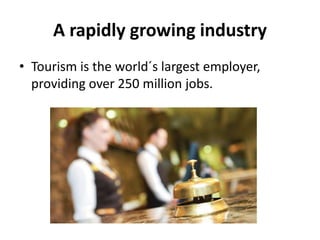
• Tourism is the world´s largest employer,
providing over 250 million jobs.
A rapidly growing industry
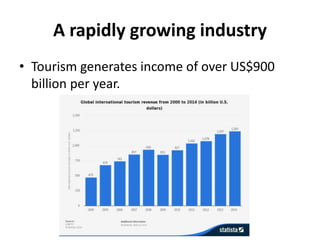
• Tourism generates income of over US$900
billion per year.
A rapidly growing industry
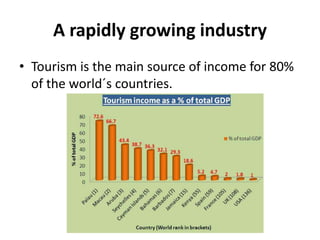
• Tourism is the main source of income for 80%
of the world´s countries.
A rapidly growing industry
REASONS FOR THE GROWTH OF
TOURISM
REASONS FOR THE GROWTH OF
TOURISM
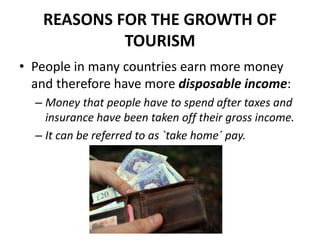
• People in many countries earn more money
and therefore have more disposable income:
– Money that people have to spend after taxes and
insurance have been taken off their gross income.
– It can be referred to as `take home´ pay.
REASONS FOR THE GROWTH OF
TOURISM
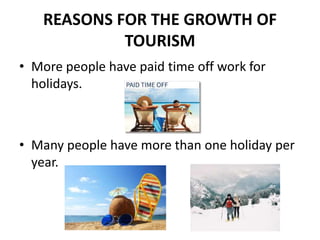
• More people have paid time off work for
holidays.
• Many people have more than one holiday per
year.
REASONS FOR THE GROWTH OF
TOURISM
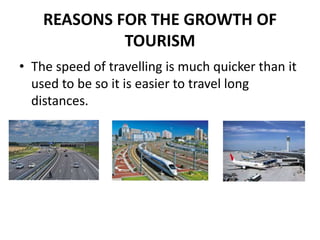
• The speed of travelling is much quicker than it
used to be so it is easier to travel long
distances.
REASONS FOR THE GROWTH OF
TOURISM
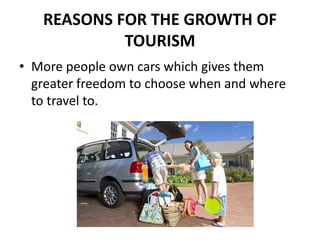
• More people own cars which gives them
greater freedom to choose when and where
to travel to.
REASONS FOR THE GROWTH OF
TOURISM
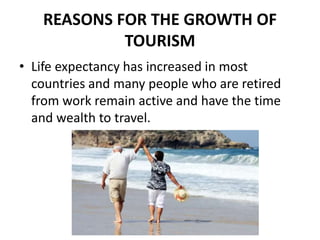
• Life expectancy has increased in most
countries and many people who are retired
from work remain active and have the time
and wealth to travel.
REASONS FOR THE GROWTH OF
TOURISM
• Television programmes and advertising make
people more aware of how and where they
can choose to spend their free time.
REASONS FOR THE GROWTH OF
TOURISM
• The Internet makes it easier for people to
search for and book holidays from home.
REASONS FOR THE GROWTH OF
TOURISM
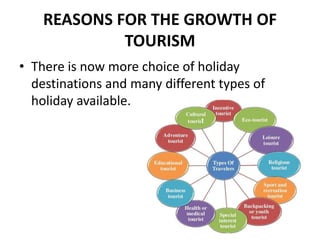
• There is now more choice of holiday
destinations and many different types of
holiday available.
THE MAIN ATRACTIONS FOR
TOURISM
The main atractions for tourism
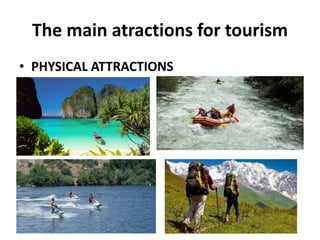
• PHYSICAL ATTRACTIONS
The main atractions for tourism
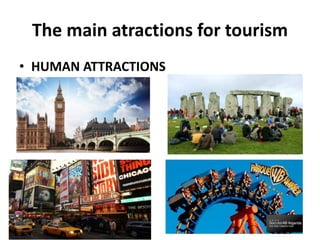
• HUMAN ATTRACTIONS
• Task 1
• Task 2
• Task 3
• Task 4
THE BENEFITS OF TOURISM
TOURISM
BENEFITS OF TOURISM
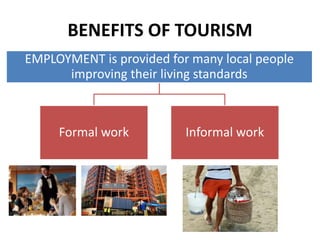
EMPLOYMENT is provided for many local people
improving their living standards
Formal work Informal work
BENEFITS OF TOURISM
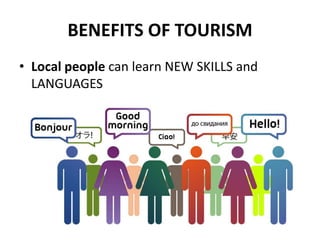
• Local people can learn NEW SKILLS and
LANGUAGES
BENEFITS OF TOURISM
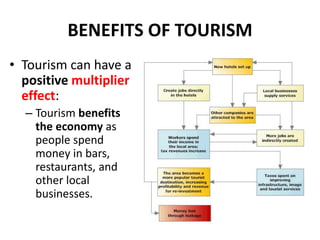
• Tourism can have a
positive multiplier
effect:
– Tourism benefits
the economy as
people spend
money in bars,
restaurants, and
other local
businesses.
BENEFITS OF TOURISM
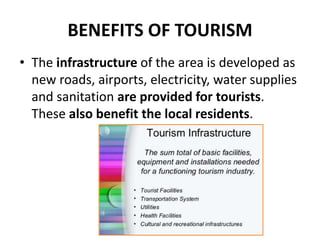
• The infrastructure of the area is developed as
new roads, airports, electricity, water supplies
and sanitation are provided for tourists.
These also benefit the local residents.
BENEFITS OF TOURISM
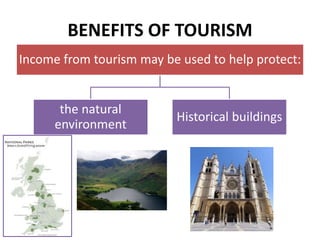
Income from tourism may be used to help protect:
the natural
environment
Historical buildings
BENEFITS OF TOURISM
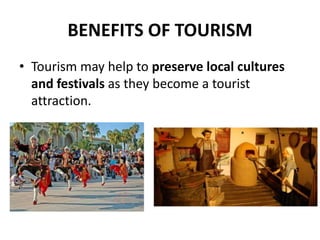
• Tourism may help to preserve local cultures
and festivals as they become a tourist
attraction.
BENEFITS OF TOURISM
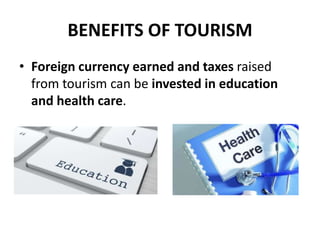
• Foreign currency earned and taxes raised
from tourism can be invested in education
and health care.
THE DISADVANTAGES OF TOURISM
TOURISM
THE DISADVANTAGES OF TOURISM
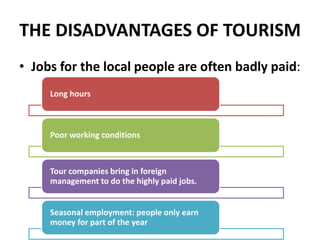
• Jobs for the local people are often badly paid:
Long hours
Poor working conditions
Tour companies bring in foreign
management to do the highly paid jobs.
Seasonal employment: people only earn
money for part of the year
THE DISADVANTAGES OF TOURISM
• Transnational tour companies, travel agents,
airlines and hotels get most of the money
paid for the holiday, so only a small amount
gets to the local people.
THE DISADVANTAGES OF TOURISM
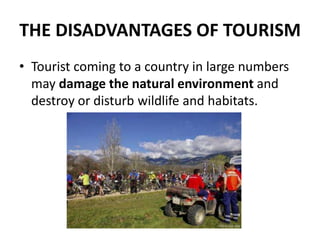
• Tourist coming to a country in large numbers
may damage the natural environment and
destroy or disturb wildlife and habitats.
THE DISADVANTAGES OF TOURISM
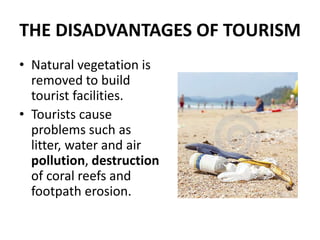
• Natural vegetation is
removed to build
tourist facilities.
• Tourists cause
problems such as
litter, water and air
pollution, destruction
of coral reefs and
footpath erosion.
THE DISADVANTAGES OF TOURISM
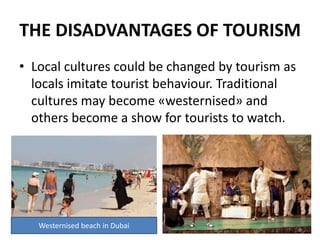
• Local cultures could be changed by tourism as
locals imitate tourist behaviour. Traditional
cultures may become «westernised» and
others become a show for tourists to watch.
Westernised beach in Dubai
THE DISADVANTAGES OF TOURISM
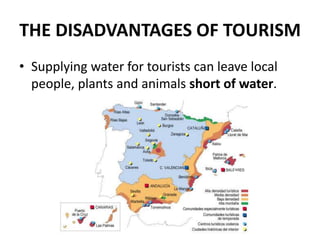
• Supplying water for tourists can leave local
people, plants and animals short of water.
THE DISADVANTAGES OF TOURISM
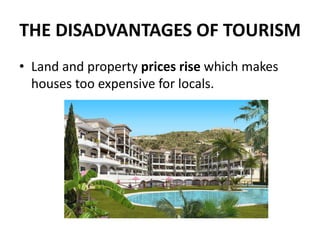
• Land and property prices rise which makes
houses too expensive for locals.
THE DISADVANTAGES OF TOURISM
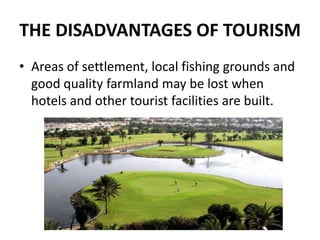
• Areas of settlement, local fishing grounds and
good quality farmland may be lost when
hotels and other tourist facilities are built.
THE DISADVANTAGES OF TOURISM
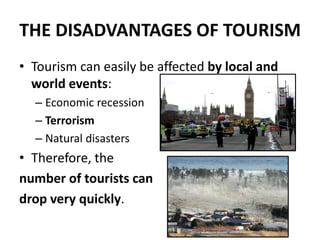
• Tourism can easily be affected by local and
world events:
– Economic recession
– Terrorism
– Natural disasters
• Therefore, the
number of tourists can
drop very quickly.
THE DISADVANTAGES OF TOURISM
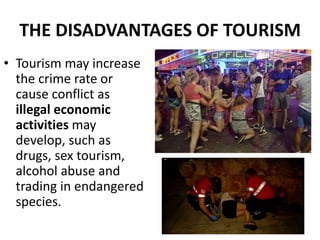
• Tourism may increase
the crime rate or
cause conflict as
illegal economic
activities may
develop, such as
drugs, sex tourism,
alcohol abuse and
trading in endangered
species.
• Page 163
– Task 1
– Task 2
– Task 3
– Task 4

Tourism

  • 1.
  • 2.
    Which attractions areshown in this holiday destination?
  • 3.
    A RAPIDLY GROWINGINDUSTRY TOURISM
  • 4.
    A rapidly growingindustry • Tourism is the world´s largest employer, providing over 250 million jobs.
  • 5.
    A rapidly growingindustry • Tourism generates income of over US$900 billion per year.
  • 6.
    A rapidly growingindustry • Tourism is the main source of income for 80% of the world´s countries.
  • 7.
  • 8.
    REASONS FOR THEGROWTH OF TOURISM
  • 9.
    REASONS FOR THEGROWTH OF TOURISM • People in many countries earn more money and therefore have more disposable income: – Money that people have to spend after taxes and insurance have been taken off their gross income. – It can be referred to as `take home´ pay.
  • 10.
    REASONS FOR THEGROWTH OF TOURISM • More people have paid time off work for holidays. • Many people have more than one holiday per year.
  • 11.
    REASONS FOR THEGROWTH OF TOURISM • The speed of travelling is much quicker than it used to be so it is easier to travel long distances.
  • 12.
    REASONS FOR THEGROWTH OF TOURISM • More people own cars which gives them greater freedom to choose when and where to travel to.
  • 13.
    REASONS FOR THEGROWTH OF TOURISM • Life expectancy has increased in most countries and many people who are retired from work remain active and have the time and wealth to travel.
  • 14.
    REASONS FOR THEGROWTH OF TOURISM • Television programmes and advertising make people more aware of how and where they can choose to spend their free time.
  • 15.
    REASONS FOR THEGROWTH OF TOURISM • The Internet makes it easier for people to search for and book holidays from home.
  • 16.
    REASONS FOR THEGROWTH OF TOURISM • There is now more choice of holiday destinations and many different types of holiday available.
  • 17.
  • 18.
    The main atractionsfor tourism • PHYSICAL ATTRACTIONS
  • 19.
    The main atractionsfor tourism • HUMAN ATTRACTIONS
  • 20.
    • Task 1 •Task 2 • Task 3 • Task 4
  • 21.
    THE BENEFITS OFTOURISM TOURISM
  • 22.
    BENEFITS OF TOURISM EMPLOYMENTis provided for many local people improving their living standards Formal work Informal work
  • 23.
    BENEFITS OF TOURISM •Local people can learn NEW SKILLS and LANGUAGES
  • 24.
    BENEFITS OF TOURISM •Tourism can have a positive multiplier effect: – Tourism benefits the economy as people spend money in bars, restaurants, and other local businesses.
  • 25.
    BENEFITS OF TOURISM •The infrastructure of the area is developed as new roads, airports, electricity, water supplies and sanitation are provided for tourists. These also benefit the local residents.
  • 26.
    BENEFITS OF TOURISM Incomefrom tourism may be used to help protect: the natural environment Historical buildings
  • 27.
    BENEFITS OF TOURISM •Tourism may help to preserve local cultures and festivals as they become a tourist attraction.
  • 28.
    BENEFITS OF TOURISM •Foreign currency earned and taxes raised from tourism can be invested in education and health care.
  • 29.
    THE DISADVANTAGES OFTOURISM TOURISM
  • 30.
    THE DISADVANTAGES OFTOURISM • Jobs for the local people are often badly paid: Long hours Poor working conditions Tour companies bring in foreign management to do the highly paid jobs. Seasonal employment: people only earn money for part of the year
  • 31.
    THE DISADVANTAGES OFTOURISM • Transnational tour companies, travel agents, airlines and hotels get most of the money paid for the holiday, so only a small amount gets to the local people.
  • 32.
    THE DISADVANTAGES OFTOURISM • Tourist coming to a country in large numbers may damage the natural environment and destroy or disturb wildlife and habitats.
  • 33.
    THE DISADVANTAGES OFTOURISM • Natural vegetation is removed to build tourist facilities. • Tourists cause problems such as litter, water and air pollution, destruction of coral reefs and footpath erosion.
  • 34.
    THE DISADVANTAGES OFTOURISM • Local cultures could be changed by tourism as locals imitate tourist behaviour. Traditional cultures may become «westernised» and others become a show for tourists to watch. Westernised beach in Dubai
  • 35.
    THE DISADVANTAGES OFTOURISM • Supplying water for tourists can leave local people, plants and animals short of water.
  • 36.
    THE DISADVANTAGES OFTOURISM • Land and property prices rise which makes houses too expensive for locals.
  • 37.
    THE DISADVANTAGES OFTOURISM • Areas of settlement, local fishing grounds and good quality farmland may be lost when hotels and other tourist facilities are built.
  • 38.
    THE DISADVANTAGES OFTOURISM • Tourism can easily be affected by local and world events: – Economic recession – Terrorism – Natural disasters • Therefore, the number of tourists can drop very quickly.
  • 39.
    THE DISADVANTAGES OFTOURISM • Tourism may increase the crime rate or cause conflict as illegal economic activities may develop, such as drugs, sex tourism, alcohol abuse and trading in endangered species.
  • 40.
    • Page 163 –Task 1 – Task 2 – Task 3 – Task 4