Cold War
Cold War - definition
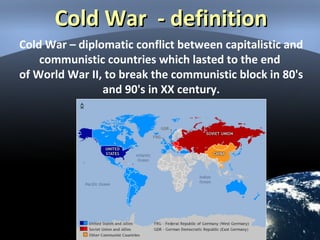
Cold War – diplomatic conflict between capitalistic and
    communistic countries which lasted to the end
of World War II, to break the communistic block in 80's
                and 90's in XX century.
The beginning of Cold War
  For the beginning of Cold War,
 the speach of Winston Churchil
  is taken, which was presented
     in Fulton on 5 March 1946,
 in which he attacked the Soviet
  Union and called on the West           Winston Churchil
to union against the communism.
  But before that, on 9 February
   1946 Józef Stalin in his speach
claimed that neither communism
nor capitalism can exist together.
 The term of Cold War was used
  in 1947 by American Bernard
            Baruch.
                                     Józef Stalin
Cold War – the plannes of fight
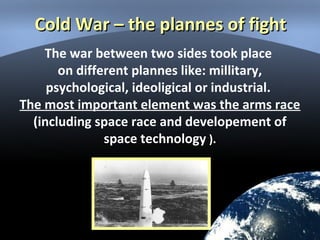
    The war between two sides took place
       on different plannes like: millitary,
     psychological, ideoligical or industrial.
The most important element was the arms race
  (including space race and developement of
               space technology ).
The main point
The main time during the conflict was the 50's when
  was the first millitary confrontation – Korean War.
Next conflicts

    In 60's the international
    situation got worse:
•   1961 the building of Berlin
    Wall,
•   1962 Cuban Crisis,
•   1965-1973 War in Wietnam,
•   1968 the intervention of
    Warsaw      Pact     army in
    Czechoslovakia
The mass weapon restriction

In 70's, thanks to negotiations connected with mass
    weapon restriction, the situation between two
                   blocks got better.
The ending of Cold War
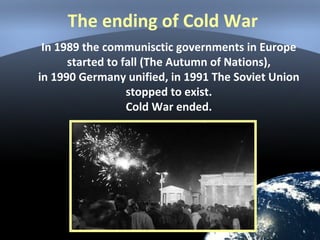
 In 1989 the communisctic governments in Europe
      started to fall (The Autumn of Nations),
in 1990 Germany unified, in 1991 The Soviet Union
                  stopped to exist.
                  Cold War ended.
Polish during Cold War
   In that time the communistic
  government tried to cause hate
   and fear to The United States
and West European countries using
   different kind of propaganda.


       „The USA planes dropped
       the Colorado potato beetle“
Radio Free Europe
    Polish officially
     agreed with
     communistic
   propaganda but
in secret they listened
 to Radio Free Europe
(created in New York)
 thanks to which they
   knew about facts
 which were hidding.
Life in communistic Poland
Everyday life was very difficult: lack of basic products
 (reglamentation e.g. meat, sugar, flour...), queues in
          shops, low salary, dullness of life...
Dreams about better life
 Polish couldn't leave the country without the
permission. Many of them would like to change
     their lives so they decided to escape.
Some of them did not come back to the country
          after ending their visa term.
Some of them escaped because of fear of life or
                 threat of prison.
Ryszard Kukliński
The symbolic character
    of that time was
Ryszard Jerzy Kukliński
      (1930-2004).
   He was the colonel
    of People's Army
of Poland who decided
 to cooperate with CIA.
When he escaped to USA
   Polish government
     announced him
       as a traitor
 but others called him
         a hero.
The choice of Pope
One of the most important event in Polish history was
         the choice Karola Wojtyła as a Pope.
   Country isolated from years from West achieved
          the hope of coming back to Europe.
   Jan Paweł II gave Polish hope and bravery to say
                   communism no.
AUTHORS:
 Dawid Goclan
Tomasz Gołąbek

Cold war

  • 1.
  • 2.
    Cold War -definition Cold War – diplomatic conflict between capitalistic and communistic countries which lasted to the end of World War II, to break the communistic block in 80's and 90's in XX century.
  • 3.
    The beginning ofCold War For the beginning of Cold War, the speach of Winston Churchil is taken, which was presented in Fulton on 5 March 1946, in which he attacked the Soviet Union and called on the West Winston Churchil to union against the communism. But before that, on 9 February 1946 Józef Stalin in his speach claimed that neither communism nor capitalism can exist together. The term of Cold War was used in 1947 by American Bernard Baruch. Józef Stalin
  • 4.
    Cold War –the plannes of fight The war between two sides took place on different plannes like: millitary, psychological, ideoligical or industrial. The most important element was the arms race (including space race and developement of space technology ).
  • 5.
    The main point Themain time during the conflict was the 50's when was the first millitary confrontation – Korean War.
  • 6.
    Next conflicts In 60's the international situation got worse: • 1961 the building of Berlin Wall, • 1962 Cuban Crisis, • 1965-1973 War in Wietnam, • 1968 the intervention of Warsaw Pact army in Czechoslovakia
  • 7.
    The mass weaponrestriction In 70's, thanks to negotiations connected with mass weapon restriction, the situation between two blocks got better.
  • 8.
    The ending ofCold War In 1989 the communisctic governments in Europe started to fall (The Autumn of Nations), in 1990 Germany unified, in 1991 The Soviet Union stopped to exist. Cold War ended.
  • 9.
    Polish during ColdWar In that time the communistic government tried to cause hate and fear to The United States and West European countries using different kind of propaganda. „The USA planes dropped the Colorado potato beetle“
  • 10.
    Radio Free Europe Polish officially agreed with communistic propaganda but in secret they listened to Radio Free Europe (created in New York) thanks to which they knew about facts which were hidding.
  • 11.
    Life in communisticPoland Everyday life was very difficult: lack of basic products (reglamentation e.g. meat, sugar, flour...), queues in shops, low salary, dullness of life...
  • 12.
    Dreams about betterlife Polish couldn't leave the country without the permission. Many of them would like to change their lives so they decided to escape. Some of them did not come back to the country after ending their visa term. Some of them escaped because of fear of life or threat of prison.
  • 13.
    Ryszard Kukliński The symboliccharacter of that time was Ryszard Jerzy Kukliński (1930-2004). He was the colonel of People's Army of Poland who decided to cooperate with CIA. When he escaped to USA Polish government announced him as a traitor but others called him a hero.
  • 14.
    The choice ofPope One of the most important event in Polish history was the choice Karola Wojtyła as a Pope. Country isolated from years from West achieved the hope of coming back to Europe. Jan Paweł II gave Polish hope and bravery to say communism no.
  • 15.