U.N.
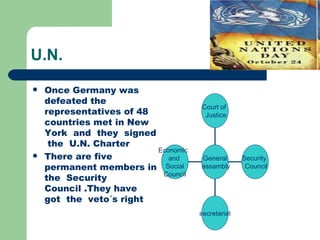
   Once Germany was
    defeated the
                                     Court of
    representatives of 48             Justice
    countries met in New
    York and they signed
     the U.N. Charter
                          Economic
   There are five           and     General       Security
    permanent members in Social      assambly       Council
                           Council
    the Security
    Council .They have
    got the veto´s right
                                     secretariat
Key factors
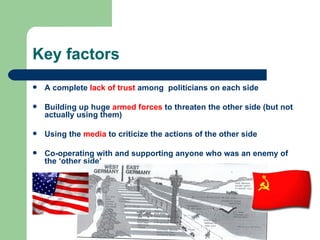
   A complete lack of trust among politicians on each side

   Building up huge armed forces to threaten the other side (but not
    actually using them)

   Using the media to criticize the actions of the other side

   Co-operating with and supporting anyone who was an enemy of
    the ‘other side’
The Marshall Plan

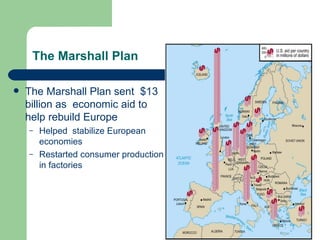
   The Marshall Plan sent $13
    billion as economic aid to
    help rebuild Europe
    –   Helped stabilize European
        economies
    –   Restarted consumer production
        in factories
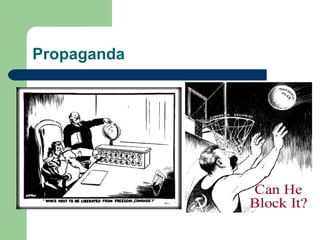
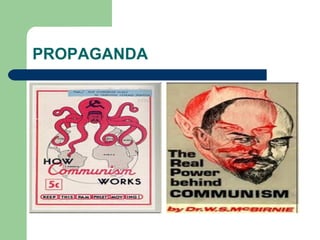
Propaganda
PROPAGANDA
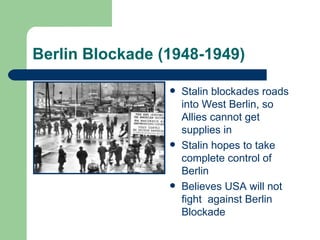
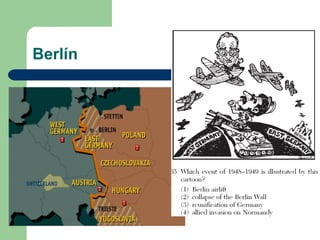
Berlin Blockade (1948-1949)

                    Stalin blockades roads
                     into West Berlin, so
                     Allies cannot get
                     supplies in
                    Stalin hopes to take
                     complete control of
                     Berlin
                    Believes USA will not
                     fight against Berlin
                     Blockade
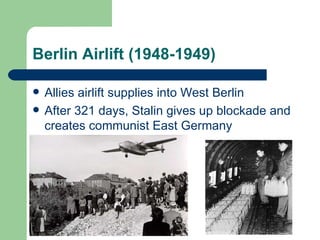
Berlin Airlift (1948-1949)

   Allies airlift supplies into West Berlin
   After 321 days, Stalin gives up blockade and
    creates communist East Germany
Berlín
The Berlin wall 1961
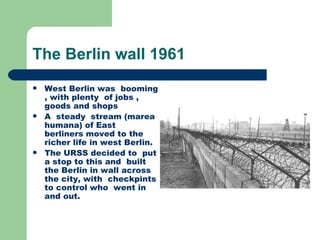
   West Berlin was booming
    , with plenty of jobs ,
    goods and shops
   A steady stream (marea
    humana) of East
    berliners moved to the
    richer life in west Berlin.
   The URSS decided to put
    a stop to this and built
    the Berlin in wall across
    the city, with checkpints
    to control who went in
    and out.
KOREA
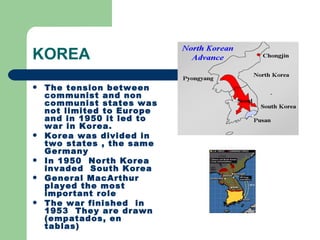
   The tension between
    communist and non
    communist states was
    not limited to Europe
    and in 1950 it led to
    war in Korea.
   Korea was divided in
    two states , the same
    Germany
   In 1950 North Korea
    invaded South Korea
   General MacArthur
    played the most
    important role
   The war finished in
    1953 They are drawn
    (empatados, en
    tablas)
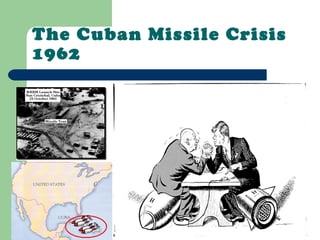
CUBA 1962, the longest night
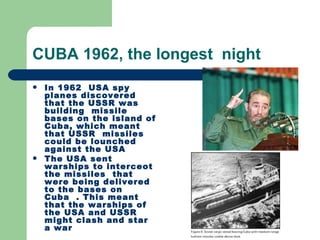
   In 1962 USA spy
    planes discovered
    that the USSR was
    building missile
    bases on the island of
    Cuba, which meant
    that USSR missiles
    could be lounched
    against the USA
   The USA sent
    warships to interceot
    the missiles that
    were being delivered
    to the bases on
    Cuba . This meant
    that the warships of
    the USA and USSR
    might clash and star
    a war
The Cuban Missile Crisis
1962
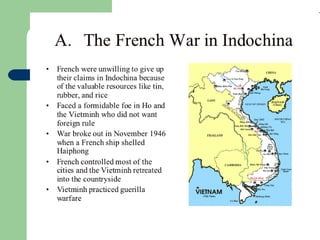
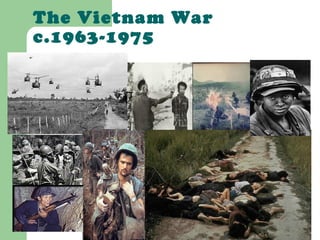
The Vietnam War
c.1963-1975
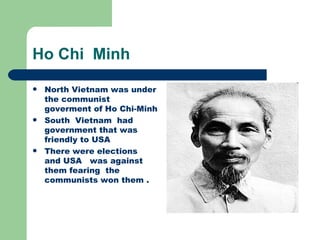
Ho Chi Minh
   North Vietnam was under
    the communist
    goverment of Ho Chi-Minh
   South Vietnam had
    government that was
    friendly to USA
   There were elections
    and USA was against
    them fearing the
    communists won them .
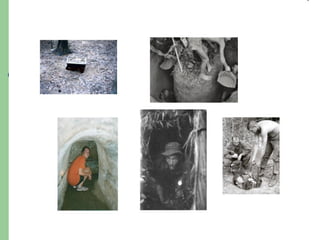
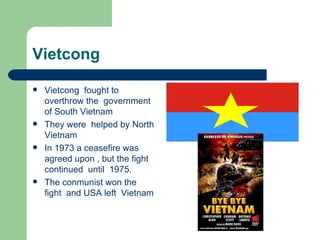
Vietcong

   Vietcong fought to
    overthrow the government
    of South Vietnam
   They were helped by North
    Vietnam
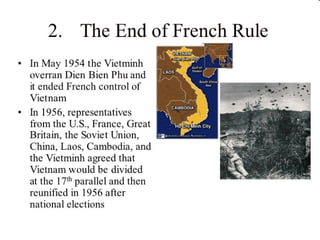
   In 1973 a ceasefire was
    agreed upon , but the fight
    continued until 1975.
   The conmunist won the
    fight and USA left Vietnam
Vietnam War Ends
End of War
   1973, after long negotiations, U.S. reached peace agreement with North Vietnam,
    withdrew military support; without support, South lost ground
   1975, North Vietnamese tanks rolled into Saigon, ending war

After the War
   1976, Vietnam reunited officially, but faced major problems
   Millions dead or made homeless; Vietnamese economy severely crippled
   1980s, abandoned Soviet-style planned economy, made economic reforms

Still Communist Nation
   1995, U.S. formally recognized united Vietnam
   Two nations agreed to improve trade relationship
   Many economic reforms; political reforms slow for Communist nation
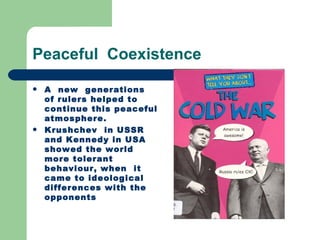
Peaceful Coexistence
   A new generations
    of rulers helped to
    continue this peaceful
    atmosphere.
   Krushchev in USSR
    and Kennedy in USA
    showed the world
    more tolerant
    behaviour, when it
    came to ideological
    differences with the
    opponents