Cold War Conflicts
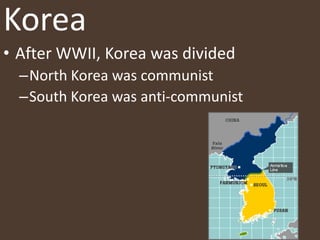
KoreaAfter WWII, Korea was dividedNorth Korea was communistSouth Korea was anti-communist
Korean War (1950-1953)North Koreans invaded South KoreaSupplied by USSR and China who wanted to unite the two Koreas under a communist governmentThe United Nations (UN) sent troops (mostly Americans) to protect South Korea and to stop the spread of communismThe Chinese sent troops into North Korea to fight the UNArmistice (ceasefire) signed (1953)The border between North and South Korea was set at the 38th Parallel (38 ۫۫ N latitude)Communism was contained and South Korea remained non-communist
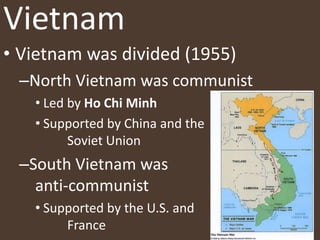
VietnamVietnam was divided (1955)North Vietnam was communistLed by Ho Chi MinhSupported by China and the 			Soviet UnionSouth Vietnam was 				anti-communistSupported by the U.S. and 			France
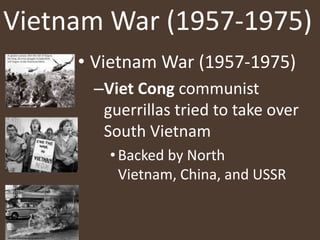
Vietnam War (1957-1975)Vietnam War (1957-1975)Viet Cong communist guerrillas tried to take over South VietnamBacked by North Vietnam, China, and USSR
U.S. involvement in Vietnam (1960s - 1973)U.S. sent money, weapons, and military advisors to South VietnamU.S. began sending troops to Vietnam (1964)1.5 million Vietnamese and 58,000 Americans diedAmericans were bitterly divided over warAnti-war protests push U.S. to end warU.S. withdrew troops from Vietnam (1969-1973)Communists took over South Vietnam (1975)Vietnam reunited as communist nationU.S. failed to contain communism
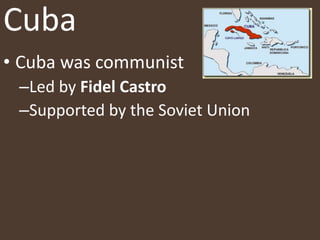
CubaCuba was communistLed by Fidel CastroSupported by the Soviet Union
The Cuban Missile Crisis (1962)Soviet Union brought nuclear missiles to CubaAmerican spy planes took photos of the missile sitesHuge threat to U.S. security!Cuba is only 90 miles away from the U.S.Missiles could easily reach major U.S. citiesThe U.S. and the Soviets came very close to nuclear warU.S. President John F. Kennedy demanded that the Soviets remove the missiles from CubaCuba was blockaded by the U.S. navy until the Soviets agreed to remove the missilesNikita Khrushchev, the Soviet leader, agreed to remove the missiles as long as the U.S. agreed not to invade Cuba and nuclear war was avoided!
Struggle for Influence in AfricaAfter WWII, African nations began fighting for independenceThe United States and the Soviet Union competed for influence in the African countriesGave money and military aid Tried to spread their ideasSome African nations chose not to take sides

Cold war conflicts

  • 1.
  • 2.
    KoreaAfter WWII, Koreawas dividedNorth Korea was communistSouth Korea was anti-communist
  • 3.
    Korean War (1950-1953)NorthKoreans invaded South KoreaSupplied by USSR and China who wanted to unite the two Koreas under a communist governmentThe United Nations (UN) sent troops (mostly Americans) to protect South Korea and to stop the spread of communismThe Chinese sent troops into North Korea to fight the UNArmistice (ceasefire) signed (1953)The border between North and South Korea was set at the 38th Parallel (38 ۫۫ N latitude)Communism was contained and South Korea remained non-communist
  • 4.
    VietnamVietnam was divided(1955)North Vietnam was communistLed by Ho Chi MinhSupported by China and the Soviet UnionSouth Vietnam was anti-communistSupported by the U.S. and France
  • 5.
    Vietnam War (1957-1975)VietnamWar (1957-1975)Viet Cong communist guerrillas tried to take over South VietnamBacked by North Vietnam, China, and USSR
  • 6.
    U.S. involvement inVietnam (1960s - 1973)U.S. sent money, weapons, and military advisors to South VietnamU.S. began sending troops to Vietnam (1964)1.5 million Vietnamese and 58,000 Americans diedAmericans were bitterly divided over warAnti-war protests push U.S. to end warU.S. withdrew troops from Vietnam (1969-1973)Communists took over South Vietnam (1975)Vietnam reunited as communist nationU.S. failed to contain communism
  • 7.
    CubaCuba was communistLedby Fidel CastroSupported by the Soviet Union
  • 8.
    The Cuban MissileCrisis (1962)Soviet Union brought nuclear missiles to CubaAmerican spy planes took photos of the missile sitesHuge threat to U.S. security!Cuba is only 90 miles away from the U.S.Missiles could easily reach major U.S. citiesThe U.S. and the Soviets came very close to nuclear warU.S. President John F. Kennedy demanded that the Soviets remove the missiles from CubaCuba was blockaded by the U.S. navy until the Soviets agreed to remove the missilesNikita Khrushchev, the Soviet leader, agreed to remove the missiles as long as the U.S. agreed not to invade Cuba and nuclear war was avoided!
  • 9.
    Struggle for Influencein AfricaAfter WWII, African nations began fighting for independenceThe United States and the Soviet Union competed for influence in the African countriesGave money and military aid Tried to spread their ideasSome African nations chose not to take sides