Good MafternoonGood Mafternoon!! 11/4-511/4-5
EQ: What is the Cold War and how did it impact the world?
HW: Complete PowerPoints & Alphaboxes notes
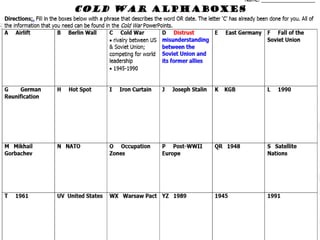
Directions:
Go through the PowerPoint and complete the
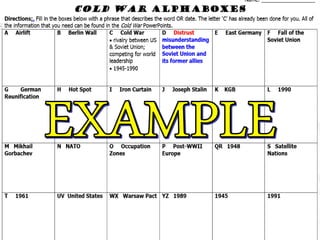
graphic organizer “Cold War Alphaboxes”
Hint: You are looking for words highlighted in
REDRED andand BLUEBLUE
EX
Origins of
the
Cold War
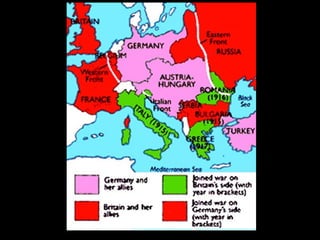
What was
Europe like
after WWII?
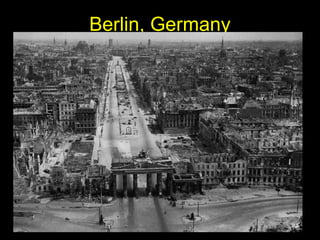
Berlin, Germany
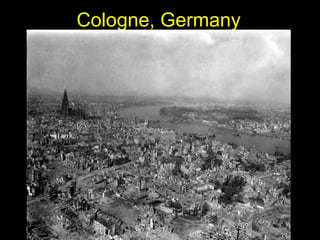
Cologne, Germany
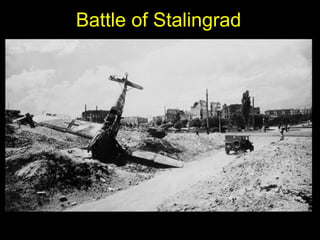
Battle of Stalingrad
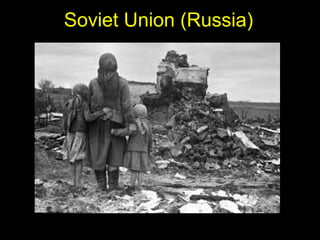
Soviet Union (Russia)
After WWII
• Postwar Governments, Politics, and
Need for New Leaders
Self ReflectionSelf Reflection
 Why do you think the Cold War
was described as “cold”?
A Difference In Opinion
• 1945—the beginning of a long period of
distrust & misunderstanding betweenmisunderstanding between
the Soviet Unionthe Soviet Union and itsand its former alliesformer allies
in the West (particularly the US)
– Soviet Union believed a powerful central
government should control government
and economy
– US believed that businesses should be
privately owned
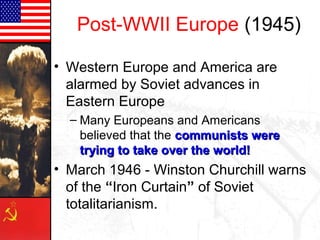
Post-WWII Europe (1945)
• Western Europe and America are
alarmed by Soviet advances in
Eastern Europe
– Many Europeans and Americans
believed that the communists werecommunists were
trying to take over the world!trying to take over the world!
• March 1946 - Winston Churchill warns
of the “Iron Curtain” of Soviet
totalitarianism.
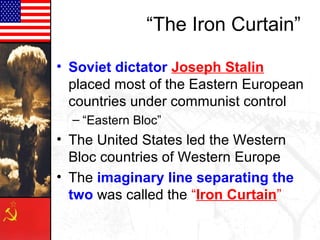
“The Iron Curtain”
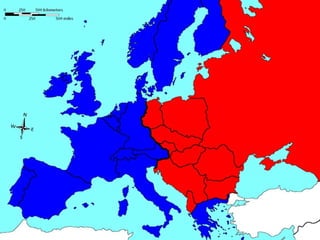
• Soviet dictator Joseph Stalin
placed most of the Eastern European
countries under communist control
– “Eastern Bloc”
• The United States led the Western
Bloc countries of Western Europe
• The imaginary line separating the
two was called the “Iron Curtain”
Self ReflectionSelf Reflection
 Think about...
 Why do you think it was called
the “Iron Curtain”?
The “Iron Curtain”The “Iron Curtain”
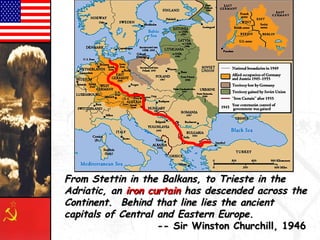
From Stettin in the Balkans, to Trieste in theFrom Stettin in the Balkans, to Trieste in the
Adriatic, anAdriatic, an iron curtainiron curtain has descended across thehas descended across the
Continent. Behind that line lies the ancientContinent. Behind that line lies the ancient
capitals of Central and Eastern Europe.capitals of Central and Eastern Europe.
-- Sir Winston Churchill, 1946-- Sir Winston Churchill, 1946
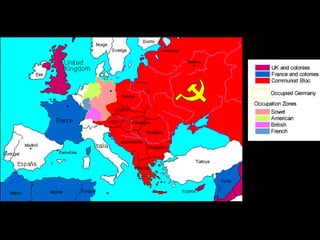
Division of Germany
• End of WWII, Allies divided Germany
into 4 sections to keep it from regaining
power
– US, Great Britain, France, & Soviet Union
each controlled a section
• 1948: Western Allies wanted to reunite
Germany, but Soviets disagreed
– Soviet section becameSoviet section became “East Germany”
and the reunited sections became “West
Germany”
– Berlin was also divided into East & West
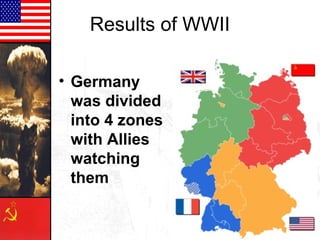
Results of WWII
• Germany
was divided
into 4 zones
with Allies
watching
them
Results of WWII
• Germany became
divided into East
and West
Germany
• East Germany-
communist
• West Germany-
democratic
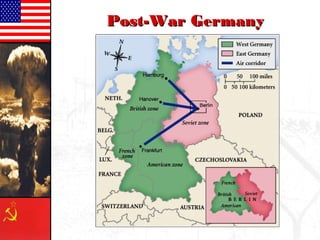
Post-War GermanyPost-War Germany
Self ReflectionSelf Reflection
 Think about...
 How do you think the dividing of
Germany into East and West
effected Germans?
A Nuclear War
• Each side thought the other was
trying to rule the world
– Neither side would give up, people lived
in fear that another world war would
erupt
• This time it could be a nuclear war,
which could destroy the entire planet
• Countries began to form alliances to
protect themselves…
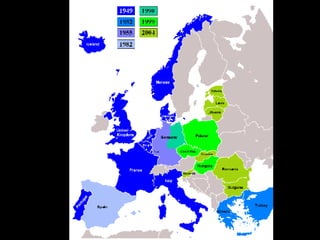
NATO
• 1949: Western European countries,
Canada, & US formed the North
Atlantic Treaty Organization
(NATO)
• Each nation in NATO believed the Soviet Union
would not attack western Europe if the U.S.
would launch nuclear war in return
The Warsaw Pact
• What was the Warsaw Pact?Warsaw Pact?
– an alliance of the Soviet Union and its communist
satellite nations
• Why was it formed?
– to counter NATO
– an anti-Western military alliance
• Why “Warsaw”?
– Warsaw, Poland was the city where the treaty was signed
• Satellite nation?
– Satellite nations are nations that are dependent upon a
stronger power.
– The Soviet satellite nations were Bulgaria, Romania,
Czechoslovakia, Hungary, Poland, and East Germany.
• As the Cold War continued, more
countries allied with each side
• The US and USSR had the ability to
influence world events and project
worldwide power
• The countries were evenly matched…
Self ReflectionSelf Reflection
 Think about...
 Pretend you are living during the
Cold War. What might you feel?
Think? Experience?
Soviet Union
• Had a permanent seat on
the UN Security Council
• Influenced other
communist countries and
dictatorships around the
world
• Occupied the largest
country in the world, 3rd
largest population, & the
2nd
largest economy
• Had military and space
technology, a worldwide
spy network (the KGB), &
one of the largest
stockpiles of nuclear
weapons in the world
vs.United States
• Also had a permanent seat on
the UN Security Council, as
well as strong ties with
Western Europe & Latin
America
• 4th
most populated country,
Largest economy
• Had powerful military support
from NATO, the largest navy
in the world, bases all over the
world, the CIA, and a large
reserve of nuclear weapons
What about Berlin?
• During the Cold war, there were many “hot
spots” (areas of extreme tension)
– The earliest hot spot was Berlin.
• At the end of World War II, Germany was
divided into four occupation zones
– American, British, French, and Soviet
• The Soviets controlled the eastern part of
Germany, the western countries controlled
the western part of Germany.
• The capital Berlin, deep within Soviet-
controlled territory, was also divided into four
occupation zones.
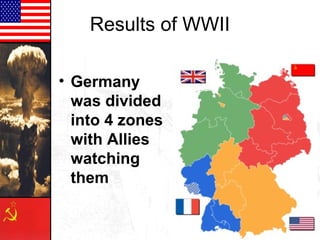
Results of WWII
• Germany
was divided
into 4 zones
with Allies
watching
them
Self ReflectionSelf Reflection
 Think about...
 Make a prediction- what do you
think happens to the city of
Berlin?
Berlin Blockaded!
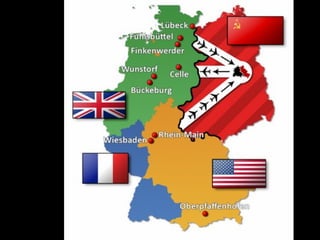
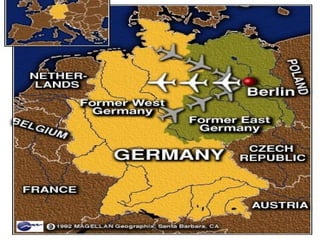
• In June 1948, the Soviets blockaded
all land and water traffic into western
Berlin hoping to make Britain,
France, and America leave the city.
--(Remember Berlin was in East
Germany which the USSR occupied.)
• In response, the United States and
Great Britain began an airlift…
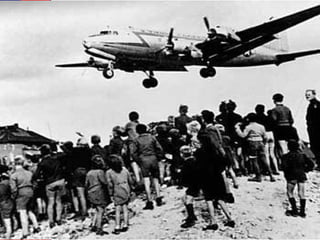
Berlin Airlift
• What’s an airlift?
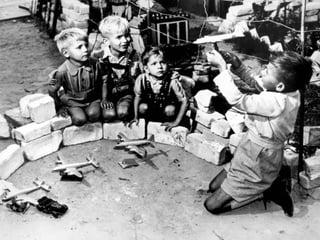
– a system of carrying supplies into West Berlin by
plane
– Day and night, British and American pilots flew
in tons of food, fuel, and raw materials.
• How long did it last?
– 11 months
• The airlift is over. Now what?
– Germany officially becomes two countries with two
governments.
– Bonn becomes the capital of West Germany.
– East Berlin becomes the capital of East Germany.
– West Berlin remains a democratic stronghold,
surrounded by communism.
The Berlin Wall
• Berliners hated living under communism
• Luckily, West Berlin and freedom were
just across the street
– About 3 million people fled to West Berlin looking
for political freedom and better lives
– The East German government wanted it to stop
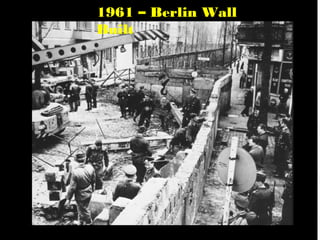
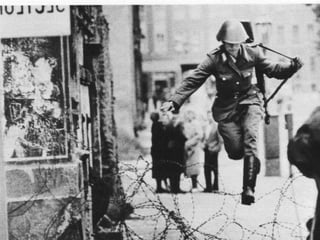
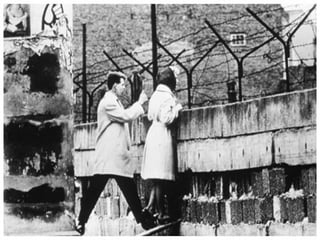
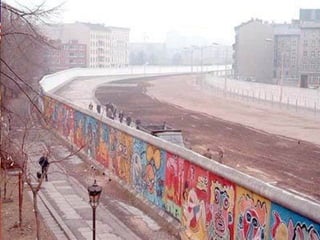
• In August 1961, East Germany built a
103 mile wall between East and West
Berlin.
– Guarded by Soviet troops, it became a symbol of
the split between western and eastern Europe.
1961 – Berlin Wall
Built
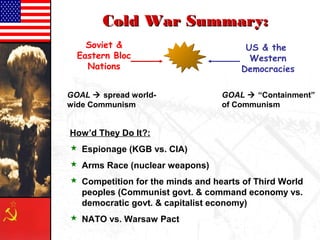
Cold War Summary:Cold War Summary:
Soviet &
Eastern Bloc
Nations
US & the
Western
Democracies
GOAL  spread world-
wide Communism
GOAL  “Containment”
of Communism
How’d They Do It?:
 Espionage (KGB vs. CIA)
 Arms Race (nuclear weapons)
 Competition for the minds and hearts of Third World
peoples (Communist govt. & command economy vs.
democratic govt. & capitalist economy)
 NATO vs. Warsaw Pact
The Fall of the Soviet Union
Unit Two Notes
Losing Control
• Soviet Union was spending tons of
money putting down revolts, protecting
its borders, and keeping up with the US
in the arms race
• 1985: economy was so unstable that
Mikhail Gorbachev, head of USSR,
reduced government control of
business and increased the freedoms
for all citizens
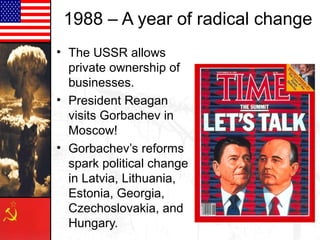
1988 – A year of radical change
• The USSR allows
private ownership of
businesses.
• President Reagan
visits Gorbachev in
Moscow!
• Gorbachev’s reforms
spark political change
in Latvia, Lithuania,
Estonia, Georgia,
Czechoslovakia, and
Hungary.
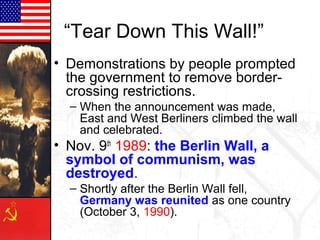
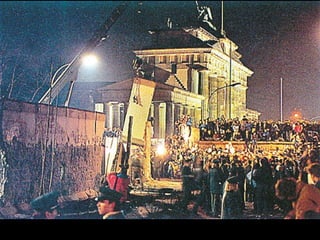
“Tear Down This Wall!”
• Demonstrations by people prompted
the government to remove border-
crossing restrictions.
– When the announcement was made,
East and West Berliners climbed the wall
and celebrated.
• Nov. 9th
1989: the Berlin Wall, a
symbol of communism, was
destroyed.
– Shortly after the Berlin Wall fell,
Germany was reunited as one country
(October 3, 1990).
1991: The Cold War Ends
• After Germany was reunified, the
Soviet republics that had once been
separate countries began seeking
their independence also
• Soviet Union was no more
• Many countries were created; Russia
was the largest
Check your answersCheck your answers
• Make sure you have completed
your Alphaboxes before you
move on
Cold war

Cold war

  • 1.
    Good MafternoonGood Mafternoon!!11/4-511/4-5 EQ: What is the Cold War and how did it impact the world? HW: Complete PowerPoints & Alphaboxes notes Directions: Go through the PowerPoint and complete the graphic organizer “Cold War Alphaboxes” Hint: You are looking for words highlighted in REDRED andand BLUEBLUE
  • 2.
  • 3.
  • 4.
  • 6.
  • 7.
  • 8.
  • 9.
  • 11.
    After WWII • PostwarGovernments, Politics, and Need for New Leaders
  • 13.
    Self ReflectionSelf Reflection Why do you think the Cold War was described as “cold”?
  • 14.
    A Difference InOpinion • 1945—the beginning of a long period of distrust & misunderstanding betweenmisunderstanding between the Soviet Unionthe Soviet Union and itsand its former alliesformer allies in the West (particularly the US) – Soviet Union believed a powerful central government should control government and economy – US believed that businesses should be privately owned
  • 16.
    Post-WWII Europe (1945) •Western Europe and America are alarmed by Soviet advances in Eastern Europe – Many Europeans and Americans believed that the communists werecommunists were trying to take over the world!trying to take over the world! • March 1946 - Winston Churchill warns of the “Iron Curtain” of Soviet totalitarianism.
  • 18.
    “The Iron Curtain” •Soviet dictator Joseph Stalin placed most of the Eastern European countries under communist control – “Eastern Bloc” • The United States led the Western Bloc countries of Western Europe • The imaginary line separating the two was called the “Iron Curtain”
  • 19.
    Self ReflectionSelf Reflection Think about...  Why do you think it was called the “Iron Curtain”?
  • 20.
    The “Iron Curtain”The“Iron Curtain” From Stettin in the Balkans, to Trieste in theFrom Stettin in the Balkans, to Trieste in the Adriatic, anAdriatic, an iron curtainiron curtain has descended across thehas descended across the Continent. Behind that line lies the ancientContinent. Behind that line lies the ancient capitals of Central and Eastern Europe.capitals of Central and Eastern Europe. -- Sir Winston Churchill, 1946-- Sir Winston Churchill, 1946
  • 21.
    Division of Germany •End of WWII, Allies divided Germany into 4 sections to keep it from regaining power – US, Great Britain, France, & Soviet Union each controlled a section • 1948: Western Allies wanted to reunite Germany, but Soviets disagreed – Soviet section becameSoviet section became “East Germany” and the reunited sections became “West Germany” – Berlin was also divided into East & West
  • 22.
    Results of WWII •Germany was divided into 4 zones with Allies watching them
  • 23.
    Results of WWII •Germany became divided into East and West Germany • East Germany- communist • West Germany- democratic
  • 24.
  • 25.
    Self ReflectionSelf Reflection Think about...  How do you think the dividing of Germany into East and West effected Germans?
  • 26.
    A Nuclear War •Each side thought the other was trying to rule the world – Neither side would give up, people lived in fear that another world war would erupt • This time it could be a nuclear war, which could destroy the entire planet • Countries began to form alliances to protect themselves…
  • 27.
    NATO • 1949: WesternEuropean countries, Canada, & US formed the North Atlantic Treaty Organization (NATO) • Each nation in NATO believed the Soviet Union would not attack western Europe if the U.S. would launch nuclear war in return
  • 29.
    The Warsaw Pact •What was the Warsaw Pact?Warsaw Pact? – an alliance of the Soviet Union and its communist satellite nations • Why was it formed? – to counter NATO – an anti-Western military alliance • Why “Warsaw”? – Warsaw, Poland was the city where the treaty was signed • Satellite nation? – Satellite nations are nations that are dependent upon a stronger power. – The Soviet satellite nations were Bulgaria, Romania, Czechoslovakia, Hungary, Poland, and East Germany.
  • 30.
    • As theCold War continued, more countries allied with each side • The US and USSR had the ability to influence world events and project worldwide power • The countries were evenly matched…
  • 31.
    Self ReflectionSelf Reflection Think about...  Pretend you are living during the Cold War. What might you feel? Think? Experience?
  • 32.
    Soviet Union • Hada permanent seat on the UN Security Council • Influenced other communist countries and dictatorships around the world • Occupied the largest country in the world, 3rd largest population, & the 2nd largest economy • Had military and space technology, a worldwide spy network (the KGB), & one of the largest stockpiles of nuclear weapons in the world vs.United States • Also had a permanent seat on the UN Security Council, as well as strong ties with Western Europe & Latin America • 4th most populated country, Largest economy • Had powerful military support from NATO, the largest navy in the world, bases all over the world, the CIA, and a large reserve of nuclear weapons
  • 33.
    What about Berlin? •During the Cold war, there were many “hot spots” (areas of extreme tension) – The earliest hot spot was Berlin. • At the end of World War II, Germany was divided into four occupation zones – American, British, French, and Soviet • The Soviets controlled the eastern part of Germany, the western countries controlled the western part of Germany. • The capital Berlin, deep within Soviet- controlled territory, was also divided into four occupation zones.
  • 34.
    Results of WWII •Germany was divided into 4 zones with Allies watching them
  • 36.
    Self ReflectionSelf Reflection Think about...  Make a prediction- what do you think happens to the city of Berlin?
  • 37.
    Berlin Blockaded! • InJune 1948, the Soviets blockaded all land and water traffic into western Berlin hoping to make Britain, France, and America leave the city. --(Remember Berlin was in East Germany which the USSR occupied.) • In response, the United States and Great Britain began an airlift…
  • 39.
    Berlin Airlift • What’san airlift? – a system of carrying supplies into West Berlin by plane – Day and night, British and American pilots flew in tons of food, fuel, and raw materials. • How long did it last? – 11 months • The airlift is over. Now what? – Germany officially becomes two countries with two governments. – Bonn becomes the capital of West Germany. – East Berlin becomes the capital of East Germany. – West Berlin remains a democratic stronghold, surrounded by communism.
  • 43.
    The Berlin Wall •Berliners hated living under communism • Luckily, West Berlin and freedom were just across the street – About 3 million people fled to West Berlin looking for political freedom and better lives – The East German government wanted it to stop • In August 1961, East Germany built a 103 mile wall between East and West Berlin. – Guarded by Soviet troops, it became a symbol of the split between western and eastern Europe.
  • 44.
    1961 – BerlinWall Built
  • 48.
    Cold War Summary:ColdWar Summary: Soviet & Eastern Bloc Nations US & the Western Democracies GOAL  spread world- wide Communism GOAL  “Containment” of Communism How’d They Do It?:  Espionage (KGB vs. CIA)  Arms Race (nuclear weapons)  Competition for the minds and hearts of Third World peoples (Communist govt. & command economy vs. democratic govt. & capitalist economy)  NATO vs. Warsaw Pact
  • 49.
    The Fall ofthe Soviet Union Unit Two Notes
  • 50.
    Losing Control • SovietUnion was spending tons of money putting down revolts, protecting its borders, and keeping up with the US in the arms race • 1985: economy was so unstable that Mikhail Gorbachev, head of USSR, reduced government control of business and increased the freedoms for all citizens
  • 51.
    1988 – Ayear of radical change • The USSR allows private ownership of businesses. • President Reagan visits Gorbachev in Moscow! • Gorbachev’s reforms spark political change in Latvia, Lithuania, Estonia, Georgia, Czechoslovakia, and Hungary.
  • 52.
    “Tear Down ThisWall!” • Demonstrations by people prompted the government to remove border- crossing restrictions. – When the announcement was made, East and West Berliners climbed the wall and celebrated. • Nov. 9th 1989: the Berlin Wall, a symbol of communism, was destroyed. – Shortly after the Berlin Wall fell, Germany was reunited as one country (October 3, 1990).
  • 54.
    1991: The ColdWar Ends • After Germany was reunified, the Soviet republics that had once been separate countries began seeking their independence also • Soviet Union was no more • Many countries were created; Russia was the largest
  • 55.
    Check your answersCheckyour answers • Make sure you have completed your Alphaboxes before you move on