Unit 14
The Cold War
Social Studies – ESO-4
2
The Cold War
• Background
• Peace was not stable.
• USA and USSR were different.
• No fighting but alliances and diplomatic
conflict.
• The USA was afraid of the spread of
Communism.
• The USSR blockaded Berlin.
• In 1949 the two Germanies appeared and
NATO was formed.
• 1955 Warsaw Pact.
•
3
The Cold War
• Eastern Europe
• The USSR controlled Eastern Europe.
• In 1961 Berlin was divided by a wall.
• The Cold war in Asia.
• In 1949 Mao transformed China into a
Communist State.
• Cold War was extended to Asia because
the USA felt the Communist threat.
4
The Cold War
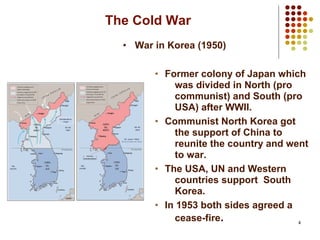
• War in Korea (1950)
• Former colony of Japan which
was divided in North (pro
communist) and South (pro
USA) after WWII.
• Communist North Korea got
the support of China to
reunite the country and went
to war.
• The USA, UN and Western
countries support South
Korea.
• In 1953 both sides agreed a
cease-fire.
5
The Cold War
• The Cuban crisis
• Since 1949 Batista, a military dictator ruled
Cuba.
• In 1956 Fidel Castro made a frustrated
attempt to overthrow government.
• In 1959 Castro began a guerrilla war and
overthrow the government.
• In 1961 Kennedy failed to invade Cuba
landing in the Bay of Pigs.
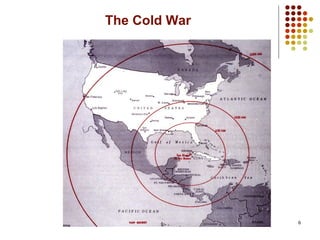
• Castro got Soviet military assistance with
missiles.
• A naval blockade of Cuba was ordered by
Kennedy.
• Hot phone line between USA and USSR.
6
The Cold War
7
The Cold War
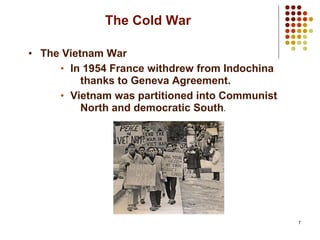
• The Vietnam War
• In 1954 France withdrew from Indochina
thanks to Geneva Agreement.
• Vietnam was partitioned into Communist
North and democratic South.
8
The Cold War
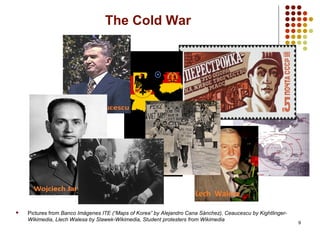
• Eastern Europe and the USSR during
and after the 1960s.
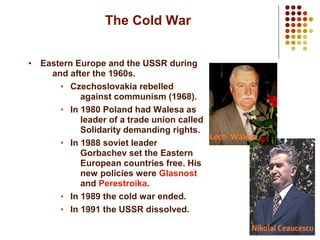
• Czechoslovakia rebelled
against communism (1968).
• In 1980 Poland had Walesa as
leader of a trade union called
Solidarity demanding rights.
• In 1988 soviet leader
Gorbachev set the Eastern
European countries free. His
new policies were Glasnost
and Perestroika.
• In 1989 the cold war ended.
• In 1991 the USSR dissolved.
9
The Cold War
 Pictures from Banco Imágenes ITE (“Maps of Korea” by Alejandro Cana Sánchez), Ceaucescu by Kightlinger-
Wikimedia, Llech Walesa by Slawek-Wikimedia, Student protesters from Wikimedia

Unit 14 - The Cold War

  • 1.
    Unit 14 The ColdWar Social Studies – ESO-4
  • 2.
    2 The Cold War •Background • Peace was not stable. • USA and USSR were different. • No fighting but alliances and diplomatic conflict. • The USA was afraid of the spread of Communism. • The USSR blockaded Berlin. • In 1949 the two Germanies appeared and NATO was formed. • 1955 Warsaw Pact. •
  • 3.
    3 The Cold War •Eastern Europe • The USSR controlled Eastern Europe. • In 1961 Berlin was divided by a wall. • The Cold war in Asia. • In 1949 Mao transformed China into a Communist State. • Cold War was extended to Asia because the USA felt the Communist threat.
  • 4.
    4 The Cold War •War in Korea (1950) • Former colony of Japan which was divided in North (pro communist) and South (pro USA) after WWII. • Communist North Korea got the support of China to reunite the country and went to war. • The USA, UN and Western countries support South Korea. • In 1953 both sides agreed a cease-fire.
  • 5.
    5 The Cold War •The Cuban crisis • Since 1949 Batista, a military dictator ruled Cuba. • In 1956 Fidel Castro made a frustrated attempt to overthrow government. • In 1959 Castro began a guerrilla war and overthrow the government. • In 1961 Kennedy failed to invade Cuba landing in the Bay of Pigs. • Castro got Soviet military assistance with missiles. • A naval blockade of Cuba was ordered by Kennedy. • Hot phone line between USA and USSR.
  • 6.
  • 7.
    7 The Cold War •The Vietnam War • In 1954 France withdrew from Indochina thanks to Geneva Agreement. • Vietnam was partitioned into Communist North and democratic South.
  • 8.
    8 The Cold War •Eastern Europe and the USSR during and after the 1960s. • Czechoslovakia rebelled against communism (1968). • In 1980 Poland had Walesa as leader of a trade union called Solidarity demanding rights. • In 1988 soviet leader Gorbachev set the Eastern European countries free. His new policies were Glasnost and Perestroika. • In 1989 the cold war ended. • In 1991 the USSR dissolved.
  • 9.
    9 The Cold War Pictures from Banco Imágenes ITE (“Maps of Korea” by Alejandro Cana Sánchez), Ceaucescu by Kightlinger- Wikimedia, Llech Walesa by Slawek-Wikimedia, Student protesters from Wikimedia