The Cold War - Causes
OCR GCSE History
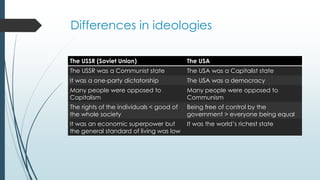
Differences in ideologies
The USSR (Soviet Union) The USA
The USSR was a Communist state The USA was a Capitalist state
It was a one-party dictatorship The USA was a democracy
Many people were opposed to
Capitalism
Many people were opposed to
Communism
The rights of the individuals < good of
the whole society
Being free of control by the
government > everyone being equal
It was an economic superpower but
the general standard of living was low
It was the world’s richest state
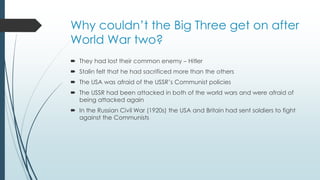
Why couldn’t the Big Three get on after
World War two?
 They had lost their common enemy – Hitler
 Stalin felt that he had sacrificed more than the others
 The USA was afraid of the USSR’s Communist policies
 The USSR had been attacked in both of the world wars and were afraid of
being attacked again
 In the Russian Civil War (1920s) the USA and Britain had sent soldiers to fight
against the Communists
Policy of appeasement
 1930s: Stalin thought Britain was happy to see Germany grow in power so
Hitler could attack the USSR
 August 1939: Nazi Soviet Pact – Germany would not fight. The USSR and
Germany secretly agreed to attack Poland together and divide between
them
 1941: Hitler broke the pact, and invaded the USSR
The Yalta conference
 February 1945
 Stalin, Churchill and FDR met to discuss what to do about Hitler
 Met in Yalta in Ukraine
The Yalta conference: positives
 They agreed that as countries were liberated from the Germans, they
would be allowed to hold free elections to choose the government they
wanted.
 They all agreed to join the United Nations (UN) Organisation, which would
keep peace after the war.
 They agreed to divide Germany into four zones: American, French, British,
and Soviet.
 Berlin would also be divided into four zones.
 Stalin was concerned about the future security of the USSR and they
agreed that eastern Europe would be seen as a Soviet Sphere of influence.
The Yalta conference: positives
 Churchill persuaded FDR to accept Stalin’s plan for Poland as long as the
USSR agreed not to interfere in Greece, where Britain was attempting to
stop the Communists from taking over. Stalin accepted that.
 They agreed to hunt down and punish war criminals who were responsible
for the genocide in the concentration camps in Germany.
 Stalin agreed to enter the war against Japan once Germany had
surrendered.
The Yalta conference: negatives
 Churchill and FDR did not approve of Stalin’s plan for Poland, but they
knew they couldn’t do much about it as Stalin’s red army was in control of
Poland
 They disagreed about what to do with Poland. Stalin wanted the border of
the USSR to move westwards into Poland.
 Churchill was worried that FDR was too friendly with the Russians.
 British army chiefs, in a top-secret memo, planned how they would impose
the will of the USA and Britain on the Russians. This was called Operation
Unthinkable and was eventually rejected by Churchill.
 Stalin thought that the Polish border could be moved into German territory.
This would not make the Germans or the USA or UK happy.
The Potsdam conference
 July 1945 in Potsdam in Germany
 Yalta had shown how difficult it was for the Allies to reach agreement
 By this point, Soviet troops had liberated the whole of Eastern Europe from
Nazi control
 The USA and Britain hoped that there would be free elections to set up
democratic governments. Instead Soviet troops remained in the liberated
countries
 By the time the conference got underway the Americans had successfully
tested an atomic bomb
 Truman (USA president) informed Stalin and Clement Attlee (Prime Minister)
that his country now had the bomb
The Potsdam conference: positives
 Germany would be divided as agreed at Yalta, and the Allies would
receive reparations
 Poland’s eastern border would be moved west to the rivers Oder and
Neisse
 The Nazi Party was banned and its leaders were to be tried as war criminals
 Germans living in Poland, Hungary and Czechoslovakia would be sent
back to Germany
The Potsdam conference: negatives
 The Soviet Union wanted to impose severe reparations on Germany to
cripple it for years to come. Truman blocked this
 The Soviet Union wanted to share in the occupation of Japan once it was
defeated. Truman refused
 After the conference, Stalin ordered his scientists to work flat out to develop
a Soviet atomic bomb
Lublin and London poles
 Lublin Poles: a Russian government in exile, ready to take over Poland
 London Poles: a strongly anti-communist group, who were aiming to gain
part of Poland before Stalin’s Red Army took full control
 By January 1945, the Lublin Poles had full control of Poland
Soviet expansion
 Czechoslovakia: a left-wing coalition won elections in 1945. in 1946
Communists became the largest single party, but still in a coalition. In 1948,
when their position was threatened, they banned other parties and made
Czechoslovakia a Communist, one-party state
 East Germany: the Allies had given the USSR control of the eastern sector of
Germany. It was run by the USSR effectively under Red Army control until
the creation of the German Democratic Republic in 1949
 Poland: after the war the Communists joined a coalition government, then
became outright leaders in 1947 when they forced the non-Communist
leader into exile
Soviet expansion
 Hungary: Communists became the largest single party in the 1947 election.
They imprisoned opposition politicians, and attacked Church leaders
 Albania: Communists gained power immediately after the war. There was
little opposition
 Yugoslavia: Marshall Tito had led war-time resistance to the Nazis. He was
elected President in 1945. Although Communist, he was determined to
apply Communism in his own way, not Stalin’s, and was expelled from
Cominform in 1948
The Iron Curtain
 5th March 1946
 Winston Churchill gave a speech in Fulton in America
 He said that Eastern Europe was cut off from the free by ‘an iron curtain’
and was ‘subject to Soviet influence’
 The message of the speech was so clear that Stalin claimed Churchill’s
speech was a declaration of war
Greece
 In 1944, there were two rival groups in Greece, the monarchists and the
Communists, who wanted to rule the country
 Churchill sent British troops to Greece in 1945, supposedly to help restore
order and supervise free elections. In fact, the British supported the
monarchists and the king was returned to power
 In 1946, the USSR protested to the UN that British troops were a threat to
peace in Greece. The UN took no action and so the Communists tried to
take control of Greece by force. This triggered a civil war
 The British could not afford this cost and announced they were withdrawing
their troops
 Truman paid for them to stay instead
The Truman Doctrine
 A speech made by Truman on 12th March 1947
 It officially announced the policy of containment
 The policy of containment was the plan to stop the spread of Communism
 “USA is prepared to give help to any country under threat from
communism”
Marshall Aid
 The Truman Doctrine in action
 Congress agreed to fund this after Czechoslovakia turned Communist in
1948
 1948-52: $13 billion given to 16 European states, mostly Britain and France
 Also offered funds to Communist satellite states, but Stalin prevented
Marshall Aid from reaching the East
 Stalin thought they were using economic imperialism to bribe other
countries to unite against the USSR
 As a response, Stalin formed COMINFORM in September 1947. This
strengthened ties between Communist countries
 The Communist countries in Western Europe were ordered to wreck
Marshall Aid by going on strike
NATO
 North Atlantic Treaty Organisation
 It was formed in April 1949
 This was a military alliance that promised to help if any of the members
were attacked
 It consisted of the USA, Britain, Canada, Denmark, France, Ireland, Italy,
Luxembourg, Netherlands, Norway and Portugal
 Greece and Turkey joined in 1952
 West Germany joined in 1955
The Berlin Blockade: causes
 The American, British and French zones had merged to form Trizonia
 They had introduced a new currency into Western Berlin and West
Germany on 23rd June
 The USSR wanted to keep Germany weak but the USA and UK wanted to
rebuild the German economy
 West Berlin became a show piece of capitalism and showed that Marshall
Aid worked, which was an embarrassment to Stalin
The Berlin Blockade: what happened
 24th June 1948: Stalin blocked all routes in and out of Berlin – road, rail and
canal
 The Allies would not give into Stalin but didn’t want to provoke a war. Their
response was to fly supplies into West Berlin
 This caused the Berlin Airlift
 For 11 months, food and other supplies were flown into Berlin. At its peak,
one plane landed every three minutes
 May 1949 – Stalin called off the Blockade
The Berlin Blockade: results
 In May 1949, Trizonia became the Federal Republic of Germany
 The USSR’s zone was formed into the German Democratic Republic in
October 1949
 At the height of the crisis of the Berlin Blockade, the Western powers met in
Washington and signed an agreement to work together. NATO was formed
in April 1949

The Cold War - Causes

  • 1.
    The Cold War- Causes OCR GCSE History
  • 2.
    Differences in ideologies TheUSSR (Soviet Union) The USA The USSR was a Communist state The USA was a Capitalist state It was a one-party dictatorship The USA was a democracy Many people were opposed to Capitalism Many people were opposed to Communism The rights of the individuals < good of the whole society Being free of control by the government > everyone being equal It was an economic superpower but the general standard of living was low It was the world’s richest state
  • 3.
    Why couldn’t theBig Three get on after World War two?  They had lost their common enemy – Hitler  Stalin felt that he had sacrificed more than the others  The USA was afraid of the USSR’s Communist policies  The USSR had been attacked in both of the world wars and were afraid of being attacked again  In the Russian Civil War (1920s) the USA and Britain had sent soldiers to fight against the Communists
  • 4.
    Policy of appeasement 1930s: Stalin thought Britain was happy to see Germany grow in power so Hitler could attack the USSR  August 1939: Nazi Soviet Pact – Germany would not fight. The USSR and Germany secretly agreed to attack Poland together and divide between them  1941: Hitler broke the pact, and invaded the USSR
  • 5.
    The Yalta conference February 1945  Stalin, Churchill and FDR met to discuss what to do about Hitler  Met in Yalta in Ukraine
  • 6.
    The Yalta conference:positives  They agreed that as countries were liberated from the Germans, they would be allowed to hold free elections to choose the government they wanted.  They all agreed to join the United Nations (UN) Organisation, which would keep peace after the war.  They agreed to divide Germany into four zones: American, French, British, and Soviet.  Berlin would also be divided into four zones.  Stalin was concerned about the future security of the USSR and they agreed that eastern Europe would be seen as a Soviet Sphere of influence.
  • 7.
    The Yalta conference:positives  Churchill persuaded FDR to accept Stalin’s plan for Poland as long as the USSR agreed not to interfere in Greece, where Britain was attempting to stop the Communists from taking over. Stalin accepted that.  They agreed to hunt down and punish war criminals who were responsible for the genocide in the concentration camps in Germany.  Stalin agreed to enter the war against Japan once Germany had surrendered.
  • 8.
    The Yalta conference:negatives  Churchill and FDR did not approve of Stalin’s plan for Poland, but they knew they couldn’t do much about it as Stalin’s red army was in control of Poland  They disagreed about what to do with Poland. Stalin wanted the border of the USSR to move westwards into Poland.  Churchill was worried that FDR was too friendly with the Russians.  British army chiefs, in a top-secret memo, planned how they would impose the will of the USA and Britain on the Russians. This was called Operation Unthinkable and was eventually rejected by Churchill.  Stalin thought that the Polish border could be moved into German territory. This would not make the Germans or the USA or UK happy.
  • 9.
    The Potsdam conference July 1945 in Potsdam in Germany  Yalta had shown how difficult it was for the Allies to reach agreement  By this point, Soviet troops had liberated the whole of Eastern Europe from Nazi control  The USA and Britain hoped that there would be free elections to set up democratic governments. Instead Soviet troops remained in the liberated countries  By the time the conference got underway the Americans had successfully tested an atomic bomb  Truman (USA president) informed Stalin and Clement Attlee (Prime Minister) that his country now had the bomb
  • 10.
    The Potsdam conference:positives  Germany would be divided as agreed at Yalta, and the Allies would receive reparations  Poland’s eastern border would be moved west to the rivers Oder and Neisse  The Nazi Party was banned and its leaders were to be tried as war criminals  Germans living in Poland, Hungary and Czechoslovakia would be sent back to Germany
  • 11.
    The Potsdam conference:negatives  The Soviet Union wanted to impose severe reparations on Germany to cripple it for years to come. Truman blocked this  The Soviet Union wanted to share in the occupation of Japan once it was defeated. Truman refused  After the conference, Stalin ordered his scientists to work flat out to develop a Soviet atomic bomb
  • 12.
    Lublin and Londonpoles  Lublin Poles: a Russian government in exile, ready to take over Poland  London Poles: a strongly anti-communist group, who were aiming to gain part of Poland before Stalin’s Red Army took full control  By January 1945, the Lublin Poles had full control of Poland
  • 13.
    Soviet expansion  Czechoslovakia:a left-wing coalition won elections in 1945. in 1946 Communists became the largest single party, but still in a coalition. In 1948, when their position was threatened, they banned other parties and made Czechoslovakia a Communist, one-party state  East Germany: the Allies had given the USSR control of the eastern sector of Germany. It was run by the USSR effectively under Red Army control until the creation of the German Democratic Republic in 1949  Poland: after the war the Communists joined a coalition government, then became outright leaders in 1947 when they forced the non-Communist leader into exile
  • 14.
    Soviet expansion  Hungary:Communists became the largest single party in the 1947 election. They imprisoned opposition politicians, and attacked Church leaders  Albania: Communists gained power immediately after the war. There was little opposition  Yugoslavia: Marshall Tito had led war-time resistance to the Nazis. He was elected President in 1945. Although Communist, he was determined to apply Communism in his own way, not Stalin’s, and was expelled from Cominform in 1948
  • 15.
    The Iron Curtain 5th March 1946  Winston Churchill gave a speech in Fulton in America  He said that Eastern Europe was cut off from the free by ‘an iron curtain’ and was ‘subject to Soviet influence’  The message of the speech was so clear that Stalin claimed Churchill’s speech was a declaration of war
  • 16.
    Greece  In 1944,there were two rival groups in Greece, the monarchists and the Communists, who wanted to rule the country  Churchill sent British troops to Greece in 1945, supposedly to help restore order and supervise free elections. In fact, the British supported the monarchists and the king was returned to power  In 1946, the USSR protested to the UN that British troops were a threat to peace in Greece. The UN took no action and so the Communists tried to take control of Greece by force. This triggered a civil war  The British could not afford this cost and announced they were withdrawing their troops  Truman paid for them to stay instead
  • 17.
    The Truman Doctrine A speech made by Truman on 12th March 1947  It officially announced the policy of containment  The policy of containment was the plan to stop the spread of Communism  “USA is prepared to give help to any country under threat from communism”
  • 18.
    Marshall Aid  TheTruman Doctrine in action  Congress agreed to fund this after Czechoslovakia turned Communist in 1948  1948-52: $13 billion given to 16 European states, mostly Britain and France  Also offered funds to Communist satellite states, but Stalin prevented Marshall Aid from reaching the East  Stalin thought they were using economic imperialism to bribe other countries to unite against the USSR  As a response, Stalin formed COMINFORM in September 1947. This strengthened ties between Communist countries  The Communist countries in Western Europe were ordered to wreck Marshall Aid by going on strike
  • 19.
    NATO  North AtlanticTreaty Organisation  It was formed in April 1949  This was a military alliance that promised to help if any of the members were attacked  It consisted of the USA, Britain, Canada, Denmark, France, Ireland, Italy, Luxembourg, Netherlands, Norway and Portugal  Greece and Turkey joined in 1952  West Germany joined in 1955
  • 20.
    The Berlin Blockade:causes  The American, British and French zones had merged to form Trizonia  They had introduced a new currency into Western Berlin and West Germany on 23rd June  The USSR wanted to keep Germany weak but the USA and UK wanted to rebuild the German economy  West Berlin became a show piece of capitalism and showed that Marshall Aid worked, which was an embarrassment to Stalin
  • 21.
    The Berlin Blockade:what happened  24th June 1948: Stalin blocked all routes in and out of Berlin – road, rail and canal  The Allies would not give into Stalin but didn’t want to provoke a war. Their response was to fly supplies into West Berlin  This caused the Berlin Airlift  For 11 months, food and other supplies were flown into Berlin. At its peak, one plane landed every three minutes  May 1949 – Stalin called off the Blockade
  • 22.
    The Berlin Blockade:results  In May 1949, Trizonia became the Federal Republic of Germany  The USSR’s zone was formed into the German Democratic Republic in October 1949  At the height of the crisis of the Berlin Blockade, the Western powers met in Washington and signed an agreement to work together. NATO was formed in April 1949