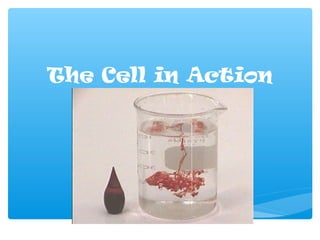
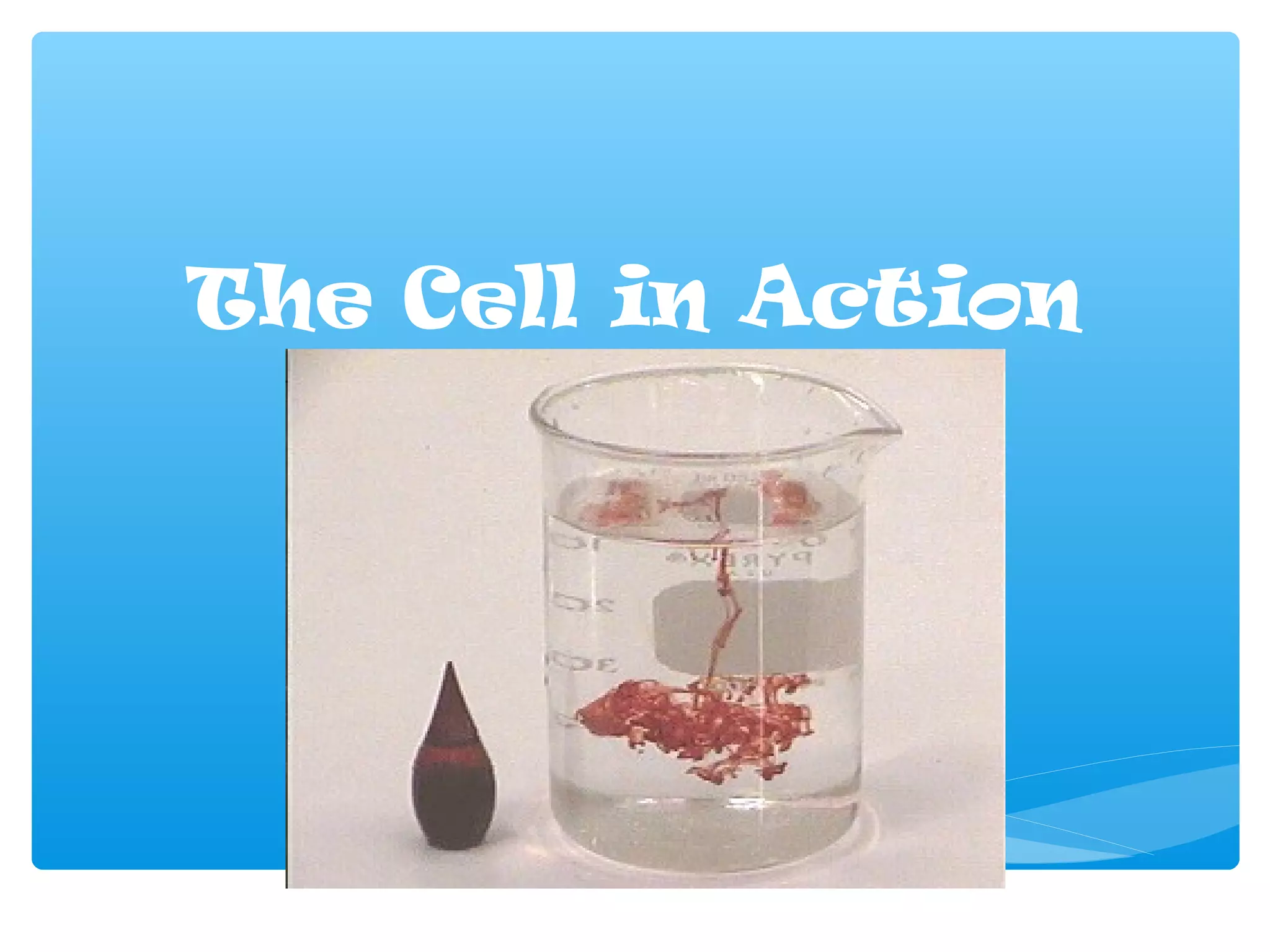
The Cell in Action
Section 1: Exchange with the
            Environment


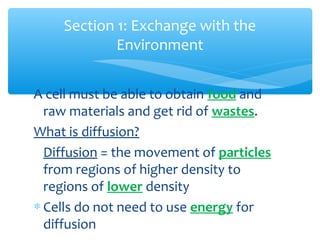
A cell must be able to obtain food and
  raw materials and get rid of wastes.
What is diffusion?
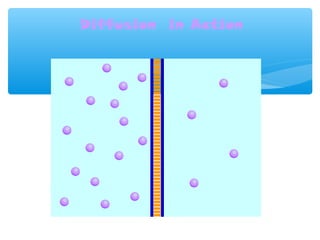
  Diffusion = the movement of particles
  from regions of higher density to
  regions of lower density
∗ Cells do not need to use energy for
  diffusion
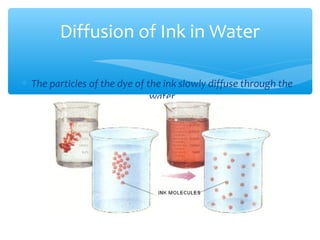
Diffusion of Ink in Water

∗ The particles of the dye of the ink slowly diffuse through the
                               water
Diffusion of Water


∗ The cells of organisms are surrounded
  by and filled with fluids that are made
  mostly of water
∗ Osmosis = the diffusion of water
  through a semi-permeable membrane
∗ “semi permeable” means that some
  things, but not all, can get through
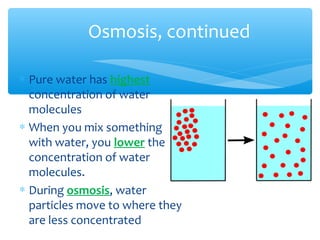
Osmosis, continued

∗ Pure water has highest
  concentration of water
  molecules
∗ When you mix something
  with water, you lower the
  concentration of water
  molecules.
∗ During osmosis, water
  particles move to where they
  are less concentrated
Diffusion in Action
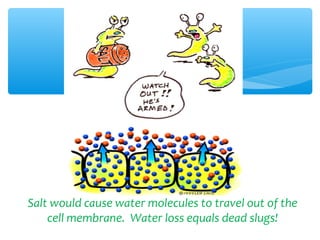
Salt would cause water molecules to travel out of the
    cell membrane. Water loss equals dead slugs!
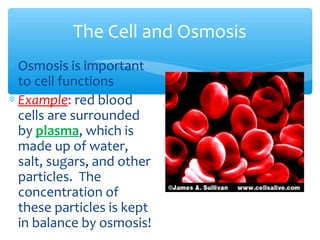
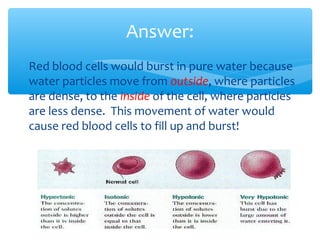
The Cell and Osmosis
∗ Osmosis is important
  to cell functions
∗ Example: red blood
  cells are surrounded
  by plasma, which is
  made up of water,
  salt, sugars, and other
  particles. The
  concentration of
  these particles is kept
  in balance by osmosis!
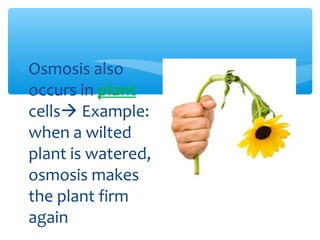
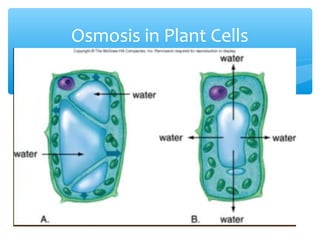
∗ Osmosis also
  occurs in plant
  cells Example:
  when a wilted
  plant is watered,
  osmosis makes
  the plant firm
  again
Osmosis in Plant Cells
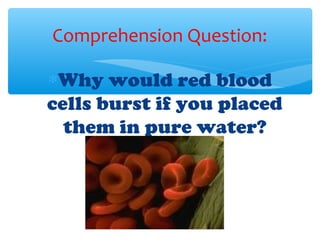
Comprehension Question:

∗Why would red blood
cells burst if you placed
  them in pure water?
Answer:
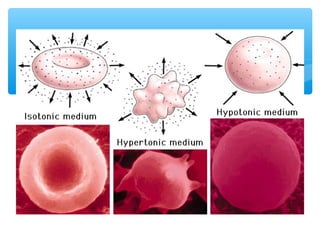
∗ Red blood cells would burst in pure water because
  water particles move from outside, where particles
  are dense, to the inside of the cell, where particles
  are less dense. This movement of water would
  cause red blood cells to fill up and burst!
SORRY!

Knowledge does
    not diffuse
from the pages
 of the textbook
  to your brain!
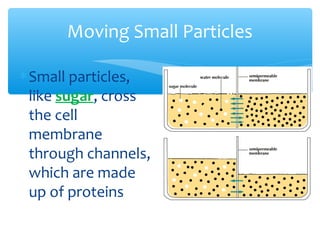
Moving Small Particles

∗ Small particles,
  like sugar, cross
  the cell
  membrane
  through channels,
  which are made
  up of proteins
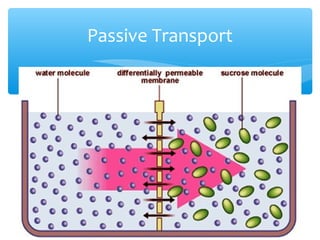
Passive Transport


∗ Passive transport = the movement of
  substances across the cell membrane
  without the use of energy by the cell
∗ During passive transport, particles move
  from an area of high concentration to an
  area of low concentration
∗ Examples of passive transport : osmosis
  and diffusion
Passive Transport
Active Transport

∗ Active transport = the movement of
  substances across the cell membrane
  that requires the cell to use energy
∗ Examples of active transport:
  endocytosis and exocytosis
∗ involves the movement of particles
  from an area of low concentration to an
  area of high concentration
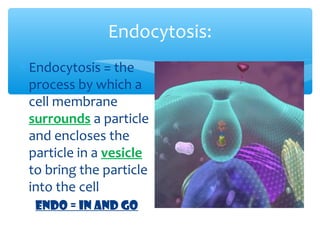
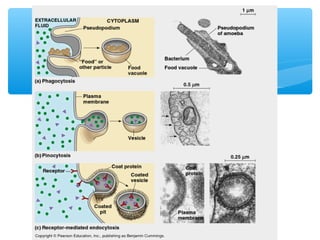
Endocytosis:
∗ Endocytosis = the
  process by which a
  cell membrane
  surrounds a particle
  and encloses the
  particle in a vesicle
  to bring the particle
  into the cell
  ENDO = IN and GO
Steps of Endocytosis:


1. The cell comes into contact with a
   particle
2. The cell membrane begins to wrap
   around the particle
3. Once the particle is completely
   surrounded, a vesicle pinches off
4. Endocytosis = “within the cell”
Exocytosis:


∗ Exocytosis = the process in which a
  cell releases a particle by enclosing
  the particle in a vesicle that then
  moves to the cell surface and fuses
  with the cell membrane
        EXO = EXIT THE CELL
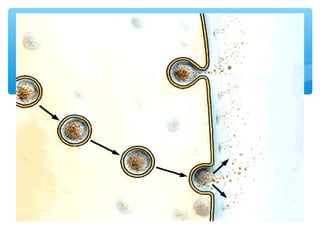
Steps of Exocytosis


∗ Large particles that leave the cell
  must be packaged in vesicles.
∗ Vesicle travels to the cell membrane
  and fuses with it.
∗ Cell releases the particle to the
  outside of the cell
∗ Exocytosis = “outside the cell”
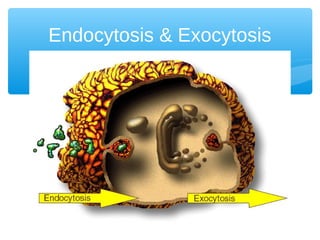
Endocytosis & Exocytosis
Let’s Review:


1.   What part of the cell do materials pass
     through to get into and out of the cell?

2.   What is osmosis?

3.   What are 2 examples of passive transport?

4. Large particles enter the cell by_________
    and leave by ______________.
Answers:


1.   Cell membrane

1.   The diffusion of water through the semi-
     permeable cell membrane

1.   Diffusion and osmosis

1.   Endocytosis, exocytosis

The cell in action

  • 1.
  • 2.
    Section 1: Exchangewith the Environment A cell must be able to obtain food and raw materials and get rid of wastes. What is diffusion? Diffusion = the movement of particles from regions of higher density to regions of lower density ∗ Cells do not need to use energy for diffusion
  • 3.
    Diffusion of Inkin Water ∗ The particles of the dye of the ink slowly diffuse through the water
  • 4.
    Diffusion of Water ∗The cells of organisms are surrounded by and filled with fluids that are made mostly of water ∗ Osmosis = the diffusion of water through a semi-permeable membrane ∗ “semi permeable” means that some things, but not all, can get through
  • 5.
    Osmosis, continued ∗ Purewater has highest concentration of water molecules ∗ When you mix something with water, you lower the concentration of water molecules. ∗ During osmosis, water particles move to where they are less concentrated
  • 6.
  • 7.
    Salt would causewater molecules to travel out of the cell membrane. Water loss equals dead slugs!
  • 8.
    The Cell andOsmosis ∗ Osmosis is important to cell functions ∗ Example: red blood cells are surrounded by plasma, which is made up of water, salt, sugars, and other particles. The concentration of these particles is kept in balance by osmosis!
  • 9.
    ∗ Osmosis also occurs in plant cells Example: when a wilted plant is watered, osmosis makes the plant firm again
  • 10.
  • 11.
    Comprehension Question: ∗Why wouldred blood cells burst if you placed them in pure water?
  • 12.
    Answer: ∗ Red bloodcells would burst in pure water because water particles move from outside, where particles are dense, to the inside of the cell, where particles are less dense. This movement of water would cause red blood cells to fill up and burst!
  • 14.
    SORRY! Knowledge does not diffuse from the pages of the textbook to your brain!
  • 15.
    Moving Small Particles ∗Small particles, like sugar, cross the cell membrane through channels, which are made up of proteins
  • 16.
    Passive Transport ∗ Passivetransport = the movement of substances across the cell membrane without the use of energy by the cell ∗ During passive transport, particles move from an area of high concentration to an area of low concentration ∗ Examples of passive transport : osmosis and diffusion
  • 17.
  • 18.
    Active Transport ∗ Activetransport = the movement of substances across the cell membrane that requires the cell to use energy ∗ Examples of active transport: endocytosis and exocytosis ∗ involves the movement of particles from an area of low concentration to an area of high concentration
  • 19.
    Endocytosis: ∗ Endocytosis =the process by which a cell membrane surrounds a particle and encloses the particle in a vesicle to bring the particle into the cell ENDO = IN and GO
  • 20.
    Steps of Endocytosis: 1.The cell comes into contact with a particle 2. The cell membrane begins to wrap around the particle 3. Once the particle is completely surrounded, a vesicle pinches off 4. Endocytosis = “within the cell”
  • 22.
    Exocytosis: ∗ Exocytosis =the process in which a cell releases a particle by enclosing the particle in a vesicle that then moves to the cell surface and fuses with the cell membrane EXO = EXIT THE CELL
  • 24.
    Steps of Exocytosis ∗Large particles that leave the cell must be packaged in vesicles. ∗ Vesicle travels to the cell membrane and fuses with it. ∗ Cell releases the particle to the outside of the cell ∗ Exocytosis = “outside the cell”
  • 25.
  • 26.
    Let’s Review: 1. What part of the cell do materials pass through to get into and out of the cell? 2. What is osmosis? 3. What are 2 examples of passive transport? 4. Large particles enter the cell by_________ and leave by ______________.
  • 27.
    Answers: 1. Cell membrane 1. The diffusion of water through the semi- permeable cell membrane 1. Diffusion and osmosis 1. Endocytosis, exocytosis