Lesson Objectives:
1. Define an Abstract
2. Enumerate and describe the 2 types of
Abstract
3. Differentiate Abstract from Introduction
4. Explain the purpose and limitations of Abstract
5. Evaluate the structured and unstructured
Abstract
6. Show example of abstract
7. Write your own abstract
ABSTRACT
TYPES OF ABSTRACT
1. Structured Abstract- usually follow
IMRAD pattern; original, norm,
citation needed
2. Unstructured Abstract- composed of
one paragraph with no explicit
headings often appropriate for review
articles that don’t follow the IMRAD
pattern within their bodies
DESCRIPTIVE VERSUS
INFORMATIVE ABSTRACT
DESCRIPTIVE ABSTRACT
-Describes major points of the
project to the reader
- Includes background purpose
and focus of the paper or article
but never the methods, results and
conclusions if it is a research
paper
-It is most likely used for
humanities and social sciences
papers or psychology essays

INFORMATIVE ABSTRACT
-Informs the audience of all the
essential points of the paper
-Briefly summarizes the
background, purpose, focus,
methods, results, findings, and
conclusions of the full length paper
-is concise usually 10% of the
original paper length, often just
one paragraph
- most likely used for sciences,
engineering or psychology report
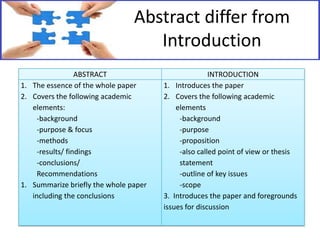
Abstract differ from
Introduction
ABSTRACT
1. The essence of the whole paper
2. Covers the following academic
elements:
-background
-purpose & focus
-methods
-results/ findings
-conclusions/
Recommendations
1. Summarize briefly the whole paper
including the conclusions

INTRODUCTION
1. Introduces the paper
2. Covers the following academic
elements
-background
-purpose
-proposition
-also called point of view or thesis
statement
-outline of key issues
-scope
3. Introduces the paper and foregrounds
issues for discussion
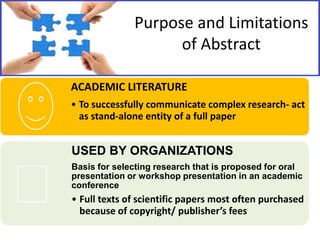
Purpose and Limitations
of Abstract
ACADEMIC LITERATURE
• To successfully communicate complex research- act
as stand-alone entity of a full paper

USED BY ORGANIZATIONS
Basis for selecting research that is proposed for oral
presentation or workshop presentation in an academic
conference

• Full texts of scientific papers most often purchased
because of copyright/ publisher’s fees
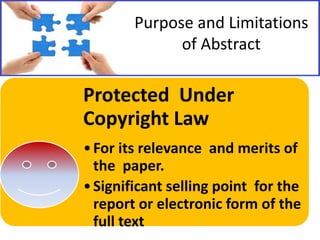
Purpose and Limitations
of Abstract

Protected Under
Copyright Law
• For its relevance and merits of
the paper.
• Significant selling point for the
report or electronic form of the
full text
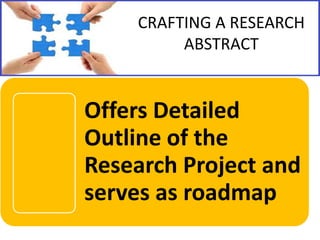
CRAFTING A RESEARCH
ABSTRACT

Offers Detailed
Outline of the
Research Project and
serves as roadmap
CRAFTING A RESEARCH
ABSTRACT

Statement of Purpose
This study examined the relationship
between the buying processes of
consumers and the motivating factors
that salesmen do for decision making
when a consumer product is introduced
through personal selling.
CRAFTING A RESEARCH
ABSTRACT

Research Question
Includes questions you are trying to
solve, concise statement that flows
from the statement of purpose,
translates into thesis statement that
you prove or disprove
EXAMPLE OF RESEARCH
QUESTION TRANSLATED
INTO THESIS STATEMENT

Salesmen of consumer
goods in Santiago City
Philippines who use
personal selling strategy
scores better than those who
merely sell online without
face to face encounter with
the consumer
CRAFTING A RESEARCH
ABSTRACT
SIGNIFICANCE OF
RESEARCH
Argues for the significance of
your research and how it will
contribute to the field or the
community; to whom and why
it is important
CRAFTING A RESEARCH
ABSTRACT
METHODS OF DATA
COLLECTION
Explain how data is
collected, analyzed and
interpreted; If these are
already been
collected, describe where the
data are from and how you
LET US WRITE
DIRECTIONS
Write in your heading the title of your
study, followed by a simple
background of your study depicting
your purpose or focus and the
expected methods you used in finding
the result of your data gathered
CRAFTING A RESEARCH
ABSTRACT
BENCHMARKS

INCLUDE REALISTIC AND
THOROUGH
TIMELINE, PRESENTED AS
SERIES OF BENCHMARKS
ASSIGNMENT

The abstract ppt

  • 2.
    Lesson Objectives: 1. Definean Abstract 2. Enumerate and describe the 2 types of Abstract 3. Differentiate Abstract from Introduction 4. Explain the purpose and limitations of Abstract 5. Evaluate the structured and unstructured Abstract 6. Show example of abstract 7. Write your own abstract
  • 3.
  • 4.
    TYPES OF ABSTRACT 1.Structured Abstract- usually follow IMRAD pattern; original, norm, citation needed 2. Unstructured Abstract- composed of one paragraph with no explicit headings often appropriate for review articles that don’t follow the IMRAD pattern within their bodies
  • 5.
    DESCRIPTIVE VERSUS INFORMATIVE ABSTRACT DESCRIPTIVEABSTRACT -Describes major points of the project to the reader - Includes background purpose and focus of the paper or article but never the methods, results and conclusions if it is a research paper -It is most likely used for humanities and social sciences papers or psychology essays INFORMATIVE ABSTRACT -Informs the audience of all the essential points of the paper -Briefly summarizes the background, purpose, focus, methods, results, findings, and conclusions of the full length paper -is concise usually 10% of the original paper length, often just one paragraph - most likely used for sciences, engineering or psychology report
  • 6.
    Abstract differ from Introduction ABSTRACT 1.The essence of the whole paper 2. Covers the following academic elements: -background -purpose & focus -methods -results/ findings -conclusions/ Recommendations 1. Summarize briefly the whole paper including the conclusions INTRODUCTION 1. Introduces the paper 2. Covers the following academic elements -background -purpose -proposition -also called point of view or thesis statement -outline of key issues -scope 3. Introduces the paper and foregrounds issues for discussion
  • 7.
    Purpose and Limitations ofAbstract ACADEMIC LITERATURE • To successfully communicate complex research- act as stand-alone entity of a full paper USED BY ORGANIZATIONS Basis for selecting research that is proposed for oral presentation or workshop presentation in an academic conference • Full texts of scientific papers most often purchased because of copyright/ publisher’s fees
  • 8.
    Purpose and Limitations ofAbstract Protected Under Copyright Law • For its relevance and merits of the paper. • Significant selling point for the report or electronic form of the full text
  • 9.
    CRAFTING A RESEARCH ABSTRACT OffersDetailed Outline of the Research Project and serves as roadmap
  • 10.
    CRAFTING A RESEARCH ABSTRACT Statementof Purpose This study examined the relationship between the buying processes of consumers and the motivating factors that salesmen do for decision making when a consumer product is introduced through personal selling.
  • 11.
    CRAFTING A RESEARCH ABSTRACT ResearchQuestion Includes questions you are trying to solve, concise statement that flows from the statement of purpose, translates into thesis statement that you prove or disprove
  • 12.
    EXAMPLE OF RESEARCH QUESTIONTRANSLATED INTO THESIS STATEMENT Salesmen of consumer goods in Santiago City Philippines who use personal selling strategy scores better than those who merely sell online without face to face encounter with the consumer
  • 13.
    CRAFTING A RESEARCH ABSTRACT SIGNIFICANCEOF RESEARCH Argues for the significance of your research and how it will contribute to the field or the community; to whom and why it is important
  • 14.
    CRAFTING A RESEARCH ABSTRACT METHODSOF DATA COLLECTION Explain how data is collected, analyzed and interpreted; If these are already been collected, describe where the data are from and how you
  • 15.
    LET US WRITE DIRECTIONS Writein your heading the title of your study, followed by a simple background of your study depicting your purpose or focus and the expected methods you used in finding the result of your data gathered
  • 16.
    CRAFTING A RESEARCH ABSTRACT BENCHMARKS INCLUDEREALISTIC AND THOROUGH TIMELINE, PRESENTED AS SERIES OF BENCHMARKS
  • 17.

Editor's Notes

  • #13 The statement can still be proven and can’t be answered with simple Yes or No