Report Writing 
(Scientific report) 
Presented To: 
Ms. Lubna Zahid 
Presented By: 
Shamim Mukhtar 13 
Maliha Hussain 14 
Aarfa Tufail 11 
Hira Sumbul 15 
Wajeeha Fiaz 37
Contents: 
 Definition of report writing 
 Types of report writing 
 Define scientific report 
 Define scientific research 
 Types of scientific research 
 Purposes of Scientific report 
 Elements/Structure of Scientific report 
 Publication of Scientific report 
 Effective report/elements of good report 
 Avoids plagiarism 
 Do’s and Don’ts in report 
 Conclusion
REPORT WRITING 
“An account given of a particular matter, especially in the form 
of an official document, after thorough investigation or 
consideration by an appointed person or body” 
– Clearly structured document 
– Help to make decision, action, recommendation 
– Particular purpose and audience 
– On particular issue 
– A quick definition might be: "This is what I did and this is what it 
means 
– If research was not “written up,” did it really occur?
Incident Report 
Types 
of 
report 
Recommendation 
Report 
Accident Report 
Feasibility Study / 
Report 
Progress Report 
Scientific 
Report 
Case Study 
Sales Report
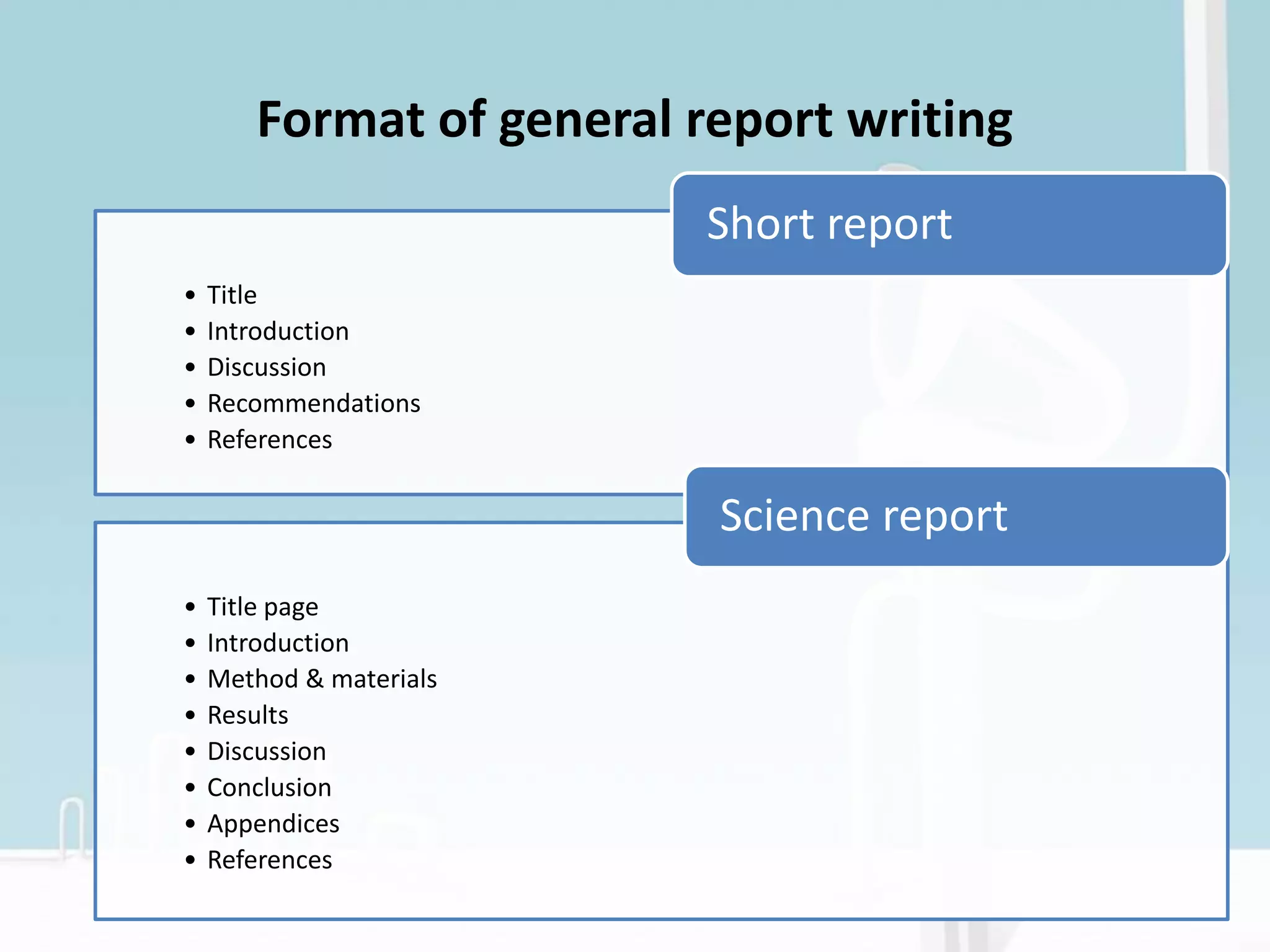
Format of general report writing 
• Title 
• Introduction 
• Discussion 
• Recommendations 
• References 
Short report 
• Title page 
• Introduction 
• Method & materials 
• Results 
• Discussion 
• Conclusion 
• Appendices 
• References 
Science report
Cont… 
Business report 
• Title page 
• Executive summary 
• Table of contents 
• Introduction 
• Discussion 
• Conclusion 
• Recommendations 
• Appendices 
• References 
Research report 
• Title page 
• Executive summary 
• Introduction 
•Method / methodology 
• Results / findings 
• Discussion 
• Conclusions 
• Recommendations 
• Appendices 
• Bibliography
Scientific report 
• Document that describe 
– Process 
– Progress 
– Results of technical or scientific research
Types of 
Scientific 
research 
Basic (pure) 
Applied 
research 
Descriptive 
Explanatory 
Predictive 
research 
Qualitative 
research 
Quantitative 
vs. 
vs. 
vs. 
vs.
Quantitative research: 
– It seeks to convert observations to numbers. 
– Testing of hypotheses based on a sample of observations, and 
a statistical analysis of the data 
– Attempt to describe relationships among variables 
mathematically 
What is the relationship 
between use 
and need of nursing 
services in the 
rural areas?
Qualitative research: 
• Emphasizes verbal descriptions and explanations of human 
behavior 
• The tools for gaining information include: participant 
observation, in- depth interviews, or an in-depth analysis of a 
single case 
How do nurses handle 
patients who refuse 
to follow instructions?
Descriptive research 
(Exploratory research) 
• Emphasizes the accurate description of some aspect of 
society. 
• A researcher assesses specific characteristics of individuals, 
groups, situations, or events by summarizing the 
commonalities found in discrete observations 
“what” 
How many of this 
“what ” 
"WHAT IS THIS?"
Explanatory research 
• Its primary goal is to understand or to explain relationships. 
• It uses correlations to study relationships between dimensions 
or characteristics of individuals, groups, situations, or events. 
HOW 
WHY
Predictive research 
• Moves beyond explanation to the prediction of precise 
relationships between dimensions or characteristics of a 
phenomenon or differences between groups. 
What are the risk factors for 
green house gases after 
emission from source?
Basic research 
• Focuses on understanding phenomena of interest. 
• Conducted to accumulate information, extending the base of 
knowledge in a discipline to improve understanding, or to 
formulate a theory. 
• It is appropriate for discovering general principles of human 
behavior and biophysiology processes. 
relationship 
between socioeconomic 
status and 
the intention to follow a 
healthy diet
Applied research 
• Focuses on finding an immediate solution to an existing 
problem. 
• Designed to indicate how the principles of human behavior 
can be used to solve problems 
effectiveness of an 
intervention such 
as attending to the hospital 
at labor 
signs
Purpose of scientific report writing 
 Sharing information with other scientists 
 Review the research by other scientists 
 To show what progress has been made 
 To persuade through logical argument
Scientific report 
• Scientific papers are for sharing your own original research work 
with other scientists or for reviewing the research conducted by 
others 
• To reach their goal, papers must aim to inform, not impress. 
• They must be highly readable — that is, clear, accurate, and concise. 
They are more likely to be cited by other scientists if they are helpful 
rather than cryptic or self-centered 
• Logical order. 
Introduction, then materials, method, result, discussion (body) 
then finally conclusion.
The Report Elements 
Title Section 
Title 
page 
Research 
title 
Abstract 
Significance 
of report 
Summarize 
the results 
Briefly 
describe 
methods 
Main 
objectives
Introduction 
Problem 
identifications 
Importance Solution 
proposed 
Deductive 
reasoning
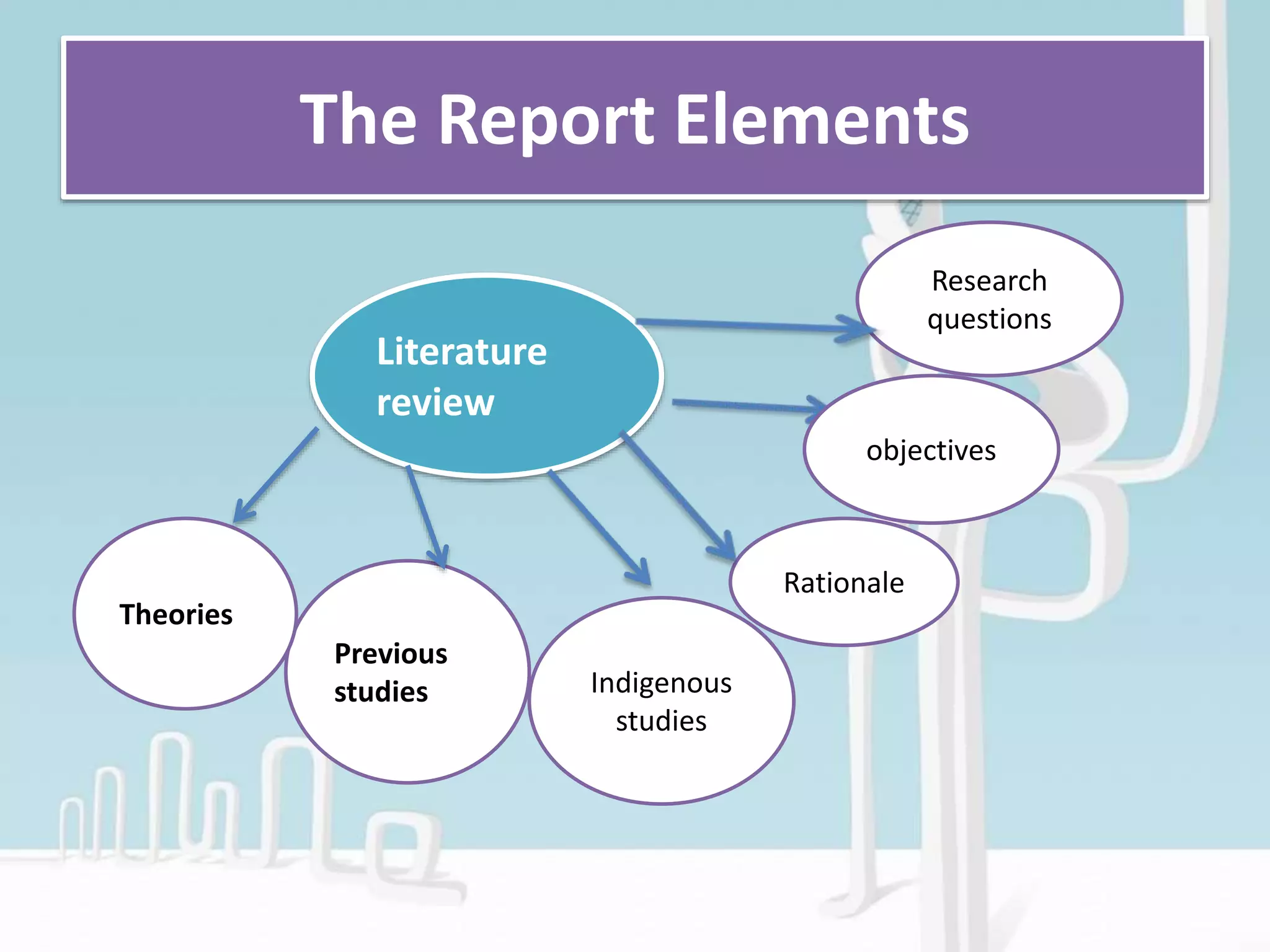
The Report Elements 
Literature 
review 
Previous 
studies 
Theories 
Indigenous 
studies 
objectives 
Rationale 
Research 
questions
The Report Elements 
• Method 
• Result 
• Discussion
Methodology 
assessment 
measures Sampling 
strategy 
Sample 
Inclusion/ 
exclusion 
Research 
design 
Method 
Procedure
Methodology 
• Style and structure 
-use narrative structure 
-past passive voice 
-written in chorological order i.e. time order
What you 
found 
Results 
Key results 
Charts 
Figures 
graphs 
Results
Results 
• Style and structure 
-active voice (past tense). 
-descriptive titles of figures and tables 
-Figures and tables should be self-explanatory 
-No interpretation of the data or conclusions about what the 
data 
might mean are given in this section
Discussion 
Final 
comment Relate to 
literature 
Interpret 
results 
Charts 
Major 
findings 
Discussion
Report format 
• Conclusion 
• Recommendations 
• Glossary 
• References 
• Appendices
Conclusion 
• A conclusion is not merely a summary of your 
points or a restatement of your research problem 
but a synthesis of key points. 
• Importance of good conclusion 
-presenting the major issue you raised in report 
-summarizing your thoughts 
-demonstrating the importance of your ideas 
-introducing possible new or expanded ways of 
thinking.
Recommendations 
• Action to be taken based on the conclusion of 
the report 
Glossary 
• Alphabetical listing of key terms in the report
References 
• List of sources 
• Use of recommend style 
• APA 
Appendices 
• It is a good place to put analysis, demographic 
information sheet, assessment measures, maps, 
extra photographs and diagrams of appratus
Thank you for your time
Any questions??
Scientific report writing

Scientific report writing

  • 3.
    Report Writing (Scientificreport) Presented To: Ms. Lubna Zahid Presented By: Shamim Mukhtar 13 Maliha Hussain 14 Aarfa Tufail 11 Hira Sumbul 15 Wajeeha Fiaz 37
  • 4.
    Contents:  Definitionof report writing  Types of report writing  Define scientific report  Define scientific research  Types of scientific research  Purposes of Scientific report  Elements/Structure of Scientific report  Publication of Scientific report  Effective report/elements of good report  Avoids plagiarism  Do’s and Don’ts in report  Conclusion
  • 5.
    REPORT WRITING “Anaccount given of a particular matter, especially in the form of an official document, after thorough investigation or consideration by an appointed person or body” – Clearly structured document – Help to make decision, action, recommendation – Particular purpose and audience – On particular issue – A quick definition might be: "This is what I did and this is what it means – If research was not “written up,” did it really occur?
  • 6.
    Incident Report Types of report Recommendation Report Accident Report Feasibility Study / Report Progress Report Scientific Report Case Study Sales Report
  • 7.
    Format of generalreport writing • Title • Introduction • Discussion • Recommendations • References Short report • Title page • Introduction • Method & materials • Results • Discussion • Conclusion • Appendices • References Science report
  • 8.
    Cont… Business report • Title page • Executive summary • Table of contents • Introduction • Discussion • Conclusion • Recommendations • Appendices • References Research report • Title page • Executive summary • Introduction •Method / methodology • Results / findings • Discussion • Conclusions • Recommendations • Appendices • Bibliography
  • 9.
    Scientific report •Document that describe – Process – Progress – Results of technical or scientific research
  • 10.
    Types of Scientific research Basic (pure) Applied research Descriptive Explanatory Predictive research Qualitative research Quantitative vs. vs. vs. vs.
  • 11.
    Quantitative research: –It seeks to convert observations to numbers. – Testing of hypotheses based on a sample of observations, and a statistical analysis of the data – Attempt to describe relationships among variables mathematically What is the relationship between use and need of nursing services in the rural areas?
  • 12.
    Qualitative research: •Emphasizes verbal descriptions and explanations of human behavior • The tools for gaining information include: participant observation, in- depth interviews, or an in-depth analysis of a single case How do nurses handle patients who refuse to follow instructions?
  • 13.
    Descriptive research (Exploratoryresearch) • Emphasizes the accurate description of some aspect of society. • A researcher assesses specific characteristics of individuals, groups, situations, or events by summarizing the commonalities found in discrete observations “what” How many of this “what ” "WHAT IS THIS?"
  • 14.
    Explanatory research •Its primary goal is to understand or to explain relationships. • It uses correlations to study relationships between dimensions or characteristics of individuals, groups, situations, or events. HOW WHY
  • 15.
    Predictive research •Moves beyond explanation to the prediction of precise relationships between dimensions or characteristics of a phenomenon or differences between groups. What are the risk factors for green house gases after emission from source?
  • 16.
    Basic research •Focuses on understanding phenomena of interest. • Conducted to accumulate information, extending the base of knowledge in a discipline to improve understanding, or to formulate a theory. • It is appropriate for discovering general principles of human behavior and biophysiology processes. relationship between socioeconomic status and the intention to follow a healthy diet
  • 17.
    Applied research •Focuses on finding an immediate solution to an existing problem. • Designed to indicate how the principles of human behavior can be used to solve problems effectiveness of an intervention such as attending to the hospital at labor signs
  • 18.
    Purpose of scientificreport writing  Sharing information with other scientists  Review the research by other scientists  To show what progress has been made  To persuade through logical argument
  • 19.
    Scientific report •Scientific papers are for sharing your own original research work with other scientists or for reviewing the research conducted by others • To reach their goal, papers must aim to inform, not impress. • They must be highly readable — that is, clear, accurate, and concise. They are more likely to be cited by other scientists if they are helpful rather than cryptic or self-centered • Logical order. Introduction, then materials, method, result, discussion (body) then finally conclusion.
  • 20.
    The Report Elements Title Section Title page Research title Abstract Significance of report Summarize the results Briefly describe methods Main objectives
  • 21.
    Introduction Problem identifications Importance Solution proposed Deductive reasoning
  • 22.
    The Report Elements Literature review Previous studies Theories Indigenous studies objectives Rationale Research questions
  • 23.
    The Report Elements • Method • Result • Discussion
  • 24.
    Methodology assessment measuresSampling strategy Sample Inclusion/ exclusion Research design Method Procedure
  • 25.
    Methodology • Styleand structure -use narrative structure -past passive voice -written in chorological order i.e. time order
  • 26.
    What you found Results Key results Charts Figures graphs Results
  • 27.
    Results • Styleand structure -active voice (past tense). -descriptive titles of figures and tables -Figures and tables should be self-explanatory -No interpretation of the data or conclusions about what the data might mean are given in this section
  • 28.
    Discussion Final commentRelate to literature Interpret results Charts Major findings Discussion
  • 29.
    Report format •Conclusion • Recommendations • Glossary • References • Appendices
  • 30.
    Conclusion • Aconclusion is not merely a summary of your points or a restatement of your research problem but a synthesis of key points. • Importance of good conclusion -presenting the major issue you raised in report -summarizing your thoughts -demonstrating the importance of your ideas -introducing possible new or expanded ways of thinking.
  • 31.
    Recommendations • Actionto be taken based on the conclusion of the report Glossary • Alphabetical listing of key terms in the report
  • 32.
    References • Listof sources • Use of recommend style • APA Appendices • It is a good place to put analysis, demographic information sheet, assessment measures, maps, extra photographs and diagrams of appratus
  • 33.
    Thank you foryour time
  • 34.

Editor's Notes

  • #6 A report is a clearly structured document that presents information as clearly and succinctly ( clear, precise expression in few words) as possible by using sections and headings so that the information is easy to locate and follow. Reports are used to help make decisions or account for actions. Reports use research to make recommendations for action. A report is written for a clear purpose and to a particular audience. Specific information and evidence are presented, analyzed and applied to a particular problem or issue. A quick definition might be: "This is what I did and this is what it means.
  • #8 Reports are written for different purposes. They therefore contain different information and structures, including headings and subheadings, and these form the outline of the report. The table below shows the sections commonly found in these types of reports.
  • #10 “A scientific report is a document that describes the process, progress, and or results of technical or scientific research or the state of a technical or scientific research problem. It might also include recommendations and conclusion of the research.”
  • #14 The descriptive research is directed toward studying "what" and how many of this “what ”. Thus, it is directed toward answering questions such as, "WHAT IS THIS?".
  • #15 Explanatory research explains (HOW THE PARTS OF A PHINOMINON ARE RELATED TO EACH OTHER). • Explanatory research asks the "WHY"question.
  • #16 Its question might be like