WRITING EFFECTIVE
ABSTRACTS
Helen E. Hodgson, Ph.D.
Westminster College
Salt Lake City, Utah
What is an Abstract?
 An abbreviated, accurate representation of a
document without added interpretation or
criticism
 Two general types
 Indicative (descriptive)
 Informative
Why is an Abstract Important?
 It is the part of the article that is read most
often.
 For some readers, it is the only part read.
 Other readers use it to determine whether the
article is worth reading.
 Researchers use it to determine the relevance
of the research to their work.
 For conferences, it is often the sole criterion on
which a presentation is judged.
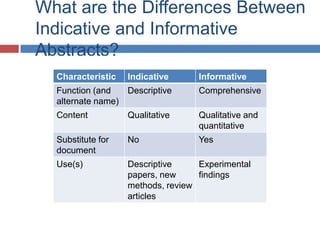
What are the Differences Between
Indicative and Informative
Abstracts?
Characteristic Indicative Informative
Function (and
alternate
name)
Descriptive Comprehensiv
e
Content Qualitative Qualitative and
quantitative
Substitute for
document
No Yes
Use(s) Descriptive
papers, new
methods,
Experimental
findings
Characteristic Indicative Informative
Function (and
alternate name)
Descriptive Comprehensive
Content Qualitative Qualitative and
quantitative
Substitute for
document
No Yes
Use(s) Descriptive
papers, new
methods, review
articles
Experimental
findings
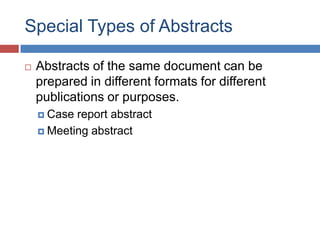
Special Types of Abstracts
 Abstracts of the same document can be
prepared in different formats for different
publications or purposes.
 Case report abstract
 Meeting abstract
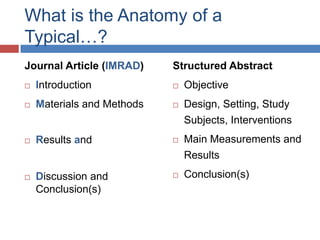
What is the Anatomy of a
Typical…?
Journal Article (IMRAD)
 Introduction
 Materials and Methods
 Results and
 Discussion and
Conclusion(s)
Structured Abstract
 Objective
 Design, Setting, Study
Subjects, Interventions
 Main Measurements and
Results
 Conclusion(s)
Ann Intern Med 1987;106:598-604.
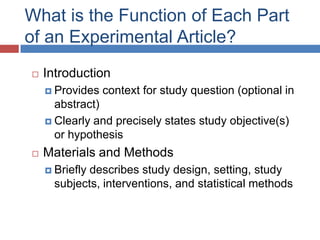
What is the Function of Each Part
of an Experimental Article?
 Introduction
 Provides context for study question (optional in
abstract)
 Clearly and precisely states study objective(s)
or hypothesis
 Materials and Methods
 Briefly describes study design, setting, study
subjects, interventions, and statistical methods
Function of Each Part of an
Experimental Article—Continued
 Results
 Provides key results, including methods of
assessing subjects and statistical results
 Discussion
 Article: Highlights, without repeating, ―Results‖
 Abstract: Excludes ―Discussion‖ or combines with
―Conclusion(s)‖
 Conclusion(s)
 Directly answers study objective
What Phrases Help Signal the
Reader?
 To determine whether . . ., we . . . .
 We found that. . . .
 We conclude that . . . .
Zeiger, Essentials of Writing Biomedical Research
Papers, 2000.
Zeiger. Essentials of Writing Biomedical Research Papers 2000.
What is the Best Approach
to Writing an Abstract?
 Start with the journal’s instructions for
authors.
 Review sample abstracts from the target
journal.
 Remember that the abstract will be
published by itself and should be self-
contained.
What are the Main Problems
with Abstracts?
 Incomplete
 Inaccurate
 Misleading
 Poorly organized
 Lacking in coherence
 Excessively detailed
What are the Qualities
of an Effective Abstract?
 Is both clear and concise
 Conforms to required length limit (usually 250
words)
 Stresses the most important aspects of the
study
 Avoids general statements
 Contains nothing that is not found in the body
of the article
Writing Style and Hints
The generally accepted rules for good writing
apply to the writing of abstracts:
 Write concisely and clearly, making each
sentence highly informative.
 Write in fluent, simple prose and make clear,
direct statements.
 Be exact and unambiguous; avoid
generalizing whenever possible.
Writing Style and Hints—Continued
 Condense, but do not interpret, the content
of the report.
 Indicate the scope of the research in the
opening sentence without repeating the title.
 Begin with a statement of the Objective, not
with the phrase ―This report . . .‖
 Indicate the treatment of the subject (eg,
brief or exhaustive, case history or survey,
etc).
Writing Style and Hints—Continued
 Use complete sentences unless the journal
allows fragments in structured abstracts (eg,
objective or setting).
 Be brief, but avoid terseness and cryptic
comments.
 Use the past tense.
 Use active voice, especially for informative
abstracts.
 Passive: B was exceeded by A.
 Active: A exceeded B.
Writing Style and Hints—Continued
 Avoid ―laboratory semantics,‖ repetition, and
unnecessary words.
 Use trade jargon and abbreviations
sparingly, defining them at first use.
 Maintain the tone and emphasis of the
overall manuscript.
 Edit the abstract carefully, scrutinizing every
word.
What Should Be Excluded
from (most) Abstracts?
 Jargon and
undefined
abbreviations
 Detailed
descriptions
 Examples
 Well-established
facts
 Tables and graphs
 Excessive
numerical results
 Speculation by
author
 Information not in
document
 References
The Introduction
 Consists of 1–3 sentences that
 introduce the topic and explain why it is important
 state the research question and, briefly, how you
went about answering it
Ways to Reduce Word Count
 Use plurals to eliminate articles.
 Use abbreviations where permitted, defining at
first use.
 Remove redundant words and phrases.
 Avoid nominalizations.
 Limit the use of prepositional phrases.
 Eliminate spaces between mathematical
operators and numbers
 Avoid starting sentences with numbers that have
to be spelled out.
Conclusion
Abstracts should
 be as clear and concise as possible
 contain only essential information
 start with the research question, why it is
important, and how you answered it
 report your principal findings
 end with a summary of your findings and their
implications

Writing effective abstracts

  • 1.
    WRITING EFFECTIVE ABSTRACTS Helen E.Hodgson, Ph.D. Westminster College Salt Lake City, Utah
  • 2.
    What is anAbstract?  An abbreviated, accurate representation of a document without added interpretation or criticism  Two general types  Indicative (descriptive)  Informative
  • 3.
    Why is anAbstract Important?  It is the part of the article that is read most often.  For some readers, it is the only part read.  Other readers use it to determine whether the article is worth reading.  Researchers use it to determine the relevance of the research to their work.  For conferences, it is often the sole criterion on which a presentation is judged.
  • 4.
    What are theDifferences Between Indicative and Informative Abstracts? Characteristic Indicative Informative Function (and alternate name) Descriptive Comprehensiv e Content Qualitative Qualitative and quantitative Substitute for document No Yes Use(s) Descriptive papers, new methods, Experimental findings Characteristic Indicative Informative Function (and alternate name) Descriptive Comprehensive Content Qualitative Qualitative and quantitative Substitute for document No Yes Use(s) Descriptive papers, new methods, review articles Experimental findings
  • 5.
    Special Types ofAbstracts  Abstracts of the same document can be prepared in different formats for different publications or purposes.  Case report abstract  Meeting abstract
  • 6.
    What is theAnatomy of a Typical…? Journal Article (IMRAD)  Introduction  Materials and Methods  Results and  Discussion and Conclusion(s) Structured Abstract  Objective  Design, Setting, Study Subjects, Interventions  Main Measurements and Results  Conclusion(s) Ann Intern Med 1987;106:598-604.
  • 7.
    What is theFunction of Each Part of an Experimental Article?  Introduction  Provides context for study question (optional in abstract)  Clearly and precisely states study objective(s) or hypothesis  Materials and Methods  Briefly describes study design, setting, study subjects, interventions, and statistical methods
  • 8.
    Function of EachPart of an Experimental Article—Continued  Results  Provides key results, including methods of assessing subjects and statistical results  Discussion  Article: Highlights, without repeating, ―Results‖  Abstract: Excludes ―Discussion‖ or combines with ―Conclusion(s)‖  Conclusion(s)  Directly answers study objective
  • 9.
    What Phrases HelpSignal the Reader?  To determine whether . . ., we . . . .  We found that. . . .  We conclude that . . . . Zeiger, Essentials of Writing Biomedical Research Papers, 2000. Zeiger. Essentials of Writing Biomedical Research Papers 2000.
  • 10.
    What is theBest Approach to Writing an Abstract?  Start with the journal’s instructions for authors.  Review sample abstracts from the target journal.  Remember that the abstract will be published by itself and should be self- contained.
  • 11.
    What are theMain Problems with Abstracts?  Incomplete  Inaccurate  Misleading  Poorly organized  Lacking in coherence  Excessively detailed
  • 12.
    What are theQualities of an Effective Abstract?  Is both clear and concise  Conforms to required length limit (usually 250 words)  Stresses the most important aspects of the study  Avoids general statements  Contains nothing that is not found in the body of the article
  • 13.
    Writing Style andHints The generally accepted rules for good writing apply to the writing of abstracts:  Write concisely and clearly, making each sentence highly informative.  Write in fluent, simple prose and make clear, direct statements.  Be exact and unambiguous; avoid generalizing whenever possible.
  • 14.
    Writing Style andHints—Continued  Condense, but do not interpret, the content of the report.  Indicate the scope of the research in the opening sentence without repeating the title.  Begin with a statement of the Objective, not with the phrase ―This report . . .‖  Indicate the treatment of the subject (eg, brief or exhaustive, case history or survey, etc).
  • 15.
    Writing Style andHints—Continued  Use complete sentences unless the journal allows fragments in structured abstracts (eg, objective or setting).  Be brief, but avoid terseness and cryptic comments.  Use the past tense.  Use active voice, especially for informative abstracts.  Passive: B was exceeded by A.  Active: A exceeded B.
  • 16.
    Writing Style andHints—Continued  Avoid ―laboratory semantics,‖ repetition, and unnecessary words.  Use trade jargon and abbreviations sparingly, defining them at first use.  Maintain the tone and emphasis of the overall manuscript.  Edit the abstract carefully, scrutinizing every word.
  • 17.
    What Should BeExcluded from (most) Abstracts?  Jargon and undefined abbreviations  Detailed descriptions  Examples  Well-established facts  Tables and graphs  Excessive numerical results  Speculation by author  Information not in document  References
  • 18.
    The Introduction  Consistsof 1–3 sentences that  introduce the topic and explain why it is important  state the research question and, briefly, how you went about answering it
  • 19.
    Ways to ReduceWord Count  Use plurals to eliminate articles.  Use abbreviations where permitted, defining at first use.  Remove redundant words and phrases.  Avoid nominalizations.  Limit the use of prepositional phrases.  Eliminate spaces between mathematical operators and numbers  Avoid starting sentences with numbers that have to be spelled out.
  • 20.
    Conclusion Abstracts should  beas clear and concise as possible  contain only essential information  start with the research question, why it is important, and how you answered it  report your principal findings  end with a summary of your findings and their implications