
Literature Review
Presented by:
Md. Fahimuzzaman
Department of Textile Engineering
Mawlana Bhashani Science and Technology University
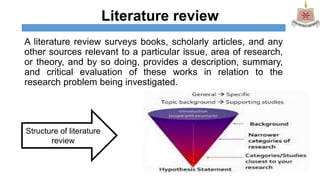
Literature review
A literature review surveys books, scholarly articles, and any
other sources relevant to a particular issue, area of research,
or theory, and by so doing, provides a description, summary,
and critical evaluation of these works in relation to the
research problem being investigated.
Structure of literature
review
The purpose of a literature review
Provide foundation of knowledge on topic
Identify areas of prior scholarship to prevent duplication and
give credit to other researchers
Identify inconstancies: gaps in research, conflicts in previous
studies, open questions left from other research
Identify need for additional research (justifying your research)
Identify the relationship of works in context of its contribution to
the topic and to other works
Place your own research within the context of existing literature
making a case for why further study is needed.
Types of literature review
On the purpose of research there are 5 main types of literature
review:
1. Narrative Literature Review
2. Argumentative Literature Review
3. Theoretical Literature Review
4. Integrative Literature Review
5. Systematic Literature Review
Narrative Literature Review
It critiques and summarizes the literature, draws conclusions
about the topic and identifies gaps in a body of knowledge.
Argumentative Literature Review
It examines literature selectively to support or refute an argument,
assumption or a philosophical problem.
Theoretical Literature Review
It focus on a pool of theory that has accumulated in regard to an
issue, concept, theory, phenomena.
Integrative Literature Review
It reviews, critiques and synthesizes secondary data about
research topic in an integrated way.
Systematic Literature Review
It is divided into two categories.
Meta-analysis: Meta-analysis detects the patterns & relationships
and draws conclusions.
Meta-synthesis: Meta-synthesis is conducted usually when following
inductive research approach.
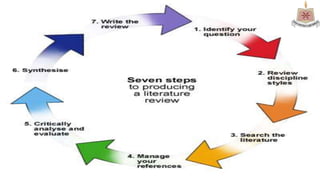
Identify the question
Choose a topic that interests you! You’ll be spending a lot of
time with it.
Explore your topic using your textbooks, reference books, and
articles and by consulting your professor.
Be open to tweaking your research question as you gather
more information.
Review discipline styles
Each discipline has its own style for writing a literature review,
Social science literature reviews may look different than those
from the biological sciences or engineering.
The best way to become familiar with literature reviews in your
field of study is to look at published journal articles and note how
they present the information.
Search the literature
 Before searching, brainstorm some keywords based on your topic.
 Search systematically and keep track of your search terms. Where to search?
-Digital libraries
-Conference papers
-Govt. publications
-Search engines
-E-books
-E-journals
-Databases
-FAQ’s
-Open access journals-DOAJ
-Google scholar
Save and organize the articles and other sources and give files names that make
sense for you. e.g. Smith_2019.pdf (Author last name, publication year.pdf)
Manage references
As part of literature review, need to provide a list of references,
professors want to know where you found your information.
Professor will also require that you use a specific format (“style”)
for citing your references, such as one of these:
 APA ( American Psychological Association )
 Chicago Manual of Style
 MLA ( Modern Language Association )
Critically analyze and evaluate
Ask yourself questions like these about each book or article you
include:
1. What is the research question?
2. What is the primary methodology used?
3. How was the data gathered?
4. How is the data presented?
5. What are the main conclusions?
6. Are these conclusions reasonable?
7. What theories are used to support the researcher’s conclusions?
Take notes on the articles as you read them and identify any themes
or concepts that may apply to your research question.
Synthesize
This is the point where you sort articles by themes or categories
in presentation for writing your literature review.
You can sort the literature in various ways, for example:
 By themes or concepts
 Historically or chronologically ( tracing a research question
across time ) or
 By methodology.
Write Literature Review
 Introduction
Cite and present the study
 Main body
Summarizes and synthesizes the sources to your study
 Conclusion
The function of your paper’s conclusion is to restate the
main argument remind the reader of the strengths of your main
argument or arguments and reiterate the most important
evidence supporting those arguments and these are the
references that you were able to find using this process.
Why is a literature review important?
It justifies your research-shows it is worth doing
It sets your research within context by looking at research in
the project area.
It helps to refine your project idea
It identifies research methods and strategies which you could
use.
It helps you avoid repeating the work of others
Basis for further reading ,as your research develops.
Distinguishes your work as an academic thesis.
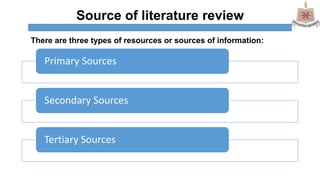
Source of literature review
Primary Sources
Secondary Sources
Tertiary Sources
There are three types of resources or sources of information:
Primary Sources
Primary sources are original materials on which other research
is based, including:
original written works – poems, diaries, court records,
interviews, surveys, and original research/fieldwork, and
research published in scholarly/academic journals.
Secondary sources
Secondary sources are those that describe or analyse primary
sources, including:
reference materials – dictionaries, encyclopaedias, textbooks,
and
books and articles that interpret, review, or synthesize original
research/fieldwork.
Tertiary sources
Tertiary sources are those used to organize and locate secondary
and primary sources.
Indexes – provide citations that fully identify a work with
information such as author, titles of a book, article, and/or
journal, publisher and publication date, volume and issue
number and page numbers.
Abstracts – summarize the primary or secondary sources,
Databases – are online indexes that usually include abstracts
for each primary or secondary resource, and may also include a
digital copy of the resource.
Thank You

Literature Review.pptx

  • 1.
    Literature Review Presented by: Md.Fahimuzzaman Department of Textile Engineering Mawlana Bhashani Science and Technology University
  • 2.
    Literature review A literaturereview surveys books, scholarly articles, and any other sources relevant to a particular issue, area of research, or theory, and by so doing, provides a description, summary, and critical evaluation of these works in relation to the research problem being investigated. Structure of literature review
  • 3.
    The purpose ofa literature review Provide foundation of knowledge on topic Identify areas of prior scholarship to prevent duplication and give credit to other researchers Identify inconstancies: gaps in research, conflicts in previous studies, open questions left from other research Identify need for additional research (justifying your research) Identify the relationship of works in context of its contribution to the topic and to other works Place your own research within the context of existing literature making a case for why further study is needed.
  • 4.
    Types of literaturereview On the purpose of research there are 5 main types of literature review: 1. Narrative Literature Review 2. Argumentative Literature Review 3. Theoretical Literature Review 4. Integrative Literature Review 5. Systematic Literature Review
  • 5.
    Narrative Literature Review Itcritiques and summarizes the literature, draws conclusions about the topic and identifies gaps in a body of knowledge.
  • 6.
    Argumentative Literature Review Itexamines literature selectively to support or refute an argument, assumption or a philosophical problem.
  • 7.
    Theoretical Literature Review Itfocus on a pool of theory that has accumulated in regard to an issue, concept, theory, phenomena.
  • 8.
    Integrative Literature Review Itreviews, critiques and synthesizes secondary data about research topic in an integrated way.
  • 9.
    Systematic Literature Review Itis divided into two categories. Meta-analysis: Meta-analysis detects the patterns & relationships and draws conclusions. Meta-synthesis: Meta-synthesis is conducted usually when following inductive research approach.
  • 11.
    Identify the question Choosea topic that interests you! You’ll be spending a lot of time with it. Explore your topic using your textbooks, reference books, and articles and by consulting your professor. Be open to tweaking your research question as you gather more information.
  • 12.
    Review discipline styles Eachdiscipline has its own style for writing a literature review, Social science literature reviews may look different than those from the biological sciences or engineering. The best way to become familiar with literature reviews in your field of study is to look at published journal articles and note how they present the information.
  • 13.
    Search the literature Before searching, brainstorm some keywords based on your topic.  Search systematically and keep track of your search terms. Where to search? -Digital libraries -Conference papers -Govt. publications -Search engines -E-books -E-journals -Databases -FAQ’s -Open access journals-DOAJ -Google scholar Save and organize the articles and other sources and give files names that make sense for you. e.g. Smith_2019.pdf (Author last name, publication year.pdf)
  • 14.
    Manage references As partof literature review, need to provide a list of references, professors want to know where you found your information. Professor will also require that you use a specific format (“style”) for citing your references, such as one of these:  APA ( American Psychological Association )  Chicago Manual of Style  MLA ( Modern Language Association )
  • 15.
    Critically analyze andevaluate Ask yourself questions like these about each book or article you include: 1. What is the research question? 2. What is the primary methodology used? 3. How was the data gathered? 4. How is the data presented? 5. What are the main conclusions? 6. Are these conclusions reasonable? 7. What theories are used to support the researcher’s conclusions? Take notes on the articles as you read them and identify any themes or concepts that may apply to your research question.
  • 16.
    Synthesize This is thepoint where you sort articles by themes or categories in presentation for writing your literature review. You can sort the literature in various ways, for example:  By themes or concepts  Historically or chronologically ( tracing a research question across time ) or  By methodology.
  • 17.
    Write Literature Review Introduction Cite and present the study  Main body Summarizes and synthesizes the sources to your study  Conclusion The function of your paper’s conclusion is to restate the main argument remind the reader of the strengths of your main argument or arguments and reiterate the most important evidence supporting those arguments and these are the references that you were able to find using this process.
  • 18.
    Why is aliterature review important? It justifies your research-shows it is worth doing It sets your research within context by looking at research in the project area. It helps to refine your project idea It identifies research methods and strategies which you could use. It helps you avoid repeating the work of others Basis for further reading ,as your research develops. Distinguishes your work as an academic thesis.
  • 19.
    Source of literaturereview Primary Sources Secondary Sources Tertiary Sources There are three types of resources or sources of information:
  • 20.
    Primary Sources Primary sourcesare original materials on which other research is based, including: original written works – poems, diaries, court records, interviews, surveys, and original research/fieldwork, and research published in scholarly/academic journals.
  • 21.
    Secondary sources Secondary sourcesare those that describe or analyse primary sources, including: reference materials – dictionaries, encyclopaedias, textbooks, and books and articles that interpret, review, or synthesize original research/fieldwork.
  • 22.
    Tertiary sources Tertiary sourcesare those used to organize and locate secondary and primary sources. Indexes – provide citations that fully identify a work with information such as author, titles of a book, article, and/or journal, publisher and publication date, volume and issue number and page numbers. Abstracts – summarize the primary or secondary sources, Databases – are online indexes that usually include abstracts for each primary or secondary resource, and may also include a digital copy of the resource.
  • 23.