

INITIAL INVESTMENT
refers to the relevant cash
outflows considered when
evaluating a prospective capital
expenditure.
These are:
• the installed cost of new asset
• After Tax proceeds from sale of Old Asset
• Change in next working capital
THE INSTALLED COST OF NEW ASSET
Installed Cost of New Asset-
is the Cost of New Asset plus
installation cost (if any)
• CNA= net outflow its acquisition requires
• IC = any added costs necessary to
place an asset for operations
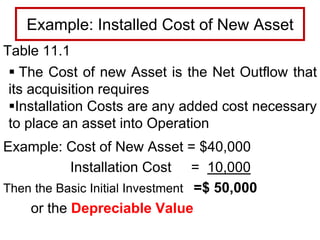
Example: Installed Cost of New Asset
Table 11.1
 The Cost of new Asset is the Net Outflow that
its acquisition requires
Installation Costs are any added cost necessary
to place an asset into Operation
Example: Cost of New Asset = $40,000
Installation Cost = 10,000
Then the Basic Initial Investment =$ 50,000
or the Depreciable Value
After Tax Proceeds from Sale of Old
Asset
ATPSOA= is the difference
between the old asset’s sale
proceeds and any applicable
taxes or tax refunds related to
its sale
• Book Value=difference between installed cost
and accumulated depreciation
• Basic Tax Rule =3 possible taxes: more than
its BV’ for its BV; Less than its BV.
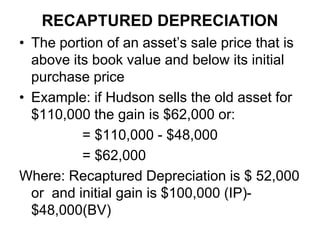
RECAPTURED DEPRECIATION
• The portion of an asset’s sale price that is
above its book value and below its initial
purchase price
• Example: if Hudson sells the old asset for
$110,000 the gain is $62,000 or:
= $110,000 - $48,000
= $62,000
Where: Recaptured Depreciation is $ 52,000
or and initial gain is $100,000 (IP)-
$48,000(BV)
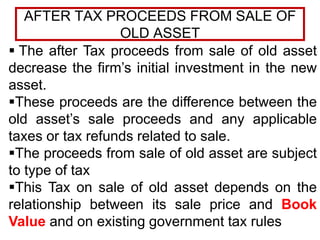
AFTER TAX PROCEEDS FROM SALE OF
OLD ASSET
 The after Tax proceeds from sale of old asset
decrease the firm’s initial investment in the new
asset.
These proceeds are the difference between the
old asset’s sale proceeds and any applicable
taxes or tax refunds related to sale.
The proceeds from sale of old asset are subject
to type of tax
This Tax on sale of old asset depends on the
relationship between its sale price and Book
Value and on existing government tax rules
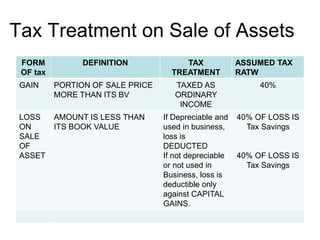
Tax Treatment on Sale of Assets
FORM
OF tax
DEFINITION TAX
TREATMENT
ASSUMED TAX
RATW
GAIN PORTION OF SALE PRICE
MORE THAN ITS BV
TAXED AS
ORDINARY
INCOME
40%
LOSS
ON
SALE
OF
ASSET
AMOUNT IS LESS THAN
ITS BOOK VALUE
If Depreciable and
used in business,
loss is
DEDUCTED
If not depreciable
or not used in
Business, loss is
deductible only
against CAPITAL
GAINS.
40% OF LOSS IS
Tax Savings
40% OF LOSS IS
Tax Savings
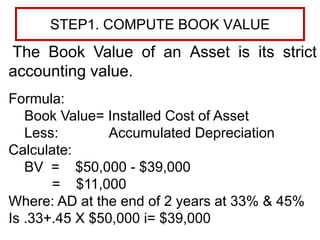
STEP1. COMPUTE BOOK VALUE
The Book Value of an Asset is its strict
accounting value.
Formula:
Book Value= Installed Cost of Asset
Less: Accumulated Depreciation
Calculate:
BV = $50,000 - $39,000
= $11,000
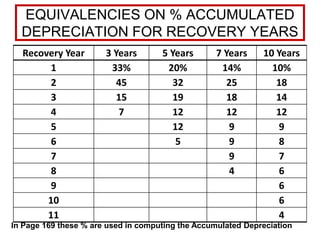
Where: AD at the end of 2 years at 33% & 45%
Is .33+.45 X $50,000 i= $39,000
EQUIVALENCIES ON % ACCUMULATED
DEPRECIATION FOR RECOVERY YEARS
Recovery Year 3 Years 5 Years 7 Years 10 Years
1 33% 20% 14% 10%
2 45 32 25 18
3 15 19 18 14
4 7 12 12 12
5 12 9 9
6 5 9 8
7 9 7
8 4 6
9 6
10 6
11 4
In Page 169 these % are used in computing the Accumulated Depreciation
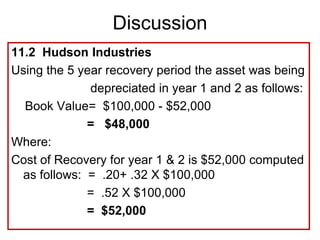
11.2 Hudson Industries
Using the 5 year recovery period the asset was being
depreciated in year 1 and 2 as follows:
Book Value= $100,000 - $52,000
= $48,000
Where:
Cost of Recovery for year 1 & 2 is $52,000 computed
as follows: = .20+ .32 X $100,000
= .52 X $100,000
= $52,000
Discussion
Discussion
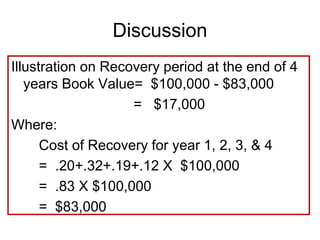
Illustration on Recovery period at the end of 4
years Book Value= $100,000 - $83,000
= $17,000
Where:
Cost of Recovery for year 1, 2, 3, & 4
= .20+.32+.19+.12 X $100,000
= .83 X $100,000
= $83,000
Discussion
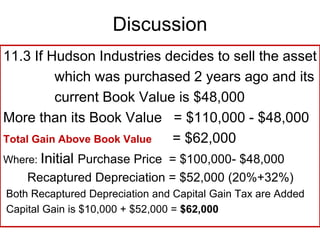
11.3 If Hudson Industries decides to sell the asset
which was purchased 2 years ago and its
current Book Value is $48,000
More than its Book Value = $110,000 - $48,000
Total Gain Above Book Value = $62,000
Where: Initial Purchase Price = $100,000- $48,000
Recaptured Depreciation = $52,000 (20%+32%)
Both Recaptured Depreciation and Capital Gain Tax are Added
Capital Gain is $10,000 + $52,000 = $62,000
Discussion
11.3 If Hudson Industries decides to sell the asset
which was purchased 2 years ago and its
current Book Value is $48,000
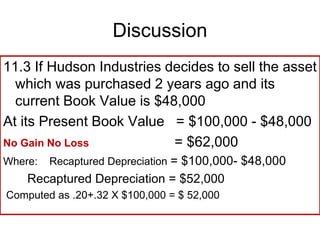
At its Present Book Value = $100,000 - $48,000
No Gain No Loss = $62,000
Where: Recaptured Depreciation = $100,000- $48,000
Recaptured Depreciation = $52,000
Computed as .20+.32 X $100,000 = $ 52,000
Discussion
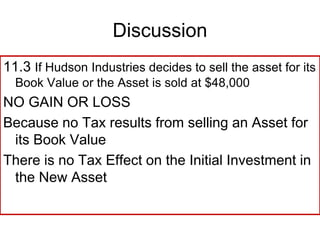
11.3 If Hudson Industries decides to sell the asset for its
Book Value or the Asset is sold at $48,000
NO GAIN OR LOSS
Because no Tax results from selling an Asset for
its Book Value
There is no Tax Effect on the Initial Investment in
the New Asset
Discussion
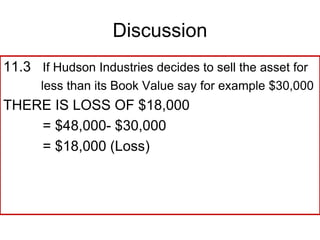
11.3 If Hudson Industries decides to sell the asset for
less than its Book Value say for example $30,000
THERE IS LOSS OF $18,000
= $48,000- $30,000
= $18,000 (Loss)
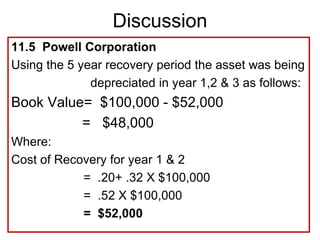
11.5 Powell Corporation
Using the 5 year recovery period the asset was being
depreciated in year 1,2 & 3 as follows:
Book Value= $100,000 - $52,000
= $48,000
Where:
Cost of Recovery for year 1 & 2
= .20+ .32 X $100,000
= .52 X $100,000
= $52,000
Discussion
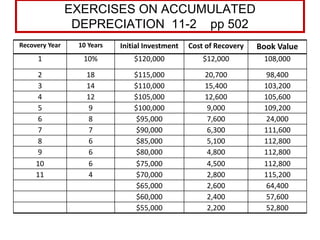
EXERCISES ON ACCUMULATED
DEPRECIATION 11-2 pp 502
Recovery Year 10 Years Initial Investment Cost of Recovery Book Value
1 10% $120,000 $12,000 108,000
2 18 $115,000 20,700 98,400
3 14 $110,000 15,400 103,200
4 12 $105,000 12,600 105,600
5 9 $100,000 9,000 109,200
6 8 $95,000 7,600 24,000
7 7 $90,000 6,300 111,600
8 6 $85,000 5,100 112,800
9 6 $80,000 4,800 112,800
10 6 $75,000 4,500 112,800
11 4 $70,000 2,800 115,200
$65,000 2,600 64,400
$60,000 2,400 57,600
$55,000 2,200 52,800
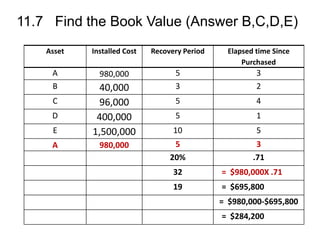
11.7 Find the Book Value (Answer B,C,D,E)
Asset Installed Cost Recovery Period Elapsed time Since
Purchased
A 980,000 5 3
B 40,000 3 2
C 96,000 5 4
D 400,000 5 1
E 1,500,000 10 5
A 980,000 5 3
20% .71
32 = $980,000X .71
19 = $695,800
= $980,000-$695,800
= $284,200
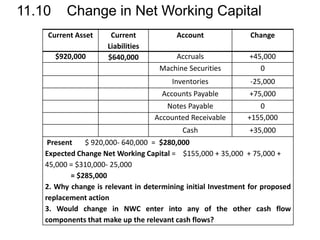
11.10 Change in Net Working Capital
Current Asset Current
Liabilities
Account Change
$920,000 $640,000 Accruals +45,000
Machine Securities 0
Inventories -25,000
Accounts Payable +75,000
Notes Payable 0
Accounted Receivable +155,000
Cash +35,000
Present $ 920,000- 640,000 = $280,000
Expected Change Net Working Capital = $155,000 + 35,000 + 75,000 +
45,000 = $310,000- 25,000
= $285,000
2. Why change is relevant in determining initial Investment for proposed
replacement action
3. Would change in NWC enter into any of the other cash flow
components that make up the relevant cash flows?
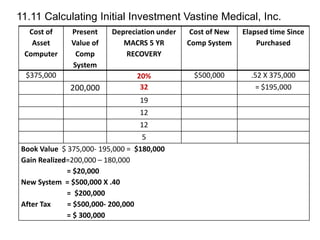
11.11 Calculating Initial Investment Vastine Medical, Inc.
Cost of
Asset
Computer
Present
Value of
Comp
System
Depreciation under
MACRS 5 YR
RECOVERY
Cost of New
Comp System
Elapsed time Since
Purchased
$375,000 20% $500,000 .52 X 375,000
200,000 32 = $195,000
19
12
12
5
Book Value $ 375,000- 195,000 = $180,000
Gain Realized=200,000 – 180,000
= $20,000
New System = $500,000 X .40
= $200,000
After Tax = $500,000- 200,000
= $ 300,000
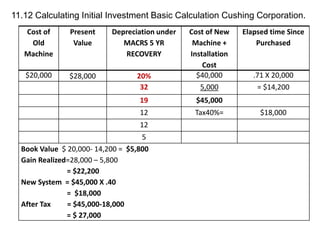
11.12 Calculating Initial Investment Basic Calculation Cushing Corporation.
Cost of
Old
Machine
Present
Value
Depreciation under
MACRS 5 YR
RECOVERY
Cost of New
Machine +
Installation
Cost
Elapsed time Since
Purchased
$20,000 $28,000 20% $40,000 .71 X 20,000
32 5,000 = $14,200
19 $45,000
12 Tax40%= $18,000
12
5
Book Value $ 20,000- 14,200 = $5,800
Gain Realized=28,000 – 5,800
= $22,200
New System = $45,000 X .40
= $18,000
After Tax = $45,000-18,000
= $ 27,000
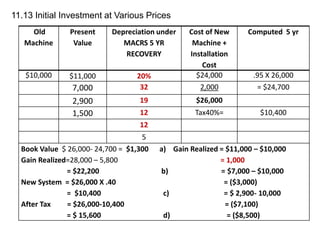
11.13 Initial Investment at Various Prices
Old
Machine
Present
Value
Depreciation under
MACRS 5 YR
RECOVERY
Cost of New
Machine +
Installation
Cost
Computed 5 yr
$10,000 $11,000 20% $24,000 .95 X 26,000
7,000 32 2,000 = $24,700
2,900 19 $26,000
1,500 12 Tax40%= $10,400
12
5
Book Value $ 26,000- 24,700 = $1,300 a) Gain Realized = $11,000 – $10,000
Gain Realized=28,000 – 5,800 = 1,000
= $22,200 b) = $7,000 – $10,000
New System = $26,000 X .40 = ($3,000)
= $10,400 c) = $ 2,900- 10,000
After Tax = $26,000-10,400 = ($7,100)
= $ 15,600 d) = ($8,500)
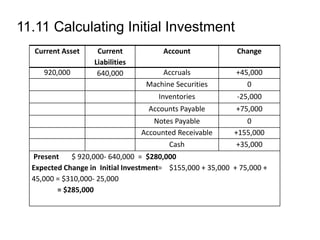
11.11 Calculating Initial Investment
Current Asset Current
Liabilities
Account Change
920,000 640,000 Accruals +45,000
Machine Securities 0
Inventories -25,000
Accounts Payable +75,000
Notes Payable 0
Accounted Receivable +155,000
Cash +35,000
Present $ 920,000- 640,000 = $280,000
Expected Change in Initial Investment= $155,000 + 35,000 + 75,000 +
45,000 = $310,000- 25,000
= $285,000
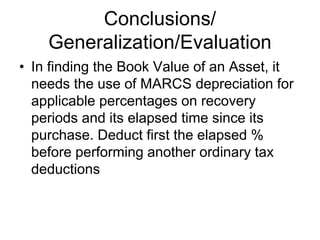
Conclusions/
Generalization/Evaluation
• In finding the Book Value of an Asset, it
needs the use of MARCS depreciation for
applicable percentages on recovery
periods and its elapsed time since its
purchase. Deduct first the elapsed %
before performing another ordinary tax
deductions
Conclusions/
Generalization/Evaluation
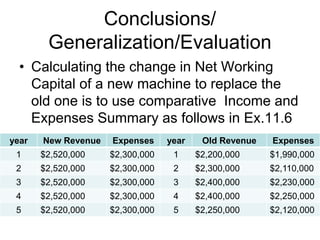
• Calculating the change in Net Working
Capital of a new machine to replace the
old one is to use comparative Income and
Expenses Summary as follows in Ex.11.6
year New Revenue Expenses year Old Revenue Expenses
1 $2,520,000 $2,300,000 1 $2,200,000 $1,990,000
2 $2,520,000 $2,300,000 2 $2,300,000 $2,110,000
3 $2,520,000 $2,300,000 3 $2,400,000 $2,230,000
4 $2,520,000 $2,300,000 4 $2,400,000 $2,250,000
5 $2,520,000 $2,300,000 5 $2,250,000 $2,120,000
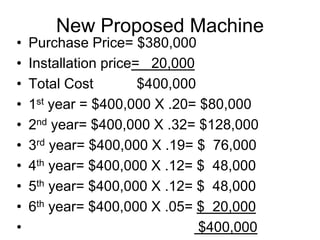
New Proposed Machine
• Purchase Price= $380,000
• Installation price= 20,000
• Total Cost $400,000
• 1st year = $400,000 X .20= $80,000
• 2nd year= $400,000 X .32= $128,000
• 3rd year= $400,000 X .19= $ 76,000
• 4th year= $400,000 X .12= $ 48,000
• 5th year= $400,000 X .12= $ 48,000
• 6th year= $400,000 X .05= $ 20,000
• $400,000
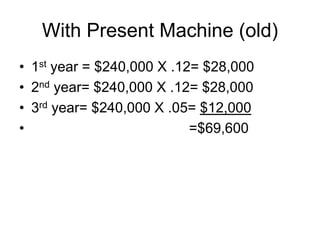
With Present Machine (old)
• 1st year = $240,000 X .12= $28,000
• 2nd year= $240,000 X .12= $28,000
• 3rd year= $240,000 X .05= $12,000
• =$69,600
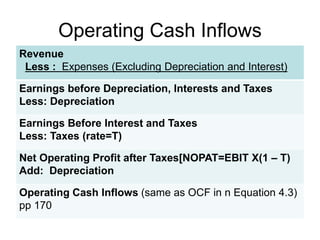
Operating Cash Inflows
Revenue
Less : Expenses (Excluding Depreciation and Interest)
Earnings before Depreciation, Interests and Taxes
Less: Depreciation
Earnings Before Interest and Taxes
Less: Taxes (rate=T)
Net Operating Profit after Taxes[NOPAT=EBIT X(1 – T)
Add: Depreciation
Operating Cash Inflows (same as OCF in n Equation 4.3)
pp 170
(Assignment)
• Check on the following exercises in
your book- pages 502-514
• Compute the following and pass them
next meeting: P11-12, P11-13, P11-16,
P11-19
• Be ready for Quiz

FINDING THE INITIAL INVESTMENT LESSON

  • 2.
    INITIAL INVESTMENT refers tothe relevant cash outflows considered when evaluating a prospective capital expenditure. These are: • the installed cost of new asset • After Tax proceeds from sale of Old Asset • Change in next working capital
  • 3.
    THE INSTALLED COSTOF NEW ASSET Installed Cost of New Asset- is the Cost of New Asset plus installation cost (if any) • CNA= net outflow its acquisition requires • IC = any added costs necessary to place an asset for operations
  • 4.
    Example: Installed Costof New Asset Table 11.1  The Cost of new Asset is the Net Outflow that its acquisition requires Installation Costs are any added cost necessary to place an asset into Operation Example: Cost of New Asset = $40,000 Installation Cost = 10,000 Then the Basic Initial Investment =$ 50,000 or the Depreciable Value
  • 5.
    After Tax Proceedsfrom Sale of Old Asset ATPSOA= is the difference between the old asset’s sale proceeds and any applicable taxes or tax refunds related to its sale • Book Value=difference between installed cost and accumulated depreciation • Basic Tax Rule =3 possible taxes: more than its BV’ for its BV; Less than its BV.
  • 6.
    RECAPTURED DEPRECIATION • Theportion of an asset’s sale price that is above its book value and below its initial purchase price • Example: if Hudson sells the old asset for $110,000 the gain is $62,000 or: = $110,000 - $48,000 = $62,000 Where: Recaptured Depreciation is $ 52,000 or and initial gain is $100,000 (IP)- $48,000(BV)
  • 7.
    AFTER TAX PROCEEDSFROM SALE OF OLD ASSET  The after Tax proceeds from sale of old asset decrease the firm’s initial investment in the new asset. These proceeds are the difference between the old asset’s sale proceeds and any applicable taxes or tax refunds related to sale. The proceeds from sale of old asset are subject to type of tax This Tax on sale of old asset depends on the relationship between its sale price and Book Value and on existing government tax rules
  • 8.
    Tax Treatment onSale of Assets FORM OF tax DEFINITION TAX TREATMENT ASSUMED TAX RATW GAIN PORTION OF SALE PRICE MORE THAN ITS BV TAXED AS ORDINARY INCOME 40% LOSS ON SALE OF ASSET AMOUNT IS LESS THAN ITS BOOK VALUE If Depreciable and used in business, loss is DEDUCTED If not depreciable or not used in Business, loss is deductible only against CAPITAL GAINS. 40% OF LOSS IS Tax Savings 40% OF LOSS IS Tax Savings
  • 9.
    STEP1. COMPUTE BOOKVALUE The Book Value of an Asset is its strict accounting value. Formula: Book Value= Installed Cost of Asset Less: Accumulated Depreciation Calculate: BV = $50,000 - $39,000 = $11,000 Where: AD at the end of 2 years at 33% & 45% Is .33+.45 X $50,000 i= $39,000
  • 10.
    EQUIVALENCIES ON %ACCUMULATED DEPRECIATION FOR RECOVERY YEARS Recovery Year 3 Years 5 Years 7 Years 10 Years 1 33% 20% 14% 10% 2 45 32 25 18 3 15 19 18 14 4 7 12 12 12 5 12 9 9 6 5 9 8 7 9 7 8 4 6 9 6 10 6 11 4 In Page 169 these % are used in computing the Accumulated Depreciation
  • 11.
    11.2 Hudson Industries Usingthe 5 year recovery period the asset was being depreciated in year 1 and 2 as follows: Book Value= $100,000 - $52,000 = $48,000 Where: Cost of Recovery for year 1 & 2 is $52,000 computed as follows: = .20+ .32 X $100,000 = .52 X $100,000 = $52,000 Discussion
  • 12.
    Discussion Illustration on Recoveryperiod at the end of 4 years Book Value= $100,000 - $83,000 = $17,000 Where: Cost of Recovery for year 1, 2, 3, & 4 = .20+.32+.19+.12 X $100,000 = .83 X $100,000 = $83,000
  • 13.
    Discussion 11.3 If HudsonIndustries decides to sell the asset which was purchased 2 years ago and its current Book Value is $48,000 More than its Book Value = $110,000 - $48,000 Total Gain Above Book Value = $62,000 Where: Initial Purchase Price = $100,000- $48,000 Recaptured Depreciation = $52,000 (20%+32%) Both Recaptured Depreciation and Capital Gain Tax are Added Capital Gain is $10,000 + $52,000 = $62,000
  • 14.
    Discussion 11.3 If HudsonIndustries decides to sell the asset which was purchased 2 years ago and its current Book Value is $48,000 At its Present Book Value = $100,000 - $48,000 No Gain No Loss = $62,000 Where: Recaptured Depreciation = $100,000- $48,000 Recaptured Depreciation = $52,000 Computed as .20+.32 X $100,000 = $ 52,000
  • 15.
    Discussion 11.3 If HudsonIndustries decides to sell the asset for its Book Value or the Asset is sold at $48,000 NO GAIN OR LOSS Because no Tax results from selling an Asset for its Book Value There is no Tax Effect on the Initial Investment in the New Asset
  • 16.
    Discussion 11.3 If HudsonIndustries decides to sell the asset for less than its Book Value say for example $30,000 THERE IS LOSS OF $18,000 = $48,000- $30,000 = $18,000 (Loss)
  • 17.
    11.5 Powell Corporation Usingthe 5 year recovery period the asset was being depreciated in year 1,2 & 3 as follows: Book Value= $100,000 - $52,000 = $48,000 Where: Cost of Recovery for year 1 & 2 = .20+ .32 X $100,000 = .52 X $100,000 = $52,000 Discussion
  • 18.
    EXERCISES ON ACCUMULATED DEPRECIATION11-2 pp 502 Recovery Year 10 Years Initial Investment Cost of Recovery Book Value 1 10% $120,000 $12,000 108,000 2 18 $115,000 20,700 98,400 3 14 $110,000 15,400 103,200 4 12 $105,000 12,600 105,600 5 9 $100,000 9,000 109,200 6 8 $95,000 7,600 24,000 7 7 $90,000 6,300 111,600 8 6 $85,000 5,100 112,800 9 6 $80,000 4,800 112,800 10 6 $75,000 4,500 112,800 11 4 $70,000 2,800 115,200 $65,000 2,600 64,400 $60,000 2,400 57,600 $55,000 2,200 52,800
  • 19.
    11.7 Find theBook Value (Answer B,C,D,E) Asset Installed Cost Recovery Period Elapsed time Since Purchased A 980,000 5 3 B 40,000 3 2 C 96,000 5 4 D 400,000 5 1 E 1,500,000 10 5 A 980,000 5 3 20% .71 32 = $980,000X .71 19 = $695,800 = $980,000-$695,800 = $284,200
  • 20.
    11.10 Change inNet Working Capital Current Asset Current Liabilities Account Change $920,000 $640,000 Accruals +45,000 Machine Securities 0 Inventories -25,000 Accounts Payable +75,000 Notes Payable 0 Accounted Receivable +155,000 Cash +35,000 Present $ 920,000- 640,000 = $280,000 Expected Change Net Working Capital = $155,000 + 35,000 + 75,000 + 45,000 = $310,000- 25,000 = $285,000 2. Why change is relevant in determining initial Investment for proposed replacement action 3. Would change in NWC enter into any of the other cash flow components that make up the relevant cash flows?
  • 21.
    11.11 Calculating InitialInvestment Vastine Medical, Inc. Cost of Asset Computer Present Value of Comp System Depreciation under MACRS 5 YR RECOVERY Cost of New Comp System Elapsed time Since Purchased $375,000 20% $500,000 .52 X 375,000 200,000 32 = $195,000 19 12 12 5 Book Value $ 375,000- 195,000 = $180,000 Gain Realized=200,000 – 180,000 = $20,000 New System = $500,000 X .40 = $200,000 After Tax = $500,000- 200,000 = $ 300,000
  • 22.
    11.12 Calculating InitialInvestment Basic Calculation Cushing Corporation. Cost of Old Machine Present Value Depreciation under MACRS 5 YR RECOVERY Cost of New Machine + Installation Cost Elapsed time Since Purchased $20,000 $28,000 20% $40,000 .71 X 20,000 32 5,000 = $14,200 19 $45,000 12 Tax40%= $18,000 12 5 Book Value $ 20,000- 14,200 = $5,800 Gain Realized=28,000 – 5,800 = $22,200 New System = $45,000 X .40 = $18,000 After Tax = $45,000-18,000 = $ 27,000
  • 23.
    11.13 Initial Investmentat Various Prices Old Machine Present Value Depreciation under MACRS 5 YR RECOVERY Cost of New Machine + Installation Cost Computed 5 yr $10,000 $11,000 20% $24,000 .95 X 26,000 7,000 32 2,000 = $24,700 2,900 19 $26,000 1,500 12 Tax40%= $10,400 12 5 Book Value $ 26,000- 24,700 = $1,300 a) Gain Realized = $11,000 – $10,000 Gain Realized=28,000 – 5,800 = 1,000 = $22,200 b) = $7,000 – $10,000 New System = $26,000 X .40 = ($3,000) = $10,400 c) = $ 2,900- 10,000 After Tax = $26,000-10,400 = ($7,100) = $ 15,600 d) = ($8,500)
  • 24.
    11.11 Calculating InitialInvestment Current Asset Current Liabilities Account Change 920,000 640,000 Accruals +45,000 Machine Securities 0 Inventories -25,000 Accounts Payable +75,000 Notes Payable 0 Accounted Receivable +155,000 Cash +35,000 Present $ 920,000- 640,000 = $280,000 Expected Change in Initial Investment= $155,000 + 35,000 + 75,000 + 45,000 = $310,000- 25,000 = $285,000
  • 25.
    Conclusions/ Generalization/Evaluation • In findingthe Book Value of an Asset, it needs the use of MARCS depreciation for applicable percentages on recovery periods and its elapsed time since its purchase. Deduct first the elapsed % before performing another ordinary tax deductions
  • 26.
    Conclusions/ Generalization/Evaluation • Calculating thechange in Net Working Capital of a new machine to replace the old one is to use comparative Income and Expenses Summary as follows in Ex.11.6 year New Revenue Expenses year Old Revenue Expenses 1 $2,520,000 $2,300,000 1 $2,200,000 $1,990,000 2 $2,520,000 $2,300,000 2 $2,300,000 $2,110,000 3 $2,520,000 $2,300,000 3 $2,400,000 $2,230,000 4 $2,520,000 $2,300,000 4 $2,400,000 $2,250,000 5 $2,520,000 $2,300,000 5 $2,250,000 $2,120,000
  • 27.
    New Proposed Machine •Purchase Price= $380,000 • Installation price= 20,000 • Total Cost $400,000 • 1st year = $400,000 X .20= $80,000 • 2nd year= $400,000 X .32= $128,000 • 3rd year= $400,000 X .19= $ 76,000 • 4th year= $400,000 X .12= $ 48,000 • 5th year= $400,000 X .12= $ 48,000 • 6th year= $400,000 X .05= $ 20,000 • $400,000
  • 28.
    With Present Machine(old) • 1st year = $240,000 X .12= $28,000 • 2nd year= $240,000 X .12= $28,000 • 3rd year= $240,000 X .05= $12,000 • =$69,600
  • 29.
    Operating Cash Inflows Revenue Less: Expenses (Excluding Depreciation and Interest) Earnings before Depreciation, Interests and Taxes Less: Depreciation Earnings Before Interest and Taxes Less: Taxes (rate=T) Net Operating Profit after Taxes[NOPAT=EBIT X(1 – T) Add: Depreciation Operating Cash Inflows (same as OCF in n Equation 4.3) pp 170
  • 30.
    (Assignment) • Check onthe following exercises in your book- pages 502-514 • Compute the following and pass them next meeting: P11-12, P11-13, P11-16, P11-19 • Be ready for Quiz