By: Premala Nair Krishnakutty 
Summary from: 
ENGLISH FOR WRITING RESEARCH PAPERS 
By: 
adrian.wallwork@gmail.com.
 Abstracts are sometimes referred as summary 
 There are 4 types of abstract 
• Unstructured abstract – contain 100 to 250 words in a paragraph with 
brief summary of each main sections 
• Structured abstract - the same as (1) but divided into several short 
sections 
• Extended abstract - A mini paper organized in the same way as a full 
paper (e.g. Introduction, Methods, Discussion…), but substantially 
shorter (two to four pages) 
• Conference abstract - standalone abstract (sometimes up to 500 
words), designed to help conference organizers to decide whether they 
would like you to make an oral presentation
 Write a draft of the abstract before writing your 
paper 
 It will help on what to write and how to structure 
your writing 
 Professional writer normally writes the abstract at 
the end of their paper which reflects the research 
process
 You can answer this questions to structure your 
abstract 
• Why did I carry out this project? Why am I writing this 
paper? 
• What did I do, and how? 
• What were my results? What was new compared to previous 
research? 
• What are the implications of my findings? What are 
my conclusions and /or recommendations?
 (1) The lifetime of a 4G cellular phone battery 
may be subject to the number of times the 
battery is recharged and how long it is charged 
for. To date, there has not been an adequate 
analytical model to predict this lifetime. 
 (2) In this work an analytical model is 
developed which describes the relationship 
between the number of times a battery is 
recharged, the length of time of each individual 
recharge, and the duration of the battery. 
 (3) This model has been validated by comparison 
with both experimental measurements and finite 
element analyses, and shows strong agreement 
for all three parameters. 
 (4) The results for the proposed model are 
more accurate than results for previous analytical 
models reported in the literature for 4G cell 
phones. 
 (5) The new model can be used to design longer 
lasting batteries. 
 1. The problem that this paper is trying to resolve 
set in the context of the current situation. Why did 
you carry out your project and why are you writing 
this paper? What gap in the current knowledge do 
you hope to fill? 
 2. New solution given by authors of the 
paper. What is the innovative contribution of 
your work? What did you do and achieve? What 
makes it different from previous research? 
 3. Validity of the model. Does it really do what you 
say it does? 
 4. Results. What is new compared to previous 
results? 
 5. Implications and future work. What does 
this all mean? What are your conclusions and 
recommendations? What do you plan to do next?
 Begin the abstract with one or two sentences saying what you 
did plus one key result, i.e. begin with information that the 
reader does NOT already know 
 Introduce the background by connecting in some way to what 
you said in your introductory sentence. 
 Use the background information (which the reader may or not 
already know) to justify what you did, and outline your 
methodology (and materials where appropriate) 
 Provide some more information on your results 
 Tell the reader the implications of your results
 Also have similar structure as a scientific abstract 
Primary objective 
 Design of research 
Methods and procedures 
Outcomes of research that support your theory/perspective 
Conclusions or Implications
 Abstracts from social and behavioral sciences tend 
to devote more space to background issues and 
context setting 
 Abstract should include the following at any case 
Background information 
Your aim and its importance 
Your contribution and its value 
What you looked at 
Your conclusions and implications
 When writing review, tell audience what is your 
primary objective 
 Explain your reasons to selecting certain papers 
 Your ‘results’ are your findings drawn from 
analyzing the literature 
 Finally, for your review to have a real purpose 
you will want to state your conclusions and 
what implications they have for further 
research in your field 
**Your structure should always consist: aim, methodology 
(selection process), results, conclusions, and implications.
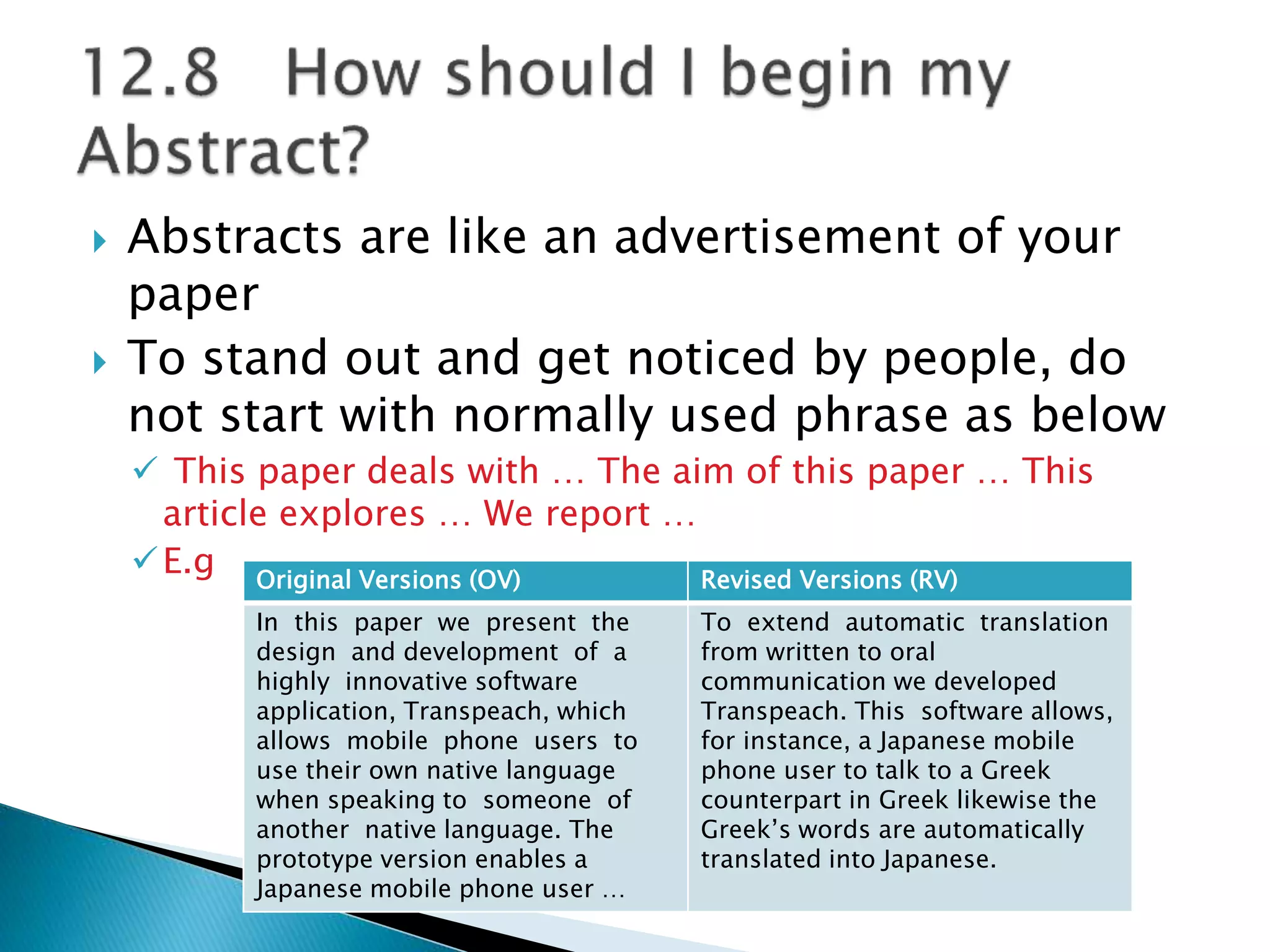
 Abstracts are like an advertisement of your 
paper 
 To stand out and get noticed by people, do 
not start with normally used phrase as below 
 This paper deals with … The aim of this paper … This 
article explores … We report … 
 E.g 
Original Versions (OV) Revised Versions (RV) 
In this paper we present the 
design and development of a 
highly innovative software 
application, Transpeach, which 
allows mobile phone users to 
use their own native language 
when speaking to someone of 
another native language. The 
prototype version enables a 
Japanese mobile phone user … 
To extend automatic translation 
from written to oral 
communication we developed 
Transpeach. This software allows, 
for instance, a Japanese mobile 
phone user to talk to a Greek 
counterpart in Greek likewise the 
Greek’s words are automatically 
translated into Japanese.
 There are 4 types to write abstract 
 Style 1: I found that x = y. 
 Style 2: We found that x = y. 
 Style 3: It was found that x = y. 
 Style 4: The authors found that x = y
Style 1: The intention of this paper is to raise 
some questions about the ‘ownership’ of 
scientific English. Its author is a native 
speaker of English and a teacher of scientific 
English, but it aims its arguments at the 
international scientific community 
communicating in English. The paper is 
deliberately somewhat provocative in parts 
in an attempt to raise some questions about 
‘scientific English’ which I think are 
important but which have not been faced to 
date. 
Style 2:We investigate the dynamics of toast 
tumbling from a table to the floor. Popular 
opinion is that the final state is usually 
butter-side down, and constitutes prima 
facie evidence of Murphy’s Law (‘If it can go 
wrong, it will’). The orthodox view, in 
contrast, is that the phenomenon is 
essentially random, with a 50 / 50 split of 
possible outcomes. We show that toast 
does indeed have an inherent tendency 
to land butter-side down for a wide 
range of conditions. 
Style 3Three red flags were identified that 
indicate that the time to leave him has come. 
These red flags are: five burps per day, two 
sitting-zapping sessions per day, and fives 
games on the Playstation with friends per 
week.A large number of women have doubts 
about the right moment for leaving their 
partner. Often women wait in hope for a 
change in their partner’s habits.One 
hundred couples were analyzed, recording 
their daily life for six months. 
Style 4 People tend to hold overly favorable 
views of their abilities in many social and 
intellectual domains. The authors suggest 
that this overestimation occurs, in part, 
because people who are unskilled in 
these domains suffer a dual burden: Not 
only do these people reach erroneous 
conclusions and make unfortunate choices, 
but their incompetence robs them of the 
metacognitive ability to realize it. Across 4 
studies, the authors found that …
 Present simple (we show) and the Past simple (we 
showed) 
 Present perfect (which have not been faced to date) 
 You can use the Present perfect and the Present 
perfect continuous when you describe a situation 
that began in the past and is still true now
 Becoming popular, looks like mini paper 
 Found in medicine, economics, natural sciences, and 
other areas 
 It also help to write more clearer abstracts 
 Force author to answer all the questions 
 Here are some typical sections in a structured abstract: 
 From a journal of vegetation sciences: 
Question - Location - Methods - Results – Conclusions 
 From an economics journal: 
Purpose - Design / Methodology / Approach - Findings - Practical implications - 
Originality / value - Keywords - Paper type 
 From various medical journals: 
Background / Context / Purpose - Methods - Results / Findings - Conclusions 
Context - Aim / Objective - Design - Setting - Patients (or Participants) - 
Interventions / 
Treatment - Main Outcome Measure(s) - Results - Conclusions 
Context - Objective - Data Sources - Study Selection - Data Extraction - Results 
- Conclusions
 an abstract for a conference must really fit the 
conference theme. 
 suitable for publishing in the conference 
handbook/proceedings 
 Your title should be interesting but not too 
obscure/unclear 
 the rules for writing the abstract are the same as 
for a journal, though your style may be slightly 
more informal.
 Conferences are generally planned up to two 
years in advance. 
 When you answer the call for papers, your 
research may not yet be complete 
 think that the conference would be a good 
way to get feedback on your progress. 
 Abstract which contains the words currently, 
will explore, seem to indicate, andwe hope, is 
to highlight that this is ongoing research
 have keywords in your abstract (and title too) 
 key words are also the words that readers are 
looking for in their initial search 
 ‘keyword spamming’ may lead to the web 
page being rejected by the search engine 
 Some journals require you to have a list of 
four or five key words directly under your 
abstract
 You should certainly mention the limitations 
of your research at some point in the paper. 
 However, given that an Abstract is designed 
to ‘sell’ your research, you might decide not 
to mention the limitations until the 
Discussion
 You should try to avoid: 
background information that is too generalist for your readers 
claims that are not supported in the paper 
terms that are too technical or too generic 
definitions of key terms 
mathematical equations 
generic quantifications (e.g. many, several, few, a wide variety) 
and the overuse or unjustified use of subjective adjectives (e.g. 
innovative, interesting, fundamental). 
unnecessary details that would be better located in your 
Introduction, such as the name of your institute, place names 
that readers will not have heard of 
references to other papers. However, if your whole paper is 
based on an extending or refuting a finding given by one 
specific author, then you will need to mention this author’s 
name.
 Firstly, put the information in the best 
possible order 
 Secondly, highlight the importance of what 
you are saying 
 Thirdly, be as concise as possible.
 If it is not self sufficient 
 If the abstract are more likely to be an 
Introduction of the paper 
 If it contains a reference to another authors 
work 
 If it mentions irrelevant details 
 If the reader has no idea of what results were 
obtained
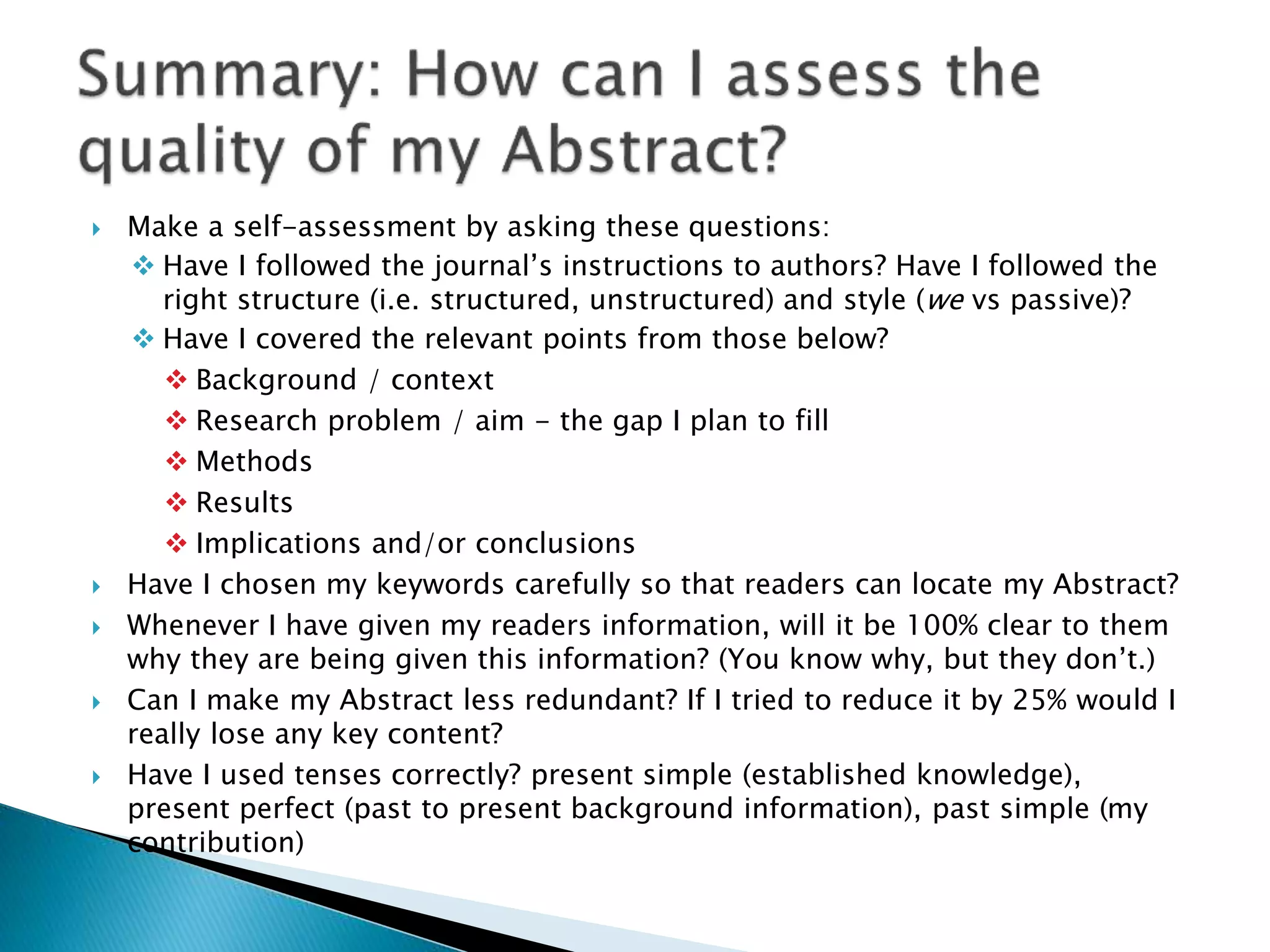
 Make a self-assessment by asking these questions: 
 Have I followed the journal’s instructions to authors? Have I followed the 
right structure (i.e. structured, unstructured) and style (we vs passive)? 
 Have I covered the relevant points from those below? 
 Background / context 
 Research problem / aim - the gap I plan to fill 
 Methods 
 Results 
 Implications and/or conclusions 
 Have I chosen my keywords carefully so that readers can locate my Abstract? 
 Whenever I have given my readers information, will it be 100% clear to them 
why they are being given this information? (You know why, but they don’t.) 
 Can I make my Abstract less redundant? If I tried to reduce it by 25% would I 
really lose any key content? 
 Have I used tenses correctly? present simple (established knowledge), 
present perfect (past to present background information), past simple (my 
contribution)

Chapter 12: Abstract ( english for writing research papers)

  • 1.
    By: Premala NairKrishnakutty Summary from: ENGLISH FOR WRITING RESEARCH PAPERS By: adrian.wallwork@gmail.com.
  • 2.
     Abstracts aresometimes referred as summary  There are 4 types of abstract • Unstructured abstract – contain 100 to 250 words in a paragraph with brief summary of each main sections • Structured abstract - the same as (1) but divided into several short sections • Extended abstract - A mini paper organized in the same way as a full paper (e.g. Introduction, Methods, Discussion…), but substantially shorter (two to four pages) • Conference abstract - standalone abstract (sometimes up to 500 words), designed to help conference organizers to decide whether they would like you to make an oral presentation
  • 3.
     Write adraft of the abstract before writing your paper  It will help on what to write and how to structure your writing  Professional writer normally writes the abstract at the end of their paper which reflects the research process
  • 4.
     You cananswer this questions to structure your abstract • Why did I carry out this project? Why am I writing this paper? • What did I do, and how? • What were my results? What was new compared to previous research? • What are the implications of my findings? What are my conclusions and /or recommendations?
  • 5.
     (1) Thelifetime of a 4G cellular phone battery may be subject to the number of times the battery is recharged and how long it is charged for. To date, there has not been an adequate analytical model to predict this lifetime.  (2) In this work an analytical model is developed which describes the relationship between the number of times a battery is recharged, the length of time of each individual recharge, and the duration of the battery.  (3) This model has been validated by comparison with both experimental measurements and finite element analyses, and shows strong agreement for all three parameters.  (4) The results for the proposed model are more accurate than results for previous analytical models reported in the literature for 4G cell phones.  (5) The new model can be used to design longer lasting batteries.  1. The problem that this paper is trying to resolve set in the context of the current situation. Why did you carry out your project and why are you writing this paper? What gap in the current knowledge do you hope to fill?  2. New solution given by authors of the paper. What is the innovative contribution of your work? What did you do and achieve? What makes it different from previous research?  3. Validity of the model. Does it really do what you say it does?  4. Results. What is new compared to previous results?  5. Implications and future work. What does this all mean? What are your conclusions and recommendations? What do you plan to do next?
  • 6.
     Begin theabstract with one or two sentences saying what you did plus one key result, i.e. begin with information that the reader does NOT already know  Introduce the background by connecting in some way to what you said in your introductory sentence.  Use the background information (which the reader may or not already know) to justify what you did, and outline your methodology (and materials where appropriate)  Provide some more information on your results  Tell the reader the implications of your results
  • 7.
     Also havesimilar structure as a scientific abstract Primary objective  Design of research Methods and procedures Outcomes of research that support your theory/perspective Conclusions or Implications
  • 8.
     Abstracts fromsocial and behavioral sciences tend to devote more space to background issues and context setting  Abstract should include the following at any case Background information Your aim and its importance Your contribution and its value What you looked at Your conclusions and implications
  • 9.
     When writingreview, tell audience what is your primary objective  Explain your reasons to selecting certain papers  Your ‘results’ are your findings drawn from analyzing the literature  Finally, for your review to have a real purpose you will want to state your conclusions and what implications they have for further research in your field **Your structure should always consist: aim, methodology (selection process), results, conclusions, and implications.
  • 10.
     Abstracts arelike an advertisement of your paper  To stand out and get noticed by people, do not start with normally used phrase as below  This paper deals with … The aim of this paper … This article explores … We report …  E.g Original Versions (OV) Revised Versions (RV) In this paper we present the design and development of a highly innovative software application, Transpeach, which allows mobile phone users to use their own native language when speaking to someone of another native language. The prototype version enables a Japanese mobile phone user … To extend automatic translation from written to oral communication we developed Transpeach. This software allows, for instance, a Japanese mobile phone user to talk to a Greek counterpart in Greek likewise the Greek’s words are automatically translated into Japanese.
  • 11.
     There are4 types to write abstract  Style 1: I found that x = y.  Style 2: We found that x = y.  Style 3: It was found that x = y.  Style 4: The authors found that x = y
  • 12.
    Style 1: Theintention of this paper is to raise some questions about the ‘ownership’ of scientific English. Its author is a native speaker of English and a teacher of scientific English, but it aims its arguments at the international scientific community communicating in English. The paper is deliberately somewhat provocative in parts in an attempt to raise some questions about ‘scientific English’ which I think are important but which have not been faced to date. Style 2:We investigate the dynamics of toast tumbling from a table to the floor. Popular opinion is that the final state is usually butter-side down, and constitutes prima facie evidence of Murphy’s Law (‘If it can go wrong, it will’). The orthodox view, in contrast, is that the phenomenon is essentially random, with a 50 / 50 split of possible outcomes. We show that toast does indeed have an inherent tendency to land butter-side down for a wide range of conditions. Style 3Three red flags were identified that indicate that the time to leave him has come. These red flags are: five burps per day, two sitting-zapping sessions per day, and fives games on the Playstation with friends per week.A large number of women have doubts about the right moment for leaving their partner. Often women wait in hope for a change in their partner’s habits.One hundred couples were analyzed, recording their daily life for six months. Style 4 People tend to hold overly favorable views of their abilities in many social and intellectual domains. The authors suggest that this overestimation occurs, in part, because people who are unskilled in these domains suffer a dual burden: Not only do these people reach erroneous conclusions and make unfortunate choices, but their incompetence robs them of the metacognitive ability to realize it. Across 4 studies, the authors found that …
  • 13.
     Present simple(we show) and the Past simple (we showed)  Present perfect (which have not been faced to date)  You can use the Present perfect and the Present perfect continuous when you describe a situation that began in the past and is still true now
  • 14.
     Becoming popular,looks like mini paper  Found in medicine, economics, natural sciences, and other areas  It also help to write more clearer abstracts  Force author to answer all the questions  Here are some typical sections in a structured abstract:  From a journal of vegetation sciences: Question - Location - Methods - Results – Conclusions  From an economics journal: Purpose - Design / Methodology / Approach - Findings - Practical implications - Originality / value - Keywords - Paper type  From various medical journals: Background / Context / Purpose - Methods - Results / Findings - Conclusions Context - Aim / Objective - Design - Setting - Patients (or Participants) - Interventions / Treatment - Main Outcome Measure(s) - Results - Conclusions Context - Objective - Data Sources - Study Selection - Data Extraction - Results - Conclusions
  • 15.
     an abstractfor a conference must really fit the conference theme.  suitable for publishing in the conference handbook/proceedings  Your title should be interesting but not too obscure/unclear  the rules for writing the abstract are the same as for a journal, though your style may be slightly more informal.
  • 16.
     Conferences aregenerally planned up to two years in advance.  When you answer the call for papers, your research may not yet be complete  think that the conference would be a good way to get feedback on your progress.  Abstract which contains the words currently, will explore, seem to indicate, andwe hope, is to highlight that this is ongoing research
  • 17.
     have keywordsin your abstract (and title too)  key words are also the words that readers are looking for in their initial search  ‘keyword spamming’ may lead to the web page being rejected by the search engine  Some journals require you to have a list of four or five key words directly under your abstract
  • 18.
     You shouldcertainly mention the limitations of your research at some point in the paper.  However, given that an Abstract is designed to ‘sell’ your research, you might decide not to mention the limitations until the Discussion
  • 19.
     You shouldtry to avoid: background information that is too generalist for your readers claims that are not supported in the paper terms that are too technical or too generic definitions of key terms mathematical equations generic quantifications (e.g. many, several, few, a wide variety) and the overuse or unjustified use of subjective adjectives (e.g. innovative, interesting, fundamental). unnecessary details that would be better located in your Introduction, such as the name of your institute, place names that readers will not have heard of references to other papers. However, if your whole paper is based on an extending or refuting a finding given by one specific author, then you will need to mention this author’s name.
  • 20.
     Firstly, putthe information in the best possible order  Secondly, highlight the importance of what you are saying  Thirdly, be as concise as possible.
  • 21.
     If itis not self sufficient  If the abstract are more likely to be an Introduction of the paper  If it contains a reference to another authors work  If it mentions irrelevant details  If the reader has no idea of what results were obtained
  • 22.
     Make aself-assessment by asking these questions:  Have I followed the journal’s instructions to authors? Have I followed the right structure (i.e. structured, unstructured) and style (we vs passive)?  Have I covered the relevant points from those below?  Background / context  Research problem / aim - the gap I plan to fill  Methods  Results  Implications and/or conclusions  Have I chosen my keywords carefully so that readers can locate my Abstract?  Whenever I have given my readers information, will it be 100% clear to them why they are being given this information? (You know why, but they don’t.)  Can I make my Abstract less redundant? If I tried to reduce it by 25% would I really lose any key content?  Have I used tenses correctly? present simple (established knowledge), present perfect (past to present background information), past simple (my contribution)