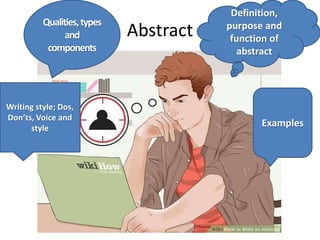
Abstract
Definition,
purpose and
function of
abstract
Qualities,types
and
components
Writing style; Dos,
Don’ts, Voice and
style
Examples
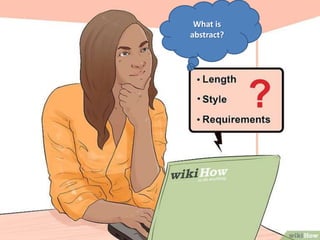
What is
abstract?
Abstract is…
• A concise summary of the entire paper.
• Usually about a paragraph (6-7 sentences, 150-
250 words) long.
• Provides readers with a quick overview of your
essay or report and its organization.
• A short summary of a longer work (such as
a dissertation or research paper).
• Concisely reports the aims and outcomes of your
research
• Expresses your thesis (or central idea) and your
key points.
When do people write abstracts?
• when submitting articles to journals,
especially online journals
• when applying for research grants
• when writing a book proposal
• when completing the Ph.D. dissertation or
B.Tech., M.Tech. thesis
• when writing a proposal for a conference
paper
• when writing a proposal for a book chapter
Components…
• The function of an abstract is to describe, not
to evaluate or defend, the paper.
• An abstract lets readers get the gist or essence
of your paper or article quickly
• Your research problem and objectives
• Your methods
• Your key results or arguments
• Your conclusion
• Keywords
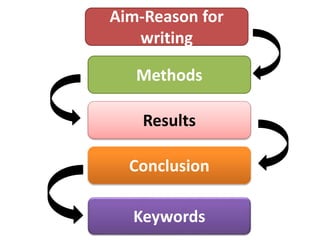
Aim-Reason for
writing
Methods
Results
Conclusion
Keywords
Design…
• Avoid beginning your sentences with phrases
like, “This essay will examine...” or “In this
research paper I will attempt to prove...”
• things you need to include:
• In a dissertation or thesis, include the abstract
on a separate page, after the title
page and acknowledgements but before
the table of contents.
Types
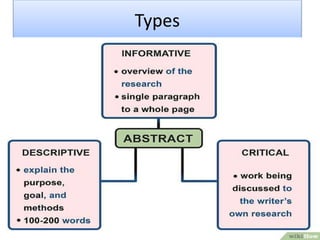
• Descriptive abstracts
• Indicates the type of information found in the work.
• Makes no judgments about the work, results or
conclusions
• It does incorporate key words, the purpose, methods,
and scope of the research.
• Describes the work being abstracted.
• An outline of the work, rather than a summary.
• Descriptive abstracts are usually very short—100 words
or less.
• Used for humanities and social science papers or
psychology essays.
• Informative abstracts
• The majority of abstracts are informative.
• Do not critique or evaluate a work, they do more than
describe it.
• A good informative abstract acts as a surrogate for the work
itself.
• Explains all the main arguments and the important results
and evidence
• An informative abstract includes purpose, methods, scope,
results, conclusions and recommendations of the author.
• The length more than 10% of the length of the entire work.
• used for science, engineering or psychology reports.
• You can also make a guess based on the length allowed;
i.e., 100-120 words = descriptive; 250+ words = informative.
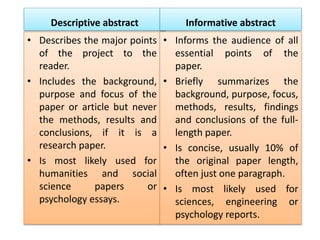
Descriptive abstract
• Describes the major points
of the project to the
reader.
• Includes the background,
purpose and focus of the
paper or article but never
the methods, results and
conclusions, if it is a
research paper.
• Is most likely used for
humanities and social
science papers or
psychology essays.
Informative abstract
• Informs the audience of all
essential points of the
paper.
• Briefly summarizes the
background, purpose, focus,
methods, results, findings
and conclusions of the full-
length paper.
• Is concise, usually 10% of
the original paper length,
often just one paragraph.
• Is most likely used for
sciences, engineering or
psychology reports.
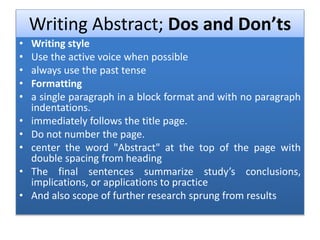
Writing Abstract; Dos and Don’ts
• Writing style
• Use the active voice when possible
• always use the past tense
• Formatting
• a single paragraph in a block format and with no paragraph
indentations.
• immediately follows the title page.
• Do not number the page.
• center the word "Abstract" at the top of the page with
double spacing from heading
• The final sentences summarize study’s conclusions,
implications, or applications to practice
• And also scope of further research sprung from results
• The abstract SHOULD NOT contain:
• Lengthy background or contextual information,
• Redundant phrases, unnecessary adverbs and
adjectives, and repetitive information;
• Acronyms or abbreviations,
• References to other literature [say something like,
"current research shows that..." or "studies have
indicated..."],
• Using elliptical [i.e., ending with "..."] or incomplete
sentences,
• Jargon or terms that may be confusing to the reader,
• Citations to other works
• Any sort of image, illustration, figure, or table, or
references to them.
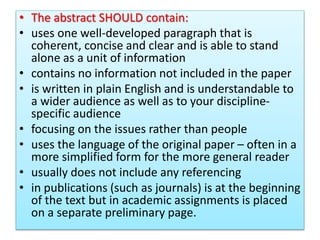
• The abstract SHOULD contain:
• uses one well-developed paragraph that is
coherent, concise and clear and is able to stand
alone as a unit of information
• contains no information not included in the paper
• is written in plain English and is understandable to
a wider audience as well as to your discipline-
specific audience
• focusing on the issues rather than people
• uses the language of the original paper – often in a
more simplified form for the more general reader
• usually does not include any referencing
• in publications (such as journals) is at the beginning
of the text but in academic assignments is placed
on a separate preliminary page.
Sources
• https://writingcenter.gmu.edu/guides/writing-an-
abstract
• https://www.scribbr.com/dissertation/abstract/
• https://writing.wisc.edu/handbook/assignments/
writing-an-abstract-for-your-research-paper/
• https://writingcenter.unc.edu/tips-and-
tools/abstracts/
• https://libguides.usc.edu/writingguide/abstract
• https://www.wikihow.com/Write-an-Abstract
• https://users.ece.cmu.edu/~koopman/essays/abs
tract.html

Writing abstract

  • 2.
  • 3.
  • 4.
    Abstract is… • Aconcise summary of the entire paper. • Usually about a paragraph (6-7 sentences, 150- 250 words) long. • Provides readers with a quick overview of your essay or report and its organization. • A short summary of a longer work (such as a dissertation or research paper). • Concisely reports the aims and outcomes of your research • Expresses your thesis (or central idea) and your key points.
  • 5.
    When do peoplewrite abstracts? • when submitting articles to journals, especially online journals • when applying for research grants • when writing a book proposal • when completing the Ph.D. dissertation or B.Tech., M.Tech. thesis • when writing a proposal for a conference paper • when writing a proposal for a book chapter
  • 6.
    Components… • The functionof an abstract is to describe, not to evaluate or defend, the paper. • An abstract lets readers get the gist or essence of your paper or article quickly • Your research problem and objectives • Your methods • Your key results or arguments • Your conclusion • Keywords
  • 7.
  • 8.
    Design… • Avoid beginningyour sentences with phrases like, “This essay will examine...” or “In this research paper I will attempt to prove...” • things you need to include: • In a dissertation or thesis, include the abstract on a separate page, after the title page and acknowledgements but before the table of contents.
  • 9.
  • 10.
    • Descriptive abstracts •Indicates the type of information found in the work. • Makes no judgments about the work, results or conclusions • It does incorporate key words, the purpose, methods, and scope of the research. • Describes the work being abstracted. • An outline of the work, rather than a summary. • Descriptive abstracts are usually very short—100 words or less. • Used for humanities and social science papers or psychology essays.
  • 11.
    • Informative abstracts •The majority of abstracts are informative. • Do not critique or evaluate a work, they do more than describe it. • A good informative abstract acts as a surrogate for the work itself. • Explains all the main arguments and the important results and evidence • An informative abstract includes purpose, methods, scope, results, conclusions and recommendations of the author. • The length more than 10% of the length of the entire work. • used for science, engineering or psychology reports. • You can also make a guess based on the length allowed; i.e., 100-120 words = descriptive; 250+ words = informative.
  • 12.
    Descriptive abstract • Describesthe major points of the project to the reader. • Includes the background, purpose and focus of the paper or article but never the methods, results and conclusions, if it is a research paper. • Is most likely used for humanities and social science papers or psychology essays. Informative abstract • Informs the audience of all essential points of the paper. • Briefly summarizes the background, purpose, focus, methods, results, findings and conclusions of the full- length paper. • Is concise, usually 10% of the original paper length, often just one paragraph. • Is most likely used for sciences, engineering or psychology reports.
  • 13.
    Writing Abstract; Dosand Don’ts • Writing style • Use the active voice when possible • always use the past tense • Formatting • a single paragraph in a block format and with no paragraph indentations. • immediately follows the title page. • Do not number the page. • center the word "Abstract" at the top of the page with double spacing from heading • The final sentences summarize study’s conclusions, implications, or applications to practice • And also scope of further research sprung from results
  • 14.
    • The abstractSHOULD NOT contain: • Lengthy background or contextual information, • Redundant phrases, unnecessary adverbs and adjectives, and repetitive information; • Acronyms or abbreviations, • References to other literature [say something like, "current research shows that..." or "studies have indicated..."], • Using elliptical [i.e., ending with "..."] or incomplete sentences, • Jargon or terms that may be confusing to the reader, • Citations to other works • Any sort of image, illustration, figure, or table, or references to them.
  • 15.
    • The abstractSHOULD contain: • uses one well-developed paragraph that is coherent, concise and clear and is able to stand alone as a unit of information • contains no information not included in the paper • is written in plain English and is understandable to a wider audience as well as to your discipline- specific audience • focusing on the issues rather than people • uses the language of the original paper – often in a more simplified form for the more general reader • usually does not include any referencing • in publications (such as journals) is at the beginning of the text but in academic assignments is placed on a separate preliminary page.
  • 17.
    Sources • https://writingcenter.gmu.edu/guides/writing-an- abstract • https://www.scribbr.com/dissertation/abstract/ •https://writing.wisc.edu/handbook/assignments/ writing-an-abstract-for-your-research-paper/ • https://writingcenter.unc.edu/tips-and- tools/abstracts/ • https://libguides.usc.edu/writingguide/abstract • https://www.wikihow.com/Write-an-Abstract • https://users.ece.cmu.edu/~koopman/essays/abs tract.html