

The 21st Century DIGITAL Teacher!Dr. DheerajMehrotrahttp://dheerajmehrotra.tripod.com
21st century is characterized with the emergence of knowledge based society wherein Information and Communication Technology pays a pivotal role. The convergence of computer, communication and content technologies, being known as ICT, have attracted attention of academia, business, government and communities to use it for innovating profitable propositions. ICT has permeated in every walk of life affecting the fields such as launching satellites, managing businesses across the globe and also enabling social networking. Year by year it is becoming simpler to use devices such as desktop palm top, iPod etc.2
In its vision, the national Policy on ICT in School Education by MHRD Govt. of India states “The ICT policy in School Education aims at preparing youth to participate creatively in the establishment, sustenance and growth of a knowledge society leading to all around social economic development of the nation and global competitiveness”. The policy envisages three stages of ICT implementation at school level –ICT literacy and Competency Enhancement, ICT enabled teaching – learning and introduction of ICT related elective subjects at Senior Secondary level.3
The National Curriculum Framework 2005 (NCF 2005) has also highlighted the importance of ICT in school education. With this backdrop, major paradigm shift is imperative in education characterized by technology enabled instructions, collaborative learning, multidisciplinary problem-solving and promoting critical    thinking skills.4
5
Technology is a tool that should be used to improve learning and productivity, broaden access to knowledge and help Teachers, Parents and Students maximize the opportunities for learners to achieve their goals.We understand well……..
As a matter of fact:In the education arena, we have only begun to harness the power of technology.Technology is an effective tool for an image-based generation.Professional development is essential to the success of an instructional technology implementation.
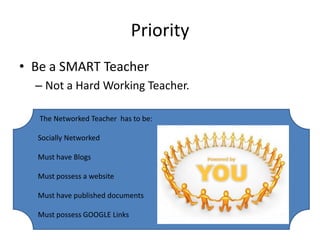
PriorityBe a SMART TeacherNot a Hard Working Teacher. The Networked Teacher  has to be:Socially NetworkedMust have BlogsMust possess a websiteMust have published documentsMust possess GOOGLE Links
The IT KnowledgeNo longer MS OFFICENo longer PROGRAMMING SKILLSNo longer by just Sending & Receiving Mails and SURFING the net.
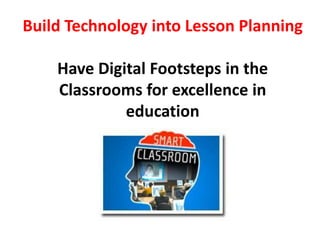
Build Technology into Lesson PlanningHave Digital Footsteps in the Classrooms for excellence in education
Provide Real-time Support
Share Successes and have Teachers Present Them
Make Training Relevant
Keep Learning
Keep Exploring
Vocabulary of 21st Century LearningForget the English vocabulary rather remember the IT words and their preface. Make them use in your day to day life.Say for Example:bandwidth:  blog:  blogger:  bluetooth:broadband: browser:As common……and many more to follow….
A Learner is more towards Success….
Follow and be a……..D I G I T A L N A T I V E

The 21st century digital teacher!

  • 1.
    The 21st CenturyDIGITAL Teacher!Dr. DheerajMehrotrahttp://dheerajmehrotra.tripod.com
  • 2.
    21st century ischaracterized with the emergence of knowledge based society wherein Information and Communication Technology pays a pivotal role. The convergence of computer, communication and content technologies, being known as ICT, have attracted attention of academia, business, government and communities to use it for innovating profitable propositions. ICT has permeated in every walk of life affecting the fields such as launching satellites, managing businesses across the globe and also enabling social networking. Year by year it is becoming simpler to use devices such as desktop palm top, iPod etc.2
  • 3.
    In its vision,the national Policy on ICT in School Education by MHRD Govt. of India states “The ICT policy in School Education aims at preparing youth to participate creatively in the establishment, sustenance and growth of a knowledge society leading to all around social economic development of the nation and global competitiveness”. The policy envisages three stages of ICT implementation at school level –ICT literacy and Competency Enhancement, ICT enabled teaching – learning and introduction of ICT related elective subjects at Senior Secondary level.3
  • 4.
    The National CurriculumFramework 2005 (NCF 2005) has also highlighted the importance of ICT in school education. With this backdrop, major paradigm shift is imperative in education characterized by technology enabled instructions, collaborative learning, multidisciplinary problem-solving and promoting critical thinking skills.4
  • 5.
  • 6.
    Technology is atool that should be used to improve learning and productivity, broaden access to knowledge and help Teachers, Parents and Students maximize the opportunities for learners to achieve their goals.We understand well……..
  • 7.
    As a matterof fact:In the education arena, we have only begun to harness the power of technology.Technology is an effective tool for an image-based generation.Professional development is essential to the success of an instructional technology implementation.
  • 8.
    PriorityBe a SMARTTeacherNot a Hard Working Teacher. The Networked Teacher has to be:Socially NetworkedMust have BlogsMust possess a websiteMust have published documentsMust possess GOOGLE Links
  • 9.
    The IT KnowledgeNolonger MS OFFICENo longer PROGRAMMING SKILLSNo longer by just Sending & Receiving Mails and SURFING the net.
  • 10.
    Build Technology intoLesson PlanningHave Digital Footsteps in the Classrooms for excellence in education
  • 11.
  • 12.
    Share Successes andhave Teachers Present Them
  • 13.
  • 14.
  • 15.
  • 16.
    Vocabulary of 21stCentury LearningForget the English vocabulary rather remember the IT words and their preface. Make them use in your day to day life.Say for Example:bandwidth: blog: blogger: bluetooth:broadband: browser:As common……and many more to follow….
  • 17.
    A Learner ismore towards Success….
  • 18.
    Follow and bea……..D I G I T A L N A T I V E