Lesson 1
1 Technology for Teaching and Learning 1
TECHNOLOGY for TEACHING and LEARNING 1 Module 1
Teaching and Learning with Technology: An Introduction
Module Outcomes:
1. Identified the competency standards of ICT for teaching and learning in pre-service teacher education
2. Unpacked the basic concepts of ICT to provide common understanding for teachers and learners
3. Valued the use of ICT in the teaching and learning processes
Introduction
If there is one thing that changed the world so fast, it is TECHNOLOGY. While there exists
technology in the past as non-digital technology, the current digital technology has been a factor that
shrunk the world and made it flat. It has provided a new environment for learning; new ways teachers
teach and also the new ways of how learners learn. In the beginning, it has created a divide between the
digital natives and the digital immigrants. However, as the years go by, such a divide has become
narrower and even blurred. This has led to the new educational revolution in teaching and learning
which has been triggered by technology and resulted in better learning outcomes in the 21" century.
Lesson 1: ICT Competency Standards for Philippine Pre-Service Teacher Education
Lesson Outcomes:
1. Identified the competency standards of ICT necessary in teaching for pre- service teacher
education
2. Familiarized with the ISTE National Educational Technology Standards for Teachers
What are competency standards? What are the ICT standards for teaching and learning in
Philippine pre-service teacher education?
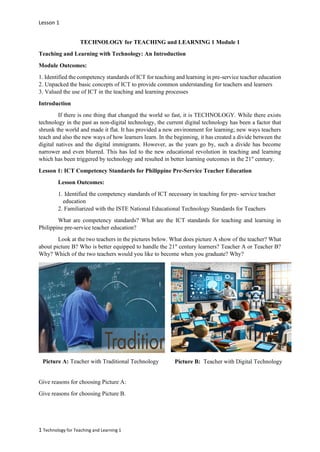
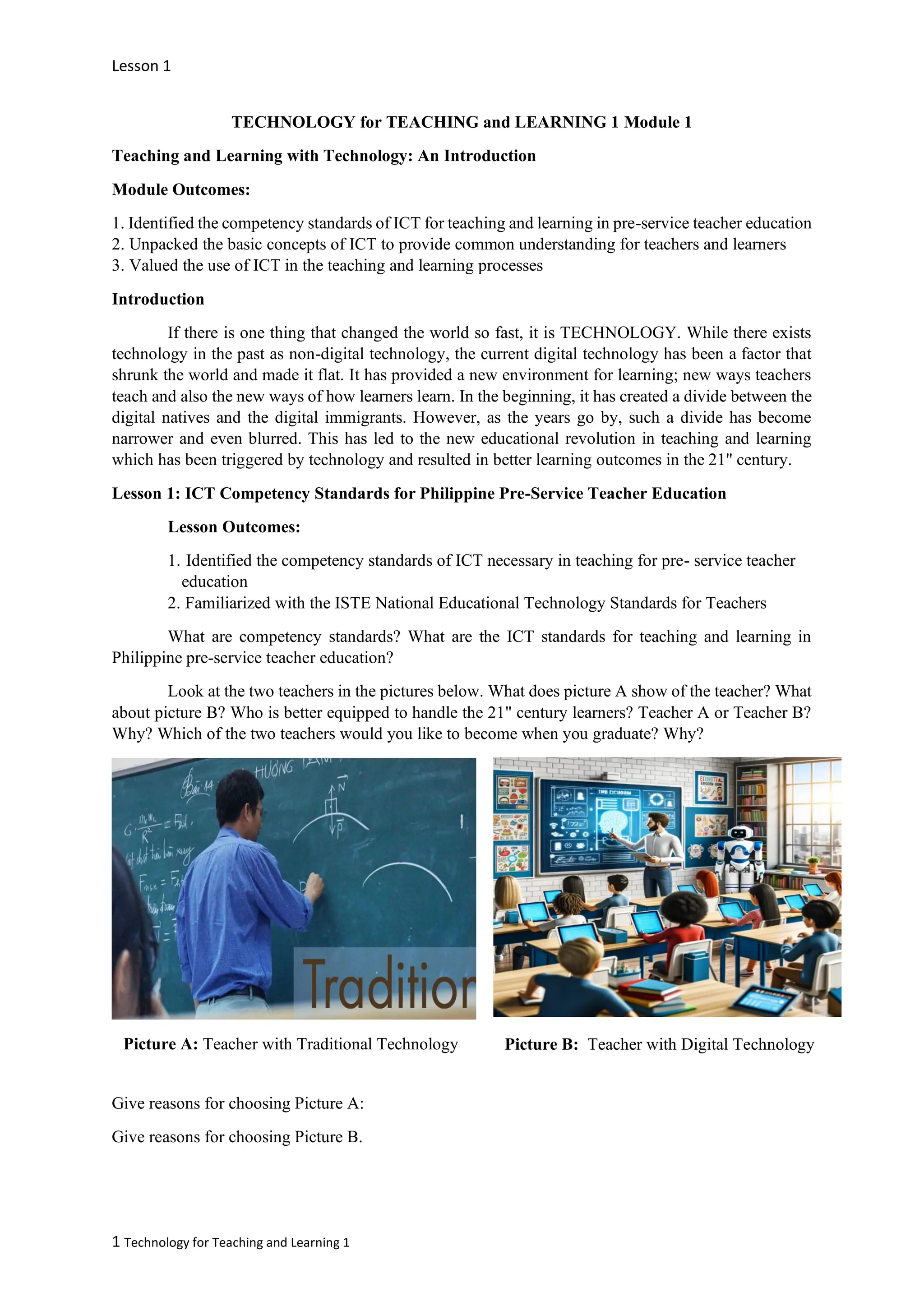
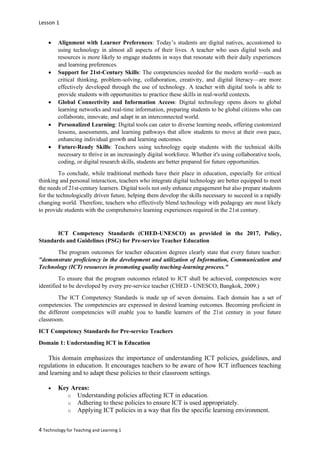
Look at the two teachers in the pictures below. What does picture A show of the teacher? What
about picture B? Who is better equipped to handle the 21" century learners? Teacher A or Teacher B?
Why? Which of the two teachers would you like to become when you graduate? Why?
Give reasons for choosing Picture A:
Give reasons for choosing Picture B.
Picture A: Teacher with Traditional Technology Picture B: Teacher with Digital Technology
Lesson 1
2 Technology for Teaching and Learning 1
In the context of preparing students for the challenges and demands of the 21st century, the
question of whether a teacher with traditional technology or a teacher with digital technology is better
equipped to handle contemporary learners is highly relevant. However, the answer is nuanced and
requires considering several factors, including teaching strategies, student needs, and the role of
technology in education.
*The Nature of 21st Century Learners
21st-century learners are often characterized by their high level of exposure to digital media,
constant connectivity, and access to a vast amount of information through digital technologies. These
learners are typically:
• Tech-Savvy: Growing up in an environment saturated with technology, students are often very
comfortable with digital tools and platforms. They use the internet, social media, and mobile
apps to communicate, learn, and entertain themselves.
• Multitaskers: Modern learners frequently navigate multiple forms of media and tasks
simultaneously, often switching between apps, devices, and online platforms.
• Collaborative and Global: With the power of digital communication tools, students are
increasingly learning in collaborative environments, connecting with peers and experts around
the world.
• Critical Thinkers and Problem-Solvers: 21st-century education emphasizes skills such as
critical thinking, creativity, and problem-solving that are essential in the digital age.
• Self-Directed: These learners are accustomed to searching for and accessing information
independently, enabling them to take charge of their own learning process.
Given these characteristics, it’s evident that teachers need to be equipped with tools and
strategies that resonate with students' technological experiences and prepare them for the future.
*The Role of Digital Technology in 21st Century Education
Digital technology plays a critical role in modern education by:
• Enhancing Engagement: Digital tools such as interactive whiteboards, simulations,
educational games, and multimedia content can engage students in ways that traditional
methods often cannot. For example, video lessons, interactive quizzes, and digital storytelling
can make learning more dynamic and interesting.
• Providing Access to Information: The internet and digital resources (e.g., online databases,
e-books, educational websites) provide vast, instant access to information. Teachers can guide
students to curate and evaluate this information, promoting skills like information literacy and
critical thinking.
• Fostering Collaboration: Online platforms (such as Google Classroom, Microsoft Teams, and
other learning management systems) allow students to collaborate on projects, share resources,
and engage in discussions outside of the classroom, fostering teamwork and communication.
• Supporting Personalization: Digital technology allows for personalized learning, where
students can progress at their own pace using adaptive learning software or online assessments
that cater to different learning styles and levels of proficiency.
• Improving Assessment: Digital technologies can streamline and enhance assessment
processes through formative assessments, instant feedback, and tools that track student
progress. This allows teachers to adjust their instruction more effectively.
In essence, digital technology empowers teachers to provide a more interactive, engaging, and
responsive learning experience, which is crucial for developing the skills needed in the digital age.
Lesson 1
3 Technology for Teaching and Learning 1
Teacher with Traditional Technology vs. Teacher with Digital Technology
Teacher with Traditional Technology
A teacher with traditional technology is someone who relies on methods like chalk and board,
printed textbooks, overhead projectors, and paper-based assessments. These methods have their own
merits, such as:
• Fostering Deep Thinking: Traditional teaching methods, like long-form essays or group
discussions, can help students engage deeply with content and develop analytical skills.
• Personalized Teacher-Student Interaction: Traditional methods often provide more direct,
one-on-one interaction between the teacher and students. This can be crucial for developing
strong teacher-student relationships and supporting individual needs.
• Simplified Tools for Learning: Some students may find digital technology overwhelming and
distracting. A traditional approach can reduce cognitive overload and help students focus on
the basics of learning.
However, in the 21st-century context, traditional methods face limitations:
• Limited Access to Real-Time Information: Traditional methods rely on printed materials or
teacher-provided resources, which cannot provide the same real-time, up-to-date information
that digital tools can offer.
• Passive Learning: While traditional methods can encourage active thinking, they may also
lead to more passive forms of learning, where students are merely recipients of information
rather than active creators or collaborators.
• Lack of Technological Skills: In a world where digital literacy is essential, students who only
experience traditional methods may lack the necessary skills to navigate and succeed in a
digitally-driven society.
Teacher with Digital Technology
A teacher with digital technology, on the other hand, uses computers, tablets, interactive platforms,
cloud-based tools, and multimedia resources to deliver instruction. This approach has several
advantages, particularly in the context of preparing students for the 21st century:
• Engaging Learning Environment: Digital tools can make lessons more interactive and
immersive. Through videos, games, simulations, and virtual field trips, students can experience
learning in a more engaging and hands-on way.
• Skill Development: Digital tools teach students valuable skills in areas like digital literacy,
media literacy, coding, and research skills that are increasingly important in the job market.
• Access to Global Resources: The internet and digital platforms allow students to access a
wealth of information beyond their textbooks, connecting them to global perspectives, experts,
and real-world issues.
• Collaboration and Communication: Technology enables students to collaborate easily with
peers and teachers, both in and outside the classroom. This builds teamwork and
communication skills that are crucial for the future.
• Flexibility and Personalization: Digital platforms allow students to work at their own pace,
ensuring that their learning experience is tailored to their individual needs.
Who is Better Equipped to Handle 21st Century Learners?
In the context of 21st-century learners, teachers with digital technology are generally better
equipped to handle the dynamic needs of modern students for several reasons:
Lesson 1
4 Technology for Teaching and Learning 1
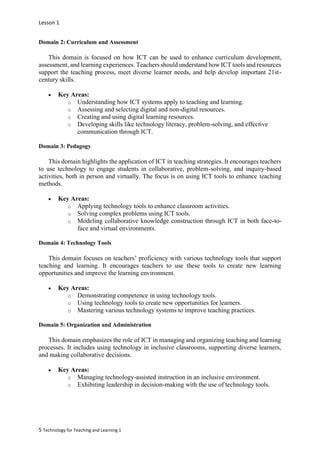
• Alignment with Learner Preferences: Today’s students are digital natives, accustomed to
using technology in almost all aspects of their lives. A teacher who uses digital tools and
resources is more likely to engage students in ways that resonate with their daily experiences
and learning preferences.
• Support for 21st-Century Skills: The competencies needed for the modern world—such as
critical thinking, problem-solving, collaboration, creativity, and digital literacy—are more
effectively developed through the use of technology. A teacher with digital tools is able to
provide students with opportunities to practice these skills in real-world contexts.
• Global Connectivity and Information Access: Digital technology opens doors to global
learning networks and real-time information, preparing students to be global citizens who can
collaborate, innovate, and adapt in an interconnected world.
• Personalized Learning: Digital tools can cater to diverse learning needs, offering customized
lessons, assessments, and learning pathways that allow students to move at their own pace,
enhancing individual growth and learning outcomes.
• Future-Ready Skills: Teachers using technology equip students with the technical skills
necessary to thrive in an increasingly digital workforce. Whether it's using collaborative tools,
coding, or digital research skills, students are better prepared for future opportunities.
To conclude, while traditional methods have their place in education, especially for critical
thinking and personal interaction, teachers who integrate digital technology are better equipped to meet
the needs of 21st-century learners. Digital tools not only enhance engagement but also prepare students
for the technologically driven future, helping them develop the skills necessary to succeed in a rapidly
changing world. Therefore, teachers who effectively blend technology with pedagogy are most likely
to provide students with the comprehensive learning experiences required in the 21st century.
ICT Competency Standards (CHED-UNESCO) as provided in the 2017, Policy,
Standards and Guidelines (PSG) for Pre-service Teacher Education
The program outcomes for teacher education degrees clearly state that every future teacher:
"demonstrate proficiency in the development and utilization of Information, Communication and
Technology (ICT) resources in promoting quality teaching-learning process."
To ensure that the program outcomes related to ICT shall be achieved, competencies were
identified to be developed by every pre-service teacher (CHED - UNESCO, Bangkok, 2009.)
The ICT Competency Standards is made up of seven domains. Each domain has a set of
competencies. The competencies are expressed in desired learning outcomes. Becoming proficient in
the different competencies will enable you to handle learners of the 21st century in your future
classroom.
ICT Competency Standards for Pre-service Teachers
Domain 1: Understanding ICT in Education
This domain emphasizes the importance of understanding ICT policies, guidelines, and
regulations in education. It encourages teachers to be aware of how ICT influences teaching
and learning and to adapt these policies to their classroom settings.
• Key Areas:
o Understanding policies affecting ICT in education.
o Adhering to these policies to ensure ICT is used appropriately.
o Applying ICT policies in a way that fits the specific learning environment.
Lesson 1
5 Technology for Teaching and Learning 1
Domain 2: Curriculum and Assessment
This domain is focused on how ICT can be used to enhance curriculum development,
assessment, and learning experiences. Teachers should understand how ICT tools and resources
support the teaching process, meet diverse learner needs, and help develop important 21st-
century skills.
• Key Areas:
o Understanding how ICT systems apply to teaching and learning.
o Assessing and selecting digital and non-digital resources.
o Creating and using digital learning resources.
o Developing skills like technology literacy, problem-solving, and effective
communication through ICT.
Domain 3: Pedagogy
This domain highlights the application of ICT in teaching strategies. It encourages teachers
to use technology to engage students in collaborative, problem-solving, and inquiry-based
activities, both in person and virtually. The focus is on using ICT tools to enhance teaching
methods.
• Key Areas:
o Applying technology tools to enhance classroom activities.
o Solving complex problems using ICT tools.
o Modeling collaborative knowledge construction through ICT in both face-to-
face and virtual environments.
Domain 4: Technology Tools
This domain focuses on teachers’ proficiency with various technology tools that support
teaching and learning. It encourages teachers to use these tools to create new learning
opportunities and improve the learning environment.
• Key Areas:
o Demonstrating competence in using technology tools.
o Using technology tools to create new opportunities for learners.
o Mastering various technology systems to improve teaching practices.
Domain 5: Organization and Administration
This domain emphasizes the role of ICT in managing and organizing teaching and learning
processes. It includes using technology in inclusive classrooms, supporting diverse learners,
and making collaborative decisions.
• Key Areas:
o Managing technology-assisted instruction in an inclusive environment.
o Exhibiting leadership in decision-making with the use of technology tools.
Lesson 1
6 Technology for Teaching and Learning 1
Domain 6: Teacher Professional Learning
This domain focuses on the continuous professional development of teachers through the
use of ICT. Teachers are encouraged to explore new and emerging technologies, collaborate
with peers, and create communities of practice that enhance their professional knowledge.
• Key Areas:
o Exploring new technologies to improve content and pedagogy knowledge.
o Creating and engaging in communities of practice through ICT.
o Collaborating with peers and stakeholders to support professional growth.
Domain 7: Teacher Disposition
This domain focuses on the attitudes and responsibilities teachers must display when using
technology. It emphasizes social, ethical, and legal responsibilities in the use of ICT, as well
as fostering a positive attitude toward technology integration in education.
• Key Areas:
o Demonstrating social, ethical, and legal responsibility in using technology.
o Maintaining a positive attitude towards using ICT for enhancing teaching and
learning.
Likewise, the Department of Education issued Department of Education Order 42, s. 2017
mandating the use of the Philippine Professional Standard for Teachers (PPST) to start with the
Beginning Teachers who are the fresh graduates from the teacher education program. The document
includes: Show skills in the positive use of ICT to facilitate teaching and learning and Show skills in
the selection, development and use of the variety of teaching learning resources including ICT to
address learning goals.
These competency standards to learn and master will assure the 21st century learners in your
class of more enjoyable, creative, innovative ways in teaching and learning.
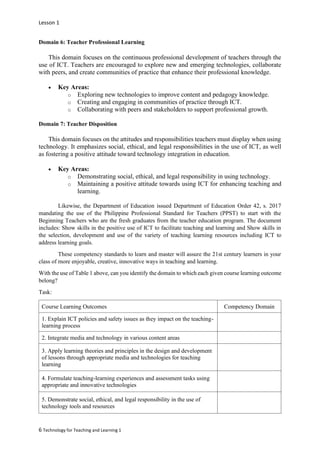
With the use of Table 1 above, can you identify the domain to which each given course learning outcome
belong?
Task:
Course Learning Outcomes Competency Domain
1. Explain ICT policies and safety issues as they impact on the teaching-
learning process
2. Integrate media and technology in various content areas
3. Apply learning theories and principles in the design and development
of lessons through appropriate media and technologies for teaching
learning
4. Formulate teaching-learning experiences and assessment tasks using
appropriate and innovative technologies
5. Demonstrate social, ethical, and legal responsibility in the use of
technology tools and resources
Lesson 1
7 Technology for Teaching and Learning 1
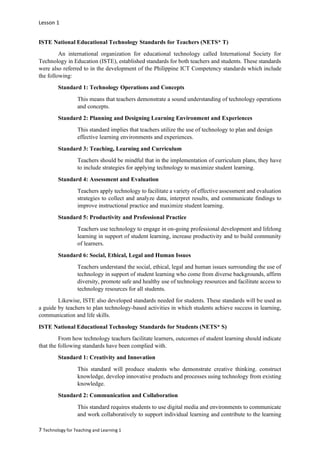
ISTE National Educational Technology Standards for Teachers (NETS* T)
An international organization for educational technology called International Society for
Technology in Education (ISTE), established standards for both teachers and students. These standards
were also referred to in the development of the Philippine ICT Competency standards which include
the following:
Standard 1: Technology Operations and Concepts
This means that teachers demonstrate a sound understanding of technology operations
and concepts.
Standard 2: Planning and Designing Learning Environment and Experiences
This standard implies that teachers utilize the use of technology to plan and design
effective learning environments and experiences.
Standard 3: Teaching, Learning and Curriculum
Teachers should be mindful that in the implementation of curriculum plans, they have
to include strategies for applying technology to maximize student learning.
Standard 4: Assessment and Evaluation
Teachers apply technology to facilitate a variety of effective assessment and evaluation
strategies to collect and analyze data, interpret results, and communicate findings to
improve instructional practice and maximize student learning.
Standard 5: Productivity and Professional Practice
Teachers use technology to engage in on-going professional development and lifelong
learning in support of student learning, increase productivity and to build community
of learners.
Standard 6: Social, Ethical, Legal and Human Issues
Teachers understand the social, ethical, legal and human issues surrounding the use of
technology in support of student learning who come from diverse backgrounds, affirm
diversity, promote safe and healthy use of technology resources and facilitate access to
technology resources for all students.
Likewise, ISTE also developed standards needed for students. These standards will be used as
a guide by teachers to plan technology-based activities in which students achieve success in learning,
communication and life skills.
ISTE National Educational Technology Standards for Students (NETS* S)
From how technology teachers facilitate learners, outcomes of student learning should indicate
that the following standards have been complied with.
Standard 1: Creativity and Innovation
This standard will produce students who demonstrate creative thinking. construct
knowledge, develop innovative products and processes using technology from existing
knowledge.
Standard 2: Communication and Collaboration
This standard requires students to use digital media and environments to communicate
and work collaboratively to support individual learning and contribute to the learning
Lesson 1
8 Technology for Teaching and Learning 1
of others. This includes the use of a variety of media and formats for global awareness
with learners from other cultures.
Standard 3: Research and Information Fluency
Students are expected to apply digital tools to gather, evaluate and use information and
plan strategies for inquiry. This standard expects the student to locate, organize,
analyze, evaluate, synthesize and ethically use information from a variety of sources
and media.
Standard 4: Critical Thinking, Problem-Solving and Decision Making
This standard expects the students to use critical thinking skills to plan and conduct
research, manage projects, solve problems and make informed decisions using
appropriate digital tools.
Standard 5: Digital Citizenship
It is required by this standard that every technology student becomes a digital citizen
who demonstrates ethical and legal behavior, exemplified by the practice of safe, legal
and responsible use of information. Further, the student exhibits a positive attitude
towards the support of technology for collaboration, learning and productivity as a
digital citizen.
Standard 6: Technology Operations and Concepts
Sound understanding of technology concepts, systems and operation is a standard that
students should comply with. They too, are expected to further transfer current
knowledge to learning of new technologies.
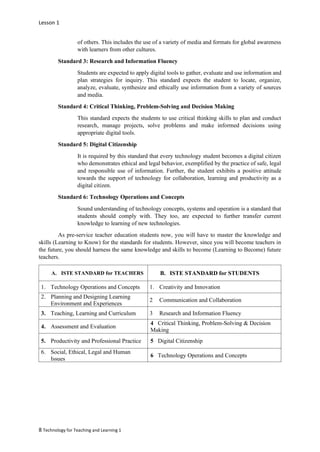
As pre-service teacher education students now, you will have to master the knowledge and
skills (Learning to Know) for the standards for students. However, since you will become teachers in
the future, you should harness the same knowledge and skills to become (Learning to Become) future
teachers.
A. ISTE STANDARD for TEACHERS B. ISTE STANDARD for STUDENTS
1. Technology Operations and Concepts 1. Creativity and Innovation
2. Planning and Designing Learning
Environment and Experiences
2 Communication and Collaboration
3. Teaching, Learning and Curriculum 3 Research and Information Fluency
4. Assessment and Evaluation
4 Critical Thinking, Problem-Solving & Decision
Making
5. Productivity and Professional Practice 5 Digital Citizenship
6. Social, Ethical, Legal and Human
Issues
6 Technology Operations and Concepts

Technology for Teaching and Learning 1 Lesson 1.pdf

  • 1.
    Lesson 1 1 Technologyfor Teaching and Learning 1 TECHNOLOGY for TEACHING and LEARNING 1 Module 1 Teaching and Learning with Technology: An Introduction Module Outcomes: 1. Identified the competency standards of ICT for teaching and learning in pre-service teacher education 2. Unpacked the basic concepts of ICT to provide common understanding for teachers and learners 3. Valued the use of ICT in the teaching and learning processes Introduction If there is one thing that changed the world so fast, it is TECHNOLOGY. While there exists technology in the past as non-digital technology, the current digital technology has been a factor that shrunk the world and made it flat. It has provided a new environment for learning; new ways teachers teach and also the new ways of how learners learn. In the beginning, it has created a divide between the digital natives and the digital immigrants. However, as the years go by, such a divide has become narrower and even blurred. This has led to the new educational revolution in teaching and learning which has been triggered by technology and resulted in better learning outcomes in the 21" century. Lesson 1: ICT Competency Standards for Philippine Pre-Service Teacher Education Lesson Outcomes: 1. Identified the competency standards of ICT necessary in teaching for pre- service teacher education 2. Familiarized with the ISTE National Educational Technology Standards for Teachers What are competency standards? What are the ICT standards for teaching and learning in Philippine pre-service teacher education? Look at the two teachers in the pictures below. What does picture A show of the teacher? What about picture B? Who is better equipped to handle the 21" century learners? Teacher A or Teacher B? Why? Which of the two teachers would you like to become when you graduate? Why? Give reasons for choosing Picture A: Give reasons for choosing Picture B. Picture A: Teacher with Traditional Technology Picture B: Teacher with Digital Technology
  • 2.
    Lesson 1 2 Technologyfor Teaching and Learning 1 In the context of preparing students for the challenges and demands of the 21st century, the question of whether a teacher with traditional technology or a teacher with digital technology is better equipped to handle contemporary learners is highly relevant. However, the answer is nuanced and requires considering several factors, including teaching strategies, student needs, and the role of technology in education. *The Nature of 21st Century Learners 21st-century learners are often characterized by their high level of exposure to digital media, constant connectivity, and access to a vast amount of information through digital technologies. These learners are typically: • Tech-Savvy: Growing up in an environment saturated with technology, students are often very comfortable with digital tools and platforms. They use the internet, social media, and mobile apps to communicate, learn, and entertain themselves. • Multitaskers: Modern learners frequently navigate multiple forms of media and tasks simultaneously, often switching between apps, devices, and online platforms. • Collaborative and Global: With the power of digital communication tools, students are increasingly learning in collaborative environments, connecting with peers and experts around the world. • Critical Thinkers and Problem-Solvers: 21st-century education emphasizes skills such as critical thinking, creativity, and problem-solving that are essential in the digital age. • Self-Directed: These learners are accustomed to searching for and accessing information independently, enabling them to take charge of their own learning process. Given these characteristics, it’s evident that teachers need to be equipped with tools and strategies that resonate with students' technological experiences and prepare them for the future. *The Role of Digital Technology in 21st Century Education Digital technology plays a critical role in modern education by: • Enhancing Engagement: Digital tools such as interactive whiteboards, simulations, educational games, and multimedia content can engage students in ways that traditional methods often cannot. For example, video lessons, interactive quizzes, and digital storytelling can make learning more dynamic and interesting. • Providing Access to Information: The internet and digital resources (e.g., online databases, e-books, educational websites) provide vast, instant access to information. Teachers can guide students to curate and evaluate this information, promoting skills like information literacy and critical thinking. • Fostering Collaboration: Online platforms (such as Google Classroom, Microsoft Teams, and other learning management systems) allow students to collaborate on projects, share resources, and engage in discussions outside of the classroom, fostering teamwork and communication. • Supporting Personalization: Digital technology allows for personalized learning, where students can progress at their own pace using adaptive learning software or online assessments that cater to different learning styles and levels of proficiency. • Improving Assessment: Digital technologies can streamline and enhance assessment processes through formative assessments, instant feedback, and tools that track student progress. This allows teachers to adjust their instruction more effectively. In essence, digital technology empowers teachers to provide a more interactive, engaging, and responsive learning experience, which is crucial for developing the skills needed in the digital age.
  • 3.
    Lesson 1 3 Technologyfor Teaching and Learning 1 Teacher with Traditional Technology vs. Teacher with Digital Technology Teacher with Traditional Technology A teacher with traditional technology is someone who relies on methods like chalk and board, printed textbooks, overhead projectors, and paper-based assessments. These methods have their own merits, such as: • Fostering Deep Thinking: Traditional teaching methods, like long-form essays or group discussions, can help students engage deeply with content and develop analytical skills. • Personalized Teacher-Student Interaction: Traditional methods often provide more direct, one-on-one interaction between the teacher and students. This can be crucial for developing strong teacher-student relationships and supporting individual needs. • Simplified Tools for Learning: Some students may find digital technology overwhelming and distracting. A traditional approach can reduce cognitive overload and help students focus on the basics of learning. However, in the 21st-century context, traditional methods face limitations: • Limited Access to Real-Time Information: Traditional methods rely on printed materials or teacher-provided resources, which cannot provide the same real-time, up-to-date information that digital tools can offer. • Passive Learning: While traditional methods can encourage active thinking, they may also lead to more passive forms of learning, where students are merely recipients of information rather than active creators or collaborators. • Lack of Technological Skills: In a world where digital literacy is essential, students who only experience traditional methods may lack the necessary skills to navigate and succeed in a digitally-driven society. Teacher with Digital Technology A teacher with digital technology, on the other hand, uses computers, tablets, interactive platforms, cloud-based tools, and multimedia resources to deliver instruction. This approach has several advantages, particularly in the context of preparing students for the 21st century: • Engaging Learning Environment: Digital tools can make lessons more interactive and immersive. Through videos, games, simulations, and virtual field trips, students can experience learning in a more engaging and hands-on way. • Skill Development: Digital tools teach students valuable skills in areas like digital literacy, media literacy, coding, and research skills that are increasingly important in the job market. • Access to Global Resources: The internet and digital platforms allow students to access a wealth of information beyond their textbooks, connecting them to global perspectives, experts, and real-world issues. • Collaboration and Communication: Technology enables students to collaborate easily with peers and teachers, both in and outside the classroom. This builds teamwork and communication skills that are crucial for the future. • Flexibility and Personalization: Digital platforms allow students to work at their own pace, ensuring that their learning experience is tailored to their individual needs. Who is Better Equipped to Handle 21st Century Learners? In the context of 21st-century learners, teachers with digital technology are generally better equipped to handle the dynamic needs of modern students for several reasons:
  • 4.
    Lesson 1 4 Technologyfor Teaching and Learning 1 • Alignment with Learner Preferences: Today’s students are digital natives, accustomed to using technology in almost all aspects of their lives. A teacher who uses digital tools and resources is more likely to engage students in ways that resonate with their daily experiences and learning preferences. • Support for 21st-Century Skills: The competencies needed for the modern world—such as critical thinking, problem-solving, collaboration, creativity, and digital literacy—are more effectively developed through the use of technology. A teacher with digital tools is able to provide students with opportunities to practice these skills in real-world contexts. • Global Connectivity and Information Access: Digital technology opens doors to global learning networks and real-time information, preparing students to be global citizens who can collaborate, innovate, and adapt in an interconnected world. • Personalized Learning: Digital tools can cater to diverse learning needs, offering customized lessons, assessments, and learning pathways that allow students to move at their own pace, enhancing individual growth and learning outcomes. • Future-Ready Skills: Teachers using technology equip students with the technical skills necessary to thrive in an increasingly digital workforce. Whether it's using collaborative tools, coding, or digital research skills, students are better prepared for future opportunities. To conclude, while traditional methods have their place in education, especially for critical thinking and personal interaction, teachers who integrate digital technology are better equipped to meet the needs of 21st-century learners. Digital tools not only enhance engagement but also prepare students for the technologically driven future, helping them develop the skills necessary to succeed in a rapidly changing world. Therefore, teachers who effectively blend technology with pedagogy are most likely to provide students with the comprehensive learning experiences required in the 21st century. ICT Competency Standards (CHED-UNESCO) as provided in the 2017, Policy, Standards and Guidelines (PSG) for Pre-service Teacher Education The program outcomes for teacher education degrees clearly state that every future teacher: "demonstrate proficiency in the development and utilization of Information, Communication and Technology (ICT) resources in promoting quality teaching-learning process." To ensure that the program outcomes related to ICT shall be achieved, competencies were identified to be developed by every pre-service teacher (CHED - UNESCO, Bangkok, 2009.) The ICT Competency Standards is made up of seven domains. Each domain has a set of competencies. The competencies are expressed in desired learning outcomes. Becoming proficient in the different competencies will enable you to handle learners of the 21st century in your future classroom. ICT Competency Standards for Pre-service Teachers Domain 1: Understanding ICT in Education This domain emphasizes the importance of understanding ICT policies, guidelines, and regulations in education. It encourages teachers to be aware of how ICT influences teaching and learning and to adapt these policies to their classroom settings. • Key Areas: o Understanding policies affecting ICT in education. o Adhering to these policies to ensure ICT is used appropriately. o Applying ICT policies in a way that fits the specific learning environment.
  • 5.
    Lesson 1 5 Technologyfor Teaching and Learning 1 Domain 2: Curriculum and Assessment This domain is focused on how ICT can be used to enhance curriculum development, assessment, and learning experiences. Teachers should understand how ICT tools and resources support the teaching process, meet diverse learner needs, and help develop important 21st- century skills. • Key Areas: o Understanding how ICT systems apply to teaching and learning. o Assessing and selecting digital and non-digital resources. o Creating and using digital learning resources. o Developing skills like technology literacy, problem-solving, and effective communication through ICT. Domain 3: Pedagogy This domain highlights the application of ICT in teaching strategies. It encourages teachers to use technology to engage students in collaborative, problem-solving, and inquiry-based activities, both in person and virtually. The focus is on using ICT tools to enhance teaching methods. • Key Areas: o Applying technology tools to enhance classroom activities. o Solving complex problems using ICT tools. o Modeling collaborative knowledge construction through ICT in both face-to- face and virtual environments. Domain 4: Technology Tools This domain focuses on teachers’ proficiency with various technology tools that support teaching and learning. It encourages teachers to use these tools to create new learning opportunities and improve the learning environment. • Key Areas: o Demonstrating competence in using technology tools. o Using technology tools to create new opportunities for learners. o Mastering various technology systems to improve teaching practices. Domain 5: Organization and Administration This domain emphasizes the role of ICT in managing and organizing teaching and learning processes. It includes using technology in inclusive classrooms, supporting diverse learners, and making collaborative decisions. • Key Areas: o Managing technology-assisted instruction in an inclusive environment. o Exhibiting leadership in decision-making with the use of technology tools.
  • 6.
    Lesson 1 6 Technologyfor Teaching and Learning 1 Domain 6: Teacher Professional Learning This domain focuses on the continuous professional development of teachers through the use of ICT. Teachers are encouraged to explore new and emerging technologies, collaborate with peers, and create communities of practice that enhance their professional knowledge. • Key Areas: o Exploring new technologies to improve content and pedagogy knowledge. o Creating and engaging in communities of practice through ICT. o Collaborating with peers and stakeholders to support professional growth. Domain 7: Teacher Disposition This domain focuses on the attitudes and responsibilities teachers must display when using technology. It emphasizes social, ethical, and legal responsibilities in the use of ICT, as well as fostering a positive attitude toward technology integration in education. • Key Areas: o Demonstrating social, ethical, and legal responsibility in using technology. o Maintaining a positive attitude towards using ICT for enhancing teaching and learning. Likewise, the Department of Education issued Department of Education Order 42, s. 2017 mandating the use of the Philippine Professional Standard for Teachers (PPST) to start with the Beginning Teachers who are the fresh graduates from the teacher education program. The document includes: Show skills in the positive use of ICT to facilitate teaching and learning and Show skills in the selection, development and use of the variety of teaching learning resources including ICT to address learning goals. These competency standards to learn and master will assure the 21st century learners in your class of more enjoyable, creative, innovative ways in teaching and learning. With the use of Table 1 above, can you identify the domain to which each given course learning outcome belong? Task: Course Learning Outcomes Competency Domain 1. Explain ICT policies and safety issues as they impact on the teaching- learning process 2. Integrate media and technology in various content areas 3. Apply learning theories and principles in the design and development of lessons through appropriate media and technologies for teaching learning 4. Formulate teaching-learning experiences and assessment tasks using appropriate and innovative technologies 5. Demonstrate social, ethical, and legal responsibility in the use of technology tools and resources
  • 7.
    Lesson 1 7 Technologyfor Teaching and Learning 1 ISTE National Educational Technology Standards for Teachers (NETS* T) An international organization for educational technology called International Society for Technology in Education (ISTE), established standards for both teachers and students. These standards were also referred to in the development of the Philippine ICT Competency standards which include the following: Standard 1: Technology Operations and Concepts This means that teachers demonstrate a sound understanding of technology operations and concepts. Standard 2: Planning and Designing Learning Environment and Experiences This standard implies that teachers utilize the use of technology to plan and design effective learning environments and experiences. Standard 3: Teaching, Learning and Curriculum Teachers should be mindful that in the implementation of curriculum plans, they have to include strategies for applying technology to maximize student learning. Standard 4: Assessment and Evaluation Teachers apply technology to facilitate a variety of effective assessment and evaluation strategies to collect and analyze data, interpret results, and communicate findings to improve instructional practice and maximize student learning. Standard 5: Productivity and Professional Practice Teachers use technology to engage in on-going professional development and lifelong learning in support of student learning, increase productivity and to build community of learners. Standard 6: Social, Ethical, Legal and Human Issues Teachers understand the social, ethical, legal and human issues surrounding the use of technology in support of student learning who come from diverse backgrounds, affirm diversity, promote safe and healthy use of technology resources and facilitate access to technology resources for all students. Likewise, ISTE also developed standards needed for students. These standards will be used as a guide by teachers to plan technology-based activities in which students achieve success in learning, communication and life skills. ISTE National Educational Technology Standards for Students (NETS* S) From how technology teachers facilitate learners, outcomes of student learning should indicate that the following standards have been complied with. Standard 1: Creativity and Innovation This standard will produce students who demonstrate creative thinking. construct knowledge, develop innovative products and processes using technology from existing knowledge. Standard 2: Communication and Collaboration This standard requires students to use digital media and environments to communicate and work collaboratively to support individual learning and contribute to the learning
  • 8.
    Lesson 1 8 Technologyfor Teaching and Learning 1 of others. This includes the use of a variety of media and formats for global awareness with learners from other cultures. Standard 3: Research and Information Fluency Students are expected to apply digital tools to gather, evaluate and use information and plan strategies for inquiry. This standard expects the student to locate, organize, analyze, evaluate, synthesize and ethically use information from a variety of sources and media. Standard 4: Critical Thinking, Problem-Solving and Decision Making This standard expects the students to use critical thinking skills to plan and conduct research, manage projects, solve problems and make informed decisions using appropriate digital tools. Standard 5: Digital Citizenship It is required by this standard that every technology student becomes a digital citizen who demonstrates ethical and legal behavior, exemplified by the practice of safe, legal and responsible use of information. Further, the student exhibits a positive attitude towards the support of technology for collaboration, learning and productivity as a digital citizen. Standard 6: Technology Operations and Concepts Sound understanding of technology concepts, systems and operation is a standard that students should comply with. They too, are expected to further transfer current knowledge to learning of new technologies. As pre-service teacher education students now, you will have to master the knowledge and skills (Learning to Know) for the standards for students. However, since you will become teachers in the future, you should harness the same knowledge and skills to become (Learning to Become) future teachers. A. ISTE STANDARD for TEACHERS B. ISTE STANDARD for STUDENTS 1. Technology Operations and Concepts 1. Creativity and Innovation 2. Planning and Designing Learning Environment and Experiences 2 Communication and Collaboration 3. Teaching, Learning and Curriculum 3 Research and Information Fluency 4. Assessment and Evaluation 4 Critical Thinking, Problem-Solving & Decision Making 5. Productivity and Professional Practice 5 Digital Citizenship 6. Social, Ethical, Legal and Human Issues 6 Technology Operations and Concepts