DEPARTMENT OF EDUCATION
Five-Year
Information and Communication
Technology for Education
(DepED ICT4E Strategic Plan)
DepEd ICT4e Strategic Plan
envisions:
 Transform students to :
dynamic life long learners
value centered
productive and responsible citizens
They will use ICT to make the following
happen:
revitalize our schools to make
them into dynamic, collaborative
and innovative learning institutions
where students can become more
motivated, inquisitive and creative
learners.
 link up our students with the vast
networked world of knowledge and
information to enable them to
acquire a broad knowledge base
and a global outlook and provide
them with their sources for the
development of a creative mind;
develop in our students skills and
capabilities to critically and
intelligently seek, absorb,
analyze, manage and present
information;
create new knowledge and
products; and
develop in our students habits
of self-learning to nurture the
attitude and capability for
lifelong learning
To achieve these visions, DepEd
aims to do the following in the
span of five years:
completely integrate ICT into the
curriculum, which includes the
development of multimedia
instructional materials, and ICT
enabled assessment;
intensify competency based
professional development
programs;
establish the necessary ICT
infrastructure and applications.
develop processes and systems
that ensure efficient, transparent
and effective governance
The key thrusts of this strategy
are:
Enhancing Curriculum
Empowering Teachers,
Administrators, Officials and
Students
Strengthening Schools,
Governance and Management
ICT in Education – the
Philippines
POLICY:
PAST and Present
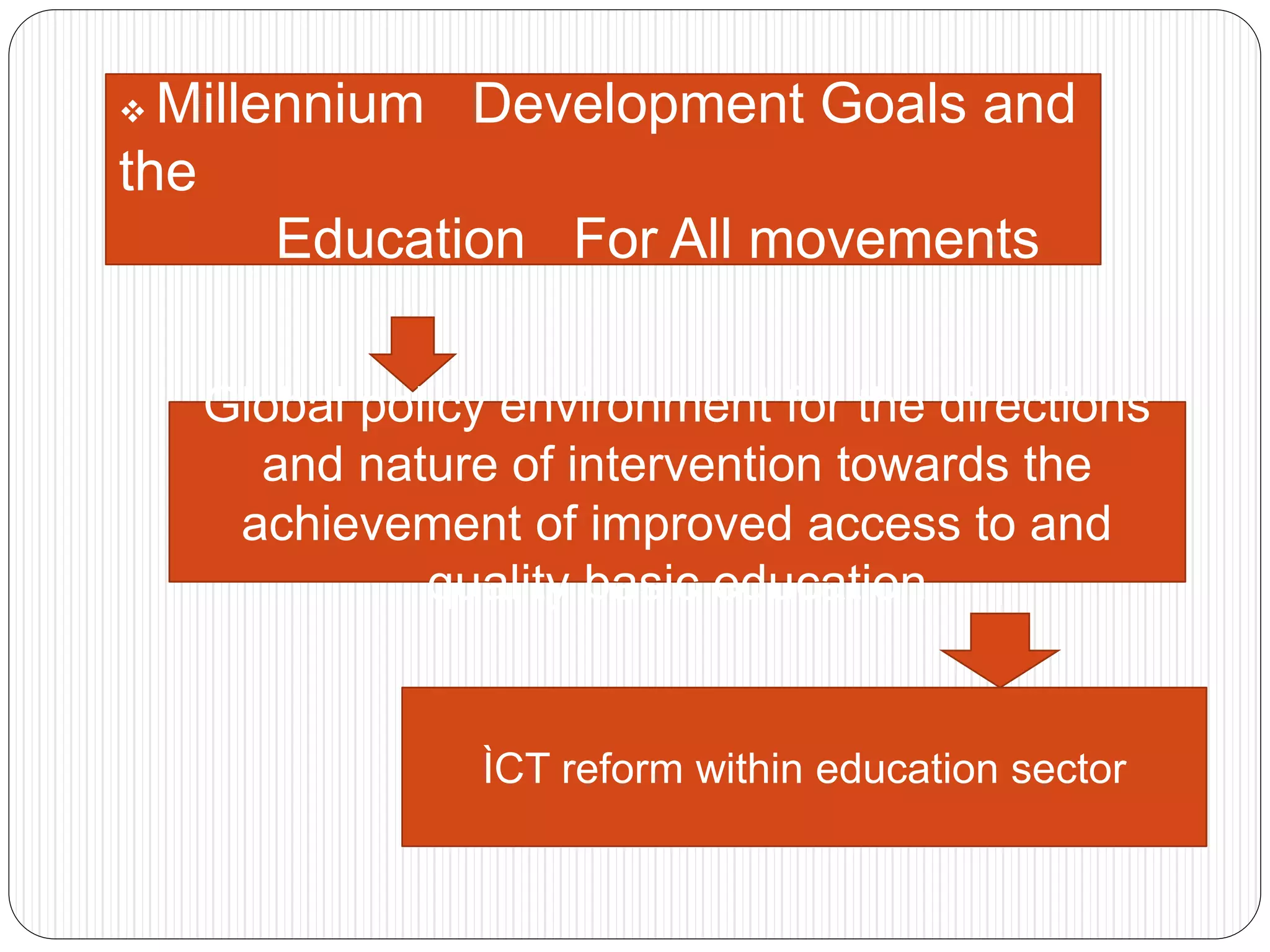
 Millennium
Development Goals and the
Education For All movements
 Millennium Development Goals and
the
Education For All movements
Global policy environment for the directions
and nature of intervention towards the
achievement of improved access to and
quality basic education
ÌCT reform within education sector
. Five-Year ICT Strategic
Plan has been developed
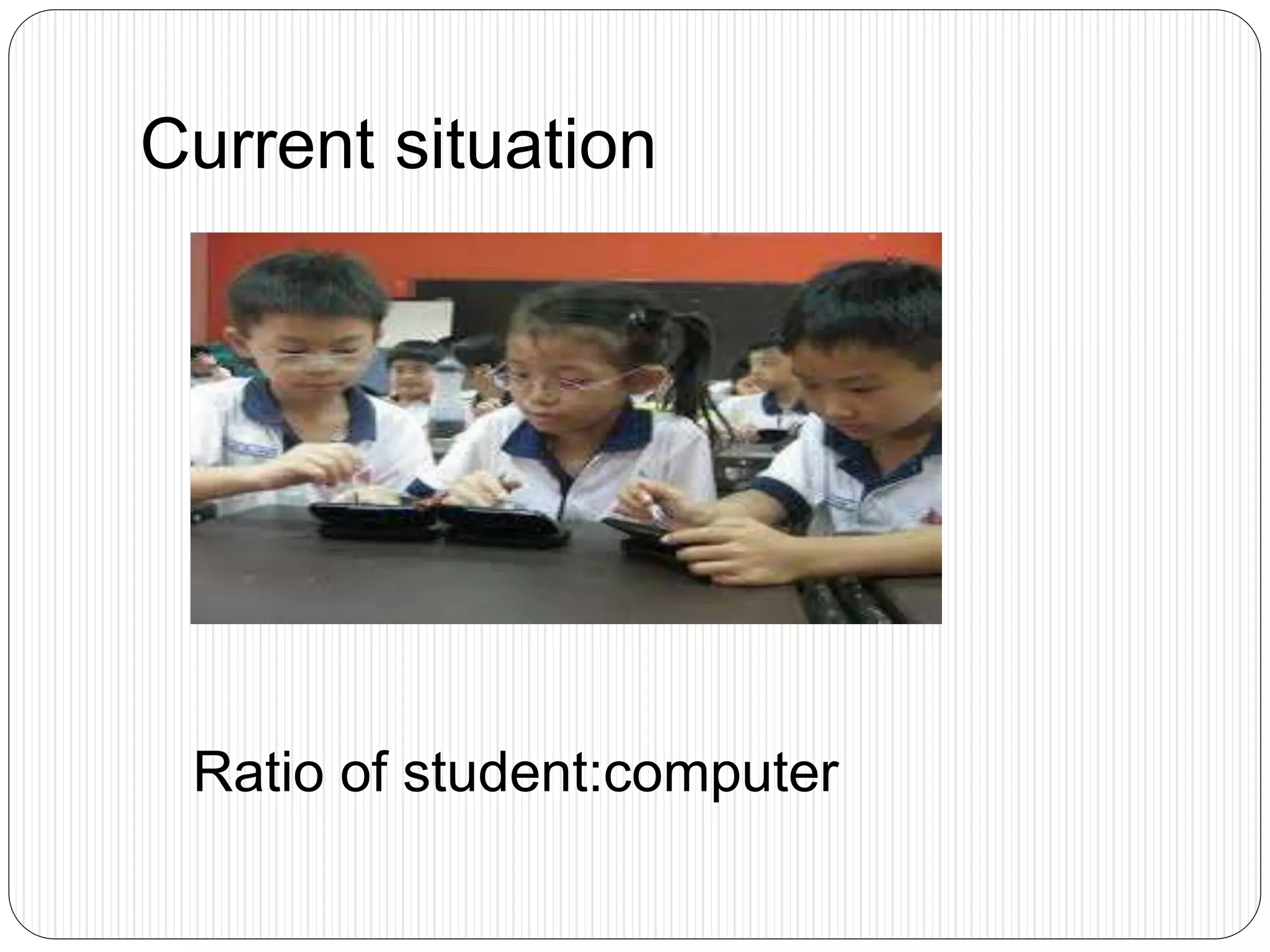
Current situation
Ratio of student:computer
Ratio of teacher: computer
Lack of infrastructure for connectivity
and access to technology
TEI’s have incorporated
computer courses into
curriculum as a requirement for
graduation
The Enhanced Curriculum
The overall curricular goals outlined
in BEC remain valid. ICT is simply a
tool to more effectively and
efficiently achieve these goals.
However, to be able to effectively
use this tool, students,
teachers,school managers and
administrators should achieve a
certain level of competence in the
ICT Learning targets for students
have been identified in the following
six areas:
 · Basic operations and concepts
 · Social, ethical and human issues
 · ICT for Producing
 · ICT for Communicating
 · ICT for Researching
 · ICT for Problem-solving
Competency standards for
ALS learners and Technical-
Vocational High School
Students have also
been developed for this
ICT4E Strategic Plan.
The use of ICT in teaching and
learning must be accompanied
by a corresponding
enhancement of
the school curriculum.
In the initial stages of this Strategic Plan, it is
suggested that ICT be integrated within the
existing curriculum
. Therefore, it is envisaged that curriculum
reform willproceed by two stages;
 (1) enhancing the level of awareness
and use of ICT in the existing curriculum
 and (2) full integration of ICT in the
enriched curriculum.
Multimedia Instructional Materials
Development
 DepED have developed customized
teaching and
learning digital content tied to the
curriculum.These materials are being
collated and are available
for use by teachers
through the DepED
website.
access to existing digital
content remains limited and
creating a comprehensive
inventory of these materials
continues to be a challenge.
 In anticipation of the more
widespread use of Multimedia
Instructional Materials (MIM), a
sectorwide Digital Content
Development and Usability
Framework has been drafted.
 In the course of this plan’s
implementation, DepED will
intensify the development and
acquisition of MIM as supplement
to, not as a replacement of, existing
(printed) instructional materials.
ICT-enabled Assessment
Assessment
Framework
 requires a reconceptualization of
the national assessment system of
the Department
 entails a range of actions that
include development of assessment
standards, tests and other
instruments,conduct of training and
advocacy programs and the
formalization of assessment roles
Competency Standards and
Professional Development
-is a document that
specifies in a structured
format how people
should perform a job or
work role.
Enterprise Architecture
the various hardware and systems
for pedagogy and professional
development as well as
governance and management.
The following principles shall guide
the design and will be promoted by
the DepED EA:
 Interoperable
 · User-centric
 · Sustainable
 · Flexible
 · Collaborative
EA – Administration and
Management
 The EA would prescribe systems that
would minimize the burden of data
collection and reporting from key school
personnel to allow them to focus on their
critical tasks in pedagogy.
Among the systems that will be
developed, in the order of priority,
are:
School-based Information
Management System
(includes raw data on
enrollment, assets, number
of teachers, etc)
Enterprise Learning
Management System,
Human Resource Information
System – that interfaces w/
GSIS, PhilHealth, BIR, DBM,
banks,etc,
· Resources Management
System
· Performance Management
Globalized Service Support
· Executive Information System
(enhanced BEIS) with
Geographical Information
System (GIS)
Governance
ICT Governance means
“specifying the decision rights
and accountability framework to
encourage
desirable behavior in the use
of ICT”.
The DepEd will adopt an ICT
Governance Framework in order
to
 1) properly evaluate the ICT in the
context of the Department’s needs
and challenges;
 2) set the direction of proposed ICT
plans andpolicies; and 3) the
monitor the performance of plans
and conformance with policies.
The DepED ICT governance framework will be
comprised of
a set of
principles
decision-
making
hierarchy
tailor-made suite of reporting
and monitoring processes
Implementation
 In the interim, the Undersecretary for
Programs will oversee the
implementation of this Strategic Plan
with support from a fully-staffed ICT TC
and the Information and Communication
Technology Unit – Technical Service
(ICTU-TS). In this, the Undersecretary
for Programs will be guided by the
targets and outcomes as outlined in the
Plan
DepED ICT4e

DepED ICT4e

  • 1.
    DEPARTMENT OF EDUCATION Five-Year Informationand Communication Technology for Education (DepED ICT4E Strategic Plan)
  • 2.
    DepEd ICT4e StrategicPlan envisions:  Transform students to : dynamic life long learners value centered productive and responsible citizens
  • 3.
    They will useICT to make the following happen: revitalize our schools to make them into dynamic, collaborative and innovative learning institutions where students can become more motivated, inquisitive and creative learners.
  • 4.
     link upour students with the vast networked world of knowledge and information to enable them to acquire a broad knowledge base and a global outlook and provide them with their sources for the development of a creative mind;
  • 5.
    develop in ourstudents skills and capabilities to critically and intelligently seek, absorb, analyze, manage and present information; create new knowledge and products; and
  • 6.
    develop in ourstudents habits of self-learning to nurture the attitude and capability for lifelong learning
  • 7.
    To achieve thesevisions, DepEd aims to do the following in the span of five years: completely integrate ICT into the curriculum, which includes the development of multimedia instructional materials, and ICT enabled assessment;
  • 8.
    intensify competency based professionaldevelopment programs; establish the necessary ICT infrastructure and applications. develop processes and systems that ensure efficient, transparent and effective governance
  • 9.
    The key thrustsof this strategy are: Enhancing Curriculum Empowering Teachers, Administrators, Officials and Students Strengthening Schools, Governance and Management
  • 10.
    ICT in Education– the Philippines POLICY: PAST and Present  Millennium Development Goals and the Education For All movements
  • 11.
     Millennium DevelopmentGoals and the Education For All movements Global policy environment for the directions and nature of intervention towards the achievement of improved access to and quality basic education ÌCT reform within education sector
  • 12.
    . Five-Year ICTStrategic Plan has been developed
  • 14.
  • 15.
  • 16.
    Lack of infrastructurefor connectivity and access to technology
  • 17.
    TEI’s have incorporated computercourses into curriculum as a requirement for graduation
  • 18.
    The Enhanced Curriculum Theoverall curricular goals outlined in BEC remain valid. ICT is simply a tool to more effectively and efficiently achieve these goals. However, to be able to effectively use this tool, students, teachers,school managers and administrators should achieve a certain level of competence in the
  • 19.
    ICT Learning targetsfor students have been identified in the following six areas:  · Basic operations and concepts  · Social, ethical and human issues  · ICT for Producing  · ICT for Communicating  · ICT for Researching  · ICT for Problem-solving
  • 20.
    Competency standards for ALSlearners and Technical- Vocational High School Students have also been developed for this ICT4E Strategic Plan.
  • 21.
    The use ofICT in teaching and learning must be accompanied by a corresponding enhancement of the school curriculum.
  • 22.
    In the initialstages of this Strategic Plan, it is suggested that ICT be integrated within the existing curriculum . Therefore, it is envisaged that curriculum reform willproceed by two stages;  (1) enhancing the level of awareness and use of ICT in the existing curriculum  and (2) full integration of ICT in the enriched curriculum.
  • 23.
    Multimedia Instructional Materials Development DepED have developed customized teaching and learning digital content tied to the curriculum.These materials are being collated and are available for use by teachers through the DepED website.
  • 24.
    access to existingdigital content remains limited and creating a comprehensive inventory of these materials continues to be a challenge.
  • 25.
     In anticipationof the more widespread use of Multimedia Instructional Materials (MIM), a sectorwide Digital Content Development and Usability Framework has been drafted.
  • 26.
     In thecourse of this plan’s implementation, DepED will intensify the development and acquisition of MIM as supplement to, not as a replacement of, existing (printed) instructional materials.
  • 27.
  • 28.
     requires areconceptualization of the national assessment system of the Department  entails a range of actions that include development of assessment standards, tests and other instruments,conduct of training and advocacy programs and the formalization of assessment roles
  • 29.
    Competency Standards and ProfessionalDevelopment -is a document that specifies in a structured format how people should perform a job or work role.
  • 30.
    Enterprise Architecture the varioushardware and systems for pedagogy and professional development as well as governance and management.
  • 31.
    The following principlesshall guide the design and will be promoted by the DepED EA:  Interoperable  · User-centric  · Sustainable  · Flexible  · Collaborative
  • 32.
    EA – Administrationand Management  The EA would prescribe systems that would minimize the burden of data collection and reporting from key school personnel to allow them to focus on their critical tasks in pedagogy.
  • 33.
    Among the systemsthat will be developed, in the order of priority, are: School-based Information Management System (includes raw data on enrollment, assets, number of teachers, etc)
  • 34.
    Enterprise Learning Management System, HumanResource Information System – that interfaces w/ GSIS, PhilHealth, BIR, DBM, banks,etc, · Resources Management System · Performance Management
  • 35.
    Globalized Service Support ·Executive Information System (enhanced BEIS) with Geographical Information System (GIS)
  • 36.
    Governance ICT Governance means “specifyingthe decision rights and accountability framework to encourage desirable behavior in the use of ICT”.
  • 37.
    The DepEd willadopt an ICT Governance Framework in order to  1) properly evaluate the ICT in the context of the Department’s needs and challenges;  2) set the direction of proposed ICT plans andpolicies; and 3) the monitor the performance of plans and conformance with policies.
  • 38.
    The DepED ICTgovernance framework will be comprised of a set of principles decision- making hierarchy tailor-made suite of reporting and monitoring processes
  • 39.
    Implementation  In theinterim, the Undersecretary for Programs will oversee the implementation of this Strategic Plan with support from a fully-staffed ICT TC and the Information and Communication Technology Unit – Technical Service (ICTU-TS). In this, the Undersecretary for Programs will be guided by the targets and outcomes as outlined in the Plan