An assignment on analysis of yarn
irregularity & its effect on cloth
appearance
Contents
• Classification
• Classification according to Wavelength
• Classification according to type
• Yarn irregularity & its effect on cloth appearance
• Weft yarn irregularity
• Effects of wave like irregularities in weft yarn
• Short & medium length drafting waves in weft
• Long range variation in weft
• Analysis of yarn irregularities
• Detection of periodic variations
• Uster Spectrograph
Analysis of yarn irregularity & its effect on
cloth appearance
In the absence of mechanical faults in the machines the irregularity of the yarn
is made up of a tarn is made up of a drafting wave 2-3 inches long from the
spinning frame together with longer & longer waves from the earlier
processes, the amplitude of which becomes progressively smaller as the
wavelength increases. The irregularities in the yarn can be classified in two
ways:-
1. According to wavelength
2. According to type( drafting waves or periodic variations)
Classification according to Wavelength
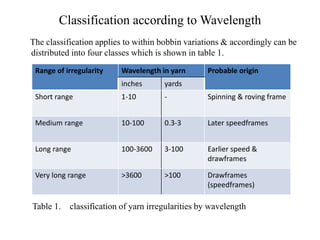
The classification applies to within bobbin variations & accordingly can be
distributed into four classes which is shown in table 1.
Table 1. classification of yarn irregularities by wavelength
Range of irregularity Wavelength in yarn Probable origin
inches yards
Short range 1-10 - Spinning & roving frame
Medium range 10-100 0.3-3 Later speedframes
Long range 100-3600 3-100 Earlier speed &
drawframes
Very long range >3600 >100 Drawframes
(speedframes)
Classification according to type
In table 1 the irregularities may be either periodic or of the drafting wave type.
In a periodic variation there is a constant wavelength & its amplitude is
either slight variable or varies so slowly along the yarn that it remains
steady over many waves.
In a drafting wave amplitude & wavelength vary considerably from one
wave to the another.
Yarn irregularity & its effect on cloth appearance
The effect of yarn irregularity on the cloth appearance depends whether it is
used in warp or weft.
Warp yarn Irregularity:- Irregularity in the warp causes streakiness into
warp direction. The intensity of streakiness does not depends upon the
range or type of irregularity, though the length of the streaks is affected by
the proportions of short, medium & long waves in the yarn. The coefficient
of variation or the mean deviation of the yarn as measured on a regularity
tester is probably a reasonable measure of the tendency to warp strekiness
in so far it will depend on quality of the yarn.
Weft yarn irregularity
The effect of weft yarn irregularity depends upon both wavelength and type of
the irregularity. There may be effects of short & medium range periodic
variations.
Short & medium length periodic variation in weft:
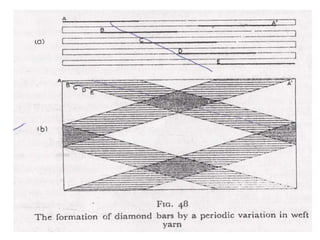
These are liable to cause a diamond barring into the cloth. This will occur
when there is a relation between the wavelength of the periodic variation
and the width of the cloth or the length of yarn in one pick. In figure 1 it
will be shown that how this will happens.
Suppose the wavelength to be a little greater then the pick length. The weft
only is drawn in figure 1 & the thick places are shown as thick lines
actually the change from thick to thin in the periodic variation is gradual.
Effects of wave like irregularities in weft yarn
In previous diagram we had seen one way in which diamond bars may be
formed. Patterns with different numbers of diamond across cloth are
produced when wavelength of the periodic variation is a different fraction
of pick length. If diamond bars are to be formed then yarn irregularities
must satisfy two conditions:-
1. It must contains a periodic variation.
2. The wavelength of this variation must be less then twice then pick length
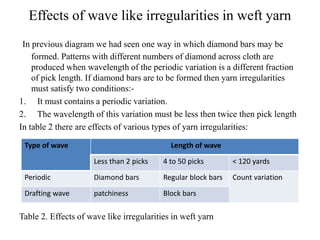
In table 2 there are effects of various types of yarn irregularities:
Table 2. Effects of wave like irregularities in weft yarn
Type of wave Length of wave
Less than 2 picks 4 to 50 picks < 120 yards
Periodic Diamond bars Regular block bars Count variation
Drafting wave patchiness Block bars
Short & medium length drafting waves in weft
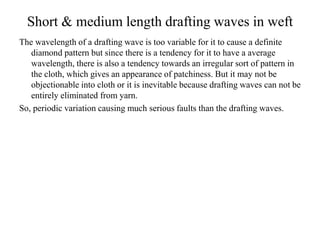
The wavelength of a drafting wave is too variable for it to cause a definite
diamond pattern but since there is a tendency for it to have a average
wavelength, there is also a tendency towards an irregular sort of pattern in
the cloth, which gives an appearance of patchiness. But it may not be
objectionable into cloth or it is inevitable because drafting waves can not be
entirely eliminated from yarn.
So, periodic variation causing much serious faults than the drafting waves.
Long range variation in weft
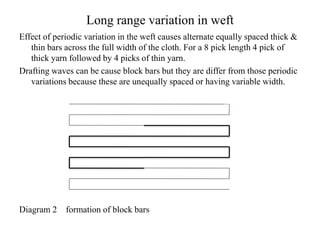
Effect of periodic variation in the weft causes alternate equally spaced thick &
thin bars across the full width of the cloth. For a 8 pick length 4 pick of
thick yarn followed by 4 picks of thin yarn.
Drafting waves can be cause block bars but they are differ from those periodic
variations because these are unequally spaced or having variable width.
Diagram 2 formation of block bars
Very long range variation in weft
As the wavelength increase about 50 pick length the block bars gradually
become so wide that they cease to be so objectionable. These very long
waves cause variations in the count of the yarn which is determined in the
in the usual way be weighing 120 yard length of yarn.
Analysis of yarn irregularities
In earlier chapter we have seen that a periodic variation caused by roller nip
movement just produces a definite pattern when wound a blackboard when
its amplitude was 8%.
Here a yarn containing a periodic variation of this amplitude may be compared
with another yarn otherwise identical but without the periodic variation.
Here an amplitude of 8% corresponds a CV of 8/1.41& if CV of a yarn is
20% then it a bad yarn.
So, according to law of addition of irregularities is
{202 + (8/21/2)2}1/2 = 20.7
This same principle applies to the long range irregularities which causes block
bars.
Detection of periodic variations
Large amplitude variations can be easily visible in a regularity trace & their
wavelength can be measured but variations of moderate or small amplitude
are difficult to put on trace.
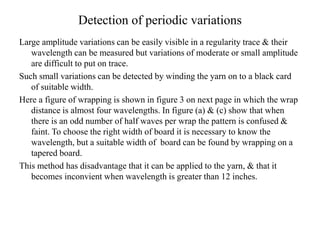
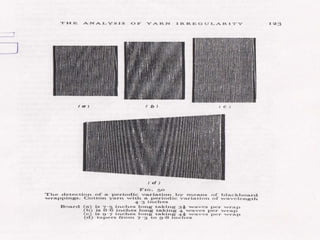
Such small variations can be detected by winding the yarn on to a black card
of suitable width.
Here a figure of wrapping is shown in figure 3 on next page in which the wrap
distance is almost four wavelengths. In figure (a) & (c) show that when
there is an odd number of half waves per wrap the pattern is confused &
faint. To choose the right width of board it is necessary to know the
wavelength, but a suitable width of board can be found by wrapping on a
tapered board.
This method has disadvantage that it can be applied to the yarn, & that it
becomes inconvient when wavelength is greater than 12 inches.
The detection of long yarn irregularities
The long range irregularities originate in the earlier speed frames & the draw
frames. Since at these stages they are short range irregularities, they are
measured by regularity test on the products of these frames. They can not
be avoided altogether, but they can be kept as small as possible by checking
the regularity of the products of these frames, & by attention to the roller
setting & the mechanical condition on them.
Here some regularity tester are fitted with a switch which can detect these. An
electrical filter is switched into the circuit which at a suitable speed of the
yarn greatly reduces the short & medium waves before the signal is passed
on the pen recorder & integrator which measure the CV. The integrator then
measures the CV of the long waves only.
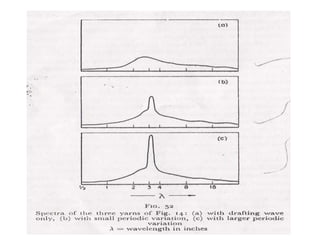
Uster Spectrograph
It is used in conjunction with uster evenness tester automatically draws the
spectrum of the irregularities in slivers, rovings, yarns. It does not use the
electrical filters which we imagined in our explanation of spectrum.
The spectrograph covers a range of wavelength from 0.5 inch to 20 yards in
bands which are 15% wide. Two tests are required to cover the whole of the
range. If we compare the whole range of the wavelengths which are of
importance in weft yarns. It could be an advantage, if the longest
wavelength measureable could be increased to 50 to 100 yards.
Thank You

yarn irregularity & its effect on cloth appearance

  • 1.
    An assignment onanalysis of yarn irregularity & its effect on cloth appearance
  • 2.
    Contents • Classification • Classificationaccording to Wavelength • Classification according to type • Yarn irregularity & its effect on cloth appearance • Weft yarn irregularity • Effects of wave like irregularities in weft yarn • Short & medium length drafting waves in weft • Long range variation in weft • Analysis of yarn irregularities • Detection of periodic variations • Uster Spectrograph
  • 3.
    Analysis of yarnirregularity & its effect on cloth appearance In the absence of mechanical faults in the machines the irregularity of the yarn is made up of a tarn is made up of a drafting wave 2-3 inches long from the spinning frame together with longer & longer waves from the earlier processes, the amplitude of which becomes progressively smaller as the wavelength increases. The irregularities in the yarn can be classified in two ways:- 1. According to wavelength 2. According to type( drafting waves or periodic variations)
  • 4.
    Classification according toWavelength The classification applies to within bobbin variations & accordingly can be distributed into four classes which is shown in table 1. Table 1. classification of yarn irregularities by wavelength Range of irregularity Wavelength in yarn Probable origin inches yards Short range 1-10 - Spinning & roving frame Medium range 10-100 0.3-3 Later speedframes Long range 100-3600 3-100 Earlier speed & drawframes Very long range >3600 >100 Drawframes (speedframes)
  • 5.
    Classification according totype In table 1 the irregularities may be either periodic or of the drafting wave type. In a periodic variation there is a constant wavelength & its amplitude is either slight variable or varies so slowly along the yarn that it remains steady over many waves. In a drafting wave amplitude & wavelength vary considerably from one wave to the another.
  • 6.
    Yarn irregularity &its effect on cloth appearance The effect of yarn irregularity on the cloth appearance depends whether it is used in warp or weft. Warp yarn Irregularity:- Irregularity in the warp causes streakiness into warp direction. The intensity of streakiness does not depends upon the range or type of irregularity, though the length of the streaks is affected by the proportions of short, medium & long waves in the yarn. The coefficient of variation or the mean deviation of the yarn as measured on a regularity tester is probably a reasonable measure of the tendency to warp strekiness in so far it will depend on quality of the yarn.
  • 7.
    Weft yarn irregularity Theeffect of weft yarn irregularity depends upon both wavelength and type of the irregularity. There may be effects of short & medium range periodic variations. Short & medium length periodic variation in weft: These are liable to cause a diamond barring into the cloth. This will occur when there is a relation between the wavelength of the periodic variation and the width of the cloth or the length of yarn in one pick. In figure 1 it will be shown that how this will happens. Suppose the wavelength to be a little greater then the pick length. The weft only is drawn in figure 1 & the thick places are shown as thick lines actually the change from thick to thin in the periodic variation is gradual.
  • 9.
    Effects of wavelike irregularities in weft yarn In previous diagram we had seen one way in which diamond bars may be formed. Patterns with different numbers of diamond across cloth are produced when wavelength of the periodic variation is a different fraction of pick length. If diamond bars are to be formed then yarn irregularities must satisfy two conditions:- 1. It must contains a periodic variation. 2. The wavelength of this variation must be less then twice then pick length In table 2 there are effects of various types of yarn irregularities: Table 2. Effects of wave like irregularities in weft yarn Type of wave Length of wave Less than 2 picks 4 to 50 picks < 120 yards Periodic Diamond bars Regular block bars Count variation Drafting wave patchiness Block bars
  • 10.
    Short & mediumlength drafting waves in weft The wavelength of a drafting wave is too variable for it to cause a definite diamond pattern but since there is a tendency for it to have a average wavelength, there is also a tendency towards an irregular sort of pattern in the cloth, which gives an appearance of patchiness. But it may not be objectionable into cloth or it is inevitable because drafting waves can not be entirely eliminated from yarn. So, periodic variation causing much serious faults than the drafting waves.
  • 11.
    Long range variationin weft Effect of periodic variation in the weft causes alternate equally spaced thick & thin bars across the full width of the cloth. For a 8 pick length 4 pick of thick yarn followed by 4 picks of thin yarn. Drafting waves can be cause block bars but they are differ from those periodic variations because these are unequally spaced or having variable width. Diagram 2 formation of block bars
  • 12.
    Very long rangevariation in weft As the wavelength increase about 50 pick length the block bars gradually become so wide that they cease to be so objectionable. These very long waves cause variations in the count of the yarn which is determined in the in the usual way be weighing 120 yard length of yarn.
  • 13.
    Analysis of yarnirregularities In earlier chapter we have seen that a periodic variation caused by roller nip movement just produces a definite pattern when wound a blackboard when its amplitude was 8%. Here a yarn containing a periodic variation of this amplitude may be compared with another yarn otherwise identical but without the periodic variation. Here an amplitude of 8% corresponds a CV of 8/1.41& if CV of a yarn is 20% then it a bad yarn. So, according to law of addition of irregularities is {202 + (8/21/2)2}1/2 = 20.7 This same principle applies to the long range irregularities which causes block bars.
  • 14.
    Detection of periodicvariations Large amplitude variations can be easily visible in a regularity trace & their wavelength can be measured but variations of moderate or small amplitude are difficult to put on trace. Such small variations can be detected by winding the yarn on to a black card of suitable width. Here a figure of wrapping is shown in figure 3 on next page in which the wrap distance is almost four wavelengths. In figure (a) & (c) show that when there is an odd number of half waves per wrap the pattern is confused & faint. To choose the right width of board it is necessary to know the wavelength, but a suitable width of board can be found by wrapping on a tapered board. This method has disadvantage that it can be applied to the yarn, & that it becomes inconvient when wavelength is greater than 12 inches.
  • 16.
    The detection oflong yarn irregularities The long range irregularities originate in the earlier speed frames & the draw frames. Since at these stages they are short range irregularities, they are measured by regularity test on the products of these frames. They can not be avoided altogether, but they can be kept as small as possible by checking the regularity of the products of these frames, & by attention to the roller setting & the mechanical condition on them. Here some regularity tester are fitted with a switch which can detect these. An electrical filter is switched into the circuit which at a suitable speed of the yarn greatly reduces the short & medium waves before the signal is passed on the pen recorder & integrator which measure the CV. The integrator then measures the CV of the long waves only.
  • 17.
    Uster Spectrograph It isused in conjunction with uster evenness tester automatically draws the spectrum of the irregularities in slivers, rovings, yarns. It does not use the electrical filters which we imagined in our explanation of spectrum. The spectrograph covers a range of wavelength from 0.5 inch to 20 yards in bands which are 15% wide. Two tests are required to cover the whole of the range. If we compare the whole range of the wavelengths which are of importance in weft yarns. It could be an advantage, if the longest wavelength measureable could be increased to 50 to 100 yards.
  • 19.