TOPIC
Take-up Mechanism
WEAVING
Weaving is the process of interlacement
between the warp and the weft in a fabric
according to design.
Take-up is to draw a fabric to the cloth roller regularly
as it is woven. Texture of a fabric largely depends upon
the number of ends and picks per centimeter or inch.
This motion determines the number of picks of weft
per inch or centimeter and contributes to the uniform
texture of the fabric. It is the work of the weaver for
accurately fixing the position of the fell of the cloth
before starting a loom.
Take up
TAKE UP MOTION
The process of withdrawing fabric from weaving zone at a
constant rate and then winding the woven cloth on the cloth roller
with the continuous progress of weaving is called take up motion
Objective of Take-up Motion
To wind the woven fabric on the cloth roller with
progress of weaving.
To maintain uniform picks per inch.
To know about the construction of the mechanism.
To know about drive of the take-up motion.
Types of motions
According to drive:
Positive take up
Negative take up
According to motion of the
cloth/Rate of take up:
Continuous
Intermitten
According to drive given to the
cloth roller:
 Direct drive
 Indirect drive
According to number of gear train:
5-Wheel
6-Wheel
7-Wheel
According to brand name:
Sulzer
Pickanol
Toyota
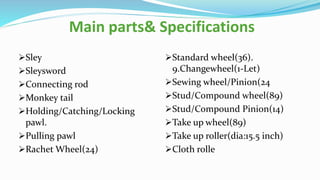
Main parts& Specifications
Sley
Sleysword
Connecting rod
Monkey tail
Holding/Catching/Locking
pawl.
Pulling pawl
Rachet Wheel(24)
Standard wheel(36).
9.Changewheel(1-Let)
Sewing wheel/Pinion(24
Stud/Compound wheel(89)
Stud/Compound Pinion(14)
Take up wheel(89)
Take up roller(dia:15.5 inch)
Cloth rolle
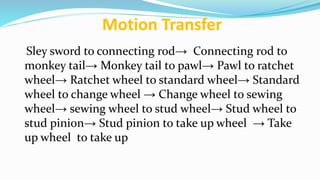
Motion Transfer
Sley sword to connecting rod→ Connecting rod to
monkey tail→ Monkey tail to pawl→ Pawl to ratchet
wheel→ Ratchet wheel to standard wheel→ Standard
wheel to change wheel → Change wheel to sewing
wheel→ sewing wheel to stud wheel→ Stud wheel to
stud pinion→ Stud pinion to take up wheel → Take
up wheel to take up
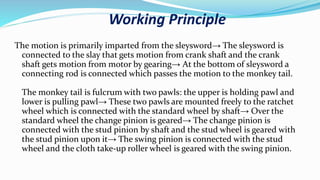
Working Principle
The motion is primarily imparted from the sleysword→ The sleysword is
connected to the slay that gets motion from crank shaft and the crank
shaft gets motion from motor by gearing→ At the bottom of sleysword a
connecting rod is connected which passes the motion to the monkey tail.
The monkey tail is fulcrum with two pawls: the upper is holding pawl and
lower is pulling pawl→ These two pawls are mounted freely to the ratchet
wheel which is connected with the standard wheel by shaft→ Over the
standard wheel the change pinion is geared→ The change pinion is
connected with the stud pinion by shaft and the stud wheel is geared with
the stud pinion upon it→ The swing pinion is connected with the stud
wheel and the cloth take-up roller wheel is geared with the swing pinion.
The cylinder upon which the woven fabric is wound, is
connected with this wheel by shaft→ Now when the sley
moves one time after one pick insertion the connecting
rod pass this motion to the monkey tail and as the pawls
are fulcrum with monkey tail they get downward
motion→ Using this downward motion the pushing pawl
pulls the rachet wheel one time and the holding pawl
holds the rachet in this position→ Finally the cloth roller
gets the motion by gear train and thus fabric is wound on
cloth roller continuously with the weaving of fabric.
Negative Take-Up
Attribute ‘negative’ justifies itself in the sense that no positive or direct
motion is imparted to the take-up roller to wind up the woven fabric. In
this system, shown in Figure. the motion of the rocking shaft actuates a
system of levers and a ratchet-pawl mechanism, favored by gravity aided
movement of dead-weights which in turn, transmits the rotational
motion to take-up roller through a worm and worm-wheel.
Backward motion of the sley ( S) or backward swing of the rocking shaft
( R) keeps the weights raised through a lever (L1) , thus system remains
inactive while forward motion of it sets free the weight system yet
motion of the wheel trains remains balanced with warp tension . The
impulsive blow of sley during beat-up brings the tension of the woven
cloth close to zero.
Weights (W) going down with gravity forces the pawl (P1) to turn
the ratchet by one tooth through lever systeams. Gear trains so
released wind up the excess woven part of the cloth. Retaining pawl
(P2) comes into play to prevent further rotation of gear trains.
With little control over uniform take-up or pick spacing, this system
is only suitable for very coarse fabric like blanket.
Positive Take-Up
In positive take-up, motion gets transmitted to
take-up roller directly through gear train. The
different types of positive take-up are
discussed below.
Five-wheel Take-up
Five-wheel take-up motion is The typical size
of the gear is also given in the Figure. It is a
positive intermittent type take-up motion.
Wheel CW denotes the change wheel which
is in the driver position for five-wheel take-
up. The amount of fabric take-up and
therefore the rotation required in the take-
up roller after every pick is minuscule. This
is achieved by keeping the driver wheels
smaller than the driven wheels. The ratchet
wheel A, having 50 teeth, is turned by one
tooth for every pick.
Seven-wheel Take-up
Seven-wheel take-up is a discontinous positive motion.A
swing motion is given to take-up lever and this will cause
the pulling pawl to drive theratchet wheel and set the
turn of motion.Thus take-up roller gets motion.
Figure : Seven-wheel take-up
Working Principle
Here the pulling pawl is connected to the slay
which is connected to the crank shaft.When the
crank shaft rotates the sley sword gets to and fro
motion which causes the pulling pawl to pull the
the one teeth of ratchet wheel.Then the motion is
transferred to the take up roller from the ratchet
wheel by means of seven wheels.
Advantages of 7 take-up wheel over 5 wheel
take-up mechanism:
1. It can give a larger number of picks per inch in cloth
from a small stock of wheels by changing two wheels
in the train
2. It can give even a fraction of a pick per inch in cloth.
3. The number of teeth in the change wheel and the
number of picks per quarter-inch has been simplified
From the presentation we know about how to cloth is
collected by take up mechanism. Also we learn the
different type of mechanism. I think this would be very
helpful in our future career