Importance of raw cotton
• a. Raw materials represents about 50-75% of the manufacturing cost
of a short-staple yarn. This fact alone is sufficient to indicate the
significance of the raw material for the yarn producer.
• b. Raw material accounts for about 80% to 90% of the yarn quality.
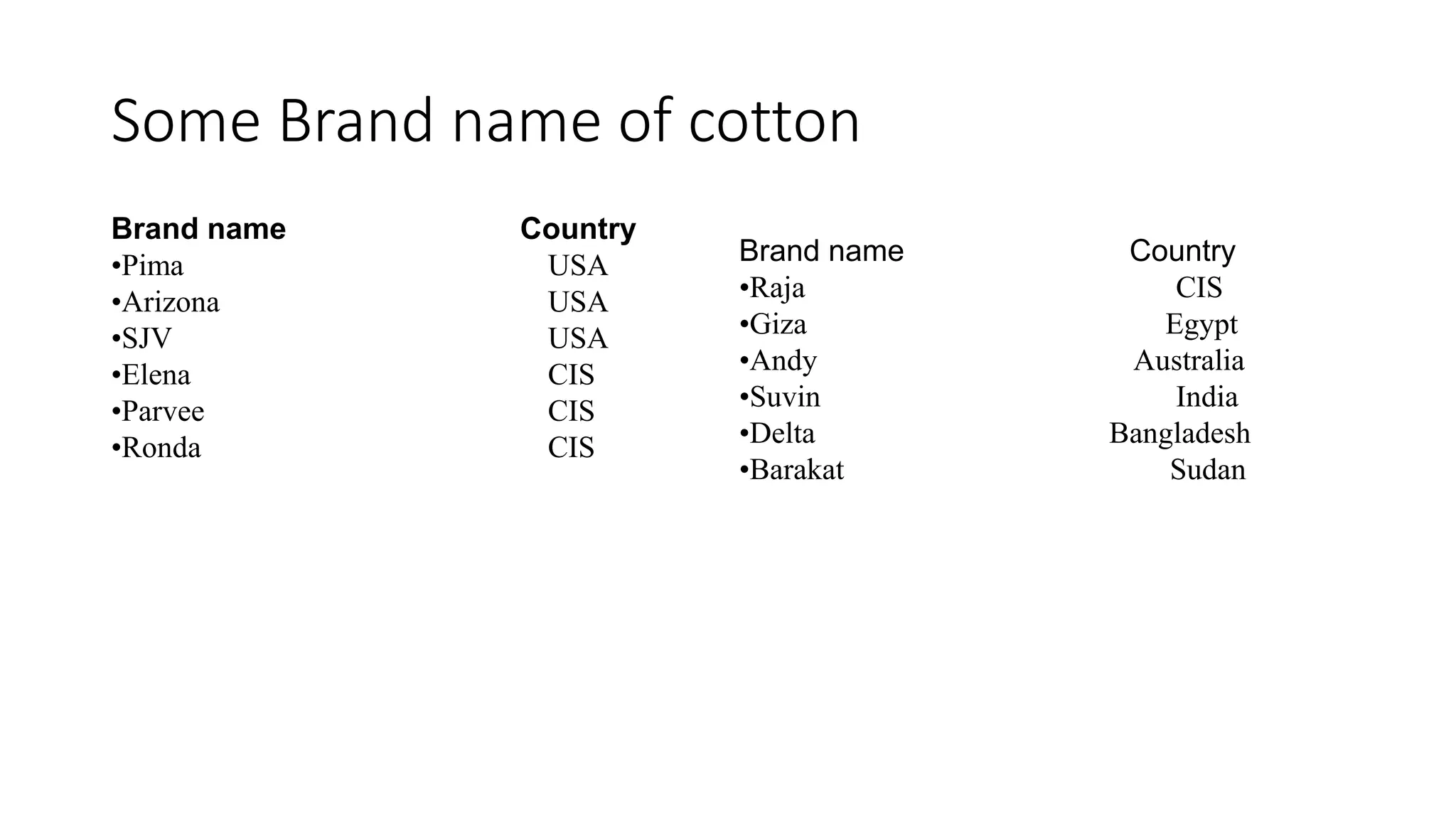
Some Brand name of cotton
Brand name Country
•Pima USA
•Arizona USA
•SJV USA
•Elena CIS
•Parvee CIS
•Ronda CIS
Brand name Country
•Raja CIS
•Giza Egypt
•Andy Australia
•Suvin India
•Delta Bangladesh
•Barakat Sudan
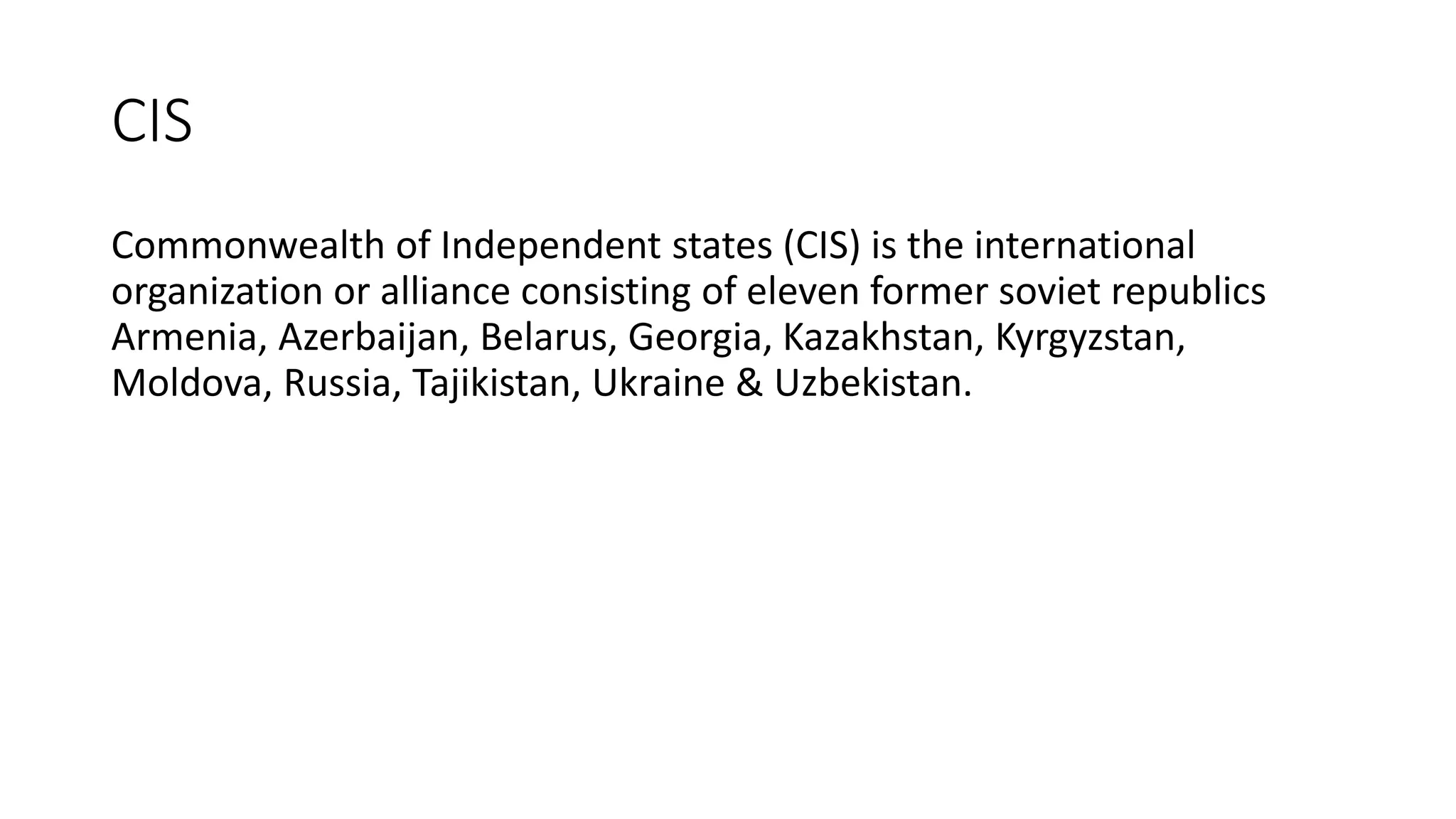
CIS
Commonwealth of Independent states (CIS) is the international
organization or alliance consisting of eleven former soviet republics
Armenia, Azerbaijan, Belarus, Georgia, Kazakhstan, Kyrgyzstan,
Moldova, Russia, Tajikistan, Ukraine & Uzbekistan.
Cotton fibers characteristics consider for spinning
process
• 1. Length
• 2. Strength
• 3. Fineness
• 4. Maturity
• 5. Cleanliness
• 6. Color
• 7. Elongation
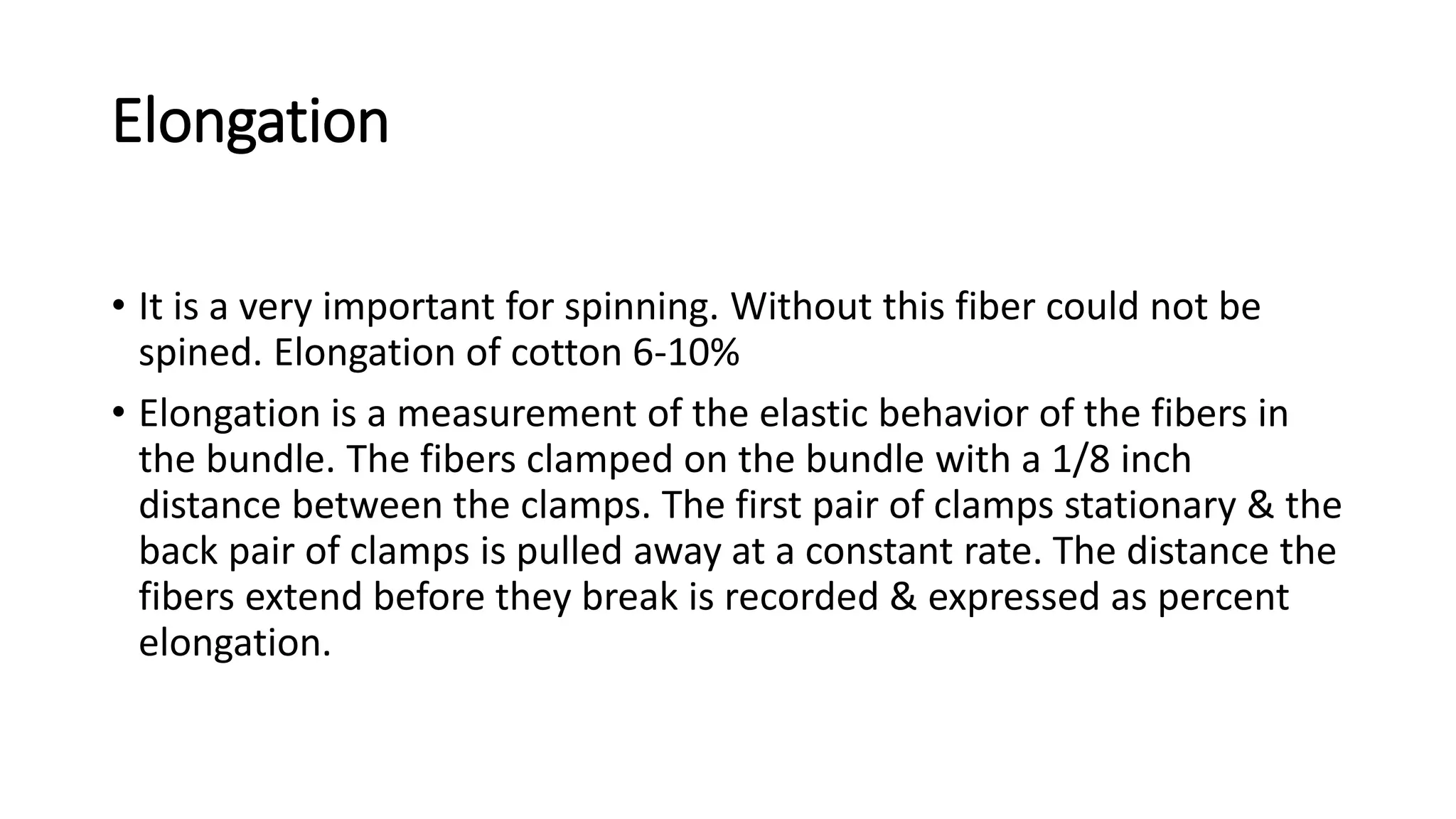
Elongation
• It is a very important for spinning. Without this fiber could not be
spined. Elongation of cotton 6-10%
• Elongation is a measurement of the elastic behavior of the fibers in
the bundle. The fibers clamped on the bundle with a 1/8 inch
distance between the clamps. The first pair of clamps stationary & the
back pair of clamps is pulled away at a constant rate. The distance the
fibers extend before they break is recorded & expressed as percent
elongation.
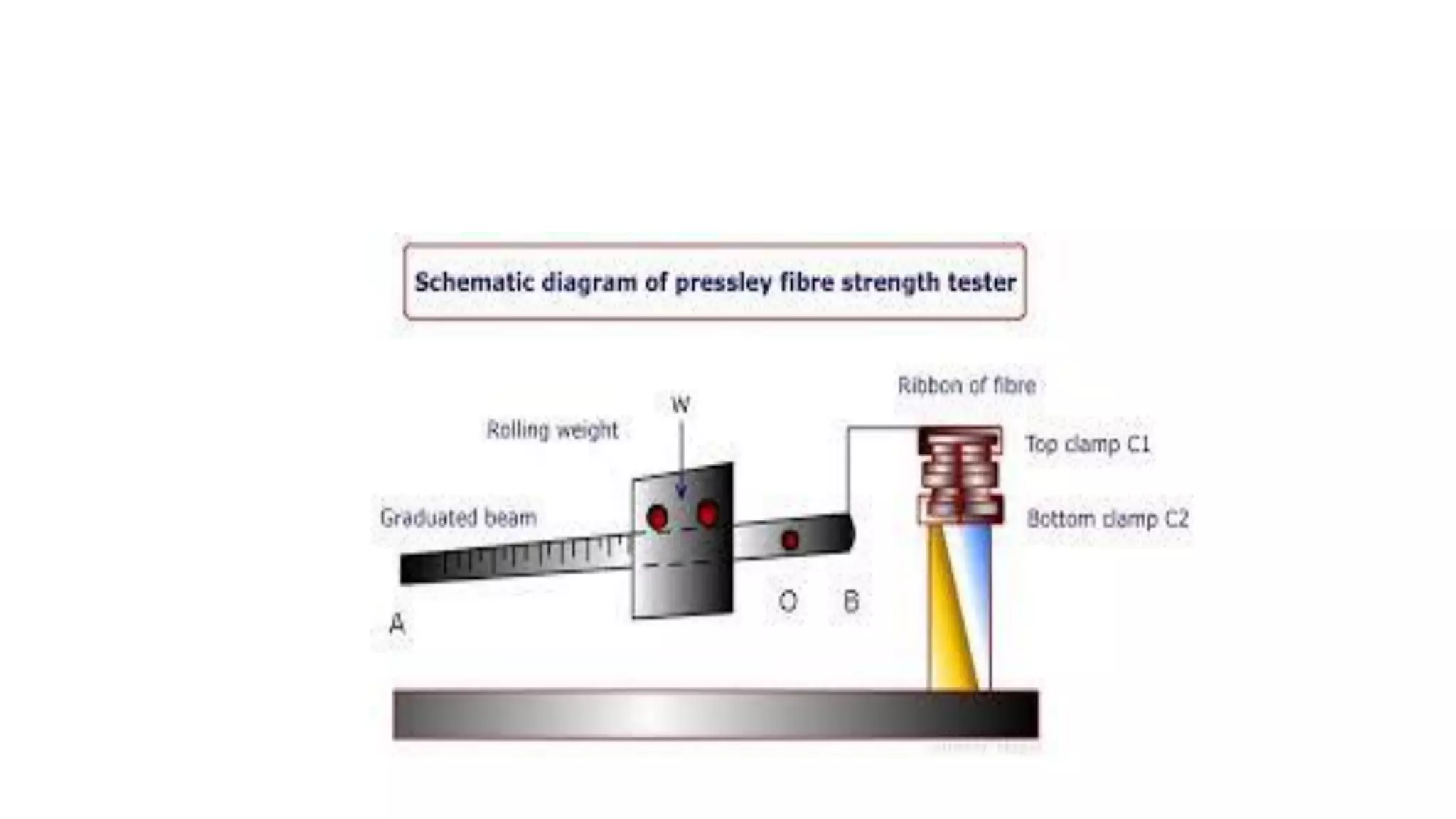
Principle of elongation measurement
Stationery (Fixed)
1/8 inch
Moveable (moves a constant rate)
Upper Clamp
Lower Clamp
Fibre
Bundle
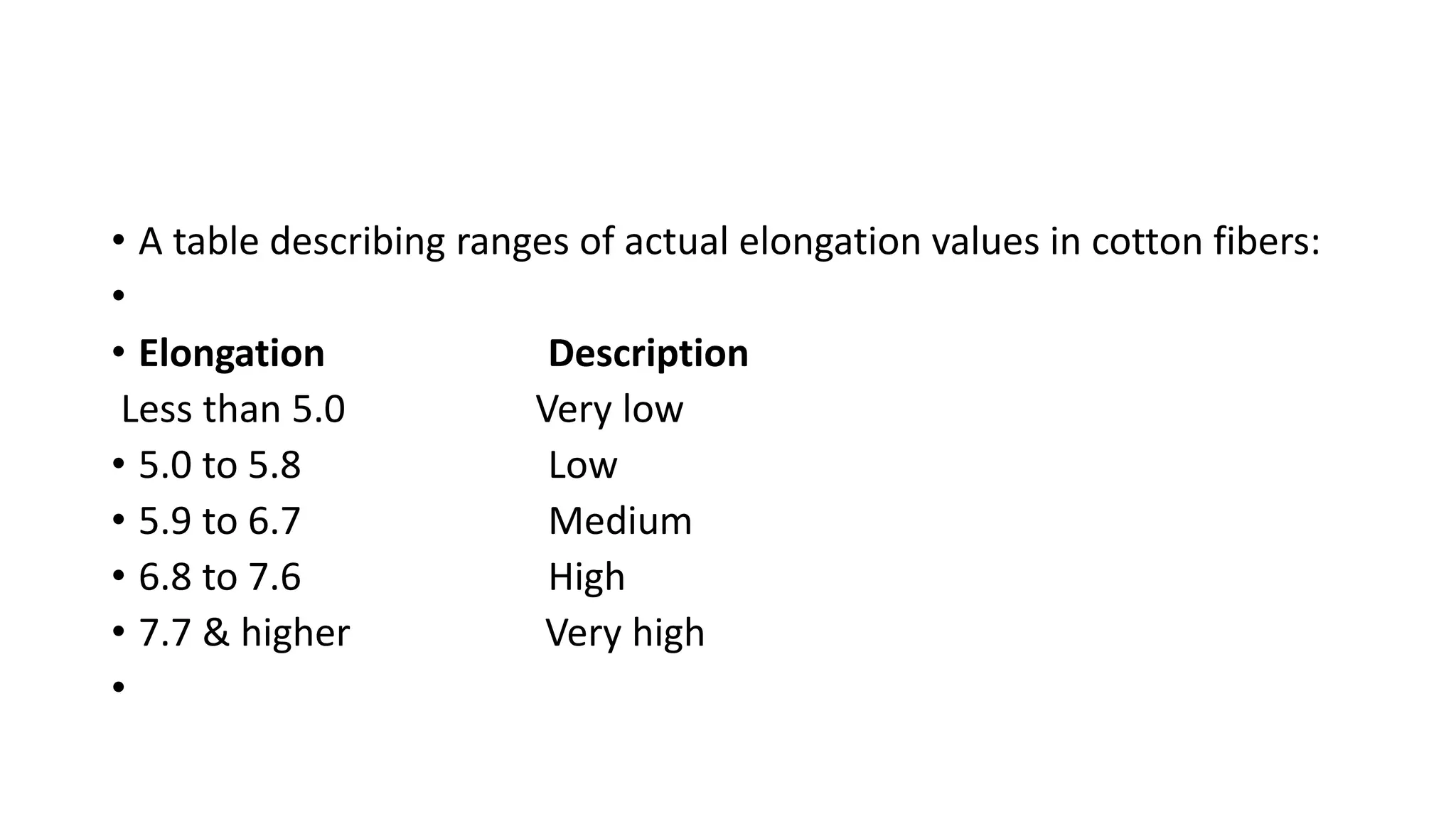
• A table describing ranges of actual elongation values in cotton fibers:
•
• Elongation Description
Less than 5.0 Very low
• 5.0 to 5.8 Low
• 5.9 to 6.7 Medium
• 6.8 to 7.6 High
• 7.7 & higher Very high
•
Color
• Color: The color of cotton is determined by the degree of reflectance
(Rd) and yellowness (+b) in the HVI instrument
•
• Reflectance (Rd):
• This value expresses the whiteness of the light that is reflected by the
cotton fibers.
•
• Yellowness (+b):
• This value expresses the Yellowness of the light that is reflected by
the cotton fibers.
Importance of color
• As the color of cotton deteriorates due to environmental conditions,
the probability for reduced processing efficiency is increased. Color
deterioration also affects the ability of fibers to absorb & hold dyes &
finishes.
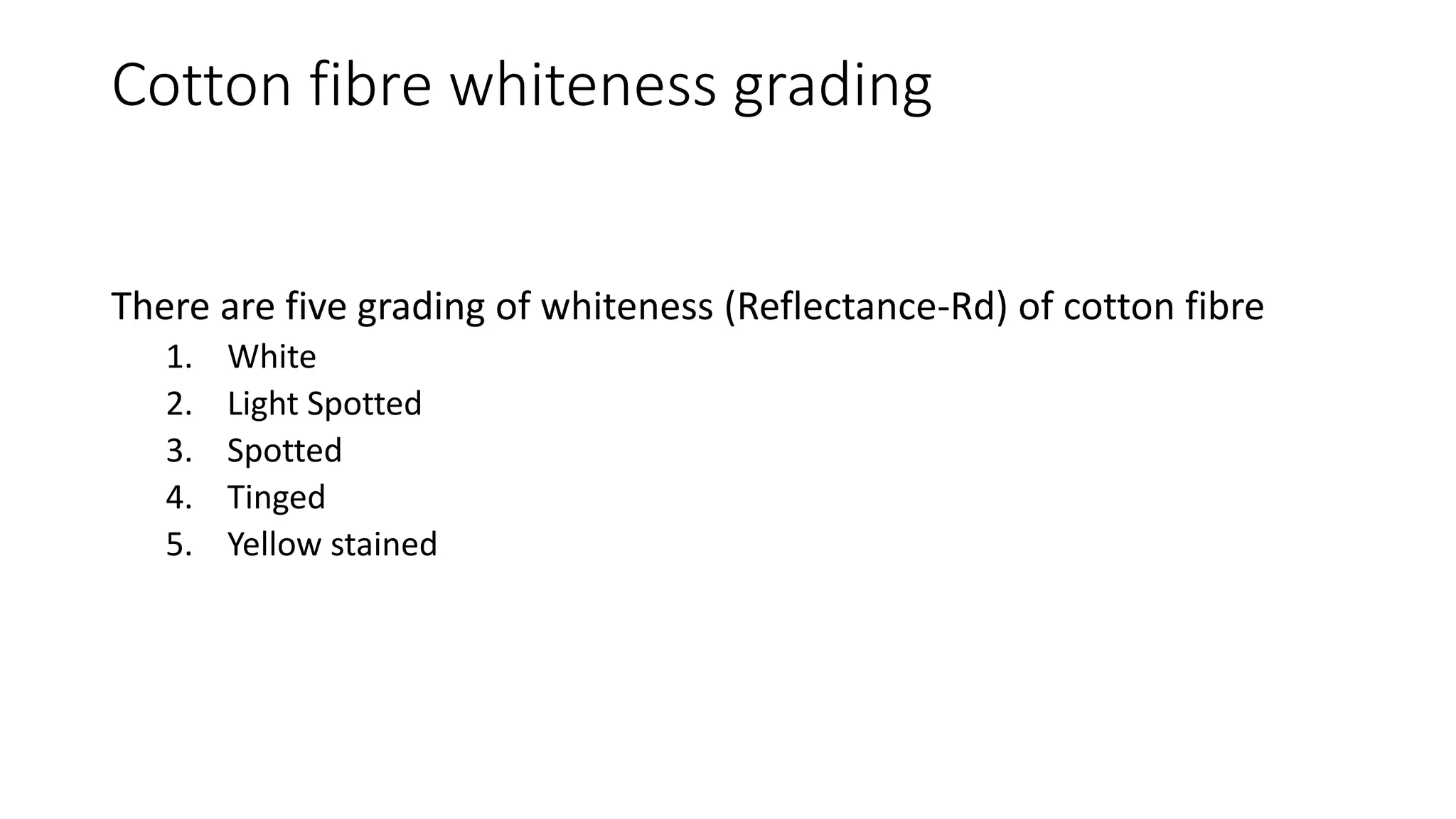
Cotton fibre whiteness grading
There are five grading of whiteness (Reflectance-Rd) of cotton fibre
1. White
2. Light Spotted
3. Spotted
4. Tinged
5. Yellow stained
Cotton fibre yellowness (+b) grading
There are seven (7) grading of yellowness (+b) of cotton fibre –
Grade Symbol
1. Good Middling GM
2. Strict Middling SM
3. Middling M
4. Strict Low Middling SLM
5. Low Middling LM
6. Strict Good ordinary SGO
7. Good ordinary GO
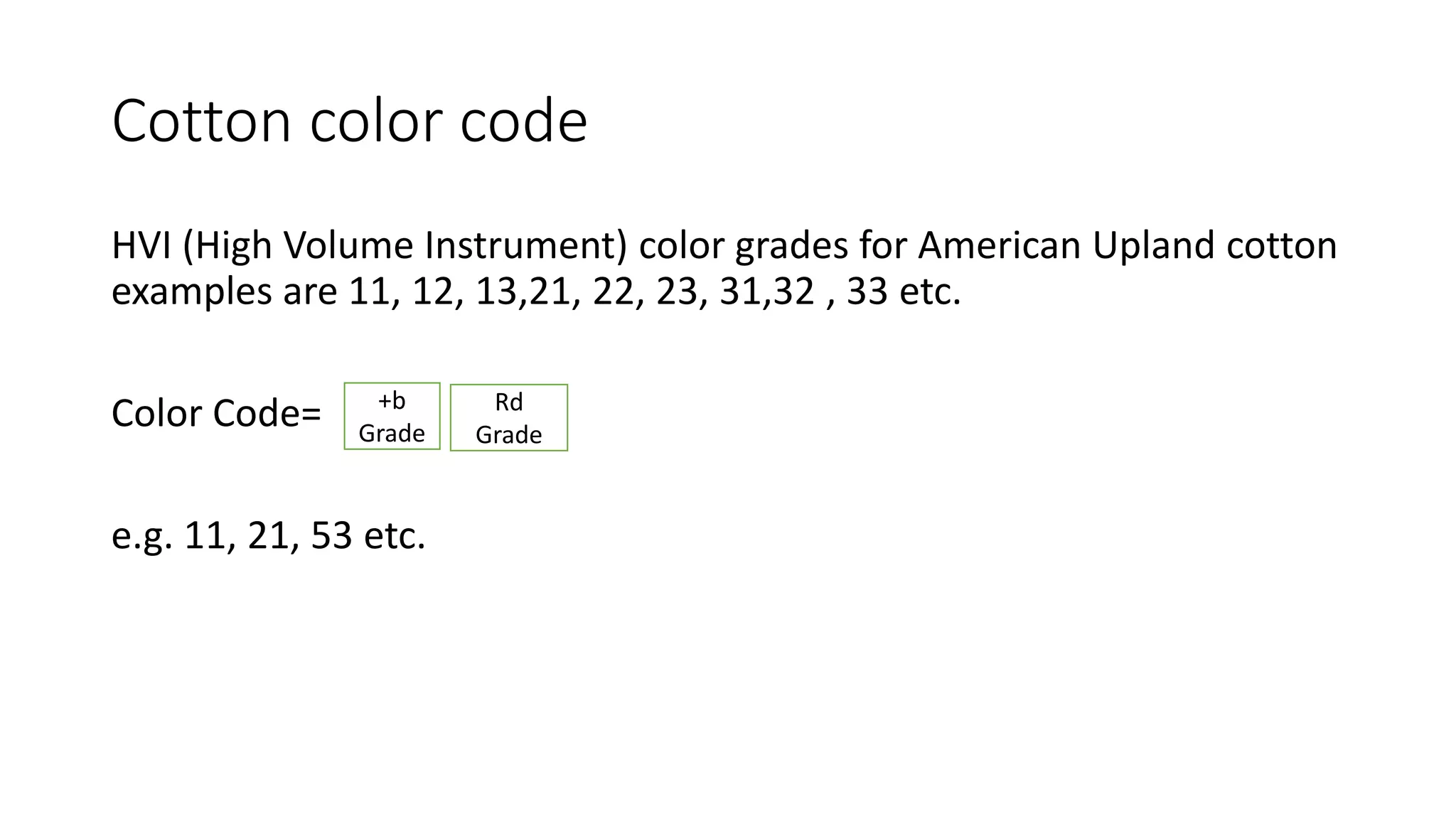
Cotton color code
HVI (High Volume Instrument) color grades for American Upland cotton
examples are 11, 12, 13,21, 22, 23, 31,32 , 33 etc.
Color Code=
e.g. 11, 21, 53 etc.
+b
Grade
Rd
Grade
Cleanliness & trash content
Generally many types of foreign
matter may contain in cotton stock
Vegetable matter
• 1. Husk portion
• 2. Seed fragments
• 3. Stem fragments
• 4. Leaf fragments
• 5. Wood fragments
Mineral matter
• Soil
• Sand
• Dust
Other foreign matters
• Metal fragments
• Cloth fragments
• Packing fragments (mostly
polymer)
Causes of presence of trashes in cotton
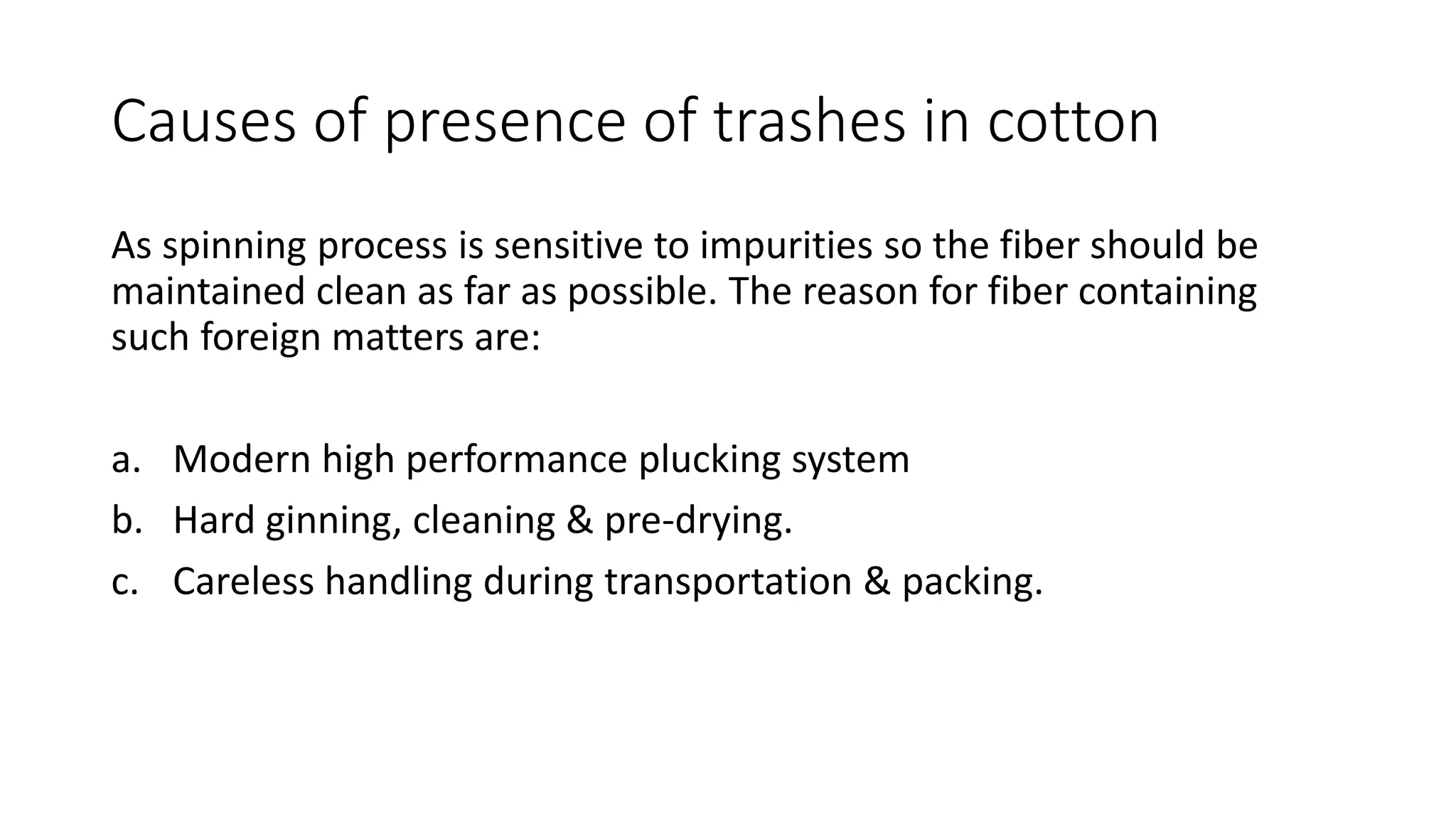
As spinning process is sensitive to impurities so the fiber should be
maintained clean as far as possible. The reason for fiber containing
such foreign matters are:
a. Modern high performance plucking system
b. Hard ginning, cleaning & pre-drying.
c. Careless handling during transportation & packing.
Problem due to unclean fiber
i. Metal parts cut the fibers & harmful to spinning machine.
ii. Vegetable matter makes disturbance in drafting.
iii. Vegetable matter jam the carding pin carding machine
iv. Mineral matter decays the rolling parts of machine.
Cotton grading on the basis of trash content
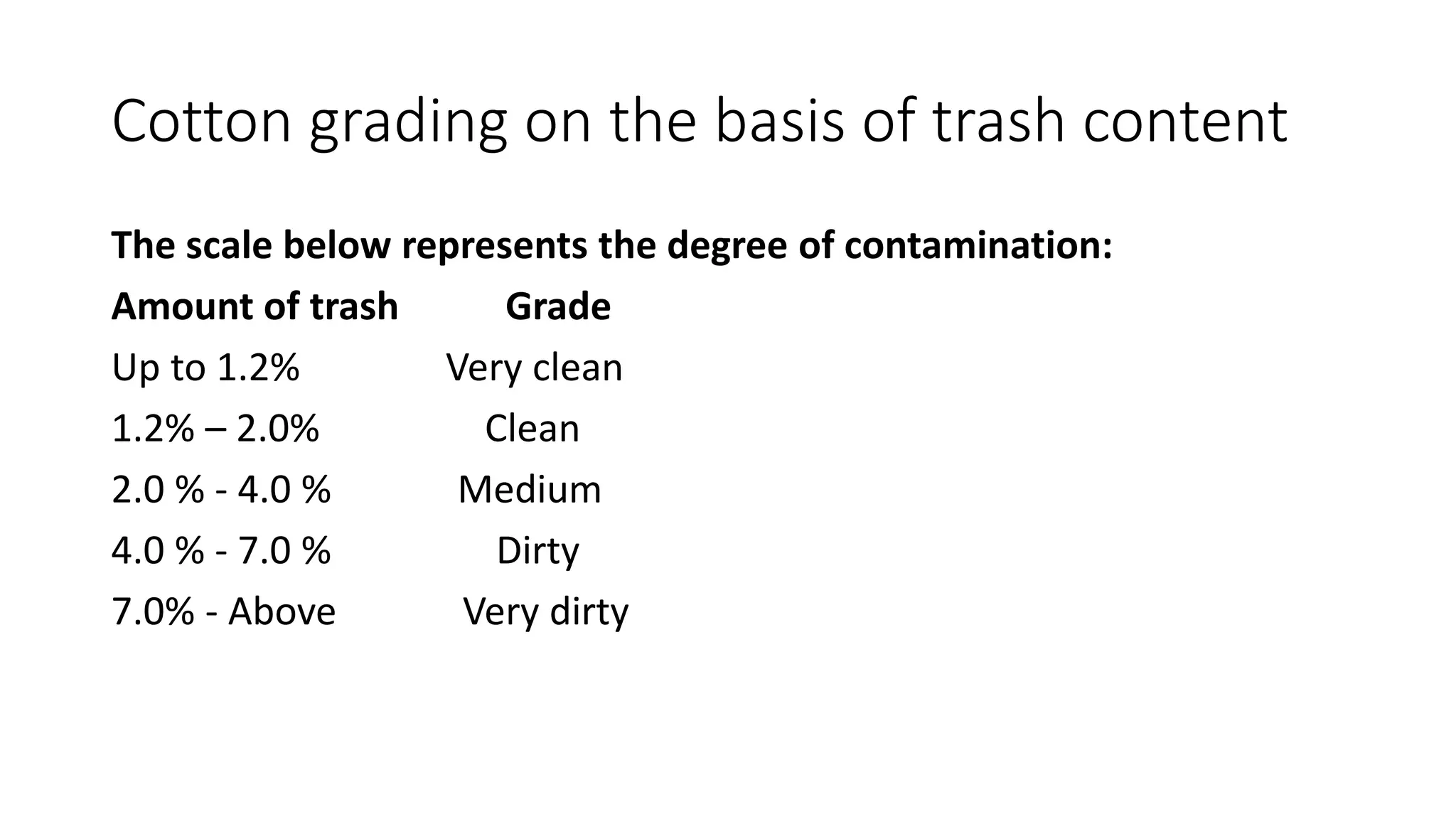
The scale below represents the degree of contamination:
Amount of trash Grade
Up to 1.2% Very clean
1.2% – 2.0% Clean
2.0 % - 4.0 % Medium
4.0 % - 7.0 % Dirty
7.0% - Above Very dirty
Fineness
Fineness is one of the most important fiber characteristics. It
determines how many fibers are present in the X-section of a yarn of
given thickness.
Micronaire Value of cotton:
The average weight of one inch length of fiber, expressed in
micrograms (0.000001g), is called micronaire value of cotton and it is
defined by ASTM (American Society for Testing and Materials)
Cotton grading on the basis of fineness
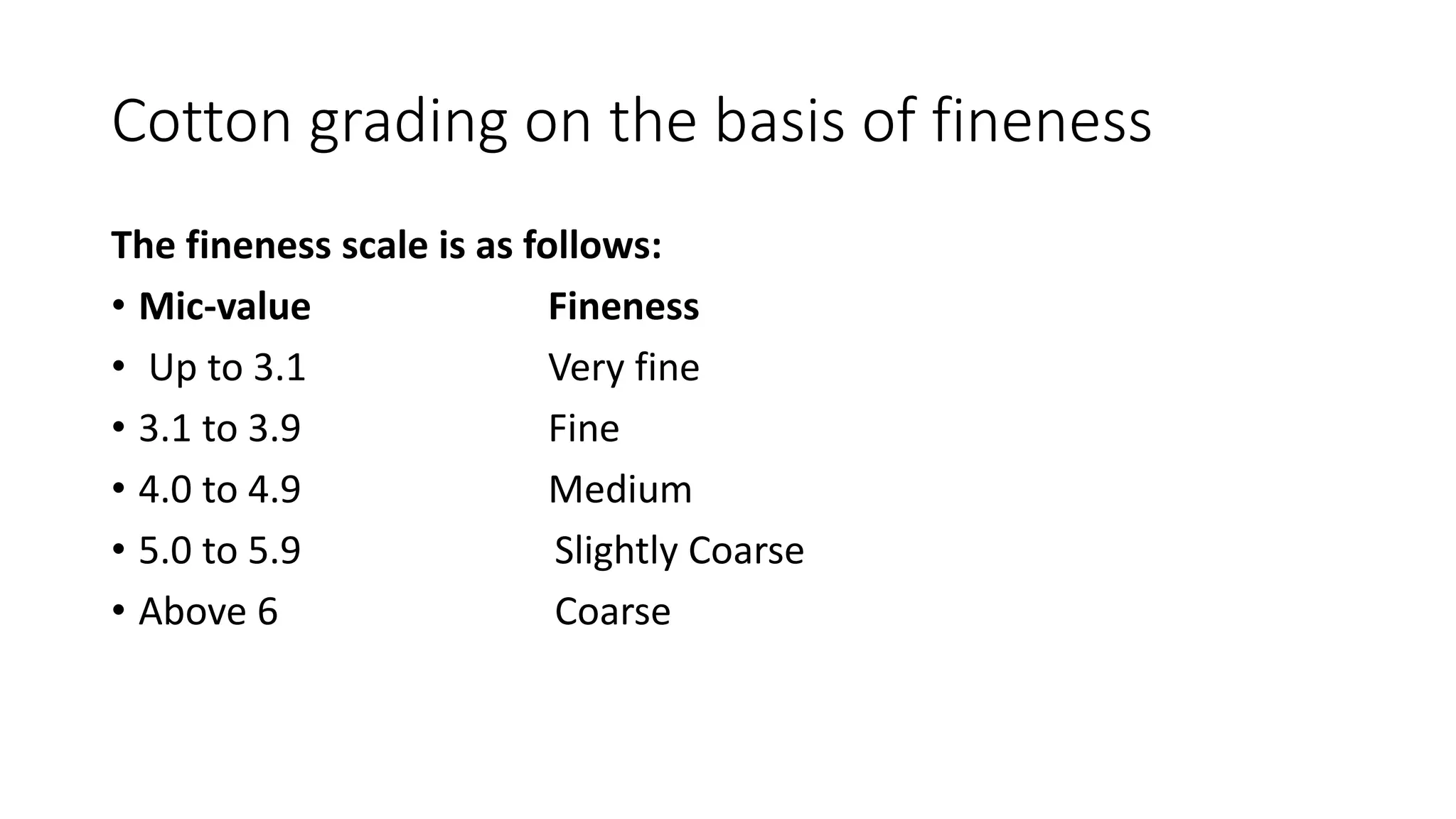
The fineness scale is as follows:
• Mic-value Fineness
• Up to 3.1 Very fine
• 3.1 to 3.9 Fine
• 4.0 to 4.9 Medium
• 5.0 to 5.9 Slightly Coarse
• Above 6 Coarse
Cross-sectional view of yarn
Yarn cross sectional view (ilustrated)
Importance of fibre fineness
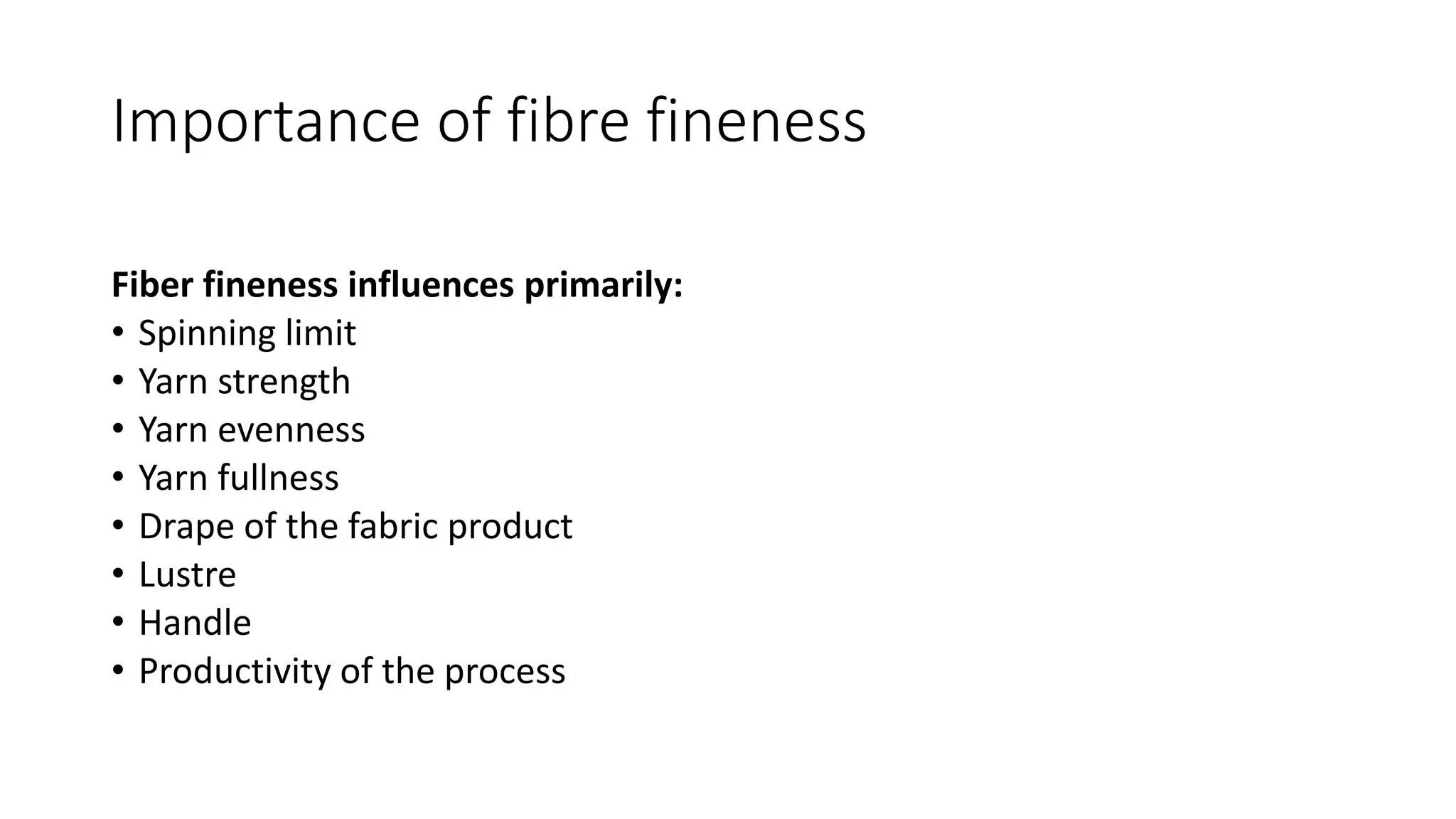
Fiber fineness influences primarily:
• Spinning limit
• Yarn strength
• Yarn evenness
• Yarn fullness
• Drape of the fabric product
• Lustre
• Handle
• Productivity of the process
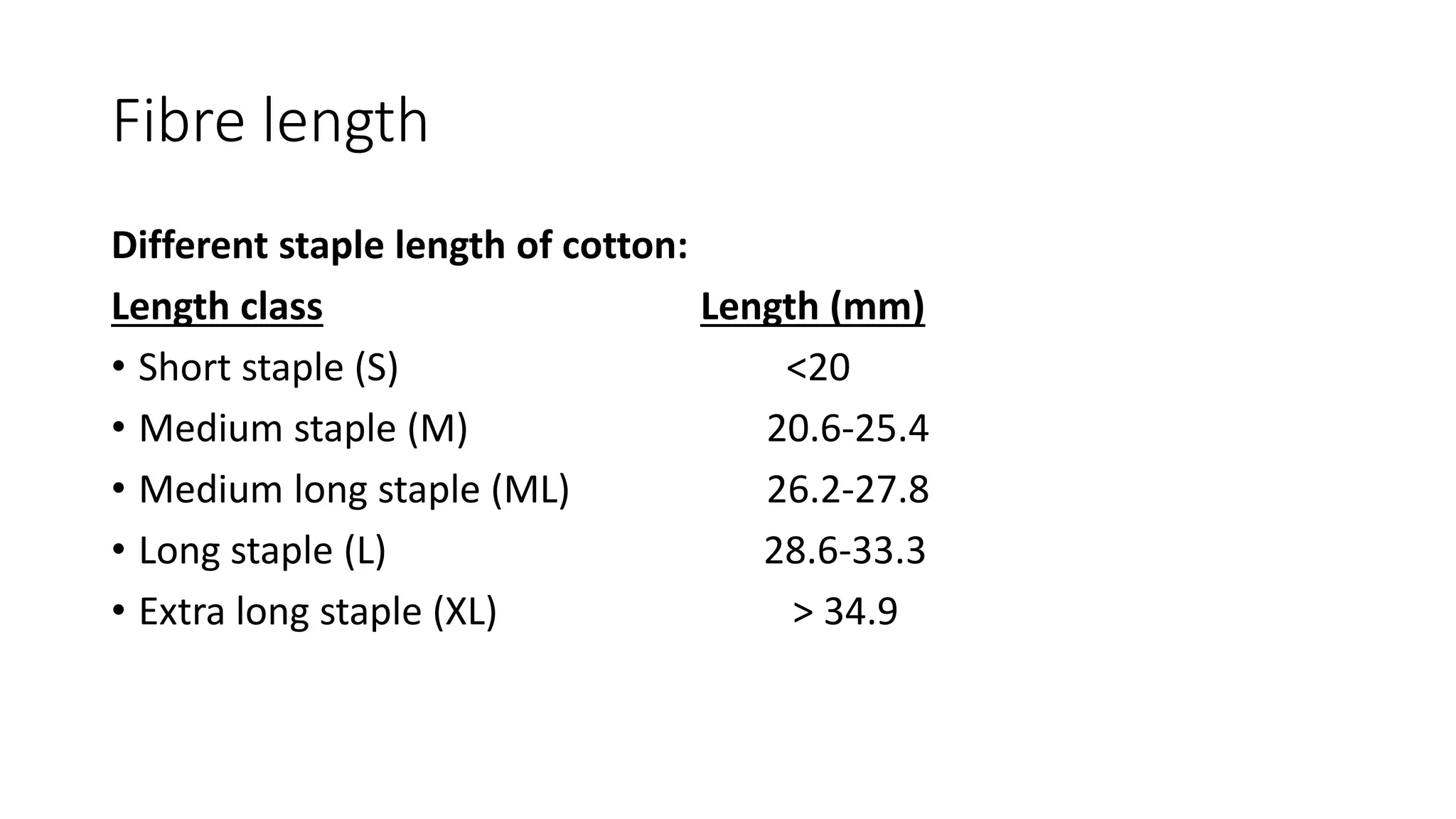
Fibre length
Different staple length of cotton:
Length class Length (mm)
• Short staple (S) <20
• Medium staple (M) 20.6-25.4
• Medium long staple (ML) 26.2-27.8
• Long staple (L) 28.6-33.3
• Extra long staple (XL) > 34.9
Importance of fibre length
Fiber length is also one of the most important fiber characteristics. It
influences:
• Spinning limit
• Yarn strength
• Yarn evenness
• Drape of the fabric product
• Lustre of the product
• Handle of the product
• Productivity
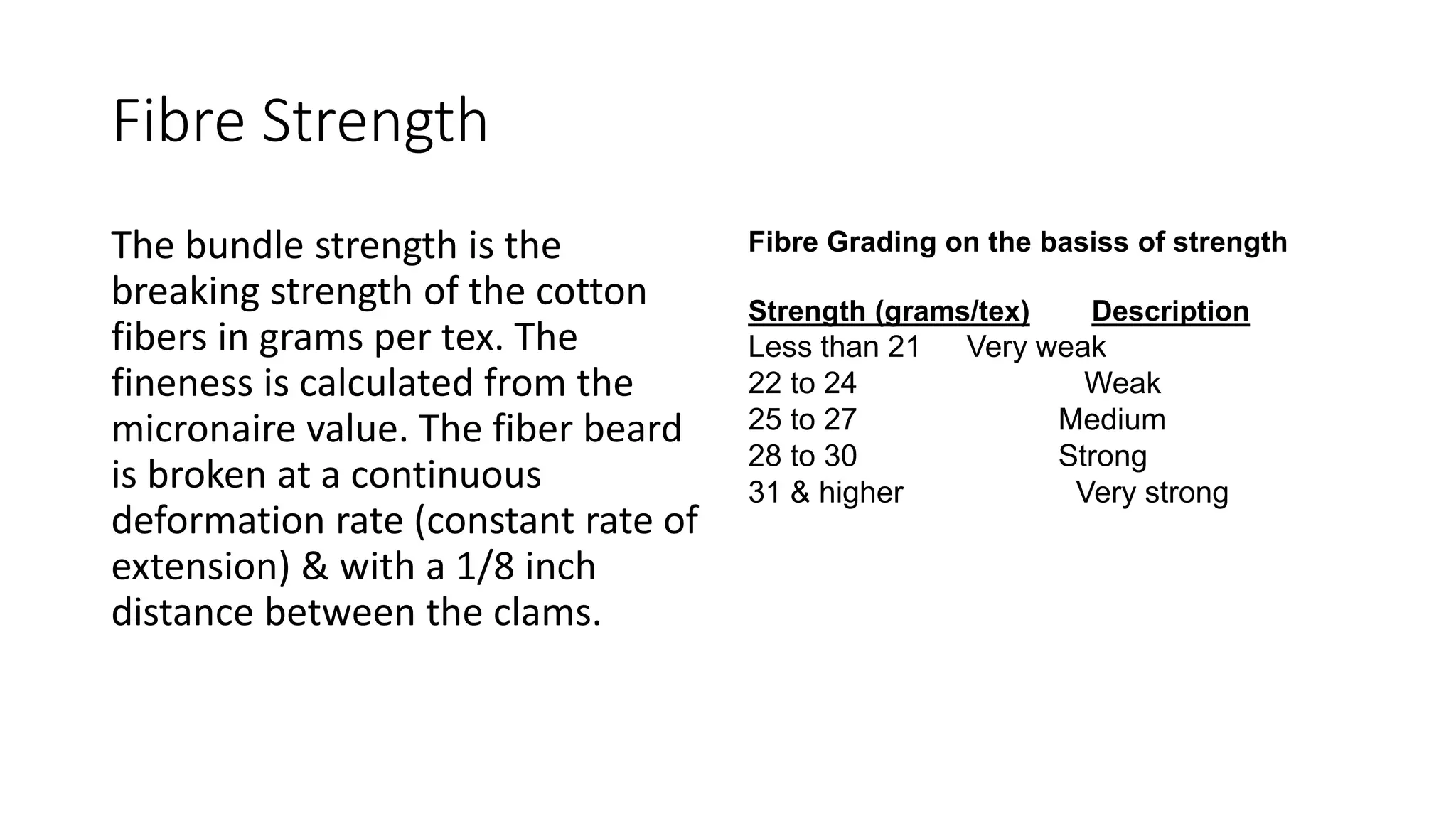
Fibre Strength
Fibre Grading on the basiss of strength
Strength (grams/tex) Description
Less than 21 Very weak
22 to 24 Weak
25 to 27 Medium
28 to 30 Strong
31 & higher Very strong
The bundle strength is the
breaking strength of the cotton
fibers in grams per tex. The
fineness is calculated from the
micronaire value. The fiber beard
is broken at a continuous
deformation rate (constant rate of
extension) & with a 1/8 inch
distance between the clams.
Fibre Maturity
Fiber maturity means the thickness of cell wall. The more thick the
more mature. Unripe fibers have neither adequate strength nor
adequate longitudinal stiffness. They therefore lead to:
a. Loss of yarn strength
b. Neppiness
c. A high proportion of short fibers
d. Varying dye ability &
e. Processing difficulties mainly at the card
Cross sectional view of fibre
Fibre microscopic view
Longitudinal view of mature fibre
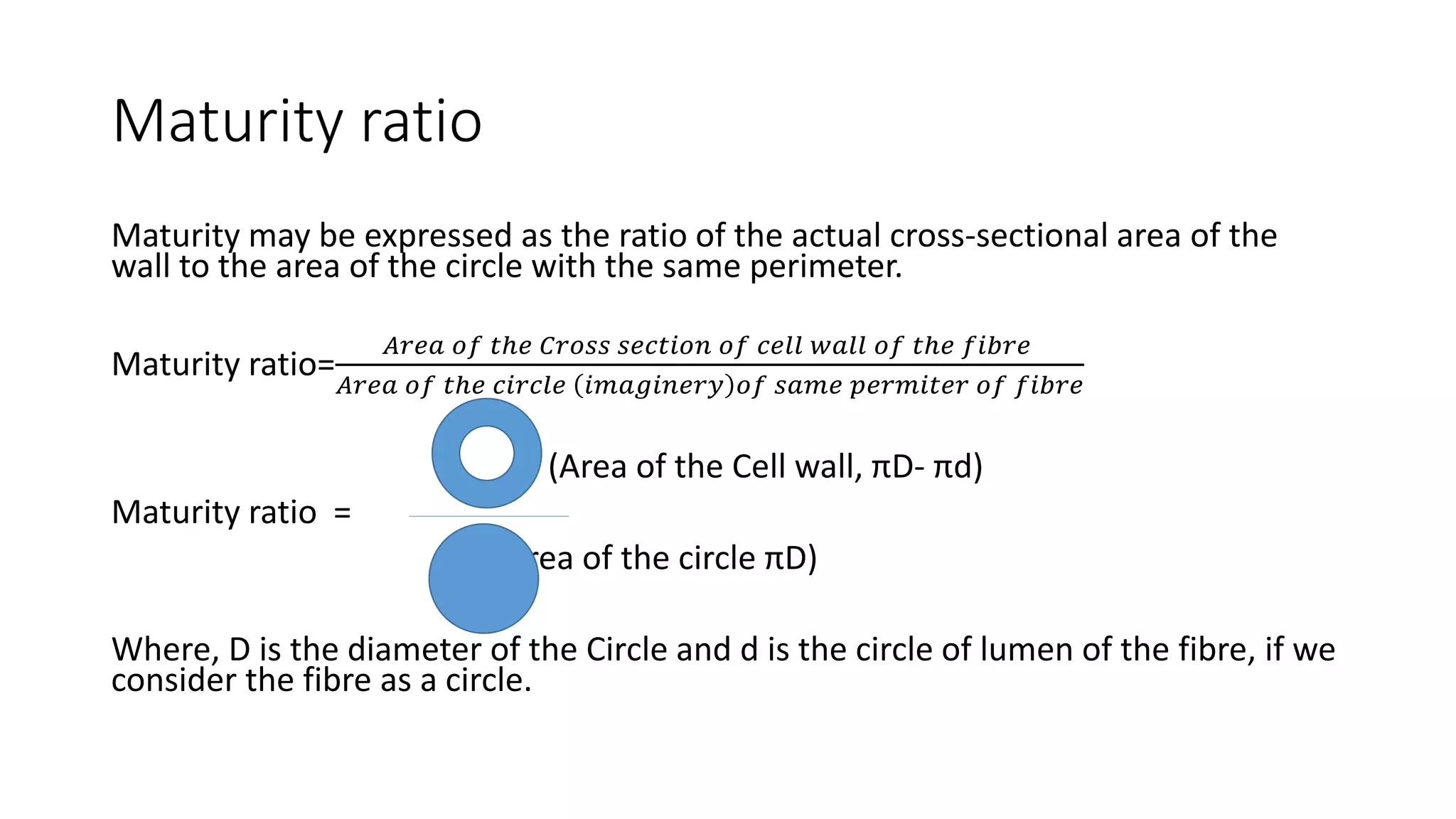
Maturity ratio
Maturity may be expressed as the ratio of the actual cross-sectional area of the
wall to the area of the circle with the same perimeter.
Maturity ratio=
𝐴𝑟𝑒𝑎 𝑜𝑓 𝑡ℎ𝑒 𝐶𝑟𝑜𝑠𝑠 𝑠𝑒𝑐𝑡𝑖𝑜𝑛 𝑜𝑓 𝑐𝑒𝑙𝑙 𝑤𝑎𝑙𝑙 𝑜𝑓 𝑡ℎ𝑒 𝑓𝑖𝑏𝑟𝑒
𝐴𝑟𝑒𝑎 𝑜𝑓 𝑡ℎ𝑒 𝑐𝑖𝑟𝑐𝑙𝑒 𝑖𝑚𝑎𝑔𝑖𝑛𝑒𝑟𝑦 𝑜𝑓 𝑠𝑎𝑚𝑒 𝑝𝑒𝑟𝑚𝑖𝑡𝑒𝑟 𝑜𝑓 𝑓𝑖𝑏𝑟𝑒
(Area of the Cell wall, πD- πd)
Maturity ratio =
(Area of the circle πD)
Where, D is the diameter of the Circle and d is the circle of lumen of the fibre, if we
consider the fibre as a circle.
Fibre Grading on the basis of maturity
Maturity may be expressed as the ratio of the actual cross-sectional
area of the wall to the area of the circle with the same perimeter.
Maturity Index Description
Below 0.75 Uncommon
0.75 to 0.85 Immature
0.86 to 0.95 Mature
Above 0.95 Very mature
Bale Management
Bale management refers to the process of inventory control & selection
of fiber according to its properties to maintain homogeneous mixing
quality for getting consistent production & quality of yarn. For bale
management, all bale samples are tested and bale with almost similar
category are arranged for homogeneous mixing.
Object of Bale management:
• To get uniform yarn quality (consistent).
• To minimize shade variation of the finished fabric.
• To reduce fabric ‘barre.’
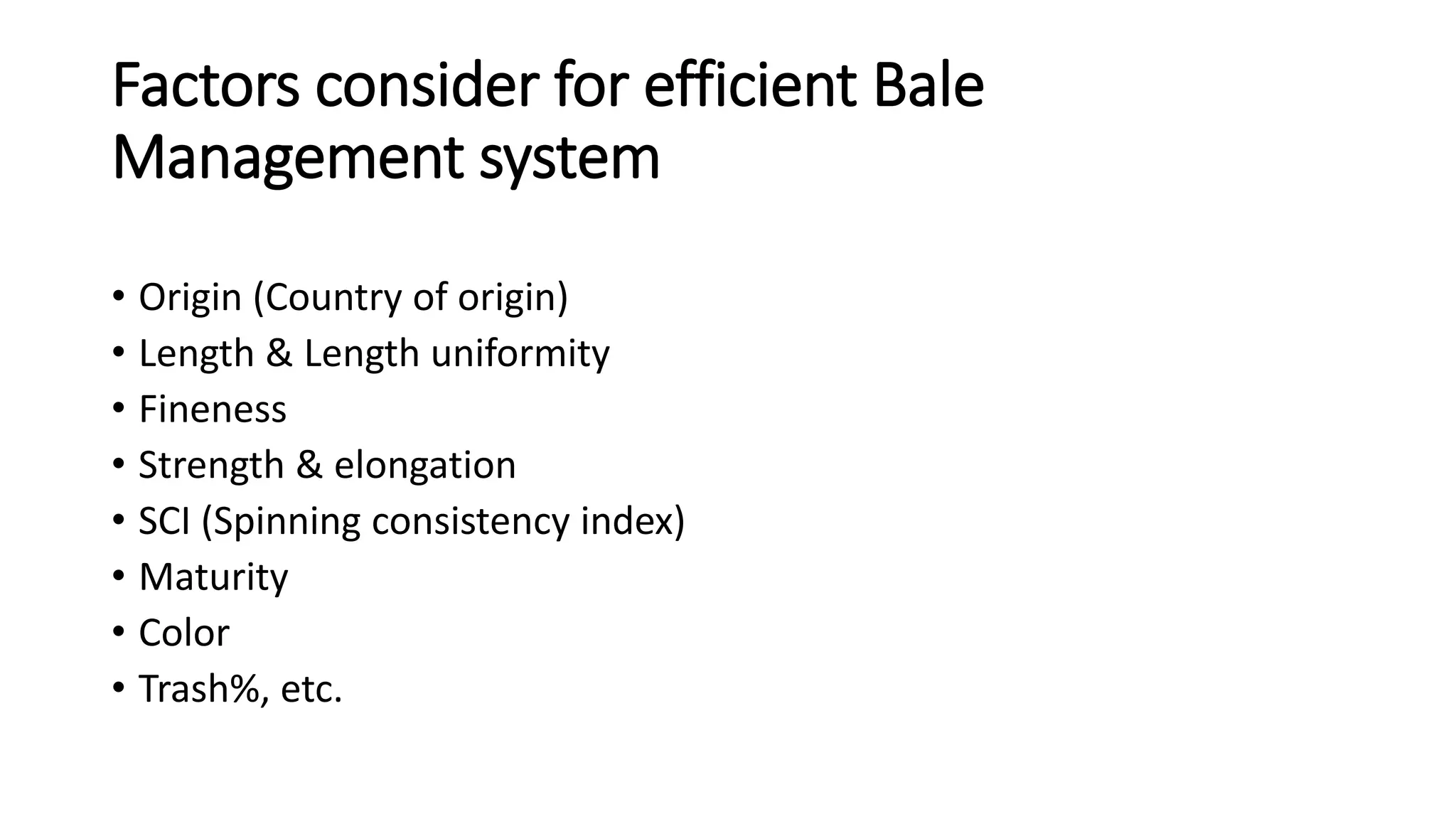
Factors consider for efficient Bale
Management system
• Origin (Country of origin)
• Length & Length uniformity
• Fineness
• Strength & elongation
• SCI (Spinning consistency index)
• Maturity
• Color
• Trash%, etc.
Bale management
Store of cotton bale
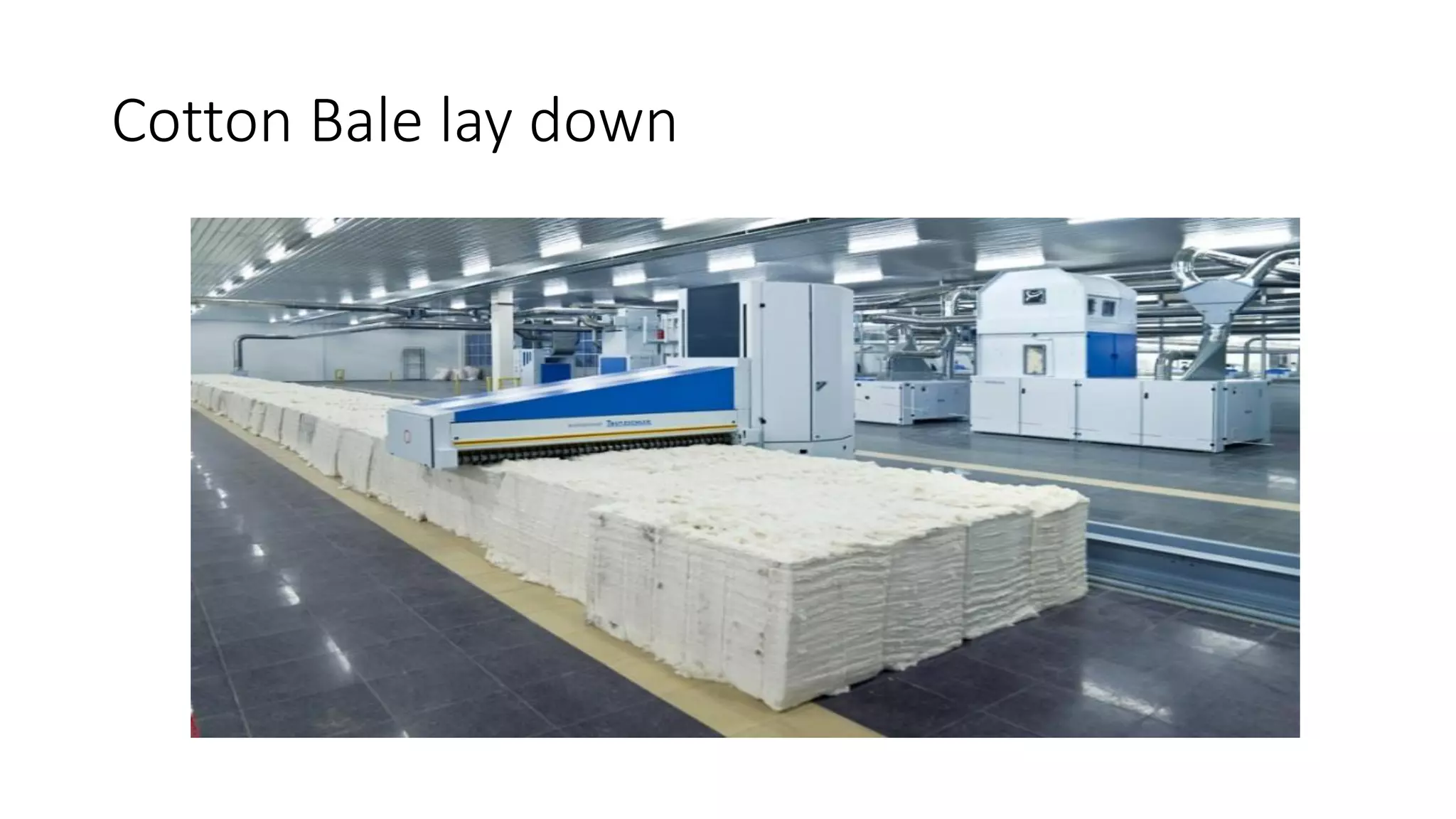
Cotton Bale lay down
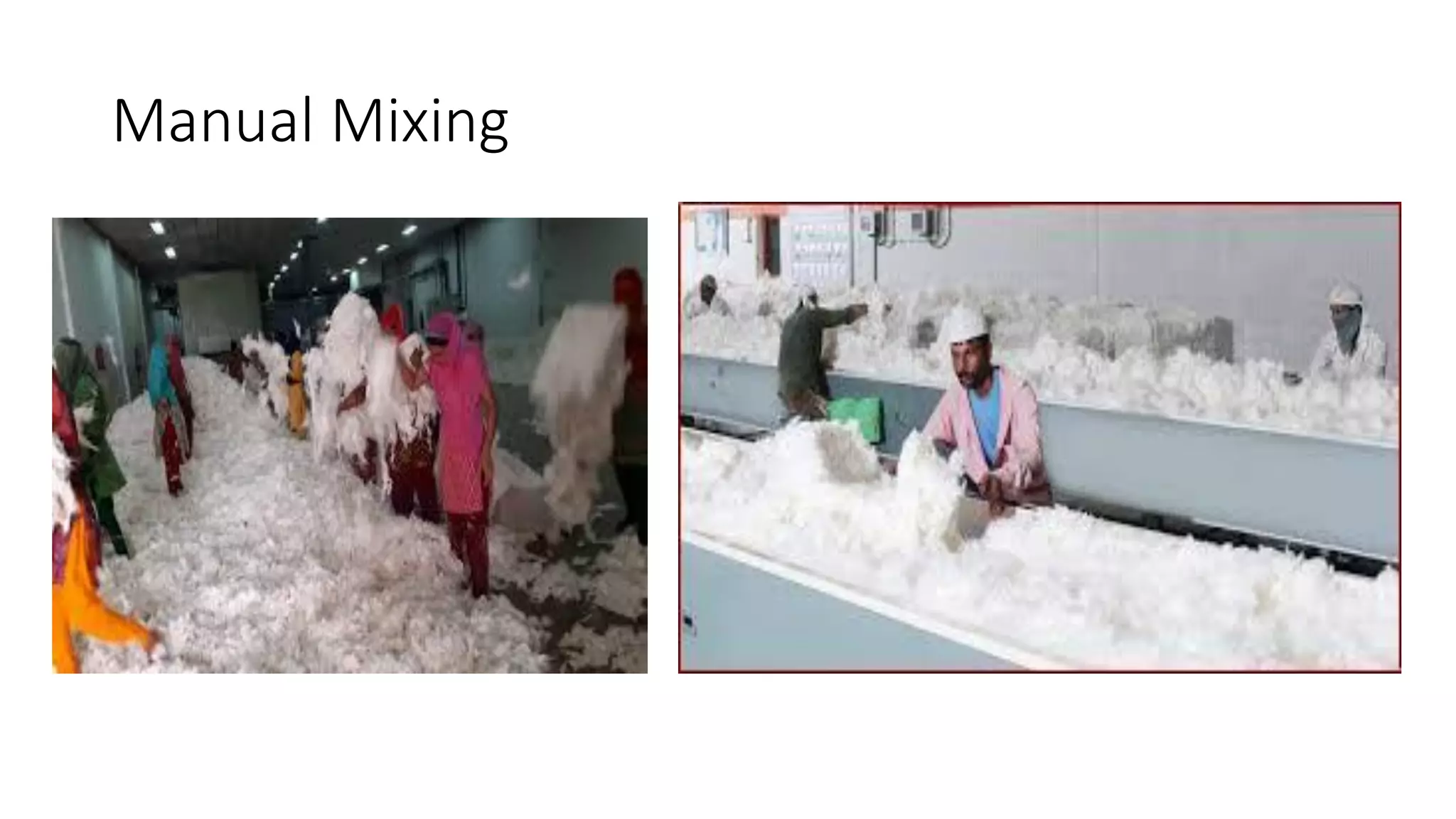
Manual Mixing
Spinning consistency Index (SCI)
Spinning consistency Index is a calculation for predicting the spin ability of
the fibers. A multiple regression equation can provide valuable information
to anticipate the yarn strength and spinning potential. The regression
equation uses most of the individual HVI measurement results to calculate
the SCI. This index can be used to simply the category system used in the
cotton warehouse. In general, the higher the index, the higher the yarn
strength and the better the overall fiber spin ability.
The equation for the SCI value is:
Spinning consistency index (SCI) = -414.67+2.9 x Strength – 9.32 x Micronaire
+ 49.17 x Length (inch) + 4.74 x Uniformity + 0.65 x Rd + 0.36 x (+b)

Properties of Fibres.pdf

  • 1.
    Importance of rawcotton • a. Raw materials represents about 50-75% of the manufacturing cost of a short-staple yarn. This fact alone is sufficient to indicate the significance of the raw material for the yarn producer. • b. Raw material accounts for about 80% to 90% of the yarn quality.
  • 2.
    Some Brand nameof cotton Brand name Country •Pima USA •Arizona USA •SJV USA •Elena CIS •Parvee CIS •Ronda CIS Brand name Country •Raja CIS •Giza Egypt •Andy Australia •Suvin India •Delta Bangladesh •Barakat Sudan
  • 3.
    CIS Commonwealth of Independentstates (CIS) is the international organization or alliance consisting of eleven former soviet republics Armenia, Azerbaijan, Belarus, Georgia, Kazakhstan, Kyrgyzstan, Moldova, Russia, Tajikistan, Ukraine & Uzbekistan.
  • 4.
    Cotton fibers characteristicsconsider for spinning process • 1. Length • 2. Strength • 3. Fineness • 4. Maturity • 5. Cleanliness • 6. Color • 7. Elongation
  • 5.
    Elongation • It isa very important for spinning. Without this fiber could not be spined. Elongation of cotton 6-10% • Elongation is a measurement of the elastic behavior of the fibers in the bundle. The fibers clamped on the bundle with a 1/8 inch distance between the clamps. The first pair of clamps stationary & the back pair of clamps is pulled away at a constant rate. The distance the fibers extend before they break is recorded & expressed as percent elongation.
  • 6.
    Principle of elongationmeasurement Stationery (Fixed) 1/8 inch Moveable (moves a constant rate) Upper Clamp Lower Clamp Fibre Bundle
  • 8.
    • A tabledescribing ranges of actual elongation values in cotton fibers: • • Elongation Description Less than 5.0 Very low • 5.0 to 5.8 Low • 5.9 to 6.7 Medium • 6.8 to 7.6 High • 7.7 & higher Very high •
  • 9.
    Color • Color: Thecolor of cotton is determined by the degree of reflectance (Rd) and yellowness (+b) in the HVI instrument • • Reflectance (Rd): • This value expresses the whiteness of the light that is reflected by the cotton fibers. • • Yellowness (+b): • This value expresses the Yellowness of the light that is reflected by the cotton fibers.
  • 10.
    Importance of color •As the color of cotton deteriorates due to environmental conditions, the probability for reduced processing efficiency is increased. Color deterioration also affects the ability of fibers to absorb & hold dyes & finishes.
  • 11.
    Cotton fibre whitenessgrading There are five grading of whiteness (Reflectance-Rd) of cotton fibre 1. White 2. Light Spotted 3. Spotted 4. Tinged 5. Yellow stained
  • 12.
    Cotton fibre yellowness(+b) grading There are seven (7) grading of yellowness (+b) of cotton fibre – Grade Symbol 1. Good Middling GM 2. Strict Middling SM 3. Middling M 4. Strict Low Middling SLM 5. Low Middling LM 6. Strict Good ordinary SGO 7. Good ordinary GO
  • 13.
    Cotton color code HVI(High Volume Instrument) color grades for American Upland cotton examples are 11, 12, 13,21, 22, 23, 31,32 , 33 etc. Color Code= e.g. 11, 21, 53 etc. +b Grade Rd Grade
  • 14.
    Cleanliness & trashcontent Generally many types of foreign matter may contain in cotton stock Vegetable matter • 1. Husk portion • 2. Seed fragments • 3. Stem fragments • 4. Leaf fragments • 5. Wood fragments Mineral matter • Soil • Sand • Dust Other foreign matters • Metal fragments • Cloth fragments • Packing fragments (mostly polymer)
  • 15.
    Causes of presenceof trashes in cotton As spinning process is sensitive to impurities so the fiber should be maintained clean as far as possible. The reason for fiber containing such foreign matters are: a. Modern high performance plucking system b. Hard ginning, cleaning & pre-drying. c. Careless handling during transportation & packing.
  • 16.
    Problem due tounclean fiber i. Metal parts cut the fibers & harmful to spinning machine. ii. Vegetable matter makes disturbance in drafting. iii. Vegetable matter jam the carding pin carding machine iv. Mineral matter decays the rolling parts of machine.
  • 17.
    Cotton grading onthe basis of trash content The scale below represents the degree of contamination: Amount of trash Grade Up to 1.2% Very clean 1.2% – 2.0% Clean 2.0 % - 4.0 % Medium 4.0 % - 7.0 % Dirty 7.0% - Above Very dirty
  • 18.
    Fineness Fineness is oneof the most important fiber characteristics. It determines how many fibers are present in the X-section of a yarn of given thickness. Micronaire Value of cotton: The average weight of one inch length of fiber, expressed in micrograms (0.000001g), is called micronaire value of cotton and it is defined by ASTM (American Society for Testing and Materials)
  • 19.
    Cotton grading onthe basis of fineness The fineness scale is as follows: • Mic-value Fineness • Up to 3.1 Very fine • 3.1 to 3.9 Fine • 4.0 to 4.9 Medium • 5.0 to 5.9 Slightly Coarse • Above 6 Coarse
  • 20.
  • 21.
    Yarn cross sectionalview (ilustrated)
  • 22.
    Importance of fibrefineness Fiber fineness influences primarily: • Spinning limit • Yarn strength • Yarn evenness • Yarn fullness • Drape of the fabric product • Lustre • Handle • Productivity of the process
  • 23.
    Fibre length Different staplelength of cotton: Length class Length (mm) • Short staple (S) <20 • Medium staple (M) 20.6-25.4 • Medium long staple (ML) 26.2-27.8 • Long staple (L) 28.6-33.3 • Extra long staple (XL) > 34.9
  • 24.
    Importance of fibrelength Fiber length is also one of the most important fiber characteristics. It influences: • Spinning limit • Yarn strength • Yarn evenness • Drape of the fabric product • Lustre of the product • Handle of the product • Productivity
  • 25.
    Fibre Strength Fibre Gradingon the basiss of strength Strength (grams/tex) Description Less than 21 Very weak 22 to 24 Weak 25 to 27 Medium 28 to 30 Strong 31 & higher Very strong The bundle strength is the breaking strength of the cotton fibers in grams per tex. The fineness is calculated from the micronaire value. The fiber beard is broken at a continuous deformation rate (constant rate of extension) & with a 1/8 inch distance between the clams.
  • 26.
    Fibre Maturity Fiber maturitymeans the thickness of cell wall. The more thick the more mature. Unripe fibers have neither adequate strength nor adequate longitudinal stiffness. They therefore lead to: a. Loss of yarn strength b. Neppiness c. A high proportion of short fibers d. Varying dye ability & e. Processing difficulties mainly at the card
  • 27.
  • 28.
  • 29.
  • 30.
    Maturity ratio Maturity maybe expressed as the ratio of the actual cross-sectional area of the wall to the area of the circle with the same perimeter. Maturity ratio= 𝐴𝑟𝑒𝑎 𝑜𝑓 𝑡ℎ𝑒 𝐶𝑟𝑜𝑠𝑠 𝑠𝑒𝑐𝑡𝑖𝑜𝑛 𝑜𝑓 𝑐𝑒𝑙𝑙 𝑤𝑎𝑙𝑙 𝑜𝑓 𝑡ℎ𝑒 𝑓𝑖𝑏𝑟𝑒 𝐴𝑟𝑒𝑎 𝑜𝑓 𝑡ℎ𝑒 𝑐𝑖𝑟𝑐𝑙𝑒 𝑖𝑚𝑎𝑔𝑖𝑛𝑒𝑟𝑦 𝑜𝑓 𝑠𝑎𝑚𝑒 𝑝𝑒𝑟𝑚𝑖𝑡𝑒𝑟 𝑜𝑓 𝑓𝑖𝑏𝑟𝑒 (Area of the Cell wall, πD- πd) Maturity ratio = (Area of the circle πD) Where, D is the diameter of the Circle and d is the circle of lumen of the fibre, if we consider the fibre as a circle.
  • 31.
    Fibre Grading onthe basis of maturity Maturity may be expressed as the ratio of the actual cross-sectional area of the wall to the area of the circle with the same perimeter. Maturity Index Description Below 0.75 Uncommon 0.75 to 0.85 Immature 0.86 to 0.95 Mature Above 0.95 Very mature
  • 32.
    Bale Management Bale managementrefers to the process of inventory control & selection of fiber according to its properties to maintain homogeneous mixing quality for getting consistent production & quality of yarn. For bale management, all bale samples are tested and bale with almost similar category are arranged for homogeneous mixing. Object of Bale management: • To get uniform yarn quality (consistent). • To minimize shade variation of the finished fabric. • To reduce fabric ‘barre.’
  • 33.
    Factors consider forefficient Bale Management system • Origin (Country of origin) • Length & Length uniformity • Fineness • Strength & elongation • SCI (Spinning consistency index) • Maturity • Color • Trash%, etc.
  • 34.
  • 35.
  • 36.
  • 37.
  • 38.
    Spinning consistency Index(SCI) Spinning consistency Index is a calculation for predicting the spin ability of the fibers. A multiple regression equation can provide valuable information to anticipate the yarn strength and spinning potential. The regression equation uses most of the individual HVI measurement results to calculate the SCI. This index can be used to simply the category system used in the cotton warehouse. In general, the higher the index, the higher the yarn strength and the better the overall fiber spin ability. The equation for the SCI value is: Spinning consistency index (SCI) = -414.67+2.9 x Strength – 9.32 x Micronaire + 49.17 x Length (inch) + 4.74 x Uniformity + 0.65 x Rd + 0.36 x (+b)