Spinning Technology - 1
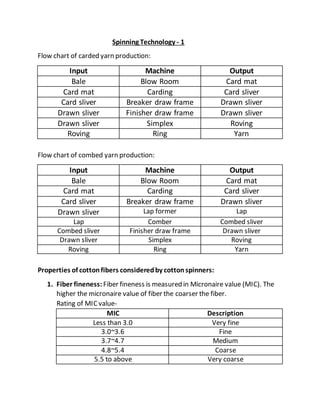
Flow chart of carded yarn production:
Input Machine Output
Bale Blow Room Card mat
Card mat Carding Card sliver
Card sliver Breaker draw frame Drawn sliver
Drawn sliver Finisher draw frame Drawn sliver
Drawn sliver Simplex Roving
Roving Ring Yarn
Flow chart of combed yarn production:
Input Machine Output
Bale Blow Room Card mat
Card mat Carding Card sliver
Card sliver Breaker draw frame Drawn sliver
Drawn sliver Lap former Lap
Lap Comber Combed sliver
Combed sliver Finisher draw frame Drawn sliver
Drawn sliver Simplex Roving
Roving Ring Yarn
Properties of cottonfibers consideredby cottonspinners:
1. Fiber fineness: Fiber fineness is measured in Micronaire value (MIC). The
higher the micronaire value of fiber the coarser the fiber.
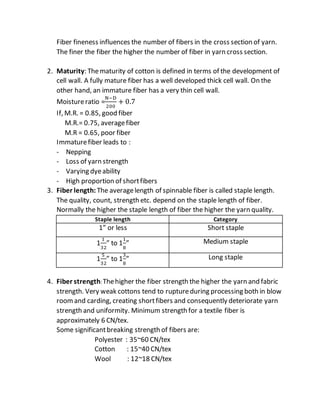
Rating of MICvalue-
MIC Description
Less than 3.0 Very fine
3.0~3.6 Fine
3.7~4.7 Medium
4.8~5.4 Coarse
5.5 to above Very coarse
Fiber fineness influences the number of fibers in the cross section of yarn.
The finer the fiber the higher the number of fiber in yarn cross section.
2. Maturity: Thematurity of cotton is defined in terms of the development of
cell wall. A fully mature fiber has a well developed thick cell wall. On the
other hand, an immature fiber has a very thin cell wall.
Moistureratio =
N−D
200
+ 0.7
If, M.R. = 0.85, good fiber
M.R.= 0.75, averagefiber
M.R = 0.65, poor fiber
Immaturefiber leads to :
- Nepping
- Loss of yarn strength
- Varying dyeability
- High proportion of shortfibers
3. Fiber length: The averagelength of spinnable fiber is called staple length.
The quality, count, strength etc. depend on the staple length of fiber.
Normally the higher the staple length of fiber the higher the yarn quality.
Staple length Category
1” or less Short staple
1
1
32
” to 1
1
8
” Medium staple
1
5
32
” to 1
3
8
” Long staple
4. Fiber strength:Thehigher the fiber strength the higher the yarn and fabric
strength. Very weak cottons tend to ruptureduring processing both in blow
roomand carding, creating shortfibers and consequently deteriorate yarn
strength and uniformity. Minimum strength for a textile fiber is
approximately 6 CN/tex.
Some significantbreaking strength of fibers are:
Polyester : 35~60 CN/tex
Cotton : 15~40 CN/tex
Wool : 12~18 CN/tex
5. Fiber cleanness: In addition to usable fibers, cotton stock contain foreign
matter of various kinds:
Vegetable matter- Husk portions, seed fragments, stemfragments, leaf
fragments wood fragments.
Mineral material- sand, dust, coal.
Other foreign matters- metal fragments cloth fragments, packing materials.
Accepted the rangeof foreign materials to the bale:
Up to 1.2% - Very clean
1.2% to 2.0% - clean
2.0% to 4.0% - Medium
4.0% to 7.0% - Dirty
7.0% to above - very dirty
According to the international committee for cotton testing methods the
following types are to be distinguished:
Trash - above 500 µm
Dust - (50~500) µm
Micro dust - (15~50) µm
Breathable - below 15 µm
6. Fiber color: color is particularly important as a measureof how well a yarn
or fabric will dye or bleach. Instrumentaltechniques for determining the
color of the sample haveonly now reached the industry, HVI measurement
of color provides reasonably accurateresults of averagereflectance and
yellowness in a sample.
7. Fiber elongation: Elongation is specified as a percentage of the starting
length. The greater crease-resistanceof wool compared with cotton arises
for example fromthe difference in their elongations, cotton-6~10%, wool-25~45%.
contribution of fiber properties to yarn quality.
Mixing and Blending
Mixing: If differentgradeof same fibers are kept together, then it is called mixing.
Example: 50% of 4 Mic cotton + 50% of 5 Mic cotton.
Blending: When different fibers of same or different grades are kept together,
then it is called blending.
Example: PC, CVC. (polyester- cotton blend).
Objects of mixing and blending:
1. To achieve uniformquality
2. To improveprocessing performance
3. To reduce and controlof production cost
4. To meet function and end used requirement
5. Aesthetic, (fashion, texture, luster).
6. To give the required characteristics to the end product.
strength
25%
fineness
14%
elongation
5%trash
6%
others
20%
length
12%
length
uniformity
18%

Fiber properties

  • 1.
    Spinning Technology -1 Flow chart of carded yarn production: Input Machine Output Bale Blow Room Card mat Card mat Carding Card sliver Card sliver Breaker draw frame Drawn sliver Drawn sliver Finisher draw frame Drawn sliver Drawn sliver Simplex Roving Roving Ring Yarn Flow chart of combed yarn production: Input Machine Output Bale Blow Room Card mat Card mat Carding Card sliver Card sliver Breaker draw frame Drawn sliver Drawn sliver Lap former Lap Lap Comber Combed sliver Combed sliver Finisher draw frame Drawn sliver Drawn sliver Simplex Roving Roving Ring Yarn Properties of cottonfibers consideredby cottonspinners: 1. Fiber fineness: Fiber fineness is measured in Micronaire value (MIC). The higher the micronaire value of fiber the coarser the fiber. Rating of MICvalue- MIC Description Less than 3.0 Very fine 3.0~3.6 Fine 3.7~4.7 Medium 4.8~5.4 Coarse 5.5 to above Very coarse
  • 2.
    Fiber fineness influencesthe number of fibers in the cross section of yarn. The finer the fiber the higher the number of fiber in yarn cross section. 2. Maturity: Thematurity of cotton is defined in terms of the development of cell wall. A fully mature fiber has a well developed thick cell wall. On the other hand, an immature fiber has a very thin cell wall. Moistureratio = N−D 200 + 0.7 If, M.R. = 0.85, good fiber M.R.= 0.75, averagefiber M.R = 0.65, poor fiber Immaturefiber leads to : - Nepping - Loss of yarn strength - Varying dyeability - High proportion of shortfibers 3. Fiber length: The averagelength of spinnable fiber is called staple length. The quality, count, strength etc. depend on the staple length of fiber. Normally the higher the staple length of fiber the higher the yarn quality. Staple length Category 1” or less Short staple 1 1 32 ” to 1 1 8 ” Medium staple 1 5 32 ” to 1 3 8 ” Long staple 4. Fiber strength:Thehigher the fiber strength the higher the yarn and fabric strength. Very weak cottons tend to ruptureduring processing both in blow roomand carding, creating shortfibers and consequently deteriorate yarn strength and uniformity. Minimum strength for a textile fiber is approximately 6 CN/tex. Some significantbreaking strength of fibers are: Polyester : 35~60 CN/tex Cotton : 15~40 CN/tex Wool : 12~18 CN/tex
  • 3.
    5. Fiber cleanness:In addition to usable fibers, cotton stock contain foreign matter of various kinds: Vegetable matter- Husk portions, seed fragments, stemfragments, leaf fragments wood fragments. Mineral material- sand, dust, coal. Other foreign matters- metal fragments cloth fragments, packing materials. Accepted the rangeof foreign materials to the bale: Up to 1.2% - Very clean 1.2% to 2.0% - clean 2.0% to 4.0% - Medium 4.0% to 7.0% - Dirty 7.0% to above - very dirty According to the international committee for cotton testing methods the following types are to be distinguished: Trash - above 500 µm Dust - (50~500) µm Micro dust - (15~50) µm Breathable - below 15 µm 6. Fiber color: color is particularly important as a measureof how well a yarn or fabric will dye or bleach. Instrumentaltechniques for determining the color of the sample haveonly now reached the industry, HVI measurement of color provides reasonably accurateresults of averagereflectance and yellowness in a sample. 7. Fiber elongation: Elongation is specified as a percentage of the starting length. The greater crease-resistanceof wool compared with cotton arises
  • 4.
    for example fromthedifference in their elongations, cotton-6~10%, wool-25~45%. contribution of fiber properties to yarn quality. Mixing and Blending Mixing: If differentgradeof same fibers are kept together, then it is called mixing. Example: 50% of 4 Mic cotton + 50% of 5 Mic cotton. Blending: When different fibers of same or different grades are kept together, then it is called blending. Example: PC, CVC. (polyester- cotton blend). Objects of mixing and blending: 1. To achieve uniformquality 2. To improveprocessing performance 3. To reduce and controlof production cost 4. To meet function and end used requirement 5. Aesthetic, (fashion, texture, luster). 6. To give the required characteristics to the end product. strength 25% fineness 14% elongation 5%trash 6% others 20% length 12% length uniformity 18%