Factors affecting Yarn Realization 2012
By Mr. Sunil Kumar Sharma, Manager – QAD, Mobile - 09552596742, E_mail :sunil_ku67@yahoo.com
Loknayak Jayprakash Narayan Shetkari Sahakari Soot Girni Ltd. – Shahada (MS) Page 1
Q. What are the key factors affecting cotton yarn realization?
Ans. The yarn realization is the most important factor to assess the technical
performance and profitability of spinning mills. Yarn realization means
conversion of raw material in percentage terms into finished yarn. Following
key factors affecting the cotton yarn realization : -
1. Cotton Characteristics.
2. Bales Management system in Mixing.
3. Atmospheric condition of Blow room & Packing.
4. Process Parameters.
5. Count Pattern.
6. End use or Quality Requirement.
7. Invisible Loss / Gain or moisture management.
1. : - Performance of any process is always depends on
input feed or raw material quality. Cotton characteristics are basic key factor for
deciding the yarn realization. It’s assumed here that cotton fibre length consider
according to desire count pattern. Only critical cotton characteristics which
playing major role for deciding yarn realization are discussed below : -
: - Fibre length shorter than 12.5 mm are usually
consider as short fibre content % (i.e. SFC %) in cotton. These cotton fibres
could not contribute for smooth spinning operation and generally either removed
as waste extracted in blow room – carding, comber noil or in process during
drafting as draft zone fan fly or fluff in the departm t. This is the most
important factors deciding for cotton combed yarn realization.
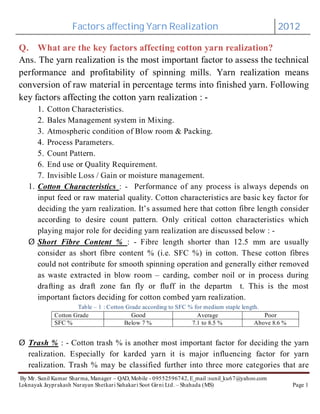
Table – 1 : Cotton Grade according to SFC % for medium staple length.
Cotton Grade Good Average Poor
SFC % Below 7 % 7.1 to 8.5 % Above 8.6 %
: - Cotton trash % is another most important factor for deciding the yarn
realization. Especially for karded yarn it is major influencing factor for yarn
realization. Trash % may be classified further into three more categories that are
Cotton Characteristics
Short Fibre Content %
Trash %
Ø
Ø
Factors affecting Yarn Realization 2012
By Mr. Sunil Kumar Sharma, Manager – QAD, Mobile - 09552596742, E_mail :sunil_ku67@yahoo.com
Loknayak Jayprakash Narayan Shetkari Sahakari Soot Girni Ltd. – Shahada (MS) Page 2
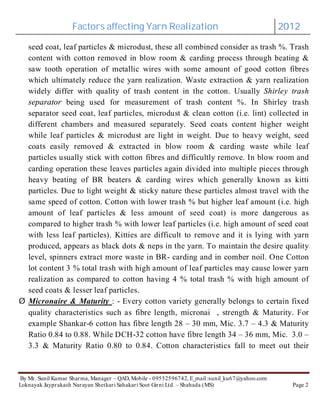
seed coat, leaf particles & microdust, these all combined consider as trash %. Trash
content with cotton removed in blow room & carding process through beating &
saw tooth operation of metallic wires with some amount of good cotton fibres
which ultimately reduce the yarn realization. Waste extraction & yarn realization
widely differ with quality of trash content in the cotton. Usually
being used for measurement of trash content %. In Shirley trash
separator seed coat, leaf particles, microdust & clean cotton (i.e. lint) collected in
different chambers and measured separately. Seed coats content higher weight
while leaf particles & microdust are light in weight. Due to heavy weight, seed
coats easily removed & extracted in blow room & carding waste while leaf
particles usually stick with cotton fibres and difficultly remove. In blow room and
carding operation these leaves particles again divided into multiple pieces through
heavy beating of BR beaters & carding wires which generally known as kitti
particles. Due to light weight & sticky nature these particles almost travel with the
same speed of cotton. Cotton with lower trash % but higher leaf amount (i.e. high
amount of leaf particles & less amount of seed coat) is more dangerous as
compared to higher trash % with lower leaf particles (i.e. high amount of seed coat
with less leaf particles). Kitties are difficult to remove and it is lying with yarn
produced, appears as black dots & neps in the yarn. To maintain the desire quality
level, spinners extract more waste in BR- carding and in comber noil. One Cotton
lot content 3 % total trash with high amount of leaf particles may cause lower yarn
realization as compared to cotton having 4 % total trash % with high amount of
seed coats & lesser leaf particles.
: - Every cotton variety generally belongs to certain fixed
quality characteristics such as fibre length, micronai , strength & Maturity. For
example Shankar-6 cotton has fibre length 28 – 30 mm, Mic. 3.7 – 4.3 & Maturity
Ratio 0.84 to 0.88. While DCH-32 cotton have fibre length 34 – 36 mm, Mic. 3.0 –
3.3 & Maturity Ratio 0.80 to 0.84. Cotton characteristics fall to meet out their
Shirley trash
separator
Ø Micronaire & Maturity
Factors affecting Yarn Realization 2012
By Mr. Sunil Kumar Sharma, Manager – QAD, Mobile - 09552596742, E_mail :sunil_ku67@yahoo.com
Loknayak Jayprakash Narayan Shetkari Sahakari Soot Girni Ltd. – Shahada (MS) Page 3
origin range of characteristics generally creates the blem in spinning process
and ultimately causing lower realization.
: - Lower fibre strength causes fibre rupture in spinning cess.
Lower fibre strength also causes lower yarn CSP, RKM & poor working of
spinning process. To meet desire level of Quality & working requirement,
ultimately higher amount of waste being extracted which lead lower yarn
realization.
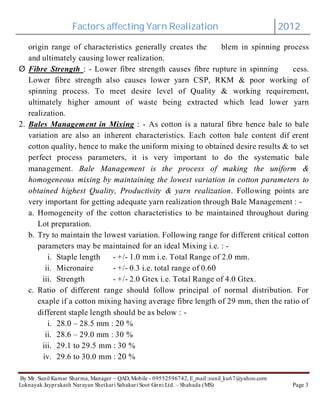
2. : - As cotton is a natural fibre hence bale to bale
variation are also an inherent characteristics. Each cotton bale content dif erent
cotton quality, hence to make the uniform mixing to obtained desire results & to set
perfect process parameters, it is very important to do the systematic bale
management.
. Following points are
very important for getting adequate yarn realization through Bale Management : -
a. Homogeneity of the cotton characteristics to be maintained throughout during
Lot preparation.
b. Try to maintain the lowest variation. Following range for different critical cotton
parameters may be maintained for an ideal Mixing i.e. : -
i. Staple length - +/- 1.0 mm i.e. Total Range of 2.0 mm.
ii. Micronaire - +/- 0.3 i.e. total range of 0.60
iii. Strength - +/- 2.0 Gtex i.e. Total Range of 4.0 Gtex.
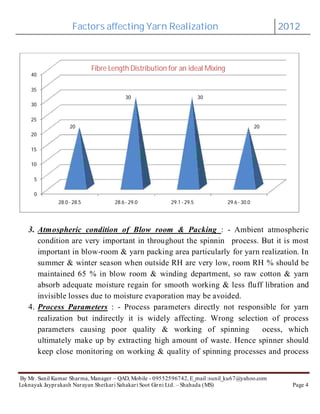
c. Ratio of different range should follow principal of normal distribution. For
exaple if a cotton mixing having average fibre length of 29 mm, then the ratio of
different staple length should be as below : -
i. 28.0 – 28.5 mm : 20 %
ii. 28.6 – 29.0 mm : 30 %
iii. 29.1 to 29.5 mm : 30 %
iv. 29.6 to 30.0 mm : 20 %
Ø Fibre Strength
Bales Management in Mixing
Bale Management is the process of making the uniform &
homogeneous mixing by maintaining the lowest variation in cotton parameters to
obtained highest Quality, Productivity & yarn realization
Factors affecting Yarn Realization 2012
By Mr. Sunil Kumar Sharma, Manager – QAD, Mobile - 09552596742, E_mail :sunil_ku67@yahoo.com
Loknayak Jayprakash Narayan Shetkari Sahakari Soot Girni Ltd. – Shahada (MS) Page 4
3. Atmospheric condition of Blow room & Packing
Process Parameters
: - Ambient atmospheric
condition are very important in throughout the spinnin process. But it is most
important in blow-room & yarn packing area particularly for yarn realization. In
summer & winter season when outside RH are very low, room RH % should be
maintained 65 % in blow room & winding department, so raw cotton & yarn
absorb adequate moisture regain for smooth working & less fluff libration and
invisible losses due to moisture evaporation may be avoided.
4. : - Process parameters directly not responsible for yarn
realization but indirectly it is widely affecting. Wrong selection of process
parameters causing poor quality & working of spinning ocess, which
ultimately make up by extracting high amount of waste. Hence spinner should
keep close monitoring on working & quality of spinning processes and process
0
5
10
15
20
25
30
35
40
28.0 - 28.5 28.6 - 29.0 29.1 - 29.5 29.6 - 30.0
20
30 30
20
Fibre Length Distribution for an ideal Mixing
Factors affecting Yarn Realization 2012
By Mr. Sunil Kumar Sharma, Manager – QAD, Mobile - 09552596742, E_mail :sunil_ku67@yahoo.com
Loknayak Jayprakash Narayan Shetkari Sahakari Soot Girni Ltd. – Shahada (MS) Page 5
parameters must fine tune time to time according to ra material quality,
atmospheric condition & process requirement instead of increasing the waste.
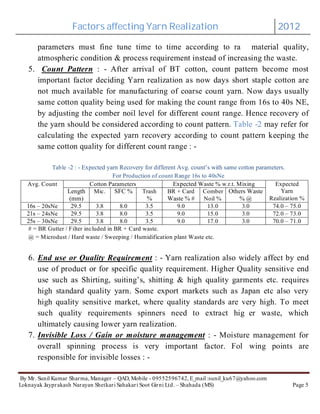
5. : - After arrival of BT cotton, count pattern become most
important factor deciding Yarn realization as now days short staple cotton are
not much available for manufacturing of coarse count yarn. Now days usually
same cotton quality being used for making the count range from 16s to 40s NE,
by adjusting the comber noil level for different count range. Hence recovery of
the yarn should be considered according to count pattern. Table -2 may refer for
calculating the expected yarn recovery according to count pattern keeping the
same cotton quality for different count range : -
Table -2 : - Expected yarn Recovery for different Avg. count’s with same cotton parameters.
For Production of count Range 16s to 40sNe
Avg. Count Cotton Parameters Expected Waste % w.r.t. Mixing Expected
Yarn
Realization %
Length
(mm)
Mic. SFC % Trash
%
BR + Card
Waste % #
Comber
Noil %
Others Waste
% @
16s – 20sNe 29.5 3.8 8.0 3.5 9.0 13.0 3.0 74.0 – 75.0
21s – 24sNe 29.5 3.8 8.0 3.5 9.0 15.0 3.0 72.0 – 73.0
25s – 30sNe 29.5 3.8 8.0 3.5 9.0 17.0 3.0 70.0 – 71.0
# = BR Gutter / Filter included in BR + Card waste.
@ = Microdust / Hard waste / Sweeping / Humidification plant Waste etc.
6. : - Yarn realization also widely affect by end
use of product or for specific quality requirement. Higher Quality sensitive end
use such as Shirting, suiting’s, shitting & high quality garments etc. requires
high standard quality yarn. Some export markets such as Japan etc also very
high quality sensitive market, where quality standards are very high. To meet
such quality requirements spinners need to extract hig er waste, which
ultimately causing lower yarn realization.
7. : - Moisture management for
overall spinning process is very important factor. Fol wing points are
responsible for invisible losses : -
Count Pattern
End use or Quality Requirement
Invisible Loss / Gain or moisture management
Factors affecting Yarn Realization 2012
By Mr. Sunil Kumar Sharma, Manager – QAD, Mobile - 09552596742, E_mail :sunil_ku67@yahoo.com
Loknayak Jayprakash Narayan Shetkari Sahakari Soot Girni Ltd. – Shahada (MS) Page 6
a. Moisture content in cotton bales.
b. Each cotton bales to be weighted and calibration of weighin balance to be
confirm on daily basis before taking it into Mixing.
c. Relative humidity in blow room to be kept 60 to 65 %. Lower RH i BR
causing invisible losses through waste and also respon ble for
unaccountable fluff generation.
d. Moisture regain of cotton waste to be checked especially for BR – Card
waste & comber noil, if require arrangement to be made to obtain similar
level moisture regain as cotton bales.
e. It is to be assured that accounting of waste made perfectly especially for
microdust & sweeping etc.
f. Weight gain & moisture regains after yarn conditioning system to be
ensured on daily basis.
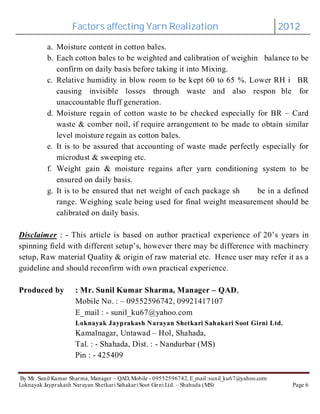
g. It is to be ensured that net weight of each package sh be in a defined
range. Weighing scale being used for final weight measurement should be
calibrated on daily basis.
: - This article is based on author practical experience of 20’s years in
spinning field with different setup’s, however there may be difference with machinery
setup, Raw material Quality & origin of raw material etc. Hence user may refer it as a
guideline and should reconfirm with own practical experience.
,
Mobile No. : – 09552596742, 09921417107
E_mail : - sunil_ku67@yahoo.com
Kamalnagar, Untawad – Hol, Shahada,
Tal. : - Shahada, Dist. : - Nandurbar (MS)
Pin : - 425409
Disclaimer
Produced by : Mr. Sunil Kumar Sharma, Manager – QAD
Loknayak Jayprakash Narayan Shetkari Sahakari Soot Girni Ltd.

Yarn Realization

  • 1.
    Factors affecting YarnRealization 2012 By Mr. Sunil Kumar Sharma, Manager – QAD, Mobile - 09552596742, E_mail :sunil_ku67@yahoo.com Loknayak Jayprakash Narayan Shetkari Sahakari Soot Girni Ltd. – Shahada (MS) Page 1 Q. What are the key factors affecting cotton yarn realization? Ans. The yarn realization is the most important factor to assess the technical performance and profitability of spinning mills. Yarn realization means conversion of raw material in percentage terms into finished yarn. Following key factors affecting the cotton yarn realization : - 1. Cotton Characteristics. 2. Bales Management system in Mixing. 3. Atmospheric condition of Blow room & Packing. 4. Process Parameters. 5. Count Pattern. 6. End use or Quality Requirement. 7. Invisible Loss / Gain or moisture management. 1. : - Performance of any process is always depends on input feed or raw material quality. Cotton characteristics are basic key factor for deciding the yarn realization. It’s assumed here that cotton fibre length consider according to desire count pattern. Only critical cotton characteristics which playing major role for deciding yarn realization are discussed below : - : - Fibre length shorter than 12.5 mm are usually consider as short fibre content % (i.e. SFC %) in cotton. These cotton fibres could not contribute for smooth spinning operation and generally either removed as waste extracted in blow room – carding, comber noil or in process during drafting as draft zone fan fly or fluff in the departm t. This is the most important factors deciding for cotton combed yarn realization. Table – 1 : Cotton Grade according to SFC % for medium staple length. Cotton Grade Good Average Poor SFC % Below 7 % 7.1 to 8.5 % Above 8.6 % : - Cotton trash % is another most important factor for deciding the yarn realization. Especially for karded yarn it is major influencing factor for yarn realization. Trash % may be classified further into three more categories that are Cotton Characteristics Short Fibre Content % Trash % Ø Ø
  • 2.
    Factors affecting YarnRealization 2012 By Mr. Sunil Kumar Sharma, Manager – QAD, Mobile - 09552596742, E_mail :sunil_ku67@yahoo.com Loknayak Jayprakash Narayan Shetkari Sahakari Soot Girni Ltd. – Shahada (MS) Page 2 seed coat, leaf particles & microdust, these all combined consider as trash %. Trash content with cotton removed in blow room & carding process through beating & saw tooth operation of metallic wires with some amount of good cotton fibres which ultimately reduce the yarn realization. Waste extraction & yarn realization widely differ with quality of trash content in the cotton. Usually being used for measurement of trash content %. In Shirley trash separator seed coat, leaf particles, microdust & clean cotton (i.e. lint) collected in different chambers and measured separately. Seed coats content higher weight while leaf particles & microdust are light in weight. Due to heavy weight, seed coats easily removed & extracted in blow room & carding waste while leaf particles usually stick with cotton fibres and difficultly remove. In blow room and carding operation these leaves particles again divided into multiple pieces through heavy beating of BR beaters & carding wires which generally known as kitti particles. Due to light weight & sticky nature these particles almost travel with the same speed of cotton. Cotton with lower trash % but higher leaf amount (i.e. high amount of leaf particles & less amount of seed coat) is more dangerous as compared to higher trash % with lower leaf particles (i.e. high amount of seed coat with less leaf particles). Kitties are difficult to remove and it is lying with yarn produced, appears as black dots & neps in the yarn. To maintain the desire quality level, spinners extract more waste in BR- carding and in comber noil. One Cotton lot content 3 % total trash with high amount of leaf particles may cause lower yarn realization as compared to cotton having 4 % total trash % with high amount of seed coats & lesser leaf particles. : - Every cotton variety generally belongs to certain fixed quality characteristics such as fibre length, micronai , strength & Maturity. For example Shankar-6 cotton has fibre length 28 – 30 mm, Mic. 3.7 – 4.3 & Maturity Ratio 0.84 to 0.88. While DCH-32 cotton have fibre length 34 – 36 mm, Mic. 3.0 – 3.3 & Maturity Ratio 0.80 to 0.84. Cotton characteristics fall to meet out their Shirley trash separator Ø Micronaire & Maturity
  • 3.
    Factors affecting YarnRealization 2012 By Mr. Sunil Kumar Sharma, Manager – QAD, Mobile - 09552596742, E_mail :sunil_ku67@yahoo.com Loknayak Jayprakash Narayan Shetkari Sahakari Soot Girni Ltd. – Shahada (MS) Page 3 origin range of characteristics generally creates the blem in spinning process and ultimately causing lower realization. : - Lower fibre strength causes fibre rupture in spinning cess. Lower fibre strength also causes lower yarn CSP, RKM & poor working of spinning process. To meet desire level of Quality & working requirement, ultimately higher amount of waste being extracted which lead lower yarn realization. 2. : - As cotton is a natural fibre hence bale to bale variation are also an inherent characteristics. Each cotton bale content dif erent cotton quality, hence to make the uniform mixing to obtained desire results & to set perfect process parameters, it is very important to do the systematic bale management. . Following points are very important for getting adequate yarn realization through Bale Management : - a. Homogeneity of the cotton characteristics to be maintained throughout during Lot preparation. b. Try to maintain the lowest variation. Following range for different critical cotton parameters may be maintained for an ideal Mixing i.e. : - i. Staple length - +/- 1.0 mm i.e. Total Range of 2.0 mm. ii. Micronaire - +/- 0.3 i.e. total range of 0.60 iii. Strength - +/- 2.0 Gtex i.e. Total Range of 4.0 Gtex. c. Ratio of different range should follow principal of normal distribution. For exaple if a cotton mixing having average fibre length of 29 mm, then the ratio of different staple length should be as below : - i. 28.0 – 28.5 mm : 20 % ii. 28.6 – 29.0 mm : 30 % iii. 29.1 to 29.5 mm : 30 % iv. 29.6 to 30.0 mm : 20 % Ø Fibre Strength Bales Management in Mixing Bale Management is the process of making the uniform & homogeneous mixing by maintaining the lowest variation in cotton parameters to obtained highest Quality, Productivity & yarn realization
  • 4.
    Factors affecting YarnRealization 2012 By Mr. Sunil Kumar Sharma, Manager – QAD, Mobile - 09552596742, E_mail :sunil_ku67@yahoo.com Loknayak Jayprakash Narayan Shetkari Sahakari Soot Girni Ltd. – Shahada (MS) Page 4 3. Atmospheric condition of Blow room & Packing Process Parameters : - Ambient atmospheric condition are very important in throughout the spinnin process. But it is most important in blow-room & yarn packing area particularly for yarn realization. In summer & winter season when outside RH are very low, room RH % should be maintained 65 % in blow room & winding department, so raw cotton & yarn absorb adequate moisture regain for smooth working & less fluff libration and invisible losses due to moisture evaporation may be avoided. 4. : - Process parameters directly not responsible for yarn realization but indirectly it is widely affecting. Wrong selection of process parameters causing poor quality & working of spinning ocess, which ultimately make up by extracting high amount of waste. Hence spinner should keep close monitoring on working & quality of spinning processes and process 0 5 10 15 20 25 30 35 40 28.0 - 28.5 28.6 - 29.0 29.1 - 29.5 29.6 - 30.0 20 30 30 20 Fibre Length Distribution for an ideal Mixing
  • 5.
    Factors affecting YarnRealization 2012 By Mr. Sunil Kumar Sharma, Manager – QAD, Mobile - 09552596742, E_mail :sunil_ku67@yahoo.com Loknayak Jayprakash Narayan Shetkari Sahakari Soot Girni Ltd. – Shahada (MS) Page 5 parameters must fine tune time to time according to ra material quality, atmospheric condition & process requirement instead of increasing the waste. 5. : - After arrival of BT cotton, count pattern become most important factor deciding Yarn realization as now days short staple cotton are not much available for manufacturing of coarse count yarn. Now days usually same cotton quality being used for making the count range from 16s to 40s NE, by adjusting the comber noil level for different count range. Hence recovery of the yarn should be considered according to count pattern. Table -2 may refer for calculating the expected yarn recovery according to count pattern keeping the same cotton quality for different count range : - Table -2 : - Expected yarn Recovery for different Avg. count’s with same cotton parameters. For Production of count Range 16s to 40sNe Avg. Count Cotton Parameters Expected Waste % w.r.t. Mixing Expected Yarn Realization % Length (mm) Mic. SFC % Trash % BR + Card Waste % # Comber Noil % Others Waste % @ 16s – 20sNe 29.5 3.8 8.0 3.5 9.0 13.0 3.0 74.0 – 75.0 21s – 24sNe 29.5 3.8 8.0 3.5 9.0 15.0 3.0 72.0 – 73.0 25s – 30sNe 29.5 3.8 8.0 3.5 9.0 17.0 3.0 70.0 – 71.0 # = BR Gutter / Filter included in BR + Card waste. @ = Microdust / Hard waste / Sweeping / Humidification plant Waste etc. 6. : - Yarn realization also widely affect by end use of product or for specific quality requirement. Higher Quality sensitive end use such as Shirting, suiting’s, shitting & high quality garments etc. requires high standard quality yarn. Some export markets such as Japan etc also very high quality sensitive market, where quality standards are very high. To meet such quality requirements spinners need to extract hig er waste, which ultimately causing lower yarn realization. 7. : - Moisture management for overall spinning process is very important factor. Fol wing points are responsible for invisible losses : - Count Pattern End use or Quality Requirement Invisible Loss / Gain or moisture management
  • 6.
    Factors affecting YarnRealization 2012 By Mr. Sunil Kumar Sharma, Manager – QAD, Mobile - 09552596742, E_mail :sunil_ku67@yahoo.com Loknayak Jayprakash Narayan Shetkari Sahakari Soot Girni Ltd. – Shahada (MS) Page 6 a. Moisture content in cotton bales. b. Each cotton bales to be weighted and calibration of weighin balance to be confirm on daily basis before taking it into Mixing. c. Relative humidity in blow room to be kept 60 to 65 %. Lower RH i BR causing invisible losses through waste and also respon ble for unaccountable fluff generation. d. Moisture regain of cotton waste to be checked especially for BR – Card waste & comber noil, if require arrangement to be made to obtain similar level moisture regain as cotton bales. e. It is to be assured that accounting of waste made perfectly especially for microdust & sweeping etc. f. Weight gain & moisture regains after yarn conditioning system to be ensured on daily basis. g. It is to be ensured that net weight of each package sh be in a defined range. Weighing scale being used for final weight measurement should be calibrated on daily basis. : - This article is based on author practical experience of 20’s years in spinning field with different setup’s, however there may be difference with machinery setup, Raw material Quality & origin of raw material etc. Hence user may refer it as a guideline and should reconfirm with own practical experience. , Mobile No. : – 09552596742, 09921417107 E_mail : - sunil_ku67@yahoo.com Kamalnagar, Untawad – Hol, Shahada, Tal. : - Shahada, Dist. : - Nandurbar (MS) Pin : - 425409 Disclaimer Produced by : Mr. Sunil Kumar Sharma, Manager – QAD Loknayak Jayprakash Narayan Shetkari Sahakari Soot Girni Ltd.