


?What is tetanus & its causes
              By
       Amin Abusallamah
? What is tetanus
• Tetanus, also called lockjaw, is a medical
  condition characterized by a prolonged
  contraction of skeletal muscle fibers.

•      The primary symptoms are caused
    by tetanospasmin, a neurotoxin produced by
    the Gram-positive      obligate   anaerobic
    bacterium Clostridium tetani.
… Cont
• Infection generally occurs through wound
  contamination and often involves a cut or
  deep puncture wound. As the infection
  progresses, muscle spasms develop in the jaw
  (thus the name "lockjaw")
Epidemiology
• Tetanus - Greek Word -- Tetanos-to Contract
• Tetanus was first described in Egypt over
  3000 years ago.
• Toxoid was first widely used during world war
  II
• Tetanus Remains a Major Public Health
  Problem in the Developing World and Is Still
  Encountered in the Developed World.
… Cont

• There Are Between 800 000 and 1 Million
  Deaths Due to Tetanus Each Year. Eighty Per
  Cent of These Deaths Occur in Africa and
  South East Asia and It Remains Endemic in
  90 Countries World Wide.
Causes of tetanus
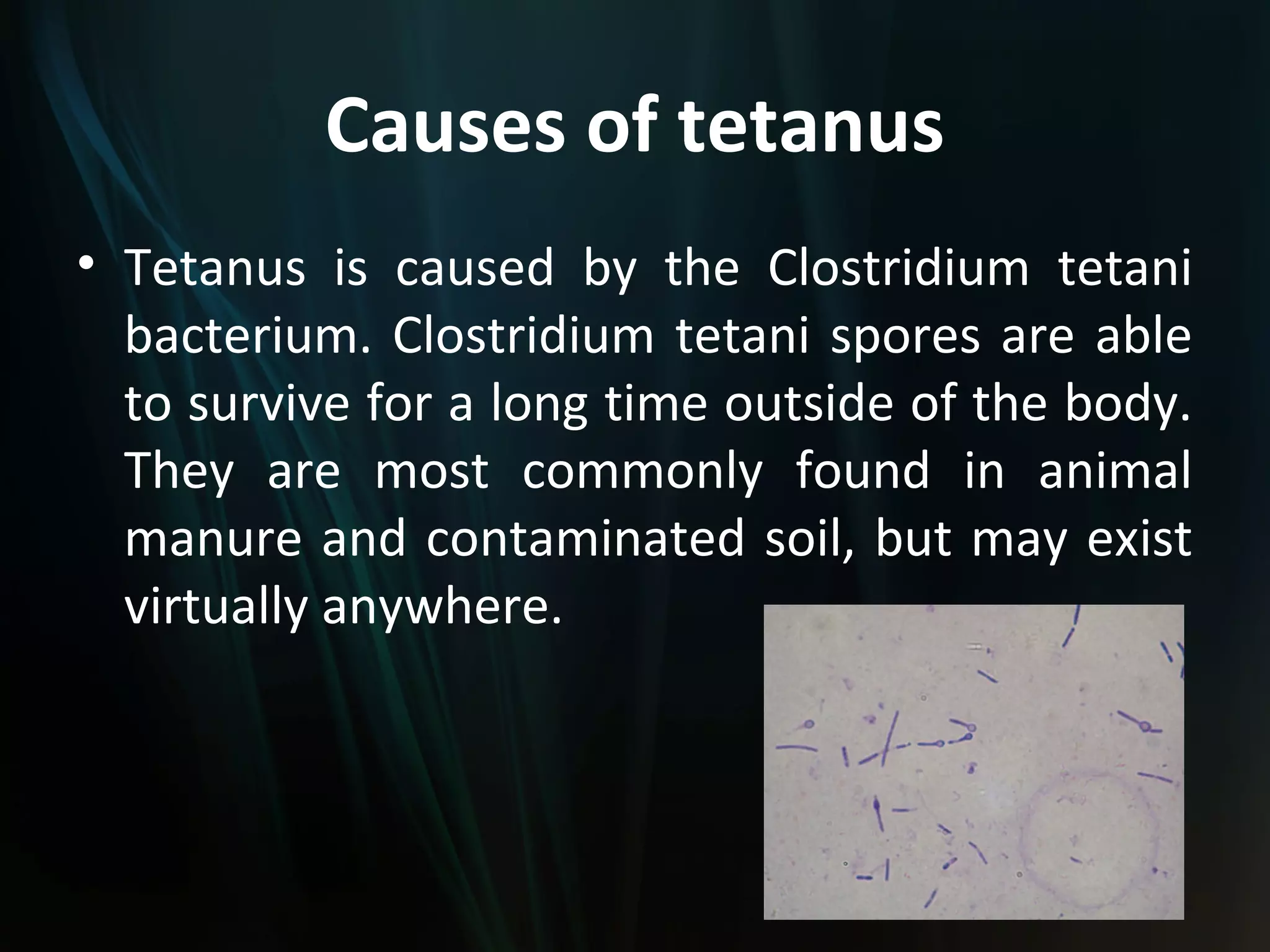
• Tetanus is caused by the Clostridium tetani
  bacterium. Clostridium tetani spores are able
  to survive for a long time outside of the body.
  They are most commonly found in animal
  manure and contaminated soil, but may exist
  virtually anywhere.
… Cont
• When Clostridium tetani enter the body they
  multiply rapidly and release tetanospasmin, a
  neurotoxin (poison that affects the nervous
  system). When tetanospasmin enters the
  bloodstream it rapidly spreads around the
  body, causing tetanus symptoms.
… Cont
• Tetanospasmin interferes with the signals sent
  from the brain to the nerves in the spinal
  cord, and then on to the muscles, causing
  muscle spasms and stiffness.

• Puncture wounds - Clostridium tetani enters
  the body mainly through a skin lesion (skin cut
  or puncture wound).
Tetanus and its causes

Tetanus and its causes

  • 1.
    ?What is tetanus& its causes By Amin Abusallamah
  • 2.
    ? What istetanus • Tetanus, also called lockjaw, is a medical condition characterized by a prolonged contraction of skeletal muscle fibers. • The primary symptoms are caused by tetanospasmin, a neurotoxin produced by the Gram-positive obligate anaerobic bacterium Clostridium tetani.
  • 3.
    … Cont • Infectiongenerally occurs through wound contamination and often involves a cut or deep puncture wound. As the infection progresses, muscle spasms develop in the jaw (thus the name "lockjaw")
  • 5.
    Epidemiology • Tetanus -Greek Word -- Tetanos-to Contract • Tetanus was first described in Egypt over 3000 years ago. • Toxoid was first widely used during world war II • Tetanus Remains a Major Public Health Problem in the Developing World and Is Still Encountered in the Developed World.
  • 6.
    … Cont • ThereAre Between 800 000 and 1 Million Deaths Due to Tetanus Each Year. Eighty Per Cent of These Deaths Occur in Africa and South East Asia and It Remains Endemic in 90 Countries World Wide.
  • 7.
    Causes of tetanus •Tetanus is caused by the Clostridium tetani bacterium. Clostridium tetani spores are able to survive for a long time outside of the body. They are most commonly found in animal manure and contaminated soil, but may exist virtually anywhere.
  • 8.
    … Cont • WhenClostridium tetani enter the body they multiply rapidly and release tetanospasmin, a neurotoxin (poison that affects the nervous system). When tetanospasmin enters the bloodstream it rapidly spreads around the body, causing tetanus symptoms.
  • 9.
    … Cont • Tetanospasmininterferes with the signals sent from the brain to the nerves in the spinal cord, and then on to the muscles, causing muscle spasms and stiffness. • Puncture wounds - Clostridium tetani enters the body mainly through a skin lesion (skin cut or puncture wound).