Tooth Extraction
Simple Technique
Dr. Md. Nazmul Hassan Bin Khair
BDS (DU)
Definition
Extraction:
Extraction can be defined as a painless removal of
the whole tooth or tooth root with minimal trauma
to the investing tissue.
Types
1. Intra-alveolar extraction: The blades of the
forceps are forced down the periodontal
membrane between the tooth root & bony socket
wall.
2. Trans-alveolar extraction: This method of
extraction comprises the dissection of a tooth or
root from the bony attachment.
Indication
 Severly carious teeth where endodontic treatment
are not possible.
 Teeth with non-vital pulp where acute or chronic
pulpitis when root canal treatment can not be
indicated.
 Severe periodontitis where excessive bone loss.
 Third degree mobile teeth
 Malposed teeth
 Impacted & Unerrupted teeth
 Supernumery teeth.
 Retained desiduous teeth.
 Teeth with fractured root.
 Teeth directly or indirectly involving cyst & tumour.
Contraindication
 Local
 Acute oral infection- ANUG, Herpetic
gingivostomatitis
 Pericoronitis
 Acute maxillary sinusitis
 Osteoradionecrosis area
 Systemic
 CVS Diseases-
 Sub acute bacterial endocarditis
 Ischemic heart disease
 Hypertension
 CCF
 Valvular disease
 Blood dyscrasias
 Haemophilia
 Purpura
 Severe anemia
 Leukaemia
 Scurvy
 Uncontrolled DM
 Thyrotoxicosis
 Viral hepatitis
 Severe Jaundice
 Kidney disease- Nephritis, Renal failure
 Vit-K deficiency
 Radiation therapy
 Epilepsy
 AIDS
 Syphilis
Instruments Required
 Local anaesthetic solution with or without adrenaline
 Curved elevator
 Straight elevator
 Cryer
 Forceps
 Curettor
 Normal saline
 Disposable syringe
 Cotton rolls
 Suturing materials
Basic necessity of extraction
 Adequate access
 Comforatable patient
 Adequate oral opening
 Proper retraction of the tissue by assistant
 High volume suction
 Patient Preparation
 Comforatable, mentally & physically
 Alleviation of fear, assurance
 Informed consent
 Minimum amount of draping
 Rinsing with antiseptic mouth wash.
Surgeon’s & Assistant’s Preparation
 Wearing of protective eye glass
 Wearing mask
 Wearing surgical cap
 Wearing gloves
Chair Position For Extraction
 MAXILLARY Extraction
 The chair should be tipped backward and maxillary
occlusal plane is at 60 degrees to the floor.
 The height of the chair should be patient’s mouth
is at or below the operator’s elbow level
 MANDIBULAR Extraction
The patient should be positioned in a more
upright position.
The occlusal plane is parallel to the
floor.
The chair should be lower than
for extraction of maxillary teeth.
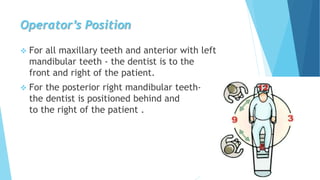
Operator’s Position
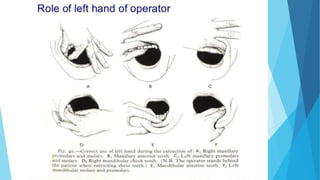
 For all maxillary teeth and anterior with left
mandibular teeth - the dentist is to the
front and right of the patient.
 For the posterior right mandibular teeth-
the dentist is positioned behind and
to the right of the patient .
Mechanical Principles In Extraction
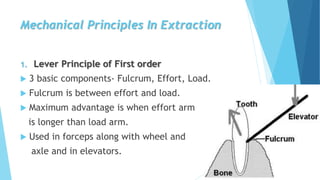
1. Lever Principle of First order
 3 basic components- Fulcrum, Effort, Load.
 Fulcrum is between effort and load.
 Maximum advantage is when effort arm
is longer than load arm.
 Used in forceps along with wheel and
axle and in elevators.
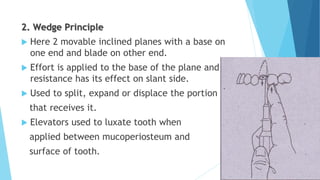
2. Wedge Principle
 Here 2 movable inclined planes with a base on
one end and blade on other end.
 Effort is applied to the base of the plane and
resistance has its effect on slant side.
 Used to split, expand or displace the portion
that receives it.
 Elevators used to luxate tooth when
applied between mucoperiosteum and
surface of tooth.
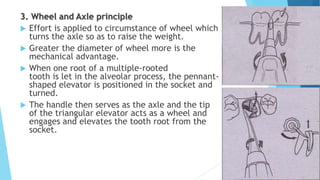
3. Wheel and Axle principle
 Effort is applied to circumstance of wheel which
turns the axle so as to raise the weight.
 Greater the diameter of wheel more is the
mechanical advantage.
 When one root of a multiple-rooted
tooth is let in the alveolar process, the pennant-
shaped elevator is positioned in the socket and
turned.
 The handle then serves as the axle and the tip
of the triangular elevator acts as a wheel and
engages and elevates the tooth root from the
socket.
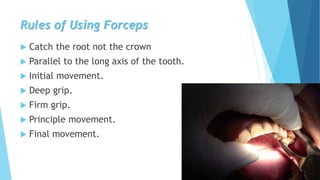
Rules of Using Forceps
 Catch the root not the crown
 Parallel to the long axis of the tooth.
 Initial movement.
 Deep grip.
 Firm grip.
 Principle movement.
 Final movement.
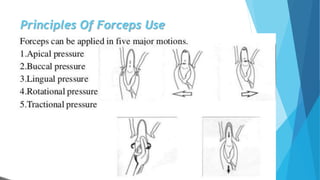
Principles Of Forceps Use
Forces applied for different teeth
 MAXILLARY:
 Incisors: labial-lingual-labial with mesial rotation.
 Cuspids: labial-lingual-labial with mesial rotation.
 First premolar: buccal-palatal-removal in buccal
direction.
 Second premolar: buccal-palatal-removal in buccal
or palatal direction.
 Molars: buccal-slight palatal and distal rotation.
 MANDIBULAR:
 Anteriors: labial-lingual-slight mesial to distal
force and removal in labial direction.
 Premolars: buccal with slight mesio-distal
rotation.
 Molars: buccal-lingual and removal in buccal
direction.
 Third molars: buccal pressure and removal in
buccal or lingual direction.
Postoperative instructions after a tooth
extraction
 Day of surgery
 Keep gauzes in the mouth for an hour or two by
maintaining a firm pressure and replace them every
half-hour, as needed.
 Always keep your head elevated.
 Apply ice on the cheek at regular intervals (20
minutes every hour).
 Blood-tinged saliva is a normal postoperative effect.
 Limit your physical efforts and don’t forget to rest.
 Do not dislodge the blood clot that has formed in the
tooth socket because it helps to heal.
 Do not eat anything until the bleeding has stopped.
 Avoid drinking through a straw.
 Do not rinse your mouth or spit.
 Avoid smoking or drinking alcohol.
 Do not eat hard foods.
 Avoid brushing your teeth near the extraction site for the first
72 hours.
 Pain
 If you are experiencing some pain, take the medication that has
been prescribed to you.
 If you were prescribed antibiotics for this treatment, continue
to take them for the specified time period, even if the
symptoms go away.
 Diet
 Only eat soft foods and cold liquids on the day of the
extraction. Resume your usual diet as soon as you are able to.
 From the next day and until complete healing
 Rinse your mouth three times a day with warm water and salt
(2 ml or 1/2 tsp of salt in 250 ml or 1 cup of water).
 Brush and floss every day to remove plaque and ensure better
results in the long term.
 Avoid brushing near the extraction site for the first 72 hours.
 Avoid eating hard foods (nuts, candies, ice).
 You may experience pronunciation difficulties and an increased
amount of saliva. Everything should come back to normal within
a week.
 Bruising may appear on the skin. It will disappear after five to
seven days.
 You may have difficulty opening your mouth. It should come
back to normal after four to five days.
 If after three days the pain increases instead of decreasing, call
us.
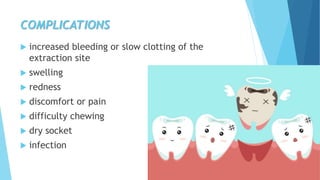
COMPLICATIONS
 increased bleeding or slow clotting of the
extraction site
 swelling
 redness
 discomfort or pain
 difficulty chewing
 dry socket
 infection
References
 Text Book of Oral and Maxillofacial Surgery 3rd edition, Dr.
Neelima Anil Malik
 Peterson, L. J. Contemporary Oral and Maxillofacial
Surgery, 4th ed. Amsterdam Elsevier Science. 2002. ch.7
 The Extraction of Teeth by- GEOFFREY L HOWE
 Sweedan, O. A. Textbook of Oral and Maxillofacial v, 1st
ed., 2009
 Fragiskos D. Fragiskos Oral Surger. 2007
 Carmen Scheller BASIC GUIDE TO DENTAL INSTRUMENTS
 Wikipedia
Tooth Extraction Simple Technique

Tooth Extraction Simple Technique

  • 1.
    Tooth Extraction Simple Technique Dr.Md. Nazmul Hassan Bin Khair BDS (DU)
  • 2.
    Definition Extraction: Extraction can bedefined as a painless removal of the whole tooth or tooth root with minimal trauma to the investing tissue.
  • 3.
    Types 1. Intra-alveolar extraction:The blades of the forceps are forced down the periodontal membrane between the tooth root & bony socket wall. 2. Trans-alveolar extraction: This method of extraction comprises the dissection of a tooth or root from the bony attachment.
  • 4.
    Indication  Severly cariousteeth where endodontic treatment are not possible.  Teeth with non-vital pulp where acute or chronic pulpitis when root canal treatment can not be indicated.  Severe periodontitis where excessive bone loss.  Third degree mobile teeth  Malposed teeth  Impacted & Unerrupted teeth  Supernumery teeth.  Retained desiduous teeth.  Teeth with fractured root.  Teeth directly or indirectly involving cyst & tumour.
  • 5.
    Contraindication  Local  Acuteoral infection- ANUG, Herpetic gingivostomatitis  Pericoronitis  Acute maxillary sinusitis  Osteoradionecrosis area
  • 6.
     Systemic  CVSDiseases-  Sub acute bacterial endocarditis  Ischemic heart disease  Hypertension  CCF  Valvular disease  Blood dyscrasias  Haemophilia  Purpura  Severe anemia  Leukaemia  Scurvy
  • 7.
     Uncontrolled DM Thyrotoxicosis  Viral hepatitis  Severe Jaundice  Kidney disease- Nephritis, Renal failure  Vit-K deficiency  Radiation therapy  Epilepsy  AIDS  Syphilis
  • 8.
    Instruments Required  Localanaesthetic solution with or without adrenaline  Curved elevator  Straight elevator  Cryer  Forceps  Curettor  Normal saline  Disposable syringe  Cotton rolls  Suturing materials
  • 9.
    Basic necessity ofextraction  Adequate access  Comforatable patient  Adequate oral opening  Proper retraction of the tissue by assistant  High volume suction  Patient Preparation  Comforatable, mentally & physically  Alleviation of fear, assurance  Informed consent  Minimum amount of draping  Rinsing with antiseptic mouth wash.
  • 10.
    Surgeon’s & Assistant’sPreparation  Wearing of protective eye glass  Wearing mask  Wearing surgical cap  Wearing gloves
  • 11.
    Chair Position ForExtraction  MAXILLARY Extraction  The chair should be tipped backward and maxillary occlusal plane is at 60 degrees to the floor.  The height of the chair should be patient’s mouth is at or below the operator’s elbow level  MANDIBULAR Extraction The patient should be positioned in a more upright position. The occlusal plane is parallel to the floor. The chair should be lower than for extraction of maxillary teeth.
  • 12.
    Operator’s Position  Forall maxillary teeth and anterior with left mandibular teeth - the dentist is to the front and right of the patient.  For the posterior right mandibular teeth- the dentist is positioned behind and to the right of the patient .
  • 14.
    Mechanical Principles InExtraction 1. Lever Principle of First order  3 basic components- Fulcrum, Effort, Load.  Fulcrum is between effort and load.  Maximum advantage is when effort arm is longer than load arm.  Used in forceps along with wheel and axle and in elevators.
  • 15.
    2. Wedge Principle Here 2 movable inclined planes with a base on one end and blade on other end.  Effort is applied to the base of the plane and resistance has its effect on slant side.  Used to split, expand or displace the portion that receives it.  Elevators used to luxate tooth when applied between mucoperiosteum and surface of tooth.
  • 16.
    3. Wheel andAxle principle  Effort is applied to circumstance of wheel which turns the axle so as to raise the weight.  Greater the diameter of wheel more is the mechanical advantage.  When one root of a multiple-rooted tooth is let in the alveolar process, the pennant- shaped elevator is positioned in the socket and turned.  The handle then serves as the axle and the tip of the triangular elevator acts as a wheel and engages and elevates the tooth root from the socket.
  • 17.
    Rules of UsingForceps  Catch the root not the crown  Parallel to the long axis of the tooth.  Initial movement.  Deep grip.  Firm grip.  Principle movement.  Final movement.
  • 18.
  • 19.
    Forces applied fordifferent teeth  MAXILLARY:  Incisors: labial-lingual-labial with mesial rotation.  Cuspids: labial-lingual-labial with mesial rotation.  First premolar: buccal-palatal-removal in buccal direction.  Second premolar: buccal-palatal-removal in buccal or palatal direction.  Molars: buccal-slight palatal and distal rotation.
  • 20.
     MANDIBULAR:  Anteriors:labial-lingual-slight mesial to distal force and removal in labial direction.  Premolars: buccal with slight mesio-distal rotation.  Molars: buccal-lingual and removal in buccal direction.  Third molars: buccal pressure and removal in buccal or lingual direction.
  • 21.
    Postoperative instructions aftera tooth extraction  Day of surgery  Keep gauzes in the mouth for an hour or two by maintaining a firm pressure and replace them every half-hour, as needed.  Always keep your head elevated.  Apply ice on the cheek at regular intervals (20 minutes every hour).  Blood-tinged saliva is a normal postoperative effect.  Limit your physical efforts and don’t forget to rest.  Do not dislodge the blood clot that has formed in the tooth socket because it helps to heal.
  • 22.
     Do noteat anything until the bleeding has stopped.  Avoid drinking through a straw.  Do not rinse your mouth or spit.  Avoid smoking or drinking alcohol.  Do not eat hard foods.  Avoid brushing your teeth near the extraction site for the first 72 hours.  Pain  If you are experiencing some pain, take the medication that has been prescribed to you.  If you were prescribed antibiotics for this treatment, continue to take them for the specified time period, even if the symptoms go away.  Diet  Only eat soft foods and cold liquids on the day of the extraction. Resume your usual diet as soon as you are able to.
  • 23.
     From thenext day and until complete healing  Rinse your mouth three times a day with warm water and salt (2 ml or 1/2 tsp of salt in 250 ml or 1 cup of water).  Brush and floss every day to remove plaque and ensure better results in the long term.  Avoid brushing near the extraction site for the first 72 hours.  Avoid eating hard foods (nuts, candies, ice).  You may experience pronunciation difficulties and an increased amount of saliva. Everything should come back to normal within a week.  Bruising may appear on the skin. It will disappear after five to seven days.  You may have difficulty opening your mouth. It should come back to normal after four to five days.  If after three days the pain increases instead of decreasing, call us.
  • 24.
    COMPLICATIONS  increased bleedingor slow clotting of the extraction site  swelling  redness  discomfort or pain  difficulty chewing  dry socket  infection
  • 25.
    References  Text Bookof Oral and Maxillofacial Surgery 3rd edition, Dr. Neelima Anil Malik  Peterson, L. J. Contemporary Oral and Maxillofacial Surgery, 4th ed. Amsterdam Elsevier Science. 2002. ch.7  The Extraction of Teeth by- GEOFFREY L HOWE  Sweedan, O. A. Textbook of Oral and Maxillofacial v, 1st ed., 2009  Fragiskos D. Fragiskos Oral Surger. 2007  Carmen Scheller BASIC GUIDE TO DENTAL INSTRUMENTS  Wikipedia