ODONTOMA AMIN ABUSALLAMAH COMPOUND
INTRO Most common odontogenic tumor. Considered hamartomas, rather than neoplasm. In a fully developed odontoma, mainly enamel and dentin along with variable amounts of pulp and cementum are seen.
CLASSIFICATION Odontomas are further sub classified into COMPOUND ODONTOMA COMPLEX ODONTOMA
CLINICAL FEATURES  Age incidence:   First 2 decades. Sex incidence:   None. Site predilection:  Anterior maxilla. Signs & symptoms:   Mostly asymptomatic, small, seldom exceeding the size of tooth missing in the region. Larger lesions may cause jaw expansion.
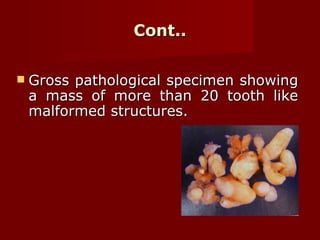
Cont.. Gross pathological specimen showing a mass of more than 20 tooth like malformed structures.
RADIOLOGICAL FEATURES This type is composed of multiple, small tooth like structures. The entire mass appears surrounded by a radiolucent rim. An unerupted tooth is usually associated with both types of  odontomes which impedes normal eruption of the tooth.
References  Soames JV, Southam JC. Oral pathology/. 3 rd  ed. Oxford 2002. Shafer WG, Hine MK, Levy BM. A text book of oral pathology. 6 th  ed. W.B. Saunders Company. Phil, London, Toronto, 2005.
THANK YOU! ?

COMPOUND ODONTOMA

  • 1.
  • 2.
    INTRO Most commonodontogenic tumor. Considered hamartomas, rather than neoplasm. In a fully developed odontoma, mainly enamel and dentin along with variable amounts of pulp and cementum are seen.
  • 3.
    CLASSIFICATION Odontomas arefurther sub classified into COMPOUND ODONTOMA COMPLEX ODONTOMA
  • 4.
    CLINICAL FEATURES Age incidence: First 2 decades. Sex incidence: None. Site predilection: Anterior maxilla. Signs & symptoms: Mostly asymptomatic, small, seldom exceeding the size of tooth missing in the region. Larger lesions may cause jaw expansion.
  • 5.
    Cont.. Gross pathologicalspecimen showing a mass of more than 20 tooth like malformed structures.
  • 6.
    RADIOLOGICAL FEATURES Thistype is composed of multiple, small tooth like structures. The entire mass appears surrounded by a radiolucent rim. An unerupted tooth is usually associated with both types of odontomes which impedes normal eruption of the tooth.
  • 7.
    References SoamesJV, Southam JC. Oral pathology/. 3 rd ed. Oxford 2002. Shafer WG, Hine MK, Levy BM. A text book of oral pathology. 6 th ed. W.B. Saunders Company. Phil, London, Toronto, 2005.
  • 8.