
TECHNOLOGICAL
ADVANCES IN PRIMARY
DENTAL CARE
Presented By
Dr.Sindhu R
IIIrd Year Postgraduate
Department of Public Health
Dentistry
CONTENTS
◦ Introduction
◦ Primary preventive modalities
◦ Immunizations in oral health
Dental caries vaccine
◦ Genetics in oral health
Genetic epidemiology
Dental caries
Periodontal diseases
Oral cancer
◦ Gene therapy
Applications in dentistry
◦ Stem cells in oral health
◦ Information technology in oral health
◦ References
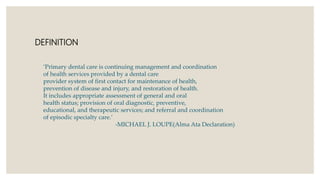
DEFINITION
‘Primary dental care is continuing management and coordination
of health services provided by a dental care
provider system of first contact for maintenance of health,
prevention of disease and injury, and restoration of health.
It includes appropriate assessment of general and oral
health status; provision of oral diagnostic, preventive,
educational, and therapeutic services; and referral and coordination
of episodic specialty care.’
-MICHAEL J. LOUPE(Alma Ata Declaration)
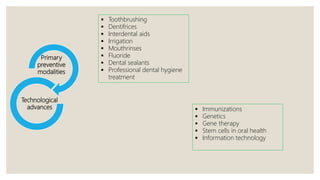
Primary
preventive
modalities
Technological
advances
 Toothbrushing
 Dentifrices
 Interdental aids
 Irrigation
 Mouthrinses
 Fluoride
 Dental sealants
 Professional dental hygiene
treatment
 Immunizations
 Genetics
 Gene therapy
 Stem cells in oral health
 Information technology
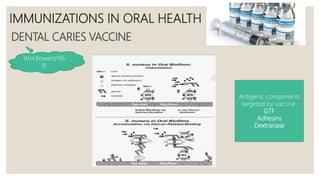
IMMUNIZATIONS IN ORAL HEALTH
DENTAL CARIES VACCINE
W.H.Bowen(196
9)
Antigenic components
targeted by vaccine:
GTF
Adhesins
Dextranase
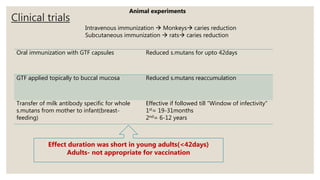
Clinical trials
Oral immunization with GTF capsules Reduced s.mutans for upto 42days
GTF applied topically to buccal mucosa Reduced s.mutans reaccumulation
Transfer of milk antibody specific for whole
s.mutans from mother to infant(breast-
feeding)
Effective if followed till “Window of infectivity”
1st= 19-31months
2nd= 6-12 years
Effect duration was short in young adults(<42days)
Adults- not appropriate for vaccination
Animal experiments
Intravenous immunization  Monkeys caries reduction
Subcutaneous immunization  rats caries reduction
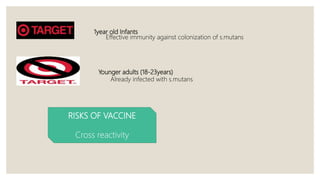
1year old Infants
Effective immunity against colonization of s.mutans
Younger adults (18-23years)
Already infected with s.mutans
RISKS OF VACCINE
Cross reactivity
GENETICS AND ORAL
HEALTH
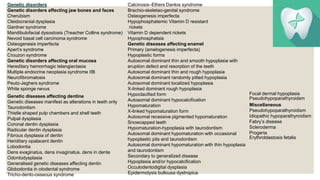
Genetic disorders
Genetic disorders affecting jaw bones and faces
Cherubism
Cleidocranial dysplasia
Gardner syndrome
Mandibulofacial dysostosis (Treacher Collins syndrome)
Nevoid basal cell carcinoma syndrome
Osteogenesis imperfecta
Apert’s syndrome
Crouzon syndrome
Genetic disorders affecting oral mucosa
Hereditary hemorrhagic telangiectasia
Multiple endocrine neoplasia syndrome IIB
Neurofibromatosis
Peutz-Jeghers syndrome
White sponge nevus
Calcinosis–Elhers Danlos syndrome
Brachio-skeletao-genital syndrome
Osteogenesis imperfecta
Hypophosphatemic Vitamin D resistant
rickets
Vitamin D dependent rickets
Hypophosphatsia
Genetic diseases affecting enamel
Primary (amelogenesis imperfecta)
Hypoplastic forms
Autosomal dominant thin and smooth hypoplasia with
eruption defect and resorption of the teeth
Autosomal dominant thin and rough hypoplasia
Autosomal dominant randomly pitted hypoplasia
Autosomal dominant localized hypoplasia
X-linked dominant rough hypoplasia
Hypoclacified form
Autosomal dominant hypocalcification
Hypomaturation
X-linked hypomaturation form
Autosomal recessive pigmented hypomaturation
Snowcapped teeth
Hypomaturation-hypoplasia with taurodontism
Autosomal dominant hypomaturation with occasional
hypoplastic pits and taurodontism
Autosomal dominant hypomaturation with thin hypoplasia
and taurodontism
Secondary to generalized disease
Hypoplasia and/or hypocalcification
Occulodentodigital dysplasia
Epidermolysis bullousa dystropica
Genetic diseases affecting dentine
Genetic diseases manifest as alterations in teeth only
Taurodontism
Thistle shaped pulp chambers and shell teeth
Pulpal dysplasia
Coronal dentin dysplasia
Radicular dentin dysplasia
Fibrous dysplasia of dentin
Heriditary opalacent dentin
Lobodontia
Dens evaginatus, dens invaginatus. dens in dente
Odontodysplasia
Generalised genetic diseases affecting dentin
Globodontia in otodental syndrome
Tricho-dento-osseous syndrome
Focal dermal hypoplasia
Pseudohypoparathyroidsm
Miscellaneous
Pseudohypoparathyroidism
Idiopathic hypoparathyroidism
Fabry’s disease
Scleroderma
Progeria
Erythroblastosis fetalis
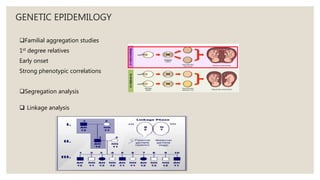
GENETIC EPIDEMILOGY
Familial aggregation studies
1st degree relatives
Early onset
Strong phenotypic correlations
Segregation analysis
 Linkage analysis
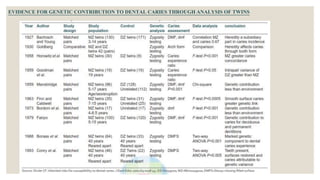
EVIDENCE FOR GENETIC CONTRIBUTION TO DENTAL CARIES THROUGH ANALYSIS OF TWINS
PREVENTION OF DENTAL CARIES
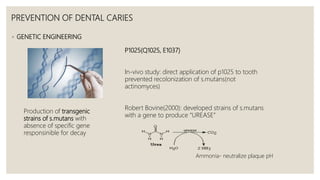
◦ GENETIC ENGINEERING
Production of transgenic
strains of s.mutans with
absence of specific gene
responsinible for decay
P1025(Q1025, E1037)
In-vivo study: direct application of p1025 to tooth
prevented recolonization of s.mutans(not
actinomyces)
Robert Bovine(2000): developed strains of s.mutans
with a gene to produce “UREASE”
Ammonia- neutralize plaque pH
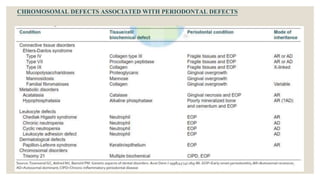
CHROMOSOMAL DEFECTS ASSOCIATED WITH PERIODONTAL DEFECTS
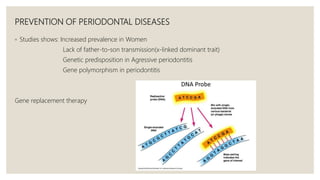
PREVENTION OF PERIODONTAL DISEASES
◦ Studies shows: Increased prevalence in Women
Lack of father-to-son transmission(x-linked dominant trait)
Genetic predisposition in Agressive periodontitis
Gene polymorphism in periodontitis
Gene replacement therapy
ORAL CANCER
Dr.Alfred Knutson(1971) proposed “two-hit hypothesis” for cancer
Genes: cytochrome P450, p16, 9p21, APC5q21-22 and p53
RR for developing cancer
1st degree relatives: 3.5 times
Siblings: 8.6 times
CLEFT LIP/PALATE
70% non-syndromic
30% syndromic
Siblings: 30 times more risk
MALOCCLUSION
Twin studies: Genetic predisposition among siblings
Folkes et al
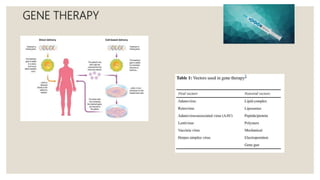
GENE THERAPY
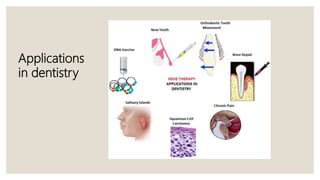
Applications
in dentistry
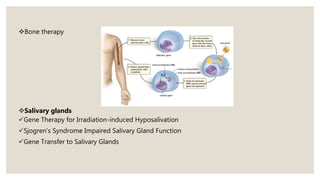
Bone therapy
Salivary glands
Gene Therapy for Irradiation-induced Hyposalivation
Sjogren’s Syndrome Impaired Salivary Gland Function
Gene Transfer to Salivary Glands
Pain
 Intrathecal injection
 Injection to CSF
 Neurons of Dorsal root ganglia
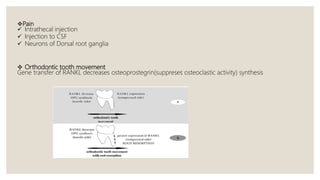
 Orthodontic tooth movement
Gene transfer of RANKL decreases osteoprostegrin(suppreses osteoclastic activity) synthesis
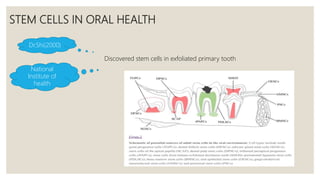
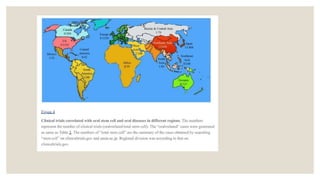
STEM CELLS IN ORAL HEALTH
Dr.Shi(2000)
Discovered stem cells in exfoliated primary tooth
National
Institute of
health
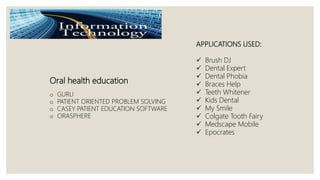
Oral health education
o GURU
o PATIENT ORIENTED PROBLEM SOLVING
o CASEY PATIENT EDUCATION SOFTWARE
o ORASPHERE
APPLICATIONS USED:
 Brush DJ
 Dental Expert
 Dental Phobia
 Braces Help
 Teeth Whitener
 Kids Dental
 My Smile
 Colgate Tooth Fairy
 Medscape Mobile
 Epocrates
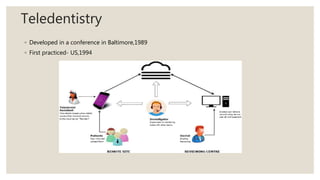
Teledentistry
◦ Developed in a conference in Baltimore,1989
◦ First practiced- US,1994
REFERENCES
◦ Harris, N.O. and Grading, E., 1991. Preventive dentistry.7th edition.
◦ Shivakumar KM, Vidya SK, Chandu GN. Dental caries vaccine. Indian Journal of Dental Research.
2009 Jan 1;20(1):99.
◦ Rai R, Kumar PN, Hirekalmath SV, Sunil LA. Genetics and oral health. Dentistry and Medical
Research. 2016 Jan 1;4(1):9.
◦ Prabhakar AR, Paul JM, Basappa N. Gene therapy and its implications in dentistry. International
journal of clinical pediatric dentistry. 2011 May;4(2):85.
◦ Yang B, Qiu Y, Zhou N, Ouyang H, Ding J, Cheng B, Sun J. Application of stem cells in oral
disease therapy: progresses and perspectives. Frontiers in physiology. 2017 Apr 3;8:197.
Technological advances in primary dental care

Technological advances in primary dental care

  • 1.
    TECHNOLOGICAL ADVANCES IN PRIMARY DENTALCARE Presented By Dr.Sindhu R IIIrd Year Postgraduate Department of Public Health Dentistry
  • 2.
    CONTENTS ◦ Introduction ◦ Primarypreventive modalities ◦ Immunizations in oral health Dental caries vaccine ◦ Genetics in oral health Genetic epidemiology Dental caries Periodontal diseases Oral cancer ◦ Gene therapy Applications in dentistry ◦ Stem cells in oral health ◦ Information technology in oral health ◦ References
  • 3.
    DEFINITION ‘Primary dental careis continuing management and coordination of health services provided by a dental care provider system of first contact for maintenance of health, prevention of disease and injury, and restoration of health. It includes appropriate assessment of general and oral health status; provision of oral diagnostic, preventive, educational, and therapeutic services; and referral and coordination of episodic specialty care.’ -MICHAEL J. LOUPE(Alma Ata Declaration)
  • 5.
    Primary preventive modalities Technological advances  Toothbrushing  Dentifrices Interdental aids  Irrigation  Mouthrinses  Fluoride  Dental sealants  Professional dental hygiene treatment  Immunizations  Genetics  Gene therapy  Stem cells in oral health  Information technology
  • 6.
    IMMUNIZATIONS IN ORALHEALTH DENTAL CARIES VACCINE W.H.Bowen(196 9) Antigenic components targeted by vaccine: GTF Adhesins Dextranase
  • 7.
    Clinical trials Oral immunizationwith GTF capsules Reduced s.mutans for upto 42days GTF applied topically to buccal mucosa Reduced s.mutans reaccumulation Transfer of milk antibody specific for whole s.mutans from mother to infant(breast- feeding) Effective if followed till “Window of infectivity” 1st= 19-31months 2nd= 6-12 years Effect duration was short in young adults(<42days) Adults- not appropriate for vaccination Animal experiments Intravenous immunization  Monkeys caries reduction Subcutaneous immunization  rats caries reduction
  • 8.
    1year old Infants Effectiveimmunity against colonization of s.mutans Younger adults (18-23years) Already infected with s.mutans RISKS OF VACCINE Cross reactivity
  • 9.
  • 10.
    Genetic disorders Genetic disordersaffecting jaw bones and faces Cherubism Cleidocranial dysplasia Gardner syndrome Mandibulofacial dysostosis (Treacher Collins syndrome) Nevoid basal cell carcinoma syndrome Osteogenesis imperfecta Apert’s syndrome Crouzon syndrome Genetic disorders affecting oral mucosa Hereditary hemorrhagic telangiectasia Multiple endocrine neoplasia syndrome IIB Neurofibromatosis Peutz-Jeghers syndrome White sponge nevus Calcinosis–Elhers Danlos syndrome Brachio-skeletao-genital syndrome Osteogenesis imperfecta Hypophosphatemic Vitamin D resistant rickets Vitamin D dependent rickets Hypophosphatsia Genetic diseases affecting enamel Primary (amelogenesis imperfecta) Hypoplastic forms Autosomal dominant thin and smooth hypoplasia with eruption defect and resorption of the teeth Autosomal dominant thin and rough hypoplasia Autosomal dominant randomly pitted hypoplasia Autosomal dominant localized hypoplasia X-linked dominant rough hypoplasia Hypoclacified form Autosomal dominant hypocalcification Hypomaturation X-linked hypomaturation form Autosomal recessive pigmented hypomaturation Snowcapped teeth Hypomaturation-hypoplasia with taurodontism Autosomal dominant hypomaturation with occasional hypoplastic pits and taurodontism Autosomal dominant hypomaturation with thin hypoplasia and taurodontism Secondary to generalized disease Hypoplasia and/or hypocalcification Occulodentodigital dysplasia Epidermolysis bullousa dystropica Genetic diseases affecting dentine Genetic diseases manifest as alterations in teeth only Taurodontism Thistle shaped pulp chambers and shell teeth Pulpal dysplasia Coronal dentin dysplasia Radicular dentin dysplasia Fibrous dysplasia of dentin Heriditary opalacent dentin Lobodontia Dens evaginatus, dens invaginatus. dens in dente Odontodysplasia Generalised genetic diseases affecting dentin Globodontia in otodental syndrome Tricho-dento-osseous syndrome Focal dermal hypoplasia Pseudohypoparathyroidsm Miscellaneous Pseudohypoparathyroidism Idiopathic hypoparathyroidism Fabry’s disease Scleroderma Progeria Erythroblastosis fetalis
  • 11.
    GENETIC EPIDEMILOGY Familial aggregationstudies 1st degree relatives Early onset Strong phenotypic correlations Segregation analysis  Linkage analysis
  • 12.
    EVIDENCE FOR GENETICCONTRIBUTION TO DENTAL CARIES THROUGH ANALYSIS OF TWINS
  • 13.
    PREVENTION OF DENTALCARIES ◦ GENETIC ENGINEERING Production of transgenic strains of s.mutans with absence of specific gene responsinible for decay P1025(Q1025, E1037) In-vivo study: direct application of p1025 to tooth prevented recolonization of s.mutans(not actinomyces) Robert Bovine(2000): developed strains of s.mutans with a gene to produce “UREASE” Ammonia- neutralize plaque pH
  • 14.
    CHROMOSOMAL DEFECTS ASSOCIATEDWITH PERIODONTAL DEFECTS
  • 15.
    PREVENTION OF PERIODONTALDISEASES ◦ Studies shows: Increased prevalence in Women Lack of father-to-son transmission(x-linked dominant trait) Genetic predisposition in Agressive periodontitis Gene polymorphism in periodontitis Gene replacement therapy
  • 16.
    ORAL CANCER Dr.Alfred Knutson(1971)proposed “two-hit hypothesis” for cancer Genes: cytochrome P450, p16, 9p21, APC5q21-22 and p53 RR for developing cancer 1st degree relatives: 3.5 times Siblings: 8.6 times CLEFT LIP/PALATE 70% non-syndromic 30% syndromic Siblings: 30 times more risk MALOCCLUSION Twin studies: Genetic predisposition among siblings Folkes et al
  • 17.
  • 18.
  • 19.
    Bone therapy Salivary glands GeneTherapy for Irradiation-induced Hyposalivation Sjogren’s Syndrome Impaired Salivary Gland Function Gene Transfer to Salivary Glands
  • 20.
    Pain  Intrathecal injection Injection to CSF  Neurons of Dorsal root ganglia  Orthodontic tooth movement Gene transfer of RANKL decreases osteoprostegrin(suppreses osteoclastic activity) synthesis
  • 21.
    STEM CELLS INORAL HEALTH Dr.Shi(2000) Discovered stem cells in exfoliated primary tooth National Institute of health
  • 23.
    Oral health education oGURU o PATIENT ORIENTED PROBLEM SOLVING o CASEY PATIENT EDUCATION SOFTWARE o ORASPHERE APPLICATIONS USED:  Brush DJ  Dental Expert  Dental Phobia  Braces Help  Teeth Whitener  Kids Dental  My Smile  Colgate Tooth Fairy  Medscape Mobile  Epocrates
  • 24.
    Teledentistry ◦ Developed ina conference in Baltimore,1989 ◦ First practiced- US,1994
  • 25.
    REFERENCES ◦ Harris, N.O.and Grading, E., 1991. Preventive dentistry.7th edition. ◦ Shivakumar KM, Vidya SK, Chandu GN. Dental caries vaccine. Indian Journal of Dental Research. 2009 Jan 1;20(1):99. ◦ Rai R, Kumar PN, Hirekalmath SV, Sunil LA. Genetics and oral health. Dentistry and Medical Research. 2016 Jan 1;4(1):9. ◦ Prabhakar AR, Paul JM, Basappa N. Gene therapy and its implications in dentistry. International journal of clinical pediatric dentistry. 2011 May;4(2):85. ◦ Yang B, Qiu Y, Zhou N, Ouyang H, Ding J, Cheng B, Sun J. Application of stem cells in oral disease therapy: progresses and perspectives. Frontiers in physiology. 2017 Apr 3;8:197.