Dr. Deepthi P.R.
3rdYear MDS
Dept. of Conservative Dentistry & Endodontics
 Amalgam
 Asbestos
 Balsam
 Bamboo
 Cement
 Cu, Fe, ZnOCl, Au or Sn foil, Ag points
 Pastes
 PoP
 Resin
 Rubber
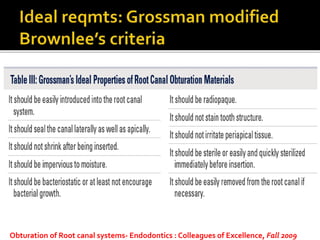
Obturation of Root canal systems- Endodontics : Colleagues of Excellence, Fall 2009
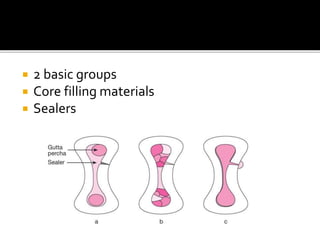
 2 basic groups
 Core filling materials
 Sealers
 Solid core : Ag points
 Semisolid core: Gutta percha
 Paste : ZnO containing pastes
 Jasper- 1933
 1930s- 1960s
 Advantages
 Drawbacks
 Seltzer et al.
 Brady & Del Rio
 Goldberg
 Guttirez
 Kehoe
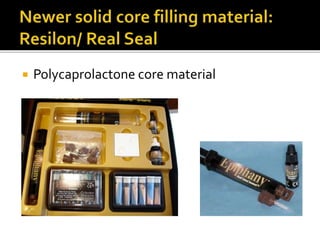
 Polycaprolactone core material
 Bioactive glass
 Bi, Ba salts: fillers
 Pigments
 Resin sealer
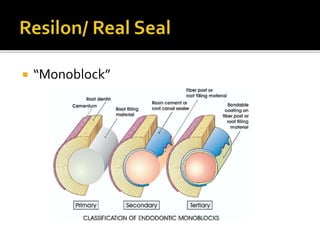
 “Monoblock”
 Primer
 Sealer
 Synthetic polymer points/ pellets
 Lower temperatures than GP
 Miner et al.
 Nielsen & Baumgartner
 Shipper et al.
 Susceptibility to degradation- Tay et al.
 Interfacial strength analysis: Gesi et al.
 Stratton et al,Von Fraunhofer et al.
 Wang et al.
 Epley et al.
 Williams et al.
 Karr et al.
J Endod 2007; 33: 749-752
 Gutta percha
 C- points
 “GETAH”: gum
 “PERTJA”: name of the tree in Malay
language
 JohnTradescant: 1656- ‘ MazerWood’
 Dr. William Montgomerie: Gold medal in
1843
 Ernst Werner von Siemans: 1848
Prakash et al. Gutta- percha: An untold story- ENDODONTOLOGY
 Alexander Cabriol & Duclos: first GP patent
 Hamock & Bewley: 1845
 James Paterson: 1845- hand moulded golf
balls ‘Gutties’
 Field of Medicine
Prakash et al. Gutta- percha: An untold story- ENDODONTOLOGY
 EdwinTruman: Temporary filling material
 Hill’s stopping: 1847
 Bowman: 1867- root canal filling material
 Perry: 1883
 S.S. White company: 1887
 Rollins: 1893
Prakash et al. Gutta- percha: An untold story- ENDODONTOLOGY
 Callahan: 1914
 Ingle & Levine: 1959
 Standardized GP: 2nd International
Conference at Philadelphia – 1959
 ISO: 1976
 ADA # 78
Prakash et al. Gutta- percha: An untold story- ENDODONTOLOGY
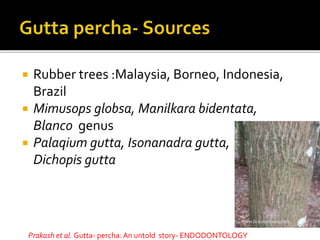
 Rubber trees :Malaysia, Borneo, Indonesia,
Brazil
 Mimusops globsa, Manilkara bidentata,
Blanco genus
 Palaqium gutta, Isonanadra gutta,
Dichopis gutta
Prakash et al. Gutta- percha: An untold story- ENDODONTOLOGY
 Palaquium obavatum
 Palaquium polyanthum
 Palaquium ellipticum
 Palaquium gutta
Prakash et al. Gutta- percha: An untold story- ENDODONTOLOGY
 Surinam Gutta-percha
 Butyrospermum park
 Dyera costulata
 Maytenus phyllanthoides
 Calatropis giganlea
 Manilkara species
 Synthetic trans- poly isoprene
Prakash et al. Gutta- percha: An untold story- ENDODONTOLOGY
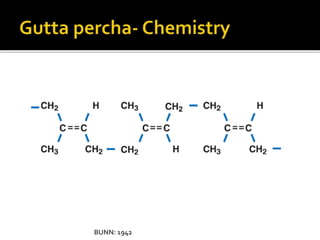
BUNN: 1942
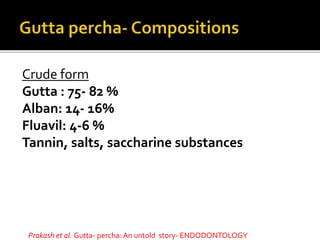
Crude form
Gutta : 75- 82 %
Alban: 14- 16%
Fluavil: 4-6 %
Tannin, salts, saccharine substances
Prakash et al. Gutta- percha: An untold story- ENDODONTOLOGY
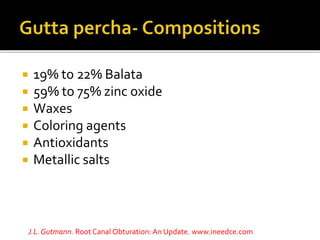
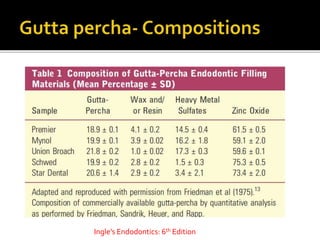
 19% to 22% Balata
 59% to 75% zinc oxide
 Waxes
 Coloring agents
 Antioxidants
 Metallic salts
J.L. Gutmann. Root Canal Obturation: An Update. www.ineedce.com
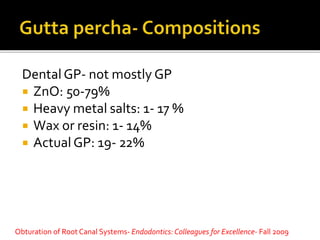
Dental GP- not mostly GP
 ZnO: 50-79%
 Heavy metal salts: 1- 17 %
 Wax or resin: 1- 14%
 Actual GP: 19- 22%
Obturation of Root Canal Systems- Endodontics: Colleagues for Excellence- Fall 2009
Ingle’s Endodontics: 6th Edition
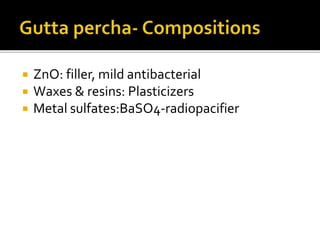
 ZnO: filler, mild antibacterial
 Waxes & resins: Plasticizers
 Metal sulfates:BaSO4-radiopacifier
 Iodoform
 Free iodine
 Protection
 No difference: regular GP points & MGP-
ability to delay microleakage of E. faecalis
Martin et al. 1999
 Ca(OH)2: (40–60%)
(Roeko/Coltene/Whaledent, Langenau,
Germany)
 Ca(OH)2 containingGP point: improvement
in the apical sealing quality Holland et al.
 Activ Point (Roeko/Coltene/Whaledent): CHX
 Better antibacterial than Ca(OH)2 containing
GP: Lin et al.
 Podbielski et al.
 GP + tetracycline
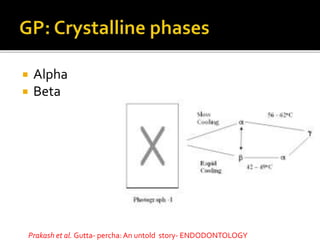
 Alpha
 Beta
Prakash et al. Gutta- percha: An untold story- ENDODONTOLOGY
 Coagulation
 Obach’s technique
 Aging: rejuvenation
Prakash et al. Gutta- percha: An untold story- ENDODONTOLOGY
 ISO sizes
 0.04 & 0.06 taper
 Traditional sizes
 Pellets
 Low humidity
 Effects of high
humidity
 Senia et al.- 5.25%
NaOCl – 1 minute
 Short et al.
 Valois et al.
 Gomes et al.
 Solid core Gutta-percha points
- Standardized
- Non standardized
 Thermo mechanical compactibleGP
 Thermo plasticizedGP
- Solid core system
- Injectable form
 MedicatedGutta-percha
Prakash et al. Gutta- percha: An untold story- ENDODONTOLOGY
 Toxicity
 Sjogren et al.
 Serene et al.
 Cross reactivity
 Costa et al. , Hamann et al.
 Solubility
 Plasticity at relatively low temperatures
 Heat cycling
 Shrinkage: 1-2 %
 Relative inability to transmit heat for
softening and 3D molding
SimonsW. Revolutionary Advances, Part 3: Pursuit of the 3-D cork. DentistryToday. 2015
Obturation of Root Canal Systems- Endodontics: Colleagues for Excellence- Fall 2009
 Natural
 Inert
 High biocompatibility
 Dimensionally stable
 Thermoplastic
 Compactable
 Radiopaque
 Dissolvable
 Antibacterial activity
SimonsW. Revolutionary Advances, Part 3: Pursuit of the 3-D cork. DentistryToday. 2015
 Distorted by pressure
 Forced through the apical foramen if too
much pressure is used
 Not rigid
 A sealer is necessary
Carrotte P. Endodontics: Part 8. Filling the Root Canal System. British Dental Journal 197, 667- 672
(2004)
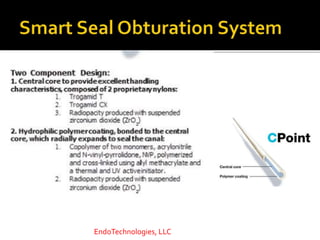
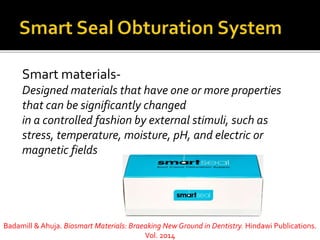
Smart materials-
Designed materials that have one or more properties
that can be significantly changed
in a controlled fashion by external stimuli, such as
stress, temperature, moisture, pH, and electric or
magnetic fields
Badamill & Ahuja. Biosmart Materials: Braeaking New Ground in Dentistry. Hindawi Publications.
Vol. 2014
EndoTechnologies, LLC
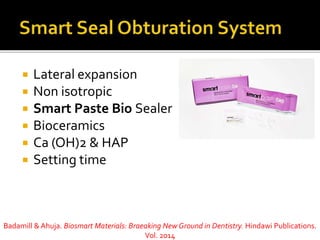
 Lateral expansion
 Non isotropic
 Smart Paste Bio Sealer
 Bioceramics
 Ca (OH)2 & HAP
 Setting time
Badamill & Ahuja. Biosmart Materials: Braeaking New Ground in Dentistry. Hindawi Publications.
Vol. 2014
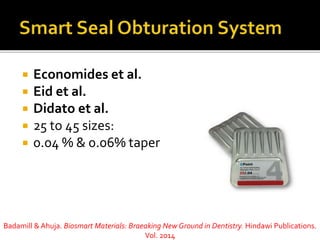
 Economides et al.
 Eid et al.
 Didato et al.
 25 to 45 sizes:
 0.04 % & 0.06% taper
Badamill & Ahuja. Biosmart Materials: Braeaking New Ground in Dentistry. Hindawi Publications.
Vol. 2014
 Self sealing; dentin derived moisture
 Less dentin removal
 Avoids compaction forces
EndoTechnologies, LLC
 ZnO
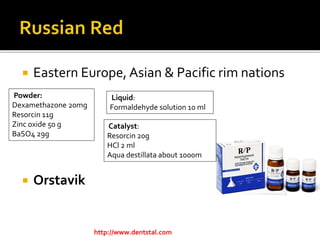
 Russian Red
 Trailement SPAD
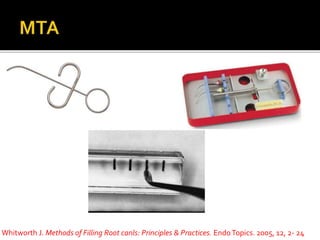
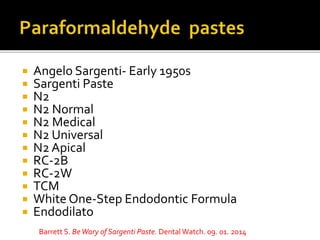
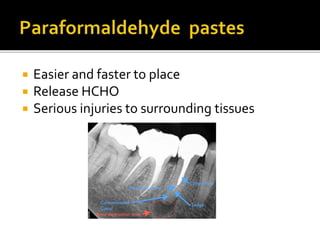
 MTA
 Paraformaldehyde
 Eastern Europe, Asian & Pacific rim nations
 Orstavik
http://www.dentstal.com
Powder:
Dexamethazone 20mg
Resorcin 11g
Zinc oxide 50 g
BaSO4 29g
Liquid:
Formaldehyde solution 10 ml
Catalyst:
Resorcin 20g
HCl 2 ml
Aqua destillata about 1000m
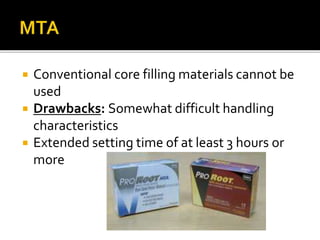
 Conventional core filling materials cannot be
used
 Drawbacks: Somewhat difficult handling
characteristics
 Extended setting time of at least 3 hours or
more
 Sealing ability
 Marginal adaptation
 Leakage
 Cytotoxicity
 Repair & Regeneration
 Use of moist cotton
 Solubility
Whitworth J. Methods of Filling Root canls: Principles & Practices. EndoTopics. 2005, 12, 2- 24
 Angelo Sargenti- Early 1950s
 Sargenti Paste
 N2
 N2 Normal
 N2 Medical
 N2 Universal
 N2 Apical
 RC-2B
 RC-2W
 TCM
 White One-Step Endodontic Formula
 Endodilato
Barrett S. BeWary of Sargenti Paste. Dental Watch. 09. 01. 2014
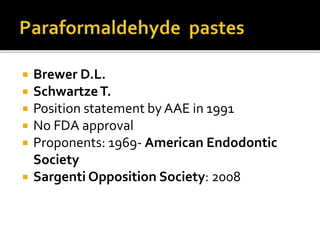
 Easier and faster to place
 Release HCHO
 Serious injuries to surrounding tissues
 Brewer D.L.
 SchwartzeT.
 Position statement by AAE in 1991
 No FDA approval
 Proponents: 1969- American Endodontic
Society
 Sargenti Opposition Society: 2008
Endomethasone:
 Powder: dexamethasone, hydrocortisone
acetate, thymol iodide, paraformaldehyde, &
a radiopaque excipient
 Liquid: eugenol, peppermint oil & Anise oil
Riebler’s paste
Trailement SPAD
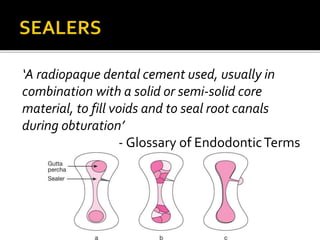
‘A radiopaque dental cement used, usually in
combination with a solid or semi-solid core
material, to fill voids and to seal root canals
during obturation’
- Glossary of EndodonticTerms
 Impervious seal
 Filler
 Antimicrobial
 Lubricant
 Adhesive properties
J.L. Gutmann. Root Canal Obturation: An Update. www.ineedce.com
1. It should be tacky when mixed to provide
good adhesion between it and the canal wall
when set.
2. It should make a hermetic seal.
3. It should be radiopaque so it can be
visualized in the radiograph.
4.The particles of powder should be very fine
so they can mix easily with the liquid.
5. It should not shrink upon setting.
6. It should not stain tooth structure.
7. It should be bacteriostatic or at least not
encourage bacterial growth.
8. It should set slowly.
9. It should be insoluble in tissue fluids.
10. It should be tissue tolerant, that is,
nonirritating to periradicular tissues.
11. It should be soluble in a common solvent, if
it is necessary to remove the root canal
filling
12. It should not provoke an immune response
in periradicular tissues. ( Block et al.)
13. It should be neither mutagenic nor
carcinogenic. ( Harnden & Lewis)
The sealer should adhere to the obturating
material, usually gutta percha, when placed in
the canal, and should adhere to the canal wall
with its irregularities to completely fill the canal
space.
Gatewood R.S. Endodontic Materials. Dent Clin N Am 51 (2007) 695–712
The core material itself does not provide an
adhesive seal to the canal wall.To create
and maintain a fluid-tight seal of the
canal is a prime requirement of a sealer
Gatewood R.S. Endodontic Materials. Dent Clin N Am 51 (2007) 695–712
The sealer should contribute to the
radiopacity of the root filling for
visualization on radiographs and
evaluation of obturation of lateral canals
and apical ramifications.
Gatewood R.S. Endodontic Materials. Dent Clin N Am 51 (2007) 695–712
Any shrinkage of the sealer would tend to
create gaps at the dentin interface or
within the core material, compromising
the seal.
Components of sealer should not leach into
dentin leading to coronal or cervical
discoloration of the crown
Gatewood R.S. Endodontic Materials. Dent Clin N Am 51 (2007) 695–712
This property is desirable, but increasing
the antibacterial qualities of a sealer also
increases its toxicity to host tissues.
Should set slowly. A sealer must have ample
working time to
allow for placement during obturation
and adjustment in the case of immediate
post-space preparation.
Gatewood R.S. Endodontic Materials. Dent Clin N Am 51 (2007) 695–712
Stability of sealer when set is a prime factor
in maintaining a hermetic seal over time.
This is compromised if fluid contact
causes dissolution of the sealer.
Biocompatibility of the sealer promotes
periradicular repair. Most sealers tend to
be more tissue-toxic in the unset state
and considerably less toxic when fully
set.
Gatewood R.S. Endodontic Materials. Dent Clin N Am 51 (2007) 695–712
To allow for retreatment or post-space
preparation, the sealer and the core
material should be removable.This can
be facilitated by using a solvent.
Gatewood R.S. Endodontic Materials. Dent Clin N Am 51 (2007) 695–712
 Zinc oxide-eugenol
 Polyketone
 Epoxy
 Ca(OH)2
 Silicone
 Resin
 Glass ionomer
 Resin-modified glass ionomer
J.L. Gutmann. Root Canal Obturation: An Update. www.ineedce.com
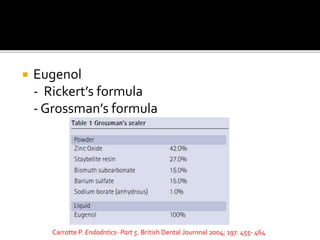
 Eugenol
- Rickert’s formula
- Grossman’s formula
Carrotte P. Endodntics- Part 5. British Dental Journnal 2004; 197: 455- 464
 Non- eugenol
 Medicated : Corticosteroid +
paraformaldehyde
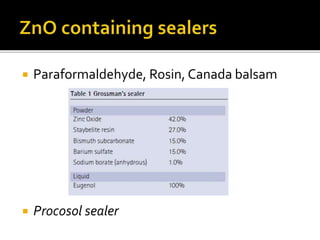
 Paraformaldehyde, Rosin, Canada balsam
 Procosol sealer
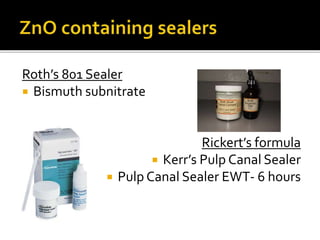
Roth’s 801 Sealer
 Bismuth subnitrate
Rickert’s formula
 Kerr’s Pulp Canal Sealer
 Pulp Canal Sealer EWT- 6 hours
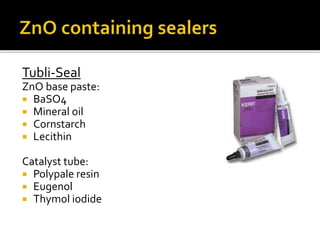
Tubli-Seal
ZnO base paste:
 BaSO4
 Mineral oil
 Cornstarch
 Lecithin
Catalyst tube:
 Polypale resin
 Eugenol
 Thymol iodide
Wach’s Paste
Powder:
 ZnO
 Bi subnitrate
 Bi subiodide
 MgO, Ca3(PO4)2
Liquid:
 Oil of cloves
 Eucalyptol
 Canada balsam
 Beechwood creosote
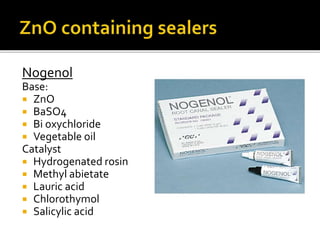
Nogenol
Base:
 ZnO
 BaSO4
 Bi oxychloride
 Vegetable oil
Catalyst
 Hydrogenated rosin
 Methyl abietate
 Lauric acid
 Chlorothymol
 Salicylic acid
MedicatedCanal Sealer
 Martin
 Iodoform
 MGP GP- 10% CHI3
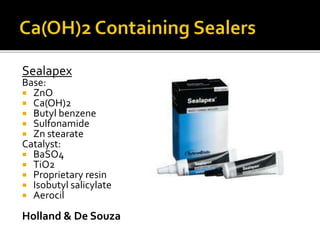
Sealapex
Base:
 ZnO
 Ca(OH)2
 Butyl benzene
 Sulfonamide
 Zn stearate
Catalyst:
 BaSO4
 TiO2
 Proprietary resin
 Isobutyl salicylate
 Aerocil
Holland & De Souza
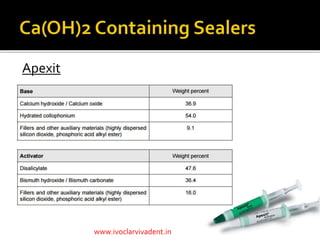
Apexit
www.ivoclarvivadent.in
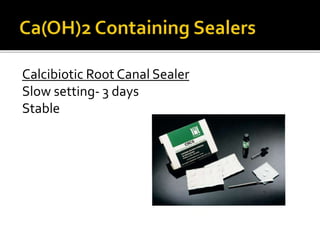
Calcibiotic Root Canal Sealer
Slow setting- 3 days
Stable
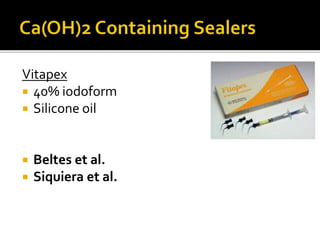
Vitapex
 40% iodoform
 Silicone oil
 Beltes et al.
 Siquiera et al.
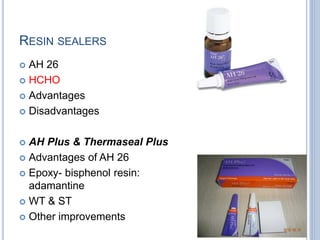
RESIN SEALERS
 AH 26
 HCHO
 Advantages
 Disadvantages
 AH Plus & Thermaseal Plus
 Advantages of AH 26
 Epoxy- bisphenol resin:
adamantine
 WT & ST
 Other improvements
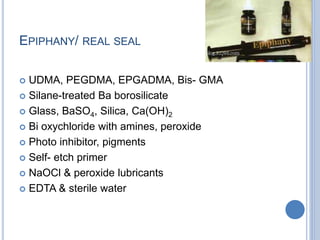
EPIPHANY/ REAL SEAL
 UDMA, PEGDMA, EPGADMA, Bis- GMA
 Silane-treated Ba borosilicate
 Glass, BaSO4, Silica, Ca(OH)2
 Bi oxychloride with amines, peroxide
 Photo inhibitor, pigments
 Self- etch primer
 NaOCl & peroxide lubricants
 EDTA & sterile water
EPIPHANY/ REAL SEAL
 Sousa et al.
 Versiani et al.
 Solubility
 Dimensional stability
 ANSI/ ADA standards
 Ungor et al.
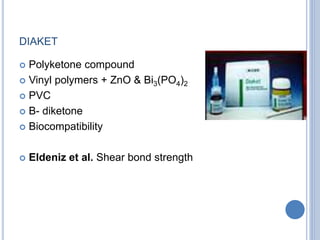
DIAKET
 Polyketone compound
 Vinyl polymers + ZnO & Bi3(PO4)2
 PVC
 B- diketone
 Biocompatibility
 Eldeniz et al. Shear bond strength
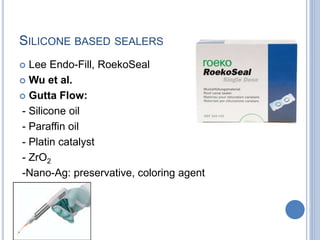
SILICONE BASED SEALERS
 Lee Endo-Fill, RoekoSeal
 Wu et al.
 Gutta Flow:
- Silicone oil
- Paraffin oil
- Platin catalyst
- ZrO2
-Nano-Ag: preservative, coloring agent
URETHANE METHACRYLATE SEALERS
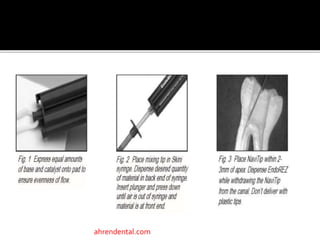
 EndoREZ
 2- part: chemical set
 Sealer, Resin- coated Gutta Percha, Accelerators
 Hydrophilic characteristics
 Tay et al.
 Hirashi et al.
 Zmener et al.
ahrendental.com
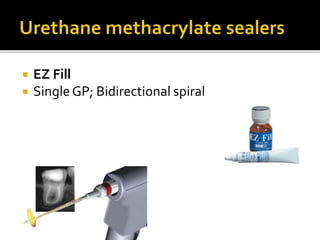
 EZ Fill
 Single GP; Bidirectional spiral
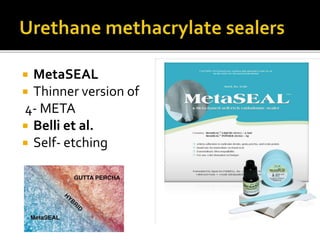
 MetaSEAL
 Thinner version of
4- META
 Belli et al.
 Self- etching
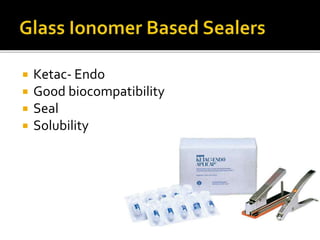
 Ketac- Endo
 Good biocompatibility
 Seal
 Solubility
 Johnston & Callahan
 GP particles + CHCl3
 Shrinkage & voids
 Chlorosin
 Chloropercha
 Kloropercha N- 
 Orstavik
 ANSI/ADA & ISO
 Flow,WT, ST
 Radiopacity
 Solubility & disintegration
 Dimensional change following setting
 Biologic tests, Usage tests , Antibacterial
testing
 Clinical test
 Juhasz et al.-Sealapex allowed more leakage
than Pulp Canal Sealer
 Cobankara et al.- Sealapex
 Orucoglu et al. Diaket + cold lateral
compaction
 Saleh et al.
 Pommel et al.
 Lee et al.
 Tagger et al.
 Miletic et al.
 Spangberg & Pascon
 Economides et al.
 Huumonen et al.
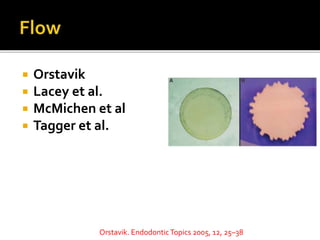
 Orstavik
 Lacey et al.
 McMichen et al
 Tagger et al.
Orstavik. EndodonticTopics 2005, 12, 25–38
 Nielsen et al.
 Anaerobic: Ketac-Endo
& Resilon
 Aerobic: KerrTubli Seal
& Ketac Endo
 Roth’s 801 & 811-
slowest
 Kazemi et al:
- ZOE: 4 hours
- Endomethasone: 9 hrs
- Endo-Fill: 2.5 hrs
- AH-26: 12 hrs
 Orstavik et al.
 Flow as a function of
time
 ZOE sealers
 ZOE & Ca(OH)2
 Schafer & Zandbiglari
 AH plus
 Kazemi et al.
 ZOE sealers
 Endo- Fill : least
 Endo- Fill & AH- 26-
lower rates
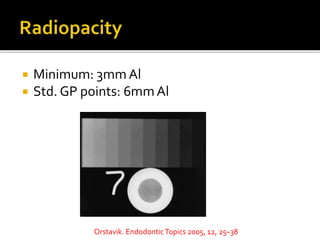
 Minimum: 3mm Al
 Std. GP points: 6mmAl
Orstavik. EndodonticTopics 2005, 12, 25–38
 Concern for untoward reaction
 Extreme situations
 Delay / prevent resolution
Orstavik. EndodonticTopics 2005, 12, 25–38
 Expt. Animals
 Uninfected teeth
 Katebzadeh et al. Induced apical
periodontitis
Orstavik. EndodonticTopics 2005, 12, 25–38
 Sipert et al.
 Pizzo et al.
 Williamson et al.
 Siqueira and Goncalves
 Leonardo et al.
 Kayaoglu et al.
 Aravind et al.
JCD. Iss. 9(1): 2006
 Composite resins
 Glass ionomers
 Cavit
 IRM
 Super EBA
 Dentin bonding agent
Cavit:
 ZnO
 CaSO4
 ZnSO4
 Glycoacetate
 Polyvinylacetate resin
 PVC acetate
 Triethanolamine
 Red pigment
IRM:
Polymer-resin-reinforced ZOE
TERM:
 UDMA polymers
 Inorganic radiopaque filler
 Pigments
 Initiators
 Grossman’s requirements
 Long term RCTs
 Tissue regeneration

Root Canal Filing Materials

  • 1.
    Dr. Deepthi P.R. 3rdYearMDS Dept. of Conservative Dentistry & Endodontics
  • 2.
     Amalgam  Asbestos Balsam  Bamboo  Cement  Cu, Fe, ZnOCl, Au or Sn foil, Ag points  Pastes  PoP  Resin  Rubber
  • 3.
    Obturation of Rootcanal systems- Endodontics : Colleagues of Excellence, Fall 2009
  • 4.
     2 basicgroups  Core filling materials  Sealers
  • 5.
     Solid core: Ag points  Semisolid core: Gutta percha  Paste : ZnO containing pastes
  • 6.
     Jasper- 1933 1930s- 1960s  Advantages  Drawbacks  Seltzer et al.  Brady & Del Rio  Goldberg  Guttirez  Kehoe
  • 7.
  • 8.
     Bioactive glass Bi, Ba salts: fillers  Pigments  Resin sealer
  • 9.
  • 10.
     Primer  Sealer Synthetic polymer points/ pellets  Lower temperatures than GP  Miner et al.  Nielsen & Baumgartner  Shipper et al.
  • 11.
     Susceptibility todegradation- Tay et al.  Interfacial strength analysis: Gesi et al.  Stratton et al,Von Fraunhofer et al.  Wang et al.  Epley et al.  Williams et al.  Karr et al. J Endod 2007; 33: 749-752
  • 12.
  • 13.
     “GETAH”: gum “PERTJA”: name of the tree in Malay language  JohnTradescant: 1656- ‘ MazerWood’  Dr. William Montgomerie: Gold medal in 1843  Ernst Werner von Siemans: 1848 Prakash et al. Gutta- percha: An untold story- ENDODONTOLOGY
  • 14.
     Alexander Cabriol& Duclos: first GP patent  Hamock & Bewley: 1845  James Paterson: 1845- hand moulded golf balls ‘Gutties’  Field of Medicine Prakash et al. Gutta- percha: An untold story- ENDODONTOLOGY
  • 15.
     EdwinTruman: Temporaryfilling material  Hill’s stopping: 1847  Bowman: 1867- root canal filling material  Perry: 1883  S.S. White company: 1887  Rollins: 1893 Prakash et al. Gutta- percha: An untold story- ENDODONTOLOGY
  • 16.
     Callahan: 1914 Ingle & Levine: 1959  Standardized GP: 2nd International Conference at Philadelphia – 1959  ISO: 1976  ADA # 78 Prakash et al. Gutta- percha: An untold story- ENDODONTOLOGY
  • 17.
     Rubber trees:Malaysia, Borneo, Indonesia, Brazil  Mimusops globsa, Manilkara bidentata, Blanco genus  Palaqium gutta, Isonanadra gutta, Dichopis gutta Prakash et al. Gutta- percha: An untold story- ENDODONTOLOGY
  • 18.
     Palaquium obavatum Palaquium polyanthum  Palaquium ellipticum  Palaquium gutta Prakash et al. Gutta- percha: An untold story- ENDODONTOLOGY
  • 19.
     Surinam Gutta-percha Butyrospermum park  Dyera costulata  Maytenus phyllanthoides  Calatropis giganlea  Manilkara species  Synthetic trans- poly isoprene Prakash et al. Gutta- percha: An untold story- ENDODONTOLOGY
  • 20.
  • 21.
    Crude form Gutta :75- 82 % Alban: 14- 16% Fluavil: 4-6 % Tannin, salts, saccharine substances Prakash et al. Gutta- percha: An untold story- ENDODONTOLOGY
  • 22.
     19% to22% Balata  59% to 75% zinc oxide  Waxes  Coloring agents  Antioxidants  Metallic salts J.L. Gutmann. Root Canal Obturation: An Update. www.ineedce.com
  • 23.
    Dental GP- notmostly GP  ZnO: 50-79%  Heavy metal salts: 1- 17 %  Wax or resin: 1- 14%  Actual GP: 19- 22% Obturation of Root Canal Systems- Endodontics: Colleagues for Excellence- Fall 2009
  • 24.
  • 25.
     ZnO: filler,mild antibacterial  Waxes & resins: Plasticizers  Metal sulfates:BaSO4-radiopacifier
  • 26.
     Iodoform  Freeiodine  Protection  No difference: regular GP points & MGP- ability to delay microleakage of E. faecalis Martin et al. 1999
  • 27.
     Ca(OH)2: (40–60%) (Roeko/Coltene/Whaledent,Langenau, Germany)  Ca(OH)2 containingGP point: improvement in the apical sealing quality Holland et al.
  • 28.
     Activ Point(Roeko/Coltene/Whaledent): CHX  Better antibacterial than Ca(OH)2 containing GP: Lin et al.  Podbielski et al.  GP + tetracycline
  • 29.
     Alpha  Beta Prakashet al. Gutta- percha: An untold story- ENDODONTOLOGY
  • 30.
     Coagulation  Obach’stechnique  Aging: rejuvenation Prakash et al. Gutta- percha: An untold story- ENDODONTOLOGY
  • 31.
     ISO sizes 0.04 & 0.06 taper  Traditional sizes  Pellets
  • 32.
     Low humidity Effects of high humidity  Senia et al.- 5.25% NaOCl – 1 minute  Short et al.  Valois et al.  Gomes et al.
  • 33.
     Solid coreGutta-percha points - Standardized - Non standardized  Thermo mechanical compactibleGP  Thermo plasticizedGP - Solid core system - Injectable form  MedicatedGutta-percha Prakash et al. Gutta- percha: An untold story- ENDODONTOLOGY
  • 34.
     Toxicity  Sjogrenet al.  Serene et al.  Cross reactivity  Costa et al. , Hamann et al.  Solubility
  • 35.
     Plasticity atrelatively low temperatures  Heat cycling  Shrinkage: 1-2 %  Relative inability to transmit heat for softening and 3D molding SimonsW. Revolutionary Advances, Part 3: Pursuit of the 3-D cork. DentistryToday. 2015 Obturation of Root Canal Systems- Endodontics: Colleagues for Excellence- Fall 2009
  • 36.
     Natural  Inert High biocompatibility  Dimensionally stable  Thermoplastic  Compactable  Radiopaque  Dissolvable  Antibacterial activity SimonsW. Revolutionary Advances, Part 3: Pursuit of the 3-D cork. DentistryToday. 2015
  • 37.
     Distorted bypressure  Forced through the apical foramen if too much pressure is used  Not rigid  A sealer is necessary Carrotte P. Endodontics: Part 8. Filling the Root Canal System. British Dental Journal 197, 667- 672 (2004)
  • 38.
    Smart materials- Designed materialsthat have one or more properties that can be significantly changed in a controlled fashion by external stimuli, such as stress, temperature, moisture, pH, and electric or magnetic fields Badamill & Ahuja. Biosmart Materials: Braeaking New Ground in Dentistry. Hindawi Publications. Vol. 2014
  • 39.
  • 40.
     Lateral expansion Non isotropic  Smart Paste Bio Sealer  Bioceramics  Ca (OH)2 & HAP  Setting time Badamill & Ahuja. Biosmart Materials: Braeaking New Ground in Dentistry. Hindawi Publications. Vol. 2014
  • 41.
     Economides etal.  Eid et al.  Didato et al.  25 to 45 sizes:  0.04 % & 0.06% taper Badamill & Ahuja. Biosmart Materials: Braeaking New Ground in Dentistry. Hindawi Publications. Vol. 2014
  • 42.
     Self sealing;dentin derived moisture  Less dentin removal  Avoids compaction forces EndoTechnologies, LLC
  • 43.
     ZnO  RussianRed  Trailement SPAD  MTA  Paraformaldehyde
  • 44.
     Eastern Europe,Asian & Pacific rim nations  Orstavik http://www.dentstal.com Powder: Dexamethazone 20mg Resorcin 11g Zinc oxide 50 g BaSO4 29g Liquid: Formaldehyde solution 10 ml Catalyst: Resorcin 20g HCl 2 ml Aqua destillata about 1000m
  • 45.
     Conventional corefilling materials cannot be used  Drawbacks: Somewhat difficult handling characteristics  Extended setting time of at least 3 hours or more
  • 46.
     Sealing ability Marginal adaptation  Leakage  Cytotoxicity  Repair & Regeneration  Use of moist cotton  Solubility
  • 47.
    Whitworth J. Methodsof Filling Root canls: Principles & Practices. EndoTopics. 2005, 12, 2- 24
  • 48.
     Angelo Sargenti-Early 1950s  Sargenti Paste  N2  N2 Normal  N2 Medical  N2 Universal  N2 Apical  RC-2B  RC-2W  TCM  White One-Step Endodontic Formula  Endodilato Barrett S. BeWary of Sargenti Paste. Dental Watch. 09. 01. 2014
  • 49.
     Easier andfaster to place  Release HCHO  Serious injuries to surrounding tissues
  • 50.
     Brewer D.L. SchwartzeT.  Position statement by AAE in 1991  No FDA approval  Proponents: 1969- American Endodontic Society  Sargenti Opposition Society: 2008
  • 51.
    Endomethasone:  Powder: dexamethasone,hydrocortisone acetate, thymol iodide, paraformaldehyde, & a radiopaque excipient  Liquid: eugenol, peppermint oil & Anise oil Riebler’s paste Trailement SPAD
  • 52.
    ‘A radiopaque dentalcement used, usually in combination with a solid or semi-solid core material, to fill voids and to seal root canals during obturation’ - Glossary of EndodonticTerms
  • 53.
     Impervious seal Filler  Antimicrobial  Lubricant  Adhesive properties J.L. Gutmann. Root Canal Obturation: An Update. www.ineedce.com
  • 54.
    1. It shouldbe tacky when mixed to provide good adhesion between it and the canal wall when set. 2. It should make a hermetic seal. 3. It should be radiopaque so it can be visualized in the radiograph. 4.The particles of powder should be very fine so they can mix easily with the liquid. 5. It should not shrink upon setting. 6. It should not stain tooth structure.
  • 55.
    7. It shouldbe bacteriostatic or at least not encourage bacterial growth. 8. It should set slowly. 9. It should be insoluble in tissue fluids. 10. It should be tissue tolerant, that is, nonirritating to periradicular tissues. 11. It should be soluble in a common solvent, if it is necessary to remove the root canal filling
  • 56.
    12. It shouldnot provoke an immune response in periradicular tissues. ( Block et al.) 13. It should be neither mutagenic nor carcinogenic. ( Harnden & Lewis)
  • 57.
    The sealer shouldadhere to the obturating material, usually gutta percha, when placed in the canal, and should adhere to the canal wall with its irregularities to completely fill the canal space. Gatewood R.S. Endodontic Materials. Dent Clin N Am 51 (2007) 695–712
  • 58.
    The core materialitself does not provide an adhesive seal to the canal wall.To create and maintain a fluid-tight seal of the canal is a prime requirement of a sealer Gatewood R.S. Endodontic Materials. Dent Clin N Am 51 (2007) 695–712
  • 59.
    The sealer shouldcontribute to the radiopacity of the root filling for visualization on radiographs and evaluation of obturation of lateral canals and apical ramifications. Gatewood R.S. Endodontic Materials. Dent Clin N Am 51 (2007) 695–712
  • 60.
    Any shrinkage ofthe sealer would tend to create gaps at the dentin interface or within the core material, compromising the seal. Components of sealer should not leach into dentin leading to coronal or cervical discoloration of the crown Gatewood R.S. Endodontic Materials. Dent Clin N Am 51 (2007) 695–712
  • 61.
    This property isdesirable, but increasing the antibacterial qualities of a sealer also increases its toxicity to host tissues. Should set slowly. A sealer must have ample working time to allow for placement during obturation and adjustment in the case of immediate post-space preparation. Gatewood R.S. Endodontic Materials. Dent Clin N Am 51 (2007) 695–712
  • 62.
    Stability of sealerwhen set is a prime factor in maintaining a hermetic seal over time. This is compromised if fluid contact causes dissolution of the sealer. Biocompatibility of the sealer promotes periradicular repair. Most sealers tend to be more tissue-toxic in the unset state and considerably less toxic when fully set. Gatewood R.S. Endodontic Materials. Dent Clin N Am 51 (2007) 695–712
  • 63.
    To allow forretreatment or post-space preparation, the sealer and the core material should be removable.This can be facilitated by using a solvent. Gatewood R.S. Endodontic Materials. Dent Clin N Am 51 (2007) 695–712
  • 64.
     Zinc oxide-eugenol Polyketone  Epoxy  Ca(OH)2  Silicone  Resin  Glass ionomer  Resin-modified glass ionomer J.L. Gutmann. Root Canal Obturation: An Update. www.ineedce.com
  • 65.
     Eugenol - Rickert’sformula - Grossman’s formula Carrotte P. Endodntics- Part 5. British Dental Journnal 2004; 197: 455- 464
  • 66.
     Non- eugenol Medicated : Corticosteroid + paraformaldehyde
  • 67.
     Paraformaldehyde, Rosin,Canada balsam  Procosol sealer
  • 68.
    Roth’s 801 Sealer Bismuth subnitrate Rickert’s formula  Kerr’s Pulp Canal Sealer  Pulp Canal Sealer EWT- 6 hours
  • 69.
    Tubli-Seal ZnO base paste: BaSO4  Mineral oil  Cornstarch  Lecithin Catalyst tube:  Polypale resin  Eugenol  Thymol iodide
  • 70.
    Wach’s Paste Powder:  ZnO Bi subnitrate  Bi subiodide  MgO, Ca3(PO4)2 Liquid:  Oil of cloves  Eucalyptol  Canada balsam  Beechwood creosote
  • 71.
    Nogenol Base:  ZnO  BaSO4 Bi oxychloride  Vegetable oil Catalyst  Hydrogenated rosin  Methyl abietate  Lauric acid  Chlorothymol  Salicylic acid
  • 72.
    MedicatedCanal Sealer  Martin Iodoform  MGP GP- 10% CHI3
  • 73.
    Sealapex Base:  ZnO  Ca(OH)2 Butyl benzene  Sulfonamide  Zn stearate Catalyst:  BaSO4  TiO2  Proprietary resin  Isobutyl salicylate  Aerocil Holland & De Souza
  • 74.
  • 75.
    Calcibiotic Root CanalSealer Slow setting- 3 days Stable
  • 76.
    Vitapex  40% iodoform Silicone oil  Beltes et al.  Siquiera et al.
  • 77.
    RESIN SEALERS  AH26  HCHO  Advantages  Disadvantages  AH Plus & Thermaseal Plus  Advantages of AH 26  Epoxy- bisphenol resin: adamantine  WT & ST  Other improvements
  • 78.
    EPIPHANY/ REAL SEAL UDMA, PEGDMA, EPGADMA, Bis- GMA  Silane-treated Ba borosilicate  Glass, BaSO4, Silica, Ca(OH)2  Bi oxychloride with amines, peroxide  Photo inhibitor, pigments  Self- etch primer  NaOCl & peroxide lubricants  EDTA & sterile water
  • 79.
    EPIPHANY/ REAL SEAL Sousa et al.  Versiani et al.  Solubility  Dimensional stability  ANSI/ ADA standards  Ungor et al.
  • 80.
    DIAKET  Polyketone compound Vinyl polymers + ZnO & Bi3(PO4)2  PVC  B- diketone  Biocompatibility  Eldeniz et al. Shear bond strength
  • 81.
    SILICONE BASED SEALERS Lee Endo-Fill, RoekoSeal  Wu et al.  Gutta Flow: - Silicone oil - Paraffin oil - Platin catalyst - ZrO2 -Nano-Ag: preservative, coloring agent
  • 82.
    URETHANE METHACRYLATE SEALERS EndoREZ  2- part: chemical set  Sealer, Resin- coated Gutta Percha, Accelerators  Hydrophilic characteristics  Tay et al.  Hirashi et al.  Zmener et al.
  • 83.
  • 84.
     EZ Fill Single GP; Bidirectional spiral
  • 85.
     MetaSEAL  Thinnerversion of 4- META  Belli et al.  Self- etching
  • 86.
     Ketac- Endo Good biocompatibility  Seal  Solubility
  • 87.
     Johnston &Callahan  GP particles + CHCl3  Shrinkage & voids  Chlorosin  Chloropercha  Kloropercha N- 
  • 88.
     Orstavik  ANSI/ADA& ISO  Flow,WT, ST  Radiopacity  Solubility & disintegration  Dimensional change following setting  Biologic tests, Usage tests , Antibacterial testing  Clinical test
  • 89.
     Juhasz etal.-Sealapex allowed more leakage than Pulp Canal Sealer  Cobankara et al.- Sealapex  Orucoglu et al. Diaket + cold lateral compaction  Saleh et al.  Pommel et al.  Lee et al.  Tagger et al.
  • 90.
     Miletic etal.  Spangberg & Pascon  Economides et al.  Huumonen et al.
  • 91.
     Orstavik  Laceyet al.  McMichen et al  Tagger et al. Orstavik. EndodonticTopics 2005, 12, 25–38
  • 92.
     Nielsen etal.  Anaerobic: Ketac-Endo & Resilon  Aerobic: KerrTubli Seal & Ketac Endo  Roth’s 801 & 811- slowest  Kazemi et al: - ZOE: 4 hours - Endomethasone: 9 hrs - Endo-Fill: 2.5 hrs - AH-26: 12 hrs  Orstavik et al.  Flow as a function of time  ZOE sealers
  • 93.
     ZOE &Ca(OH)2  Schafer & Zandbiglari  AH plus  Kazemi et al.  ZOE sealers  Endo- Fill : least  Endo- Fill & AH- 26- lower rates
  • 94.
     Minimum: 3mmAl  Std. GP points: 6mmAl Orstavik. EndodonticTopics 2005, 12, 25–38
  • 95.
     Concern foruntoward reaction  Extreme situations  Delay / prevent resolution Orstavik. EndodonticTopics 2005, 12, 25–38
  • 96.
     Expt. Animals Uninfected teeth  Katebzadeh et al. Induced apical periodontitis Orstavik. EndodonticTopics 2005, 12, 25–38
  • 97.
     Sipert etal.  Pizzo et al.  Williamson et al.  Siqueira and Goncalves  Leonardo et al.  Kayaoglu et al.  Aravind et al. JCD. Iss. 9(1): 2006
  • 98.
     Composite resins Glass ionomers  Cavit  IRM  Super EBA  Dentin bonding agent
  • 99.
    Cavit:  ZnO  CaSO4 ZnSO4  Glycoacetate  Polyvinylacetate resin  PVC acetate  Triethanolamine  Red pigment
  • 100.
    IRM: Polymer-resin-reinforced ZOE TERM:  UDMApolymers  Inorganic radiopaque filler  Pigments  Initiators
  • 101.
     Grossman’s requirements Long term RCTs  Tissue regeneration