Islam Kassem, BDS , MSc, MOMS RCPS Glasg, FFD RCSI
Oral & Maxillofacial Surgeon
Doha, Qatar
21 February 2015
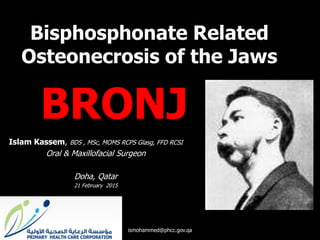
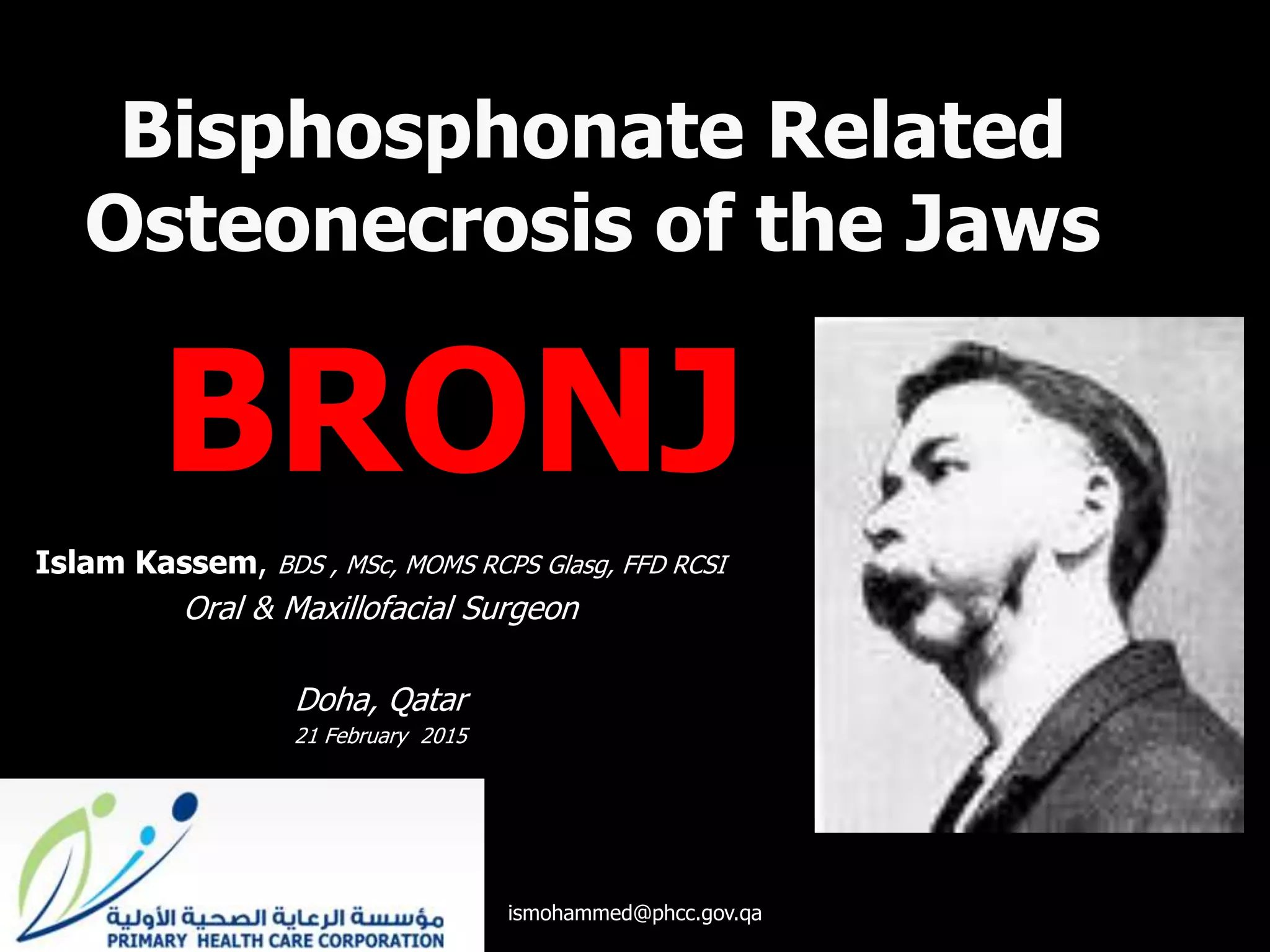
Bisphosphonate Related
Osteonecrosis of the Jaws
ismohammed@phcc.gov.qa
BRONJ
Declaration
 There is no conflict of interest in this Lecture .
 I have no monetary benefit from this Lecture.
 No implied sponsorship by any company to the
speaker
 All patients in the presentation had an informed
consent for photography & publication
ismohammed@phcc.gov.qa
Islam Kassem, BDS , MSc, MOMS RCPS Glasg
Oral & Maxillofacial Surgeon
Alexandria university Hospital
Cairo
National institute of cancer
Scientific day of Head & neck surgery unit
12 March 2009
Bisphosphonate & Osteonecrosis
of the mandible, case report
ikassem@dr.com
Objectives
 Bisphosphonates
 Clinical applications
 Drug chemistry
 Biologic action
 BRONJ
 Pathogenesis
 Treatment of BRONJ
 Latest management recommendations
 Updates in the literature
 Case Presentations
 Latest PubMed search produced 1473 articles on Bisphosphonate
Related Osteonecrosis of the Jaw. (BRONJ)
ismohammed@phcc.gov.qa
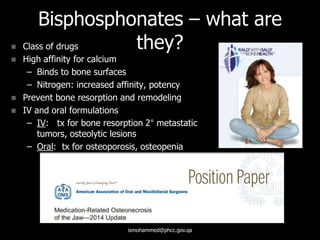
Bisphosphonates – what are
they? Class of drugs
 High affinity for calcium
– Binds to bone surfaces
– Nitrogen: increased affinity, potency
 Prevent bone resorption and remodeling
 IV and oral formulations
– IV: tx for bone resorption 2° metastatic
tumors, osteolytic lesions
– Oral: tx for osteoporosis, osteopenia
ismohammed@phcc.gov.qa
Bisphosphonates: Common uses
 Prevention and treatment of osteoporosis in
postmenopausal women
 Increase bone mass in men with osteoporosis
 Tx of glucocorticoid-induced osteoporosis
 Tx of Paget’s disease of bone
 Hypercalcemia of malignancy
 Bone metastases of solid tumors
– breast and prostate carcinoma; other solid tumors
 Osteolytic lesions of multiple myeloma
ismohammed@phcc.gov.qa
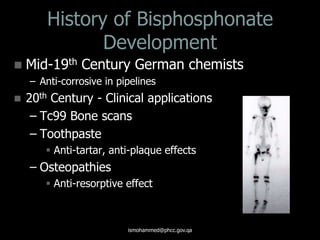
History of Bisphosphonate
Development
 Mid-19th Century German chemists
– Anti-corrosive in pipelines
 20th Century - Clinical applications
– Tc99 Bone scans
– Toothpaste
 Anti-tartar, anti-plaque effects
– Osteopathies
 Anti-resorptive effect
ismohammed@phcc.gov.qa
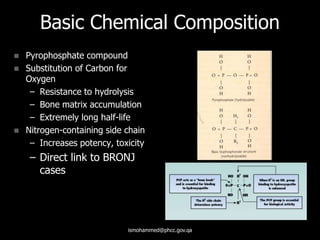
Basic Chemical Composition
 Pyrophosphate compound
 Substitution of Carbon for
Oxygen
– Resistance to hydrolysis
– Bone matrix accumulation
– Extremely long half-life
 Nitrogen-containing side chain
– Increases potency, toxicity
– Direct link to BRONJ
cases
ismohammed@phcc.gov.qa
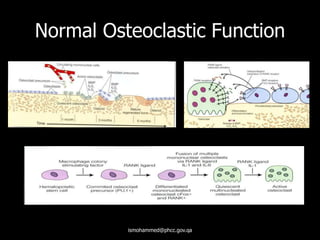
Normal Osteoclastic Function
ismohammed@phcc.gov.qa
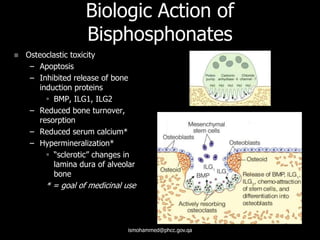
Biologic Action of
Bisphosphonates
 Osteoclastic toxicity
– Apoptosis
– Inhibited release of bone
induction proteins
 BMP, ILG1, ILG2
– Reduced bone turnover,
resorption
– Reduced serum calcium*
– Hypermineralization*
 “sclerotic” changes in
lamina dura of alveolar
bone
* = goal of medicinal use
ismohammed@phcc.gov.qa
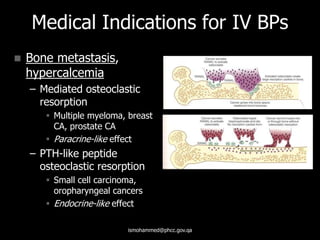
Medical Indications for IV BPs
 Bone metastasis,
hypercalcemia
– Mediated osteoclastic
resorption
 Multiple myeloma, breast
CA, prostate CA
 Paracrine-like effect
– PTH-like peptide
osteoclastic resorption
 Small cell carcinoma,
oropharyngeal cancers
 Endocrine-like effect
ismohammed@phcc.gov.qa
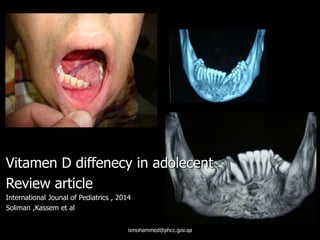
Vitamen D diffenecy in adolecent
Review article
International Jounal of Pediatrics , 2014
Soliman ,Kassem et al
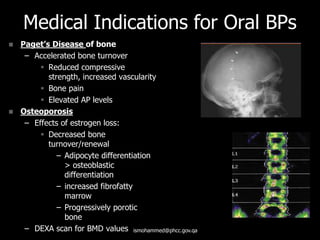
Medical Indications for Oral BPs
 Paget’s Disease of bone
– Accelerated bone turnover
 Reduced compressive
strength, increased vascularity
 Bone pain
 Elevated AP levels
 Osteoporosis
– Effects of estrogen loss:
 Decreased bone
turnover/renewal
– Adipocyte differentiation
> osteoblastic
differentiation
– increased fibrofatty
marrow
– Progressively porotic
bone
– DEXA scan for BMD values ismohammed@phcc.gov.qa
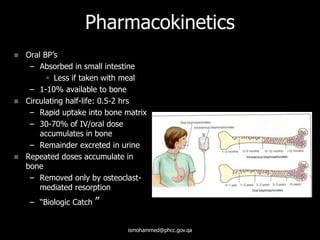
Pharmacokinetics
 Oral BP’s
– Absorbed in small intestine
 Less if taken with meal
– 1-10% available to bone
 Circulating half-life: 0.5-2 hrs
– Rapid uptake into bone matrix
– 30-70% of IV/oral dose
accumulates in bone
– Remainder excreted in urine
 Repeated doses accumulate in
bone
– Removed only by osteoclast-
mediated resorption
– “Biologic Catch ”
ismohammed@phcc.gov.qa
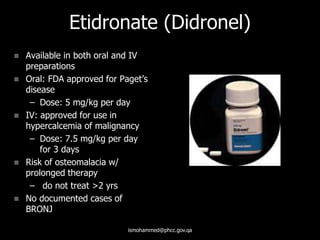
Etidronate (Didronel)
 Available in both oral and IV
preparations
 Oral: FDA approved for Paget’s
disease
– Dose: 5 mg/kg per day
 IV: approved for use in
hypercalcemia of malignancy
– Dose: 7.5 mg/kg per day
for 3 days
 Risk of osteomalacia w/
prolonged therapy
– do not treat >2 yrs
 No documented cases of
BRONJ
ismohammed@phcc.gov.qa
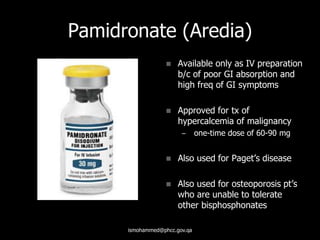
Pamidronate (Aredia)
 Available only as IV preparation
b/c of poor GI absorption and
high freq of GI symptoms
 Approved for tx of
hypercalcemia of malignancy
– one-time dose of 60-90 mg
 Also used for Paget’s disease
 Also used for osteoporosis pt’s
who are unable to tolerate
other bisphosphonates
ismohammed@phcc.gov.qa
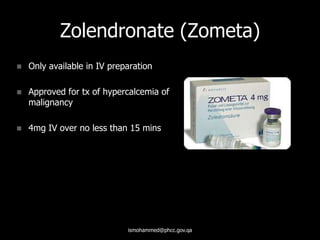
Zolendronate (Zometa)
 Only available in IV preparation
 Approved for tx of hypercalcemia of
malignancy
 4mg IV over no less than 15 mins
ismohammed@phcc.gov.qa
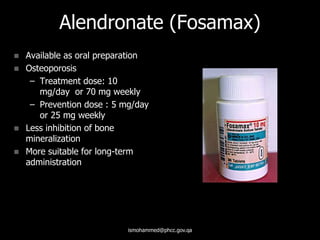
Alendronate (Fosamax)
 Available as oral preparation
 Osteoporosis
– Treatment dose: 10
mg/day or 70 mg weekly
– Prevention dose : 5 mg/day
or 25 mg weekly
 Less inhibition of bone
mineralization
 More suitable for long-term
administration
ismohammed@phcc.gov.qa
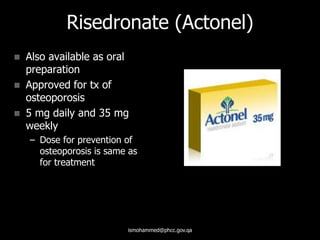
Risedronate (Actonel)
 Also available as oral
preparation
 Approved for tx of
osteoporosis
 5 mg daily and 35 mg
weekly
– Dose for prevention of
osteoporosis is same as
for treatment
ismohammed@phcc.gov.qa
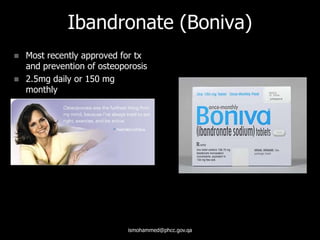
Ibandronate (Boniva)
 Most recently approved for tx
and prevention of osteoporosis
 2.5mg daily or 150 mg
monthly
ismohammed@phcc.gov.qa
Bisphosphonate Side Effects
Upset stomach
Inflammation/erosions of esophagus
Fever/flu-like symptoms
Slight increased risk for electrolyte disturbance
Uveitis
Musculoskeletal joint pain
And of course…………………
ismohammed@phcc.gov.qa
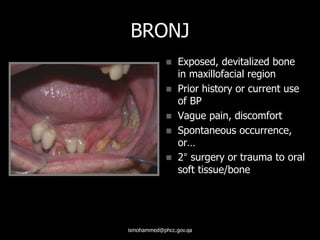
BRONJ
 Exposed, devitalized bone
in maxillofacial region
 Prior history or current use
of BP
 Vague pain, discomfort
 Spontaneous occurrence,
or…
 2° surgery or trauma to oral
soft tissue/bone
ismohammed@phcc.gov.qa
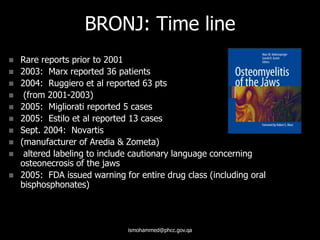
BRONJ: Time line
 Rare reports prior to 2001
 2003: Marx reported 36 patients
 2004: Ruggiero et al reported 63 pts
 (from 2001-2003)
 2005: Migliorati reported 5 cases
 2005: Estilo et al reported 13 cases
 Sept. 2004: Novartis
 (manufacturer of Aredia & Zometa)
 altered labeling to include cautionary language concerning
osteonecrosis of the jaws
 2005: FDA issued warning for entire drug class (including oral
bisphosphonates)
ismohammed@phcc.gov.qa
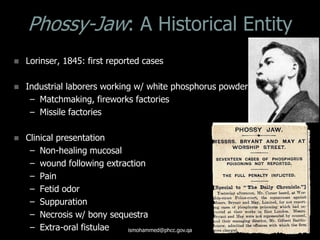
Phossy-Jaw: A Historical Entity
 Lorinser, 1845: first reported cases
 Industrial laborers working w/ white phosphorus powder
– Matchmaking, fireworks factories
– Missile factories
 Clinical presentation
– Non-healing mucosal
– wound following extraction
– Pain
– Fetid odor
– Suppuration
– Necrosis w/ bony sequestra
– Extra-oral fistulae ismohammed@phcc.gov.qa
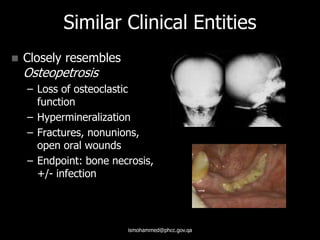
Similar Clinical Entities
 Closely resembles
Osteopetrosis
– Loss of osteoclastic
function
– Hypermineralization
– Fractures, nonunions,
open oral wounds
– Endpoint: bone necrosis,
+/- infection
ismohammed@phcc.gov.qa
NOT to be confused with these other entities:
– Osteoradionecrosis (ORN):
 avascular bone necrosis 2° radiation
– Osteomyelitis:
 thrombosis of small blood vessels leading
to infection within bone marrow
– Steroid-induced osteonecrosis:
 more common in long bones
 exposed bone very rare
ismohammed@phcc.gov.qa
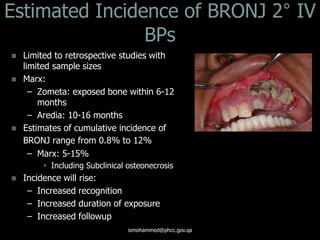
Estimated Incidence of BRONJ 2° IV
BPs
 Limited to retrospective studies with
limited sample sizes
 Marx:
– Zometa: exposed bone within 6-12
months
– Aredia: 10-16 months
 Estimates of cumulative incidence of
BRONJ range from 0.8% to 12%
– Marx: 5-15%
 Including Subclinical osteonecrosis
 Incidence will rise:
– Increased recognition
– Increased duration of exposure
– Increased followup
ismohammed@phcc.gov.qa
Estimated Incidence of BRONJ
2° Oral BPs
 >190 million oral BP prescriptions dispensed
worldwide
– Much lower risk for BRONJ vs IV administration
 Marx:
– BRONJ development after 3 years of Alendronate usage
 Merck study:
– incidence with Alendronate usage = 0.7/100,000
person/years of exposure
 Estimated incidence of BRONJ w/ weekly
administration of alendronate:
 0.01% to 0.04%
 After extractions, increased to 0.09% to 0.34%
ismohammed@phcc.gov.qa
low numbers, so…what’s all the hoopla for?
 Physicians prescribing these meds
– Endocrinologists, Oncologists, GPs, OB-Gyns,etc
– Not well informed of adverse oral effects
 Dentists diagnosing and managing the problem
– Lack of communication between Medicine and Dentistry
– likelihood of many cases unreported
– We are the “experts”…time to bridge the gap
 Effects of oral BPs lagging behind IV BPs
– Another few years for BRONJ to reveal itself among the oral BP
population
ismohammed@phcc.gov.qa
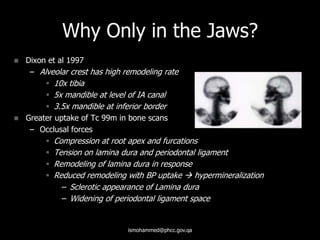
Why Only in the Jaws?
 Dixon et al 1997
– Alveolar crest has high remodeling rate
 10x tibia
 5x mandible at level of IA canal
 3.5x mandible at inferior border
 Greater uptake of Tc 99m in bone scans
– Occlusal forces
 Compression at root apex and furcations
 Tension on lamina dura and periodontal ligament
 Remodeling of lamina dura in response
 Reduced remodeling with BP uptake  hypermineralization
– Sclerotic appearance of Lamina dura
– Widening of periodontal ligament space
ismohammed@phcc.gov.qa
BRONJ Case Definition
 AAOMS Position Paper (updated September
2014):
– Patients considered to have BRONJ if all 3
characteristics met:
 Current or previous treatment with a bisphosphonate
 Exposed, necrotic bone in maxillofacial region
persisting > 8 weeks
 No history of radiation therapy to jaws
ismohammed@phcc.gov.qa
Risk Factors for Development of
BRONJ
 Drug-related factors
– Potency of BP
 Zoledronate > pamidronate > oral BPs
– Duration of therapy
 Local factors
– Dentoalveolar surgery
 Extractions, implants, periapical surgery, periodontal surgery w/
osseous injury
 7-fold risk for BRONJ with IV BPs
 5 to 21-fold risk in some studies
– Local anatomy
 lingual tori, mylohyoid ridge, palatal tori
 Mandible > maxilla (2:1)
– Concomitant oral disease
 7-fold risk for BRONJ with IV BPs
ismohammed@phcc.gov.qa
Risk factors (continued)
 Demographic/systemic factors
 Age: 9% increased risk for every passing decade
Multiple myeloma patients treated w/ IV BPs
 Race: Caucasian
 Cancer diagnosis
 multiple myeloma > breast cancer > other cancers
 Osteopenia/osteoporosis diagnosis concurrent w/ cancer diagnosis
 Additional risk factors:
 Corticosteroid therapy
 Diabetes
 Smoking
 Poor oral hygiene
 Chemotherapeutic drugs
ismohammed@phcc.gov.qa
BRONJ: Clinical Presentation
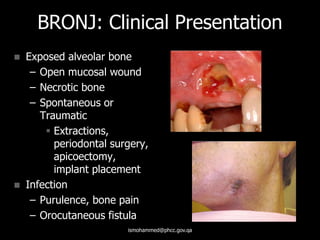
 Exposed alveolar bone
– Open mucosal wound
– Necrotic bone
– Spontaneous or
Traumatic
 Extractions,
periodontal surgery,
apicoectomy,
implant placement
 Infection
– Purulence, bone pain
– Orocutaneous fistula
ismohammed@phcc.gov.qa
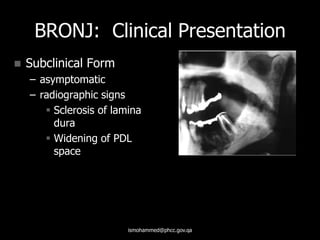
BRONJ: Clinical Presentation
 Subclinical Form
– asymptomatic
– radiographic signs
 Sclerosis of lamina
dura
 Widening of PDL
space
ismohammed@phcc.gov.qa
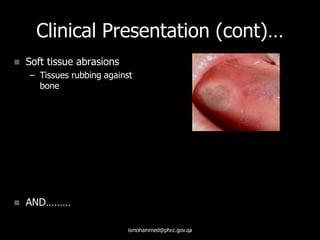
Clinical Presentation (cont)…
 Soft tissue abrasions
– Tissues rubbing against
bone
 AND………
ismohammed@phcc.gov.qa
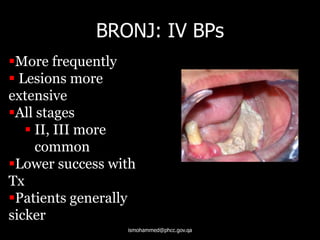
More frequently
 Lesions more
extensive
All stages
 II, III more
common
Lower success with
Tx
Patients generally
sicker
BRONJ: IV BPs
ismohammed@phcc.gov.qa
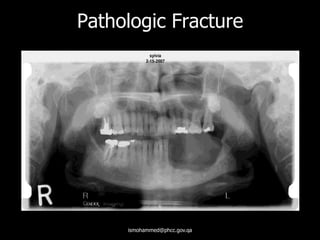
Pathologic Fracture
ismohammed@phcc.gov.qa
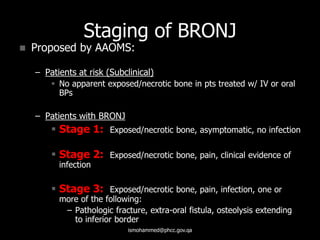
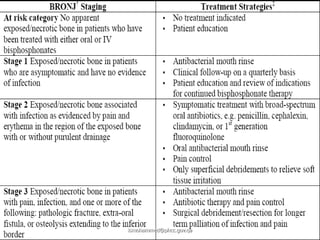
Staging of BRONJ
 Proposed by AAOMS:
– Patients at risk (Subclinical)
 No apparent exposed/necrotic bone in pts treated w/ IV or oral
BPs
– Patients with BRONJ
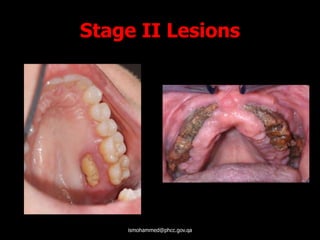
 Stage 1: Exposed/necrotic bone, asymptomatic, no infection
 Stage 2: Exposed/necrotic bone, pain, clinical evidence of
infection
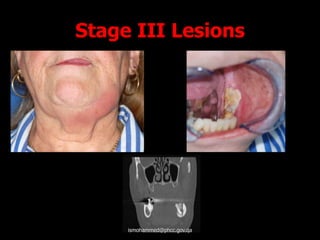
 Stage 3: Exposed/necrotic bone, pain, infection, one or
more of the following:
– Pathologic fracture, extra-oral fistula, osteolysis extending
to inferior border
ismohammed@phcc.gov.qa
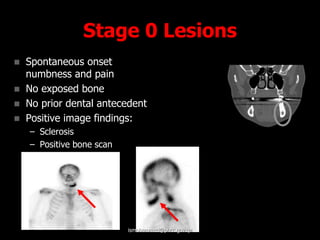
Stage 0 Lesions
 Spontaneous onset
numbness and pain
 No exposed bone
 No prior dental antecedent
 Positive image findings:
– Sclerosis
– Positive bone scan
ismohammed@phcc.gov.qa
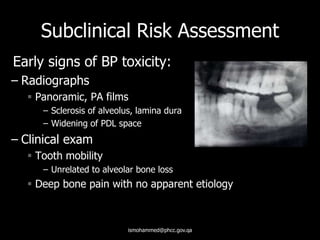
Subclinical Risk Assessment
Early signs of BP toxicity:
– Radiographs
 Panoramic, PA films
– Sclerosis of alveolus, lamina dura
– Widening of PDL space
– Clinical exam
 Tooth mobility
– Unrelated to alveolar bone loss
 Deep bone pain with no apparent etiology
ismohammed@phcc.gov.qa
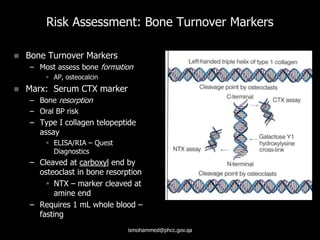
Risk Assessment: Bone Turnover Markers
 Bone Turnover Markers
– Most assess bone formation
 AP, osteocalcin
 Marx: Serum CTX marker
– Bone resorption
– Oral BP risk
– Type I collagen telopeptide
assay
 ELISA/RIA – Quest
Diagnostics
– Cleaved at carboxyl end by
osteoclast in bone resorption
 NTX – marker cleaved at
amine end
– Requires 1 mL whole blood –
fasting
ismohammed@phcc.gov.qa
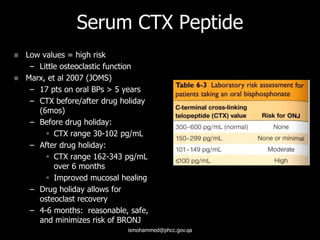
Serum CTX Peptide
 Low values = high risk
– Little osteoclastic function
 Marx, et al 2007 (JOMS)
– 17 pts on oral BPs > 5 years
– CTX before/after drug holiday
(6mos)
– Before drug holiday:
 CTX range 30-102 pg/mL
– After drug holiday:
 CTX range 162-343 pg/mL
over 6 months
 Improved mucosal healing
– Drug holiday allows for
osteoclast recovery
– 4-6 months: reasonable, safe,
and minimizes risk of BRONJ
ismohammed@phcc.gov.qa
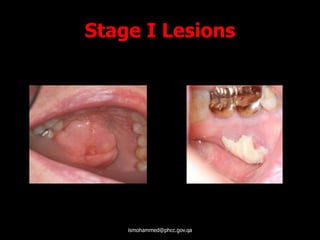
Stage I Lesions
ismohammed@phcc.gov.qa
Stage II Lesions
ismohammed@phcc.gov.qa
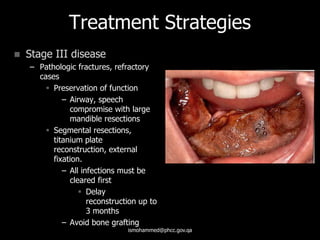
Stage III Lesions
ismohammed@phcc.gov.qa
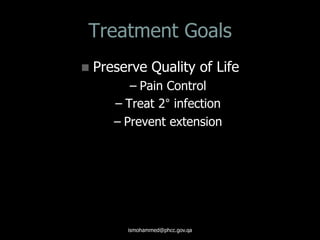
Treatment Goals
 Preserve Quality of Life
– Pain Control
– Treat 2° infection
– Prevent extension
ismohammed@phcc.gov.qa
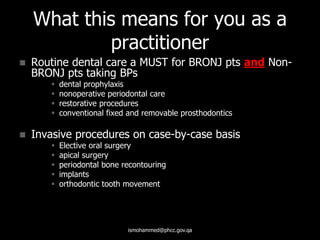
What this means for you as a
practitioner
 Routine dental care a MUST for BRONJ pts and Non-
BRONJ pts taking BPs
 dental prophylaxis
 nonoperative periodontal care
 restorative procedures
 conventional fixed and removable prosthodontics
 Invasive procedures on case-by-case basis
 Elective oral surgery
 apical surgery
 periodontal bone recontouring
 implants
 orthodontic tooth movement
ismohammed@phcc.gov.qa
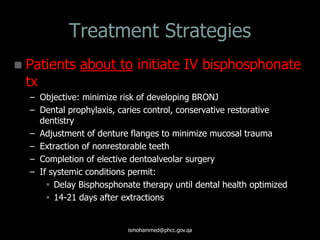
Treatment Strategies
 Patients about to initiate IV bisphosphonate
tx
– Objective: minimize risk of developing BRONJ
– Dental prophylaxis, caries control, conservative restorative
dentistry
– Adjustment of denture flanges to minimize mucosal trauma
– Extraction of nonrestorable teeth
– Completion of elective dentoalveolar surgery
– If systemic conditions permit:
 Delay Bisphosphonate therapy until dental health optimized
 14-21 days after extractions
ismohammed@phcc.gov.qa
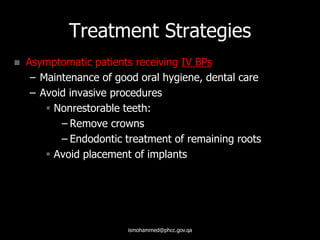
Treatment Strategies
 Asymptomatic patients receiving IV BPs
– Maintenance of good oral hygiene, dental care
– Avoid invasive procedures
 Nonrestorable teeth:
– Remove crowns
– Endodontic treatment of remaining roots
 Avoid placement of implants
ismohammed@phcc.gov.qa
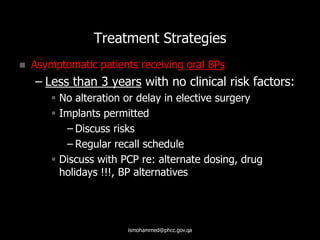
Treatment Strategies
 Asymptomatic patients receiving oral BPs
– Less than 3 years with no clinical risk factors:
 No alteration or delay in elective surgery
 Implants permitted
– Discuss risks
– Regular recall schedule
 Discuss with PCP re: alternate dosing, drug
holidays !!!, BP alternatives
ismohammed@phcc.gov.qa
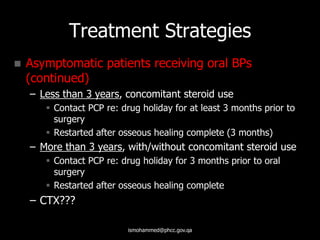
Treatment Strategies
 Asymptomatic patients receiving oral BPs
(continued)
– Less than 3 years, concomitant steroid use
 Contact PCP re: drug holiday for at least 3 months prior to
surgery
 Restarted after osseous healing complete (3 months)
– More than 3 years, with/without concomitant steroid use
 Contact PCP re: drug holiday for 3 months prior to oral
surgery
 Restarted after osseous healing complete
– CTX???
ismohammed@phcc.gov.qa
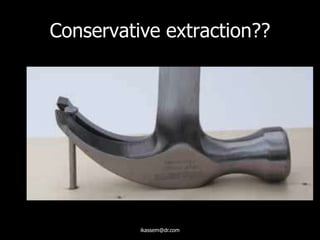
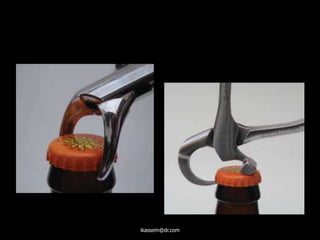
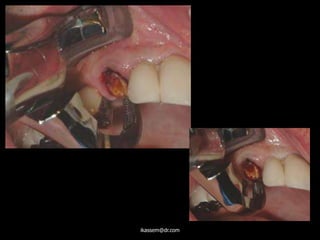
Conservative extraction??
ikassem@dr.com
ikassem@dr.com
ikassem@dr.com
Treatment Strategies
 Patients with Established Diagnosis of
BRONJ
– Objectives: eliminate pain, control infection, minimize
progression/occurrence of necrosis
– Marx:
 debridement may worsen condition
– Removal of bone serving as soft tissue irritant, loose
bony sequestra
 Without exposure of uninvolved bone
– Extraction of teeth within exposed, necrotic bone
– Avoid elective dentoalveolar surgery
ismohammed@phcc.gov.qa
Treatment Strategies
 Stage III disease
– Pathologic fractures, refractory
cases
 Preservation of function
– Airway, speech
compromise with large
mandible resections
 Segmental resections,
titanium plate
reconstruction, external
fixation.
– All infections must be
cleared first
 Delay
reconstruction up to
3 months
– Avoid bone grafting
ismohammed@phcc.gov.qa
Just write islam kassem on
google & download the lectures
ismohammed@phcc.gov.qa
An ounce of prevention is worth
a pound of cure.
ismohammed@phcc.gov.qa
Thank you

MRONJ

  • 1.
    Islam Kassem, BDS, MSc, MOMS RCPS Glasg, FFD RCSI Oral & Maxillofacial Surgeon Doha, Qatar 21 February 2015 Bisphosphonate Related Osteonecrosis of the Jaws ismohammed@phcc.gov.qa BRONJ
  • 2.
    Declaration  There isno conflict of interest in this Lecture .  I have no monetary benefit from this Lecture.  No implied sponsorship by any company to the speaker  All patients in the presentation had an informed consent for photography & publication ismohammed@phcc.gov.qa
  • 3.
    Islam Kassem, BDS, MSc, MOMS RCPS Glasg Oral & Maxillofacial Surgeon Alexandria university Hospital Cairo National institute of cancer Scientific day of Head & neck surgery unit 12 March 2009 Bisphosphonate & Osteonecrosis of the mandible, case report ikassem@dr.com
  • 4.
    Objectives  Bisphosphonates  Clinicalapplications  Drug chemistry  Biologic action  BRONJ  Pathogenesis  Treatment of BRONJ  Latest management recommendations  Updates in the literature  Case Presentations  Latest PubMed search produced 1473 articles on Bisphosphonate Related Osteonecrosis of the Jaw. (BRONJ) ismohammed@phcc.gov.qa
  • 5.
    Bisphosphonates – whatare they? Class of drugs  High affinity for calcium – Binds to bone surfaces – Nitrogen: increased affinity, potency  Prevent bone resorption and remodeling  IV and oral formulations – IV: tx for bone resorption 2° metastatic tumors, osteolytic lesions – Oral: tx for osteoporosis, osteopenia ismohammed@phcc.gov.qa
  • 6.
    Bisphosphonates: Common uses Prevention and treatment of osteoporosis in postmenopausal women  Increase bone mass in men with osteoporosis  Tx of glucocorticoid-induced osteoporosis  Tx of Paget’s disease of bone  Hypercalcemia of malignancy  Bone metastases of solid tumors – breast and prostate carcinoma; other solid tumors  Osteolytic lesions of multiple myeloma ismohammed@phcc.gov.qa
  • 7.
    History of Bisphosphonate Development Mid-19th Century German chemists – Anti-corrosive in pipelines  20th Century - Clinical applications – Tc99 Bone scans – Toothpaste  Anti-tartar, anti-plaque effects – Osteopathies  Anti-resorptive effect ismohammed@phcc.gov.qa
  • 8.
    Basic Chemical Composition Pyrophosphate compound  Substitution of Carbon for Oxygen – Resistance to hydrolysis – Bone matrix accumulation – Extremely long half-life  Nitrogen-containing side chain – Increases potency, toxicity – Direct link to BRONJ cases ismohammed@phcc.gov.qa
  • 9.
  • 10.
    Biologic Action of Bisphosphonates Osteoclastic toxicity – Apoptosis – Inhibited release of bone induction proteins  BMP, ILG1, ILG2 – Reduced bone turnover, resorption – Reduced serum calcium* – Hypermineralization*  “sclerotic” changes in lamina dura of alveolar bone * = goal of medicinal use ismohammed@phcc.gov.qa
  • 11.
  • 12.
    Medical Indications forIV BPs  Bone metastasis, hypercalcemia – Mediated osteoclastic resorption  Multiple myeloma, breast CA, prostate CA  Paracrine-like effect – PTH-like peptide osteoclastic resorption  Small cell carcinoma, oropharyngeal cancers  Endocrine-like effect ismohammed@phcc.gov.qa
  • 13.
    ismohammed@phcc.gov.qa Vitamen D diffenecyin adolecent Review article International Jounal of Pediatrics , 2014 Soliman ,Kassem et al
  • 14.
    Medical Indications forOral BPs  Paget’s Disease of bone – Accelerated bone turnover  Reduced compressive strength, increased vascularity  Bone pain  Elevated AP levels  Osteoporosis – Effects of estrogen loss:  Decreased bone turnover/renewal – Adipocyte differentiation > osteoblastic differentiation – increased fibrofatty marrow – Progressively porotic bone – DEXA scan for BMD values ismohammed@phcc.gov.qa
  • 15.
    Pharmacokinetics  Oral BP’s –Absorbed in small intestine  Less if taken with meal – 1-10% available to bone  Circulating half-life: 0.5-2 hrs – Rapid uptake into bone matrix – 30-70% of IV/oral dose accumulates in bone – Remainder excreted in urine  Repeated doses accumulate in bone – Removed only by osteoclast- mediated resorption – “Biologic Catch ” ismohammed@phcc.gov.qa
  • 16.
    Etidronate (Didronel)  Availablein both oral and IV preparations  Oral: FDA approved for Paget’s disease – Dose: 5 mg/kg per day  IV: approved for use in hypercalcemia of malignancy – Dose: 7.5 mg/kg per day for 3 days  Risk of osteomalacia w/ prolonged therapy – do not treat >2 yrs  No documented cases of BRONJ ismohammed@phcc.gov.qa
  • 17.
    Pamidronate (Aredia)  Availableonly as IV preparation b/c of poor GI absorption and high freq of GI symptoms  Approved for tx of hypercalcemia of malignancy – one-time dose of 60-90 mg  Also used for Paget’s disease  Also used for osteoporosis pt’s who are unable to tolerate other bisphosphonates ismohammed@phcc.gov.qa
  • 18.
    Zolendronate (Zometa)  Onlyavailable in IV preparation  Approved for tx of hypercalcemia of malignancy  4mg IV over no less than 15 mins ismohammed@phcc.gov.qa
  • 19.
    Alendronate (Fosamax)  Availableas oral preparation  Osteoporosis – Treatment dose: 10 mg/day or 70 mg weekly – Prevention dose : 5 mg/day or 25 mg weekly  Less inhibition of bone mineralization  More suitable for long-term administration ismohammed@phcc.gov.qa
  • 20.
    Risedronate (Actonel)  Alsoavailable as oral preparation  Approved for tx of osteoporosis  5 mg daily and 35 mg weekly – Dose for prevention of osteoporosis is same as for treatment ismohammed@phcc.gov.qa
  • 21.
    Ibandronate (Boniva)  Mostrecently approved for tx and prevention of osteoporosis  2.5mg daily or 150 mg monthly ismohammed@phcc.gov.qa
  • 22.
    Bisphosphonate Side Effects Upsetstomach Inflammation/erosions of esophagus Fever/flu-like symptoms Slight increased risk for electrolyte disturbance Uveitis Musculoskeletal joint pain And of course………………… ismohammed@phcc.gov.qa
  • 23.
    BRONJ  Exposed, devitalizedbone in maxillofacial region  Prior history or current use of BP  Vague pain, discomfort  Spontaneous occurrence, or…  2° surgery or trauma to oral soft tissue/bone ismohammed@phcc.gov.qa
  • 24.
  • 25.
    BRONJ: Time line Rare reports prior to 2001  2003: Marx reported 36 patients  2004: Ruggiero et al reported 63 pts  (from 2001-2003)  2005: Migliorati reported 5 cases  2005: Estilo et al reported 13 cases  Sept. 2004: Novartis  (manufacturer of Aredia & Zometa)  altered labeling to include cautionary language concerning osteonecrosis of the jaws  2005: FDA issued warning for entire drug class (including oral bisphosphonates) ismohammed@phcc.gov.qa
  • 26.
    Phossy-Jaw: A HistoricalEntity  Lorinser, 1845: first reported cases  Industrial laborers working w/ white phosphorus powder – Matchmaking, fireworks factories – Missile factories  Clinical presentation – Non-healing mucosal – wound following extraction – Pain – Fetid odor – Suppuration – Necrosis w/ bony sequestra – Extra-oral fistulae ismohammed@phcc.gov.qa
  • 27.
    Similar Clinical Entities Closely resembles Osteopetrosis – Loss of osteoclastic function – Hypermineralization – Fractures, nonunions, open oral wounds – Endpoint: bone necrosis, +/- infection ismohammed@phcc.gov.qa
  • 28.
    NOT to beconfused with these other entities: – Osteoradionecrosis (ORN):  avascular bone necrosis 2° radiation – Osteomyelitis:  thrombosis of small blood vessels leading to infection within bone marrow – Steroid-induced osteonecrosis:  more common in long bones  exposed bone very rare ismohammed@phcc.gov.qa
  • 29.
    Estimated Incidence ofBRONJ 2° IV BPs  Limited to retrospective studies with limited sample sizes  Marx: – Zometa: exposed bone within 6-12 months – Aredia: 10-16 months  Estimates of cumulative incidence of BRONJ range from 0.8% to 12% – Marx: 5-15%  Including Subclinical osteonecrosis  Incidence will rise: – Increased recognition – Increased duration of exposure – Increased followup ismohammed@phcc.gov.qa
  • 30.
    Estimated Incidence ofBRONJ 2° Oral BPs  >190 million oral BP prescriptions dispensed worldwide – Much lower risk for BRONJ vs IV administration  Marx: – BRONJ development after 3 years of Alendronate usage  Merck study: – incidence with Alendronate usage = 0.7/100,000 person/years of exposure  Estimated incidence of BRONJ w/ weekly administration of alendronate:  0.01% to 0.04%  After extractions, increased to 0.09% to 0.34% ismohammed@phcc.gov.qa
  • 31.
    low numbers, so…what’sall the hoopla for?  Physicians prescribing these meds – Endocrinologists, Oncologists, GPs, OB-Gyns,etc – Not well informed of adverse oral effects  Dentists diagnosing and managing the problem – Lack of communication between Medicine and Dentistry – likelihood of many cases unreported – We are the “experts”…time to bridge the gap  Effects of oral BPs lagging behind IV BPs – Another few years for BRONJ to reveal itself among the oral BP population ismohammed@phcc.gov.qa
  • 32.
    Why Only inthe Jaws?  Dixon et al 1997 – Alveolar crest has high remodeling rate  10x tibia  5x mandible at level of IA canal  3.5x mandible at inferior border  Greater uptake of Tc 99m in bone scans – Occlusal forces  Compression at root apex and furcations  Tension on lamina dura and periodontal ligament  Remodeling of lamina dura in response  Reduced remodeling with BP uptake  hypermineralization – Sclerotic appearance of Lamina dura – Widening of periodontal ligament space ismohammed@phcc.gov.qa
  • 33.
    BRONJ Case Definition AAOMS Position Paper (updated September 2014): – Patients considered to have BRONJ if all 3 characteristics met:  Current or previous treatment with a bisphosphonate  Exposed, necrotic bone in maxillofacial region persisting > 8 weeks  No history of radiation therapy to jaws ismohammed@phcc.gov.qa
  • 34.
    Risk Factors forDevelopment of BRONJ  Drug-related factors – Potency of BP  Zoledronate > pamidronate > oral BPs – Duration of therapy  Local factors – Dentoalveolar surgery  Extractions, implants, periapical surgery, periodontal surgery w/ osseous injury  7-fold risk for BRONJ with IV BPs  5 to 21-fold risk in some studies – Local anatomy  lingual tori, mylohyoid ridge, palatal tori  Mandible > maxilla (2:1) – Concomitant oral disease  7-fold risk for BRONJ with IV BPs ismohammed@phcc.gov.qa
  • 35.
    Risk factors (continued) Demographic/systemic factors  Age: 9% increased risk for every passing decade Multiple myeloma patients treated w/ IV BPs  Race: Caucasian  Cancer diagnosis  multiple myeloma > breast cancer > other cancers  Osteopenia/osteoporosis diagnosis concurrent w/ cancer diagnosis  Additional risk factors:  Corticosteroid therapy  Diabetes  Smoking  Poor oral hygiene  Chemotherapeutic drugs ismohammed@phcc.gov.qa
  • 36.
    BRONJ: Clinical Presentation Exposed alveolar bone – Open mucosal wound – Necrotic bone – Spontaneous or Traumatic  Extractions, periodontal surgery, apicoectomy, implant placement  Infection – Purulence, bone pain – Orocutaneous fistula ismohammed@phcc.gov.qa
  • 37.
    BRONJ: Clinical Presentation Subclinical Form – asymptomatic – radiographic signs  Sclerosis of lamina dura  Widening of PDL space ismohammed@phcc.gov.qa
  • 38.
    Clinical Presentation (cont)… Soft tissue abrasions – Tissues rubbing against bone  AND……… ismohammed@phcc.gov.qa
  • 39.
    More frequently  Lesionsmore extensive All stages  II, III more common Lower success with Tx Patients generally sicker BRONJ: IV BPs ismohammed@phcc.gov.qa
  • 40.
  • 41.
    Staging of BRONJ Proposed by AAOMS: – Patients at risk (Subclinical)  No apparent exposed/necrotic bone in pts treated w/ IV or oral BPs – Patients with BRONJ  Stage 1: Exposed/necrotic bone, asymptomatic, no infection  Stage 2: Exposed/necrotic bone, pain, clinical evidence of infection  Stage 3: Exposed/necrotic bone, pain, infection, one or more of the following: – Pathologic fracture, extra-oral fistula, osteolysis extending to inferior border ismohammed@phcc.gov.qa
  • 42.
    Stage 0 Lesions Spontaneous onset numbness and pain  No exposed bone  No prior dental antecedent  Positive image findings: – Sclerosis – Positive bone scan ismohammed@phcc.gov.qa
  • 43.
    Subclinical Risk Assessment Earlysigns of BP toxicity: – Radiographs  Panoramic, PA films – Sclerosis of alveolus, lamina dura – Widening of PDL space – Clinical exam  Tooth mobility – Unrelated to alveolar bone loss  Deep bone pain with no apparent etiology ismohammed@phcc.gov.qa
  • 44.
    Risk Assessment: BoneTurnover Markers  Bone Turnover Markers – Most assess bone formation  AP, osteocalcin  Marx: Serum CTX marker – Bone resorption – Oral BP risk – Type I collagen telopeptide assay  ELISA/RIA – Quest Diagnostics – Cleaved at carboxyl end by osteoclast in bone resorption  NTX – marker cleaved at amine end – Requires 1 mL whole blood – fasting ismohammed@phcc.gov.qa
  • 45.
    Serum CTX Peptide Low values = high risk – Little osteoclastic function  Marx, et al 2007 (JOMS) – 17 pts on oral BPs > 5 years – CTX before/after drug holiday (6mos) – Before drug holiday:  CTX range 30-102 pg/mL – After drug holiday:  CTX range 162-343 pg/mL over 6 months  Improved mucosal healing – Drug holiday allows for osteoclast recovery – 4-6 months: reasonable, safe, and minimizes risk of BRONJ ismohammed@phcc.gov.qa
  • 46.
  • 47.
  • 48.
  • 49.
    Treatment Goals  PreserveQuality of Life – Pain Control – Treat 2° infection – Prevent extension ismohammed@phcc.gov.qa
  • 50.
    What this meansfor you as a practitioner  Routine dental care a MUST for BRONJ pts and Non- BRONJ pts taking BPs  dental prophylaxis  nonoperative periodontal care  restorative procedures  conventional fixed and removable prosthodontics  Invasive procedures on case-by-case basis  Elective oral surgery  apical surgery  periodontal bone recontouring  implants  orthodontic tooth movement ismohammed@phcc.gov.qa
  • 51.
    Treatment Strategies  Patientsabout to initiate IV bisphosphonate tx – Objective: minimize risk of developing BRONJ – Dental prophylaxis, caries control, conservative restorative dentistry – Adjustment of denture flanges to minimize mucosal trauma – Extraction of nonrestorable teeth – Completion of elective dentoalveolar surgery – If systemic conditions permit:  Delay Bisphosphonate therapy until dental health optimized  14-21 days after extractions ismohammed@phcc.gov.qa
  • 52.
    Treatment Strategies  Asymptomaticpatients receiving IV BPs – Maintenance of good oral hygiene, dental care – Avoid invasive procedures  Nonrestorable teeth: – Remove crowns – Endodontic treatment of remaining roots  Avoid placement of implants ismohammed@phcc.gov.qa
  • 53.
    Treatment Strategies  Asymptomaticpatients receiving oral BPs – Less than 3 years with no clinical risk factors:  No alteration or delay in elective surgery  Implants permitted – Discuss risks – Regular recall schedule  Discuss with PCP re: alternate dosing, drug holidays !!!, BP alternatives ismohammed@phcc.gov.qa
  • 54.
    Treatment Strategies  Asymptomaticpatients receiving oral BPs (continued) – Less than 3 years, concomitant steroid use  Contact PCP re: drug holiday for at least 3 months prior to surgery  Restarted after osseous healing complete (3 months) – More than 3 years, with/without concomitant steroid use  Contact PCP re: drug holiday for 3 months prior to oral surgery  Restarted after osseous healing complete – CTX??? ismohammed@phcc.gov.qa
  • 55.
  • 56.
  • 57.
  • 58.
    Treatment Strategies  Patientswith Established Diagnosis of BRONJ – Objectives: eliminate pain, control infection, minimize progression/occurrence of necrosis – Marx:  debridement may worsen condition – Removal of bone serving as soft tissue irritant, loose bony sequestra  Without exposure of uninvolved bone – Extraction of teeth within exposed, necrotic bone – Avoid elective dentoalveolar surgery ismohammed@phcc.gov.qa
  • 59.
    Treatment Strategies  StageIII disease – Pathologic fractures, refractory cases  Preservation of function – Airway, speech compromise with large mandible resections  Segmental resections, titanium plate reconstruction, external fixation. – All infections must be cleared first  Delay reconstruction up to 3 months – Avoid bone grafting ismohammed@phcc.gov.qa
  • 60.
  • 61.
    Just write islamkassem on google & download the lectures ismohammed@phcc.gov.qa
  • 62.
    An ounce ofprevention is worth a pound of cure. ismohammed@phcc.gov.qa Thank you