Trauma From Occlusion

     Amin Abusallamah
Outline
1. Definition of TFO.
2. Physiologic adaptive capacity of the
   periodontium to occlusal forces.
3. Factors that help increase traumatic forces.
4. Classification of TFO.
5. Clinical features of TFO.
6. Radiographic findings of TFO.
7. Treatment of TFO.
Definition
• “ a condition where injury results to the supporting
  structures of the teeth by the act of bringing the jaws
  into a closed position .”(Stillman -1917)


• “ damage in the periodontium caused by stress on
  the teeth produced directly or indirectly by teeth of
  the opposing jaw.” (WHO in 1978)
Physiologic adaptive capacity of the
   periodontium to occlusal forces
• The periodontium attempts to accommodate the
  forces exerted on the crown.

• This adaptive capacity varies in different persons and
  in the same person at different times.

• When occlusal forces exceeds the adaptive and
  reparative capacity of the periodontal tissues, tissue
  injury results (trauma from occlusion)
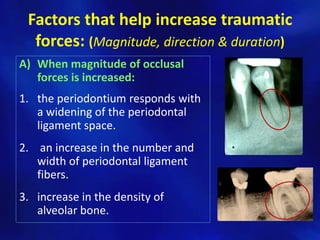
Factors that help increase traumatic
  forces: (Magnitude, direction & duration)
A) When magnitude of occlusal
   forces is increased:
1. the periodontium responds with
   a widening of the periodontal
   ligament space.
2. an increase in the number and
   width of periodontal ligament
   fibers.
3. increase in the density of
   alveolar bone.
Cont…
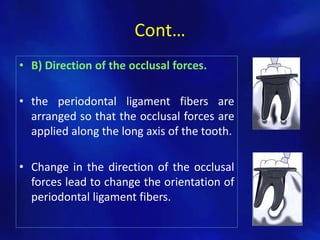
• B) Direction of the occlusal forces.

• the periodontal ligament fibers are
  arranged so that the occlusal forces are
  applied along the long axis of the tooth.

• Change in the direction of the occlusal
  forces lead to change the orientation of
  periodontal ligament fibers.
Cont…
• Duration and frequency of occlusal forces.

• Constant pressure on the bone is more injurious
  than intermittent forces.

• The more frequent the application of an
  intermittent force, the more injurious the force to
  the periodontium.
Classification
• Acute and Chronic Trauma

• Primary , Secondary and Combined TFO
Acute trauma from occlusion
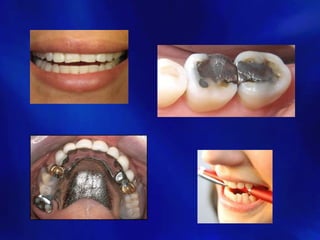
• results from an abrupt occlusal impact, such
  as that produced by biting on a hard object
  (e.g., an olive pit). In addition, restorations or
  prosthetic appliances that interfere with the
  direction of occlusal forces on the teeth may
  induce acute trauma.

                   (CARRANZA'S clinical periodntology 9th edition - 396)
Acute trauma from occlusion
• Clinical features :

1. Tooth pain.

2. Sensitivity to percussion.

3. Tooth mobility.
                     (CARRANZA'S clinical periodntology 9th edition - 396)
Chronic trauma from occlusion
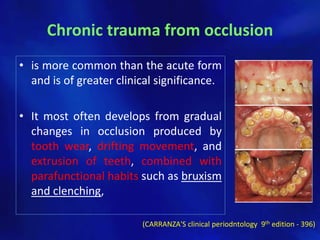
• is more common than the acute form
  and is of greater clinical significance.

• It most often develops from gradual
  changes in occlusion produced by
  tooth wear, drifting movement, and
  extrusion of teeth, combined with
  parafunctional habits such as bruxism
  and clenching,

                         (CARRANZA'S clinical periodntology 9th edition - 396)
Primary trauma from occlusion
• A tissue reaction, which is elicited around a tooth
  with normal height of the periodontium (no
  attachment loss!)
              (Clinical Periodontology and Implant Dentistry, 4th edition, 352)


• It can caused by high filling. faulty restorations or
  fixed and removable prosthesis, causing large force
  on the abutment or opposing teeth.

                       (CARRANZA'S clinical periodntology 9th edition - 396)
Secondary trauma from occlusion
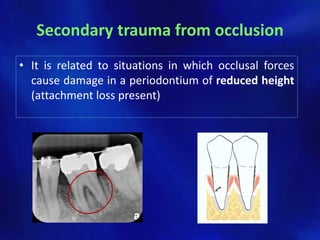
• It is related to situations in which occlusal forces
  cause damage in a periodontium of reduced height
  (attachment loss present)
Combined TFO


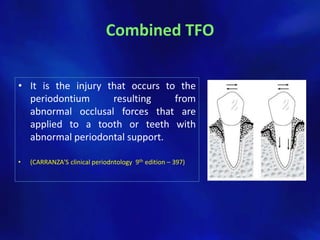
• It is the injury that occurs to the
  periodontium      resulting    from
  abnormal occlusal forces that are
  applied to a tooth or teeth with
  abnormal periodontal support.

•   (CARRANZA'S clinical periodntology 9th edition – 397)
Clinical features of TFO
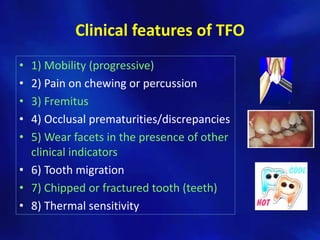
• 1) Mobility (progressive)
• 2) Pain on chewing or percussion
• 3) Fremitus
• 4) Occlusal prematurities/discrepancies
• 5) Wear facets in the presence of other
  clinical indicators
• 6) Tooth migration
• 7) Chipped or fractured tooth (teeth)
• 8) Thermal sensitivity
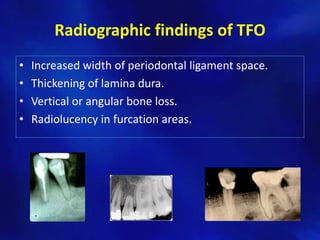
Radiographic findings of TFO
•   Increased width of periodontal ligament space.
•   Thickening of lamina dura.
•   Vertical or angular bone loss.
•   Radiolucency in furcation areas.
Treatment
• A goal of periodontal therapy in the treatment of
  occlusal traumatism should be to maintain the
  periodontium in comfort and function.
Cont…
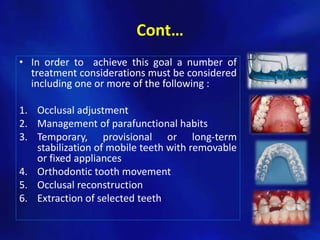
• In order to achieve this goal a number of
  treatment considerations must be considered
  including one or more of the following :

1. Occlusal adjustment
2. Management of parafunctional habits
3. Temporary, provisional or long-term
   stabilization of mobile teeth with removable
   or fixed appliances
4. Orthodontic tooth movement
5. Occlusal reconstruction
6. Extraction of selected teeth
References
•   Clinical Periodontology and Implant
    Dentistry, 4th edition, Jan
    Lindhe, Thorkild Karring . Niklaus P.
    Lang .
                                            Thank
•   (CARRANZA'S clinical periodntology


•
    9th edition

    Hallmon WW. Occlusal trauma: effect
    and impact on the periodontium. Ann
    Periodontol 1999 Dec;4(1):102-8.
                                             you
•   Parameter on occlusal traumatism in
    patients with chronic periodontitis.
    Parameters of Care. J Periodontol
    2000 May;71(5 Suppl):873-5.

Trauma from occlusion

  • 1.
    Trauma From Occlusion Amin Abusallamah
  • 2.
    Outline 1. Definition ofTFO. 2. Physiologic adaptive capacity of the periodontium to occlusal forces. 3. Factors that help increase traumatic forces. 4. Classification of TFO. 5. Clinical features of TFO. 6. Radiographic findings of TFO. 7. Treatment of TFO.
  • 3.
    Definition • “ acondition where injury results to the supporting structures of the teeth by the act of bringing the jaws into a closed position .”(Stillman -1917) • “ damage in the periodontium caused by stress on the teeth produced directly or indirectly by teeth of the opposing jaw.” (WHO in 1978)
  • 4.
    Physiologic adaptive capacityof the periodontium to occlusal forces • The periodontium attempts to accommodate the forces exerted on the crown. • This adaptive capacity varies in different persons and in the same person at different times. • When occlusal forces exceeds the adaptive and reparative capacity of the periodontal tissues, tissue injury results (trauma from occlusion)
  • 5.
    Factors that helpincrease traumatic forces: (Magnitude, direction & duration) A) When magnitude of occlusal forces is increased: 1. the periodontium responds with a widening of the periodontal ligament space. 2. an increase in the number and width of periodontal ligament fibers. 3. increase in the density of alveolar bone.
  • 6.
    Cont… • B) Directionof the occlusal forces. • the periodontal ligament fibers are arranged so that the occlusal forces are applied along the long axis of the tooth. • Change in the direction of the occlusal forces lead to change the orientation of periodontal ligament fibers.
  • 7.
    Cont… • Duration andfrequency of occlusal forces. • Constant pressure on the bone is more injurious than intermittent forces. • The more frequent the application of an intermittent force, the more injurious the force to the periodontium.
  • 8.
    Classification • Acute andChronic Trauma • Primary , Secondary and Combined TFO
  • 9.
    Acute trauma fromocclusion • results from an abrupt occlusal impact, such as that produced by biting on a hard object (e.g., an olive pit). In addition, restorations or prosthetic appliances that interfere with the direction of occlusal forces on the teeth may induce acute trauma. (CARRANZA'S clinical periodntology 9th edition - 396)
  • 11.
    Acute trauma fromocclusion • Clinical features : 1. Tooth pain. 2. Sensitivity to percussion. 3. Tooth mobility. (CARRANZA'S clinical periodntology 9th edition - 396)
  • 12.
    Chronic trauma fromocclusion • is more common than the acute form and is of greater clinical significance. • It most often develops from gradual changes in occlusion produced by tooth wear, drifting movement, and extrusion of teeth, combined with parafunctional habits such as bruxism and clenching, (CARRANZA'S clinical periodntology 9th edition - 396)
  • 13.
    Primary trauma fromocclusion • A tissue reaction, which is elicited around a tooth with normal height of the periodontium (no attachment loss!) (Clinical Periodontology and Implant Dentistry, 4th edition, 352) • It can caused by high filling. faulty restorations or fixed and removable prosthesis, causing large force on the abutment or opposing teeth. (CARRANZA'S clinical periodntology 9th edition - 396)
  • 14.
    Secondary trauma fromocclusion • It is related to situations in which occlusal forces cause damage in a periodontium of reduced height (attachment loss present)
  • 15.
    Combined TFO • Itis the injury that occurs to the periodontium resulting from abnormal occlusal forces that are applied to a tooth or teeth with abnormal periodontal support. • (CARRANZA'S clinical periodntology 9th edition – 397)
  • 16.
    Clinical features ofTFO • 1) Mobility (progressive) • 2) Pain on chewing or percussion • 3) Fremitus • 4) Occlusal prematurities/discrepancies • 5) Wear facets in the presence of other clinical indicators • 6) Tooth migration • 7) Chipped or fractured tooth (teeth) • 8) Thermal sensitivity
  • 17.
    Radiographic findings ofTFO • Increased width of periodontal ligament space. • Thickening of lamina dura. • Vertical or angular bone loss. • Radiolucency in furcation areas.
  • 18.
    Treatment • A goalof periodontal therapy in the treatment of occlusal traumatism should be to maintain the periodontium in comfort and function.
  • 19.
    Cont… • In orderto achieve this goal a number of treatment considerations must be considered including one or more of the following : 1. Occlusal adjustment 2. Management of parafunctional habits 3. Temporary, provisional or long-term stabilization of mobile teeth with removable or fixed appliances 4. Orthodontic tooth movement 5. Occlusal reconstruction 6. Extraction of selected teeth
  • 20.
    References • Clinical Periodontology and Implant Dentistry, 4th edition, Jan Lindhe, Thorkild Karring . Niklaus P. Lang . Thank • (CARRANZA'S clinical periodntology • 9th edition Hallmon WW. Occlusal trauma: effect and impact on the periodontium. Ann Periodontol 1999 Dec;4(1):102-8. you • Parameter on occlusal traumatism in patients with chronic periodontitis. Parameters of Care. J Periodontol 2000 May;71(5 Suppl):873-5.