Laboratory Diagnosis of
Human Immunodeficiency Virus
(HIV)
Dr Mostafa Mahmoud, MD, Ph D,
Consultant Microbiologist
Assist. Prof. of Medical Microbiology &
Immunology
What is the immune system?
 The immune system is the collection of cells,
tissues and molecules that protects the body from
numerous pathogenic microbes and toxins in our
environment.
What are the types of immune system?
2 main types:
1- the Innate, or natural (Non-specific) immune system (fight
microbes at site of entry) include: 1) physical epithelial
barriers, 2) phagocytic leukocytes, 3) dendritic cells, 4) a
special type of lymphocyte called a natural killer (NK) cell,
and 5) circulating plasma proteins.
2- the Acquired or adaptive (Ag-Specific) immune system:
-The second line of defense after innate
-Naturally silent need activation by infection with formation
of memory cells.
 -2 subdivisions of the adaptive or acquired the humoral
(Antibodies- by B-lymphocytes) and the cellular (CMI by T-
lymphocytes).
A. Humoral Immunity
- By antibodies from B-lymphocytes
- B-lymphocytes 10-20% of circulation lymphocytes.
- (WBCS: Neutrophils, lymphocytes, Eosinophil, Monocytes &
basophils),
- Also in bone marrow, spleen, LNs.
- Different antibody specific to each antigen.
- 5 classes of antibodies (Immunoglobulin; Igs) IgM (acute), IgG
(chronic), IgA (secretions), IgD (receptors) IgE
(hypersensitivity)
B-Cell-Mediated Immunity (CMI)
- By T-lymphocyte populations that integrate in function.
- Against viruses, fungi, intracellular bacteria, and tumor cells.
- T-lymphocytes are Thymus-dependent present in spleen and LNs.
60% to 70% of circulating lymphocytes.
- T-lymphocytes include subsets:
 Helper T-cells (CD4+) which help B-lymphocyte function by
several cytokines.
 Cytotoxic T-cells (CD8+) killing infected or tumor cells.
 Suppressor T-cells
 Memory T-cells
• What is AIDS ?= Acquired Immuno- Deficiency-
Syndrome
- It is the a disease syndrome
•.
• What is HIV ? = Human Immunodeficiency
Virus
- It is the causative viral agent of ADIS
- Enveloped ?? SS-RNA, Positive-Sense (2 segments)
• HIV is a Retrovirus?
• HIV-1, the most common worldwide
• HIV-2, few areas in Africa.
HIV-Structure
(Viral Antigens)
1- Gag= Group Antigen: ( (Capsid), P17 (Matrix), & P7
(Nucleocapsid).
2- Pol= polymerase and associated enzymes: P66 (reverse
transcriptase -RT), P32 (integrase) , P9 (protease).
2- Env= Envelope glycoproteins e.g. , .
HIV infects (CD4+) carrying cells!!!
 The effects of HIV are due to it gp 120 Ag.
 The CD4+ are the receptors of the virus.
 HIV affects the immune system & Brain??
 Why?
 They have CD4+Tmainly on T-helper cells
 Other cells having CD4+ include:
- Macrophages - Dendritic cells.
- Monocytes - Microglial cells
- Retinal cells - Colonic Mucosal cells.
(GP 120 &41)
(PCR)
(GAG)
Diagnostic lab test for HIV infection
A- Tests to diagnose HIV infections:
1- Screening 2- Confirmatory
B- Tests for follow up the disease:
1- Viral load by Quantitative PCR 2- Th-cells count (CD4+)
C- Tests for the complication of the disease:
1- TB infection 2- HBV
3- HCV 4- Toxoplasma
5- Liver function tests 6- UTIs
7- Others.
A- Tests to diagnose HIV infections
1- Screening tests
These test are rapid in giving results however, they are
not diagnostic and need confirmation by the confirmatory
tests
The Screening tests include:
i- ELISA tests (combined Ag-Ab Immunoassays) for
detecting HIV-1 & HIV-2 antibodies and P24 Ag of HIV-1.
or chemiluminescent immunoassay testing.
ii- Rapid tests
i- ELISA or chemiluminescent
immunoassay testing
 Were previously for detection of HIV Antibodies
 Now detection of P24 Antigen of HIV is included (Combo
ELISA).
 Even though, need confirmation
 They are the tests approved and done in our hospitals
 Done upon serum sample
 If initially reactive, repeat in triplicate, if positive send for
WB or PCR.
Screening test performed in
1- Premarital examination
2- Blood Donors.
3- Antenatal Care
4- Pre-employment screening
5- Before Surgical operations (Medico-legal)
6- Follow up for hemodialysis patients.
7- Others
Semi-Automated ELISA (separate washer, Incubator, Reader)
ELISA washers (for semi-automated)
Stat Fax microplate washer Bio-Tek microplate washer
In 50-bed Hospitals of MOH
Manual ELISA readers
After several incubation and wash steps, a
color reaction occurs if HIV antibody is
present
An automated reader gives a
measurement of optical density
(presence of color) for each well
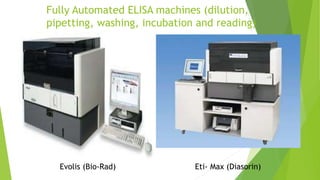
Fully Automated ELISA machines (dilution,
pipetting, washing, incubation and reading)
Evolis (Bio-Rad) Eti- Max (Diasorin)
•Do not forget ELISA is Screening not Confirmatory
ELISA Testing
Currently Previously
Detection of Antibodies and
Antigens
Detection of Antibodies only
Early results within hours or
days of infection by
detecting Antigens
Results positive only after 4-
8 weeks after infection
For HIV-1 & HIV-2 For HIV-1 only
Full automation available Cumbersome
ii- Rapid tests Advantages
 Easy to use immediate and fast results (10-20
minutes).
 Can be used at home or clinic.
 Inexpensive (1-2 $/test)
 Recently approved by MOH
 Some tests are FDA approved
 Done upon whole blood or saliva
 No equipment, refrigeration, No electricity, No
multiple timing steps required.
Disadvantages of rapid tests.
 Only detects Antibodies to HIV 1/2
 Not detecting Antigens
 Positive late after infection; after
seroconversion.
 Need confirmation for reactive tests.
 Subjective variability in result reading.
Rapid tests for HIV diagnosis
Home Rapid tests.
Add Sample
Conjugate
Control
line
Test
Line
IgG Antibodies
HIV antibodies
Colloidal gold
conjugated to
HIV antigen
Anti-IgG/gold
antibodies
HIV antigen
How Immunochromatography Works
Lab workers Health workers
Clinic Rapid Tests.
2- HIV Diagnostic Confirmatory tests
1- Differential Antibody tests (Western Blotting, WB).
2- Indirect Immunofluorescene Assay (IFA). Not available in
MOH
3- Nucleic acid Amplification tests (NAT, PCR) done in most
hospitals for screening blood donors and in RRL for
confirmation of screening tests.
4- Virus Isolation (not done for clinical diagnosis only in
research purposes).
1- Differential Antibody tests (Western
Blotting).
 Differentiate antibodies to HIV-1 from HIV-2 and
antibodies to specific antigens.
 Time consuming
 May give indeterminate results
 Performed in Riyadh Regional Lab.
Western Blot for detection of various
antibodies to various parts of the virus
When to ask for HIV infections?
when they present with a febrile, “flu”-, or “mono”-like illness that is
not otherwise explained:-
 • Those who present for HIV testing (AII)
 • Those who report a recent sexual or parenteral exposure with a
known HIV-infected partner or a partner of unknown HIV serostatus
in the past 2 to 6 weeks (AII)
 • Men who report having unsafe sexual practices with other men (AII)
 • Those who report needle-sharing (AII)
 • Those who present with a newly diagnosed sexually transmitted
infection (AII)
 • Those who present with aseptic meningitis (AII)
 • Pregnant or breastfeeding patients (AII)
 When acute HIV infection is suspected:
 • An HIV serologic screening test should be used in
conjunction with a plasma HIV RNA assay (AII);
 • Detection of HIV RNA or antigen in the absence of HIV
antibody is a preliminary positive result; HIV RNA testing to
be repeated for confirmation of HIV RNA
 • Both serologic and RNA testing should be repeated to
exclude a false-positive result with <5,000 copies/mL HIV
RNA detected in serological negative patient (AII).
CDC Recommended Laboratory HIV Testing Algorithm for
Serum or Plasma Specimens
(WB)
(ELISA)
(PCR)
REASONS FOR FALSE-POSITIVE, FALSE-NEGATIVE, AND
INDETERMINATE RESULTS IN ASSAYS FOR THE DETECTION OF
ANTIBODIES AGAINST HIV
Reasons for False-
Positive HIV
Screening Test
Results
• Increased sensitivity of assays, leading to
reduced specificity
• Technical errors
• Presence of HIV antibodies in recipients of HIV-1
trial vaccines.
Other rare possibilities:
• Hypergammaglobulinemia/antibodies reactive to
cellular components
• Influenza vaccination may cause cross-reactivity
with HIV antibody assays. The time course for such
cross-reactivity remains uncertain.
Reasons for False-
Negative HIV
Screening Test
Results
• Testing individuals during the window period (the
incubation period between exposure and seroconversion)
• Technical errors
• HIV-2 (for tests designed to detect only HIV-1).
 Other rare possibilities:
• Delayed antibody synthesis in infants and persons
receiving post-exposure prophylaxis or with concurrent
acute hepatitis C infection
• Diminished immune response in individuals receiving
intensive or long-term immunosuppressive therapy
• Congenital or drug-induced hypogammaglobulinemia or
agammaglobulinemia
• Insufficient host antibody response (i.e., advanced HIV
disease)
• Unavailability of antibodies due to the formation of
antigen-antibody complexes
• Reduced sensitivity assays
Reasons for
Indeterminate
* Western Blot
Results
(positive
screening and
negative WB)
 Probable True Positive (HIV Infection)
• Seroconverting
• HIV-2 infection
• Technical errors
 Probable True Negative (No HIV Infection)
• Recipients of HIV-1 trial vaccine
• Antibodies reactive to cellular components, as in
o Multiparous women
o Polytransfused patients
o Patients receiving chronic hemodialysis
o Patients with autoimmune disease
• Recipients of influenza and hepatitis B virus vaccines
• Persons with non-HIV acute viral infections
• Congenital bleeding disorders
• Alcoholic hepatitis and other chronic liver diseases
• Hematologic malignancies, lymphomas
• Positive rapid plasma reagin test
• Technical errors
Other lab tests for HIV patients
References:
 Centers for Disease Control and Prevention and Association of Public Health Laboratories. Laboratory Testing
for the Diagnosis of HIV Infection: Updated Recommendations. Available at
http://stacks.cdc.gov/view/cdc/23447. Published June 27, 2014. Accessed [30/11/2015].
 Diagnosis of HIV-1 Infection. Estelle Piwowar-Manning, HPTN Central Laboratory. The Johns Hopkins
University.

Thank You

Hiv lab diagnosis

  • 1.
    Laboratory Diagnosis of HumanImmunodeficiency Virus (HIV) Dr Mostafa Mahmoud, MD, Ph D, Consultant Microbiologist Assist. Prof. of Medical Microbiology & Immunology
  • 2.
    What is theimmune system?  The immune system is the collection of cells, tissues and molecules that protects the body from numerous pathogenic microbes and toxins in our environment.
  • 5.
    What are thetypes of immune system? 2 main types: 1- the Innate, or natural (Non-specific) immune system (fight microbes at site of entry) include: 1) physical epithelial barriers, 2) phagocytic leukocytes, 3) dendritic cells, 4) a special type of lymphocyte called a natural killer (NK) cell, and 5) circulating plasma proteins.
  • 6.
    2- the Acquiredor adaptive (Ag-Specific) immune system: -The second line of defense after innate -Naturally silent need activation by infection with formation of memory cells.  -2 subdivisions of the adaptive or acquired the humoral (Antibodies- by B-lymphocytes) and the cellular (CMI by T- lymphocytes).
  • 7.
    A. Humoral Immunity -By antibodies from B-lymphocytes - B-lymphocytes 10-20% of circulation lymphocytes. - (WBCS: Neutrophils, lymphocytes, Eosinophil, Monocytes & basophils), - Also in bone marrow, spleen, LNs. - Different antibody specific to each antigen. - 5 classes of antibodies (Immunoglobulin; Igs) IgM (acute), IgG (chronic), IgA (secretions), IgD (receptors) IgE (hypersensitivity)
  • 8.
    B-Cell-Mediated Immunity (CMI) -By T-lymphocyte populations that integrate in function. - Against viruses, fungi, intracellular bacteria, and tumor cells. - T-lymphocytes are Thymus-dependent present in spleen and LNs. 60% to 70% of circulating lymphocytes. - T-lymphocytes include subsets:  Helper T-cells (CD4+) which help B-lymphocyte function by several cytokines.  Cytotoxic T-cells (CD8+) killing infected or tumor cells.  Suppressor T-cells  Memory T-cells
  • 9.
    • What isAIDS ?= Acquired Immuno- Deficiency- Syndrome - It is the a disease syndrome •. • What is HIV ? = Human Immunodeficiency Virus - It is the causative viral agent of ADIS - Enveloped ?? SS-RNA, Positive-Sense (2 segments) • HIV is a Retrovirus? • HIV-1, the most common worldwide • HIV-2, few areas in Africa.
  • 10.
    HIV-Structure (Viral Antigens) 1- Gag=Group Antigen: ( (Capsid), P17 (Matrix), & P7 (Nucleocapsid). 2- Pol= polymerase and associated enzymes: P66 (reverse transcriptase -RT), P32 (integrase) , P9 (protease). 2- Env= Envelope glycoproteins e.g. , .
  • 13.
    HIV infects (CD4+)carrying cells!!!  The effects of HIV are due to it gp 120 Ag.  The CD4+ are the receptors of the virus.  HIV affects the immune system & Brain??  Why?  They have CD4+Tmainly on T-helper cells  Other cells having CD4+ include: - Macrophages - Dendritic cells. - Monocytes - Microglial cells - Retinal cells - Colonic Mucosal cells.
  • 14.
  • 15.
    Diagnostic lab testfor HIV infection A- Tests to diagnose HIV infections: 1- Screening 2- Confirmatory B- Tests for follow up the disease: 1- Viral load by Quantitative PCR 2- Th-cells count (CD4+) C- Tests for the complication of the disease: 1- TB infection 2- HBV 3- HCV 4- Toxoplasma 5- Liver function tests 6- UTIs 7- Others.
  • 16.
    A- Tests todiagnose HIV infections 1- Screening tests These test are rapid in giving results however, they are not diagnostic and need confirmation by the confirmatory tests The Screening tests include: i- ELISA tests (combined Ag-Ab Immunoassays) for detecting HIV-1 & HIV-2 antibodies and P24 Ag of HIV-1. or chemiluminescent immunoassay testing. ii- Rapid tests
  • 17.
    i- ELISA orchemiluminescent immunoassay testing  Were previously for detection of HIV Antibodies  Now detection of P24 Antigen of HIV is included (Combo ELISA).  Even though, need confirmation  They are the tests approved and done in our hospitals  Done upon serum sample  If initially reactive, repeat in triplicate, if positive send for WB or PCR.
  • 18.
    Screening test performedin 1- Premarital examination 2- Blood Donors. 3- Antenatal Care 4- Pre-employment screening 5- Before Surgical operations (Medico-legal) 6- Follow up for hemodialysis patients. 7- Others
  • 19.
    Semi-Automated ELISA (separatewasher, Incubator, Reader) ELISA washers (for semi-automated) Stat Fax microplate washer Bio-Tek microplate washer In 50-bed Hospitals of MOH
  • 20.
    Manual ELISA readers Afterseveral incubation and wash steps, a color reaction occurs if HIV antibody is present An automated reader gives a measurement of optical density (presence of color) for each well
  • 21.
    Fully Automated ELISAmachines (dilution, pipetting, washing, incubation and reading) Evolis (Bio-Rad) Eti- Max (Diasorin)
  • 23.
    •Do not forgetELISA is Screening not Confirmatory ELISA Testing Currently Previously Detection of Antibodies and Antigens Detection of Antibodies only Early results within hours or days of infection by detecting Antigens Results positive only after 4- 8 weeks after infection For HIV-1 & HIV-2 For HIV-1 only Full automation available Cumbersome
  • 24.
    ii- Rapid testsAdvantages  Easy to use immediate and fast results (10-20 minutes).  Can be used at home or clinic.  Inexpensive (1-2 $/test)  Recently approved by MOH  Some tests are FDA approved  Done upon whole blood or saliva  No equipment, refrigeration, No electricity, No multiple timing steps required.
  • 25.
    Disadvantages of rapidtests.  Only detects Antibodies to HIV 1/2  Not detecting Antigens  Positive late after infection; after seroconversion.  Need confirmation for reactive tests.  Subjective variability in result reading.
  • 26.
    Rapid tests forHIV diagnosis
  • 27.
  • 28.
    Add Sample Conjugate Control line Test Line IgG Antibodies HIVantibodies Colloidal gold conjugated to HIV antigen Anti-IgG/gold antibodies HIV antigen How Immunochromatography Works Lab workers Health workers
  • 29.
  • 31.
    2- HIV DiagnosticConfirmatory tests 1- Differential Antibody tests (Western Blotting, WB). 2- Indirect Immunofluorescene Assay (IFA). Not available in MOH 3- Nucleic acid Amplification tests (NAT, PCR) done in most hospitals for screening blood donors and in RRL for confirmation of screening tests. 4- Virus Isolation (not done for clinical diagnosis only in research purposes).
  • 32.
    1- Differential Antibodytests (Western Blotting).  Differentiate antibodies to HIV-1 from HIV-2 and antibodies to specific antigens.  Time consuming  May give indeterminate results  Performed in Riyadh Regional Lab.
  • 33.
    Western Blot fordetection of various antibodies to various parts of the virus
  • 34.
    When to askfor HIV infections? when they present with a febrile, “flu”-, or “mono”-like illness that is not otherwise explained:-  • Those who present for HIV testing (AII)  • Those who report a recent sexual or parenteral exposure with a known HIV-infected partner or a partner of unknown HIV serostatus in the past 2 to 6 weeks (AII)  • Men who report having unsafe sexual practices with other men (AII)  • Those who report needle-sharing (AII)  • Those who present with a newly diagnosed sexually transmitted infection (AII)  • Those who present with aseptic meningitis (AII)  • Pregnant or breastfeeding patients (AII)
  • 35.
     When acuteHIV infection is suspected:  • An HIV serologic screening test should be used in conjunction with a plasma HIV RNA assay (AII);  • Detection of HIV RNA or antigen in the absence of HIV antibody is a preliminary positive result; HIV RNA testing to be repeated for confirmation of HIV RNA  • Both serologic and RNA testing should be repeated to exclude a false-positive result with <5,000 copies/mL HIV RNA detected in serological negative patient (AII).
  • 36.
    CDC Recommended LaboratoryHIV Testing Algorithm for Serum or Plasma Specimens (WB) (ELISA) (PCR)
  • 37.
    REASONS FOR FALSE-POSITIVE,FALSE-NEGATIVE, AND INDETERMINATE RESULTS IN ASSAYS FOR THE DETECTION OF ANTIBODIES AGAINST HIV Reasons for False- Positive HIV Screening Test Results • Increased sensitivity of assays, leading to reduced specificity • Technical errors • Presence of HIV antibodies in recipients of HIV-1 trial vaccines. Other rare possibilities: • Hypergammaglobulinemia/antibodies reactive to cellular components • Influenza vaccination may cause cross-reactivity with HIV antibody assays. The time course for such cross-reactivity remains uncertain.
  • 38.
    Reasons for False- NegativeHIV Screening Test Results • Testing individuals during the window period (the incubation period between exposure and seroconversion) • Technical errors • HIV-2 (for tests designed to detect only HIV-1).  Other rare possibilities: • Delayed antibody synthesis in infants and persons receiving post-exposure prophylaxis or with concurrent acute hepatitis C infection • Diminished immune response in individuals receiving intensive or long-term immunosuppressive therapy • Congenital or drug-induced hypogammaglobulinemia or agammaglobulinemia • Insufficient host antibody response (i.e., advanced HIV disease) • Unavailability of antibodies due to the formation of antigen-antibody complexes • Reduced sensitivity assays
  • 39.
    Reasons for Indeterminate * WesternBlot Results (positive screening and negative WB)  Probable True Positive (HIV Infection) • Seroconverting • HIV-2 infection • Technical errors  Probable True Negative (No HIV Infection) • Recipients of HIV-1 trial vaccine • Antibodies reactive to cellular components, as in o Multiparous women o Polytransfused patients o Patients receiving chronic hemodialysis o Patients with autoimmune disease • Recipients of influenza and hepatitis B virus vaccines • Persons with non-HIV acute viral infections • Congenital bleeding disorders • Alcoholic hepatitis and other chronic liver diseases • Hematologic malignancies, lymphomas • Positive rapid plasma reagin test • Technical errors
  • 40.
    Other lab testsfor HIV patients
  • 41.
    References:  Centers forDisease Control and Prevention and Association of Public Health Laboratories. Laboratory Testing for the Diagnosis of HIV Infection: Updated Recommendations. Available at http://stacks.cdc.gov/view/cdc/23447. Published June 27, 2014. Accessed [30/11/2015].  Diagnosis of HIV-1 Infection. Estelle Piwowar-Manning, HPTN Central Laboratory. The Johns Hopkins University. 
  • 42.