PRUEBAS EN EL
DESARROLLO DE
SOFTWARE DIRIGIDO POR
MODELOS
Juan de Lara
(trabajo conjunto con Esther Guerra)
modelling&software engineering
research grouphttp://www.miso.es
PRUEBAS DE
TRANSFORMACIONES DE
MODELOS
Juan de Lara
(trabajo conjunto con Esther Guerra)
modelling&software engineering
research grouphttp://www.miso.es
Model-Driven Engineering (MDE).
• Meta-Modelling and DSMLs.
• Model Transformations.
Testing model-to-model transformations
Conclusions and Open lines
AGENDA
3
DRIVEN
ENGINEERIN
G
Increase the level of abstraction in software
development.
Models are actively used to:
• Describe the problem…
• Simulate/verify/test…
• Generate code for the final application.
Move from the solution space (code-centric) to the
problem space:
• Higher levels of productivity and quality.
• Less accidental details.
4
MODEL DRIVEN
ENGINEERING
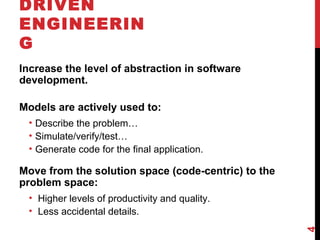
For specific domains:
• Avoid coding the same
solutions over and over.
• Families of applications.
• Domain-Specific Modelling
Languages.
Code
Generator
• Modelling, validation and automatic
generation of telephony services.
5
MODEL DRIVEN
ENGINEERING
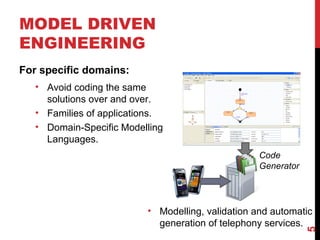
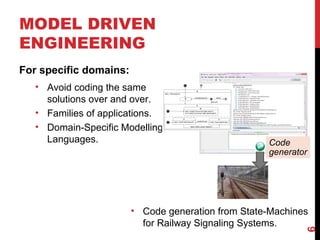
For specific domains:
• Avoid coding the same
solutions over and over.
• Families of applications.
• Domain-Specific Modelling
Languages.
• Code generation from State-Machines
for Railway Signaling Systems.
6
Code
generator
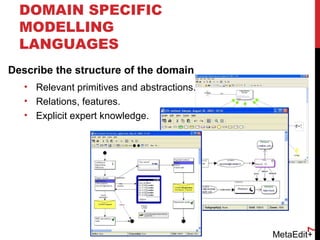
MetaEdit+
DOMAIN SPECIFIC
MODELLING
LANGUAGES
Describe the structure of the domain
• Relevant primitives and abstractions.
• Relations, features.
• Explicit expert knowledge.
7
DOMAIN SPECIFIC
MODELLING
LANGUAGES
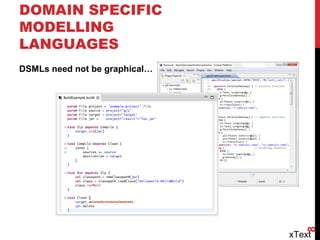
DSMLs need not be graphical…
xText
8
MODELS AND
META-MODELS
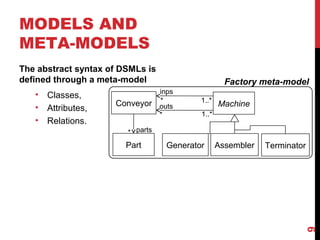
The abstract syntax of DSMLs is
defined through a meta-model
• Classes,
• Attributes,
• Relations.
9
Factory meta-model
Machine
Part
Conveyor
Generator Assembler
inps
outs
*
*
* parts
Terminator
1..*
1..*
MODELS AND
META-MODELS
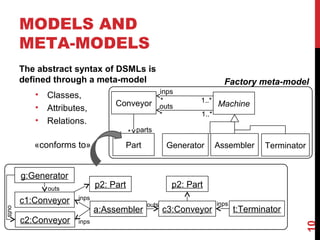
The abstract syntax of DSMLs is
defined through a meta-model
• Classes,
• Attributes,
• Relations.
10
«conforms to»
c1:Conveyor
g:Generator
a:Assembler
c2:Conveyor
c3:Conveyor t:Terminator
p2: Partp2: Partouts
outs
inps
inps
outs inps
Factory meta-model
Machine
Part
Conveyor
Generator Assembler
inps
outs
*
*
* parts
Terminator
1..*
1..*
OCL CONSTRAINTS
11
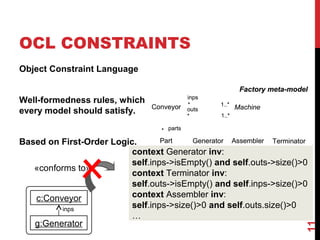
Object Constraint Language
Well-formedness rules, which
every model should satisfy.
Based on First-Order Logic.
g:Generator
«conforms to»
c:Conveyor
Factory meta-model
Machine
Part
Conveyor
Generator Assembler
inps
outs
*
*
* parts
Terminator
1..*
1..*
Factory meta-model
Machine
Part
Conveyor
Generator Assembler
inps
outs
*
*
* parts
Terminator
1..*
1..*
context Generator inv:
self.inps->isEmpty() and self.outs->size()>0
context Generator inv:
self.inps->isEmpty() and self.outs->size()>0
context Terminator inv:
self.outs->isEmpty() and self.inps->size()>0
context Assembler inv:
self.inps->size()>0 and self.outs.size()>0
…
inps
MODELS AND
META-MODELS
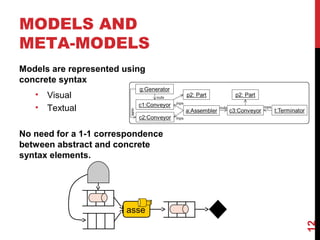
Models are represented using
concrete syntax
• Visual
• Textual
No need for a 1-1 correspondence
between abstract and concrete
syntax elements.
12
asse
MODEL
TRANSFORMATIONS
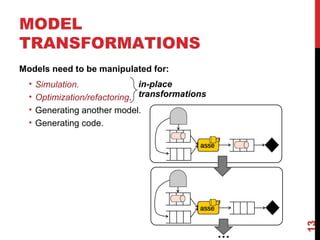
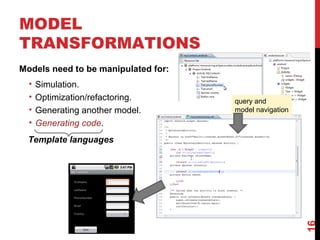
Models need to be manipulated for:
• Simulation.
• Optimization/refactoring.
• Generating another model.
• Generating code.
in-place
transformations
13
…
MODEL
TRANSFORMATIONS
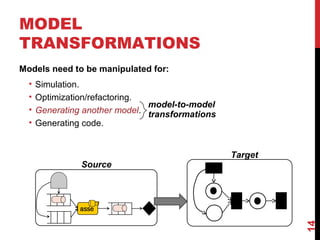
Models need to be manipulated for:
• Simulation.
• Optimization/refactoring.
• Generating another model.
• Generating code.
Source
Target
14
model-to-model
transformations
MODEL
TRANSFORMATIONS
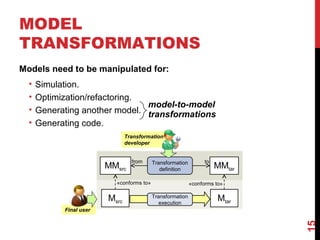
Models need to be manipulated for:
• Simulation.
• Optimization/refactoring.
• Generating another model.
• Generating code.
15
MMsrc MMtar
Msrc Mtar
Transformation
definition
from to
«conforms to» «conforms to»
Transformation
execution
Transformation
developer
Final user
model-to-model
transformations
MODEL
TRANSFORMATIONS
Models need to be manipulated for:
• Simulation.
• Optimization/refactoring.
• Generating another model.
• Generating code.
16
Template languages
query and
model navigation
17
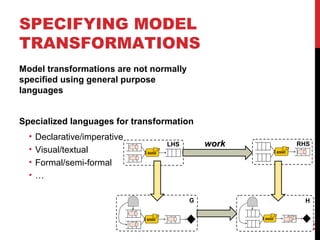
SPECIFYING MODEL
TRANSFORMATIONS
Model transformations are not normally
specified using general purpose
languages
Specialized languages for transformation
• Declarative/imperative
• Visual/textual
• Formal/semi-formal
• …
LHS RHS
G H
work
18
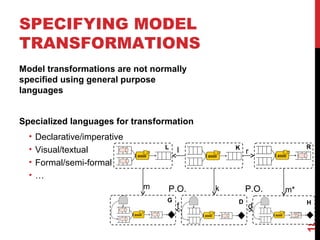
SPECIFYING MODEL
TRANSFORMATIONS
Model transformations are not normally
specified using general purpose
languages
Specialized languages for transformation
• Declarative/imperative
• Visual/textual
• Formal/semi-formal
• …
L R
G H
K
D
l r
m k m*
f d
P.O. P.O.
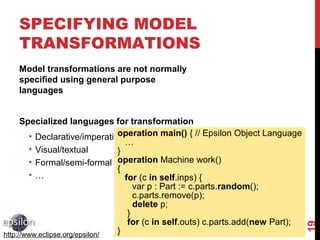
SPECIFYING MODEL
TRANSFORMATIONS
19
Model transformations are not normally
specified using general purpose
languages
Specialized languages for transformation
• Declarative/imperative
• Visual/textual
• Formal/semi-formal
• …
operation main() { // Epsilon Object Language
…
}
operation Machine work()
{
for (c in self.inps) {
var p : Part := c.parts.random();
c.parts.remove(p);
delete p;
}
for (c in self.outs) c.parts.add(new Part);
}http://www.eclipse.org/epsilon/
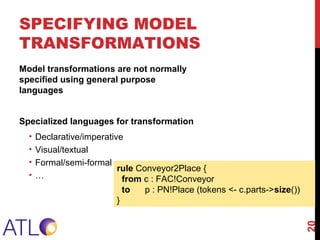
rule Conveyor2Place {
from c : FAC!Conveyor
to p : PN!Place (tokens <- c.parts->size())
}
Model transformations are not normally
specified using general purpose
languages
Specialized languages for transformation
• Declarative/imperative
• Visual/textual
• Formal/semi-formal
• …
SPECIFYING MODEL
TRANSFORMATIONS
20
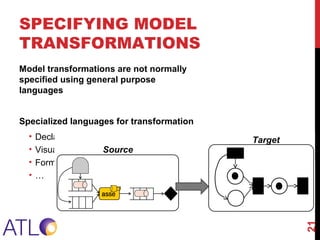
rule Conveyor2Place {
from c : FAC!Conveyor
to p : PN!Place (tokens <- c.parts->size())
}
Model transformations are not normally
specified using general purpose
languages
Specialized languages for transformation
• Declarative/imperative
• Visual/textual
• Formal/semi-formal
• …
SPECIFYING MODEL
TRANSFORMATIONS
21
Source
Target
Model-Driven Engineering (MDE).
Testing model-to-model transformations
• Challenges
• PaMoMo: A specification language for MTs
• Specification-based MT testing
Conclusions and open lines
AGENDA
22
TRANSFORMATION
TESTING
CHALLENGES
23
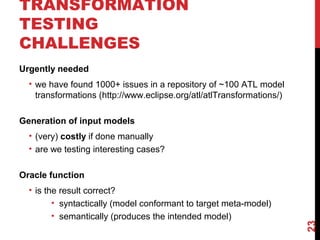
Urgently needed
• we have found 1000+ issues in a repository of ~100 ATL model
transformations (http://www.eclipse.org/atl/atlTransformations/)
Generation of input models
• (very) costly if done manually
• are we testing interesting cases?
Oracle function
• is the result correct?
• syntactically (model conformant to target meta-model)
• semantically (produces the intended model)
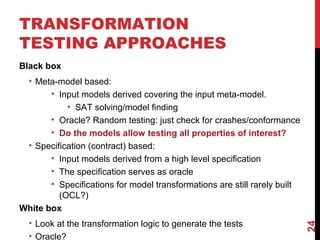
TRANSFORMATION
TESTING APPROACHES
24
Black box
• Meta-model based:
• Input models derived covering the input meta-model.
• SAT solving/model finding
• Oracle? Random testing: just check for crashes/conformance
• Do the models allow testing all properties of interest?
• Specification (contract) based:
• Input models derived from a high level specification
• The specification serves as oracle
• Specifications for model transformations are still rarely built
(OCL?)
White box
• Look at the transformation logic to generate the tests
• Oracle?
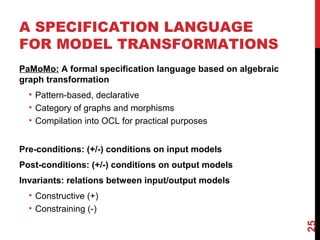
A SPECIFICATION LANGUAGE
FOR MODEL TRANSFORMATIONS
PaMoMo: A formal specification language based on algebraic
graph transformation
• Pattern-based, declarative
• Category of graphs and morphisms
• Compilation into OCL for practical purposes
Pre-conditions: (+/-) conditions on input models
Post-conditions: (+/-) conditions on output models
Invariants: relations between input/output models
• Constructive (+)
• Constraining (-)
25
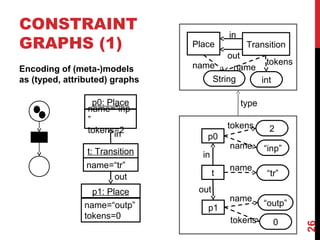
CONSTRAINT
GRAPHS (1)
Encoding of (meta-)models
as (typed, attributed) graphs
26
p0: Place
name=“inp
”
tokens=2
t: Transition
in
p1: Place
name=“outp”
tokens=0
name=“tr”
out
p0
t
p1
“inp”
2
“tr”
“outp”
0
in
out
tokens
name
name
name
tokens
Place Transition
in
out
intString
tokensname name
type
CONSTRAINT
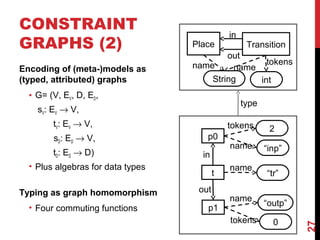
GRAPHS (2)
Encoding of (meta-)models as
(typed, attributed) graphs
• G= (V, EV, D, ED,
sV: EV → V,
tV: EV → V,
sD: ED → V,
tD: ED → D)
• Plus algebras for data types
Typing as graph homomorphism
• Four commuting functions
27
p0
t
p1
“inp”
2
“tr”
“outp”
0
in
out
tokens
name
name
name
tokens
Place Transition
in
out
intString
tokensname name
type
CONSTRAINT
GRAPHS (3)
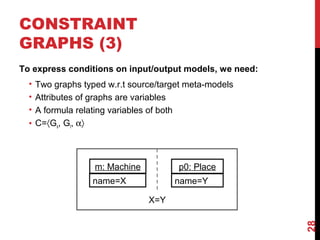
To express conditions on input/output models, we need:
• Two graphs typed w.r.t source/target meta-models
• Attributes of graphs are variables
• A formula relating variables of both
• C=〈Gs, Gt, α〉
28
p0: Place
name=Y
m: Machine
name=X
X=Y
SATISFACTION OF CONSTRAINT
GRAPHS
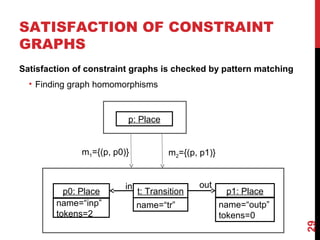
Satisfaction of constraint graphs is checked by pattern matching
• Finding graph homomorphisms
29
p: Place
p0: Place
name=“inp”
tokens=2
t: Transition
in
p1: Place
name=“outp”
tokens=0
name=“tr”
out
m1={(p, p0)} m2={(p, p1)}
SATISFACTION OF CONSTRAINT
GRAPHS
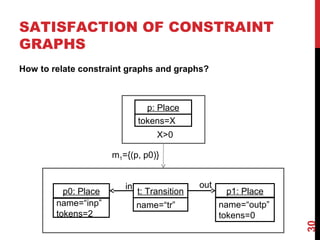
How to relate constraint graphs and graphs?
30
p: Place
p0: Place
name=“inp”
tokens=2
t: Transition
in
p1: Place
name=“outp”
tokens=0
name=“tr”
out
m1={(p, p0)}
tokens=X
X>0
SATISFACTION OF CONSTRAINT
GRAPHS
31
p: Place
p0: Place
name=N1
tokens=T1
t: Transition
in
p1: Place
name=N3
tokens=T2
name=N2
out
m1={(p, p0)}
tokens=X
α1 ≡ X>0
α2 ≡ N1=“inp” ∧ T1=2 ∧ N2=“tr” ∧ N3=“outp” ∧ T2=0
A graph can be seen as a constraint graph
• Constraint graph homomorphism = graph morphism + (reverse)
formula implication (in the example )α2[X/N1]⇒α1
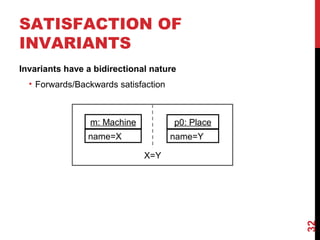
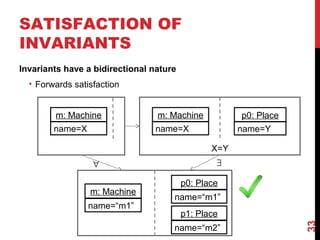
Invariants have a bidirectional nature
• Forwards/Backwards satisfaction
32
SATISFACTION OF
INVARIANTS
p0: Place
name=Y
m: Machine
name=X
X=Y
Invariants have a bidirectional nature
• Forwards satisfaction
33
SATISFACTION OF
INVARIANTS
m: Machine
name=X
p0: Place
name=Y
m: Machine
name=X
X=Y
m: Machine
name=“m1”
p0: Place
name=“m1”
p1: Place
name=“m2”
∀ ∃
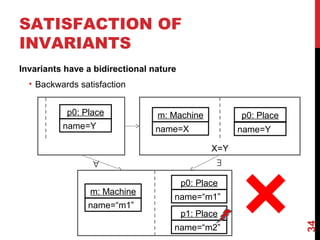
Invariants have a bidirectional nature
• Backwards satisfaction
34
SATISFACTION OF
INVARIANTS
p0: Place
name=Y
m: Machine
name=X
X=Y
m: Machine
name=“m1”
p0: Place
name=“m1”
p1: Place
name=“m2”
∀ ∃
p0: Place
name=Y
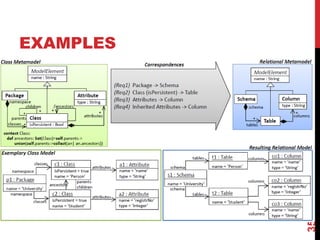
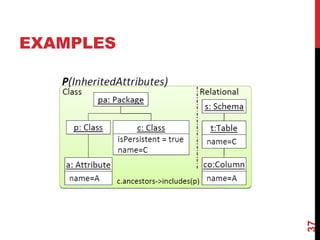
EXAMPLES
35
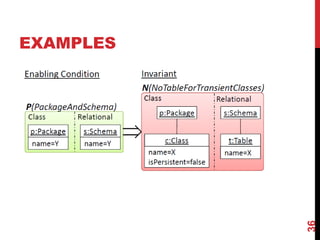
EXAMPLES
36
EXAMPLES
37
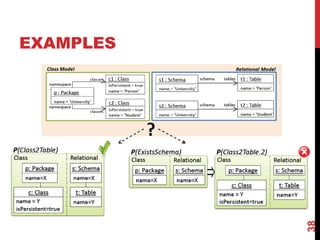
EXAMPLES
38
WHAT CAN WE DO WITH
AN SPECIFICATION?
Generate “reference” implementations [OGLE09]
• Based on graph transformation
• Terminating, correct, complete
• …but not very efficient
Testing:
• Generation of oracles based on QVT [GL13], OCL [GS15]
• Generation of input models, combining constraints [GS15]
SAT-based refinement checking w.r.t:
• Other specifications, implementations in ATL [BEGL13]
39
[BEGL13] Büttner, Egea, Guerra, de Lara. “Checking Model Transformation Refinement”. ICMT 2013: 158-173
[GL13] Guerra, de Lara, et al. “Automated verification of model transformations based on visual contracts”.
Autom. Softw. Eng. 20(1): 5-46 (2013)
[GS15] Guerra, Soeken. “Specification-driven model transformation testing”. SoSyM 14(2): 623-644 (2015)
[OGLE09] Orejas, Guerra, de Lara, Ehrig. “Correctness, Completeness and Termination of Pattern-Based
Model-to-Model Transformation”. CALCO 2009: 383-397
40
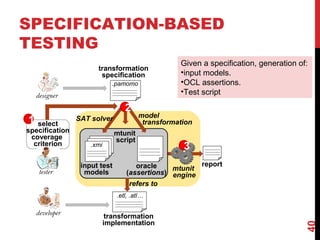
SPECIFICATION-BASED
TESTING
report
select
specification
coverage
criterion
mtunit
script
oracle
(assertions)
input test
models
.xmi
SAT solver model
transformation
transformation
specification
.pamomo
transformation
implementation
.etl, .atl…
refers to
tester mtunit
engine
1
2
3
designer
developer
Given a specification, generation of:
•input models.
•OCL assertions.
•Test script
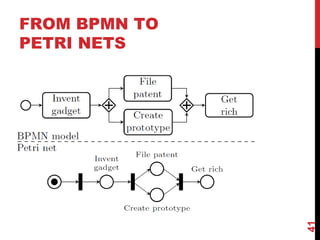
FROM BPMN TO
PETRI NETS
41
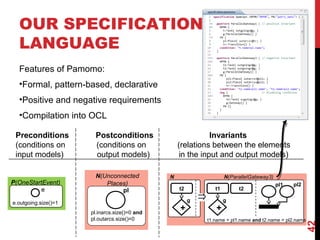
OUR SPECIFICATION
LANGUAGE
42
Features of Pamomo:
•Formal, pattern-based, declarative
•Positive and negative requirements
•Compilation into OCL
P(OneStartEvent)
e.outgoing.size()=1
e
Preconditions Postconditions Invariants
(conditions on (conditions on (relations between the elements
input models) output models) in the input and output models)
N(Unconnected
Places)
pl.inarcs.size()=0 and
pl.outarcs.size()=0
pl
N
t2
pl2
+
pl1
t1.name = pl1.name and t2.name = pl2.name
N(ParallelGateway3)
t1
g
t2
+
g
43
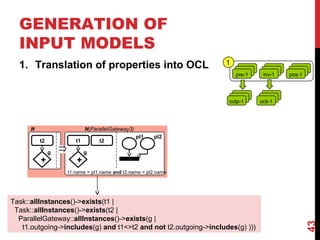
1. Translation of properties into OCL
GENERATION OF
INPUT MODELS
N
t2
pl2
+
pl1
t1.name = pl1.name and t2.name = pl2.name
N(ParallelGateway3)
t1
g
t2
+
g
Task::allInstances()->exists(t1 |
Task::allInstances()->exists(t2 |
ParallelGateway::allInstances()->exists(g |
t1.outgoing->includes(g) and t1<>t2 and not t2.outgoing->includes(g) )))
pre-1 inv-1
1
pos-1
ocli-1oclp-1
44
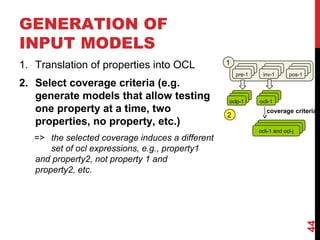
1. Translation of properties into OCL
2. Select coverage criteria (e.g.
generate models that allow testing
one property at a time, two
properties, no property, etc.)
=> the selected coverage induces a different
set of ocl expressions, e.g., property1
and property2, not property 1 and
property2, etc.
GENERATION OF
INPUT MODELS
pre-1 inv-1
coverage criteria
1
2
pos-1
ocli-1oclp-1
ocli-1 and ocl-j
45
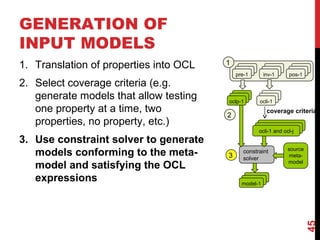
1. Translation of properties into OCL
2. Select coverage criteria (e.g.
generate models that allow testing
one property at a time, two
properties, no property, etc.)
3. Use constraint solver to generate
models conforming to the meta-
model and satisfying the OCL
expressions
GENERATION OF
INPUT MODELS
pre-1 inv-1
coverage criteria
1
2
pos-1
ocli-1oclp-1
ocli-1 and ocl-j
constraint
solver3
model-1
source
meta-
model
46
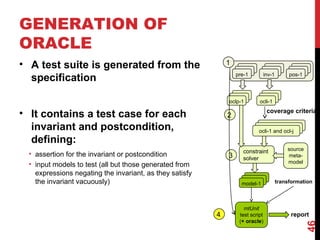
• A test suite is generated from the
specification
• It contains a test case for each
invariant and postcondition,
defining:
• assertion for the invariant or postcondition
• input models to test (all but those generated from
expressions negating the invariant, as they satisfy
the invariant vacuously)
GENERATION OF
ORACLE
pre-1 inv-1
coverage criteria
1
2
pos-1
ocli-1oclp-1
ocli-1 and ocl-j
constraint
solver3
model-1
source
meta-
model
mtUnit
test script
(+ oracle)
4
transformation
report
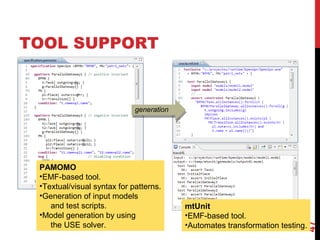
TOOL SUPPORT
47
generationgeneration
PAMOMO
•EMF-based tool.
•Textual/visual syntax for patterns.
•Generation of input models
and test scripts.
•Model generation by using
the USE solver.
mtUnit
•EMF-based tool.
•Automates transformation testing.
Model-Driven Engineering (MDE).
Testing model-to-model transformations
Conclusions
AGENDA
48
CONCLUSION
S
MDE: increase the level of abstraction in software
development by the use of (domain-specific) models.
V&V of the different MDE artefacts (meta-models,
transformations, code generators)
Model transformation testing:
• Generation of input models
• Oracle function
A specification language like PaMoMo can be used
for both
49
CURRENT LINES
Static analysis of (ATL) model transformations
• Type inference
• Quick fixes
DSLs for model mutation
• Primitives to generate mutants of models conformant to
arbitrary meta-models
• Transformations are also models
Model transformation reuse
• Transformations used with different meta-models they
were initially built
50
THANKS!
Questions?
51
http://www.miso.es
Juan.deLara@uam.es
modelling&software engineering
research group

Testing Model Transformations

  • 1.
    PRUEBAS EN EL DESARROLLODE SOFTWARE DIRIGIDO POR MODELOS Juan de Lara (trabajo conjunto con Esther Guerra) modelling&software engineering research grouphttp://www.miso.es
  • 2.
    PRUEBAS DE TRANSFORMACIONES DE MODELOS Juande Lara (trabajo conjunto con Esther Guerra) modelling&software engineering research grouphttp://www.miso.es
  • 3.
    Model-Driven Engineering (MDE). •Meta-Modelling and DSMLs. • Model Transformations. Testing model-to-model transformations Conclusions and Open lines AGENDA 3
  • 4.
    DRIVEN ENGINEERIN G Increase the levelof abstraction in software development. Models are actively used to: • Describe the problem… • Simulate/verify/test… • Generate code for the final application. Move from the solution space (code-centric) to the problem space: • Higher levels of productivity and quality. • Less accidental details. 4
  • 5.
    MODEL DRIVEN ENGINEERING For specificdomains: • Avoid coding the same solutions over and over. • Families of applications. • Domain-Specific Modelling Languages. Code Generator • Modelling, validation and automatic generation of telephony services. 5
  • 6.
    MODEL DRIVEN ENGINEERING For specificdomains: • Avoid coding the same solutions over and over. • Families of applications. • Domain-Specific Modelling Languages. • Code generation from State-Machines for Railway Signaling Systems. 6 Code generator
  • 7.
    MetaEdit+ DOMAIN SPECIFIC MODELLING LANGUAGES Describe thestructure of the domain • Relevant primitives and abstractions. • Relations, features. • Explicit expert knowledge. 7
  • 8.
  • 9.
    MODELS AND META-MODELS The abstractsyntax of DSMLs is defined through a meta-model • Classes, • Attributes, • Relations. 9 Factory meta-model Machine Part Conveyor Generator Assembler inps outs * * * parts Terminator 1..* 1..*
  • 10.
    MODELS AND META-MODELS The abstractsyntax of DSMLs is defined through a meta-model • Classes, • Attributes, • Relations. 10 «conforms to» c1:Conveyor g:Generator a:Assembler c2:Conveyor c3:Conveyor t:Terminator p2: Partp2: Partouts outs inps inps outs inps Factory meta-model Machine Part Conveyor Generator Assembler inps outs * * * parts Terminator 1..* 1..*
  • 11.
    OCL CONSTRAINTS 11 Object ConstraintLanguage Well-formedness rules, which every model should satisfy. Based on First-Order Logic. g:Generator «conforms to» c:Conveyor Factory meta-model Machine Part Conveyor Generator Assembler inps outs * * * parts Terminator 1..* 1..* Factory meta-model Machine Part Conveyor Generator Assembler inps outs * * * parts Terminator 1..* 1..* context Generator inv: self.inps->isEmpty() and self.outs->size()>0 context Generator inv: self.inps->isEmpty() and self.outs->size()>0 context Terminator inv: self.outs->isEmpty() and self.inps->size()>0 context Assembler inv: self.inps->size()>0 and self.outs.size()>0 … inps
  • 12.
    MODELS AND META-MODELS Models arerepresented using concrete syntax • Visual • Textual No need for a 1-1 correspondence between abstract and concrete syntax elements. 12 asse
  • 13.
    MODEL TRANSFORMATIONS Models need tobe manipulated for: • Simulation. • Optimization/refactoring. • Generating another model. • Generating code. in-place transformations 13 …
  • 14.
    MODEL TRANSFORMATIONS Models need tobe manipulated for: • Simulation. • Optimization/refactoring. • Generating another model. • Generating code. Source Target 14 model-to-model transformations
  • 15.
    MODEL TRANSFORMATIONS Models need tobe manipulated for: • Simulation. • Optimization/refactoring. • Generating another model. • Generating code. 15 MMsrc MMtar Msrc Mtar Transformation definition from to «conforms to» «conforms to» Transformation execution Transformation developer Final user model-to-model transformations
  • 16.
    MODEL TRANSFORMATIONS Models need tobe manipulated for: • Simulation. • Optimization/refactoring. • Generating another model. • Generating code. 16 Template languages query and model navigation
  • 17.
    17 SPECIFYING MODEL TRANSFORMATIONS Model transformationsare not normally specified using general purpose languages Specialized languages for transformation • Declarative/imperative • Visual/textual • Formal/semi-formal • … LHS RHS G H work
  • 18.
    18 SPECIFYING MODEL TRANSFORMATIONS Model transformationsare not normally specified using general purpose languages Specialized languages for transformation • Declarative/imperative • Visual/textual • Formal/semi-formal • … L R G H K D l r m k m* f d P.O. P.O.
  • 19.
    SPECIFYING MODEL TRANSFORMATIONS 19 Model transformationsare not normally specified using general purpose languages Specialized languages for transformation • Declarative/imperative • Visual/textual • Formal/semi-formal • … operation main() { // Epsilon Object Language … } operation Machine work() { for (c in self.inps) { var p : Part := c.parts.random(); c.parts.remove(p); delete p; } for (c in self.outs) c.parts.add(new Part); }http://www.eclipse.org/epsilon/
  • 20.
    rule Conveyor2Place { fromc : FAC!Conveyor to p : PN!Place (tokens <- c.parts->size()) } Model transformations are not normally specified using general purpose languages Specialized languages for transformation • Declarative/imperative • Visual/textual • Formal/semi-formal • … SPECIFYING MODEL TRANSFORMATIONS 20
  • 21.
    rule Conveyor2Place { fromc : FAC!Conveyor to p : PN!Place (tokens <- c.parts->size()) } Model transformations are not normally specified using general purpose languages Specialized languages for transformation • Declarative/imperative • Visual/textual • Formal/semi-formal • … SPECIFYING MODEL TRANSFORMATIONS 21 Source Target
  • 22.
    Model-Driven Engineering (MDE). Testingmodel-to-model transformations • Challenges • PaMoMo: A specification language for MTs • Specification-based MT testing Conclusions and open lines AGENDA 22
  • 23.
    TRANSFORMATION TESTING CHALLENGES 23 Urgently needed • wehave found 1000+ issues in a repository of ~100 ATL model transformations (http://www.eclipse.org/atl/atlTransformations/) Generation of input models • (very) costly if done manually • are we testing interesting cases? Oracle function • is the result correct? • syntactically (model conformant to target meta-model) • semantically (produces the intended model)
  • 24.
    TRANSFORMATION TESTING APPROACHES 24 Black box •Meta-model based: • Input models derived covering the input meta-model. • SAT solving/model finding • Oracle? Random testing: just check for crashes/conformance • Do the models allow testing all properties of interest? • Specification (contract) based: • Input models derived from a high level specification • The specification serves as oracle • Specifications for model transformations are still rarely built (OCL?) White box • Look at the transformation logic to generate the tests • Oracle?
  • 25.
    A SPECIFICATION LANGUAGE FORMODEL TRANSFORMATIONS PaMoMo: A formal specification language based on algebraic graph transformation • Pattern-based, declarative • Category of graphs and morphisms • Compilation into OCL for practical purposes Pre-conditions: (+/-) conditions on input models Post-conditions: (+/-) conditions on output models Invariants: relations between input/output models • Constructive (+) • Constraining (-) 25
  • 26.
    CONSTRAINT GRAPHS (1) Encoding of(meta-)models as (typed, attributed) graphs 26 p0: Place name=“inp ” tokens=2 t: Transition in p1: Place name=“outp” tokens=0 name=“tr” out p0 t p1 “inp” 2 “tr” “outp” 0 in out tokens name name name tokens Place Transition in out intString tokensname name type
  • 27.
    CONSTRAINT GRAPHS (2) Encoding of(meta-)models as (typed, attributed) graphs • G= (V, EV, D, ED, sV: EV → V, tV: EV → V, sD: ED → V, tD: ED → D) • Plus algebras for data types Typing as graph homomorphism • Four commuting functions 27 p0 t p1 “inp” 2 “tr” “outp” 0 in out tokens name name name tokens Place Transition in out intString tokensname name type
  • 28.
    CONSTRAINT GRAPHS (3) To expressconditions on input/output models, we need: • Two graphs typed w.r.t source/target meta-models • Attributes of graphs are variables • A formula relating variables of both • C=〈Gs, Gt, α〉 28 p0: Place name=Y m: Machine name=X X=Y
  • 29.
    SATISFACTION OF CONSTRAINT GRAPHS Satisfactionof constraint graphs is checked by pattern matching • Finding graph homomorphisms 29 p: Place p0: Place name=“inp” tokens=2 t: Transition in p1: Place name=“outp” tokens=0 name=“tr” out m1={(p, p0)} m2={(p, p1)}
  • 30.
    SATISFACTION OF CONSTRAINT GRAPHS Howto relate constraint graphs and graphs? 30 p: Place p0: Place name=“inp” tokens=2 t: Transition in p1: Place name=“outp” tokens=0 name=“tr” out m1={(p, p0)} tokens=X X>0
  • 31.
    SATISFACTION OF CONSTRAINT GRAPHS 31 p:Place p0: Place name=N1 tokens=T1 t: Transition in p1: Place name=N3 tokens=T2 name=N2 out m1={(p, p0)} tokens=X α1 ≡ X>0 α2 ≡ N1=“inp” ∧ T1=2 ∧ N2=“tr” ∧ N3=“outp” ∧ T2=0 A graph can be seen as a constraint graph • Constraint graph homomorphism = graph morphism + (reverse) formula implication (in the example )α2[X/N1]⇒α1
  • 32.
    Invariants have abidirectional nature • Forwards/Backwards satisfaction 32 SATISFACTION OF INVARIANTS p0: Place name=Y m: Machine name=X X=Y
  • 33.
    Invariants have abidirectional nature • Forwards satisfaction 33 SATISFACTION OF INVARIANTS m: Machine name=X p0: Place name=Y m: Machine name=X X=Y m: Machine name=“m1” p0: Place name=“m1” p1: Place name=“m2” ∀ ∃
  • 34.
    Invariants have abidirectional nature • Backwards satisfaction 34 SATISFACTION OF INVARIANTS p0: Place name=Y m: Machine name=X X=Y m: Machine name=“m1” p0: Place name=“m1” p1: Place name=“m2” ∀ ∃ p0: Place name=Y
  • 35.
  • 36.
  • 37.
  • 38.
  • 39.
    WHAT CAN WEDO WITH AN SPECIFICATION? Generate “reference” implementations [OGLE09] • Based on graph transformation • Terminating, correct, complete • …but not very efficient Testing: • Generation of oracles based on QVT [GL13], OCL [GS15] • Generation of input models, combining constraints [GS15] SAT-based refinement checking w.r.t: • Other specifications, implementations in ATL [BEGL13] 39 [BEGL13] Büttner, Egea, Guerra, de Lara. “Checking Model Transformation Refinement”. ICMT 2013: 158-173 [GL13] Guerra, de Lara, et al. “Automated verification of model transformations based on visual contracts”. Autom. Softw. Eng. 20(1): 5-46 (2013) [GS15] Guerra, Soeken. “Specification-driven model transformation testing”. SoSyM 14(2): 623-644 (2015) [OGLE09] Orejas, Guerra, de Lara, Ehrig. “Correctness, Completeness and Termination of Pattern-Based Model-to-Model Transformation”. CALCO 2009: 383-397
  • 40.
    40 SPECIFICATION-BASED TESTING report select specification coverage criterion mtunit script oracle (assertions) input test models .xmi SAT solvermodel transformation transformation specification .pamomo transformation implementation .etl, .atl… refers to tester mtunit engine 1 2 3 designer developer Given a specification, generation of: •input models. •OCL assertions. •Test script
  • 41.
  • 42.
    OUR SPECIFICATION LANGUAGE 42 Features ofPamomo: •Formal, pattern-based, declarative •Positive and negative requirements •Compilation into OCL P(OneStartEvent) e.outgoing.size()=1 e Preconditions Postconditions Invariants (conditions on (conditions on (relations between the elements input models) output models) in the input and output models) N(Unconnected Places) pl.inarcs.size()=0 and pl.outarcs.size()=0 pl N t2 pl2 + pl1 t1.name = pl1.name and t2.name = pl2.name N(ParallelGateway3) t1 g t2 + g
  • 43.
    43 1. Translation ofproperties into OCL GENERATION OF INPUT MODELS N t2 pl2 + pl1 t1.name = pl1.name and t2.name = pl2.name N(ParallelGateway3) t1 g t2 + g Task::allInstances()->exists(t1 | Task::allInstances()->exists(t2 | ParallelGateway::allInstances()->exists(g | t1.outgoing->includes(g) and t1<>t2 and not t2.outgoing->includes(g) ))) pre-1 inv-1 1 pos-1 ocli-1oclp-1
  • 44.
    44 1. Translation ofproperties into OCL 2. Select coverage criteria (e.g. generate models that allow testing one property at a time, two properties, no property, etc.) => the selected coverage induces a different set of ocl expressions, e.g., property1 and property2, not property 1 and property2, etc. GENERATION OF INPUT MODELS pre-1 inv-1 coverage criteria 1 2 pos-1 ocli-1oclp-1 ocli-1 and ocl-j
  • 45.
    45 1. Translation ofproperties into OCL 2. Select coverage criteria (e.g. generate models that allow testing one property at a time, two properties, no property, etc.) 3. Use constraint solver to generate models conforming to the meta- model and satisfying the OCL expressions GENERATION OF INPUT MODELS pre-1 inv-1 coverage criteria 1 2 pos-1 ocli-1oclp-1 ocli-1 and ocl-j constraint solver3 model-1 source meta- model
  • 46.
    46 • A testsuite is generated from the specification • It contains a test case for each invariant and postcondition, defining: • assertion for the invariant or postcondition • input models to test (all but those generated from expressions negating the invariant, as they satisfy the invariant vacuously) GENERATION OF ORACLE pre-1 inv-1 coverage criteria 1 2 pos-1 ocli-1oclp-1 ocli-1 and ocl-j constraint solver3 model-1 source meta- model mtUnit test script (+ oracle) 4 transformation report
  • 47.
    TOOL SUPPORT 47 generationgeneration PAMOMO •EMF-based tool. •Textual/visualsyntax for patterns. •Generation of input models and test scripts. •Model generation by using the USE solver. mtUnit •EMF-based tool. •Automates transformation testing.
  • 48.
    Model-Driven Engineering (MDE). Testingmodel-to-model transformations Conclusions AGENDA 48
  • 49.
    CONCLUSION S MDE: increase thelevel of abstraction in software development by the use of (domain-specific) models. V&V of the different MDE artefacts (meta-models, transformations, code generators) Model transformation testing: • Generation of input models • Oracle function A specification language like PaMoMo can be used for both 49
  • 50.
    CURRENT LINES Static analysisof (ATL) model transformations • Type inference • Quick fixes DSLs for model mutation • Primitives to generate mutants of models conformant to arbitrary meta-models • Transformations are also models Model transformation reuse • Transformations used with different meta-models they were initially built 50
  • 51.