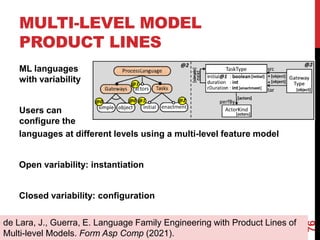
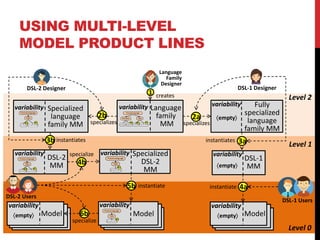
Download to read offline

![MOTIVATION
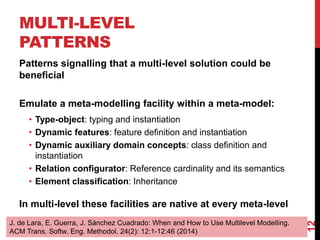
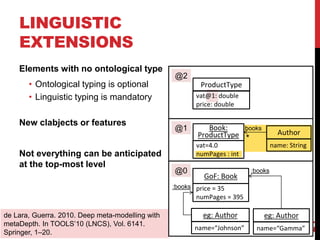
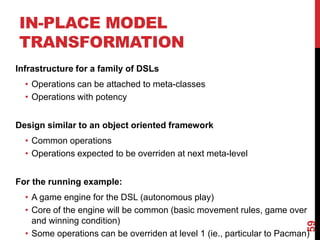
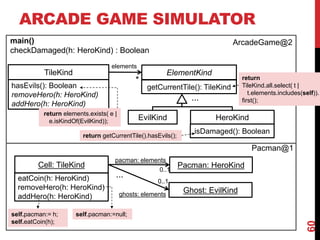
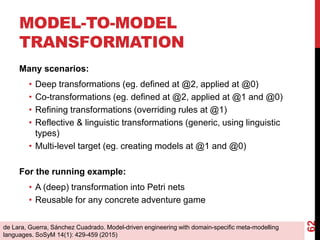
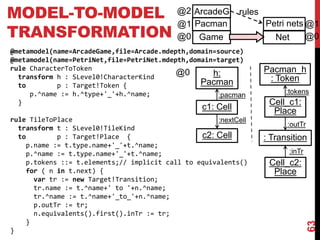
Sometimes, one needs to explicitly model meta-modelling
facilities, like:
• Instantiation (modelling both types and objects)
• Declaration and instantiation of attributes and references
• Inheritance
For example:
• Product types and instances [e-commerce applications]
• Task types and instances [process modelling languages]
• Component types and instances [architectural languages]
• Player types and instances [gaming applications]
• …
7](https://image.slidesharecdn.com/multi21-211011154221/85/Multi21-7-320.jpg)
![EXAMPLE
8
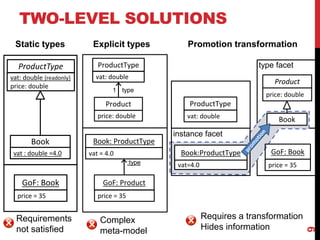
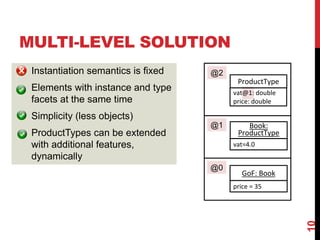
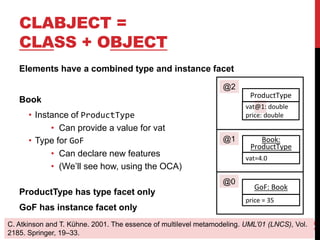
Model product types (books, CDs) and their instances, to be
added on demand. Product types have a VAT, while
instances have a price.
Explicit modelling of types and instances
• Types can be added dynamically
• Features of types are fixed and known a priori
Common modelling pattern, also known as: Type object
[Martin et. al 97], item descriptor [Coad 1992], metaobject
[Kiczales and Rivieres 1991]](https://image.slidesharecdn.com/multi21-211011154221/85/Multi21-8-320.jpg)
![PRACTICAL APPLICABILITY
How often do these patterns occur?
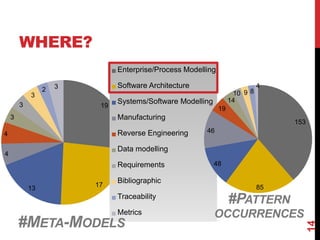
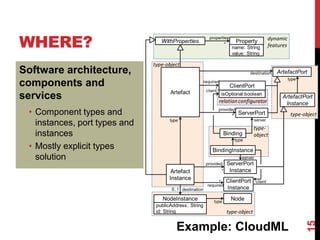
Analysis of >400 meta-models from:
• ATL meta-model zoo (305 meta-models) [8.5% occur.]
• OMG specifications (116 specs) [35%~38% occur.]
• ReMoDD (15 meta-models) [20% occur.]
• Articles in journals/conferences
84 meta-models with 459 occurrences (avg 5.5)
• Most common pattern is the type-object
• Most used solution is explicit types (~70%)
13](https://image.slidesharecdn.com/multi21-211011154221/85/Multi21-13-320.jpg)
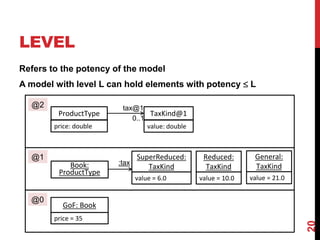
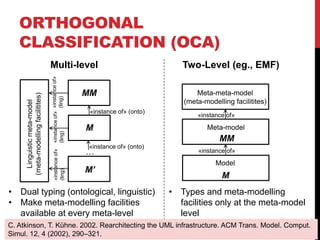
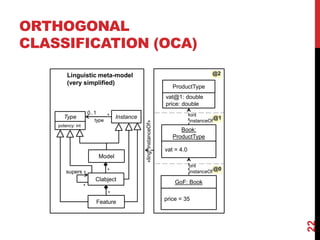
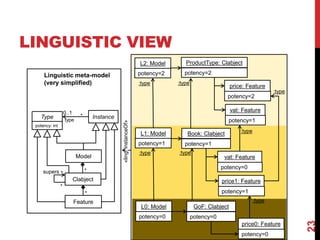

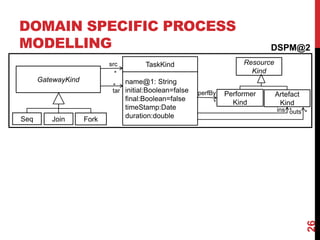
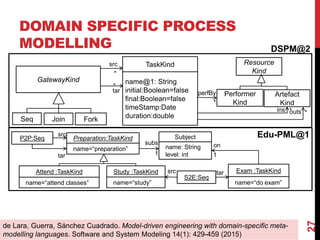
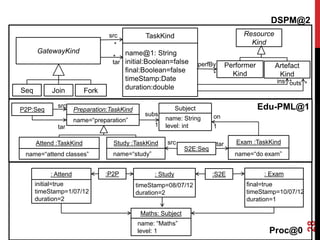
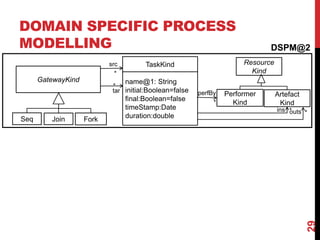
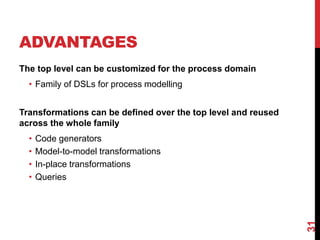
![DOMAIN SPECIFIC PROCESS
MODELLING
30
DSPM@2
TaskKind Resource
Kind
Performer
Kind
Artefact
Kind
GatewayKind
Seq Join Fork
ins outs
*
src
tar perfBy
*
*
*
*
name@1: String
initial:Boolean=false
final:Boolean=false
timeStamp:Date
duration:double
Soft-PML@1
Coding: TaskKind tests: next
1..*
Testing: TaskKind
name=“testing”
SoftwareEngineer:
PerformerKind
actor: perfBy
@1
SETask: TaskKind
*
Programmer:
PerformerKind
Tester:
PerformerKind
skills: String[*]
name=“se-task”](https://image.slidesharecdn.com/multi21-211011154221/85/Multi21-30-320.jpg)
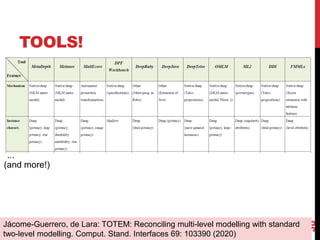
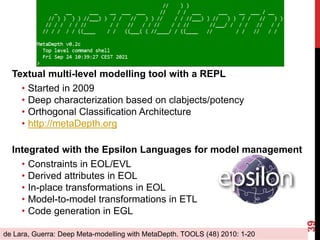
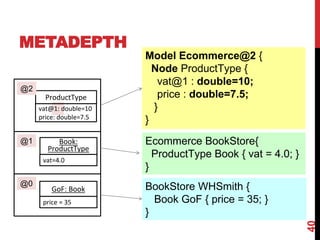
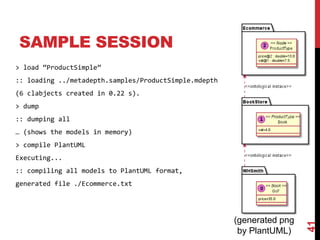
![RUNNING EXAMPLE (1)
44
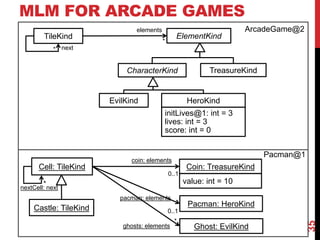
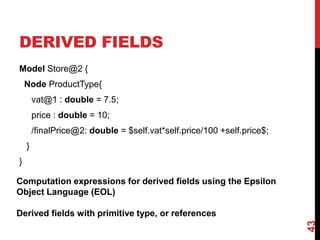
Model ArcadeGame@2 {
Node TileKind {
next : TileKind[*];
elements : ElementKind[*];
}
abstract Node ElementKind{}
abstract Node CharacterKind : ElementKind { }
Node HeroKind : CharacterKind {
initLives@1 : int = 3;
lives : int = 3;
score : int = 0;
}
Node EvilKind : CharacterKind {}
Node TreasureKind : ElementKind {}
}](https://image.slidesharecdn.com/multi21-211011154221/85/Multi21-44-320.jpg)
![RUNNING EXAMPLE (2)
45
ArcadeGame PacMan {
TileKind Cell {
nextCell : Cell[*] {next};
coin : Coin[0..1] {elements};
pacman : Pacman[0..1] {elements};
ghosts : Ghost[*] {elements};
}
TileKind Castle : Cell {}
TreasureKind Coin {
value : int=10;
}
HeroKind Pacman {
initLives = 3;
}
EvilKind Ghost {}
}
TileKind
Element
Kind
elements
*
Cell:
TileKind
Coin:
Element
Kind
coin:
elements
0..1
@2
Pacman:
Element
Kind
0..1
pacman:
elements
...](https://image.slidesharecdn.com/multi21-211011154221/85/Multi21-45-320.jpg)
![RUNNING EXAMPLE (3)
46
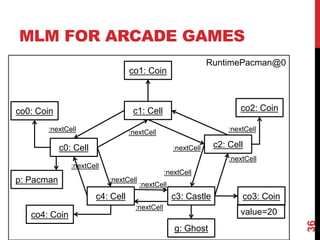
PacMan RuntimePacman {
Cell c0 { nextCell = [c1, c4]; coin = co0; pacman = p; }
Cell c1 { nextCell = [c2, c0]; coin = co1; }
Cell c2 { nextCell = [c3, c1]; coin = co2; }
Castle c3{ nextCell = [c4, c2]; coin = co3; ghosts = g; }
Cell c4 { nextCell = [c0, c3]; coin = co4;}
Pacman p {}
Ghost g {}
Coin co0 {}
Coin co1 {}
Coin co2 {}
Coin co3 { value = 20; }
Coin co4 {}
}](https://image.slidesharecdn.com/multi21-211011154221/85/Multi21-46-320.jpg)
![56
Model ArcadeGame@2 {
Node TileKind {
next : TileKind[*];
elements : ElementKind[*];
/numReachable : int = $self.next.size()$;
noIsolated : $self.numReachable>0 or
TileKind.all.exists( t | t.next.includes(self))$
}
abstract Node ElementKind{
connected : $TileKind.all.one( t | t.elements.includes(self))$
}
abstract Node CharacterKind : ElementKind { }
Node HeroKind : CharacterKind {
initLives@1 : int = 3;
lives : int = 3;
score : int = 0;
}
Node EvilKind : CharacterKind {}
Node TreasureKind : ElementKind {}
someHero@2 : $HeroKind.all.size()>=1$
moreEvils@2 : $EvilKind.all.size() >= HeroKind.all.size()$
}
RUNNING EXAMPLE
(LEVEL 2)
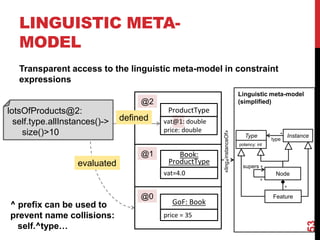
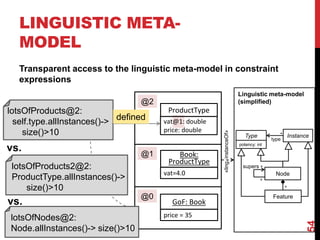
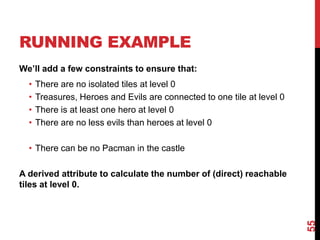
no isolated tiles at level 0
treasures, heores and evils are connected to exactly one tile
(global constraints) at least one hero, more evils than heroes](https://image.slidesharecdn.com/multi21-211011154221/85/Multi21-56-320.jpg)
![57
ArcadeGame PacMan {
TileKind Cell {
nextCell : Cell[*] {next};
coin : Coin[0..1] {elements};
pacman : Pacman[0..1] {elements};
ghosts : Ghost[*] {elements};
}
TileKind Castle : Cell {
noPacmans : $not self.pacman.isDefined()$
}
TreasureKind Coin {
value : int=10;
}
HeroKind Pacman {
initLives = 3;
}
EvilKind Ghost {
}
}
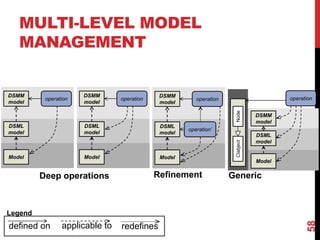
Conflicts and consistency of (ML) constraints
can be analyzed:
Guerra, de Lara: Automated analysis of integrity
constraints in multi-level models. Data Knowl.
Eng. 107: 1-23 (2017)
RUNNING EXAMPLE
(LEVEL 1)
no Pacman in the Castle](https://image.slidesharecdn.com/multi21-211011154221/85/Multi21-57-320.jpg)
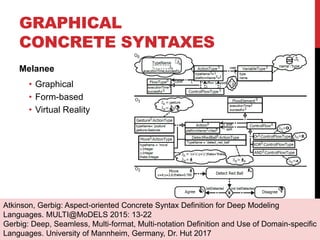
![OTHER APPROACHES
Multecore (https://ict.hvl.no/multecore/)
• A tool for MLM within Eclipse
• Graphical modelling
• Formal theory based on graph
transformation [WMR20]
• By translation into rewriting logic (MAUDE)
61
Wolter, Macías, Rutle: Multilevel Typed Graph Transformations. ICGT 2020, 163-182](https://image.slidesharecdn.com/multi21-211011154221/85/Multi21-61-320.jpg)
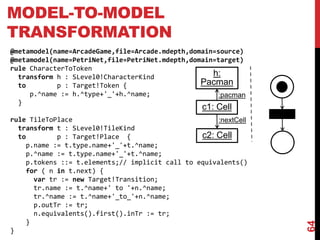
![OTHER APPROACHES
Melanee (http://www.melanee.org)
• A tool for MLM within Eclipse
• Graphical modelling (and more)
• Enhancement of the ATL
transformation language for
multi-level modelling [AGT15]
65
Atkinson, Gerbig, Tunjic. Enhancing classic transformation languages to support multi-
level modeling. Softw. Syst. Model. 14(2): 645-666 (2015)
…](https://image.slidesharecdn.com/multi21-211011154221/85/Multi21-65-320.jpg)
![CODE GENERATION
66
<!doctype html>
<html>
<head>
…
<script type="text/javascript">
// create an array with nodes
var nodes = new vis.DataSet([
[% var counter : Integer := 0;
// Generic
for(t in Level0!Node.all) {
counter := counter+1;
%]
[%if (counter > 1) {%], [%}%]
{id: [%=counter%],
label: '[%=t.type%] [%=counter%]'}
[% t.~identif := counter; %]
[%}%]
]);
…
</html>
Visualization of the game
• vis.js (http://visjs.org)
Code generator
• Deep (reusable for the DSL)
• Generic (linguistic types)
ArcadeG
Pacman
Game
@2
@1
@0
code gen
def
apply
html+js](https://image.slidesharecdn.com/multi21-211011154221/85/Multi21-66-320.jpg)
![GENERATED CODE
67
<script type="text/javascript">
// create an array with nodes
var nodes = new vis.DataSet([
{id: 1, label: 'Coin 1'}
, {id: 2, label: 'Coin 2'}
, {id: 3, label: 'Coin 3'}
, {id: 4, label: 'Coin 4'}
, {id: 5, label: 'Coin 5'}
, {id: 6, label: 'Pacman 6'}
, {id: 7, label: 'Ghost 7'}
, {id: 8, label: 'Castle 8'}
, {id: 9, label: 'Cell 9'}
, {id: 10, label: 'Cell 10'}
, {id: 11, label: 'Cell 11'}
, {id: 12, label: 'Cell 12'}
]);](https://image.slidesharecdn.com/multi21-211011154221/85/Multi21-67-320.jpg)
![TEXTUAL
CONCRETE
SYNTAX
70
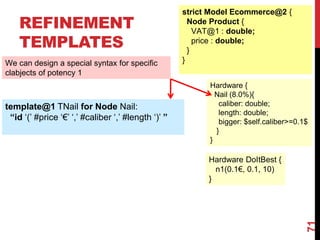
Syntax for Ecommerce [".ecommerce_mm"] {
template@1 TEcommerce for Model Ecommerce:
“id ‘{’ &TProduct * ‘}’ ”
template@1 TProduct for Node Product:
“id ‘(’ #VAT ‘%’ ‘)’ ”
}
strict Model Ecommerce@2 {
strict Node Product {
VAT@1 : double;
price : double;
}
}
Syntax for Ecommerce [".ecommerce"] {
template@2 DeepProds for Model Ecommerce:
“typename id ‘{’ &DeepProd * ‘}’ ”
template@2 DeepProd for Node Product:
“typename id ‘(’ #price ‘€’ ‘)’ ”
}
Stationer {
Pen(8%)
}
Stationer WHSmith {
Pen parker(5.0€)
}
Meta-Level 2
Meta-Level 1
Meta-Level 0](https://image.slidesharecdn.com/multi21-211011154221/85/Multi21-70-320.jpg)


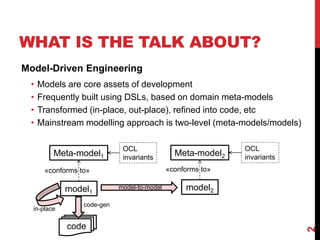
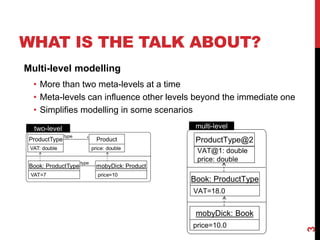
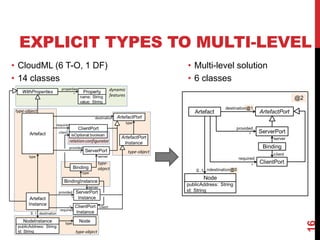
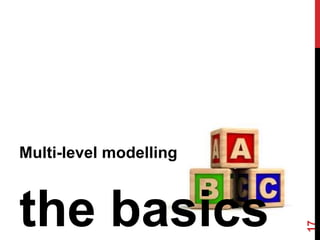
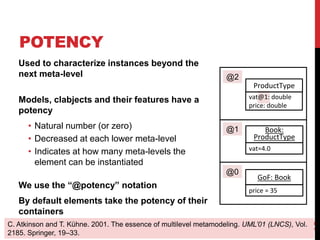
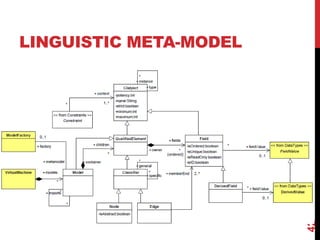
Multi-level modelling allows modelling at more than two meta-levels at once. The document discusses how multi-level modelling can be used for model-driven engineering. It presents the basics of multi-level modelling using concepts like clabjects, potency, levels and the orthogonal classification architecture. Examples are provided where multi-level modelling has advantages over two-level modelling, such as for modelling product types and instances, and domain-specific process modelling languages. Tool support for multi-level modelling is discussed, as well as how multi-level models can be managed through constraints, transformations and code generation.


