MODULAR LANGUAGE
PRODUCT LINES
A GRAPH TRANSFORMATION APPROACH
MODELS’2022, Montreal
Juan de Lara1, Esther Guerra1, Paolo Bottoni2
1Universidad Autónoma de Madrid (Spain)
2Sapienza University of Rome (Italy)
FROM DSLs TO
DSL FAMILIES
Modelling languages
• Essential for engineering disciplines
• Model-driven Engineering
• Domain-specific Languages (DSLs)
Does ONE language fit ALL?
• Different users: education, low-code development
Example: Class diagrams with different levels of sophistication
• Different expressivity: modelling purpose, analyses
Example: Petri nets with inhibitor, read arcs, time, colours
• Different levels of precision: to support different project phases
Example: From sketch-like diagrams to fully precise models
Language families!
2
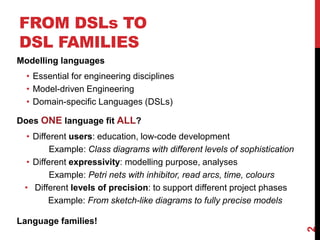
EXAMPLE
A DSL FAMILY FOR NETWORKING
3
Simple link with node
failures and acks
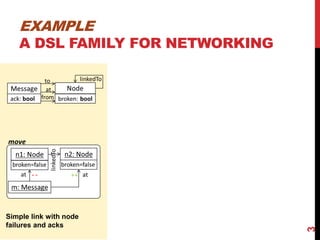
4
Simple link with node
failures and acks
Rich links with
communication failures
EXAMPLE
A DSL FAMILY FOR NETWORKING
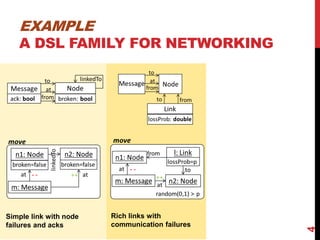
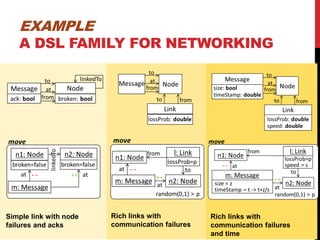
5
Simple link with node
failures and acks
Rich links with
communication failures
Rich links with
communication failures
and time
EXAMPLE
A DSL FAMILY FOR NETWORKING
HOW TO DEFINE A
LANGUAGE FAMILY?
Define each DSL separately (clone & own)
• Meta-models and rules share commonalities
• Adding a new feature (e.g., ad-hoc networks) doubles the
family size
Define just one “super-language” with all features
• Language difficult to use for users
• Unnecessary concepts
• What about alternative elements (rich vs. simple links)?
6
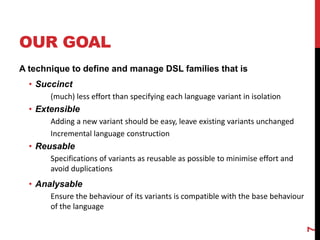
OUR GOAL
A technique to define and manage DSL families that is
• Succinct
(much) less effort than specifying each language variant in isolation
• Extensible
Adding a new variant should be easy, leave existing variants unchanged
Incremental language construction
• Reusable
Specifications of variants as reusable as possible to minimise effort and
avoid duplications
• Analysable
Ensure the behaviour of its variants is compatible with the base behaviour
of the language
7
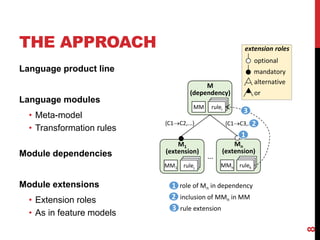
THE APPROACH
8
...
extension roles
optional
mandatory
alternative
or
M
(dependency)
MM
rule_i
rule_i
rulei
M1
(extension)
MM1
rule_i
rule_i
rulej
Mn
(extension)
MMn
rule_i
rule_i
rulek
role of Mn in dependency
inclusion of MMn in MM
{C1→C3,...}
{C1→C2,...}
rule extension
1
2
3
1
2
3
Language product line
Language modules
• Meta-model
• Transformation rules
Module dependencies
Module extensions
• Extension roles
• As in feature models
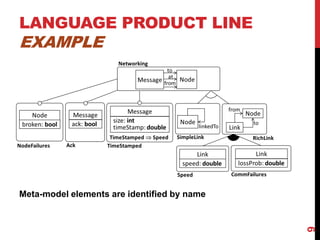
LANGUAGE PRODUCT LINE
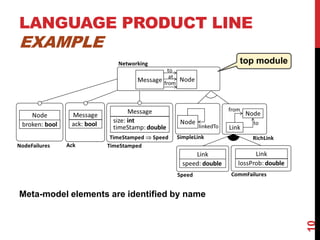
EXAMPLE
9
Meta-model elements are identified by name
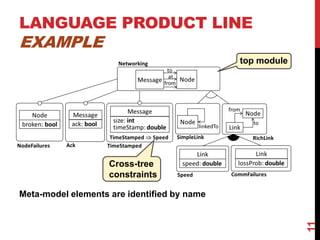
10
Meta-model elements are identified by name
top module
LANGUAGE PRODUCT LINE
EXAMPLE
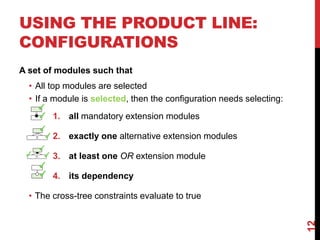
11
Meta-model elements are identified by name
top module
Cross-tree
constraints
LANGUAGE PRODUCT LINE
EXAMPLE
USING THE PRODUCT LINE:
CONFIGURATIONS
12
A set of modules such that
• All top modules are selected
• If a module is selected, then the configuration needs selecting:
1. all mandatory extension modules
2. exactly one alternative extension modules
3. at least one OR extension module
4. its dependency
• The cross-tree constraints evaluate to true
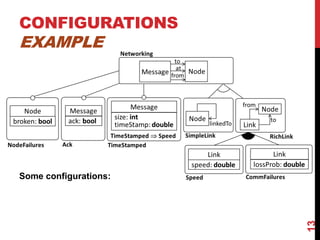
CONFIGURATIONS
EXAMPLE
13
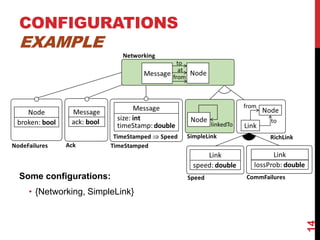
Some configurations:
CONFIGURATIONS
EXAMPLE
14
Some configurations:
• {Networking, SimpleLink}
CONFIGURATIONS
EXAMPLE
15
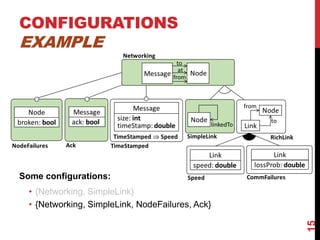
Some configurations:
• {Networking, SimpleLink}
• {Networking, SimpleLink, NodeFailures, Ack}
CONFIGURATIONS
EXAMPLE
16
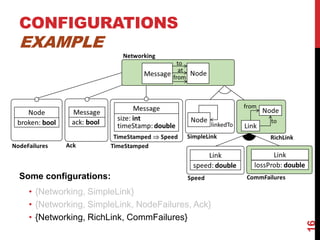
Some configurations:
• {Networking, SimpleLink}
• {Networking, SimpleLink, NodeFailures, Ack}
• {Networking, RichLink, CommFailures}
CONFIGURATIONS
EXAMPLE
17
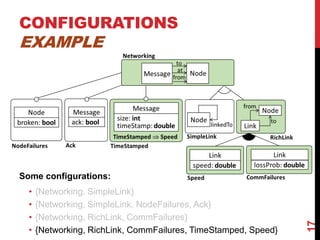
Some configurations:
• {Networking, SimpleLink}
• {Networking, SimpleLink, NodeFailures, Ack}
• {Networking, RichLink, CommFailures}
• {Networking, RichLink, CommFailures, TimeStamped, Speed}
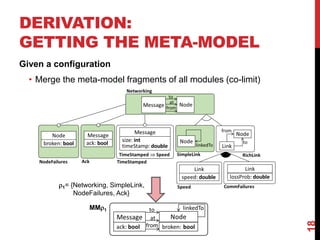
DERIVATION:
GETTING THE META-MODEL
Given a configuration
• Merge the meta-model fragments of all modules (co-limit)
18
1= {Networking, SimpleLink,
NodeFailures, Ack}
MM1
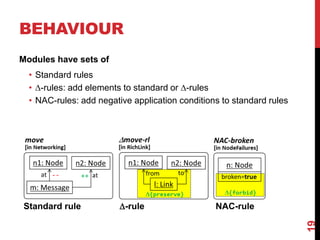
BEHAVIOUR
Modules have sets of
• Standard rules
• -rules: add elements to standard or -rules
• NAC-rules: add negative application conditions to standard rules
19
Standard rule -rule NAC-rule
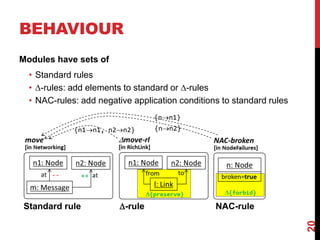
BEHAVIOUR
Modules have sets of
• Standard rules
• -rules: add elements to standard or -rules
• NAC-rules: add negative application conditions to standard rules
20
Standard rule -rule NAC-rule
{n1→n1, n2→n2}
{n→n1}
{n→n2}
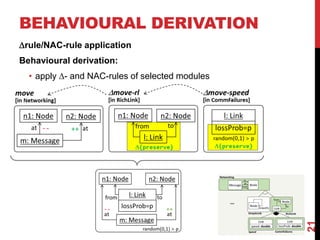
BEHAVIOURAL DERIVATION
rule/NAC-rule application
Behavioural derivation:
• apply - and NAC-rules of selected modules
21
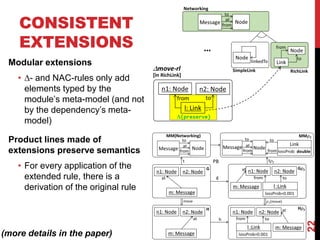
CONSISTENT
EXTENSIONS
Product lines made of
extensions preserve semantics
• For every application of the
extended rule, there is a
derivation of the original rule
22
Modular extensions
• - and NAC-rules only add
elements typed by the
module’s meta-model (and not
by the dependency’s meta-
model)
(more details in the paper)
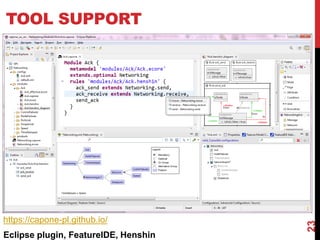
TOOL SUPPORT
23
https://capone-pl.github.io/
Eclipse plugin, FeatureIDE, Henshin
EXPERIMENTS
24
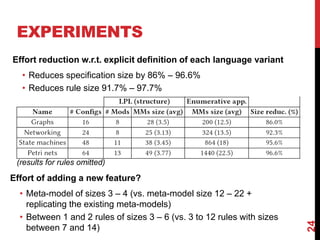
Effort reduction w.r.t. explicit definition of each language variant
• Reduces specification size by 86% – 96.6%
• Reduces rule size 91.7% – 97.7%
Effort of adding a new feature?
• Meta-model of sizes 3 – 4 (vs. meta-model size 12 – 22 +
replicating the existing meta-models)
• Between 1 and 2 rules of sizes 3 – 6 (vs. 3 to 12 rules with sizes
between 7 and 14)
(results for rules omitted)
CONCLUSIONS AND
FUTURE WORK
Modular approach to define language families
• Considers abstract syntax and semantics
Analysis, tool support, experiments
Future Work
• Fine-granular analysis of (in-)consistency
• Effective testing techniques
• Consider richer meta-model notions (e.g., OCL)
• Modules with several dependencies
• Consider concrete syntax
25
https://capone-pl.github.io/
THANKS!
Juan.deLara@uam.es
@miso_uam

Capone.pdf

  • 1.
    MODULAR LANGUAGE PRODUCT LINES AGRAPH TRANSFORMATION APPROACH MODELS’2022, Montreal Juan de Lara1, Esther Guerra1, Paolo Bottoni2 1Universidad Autónoma de Madrid (Spain) 2Sapienza University of Rome (Italy)
  • 2.
    FROM DSLs TO DSLFAMILIES Modelling languages • Essential for engineering disciplines • Model-driven Engineering • Domain-specific Languages (DSLs) Does ONE language fit ALL? • Different users: education, low-code development Example: Class diagrams with different levels of sophistication • Different expressivity: modelling purpose, analyses Example: Petri nets with inhibitor, read arcs, time, colours • Different levels of precision: to support different project phases Example: From sketch-like diagrams to fully precise models Language families! 2
  • 3.
    EXAMPLE A DSL FAMILYFOR NETWORKING 3 Simple link with node failures and acks
  • 4.
    4 Simple link withnode failures and acks Rich links with communication failures EXAMPLE A DSL FAMILY FOR NETWORKING
  • 5.
    5 Simple link withnode failures and acks Rich links with communication failures Rich links with communication failures and time EXAMPLE A DSL FAMILY FOR NETWORKING
  • 6.
    HOW TO DEFINEA LANGUAGE FAMILY? Define each DSL separately (clone & own) • Meta-models and rules share commonalities • Adding a new feature (e.g., ad-hoc networks) doubles the family size Define just one “super-language” with all features • Language difficult to use for users • Unnecessary concepts • What about alternative elements (rich vs. simple links)? 6
  • 7.
    OUR GOAL A techniqueto define and manage DSL families that is • Succinct (much) less effort than specifying each language variant in isolation • Extensible Adding a new variant should be easy, leave existing variants unchanged Incremental language construction • Reusable Specifications of variants as reusable as possible to minimise effort and avoid duplications • Analysable Ensure the behaviour of its variants is compatible with the base behaviour of the language 7
  • 8.
    THE APPROACH 8 ... extension roles optional mandatory alternative or M (dependency) MM rule_i rule_i rulei M1 (extension) MM1 rule_i rule_i rulej Mn (extension) MMn rule_i rule_i rulek roleof Mn in dependency inclusion of MMn in MM {C1→C3,...} {C1→C2,...} rule extension 1 2 3 1 2 3 Language product line Language modules • Meta-model • Transformation rules Module dependencies Module extensions • Extension roles • As in feature models
  • 9.
    LANGUAGE PRODUCT LINE EXAMPLE 9 Meta-modelelements are identified by name
  • 10.
    10 Meta-model elements areidentified by name top module LANGUAGE PRODUCT LINE EXAMPLE
  • 11.
    11 Meta-model elements areidentified by name top module Cross-tree constraints LANGUAGE PRODUCT LINE EXAMPLE
  • 12.
    USING THE PRODUCTLINE: CONFIGURATIONS 12 A set of modules such that • All top modules are selected • If a module is selected, then the configuration needs selecting: 1. all mandatory extension modules 2. exactly one alternative extension modules 3. at least one OR extension module 4. its dependency • The cross-tree constraints evaluate to true
  • 13.
  • 14.
  • 15.
    CONFIGURATIONS EXAMPLE 15 Some configurations: • {Networking,SimpleLink} • {Networking, SimpleLink, NodeFailures, Ack}
  • 16.
    CONFIGURATIONS EXAMPLE 16 Some configurations: • {Networking,SimpleLink} • {Networking, SimpleLink, NodeFailures, Ack} • {Networking, RichLink, CommFailures}
  • 17.
    CONFIGURATIONS EXAMPLE 17 Some configurations: • {Networking,SimpleLink} • {Networking, SimpleLink, NodeFailures, Ack} • {Networking, RichLink, CommFailures} • {Networking, RichLink, CommFailures, TimeStamped, Speed}
  • 18.
    DERIVATION: GETTING THE META-MODEL Givena configuration • Merge the meta-model fragments of all modules (co-limit) 18 1= {Networking, SimpleLink, NodeFailures, Ack} MM1
  • 19.
    BEHAVIOUR Modules have setsof • Standard rules • -rules: add elements to standard or -rules • NAC-rules: add negative application conditions to standard rules 19 Standard rule -rule NAC-rule
  • 20.
    BEHAVIOUR Modules have setsof • Standard rules • -rules: add elements to standard or -rules • NAC-rules: add negative application conditions to standard rules 20 Standard rule -rule NAC-rule {n1→n1, n2→n2} {n→n1} {n→n2}
  • 21.
    BEHAVIOURAL DERIVATION rule/NAC-rule application Behaviouralderivation: • apply - and NAC-rules of selected modules 21
  • 22.
    CONSISTENT EXTENSIONS Product lines madeof extensions preserve semantics • For every application of the extended rule, there is a derivation of the original rule 22 Modular extensions • - and NAC-rules only add elements typed by the module’s meta-model (and not by the dependency’s meta- model) (more details in the paper)
  • 23.
  • 24.
    EXPERIMENTS 24 Effort reduction w.r.t.explicit definition of each language variant • Reduces specification size by 86% – 96.6% • Reduces rule size 91.7% – 97.7% Effort of adding a new feature? • Meta-model of sizes 3 – 4 (vs. meta-model size 12 – 22 + replicating the existing meta-models) • Between 1 and 2 rules of sizes 3 – 6 (vs. 3 to 12 rules with sizes between 7 and 14) (results for rules omitted)
  • 25.
    CONCLUSIONS AND FUTURE WORK Modularapproach to define language families • Considers abstract syntax and semantics Analysis, tool support, experiments Future Work • Fine-granular analysis of (in-)consistency • Effective testing techniques • Consider richer meta-model notions (e.g., OCL) • Modules with several dependencies • Consider concrete syntax 25
  • 26.