ENGINEERING FAMILIES OF
MODELLING LANGUAGES
A TALE OF THREE APPROACHES
MLE’22 @ MODELS, Montreal
Juan de Lara
Universidad Autónoma de Madrid (Spain)
DOMAIN-SPECIFIC
LANGUAGES
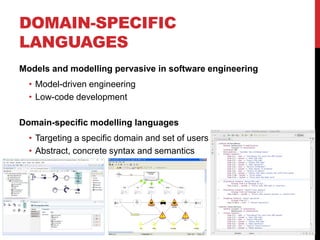
Models and modelling pervasive in software engineering
• Model-driven engineering
• Low-code development
Domain-specific modelling languages
• Targeting a specific domain and set of users
• Abstract, concrete syntax and semantics
2
DOES ONE LANGUAGE FIT ALL?
Users with different backgrounds
• Education, low-code development
Different modelling needs and expressive power
• Variants of Petri nets (w/o inhibitor, read arcs, weights, colours, etc)
Different devices and interaction modalities
• Mobile vs desktop vs digital whiteboard
• Graphical vs textual vs conversational
Different domains
• Generic language, specialized for different domains: educational
process modelling, software process modelling
3
EXAMPLE
LEARNING A FOREIGN LANGUAGE
How do we learn a foreign spoken language?
• Slowly!
• Our sentences will be wrong: syntactic errors, bad pronunciation,
lack of vocabulary
• The recipient (e.g., a teacher) adapts her “parser”, pronunciation,
speed and vocabulary to the level of knowledge of the student
The learning process occurs within a simpler language variant
As learning progresses, the variant used becomes more complex
and complete
4
EXAMPLE
LEARNING A MODELLING LANGUAGE
How do we learn a modelling language (e.g. UML)?
• We present the different primitives of the language to the student
• Examples, exercises
• The student uses an editor (e.g., Eclipse based) that:
Expects the user to be fully proficient with the syntax and
semantics of the language
Presents the user the full language “vocabulary”, even if the
user has no knowledge of it
Is unable to understand “almost correct” models, or may not
even allow to construct or persist them
Makes the “conversation” occur with a full-fledged language
version, and expects the “conversation” to be perfect
5
EXAMPLE
LEARNING A MODELLING LANGUAGE
6
What can we
do about this?
FROM LANGUAGES TO
LANGUAGE FAMILIES
7
Let’s define a
language family to
guide the learning
process!
NAÏVE APPROACHES TO
DEFINE LANGUAGE FAMILIES
Case-by-case approach (clone-and-own)
• Explicitly define each language of the family
• Exponential number of languages w.r.t. features
Class diagram with 4 features (inheritance, composition, aggregation,
interfaces) leads to 24=16 languages
• No reuse, hard to maintain
Big language with all features
• Language too complex for the user
Perhaps that’s precisely what we try to avoid with the family!
• What about alternative features?
8
THREE APPROACHES TO
LANGUAGE FAMILIES
Annotative (superimposition, negative variability)
• Design: Overlap every language variant
• Configuration: Feature model to select the elements that are present
in the language
Compositional (language modules)
• Design: Modules with language features
• Configuration: Select the modules that are present in the language
Multi-level modelling (specialise the language via instantiation)
• Design: Generic language with common primitives for all domains
• Configuration: Specialize the generic primitives for a domain
9
SUPERIMPOSITION
10
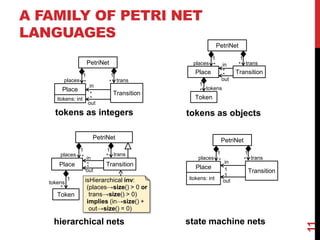
A FAMILY OF PETRI NET
LANGUAGES
11
Place
itokens: int
in
Transition
out
*
*
places
1
* trans
*
1
PetriNet
Place
in
Transition
out
*
*
Token
tokens
*
1
places
1
trans
*
1
PetriNet
*
Place
in
Transition
out
*
*
places
1
* trans
*
1
PetriNet
Token
tokens
*
1 isHierarchical inv:
(places→size() > 0 or
trans→size() > 0)
implies (in→size() +
out→size() = 0)
Place
itokens: int
in
Transition
out
1
1
places
1
trans
1
PetriNet
*
*
tokens as integers tokens as objects
hierarchical nets state machine nets
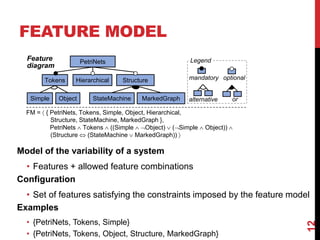
FEATURE MODEL
12
PetriNets
Tokens
Feature
diagram
Simple Object
Hierarchical
FM =  { PetriNets, Tokens, Simple, Object, Hierarchical,
Structure, StateMachine, MarkedGraph },
PetriNets  Tokens  ((Simple  Object)  (Simple  Object)) 
(Structure  (StateMachine  MarkedGraph)) 
Structure
StateMachine MarkedGraph
mandatory optional
alternative or
Legend
Model of the variability of a system
• Features + allowed feature combinations
Configuration
• Set of features satisfying the constraints imposed by the feature model
Examples
• {PetriNets, Tokens, Simple}
• {PetriNets, Tokens, Object, Structure, MarkedGraph}
150% META-MODEL
13
in
isMarkedGraph inv:
Transition.allInstances()
→one(in→includes(self))
and
Transition.allInstances()
→one(out→includes(self))
Place
itokens : int
PetriNet
Transition
out
places
Simple
1
* trans
*
1
Token
tokens *
1
Object
Object isHierarchical inv:
(places→size() > 0 or
trans→size() > 0)
implies (in→size() +
out→size() = 0)
MarkedGraph
StateMachine
[min=1, max=1]
StateMachine
[min=1, max=1]
*
*
net net
not Hierarchical
[del]
Hierarchical
Overlap the meta-models of all language variants
Presence conditions: formulae over the features
Negative variability: remove what is not selected by a configuration
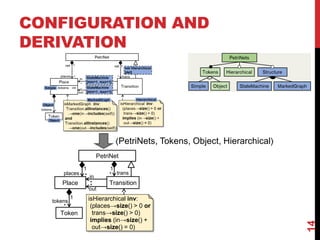
CONFIGURATION AND
DERIVATION
14
Place
in
Transition
out
*
*
places
1
* trans
*
1
PetriNet
Token
tokens
*
1 isHierarchical inv:
(places→size() > 0 or
trans→size() > 0)
implies (in→size() +
out→size() = 0)
⟨PetriNets, Tokens, Object, Hierarchical⟩
(SOME) CHALLENGES
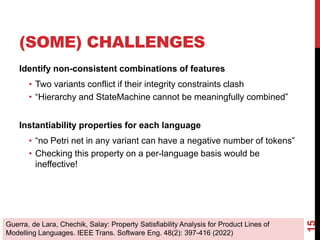
Identify non-consistent combinations of features
• Two variants conflict if their integrity constraints clash
• “Hierarchy and StateMachine cannot be meaningfully combined”
Instantiability properties for each language
• “no Petri net in any variant can have a negative number of tokens”
• Checking this property on a per-language basis would be
ineffective!
15
Guerra, de Lara, Chechik, Salay: Property Satisfiability Analysis for Product Lines of
Modelling Languages. IEEE Trans. Software Eng. 48(2): 397-416 (2022)
VACUOUS FEATURE
COMBINATIONS
16
Place
in
Transition
out
*
*
places
1
* trans
*
1
PetriNet
isHierarchical inv:
(places→size() > 0 or
trans→size() > 0)
implies (in→size() +
out→size() = 0)
Place
itokens: int
in
Transition
out
places
1
trans
1
PetriNet
*
*
hierarchical nets state machine nets
itokens: int +
Place
in
Transition
out
places
1
* trans
*
1
PetriNet
isHierarchical inv:
(places→size() > 0 or
trans→size() > 0)
implies (in→size() +
out→size() = 0)
itokens: int
hierarchical state machine nets
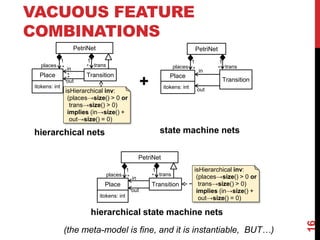
(the meta-model is fine, and it is instantiable, BUT…)
VACUOUS FEATURE
COMBINATIONS
17
pn:PetriNet
t:Transition
:trans
:net
p:Place
:places
:net
card of in = [1..1]
card of out = [1..1]
Place
in
Transition
out
places
1
* trans
*
1
PetriNet
isHierarchical inv:
(places→size() > 0 or
trans→size() > 0)
implies (in→size() +
out→size() = 0)
itokens: int
Hierarchical state machine nets
We cannot exercise the features introduced by “Hierarchical”
• Transition.places and Transition.trans need to be empty
• This means, we cannot really have hierarchical transitions
• Hierachical and StateMachine cannot be meaningfuly combined
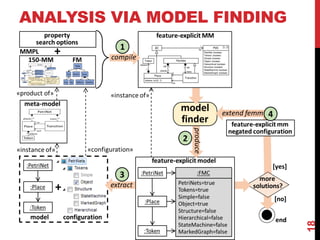
ANALYSIS VIA MODEL FINDING
18
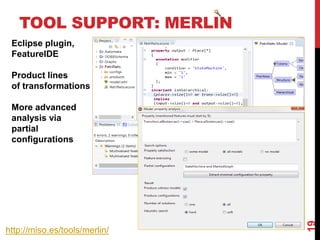
TOOL SUPPORT: MERLIN
19
http://miso.es/tools/merlin/
Eclipse plugin,
FeatureIDE
Product lines
of transformations
More advanced
analysis via
partial
configurations
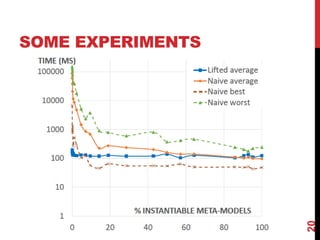
SOME EXPERIMENTS
20
NICE BUT…
21
Doesn’t the 150% meta-model become a “big ugly monster”?
• We can use slicing to visualize parts of it
Is the approach really extensible?
• We still need to dive into the 150% meta-model to add a new
feature, and also change the feature model
22
LANGUAGE MODULES
23
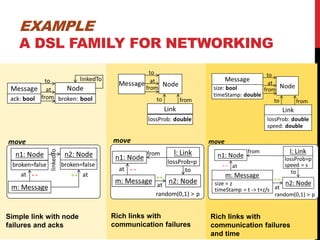
Simple link with node
failures and acks
Rich links with
communication failures
Rich links with
communication failures
and time
EXAMPLE
A DSL FAMILY FOR NETWORKING
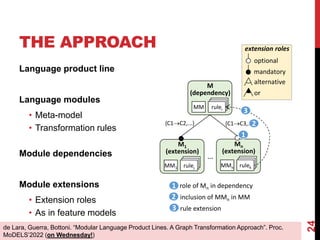
THE APPROACH
24
...
extension roles
optional
mandatory
alternative
or
M
(dependency)
MM
rule_i
rule_i
rulei
M1
(extension)
MM1
rule_i
rule_i
rulej
Mn
(extension)
MMn
rule_i
rule_i
rulek
role of Mn in dependency
inclusion of MMn in MM
{C1→C3,...}
{C1→C2,...}
rule extension
1
2
3
1
2
3
Language product line
Language modules
• Meta-model
• Transformation rules
Module dependencies
Module extensions
• Extension roles
• As in feature models
de Lara, Guerra, Bottoni. “Modular Language Product Lines. A Graph Transformation Approach”. Proc.
MoDELS’2022 (on Wednesday!)
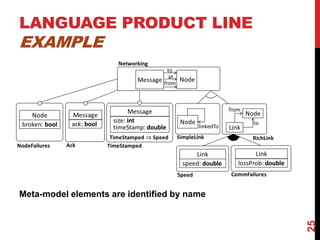
LANGUAGE PRODUCT LINE
EXAMPLE
25
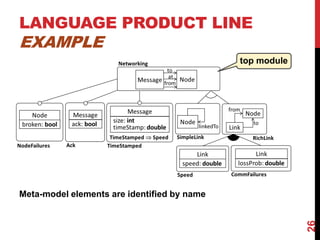
Meta-model elements are identified by name
26
Meta-model elements are identified by name
top module
LANGUAGE PRODUCT LINE
EXAMPLE
27
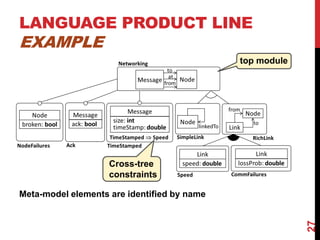
Meta-model elements are identified by name
top module
Cross-tree
constraints
LANGUAGE PRODUCT LINE
EXAMPLE
USING THE PRODUCT LINE:
CONFIGURATIONS
28
A set of modules such that
• All top modules are selected
• If a module is selected, then the configuration needs selecting:
1. all mandatory extension modules
2. exactly one alternative extension modules
3. at least one OR extension module
4. its dependency
• The cross-tree constraints evaluate to true
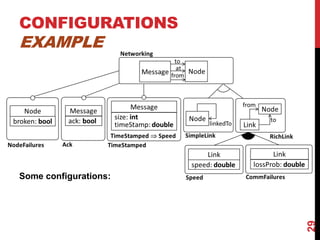
CONFIGURATIONS
EXAMPLE
29
Some configurations:
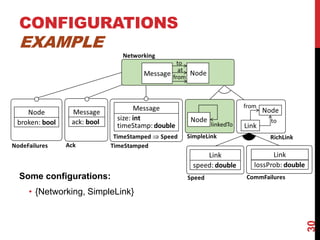
CONFIGURATIONS
EXAMPLE
30
Some configurations:
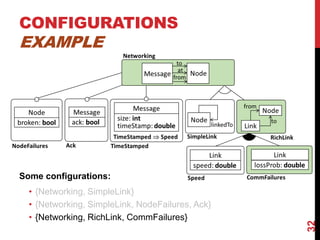
• {Networking, SimpleLink}
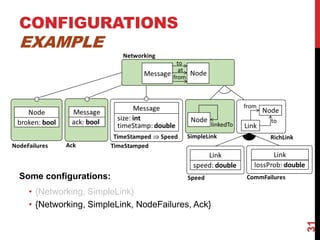
CONFIGURATIONS
EXAMPLE
31
Some configurations:
• {Networking, SimpleLink}
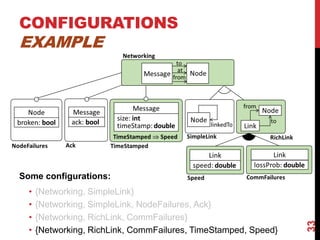
• {Networking, SimpleLink, NodeFailures, Ack}
CONFIGURATIONS
EXAMPLE
32
Some configurations:
• {Networking, SimpleLink}
• {Networking, SimpleLink, NodeFailures, Ack}
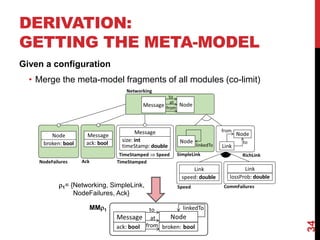
• {Networking, RichLink, CommFailures}
CONFIGURATIONS
EXAMPLE
33
Some configurations:
• {Networking, SimpleLink}
• {Networking, SimpleLink, NodeFailures, Ack}
• {Networking, RichLink, CommFailures}
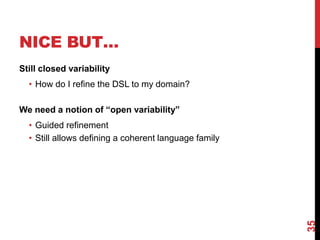
• {Networking, RichLink, CommFailures, TimeStamped, Speed}
DERIVATION:
GETTING THE META-MODEL
Given a configuration
• Merge the meta-model fragments of all modules (co-limit)
34
1= {Networking, SimpleLink,
NodeFailures, Ack}
MM1
NICE BUT…
Still closed variability
• How do I refine the DSL to my domain?
We need a notion of “open variability”
• Guided refinement
• Still allows defining a coherent language family
35
36
MULTI-LEVEL
MODELLING
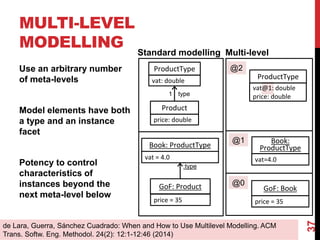
MULTI-LEVEL
MODELLING
Use an arbitrary number
of meta-levels
Model elements have both
a type and an instance
facet
Potency to control
characteristics of
instances beyond the
next meta-level below
37
ProductType
vat: double
Product
price: double
type
1
Book: ProductType
vat = 4.0
:type
GoF: Product
price = 35
ProductType
Book:
ProductType
GoF: Book
vat@1: double
price: double
vat=4.0
price = 35
@2
@1
@0
Standard modelling Multi-level
de Lara, Guerra, Sánchez Cuadrado: When and How to Use Multilevel Modelling. ACM
Trans. Softw. Eng. Methodol. 24(2): 12:1-12:46 (2014)
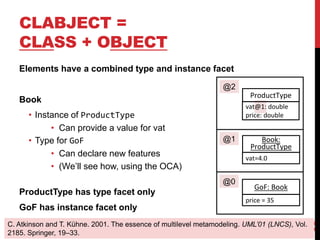
CLABJECT =
CLASS + OBJECT
Elements have a combined type and instance facet
Book
• Instance of ProductType
• Can provide a value for vat
• Type for GoF
• Can declare new features
• (We’ll see how, using the OCA)
ProductType has type facet only
GoF has instance facet only
38
ProductType
Book:
ProductType
GoF: Book
vat@1: double
price: double
vat=4.0
price = 35
@2
@1
@0
C. Atkinson and T. Kühne. 2001. The essence of multilevel metamodeling. UML’01 (LNCS), Vol.
2185. Springer, 19–33.
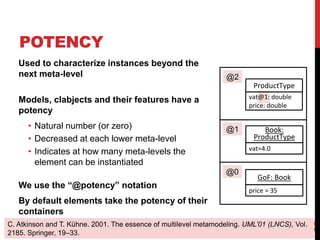
POTENCY
Used to characterize instances beyond the
next meta-level
Models, clabjects and their features have a
potency
• Natural number (or zero)
• Decreased at each lower meta-level
• Indicates at how many meta-levels the
element can be instantiated
We use the “@potency” notation
By default elements take the potency of their
containers
39
ProductType
Book:
ProductType
GoF: Book
vat@1: double
price: double
vat=4.0
price = 35
@2
@1
@0
C. Atkinson and T. Kühne. 2001. The essence of multilevel metamodeling. UML’01 (LNCS), Vol.
2185. Springer, 19–33.
ORTHOGONAL
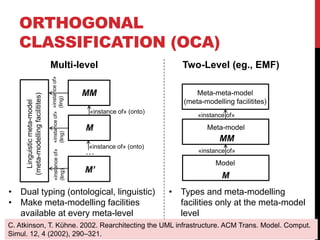
CLASSIFICATION (OCA)
40
Linguistic
meta-model
(meta-modelling
facilitites)
…
Meta-meta-model
(meta-modelling facilitites)
Meta-model
Model
MM
M
MM
M
M’
«instance of» (onto)
«instance
of»
(ling)
«instance
of»
(ling)
«instance
of»
(ling)
«instance of»
«instance of»
• Dual typing (ontological, linguistic)
• Make meta-modelling facilities
available at every meta-level
• Types and meta-modelling
facilities only at the meta-model
level
Multi-level Two-Level (eg., EMF)
C. Atkinson, T. Kühne. 2002. Rearchitecting the UML infrastructure. ACM Trans. Model. Comput.
Simul. 12, 4 (2002), 290–321.
41
ORTHOGONAL
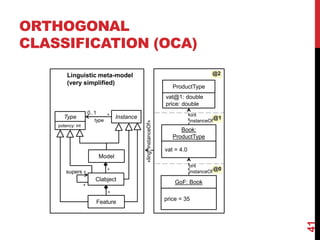
CLASSIFICATION (OCA)
Clabject
*
supers
Instance
Type
potency: int
vat@1: double
price: double
ProductType
vat = 4.0
Book:
ProductType
@1
price = 35
GoF: Book
@0
type
*
*
@2
ont
instanceOf
Linguistic meta-model
(very simplified)
*
Feature
«ling.
instanceOf»
ont
instanceOf
Model
*
0..1
42
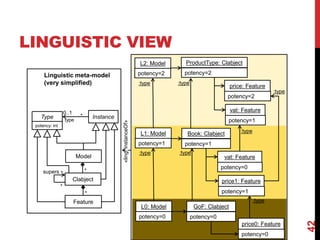
LINGUISTIC VIEW
Clabject
*
supers
Instance
Type
potency: int
type
*
*
Linguistic meta-model
(very simplified)
*
Feature
«ling.
instanceOf»
Model
*
L2: Model
vat: Feature
potency=2
ProductType: Clabject
potency=2
potency=1
price: Feature
potency=2
L1: Model
potency=1
:type
Book: Clabject
potency=1
price1: Feature
potency=1
vat: Feature
potency=0
:type
:type
L0: Model
potency=0
GoF: Clabject
potency=0
price0: Feature
potency=0
:type
:type
:type :type
0..1
de Lara, Guerra. 2010. Deep meta-modelling with
metaDepth. In TOOLS’10 (LNCS), Vol. 6141.
Springer, 1–20.
43
LINGUISTIC
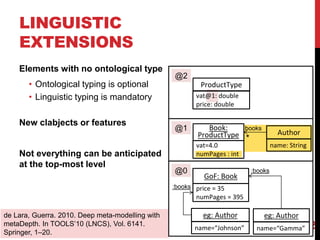
EXTENSIONS
Elements with no ontological type
• Ontological typing is optional
• Linguistic typing is mandatory
New clabjects or features
Not everything can be anticipated
at the top-most level
Author
Book:
ProductType
GoF: Book
vat@1: double
price: double
price = 35
numPages = 395
@2
@1
@0
vat=4.0
numPages : int
ProductType
name: String
books
*
eg: Author
name=“Gamma”
:books
eg: Author
name=“Johnson”
:books
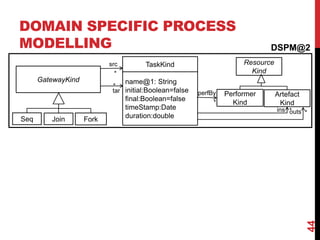
DOMAIN SPECIFIC PROCESS
MODELLING
44
TaskKind Resource
Kind
Performer
Kind
Artefact
Kind
GatewayKind
Seq Join Fork
ins outs
*
src
tar perfBy
*
*
*
*
name@1: String
initial:Boolean=false
final:Boolean=false
timeStamp:Date
duration:double
DSPM@2
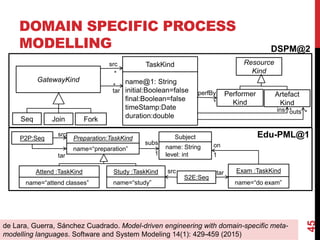
DOMAIN SPECIFIC PROCESS
MODELLING
45
DSPM@2
Attend :TaskKind
name=“attend classes”
Study :TaskKind
name=“study”
Preparation:TaskKind
name=“preparation”
P2P:Seq
Exam :TaskKind
name=“do exam”
S2E:Seq
Subject
name: String
level: int
subs
1
on
1
src
tar
src tar
TaskKind Resource
Kind
Performer
Kind
Artefact
Kind
GatewayKind
Seq Join Fork
ins outs
*
src
tar perfBy
*
*
*
*
name@1: String
initial:Boolean=false
final:Boolean=false
timeStamp:Date
duration:double
Edu-PML@1
de Lara, Guerra, Sánchez Cuadrado. Model-driven engineering with domain-specific meta-
modelling languages. Software and System Modeling 14(1): 429-459 (2015)
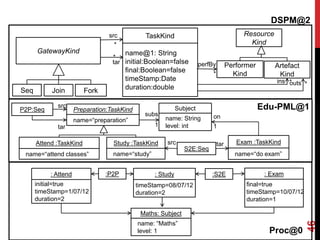
46
DSPM@2
Attend :TaskKind
name=“attend classes”
Study :TaskKind
name=“study”
Preparation:TaskKind
name=“preparation”
P2P:Seq
Exam :TaskKind
name=“do exam”
S2E:Seq
Subject
name: String
level: int
subs
1
on
1
src
tar
src tar
TaskKind Resource
Kind
Performer
Kind
Artefact
Kind
GatewayKind
Seq Join Fork
ins outs
*
src
tar perfBy
*
*
*
*
name@1: String
initial:Boolean=false
final:Boolean=false
timeStamp:Date
duration:double
Maths: Subject
name: “Maths”
level: 1
: Attend : Study : Exam
:P2P :S2E
initial=true
timeStamp=1/07/12
duration=2
timeStamp=08/07/12
duration=2
final=true
timeStamp=10/07/12
duration=1
Edu-PML@1
Proc@0
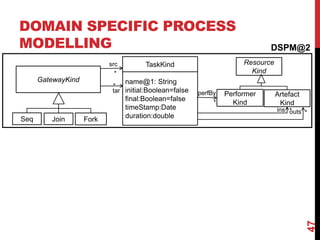
DOMAIN SPECIFIC PROCESS
MODELLING
47
TaskKind Resource
Kind
Performer
Kind
Artefact
Kind
GatewayKind
Seq Join Fork
ins outs
*
src
tar perfBy
*
*
*
*
name@1: String
initial:Boolean=false
final:Boolean=false
timeStamp:Date
duration:double
DSPM@2
DOMAIN SPECIFIC PROCESS
MODELLING
48
DSPM@2
TaskKind Resource
Kind
Performer
Kind
Artefact
Kind
GatewayKind
Seq Join Fork
ins outs
*
src
tar perfBy
*
*
*
*
name@1: String
initial:Boolean=false
final:Boolean=false
timeStamp:Date
duration:double
Soft-PML@1
Coding: TaskKind tests: next
1..*
Testing: TaskKind
name=“testing”
SoftwareEngineer:
PerformerKind
actor: perfBy
@1
SETask: TaskKind
*
Programmer:
PerformerKind
Tester:
PerformerKind
skills: String[*]
name=“se-task”
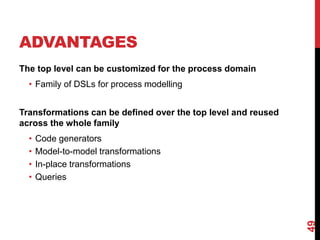
ADVANTAGES
The top level can be customized for the process domain
• Family of DSLs for process modelling
Transformations can be defined over the top level and reused
across the whole family
• Code generators
• Model-to-model transformations
• In-place transformations
• Queries
49
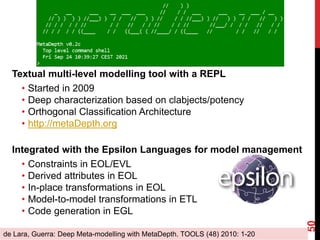
Textual multi-level modelling tool with a REPL
• Started in 2009
• Deep characterization based on clabjects/potency
• Orthogonal Classification Architecture
• http://metaDepth.org
Integrated with the Epsilon Languages for model management
• Constraints in EOL/EVL
• Derived attributes in EOL
• In-place transformations in EOL
• Model-to-model transformations in ETL
• Code generation in EGL
50
de Lara, Guerra: Deep Meta-modelling with MetaDepth. TOOLS (48) 2010: 1-20
51
DISCUSSION AND
OPEN LINES
52
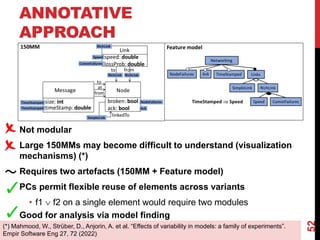
ANNOTATIVE
APPROACH
Not modular
Large 150MMs may become difficult to understand (visualization
mechanisms) (*)
Requires two artefacts (150MM + Feature model)
PCs permit flexible reuse of elements across variants
• f1  f2 on a single element would require two modules
Good for analysis via model finding
(*) Mahmood, W., Strüber, D., Anjorin, A. et al. “Effects of variability in models: a family of experiments”.
Empir Software Eng 27, 72 (2022)
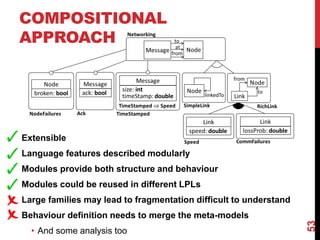
COMPOSITIONAL
APPROACH
Extensible
Language features described modularly
Modules provide both structure and behaviour
Modules could be reused in different LPLs
Large families may lead to fragmentation difficult to understand
Behaviour definition needs to merge the meta-models
• And some analysis too
53
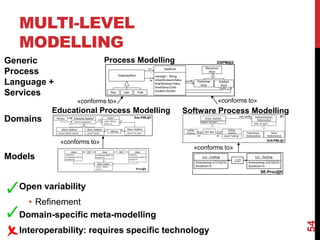
MULTI-LEVEL
MODELLING
Open variability
• Refinement
Domain-specific meta-modelling
Interoperability: requires specific technology
54
Generic
Process
Language +
Services
Domains
Models
Process Modelling
Educational Process Modelling Software Process Modelling
«conforms to» «conforms to»
«conforms to»
«conforms to»
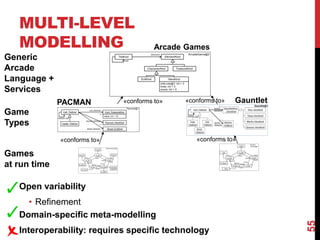
MULTI-LEVEL
MODELLING
Open variability
• Refinement
Domain-specific meta-modelling
Interoperability: requires specific technology
55
Generic
Arcade
Language +
Services
Game
Types
Games
at run time
Arcade Games
PACMAN Gauntlet
«conforms to» «conforms to»
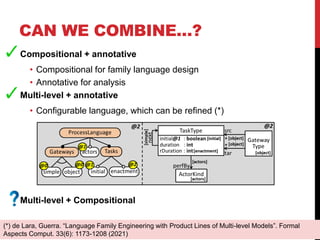
CAN WE COMBINE…?
Compositional + annotative
• Compositional for family language design
• Annotative for analysis
Multi-level + annotative
• Configurable language, which can be refined (*)
Multi-level + Compositional
56
(*) de Lara, Guerra. “Language Family Engineering with Product Lines of Multi-level Models”. Formal
Aspects Comput. 33(6): 1173-1208 (2021)
OPEN LINES
Techniques
• Analysis
• Concrete syntax
• Combination open + closed
Applications for
• Education (akin to gradual programming languages*)
• Low-code development to support citizen developers with wide range
of skills
57
(*) https://www.hedycode.com/
THANKS!
Juan.deLara@uam.es
@miso_uam
Thanks to my co-authors: Marsha Chechik, Esther Guerra, Rick Salay, Jesús
Sánchez Cuadrado

MLE_keynote.pdf

  • 1.
    ENGINEERING FAMILIES OF MODELLINGLANGUAGES A TALE OF THREE APPROACHES MLE’22 @ MODELS, Montreal Juan de Lara Universidad Autónoma de Madrid (Spain)
  • 2.
    DOMAIN-SPECIFIC LANGUAGES Models and modellingpervasive in software engineering • Model-driven engineering • Low-code development Domain-specific modelling languages • Targeting a specific domain and set of users • Abstract, concrete syntax and semantics 2
  • 3.
    DOES ONE LANGUAGEFIT ALL? Users with different backgrounds • Education, low-code development Different modelling needs and expressive power • Variants of Petri nets (w/o inhibitor, read arcs, weights, colours, etc) Different devices and interaction modalities • Mobile vs desktop vs digital whiteboard • Graphical vs textual vs conversational Different domains • Generic language, specialized for different domains: educational process modelling, software process modelling 3
  • 4.
    EXAMPLE LEARNING A FOREIGNLANGUAGE How do we learn a foreign spoken language? • Slowly! • Our sentences will be wrong: syntactic errors, bad pronunciation, lack of vocabulary • The recipient (e.g., a teacher) adapts her “parser”, pronunciation, speed and vocabulary to the level of knowledge of the student The learning process occurs within a simpler language variant As learning progresses, the variant used becomes more complex and complete 4
  • 5.
    EXAMPLE LEARNING A MODELLINGLANGUAGE How do we learn a modelling language (e.g. UML)? • We present the different primitives of the language to the student • Examples, exercises • The student uses an editor (e.g., Eclipse based) that: Expects the user to be fully proficient with the syntax and semantics of the language Presents the user the full language “vocabulary”, even if the user has no knowledge of it Is unable to understand “almost correct” models, or may not even allow to construct or persist them Makes the “conversation” occur with a full-fledged language version, and expects the “conversation” to be perfect 5
  • 6.
    EXAMPLE LEARNING A MODELLINGLANGUAGE 6 What can we do about this?
  • 7.
    FROM LANGUAGES TO LANGUAGEFAMILIES 7 Let’s define a language family to guide the learning process!
  • 8.
    NAÏVE APPROACHES TO DEFINELANGUAGE FAMILIES Case-by-case approach (clone-and-own) • Explicitly define each language of the family • Exponential number of languages w.r.t. features Class diagram with 4 features (inheritance, composition, aggregation, interfaces) leads to 24=16 languages • No reuse, hard to maintain Big language with all features • Language too complex for the user Perhaps that’s precisely what we try to avoid with the family! • What about alternative features? 8
  • 9.
    THREE APPROACHES TO LANGUAGEFAMILIES Annotative (superimposition, negative variability) • Design: Overlap every language variant • Configuration: Feature model to select the elements that are present in the language Compositional (language modules) • Design: Modules with language features • Configuration: Select the modules that are present in the language Multi-level modelling (specialise the language via instantiation) • Design: Generic language with common primitives for all domains • Configuration: Specialize the generic primitives for a domain 9
  • 10.
  • 11.
    A FAMILY OFPETRI NET LANGUAGES 11 Place itokens: int in Transition out * * places 1 * trans * 1 PetriNet Place in Transition out * * Token tokens * 1 places 1 trans * 1 PetriNet * Place in Transition out * * places 1 * trans * 1 PetriNet Token tokens * 1 isHierarchical inv: (places→size() > 0 or trans→size() > 0) implies (in→size() + out→size() = 0) Place itokens: int in Transition out 1 1 places 1 trans 1 PetriNet * * tokens as integers tokens as objects hierarchical nets state machine nets
  • 12.
    FEATURE MODEL 12 PetriNets Tokens Feature diagram Simple Object Hierarchical FM=  { PetriNets, Tokens, Simple, Object, Hierarchical, Structure, StateMachine, MarkedGraph }, PetriNets  Tokens  ((Simple  Object)  (Simple  Object))  (Structure  (StateMachine  MarkedGraph))  Structure StateMachine MarkedGraph mandatory optional alternative or Legend Model of the variability of a system • Features + allowed feature combinations Configuration • Set of features satisfying the constraints imposed by the feature model Examples • {PetriNets, Tokens, Simple} • {PetriNets, Tokens, Object, Structure, MarkedGraph}
  • 13.
    150% META-MODEL 13 in isMarkedGraph inv: Transition.allInstances() →one(in→includes(self)) and Transition.allInstances() →one(out→includes(self)) Place itokens: int PetriNet Transition out places Simple 1 * trans * 1 Token tokens * 1 Object Object isHierarchical inv: (places→size() > 0 or trans→size() > 0) implies (in→size() + out→size() = 0) MarkedGraph StateMachine [min=1, max=1] StateMachine [min=1, max=1] * * net net not Hierarchical [del] Hierarchical Overlap the meta-models of all language variants Presence conditions: formulae over the features Negative variability: remove what is not selected by a configuration
  • 14.
    CONFIGURATION AND DERIVATION 14 Place in Transition out * * places 1 * trans * 1 PetriNet Token tokens * 1isHierarchical inv: (places→size() > 0 or trans→size() > 0) implies (in→size() + out→size() = 0) ⟨PetriNets, Tokens, Object, Hierarchical⟩
  • 15.
    (SOME) CHALLENGES Identify non-consistentcombinations of features • Two variants conflict if their integrity constraints clash • “Hierarchy and StateMachine cannot be meaningfully combined” Instantiability properties for each language • “no Petri net in any variant can have a negative number of tokens” • Checking this property on a per-language basis would be ineffective! 15 Guerra, de Lara, Chechik, Salay: Property Satisfiability Analysis for Product Lines of Modelling Languages. IEEE Trans. Software Eng. 48(2): 397-416 (2022)
  • 16.
    VACUOUS FEATURE COMBINATIONS 16 Place in Transition out * * places 1 * trans * 1 PetriNet isHierarchicalinv: (places→size() > 0 or trans→size() > 0) implies (in→size() + out→size() = 0) Place itokens: int in Transition out places 1 trans 1 PetriNet * * hierarchical nets state machine nets itokens: int + Place in Transition out places 1 * trans * 1 PetriNet isHierarchical inv: (places→size() > 0 or trans→size() > 0) implies (in→size() + out→size() = 0) itokens: int hierarchical state machine nets (the meta-model is fine, and it is instantiable, BUT…)
  • 17.
    VACUOUS FEATURE COMBINATIONS 17 pn:PetriNet t:Transition :trans :net p:Place :places :net card ofin = [1..1] card of out = [1..1] Place in Transition out places 1 * trans * 1 PetriNet isHierarchical inv: (places→size() > 0 or trans→size() > 0) implies (in→size() + out→size() = 0) itokens: int Hierarchical state machine nets We cannot exercise the features introduced by “Hierarchical” • Transition.places and Transition.trans need to be empty • This means, we cannot really have hierarchical transitions • Hierachical and StateMachine cannot be meaningfuly combined
  • 18.
  • 19.
    TOOL SUPPORT: MERLIN 19 http://miso.es/tools/merlin/ Eclipseplugin, FeatureIDE Product lines of transformations More advanced analysis via partial configurations
  • 20.
  • 21.
    NICE BUT… 21 Doesn’t the150% meta-model become a “big ugly monster”? • We can use slicing to visualize parts of it Is the approach really extensible? • We still need to dive into the 150% meta-model to add a new feature, and also change the feature model
  • 22.
  • 23.
    23 Simple link withnode failures and acks Rich links with communication failures Rich links with communication failures and time EXAMPLE A DSL FAMILY FOR NETWORKING
  • 24.
    THE APPROACH 24 ... extension roles optional mandatory alternative or M (dependency) MM rule_i rule_i rulei M1 (extension) MM1 rule_i rule_i rulej Mn (extension) MMn rule_i rule_i rulek roleof Mn in dependency inclusion of MMn in MM {C1→C3,...} {C1→C2,...} rule extension 1 2 3 1 2 3 Language product line Language modules • Meta-model • Transformation rules Module dependencies Module extensions • Extension roles • As in feature models de Lara, Guerra, Bottoni. “Modular Language Product Lines. A Graph Transformation Approach”. Proc. MoDELS’2022 (on Wednesday!)
  • 25.
    LANGUAGE PRODUCT LINE EXAMPLE 25 Meta-modelelements are identified by name
  • 26.
    26 Meta-model elements areidentified by name top module LANGUAGE PRODUCT LINE EXAMPLE
  • 27.
    27 Meta-model elements areidentified by name top module Cross-tree constraints LANGUAGE PRODUCT LINE EXAMPLE
  • 28.
    USING THE PRODUCTLINE: CONFIGURATIONS 28 A set of modules such that • All top modules are selected • If a module is selected, then the configuration needs selecting: 1. all mandatory extension modules 2. exactly one alternative extension modules 3. at least one OR extension module 4. its dependency • The cross-tree constraints evaluate to true
  • 29.
  • 30.
  • 31.
    CONFIGURATIONS EXAMPLE 31 Some configurations: • {Networking,SimpleLink} • {Networking, SimpleLink, NodeFailures, Ack}
  • 32.
    CONFIGURATIONS EXAMPLE 32 Some configurations: • {Networking,SimpleLink} • {Networking, SimpleLink, NodeFailures, Ack} • {Networking, RichLink, CommFailures}
  • 33.
    CONFIGURATIONS EXAMPLE 33 Some configurations: • {Networking,SimpleLink} • {Networking, SimpleLink, NodeFailures, Ack} • {Networking, RichLink, CommFailures} • {Networking, RichLink, CommFailures, TimeStamped, Speed}
  • 34.
    DERIVATION: GETTING THE META-MODEL Givena configuration • Merge the meta-model fragments of all modules (co-limit) 34 1= {Networking, SimpleLink, NodeFailures, Ack} MM1
  • 35.
    NICE BUT… Still closedvariability • How do I refine the DSL to my domain? We need a notion of “open variability” • Guided refinement • Still allows defining a coherent language family 35
  • 36.
  • 37.
    MULTI-LEVEL MODELLING Use an arbitrarynumber of meta-levels Model elements have both a type and an instance facet Potency to control characteristics of instances beyond the next meta-level below 37 ProductType vat: double Product price: double type 1 Book: ProductType vat = 4.0 :type GoF: Product price = 35 ProductType Book: ProductType GoF: Book vat@1: double price: double vat=4.0 price = 35 @2 @1 @0 Standard modelling Multi-level de Lara, Guerra, Sánchez Cuadrado: When and How to Use Multilevel Modelling. ACM Trans. Softw. Eng. Methodol. 24(2): 12:1-12:46 (2014)
  • 38.
    CLABJECT = CLASS +OBJECT Elements have a combined type and instance facet Book • Instance of ProductType • Can provide a value for vat • Type for GoF • Can declare new features • (We’ll see how, using the OCA) ProductType has type facet only GoF has instance facet only 38 ProductType Book: ProductType GoF: Book vat@1: double price: double vat=4.0 price = 35 @2 @1 @0 C. Atkinson and T. Kühne. 2001. The essence of multilevel metamodeling. UML’01 (LNCS), Vol. 2185. Springer, 19–33.
  • 39.
    POTENCY Used to characterizeinstances beyond the next meta-level Models, clabjects and their features have a potency • Natural number (or zero) • Decreased at each lower meta-level • Indicates at how many meta-levels the element can be instantiated We use the “@potency” notation By default elements take the potency of their containers 39 ProductType Book: ProductType GoF: Book vat@1: double price: double vat=4.0 price = 35 @2 @1 @0 C. Atkinson and T. Kühne. 2001. The essence of multilevel metamodeling. UML’01 (LNCS), Vol. 2185. Springer, 19–33.
  • 40.
    ORTHOGONAL CLASSIFICATION (OCA) 40 Linguistic meta-model (meta-modelling facilitites) … Meta-meta-model (meta-modelling facilitites) Meta-model Model MM M MM M M’ «instanceof» (onto) «instance of» (onto) «instance of» (ling) «instance of» (ling) «instance of» (ling) «instance of» «instance of» • Dual typing (ontological, linguistic) • Make meta-modelling facilities available at every meta-level • Types and meta-modelling facilities only at the meta-model level Multi-level Two-Level (eg., EMF) C. Atkinson, T. Kühne. 2002. Rearchitecting the UML infrastructure. ACM Trans. Model. Comput. Simul. 12, 4 (2002), 290–321.
  • 41.
    41 ORTHOGONAL CLASSIFICATION (OCA) Clabject * supers Instance Type potency: int vat@1:double price: double ProductType vat = 4.0 Book: ProductType @1 price = 35 GoF: Book @0 type * * @2 ont instanceOf Linguistic meta-model (very simplified) * Feature «ling. instanceOf» ont instanceOf Model * 0..1
  • 42.
    42 LINGUISTIC VIEW Clabject * supers Instance Type potency: int type * * Linguisticmeta-model (very simplified) * Feature «ling. instanceOf» Model * L2: Model vat: Feature potency=2 ProductType: Clabject potency=2 potency=1 price: Feature potency=2 L1: Model potency=1 :type Book: Clabject potency=1 price1: Feature potency=1 vat: Feature potency=0 :type :type L0: Model potency=0 GoF: Clabject potency=0 price0: Feature potency=0 :type :type :type :type 0..1
  • 43.
    de Lara, Guerra.2010. Deep meta-modelling with metaDepth. In TOOLS’10 (LNCS), Vol. 6141. Springer, 1–20. 43 LINGUISTIC EXTENSIONS Elements with no ontological type • Ontological typing is optional • Linguistic typing is mandatory New clabjects or features Not everything can be anticipated at the top-most level Author Book: ProductType GoF: Book vat@1: double price: double price = 35 numPages = 395 @2 @1 @0 vat=4.0 numPages : int ProductType name: String books * eg: Author name=“Gamma” :books eg: Author name=“Johnson” :books
  • 44.
    DOMAIN SPECIFIC PROCESS MODELLING 44 TaskKindResource Kind Performer Kind Artefact Kind GatewayKind Seq Join Fork ins outs * src tar perfBy * * * * name@1: String initial:Boolean=false final:Boolean=false timeStamp:Date duration:double DSPM@2
  • 45.
    DOMAIN SPECIFIC PROCESS MODELLING 45 DSPM@2 Attend:TaskKind name=“attend classes” Study :TaskKind name=“study” Preparation:TaskKind name=“preparation” P2P:Seq Exam :TaskKind name=“do exam” S2E:Seq Subject name: String level: int subs 1 on 1 src tar src tar TaskKind Resource Kind Performer Kind Artefact Kind GatewayKind Seq Join Fork ins outs * src tar perfBy * * * * name@1: String initial:Boolean=false final:Boolean=false timeStamp:Date duration:double Edu-PML@1 de Lara, Guerra, Sánchez Cuadrado. Model-driven engineering with domain-specific meta- modelling languages. Software and System Modeling 14(1): 429-459 (2015)
  • 46.
    46 DSPM@2 Attend :TaskKind name=“attend classes” Study:TaskKind name=“study” Preparation:TaskKind name=“preparation” P2P:Seq Exam :TaskKind name=“do exam” S2E:Seq Subject name: String level: int subs 1 on 1 src tar src tar TaskKind Resource Kind Performer Kind Artefact Kind GatewayKind Seq Join Fork ins outs * src tar perfBy * * * * name@1: String initial:Boolean=false final:Boolean=false timeStamp:Date duration:double Maths: Subject name: “Maths” level: 1 : Attend : Study : Exam :P2P :S2E initial=true timeStamp=1/07/12 duration=2 timeStamp=08/07/12 duration=2 final=true timeStamp=10/07/12 duration=1 Edu-PML@1 Proc@0
  • 47.
    DOMAIN SPECIFIC PROCESS MODELLING 47 TaskKindResource Kind Performer Kind Artefact Kind GatewayKind Seq Join Fork ins outs * src tar perfBy * * * * name@1: String initial:Boolean=false final:Boolean=false timeStamp:Date duration:double DSPM@2
  • 48.
    DOMAIN SPECIFIC PROCESS MODELLING 48 DSPM@2 TaskKindResource Kind Performer Kind Artefact Kind GatewayKind Seq Join Fork ins outs * src tar perfBy * * * * name@1: String initial:Boolean=false final:Boolean=false timeStamp:Date duration:double Soft-PML@1 Coding: TaskKind tests: next 1..* Testing: TaskKind name=“testing” SoftwareEngineer: PerformerKind actor: perfBy @1 SETask: TaskKind * Programmer: PerformerKind Tester: PerformerKind skills: String[*] name=“se-task”
  • 49.
    ADVANTAGES The top levelcan be customized for the process domain • Family of DSLs for process modelling Transformations can be defined over the top level and reused across the whole family • Code generators • Model-to-model transformations • In-place transformations • Queries 49
  • 50.
    Textual multi-level modellingtool with a REPL • Started in 2009 • Deep characterization based on clabjects/potency • Orthogonal Classification Architecture • http://metaDepth.org Integrated with the Epsilon Languages for model management • Constraints in EOL/EVL • Derived attributes in EOL • In-place transformations in EOL • Model-to-model transformations in ETL • Code generation in EGL 50 de Lara, Guerra: Deep Meta-modelling with MetaDepth. TOOLS (48) 2010: 1-20
  • 51.
  • 52.
    52 ANNOTATIVE APPROACH Not modular Large 150MMsmay become difficult to understand (visualization mechanisms) (*) Requires two artefacts (150MM + Feature model) PCs permit flexible reuse of elements across variants • f1  f2 on a single element would require two modules Good for analysis via model finding (*) Mahmood, W., Strüber, D., Anjorin, A. et al. “Effects of variability in models: a family of experiments”. Empir Software Eng 27, 72 (2022)
  • 53.
    COMPOSITIONAL APPROACH Extensible Language features describedmodularly Modules provide both structure and behaviour Modules could be reused in different LPLs Large families may lead to fragmentation difficult to understand Behaviour definition needs to merge the meta-models • And some analysis too 53
  • 54.
    MULTI-LEVEL MODELLING Open variability • Refinement Domain-specificmeta-modelling Interoperability: requires specific technology 54 Generic Process Language + Services Domains Models Process Modelling Educational Process Modelling Software Process Modelling «conforms to» «conforms to» «conforms to» «conforms to»
  • 55.
    MULTI-LEVEL MODELLING Open variability • Refinement Domain-specificmeta-modelling Interoperability: requires specific technology 55 Generic Arcade Language + Services Game Types Games at run time Arcade Games PACMAN Gauntlet «conforms to» «conforms to» «conforms to» «conforms to»
  • 56.
    CAN WE COMBINE…? Compositional+ annotative • Compositional for family language design • Annotative for analysis Multi-level + annotative • Configurable language, which can be refined (*) Multi-level + Compositional 56 (*) de Lara, Guerra. “Language Family Engineering with Product Lines of Multi-level Models”. Formal Aspects Comput. 33(6): 1173-1208 (2021)
  • 57.
    OPEN LINES Techniques • Analysis •Concrete syntax • Combination open + closed Applications for • Education (akin to gradual programming languages*) • Low-code development to support citizen developers with wide range of skills 57 (*) https://www.hedycode.com/
  • 58.
    THANKS! Juan.deLara@uam.es @miso_uam Thanks to myco-authors: Marsha Chechik, Esther Guerra, Rick Salay, Jesús Sánchez Cuadrado