AN OVERVIEW OF MDE
RESEARCH ACTIVITIES IN
THE MISO GROUP
Computer Science Department
Universidad Autónoma de Madrid (Spain)
http://miso.es
@miso_uam
Esther Guerra, Juan de Lara
McGill U - 9th Feb 2018
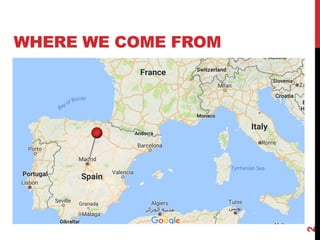
WHERE WE COME FROM
2
THE AUTONOMOUS
UNIVERSITY OF MADRID
3
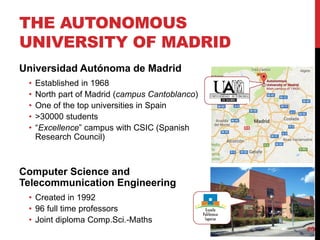
Universidad Autónoma de Madrid
• Established in 1968
• North part of Madrid (campus Cantoblanco)
• One of the top universities in Spain
• >30000 students
• “Excellence” campus with CSIC (Spanish
Research Council)
Computer Science and
Telecommunication Engineering
• Created in 1992
• 96 full time professors
• Joint diploma Comp.Sci.-Maths
THE MISO GROUP
Modelling and Software Engineering Research Group
Professors:
• Juan de Lara, PhD
• Esther Guerra, PhD
• Elena Gómez, PhD
Researchers:
• Jesús Sánchez, PhD (external)
• Jesús Juan López, PhD (external)
• Antonio Garmendia (FPI)
• Pablo Gómez (research associate)
• Mario González (research associate)
• Ángel Mora (FPU)
• Javier Palomares (research associate)
• Sara Pérez (research associate)
• Santiago Jácome (U. Fuerzas Armadas, Ecuador)
4
http://miso.es
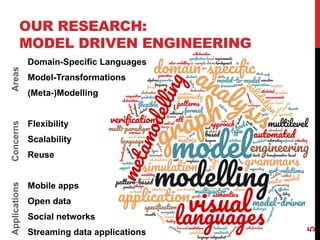
OUR RESEARCH:
MODEL DRIVEN ENGINEERING
Domain-Specific Languages
Model-Transformations
(Meta-)Modelling
Flexibility
Scalability
Reuse
Mobile apps
Open data
Social networks
Streaming data applications
5
AreasConcernsApplications
SOME BITS OF OUR
RESEARCH FOR TODAY
(Meta-)Modelling
• Multi-level modelling
• A-posteriori typing
• Modelling through social networks
Domain-Specific Languages
• Active DSLs
• DSLs by example
• Pattern-based development of DSLs
Transformations
• Verification
• Reuse
6
(Meta-)
modelling
7
MULTI-LEVEL MODELLING (1/2)
8
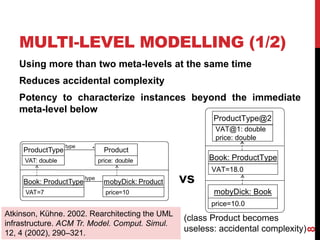
Using more than two meta-levels at the same time
Reduces accidental complexity
Potency to characterize instances beyond the immediate
meta-level below
ProductType@2
VAT@1: double
price: double
Book: ProductType
VAT=18.0
price=10.0
mobyDick: Book
vs
(class Product becomes
useless: accidental complexity)
Atkinson, Kühne. 2002. Rearchitecting the UML
infrastructure. ACM Tr. Model. Comput. Simul.
12, 4 (2002), 290–321.
MULTI-LEVEL MODELLING (2/2)
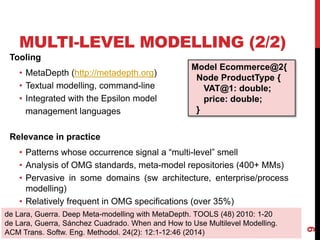
Tooling
• MetaDepth (http://metadepth.org)
• Textual modelling, command-line
• Integrated with the Epsilon model
management languages
Relevance in practice
• Patterns whose occurrence signal a “multi-level” smell
• Analysis of OMG standards, meta-model repositories (400+ MMs)
• Pervasive in some domains (sw architecture, enterprise/process
modelling)
• Relatively frequent in OMG specifications (over 35%)
9
de Lara, Guerra. Deep Meta-modelling with MetaDepth. TOOLS (48) 2010: 1-20
de Lara, Guerra, Sánchez Cuadrado. When and How to Use Multilevel Modelling.
ACM Trans. Softw. Eng. Methodol. 24(2): 12:1-12:46 (2014)
Model Ecommerce@2{
Node ProductType {
VAT@1: double;
price: double;
}
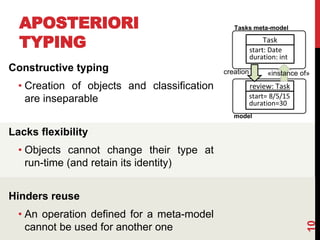
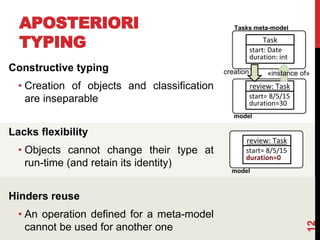
Constructive typing
• Creation of objects and classification
are inseparable
Lacks flexibility
• Objects cannot change their type at
run-time (and retain its identity)
Hinders reuse
• An operation defined for a meta-model
cannot be used for another one
APOSTERIORI
TYPING
10
Task
start: Date
duration: int
review: Task
start= 8/5/15
duration=30
creation «instance of»
Tasks meta-model
model
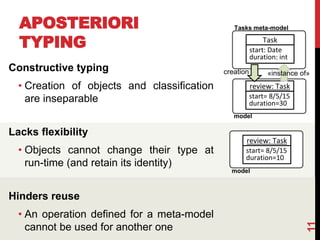
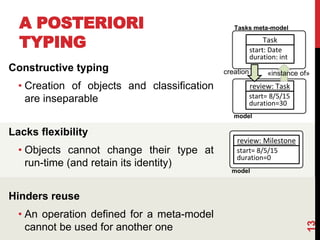
Constructive typing
• Creation of objects and classification
are inseparable
Lacks flexibility
• Objects cannot change their type at
run-time (and retain its identity)
Hinders reuse
• An operation defined for a meta-model
cannot be used for another one
APOSTERIORI
TYPING
11
review: Task
start= 8/5/15
duration=10
model
Task
start: Date
duration: int
review: Task
start= 8/5/15
duration=30
creation «instance of»
Tasks meta-model
model
Constructive typing
• Creation of objects and classification
are inseparable
Lacks flexibility
• Objects cannot change their type at
run-time (and retain its identity)
Hinders reuse
• An operation defined for a meta-model
cannot be used for another one
APOSTERIORI
TYPING
12
Task
start: Date
duration: int
review: Task
start= 8/5/15
duration=30
creation «instance of»
Tasks meta-model
model
review: Task
start= 8/5/15
duration=0
model
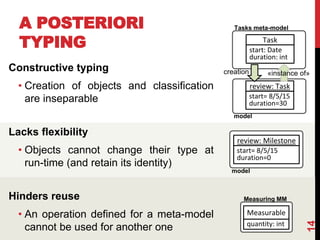
Constructive typing
• Creation of objects and classification
are inseparable
Lacks flexibility
• Objects cannot change their type at
run-time (and retain its identity)
Hinders reuse
• An operation defined for a meta-model
cannot be used for another one
A POSTERIORI
TYPING
13
Task
start: Date
duration: int
review: Task
start= 8/5/15
duration=30
creation «instance of»
Tasks meta-model
model
review: Milestone
start= 8/5/15
duration=0
model
Constructive typing
• Creation of objects and classification
are inseparable
Lacks flexibility
• Objects cannot change their type at
run-time (and retain its identity)
Hinders reuse
• An operation defined for a meta-model
cannot be used for another one
A POSTERIORI
TYPING
14
Task
start: Date
duration: int
review: Task
start= 8/5/15
duration=30
creation «instance of»
Tasks meta-model
model
Measurable
quantity: int
Measuring MM
review: Milestone
start= 8/5/15
duration=0
model
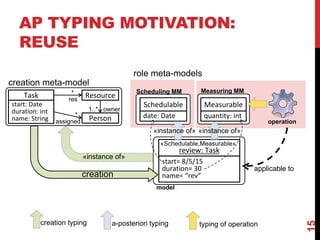
AP TYPING MOTIVATION:
REUSE
15
Measurable
quantity: int
Schedulable
date: Date
review: Task
Scheduling MM Measuring MM
model
«instance of» «instance of»
start= 8/5/15
duration= 30
name= “rev”
«Schedulable,Measurable»
*
*
res
Task
start: Date
duration: int
name: String
Resource
Person
owner
assigned
1..*
creation meta-model
role meta-models
creation
«instance of»
a-posteriori typingcreation typing
operation
typing of operation
applicable to
16
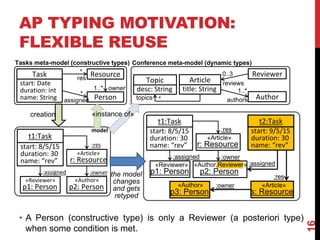
AP TYPING MOTIVATION:
FLEXIBLE REUSE
*topics
*
*
res
Task
start: Date
duration: int
name: String
Tasks meta-model (constructive types)
Resource
Person
owner
assigned
1..* 1..*
0..3
reviewsArticle
title: String
Conference meta-model (dynamic types)
Reviewer
Authorauthors
Topic
desc: String
«Author»
p2: Person
«Reviewer»
p1: Person
«Article»
r: Resource
:owner
t1:Task
start: 8/5/15
duration: 30
name: “rev”
:res
:assigned
«Author,Reviewer»
p2: Person
«Reviewer»
p1: Person
«Article»
r: Resource
:owner
t1:Task
start: 8/5/15
duration: 30
name: “rev”
:res
:assigned
«Author»
p3: Person
«Article»
s: Resource
:owner
t2:Task
start: 9/5/15
duration: 30
name: “rev”
:res
:assigned
the model
changes
and gets
retyped
creation «instance of»
model
• A Person (constructive type) is only a Reviewer (a posteriori type)
when some condition is met.
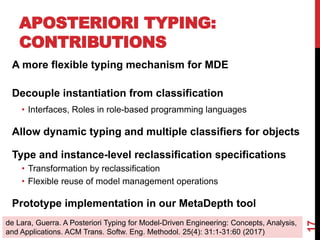
A more flexible typing mechanism for MDE
Decouple instantiation from classification
• Interfaces, Roles in role-based programming languages
Allow dynamic typing and multiple classifiers for objects
Type and instance-level reclassification specifications
• Transformation by reclassification
• Flexible reuse of model management operations
Prototype implementation in our MetaDepth tool
APOSTERIORI TYPING:
CONTRIBUTIONS
17
de Lara, Guerra. A Posteriori Typing for Model-Driven Engineering: Concepts, Analysis,
and Applications. ACM Trans. Softw. Eng. Methodol. 25(4): 31:1-31:60 (2017)
MODELLING THROUGH
SOCIAL NETWORKS
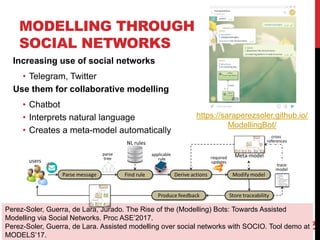
Increasing use of social networks
• Telegram, Twitter
Use them for collaborative modelling
• Chatbot
• Interprets natural language
• Creates a meta-model automatically
18
https://saraperezsoler.github.io/
ModellingBot/
Perez-Soler, Guerra, de Lara, Jurado. The Rise of the (Modelling) Bots: Towards Assisted
Modelling via Social Networks. Proc ASE’2017.
Perez-Soler, Guerra, de Lara. Assisted modelling over social networks with SOCIO. Tool demo at
MODELS’17.
19
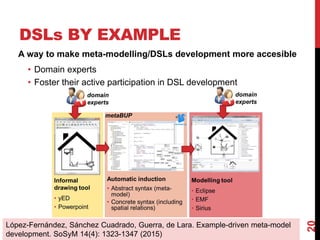
DSLs
DSLs BY EXAMPLE
A way to make meta-modelling/DSLs development more accesible
• Domain experts
• Foster their active participation in DSL development
20
López-Fernández, Sánchez Cuadrado, Guerra, de Lara. Example-driven meta-model
development. SoSyM 14(4): 1323-1347 (2015)
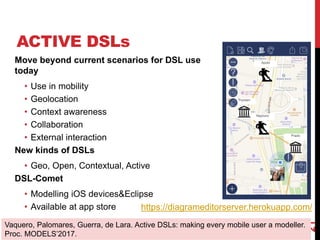
ACTIVE DSLs
Move beyond current scenarios for DSL use
today
• Use in mobility
• Geolocation
• Context awareness
• Collaboration
• External interaction
New kinds of DSLs
• Geo, Open, Contextual, Active
DSL-Comet
• Modelling iOS devices&Eclipse
• Available at app store
21
Vaquero, Palomares, Guerra, de Lara. Active DSLs: making every mobile user a modeller.
Proc. MODELS’2017.
https://diagrameditorserver.herokuapp.com/
PATTERN-BASED DSL
DEVELOPMENT
DSLs are rarely built from scratch
• DSLs for behaviour are inspired by state machines, workflow
languages, etc
Patterns
• Domain patterns (e.g., StateMachines)
• Design patterns (e.g., Lists)
• Concrete syntax patterns
• Infrastructure (e.g., model partitioning, filters, queries, etc)
• Dynamic semantics
DSL-tao: http://jdelara.github.io/DSL-tao/
22
A. Pescador, A. Garmendia, E. Guerra, J. Sánchez Cuadrado, J. de Lara. Pattern-
based development of Domain-Specific Modelling Languages. MoDELS 2015: 166-175
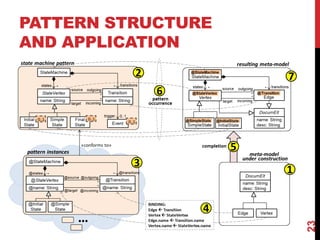
PATTERN STRUCTURE
AND APPLICATION
23
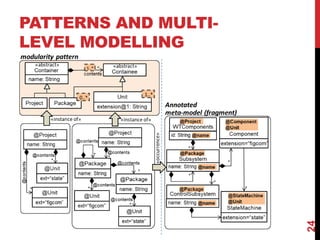
PATTERNS AND MULTI-
LEVEL MODELLING
24
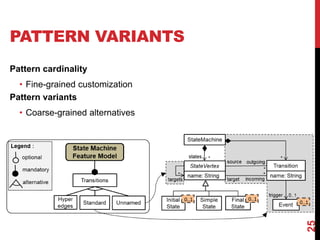
PATTERN VARIANTS
25
Pattern cardinality
• Fine-grained customization
Pattern variants
• Coarse-grained alternatives
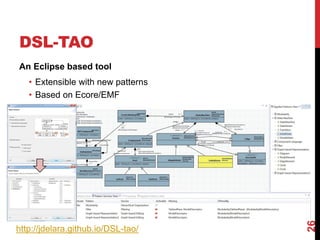
DSL-TAO
26
http://jdelara.github.io/DSL-tao/
An Eclipse based tool
• Extensible with new patterns
• Based on Ecore/EMF
27
Trafos
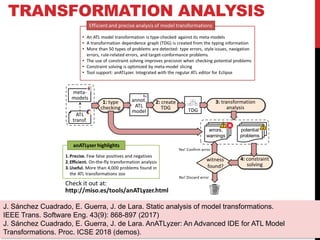
TRANSFORMATION ANALYSIS
28
J. Sánchez Cuadrado, E. Guerra, J. de Lara. Static analysis of model transformations.
IEEE Trans. Software Eng. 43(9): 868-897 (2017)
J. Sánchez Cuadrado, E. Guerra, J. de Lara. AnATLyzer: An Advanced IDE for ATL Model
Transformations. Proc. ICSE 2018 (demos).
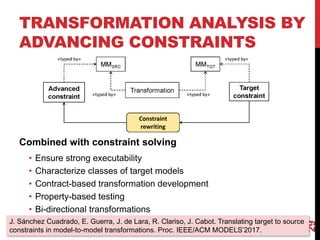
TRANSFORMATION ANALYSIS BY
ADVANCING CONSTRAINTS
29
Combined with constraint solving
• Ensure strong executability
• Characterize classes of target models
• Contract-based transformation development
• Property-based testing
• Bi-directional transformations
J. Sánchez Cuadrado, E. Guerra, J. de Lara, R. Clariso, J. Cabot. Translating target to source
constraints in model-to-model transformations. Proc. IEEE/ACM MODELS’2017.
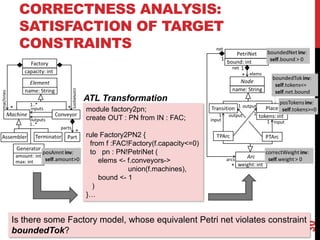
CORRECTNESS ANALYSIS:
SATISFACTION OF TARGET
CONSTRAINTS
30
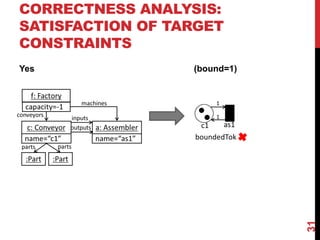
Is there some Factory model, whose equivalent Petri net violates constraint
boundedTok?
module factory2pn;
create OUT : PN from IN : FAC;
rule Factory2PN2 {
from f :FAC!Factory(f.capacity<=0)
to pn : PN!PetriNet (
elems <- f.conveyors->
union(f.machines),
bound <- 1
)
}…
ATL Transformation
Yes (bound=1)
31
CORRECTNESS ANALYSIS:
SATISFACTION OF TARGET
CONSTRAINTS
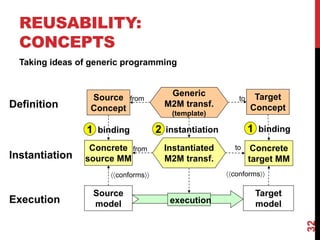
REUSABILITY:
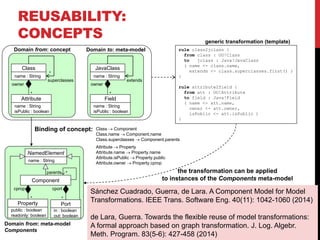
CONCEPTS
32
Taking ideas of generic programming
Source
Concept
Generic
M2M transf.
(template)
from to
Concrete
source MM
binding
Instantiated
M2M transf.
from to
instantiation1
Source
model
conforms
Target
model
2
conforms
execution
Definition
Instantiation
Execution
Concrete
target MM
binding1
Target
Concept
REUSABILITY:
CONCEPTS
33
rule class2jclass {
from class : OO!Class
to jclass : Java!JavaClass
( name <- class.name,
extends <- class.superclasses.first() )
}
rule attribute2field {
from att : OO!Attribute
to field : Java!Field
( name <- att.name,
owner <- att.owner,
isPublic <- att.isPublic )
}
JavaClass
name : String
extends
Domain to: meta-model
owner
*
name : String
isPublic : boolean
Field
Class
name : String
superclasses
*
Domain from: concept
owner
*
name : String
isPublic : boolean
Attribute
Binding of concept:
generic transformation (template)
Class  Component
Class.name  Component.name
Class.superclasses  Component.parents
Attribute  Property
Attribute.name  Property.name
Attribute.isPublic  Property.public
Attribute.owner  Property.cprop
Component
parents *
cprop
*
public : boolean
readonly: boolean
Property Port
in : boolean
out: boolean
*
the transformation can be applied
to instances of the Components meta-model
Domain from: meta-model
Components
name : String
NamedElement
cport
Sánchez Cuadrado, Guerra, de Lara. A Component Model for Model
Transformations. IEEE Trans. Software Eng. 40(11): 1042-1060 (2014)
de Lara, Guerra. Towards the flexible reuse of model transformations:
A formal approach based on graph transformation. J. Log. Algebr.
Meth. Program. 83(5-6): 427-458 (2014)
THANKS!
Questions?
Esther.Guerra@uam.es
Juan.deLara@uam.es
34
http://www.miso.es
modelling &
software engineering
research group

Miso-McGill

  • 1.
    AN OVERVIEW OFMDE RESEARCH ACTIVITIES IN THE MISO GROUP Computer Science Department Universidad Autónoma de Madrid (Spain) http://miso.es @miso_uam Esther Guerra, Juan de Lara McGill U - 9th Feb 2018
  • 2.
  • 3.
    THE AUTONOMOUS UNIVERSITY OFMADRID 3 Universidad Autónoma de Madrid • Established in 1968 • North part of Madrid (campus Cantoblanco) • One of the top universities in Spain • >30000 students • “Excellence” campus with CSIC (Spanish Research Council) Computer Science and Telecommunication Engineering • Created in 1992 • 96 full time professors • Joint diploma Comp.Sci.-Maths
  • 4.
    THE MISO GROUP Modellingand Software Engineering Research Group Professors: • Juan de Lara, PhD • Esther Guerra, PhD • Elena Gómez, PhD Researchers: • Jesús Sánchez, PhD (external) • Jesús Juan López, PhD (external) • Antonio Garmendia (FPI) • Pablo Gómez (research associate) • Mario González (research associate) • Ángel Mora (FPU) • Javier Palomares (research associate) • Sara Pérez (research associate) • Santiago Jácome (U. Fuerzas Armadas, Ecuador) 4 http://miso.es
  • 5.
    OUR RESEARCH: MODEL DRIVENENGINEERING Domain-Specific Languages Model-Transformations (Meta-)Modelling Flexibility Scalability Reuse Mobile apps Open data Social networks Streaming data applications 5 AreasConcernsApplications
  • 6.
    SOME BITS OFOUR RESEARCH FOR TODAY (Meta-)Modelling • Multi-level modelling • A-posteriori typing • Modelling through social networks Domain-Specific Languages • Active DSLs • DSLs by example • Pattern-based development of DSLs Transformations • Verification • Reuse 6
  • 7.
  • 8.
    MULTI-LEVEL MODELLING (1/2) 8 Usingmore than two meta-levels at the same time Reduces accidental complexity Potency to characterize instances beyond the immediate meta-level below ProductType@2 VAT@1: double price: double Book: ProductType VAT=18.0 price=10.0 mobyDick: Book vs (class Product becomes useless: accidental complexity) Atkinson, Kühne. 2002. Rearchitecting the UML infrastructure. ACM Tr. Model. Comput. Simul. 12, 4 (2002), 290–321.
  • 9.
    MULTI-LEVEL MODELLING (2/2) Tooling •MetaDepth (http://metadepth.org) • Textual modelling, command-line • Integrated with the Epsilon model management languages Relevance in practice • Patterns whose occurrence signal a “multi-level” smell • Analysis of OMG standards, meta-model repositories (400+ MMs) • Pervasive in some domains (sw architecture, enterprise/process modelling) • Relatively frequent in OMG specifications (over 35%) 9 de Lara, Guerra. Deep Meta-modelling with MetaDepth. TOOLS (48) 2010: 1-20 de Lara, Guerra, Sánchez Cuadrado. When and How to Use Multilevel Modelling. ACM Trans. Softw. Eng. Methodol. 24(2): 12:1-12:46 (2014) Model Ecommerce@2{ Node ProductType { VAT@1: double; price: double; }
  • 10.
    Constructive typing • Creationof objects and classification are inseparable Lacks flexibility • Objects cannot change their type at run-time (and retain its identity) Hinders reuse • An operation defined for a meta-model cannot be used for another one APOSTERIORI TYPING 10 Task start: Date duration: int review: Task start= 8/5/15 duration=30 creation «instance of» Tasks meta-model model
  • 11.
    Constructive typing • Creationof objects and classification are inseparable Lacks flexibility • Objects cannot change their type at run-time (and retain its identity) Hinders reuse • An operation defined for a meta-model cannot be used for another one APOSTERIORI TYPING 11 review: Task start= 8/5/15 duration=10 model Task start: Date duration: int review: Task start= 8/5/15 duration=30 creation «instance of» Tasks meta-model model
  • 12.
    Constructive typing • Creationof objects and classification are inseparable Lacks flexibility • Objects cannot change their type at run-time (and retain its identity) Hinders reuse • An operation defined for a meta-model cannot be used for another one APOSTERIORI TYPING 12 Task start: Date duration: int review: Task start= 8/5/15 duration=30 creation «instance of» Tasks meta-model model review: Task start= 8/5/15 duration=0 model
  • 13.
    Constructive typing • Creationof objects and classification are inseparable Lacks flexibility • Objects cannot change their type at run-time (and retain its identity) Hinders reuse • An operation defined for a meta-model cannot be used for another one A POSTERIORI TYPING 13 Task start: Date duration: int review: Task start= 8/5/15 duration=30 creation «instance of» Tasks meta-model model review: Milestone start= 8/5/15 duration=0 model
  • 14.
    Constructive typing • Creationof objects and classification are inseparable Lacks flexibility • Objects cannot change their type at run-time (and retain its identity) Hinders reuse • An operation defined for a meta-model cannot be used for another one A POSTERIORI TYPING 14 Task start: Date duration: int review: Task start= 8/5/15 duration=30 creation «instance of» Tasks meta-model model Measurable quantity: int Measuring MM review: Milestone start= 8/5/15 duration=0 model
  • 15.
    AP TYPING MOTIVATION: REUSE 15 Measurable quantity:int Schedulable date: Date review: Task Scheduling MM Measuring MM model «instance of» «instance of» start= 8/5/15 duration= 30 name= “rev” «Schedulable,Measurable» * * res Task start: Date duration: int name: String Resource Person owner assigned 1..* creation meta-model role meta-models creation «instance of» a-posteriori typingcreation typing operation typing of operation applicable to
  • 16.
    16 AP TYPING MOTIVATION: FLEXIBLEREUSE *topics * * res Task start: Date duration: int name: String Tasks meta-model (constructive types) Resource Person owner assigned 1..* 1..* 0..3 reviewsArticle title: String Conference meta-model (dynamic types) Reviewer Authorauthors Topic desc: String «Author» p2: Person «Reviewer» p1: Person «Article» r: Resource :owner t1:Task start: 8/5/15 duration: 30 name: “rev” :res :assigned «Author,Reviewer» p2: Person «Reviewer» p1: Person «Article» r: Resource :owner t1:Task start: 8/5/15 duration: 30 name: “rev” :res :assigned «Author» p3: Person «Article» s: Resource :owner t2:Task start: 9/5/15 duration: 30 name: “rev” :res :assigned the model changes and gets retyped creation «instance of» model • A Person (constructive type) is only a Reviewer (a posteriori type) when some condition is met.
  • 17.
    A more flexibletyping mechanism for MDE Decouple instantiation from classification • Interfaces, Roles in role-based programming languages Allow dynamic typing and multiple classifiers for objects Type and instance-level reclassification specifications • Transformation by reclassification • Flexible reuse of model management operations Prototype implementation in our MetaDepth tool APOSTERIORI TYPING: CONTRIBUTIONS 17 de Lara, Guerra. A Posteriori Typing for Model-Driven Engineering: Concepts, Analysis, and Applications. ACM Trans. Softw. Eng. Methodol. 25(4): 31:1-31:60 (2017)
  • 18.
    MODELLING THROUGH SOCIAL NETWORKS Increasinguse of social networks • Telegram, Twitter Use them for collaborative modelling • Chatbot • Interprets natural language • Creates a meta-model automatically 18 https://saraperezsoler.github.io/ ModellingBot/ Perez-Soler, Guerra, de Lara, Jurado. The Rise of the (Modelling) Bots: Towards Assisted Modelling via Social Networks. Proc ASE’2017. Perez-Soler, Guerra, de Lara. Assisted modelling over social networks with SOCIO. Tool demo at MODELS’17.
  • 19.
  • 20.
    DSLs BY EXAMPLE Away to make meta-modelling/DSLs development more accesible • Domain experts • Foster their active participation in DSL development 20 López-Fernández, Sánchez Cuadrado, Guerra, de Lara. Example-driven meta-model development. SoSyM 14(4): 1323-1347 (2015)
  • 21.
    ACTIVE DSLs Move beyondcurrent scenarios for DSL use today • Use in mobility • Geolocation • Context awareness • Collaboration • External interaction New kinds of DSLs • Geo, Open, Contextual, Active DSL-Comet • Modelling iOS devices&Eclipse • Available at app store 21 Vaquero, Palomares, Guerra, de Lara. Active DSLs: making every mobile user a modeller. Proc. MODELS’2017. https://diagrameditorserver.herokuapp.com/
  • 22.
    PATTERN-BASED DSL DEVELOPMENT DSLs arerarely built from scratch • DSLs for behaviour are inspired by state machines, workflow languages, etc Patterns • Domain patterns (e.g., StateMachines) • Design patterns (e.g., Lists) • Concrete syntax patterns • Infrastructure (e.g., model partitioning, filters, queries, etc) • Dynamic semantics DSL-tao: http://jdelara.github.io/DSL-tao/ 22 A. Pescador, A. Garmendia, E. Guerra, J. Sánchez Cuadrado, J. de Lara. Pattern- based development of Domain-Specific Modelling Languages. MoDELS 2015: 166-175
  • 23.
  • 24.
  • 25.
    PATTERN VARIANTS 25 Pattern cardinality •Fine-grained customization Pattern variants • Coarse-grained alternatives
  • 26.
    DSL-TAO 26 http://jdelara.github.io/DSL-tao/ An Eclipse basedtool • Extensible with new patterns • Based on Ecore/EMF
  • 27.
  • 28.
    TRANSFORMATION ANALYSIS 28 J. SánchezCuadrado, E. Guerra, J. de Lara. Static analysis of model transformations. IEEE Trans. Software Eng. 43(9): 868-897 (2017) J. Sánchez Cuadrado, E. Guerra, J. de Lara. AnATLyzer: An Advanced IDE for ATL Model Transformations. Proc. ICSE 2018 (demos).
  • 29.
    TRANSFORMATION ANALYSIS BY ADVANCINGCONSTRAINTS 29 Combined with constraint solving • Ensure strong executability • Characterize classes of target models • Contract-based transformation development • Property-based testing • Bi-directional transformations J. Sánchez Cuadrado, E. Guerra, J. de Lara, R. Clariso, J. Cabot. Translating target to source constraints in model-to-model transformations. Proc. IEEE/ACM MODELS’2017.
  • 30.
    CORRECTNESS ANALYSIS: SATISFACTION OFTARGET CONSTRAINTS 30 Is there some Factory model, whose equivalent Petri net violates constraint boundedTok? module factory2pn; create OUT : PN from IN : FAC; rule Factory2PN2 { from f :FAC!Factory(f.capacity<=0) to pn : PN!PetriNet ( elems <- f.conveyors-> union(f.machines), bound <- 1 ) }… ATL Transformation
  • 31.
  • 32.
    REUSABILITY: CONCEPTS 32 Taking ideas ofgeneric programming Source Concept Generic M2M transf. (template) from to Concrete source MM binding Instantiated M2M transf. from to instantiation1 Source model conforms Target model 2 conforms execution Definition Instantiation Execution Concrete target MM binding1 Target Concept
  • 33.
    REUSABILITY: CONCEPTS 33 rule class2jclass { fromclass : OO!Class to jclass : Java!JavaClass ( name <- class.name, extends <- class.superclasses.first() ) } rule attribute2field { from att : OO!Attribute to field : Java!Field ( name <- att.name, owner <- att.owner, isPublic <- att.isPublic ) } JavaClass name : String extends Domain to: meta-model owner * name : String isPublic : boolean Field Class name : String superclasses * Domain from: concept owner * name : String isPublic : boolean Attribute Binding of concept: generic transformation (template) Class  Component Class.name  Component.name Class.superclasses  Component.parents Attribute  Property Attribute.name  Property.name Attribute.isPublic  Property.public Attribute.owner  Property.cprop Component parents * cprop * public : boolean readonly: boolean Property Port in : boolean out: boolean * the transformation can be applied to instances of the Components meta-model Domain from: meta-model Components name : String NamedElement cport Sánchez Cuadrado, Guerra, de Lara. A Component Model for Model Transformations. IEEE Trans. Software Eng. 40(11): 1042-1060 (2014) de Lara, Guerra. Towards the flexible reuse of model transformations: A formal approach based on graph transformation. J. Log. Algebr. Meth. Program. 83(5-6): 427-458 (2014)
  • 34.