TRANSFORMATION REUSE
IN MODEL-DRIVEN
ENGINEERING
McMaster CS Seminar. Jan 22 2018.
Juan de Lara
joint work with
Esther Guerra and Jesús Sánchez Cuadrado
Modelling&Software Engineering Research Group
http://miso.es @miso_uam
MODEL DRIVEN
ENGINEERING (MDE)
Increase the level of abstraction in software
development
Models are actively used to
• Describe the problem…
• Simulate/verify/test…
• Generate code for the final application
Move from the solution space (code-centric) to the
problem space
• Higher levels of productivity and quality
• Less accidental details
2
MODEL DRIVEN
ENGINEERING (MDE)
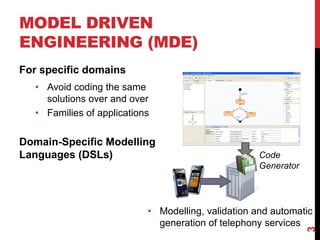
For specific domains
• Avoid coding the same
solutions over and over
• Families of applications
Domain-Specific Modelling
Languages (DSLs) Code
Generator
• Modelling, validation and automatic
generation of telephony services
3
BENEFITS OF MDE
Increase productivity
• Domain-Specific instead of General Purpose languages
• Reported productivity increases in the order of 20-30% [WH14]
Automation
• Avoid repetitive tasks
Higher level of abstraction
• Domain models vs low-level coding
• More intentional, easier to analyse
• Less accidental details
End-user development
• By Domain-Specific Languages
4
Whittle, Hutchinson, Rouncefield. “The state of practice in model-driven engineering”.
IEEE Software 31(3): 79-85 (2014)
DRAWBACKS OF MDE
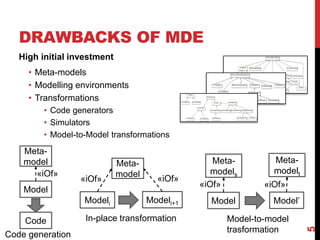
High initial investment
• Meta-models
• Modelling environments
• Transformations
• Code generators
• Simulators
• Model-to-Model transformations
5
Model
Code
Modeli Modeli+1 Model Model’
Meta-
model Meta-
model
Meta-
models
Meta-
modelt«iOf»
«iOf» «iOf»
«iOf» «iOf»
Code generation
In-place transformation Model-to-model
trasformation
OUR GOAL
6
Make MDE more widely applicable by reducing its
required initial investment
MDE artefacts (transformations, code generators,
editors) are defined over specific meta-models
• Difficult to reuse for other related meta-models
How to avoid creating (essentially)
the same transformation for
different meta-models?
IN THE REST OF THIS TALK…
7
Current practice of “reuse”
• Ad-hoc reuse (clone and own)
• Explicit model adaptation
Three different approaches to reuse
• Concepts
• Multi-level modelling
• A-posteriori typing
Tool support
Conclusions and future work
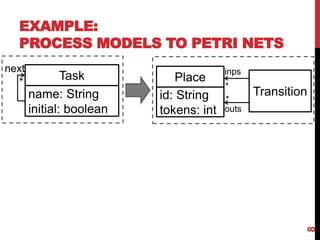
EXAMPLE:
PROCESS MODELS TO PETRI NETS
8
Task
name: String
initial: boolean
next
* Place
Transitionid: String
tokens: int
inps
outs
*
*
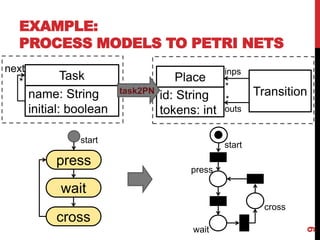
9
press
wait
cross
start
start
press
wait
cross
Task
name: String
initial: boolean
next
* Place
Transitionid: String
tokens: int
inps
outs
*
*
EXAMPLE:
PROCESS MODELS TO PETRI NETS
task2PN
10
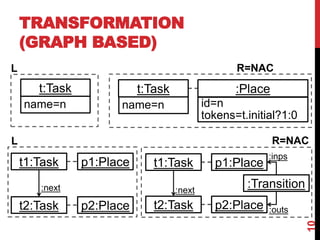
L R=NAC
t:Task
name=n
t:Task
name=n
:Place
id=n
tokens=t.initial?1:0
t1:Task
t2:Task
:next
p1:Place
p2:Place
t1:Task
t2:Task
:next
p1:Place
p2:Place
:Transition
:inps
:outs
L R=NAC
TRANSFORMATION
(GRAPH BASED)
11
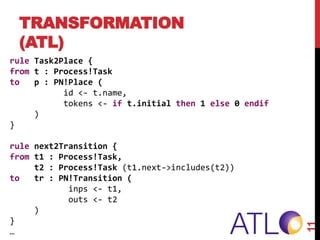
TRANSFORMATION
(ATL)
rule Task2Place {
from t : Process!Task
to p : PN!Place (
id <- t.name,
tokens <- if t.initial then 1 else 0 endif
)
}
rule next2Transition {
from t1 : Process!Task,
t2 : Process!Task (t1.next->includes(t2))
to tr : PN!Transition (
inps <- t1,
outs <- t2
)
}
…
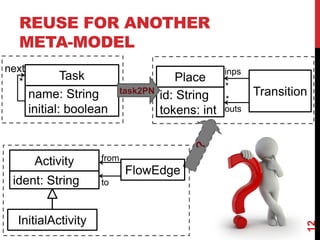
REUSE FOR ANOTHER
META-MODEL
12
Task
name: String
initial: boolean
next
* Place
Transitionid: String
tokens: int
inps
outs
*
*
Activity
ident: String
InitialActivity
task2PN
FlowEdge
from
to
13
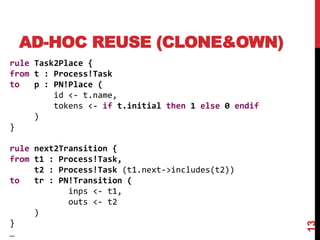
rule Task2Place {
from t : Process!Task
to p : PN!Place (
id <- t.name,
tokens <- if t.initial then 1 else 0 endif
)
}
rule next2Transition {
from t1 : Process!Task,
t2 : Process!Task (t1.next->includes(t2))
to tr : PN!Transition (
inps <- t1,
outs <- t2
)
}
…
AD-HOC REUSE (CLONE&OWN)
14
rule Task2Place {
from t : Process!Activity
to p : PN!Place (
id <- t.ident,
tokens <- if t.oclIsTypeOf(Process!InitialActivity) then
1 else 0 endif
)
}
rule next2Transition {
from t1 : Process!Activity,
t2 : Process!Activity
(Process!FlowEdge.allInstances()->exist(e |
e.from=t1 and e.to=t2))
to tr : PN!Transition (
inps <- t1,
outs <- t2
)
}
AD-HOC REUSE (CLONE&OWN)
15
rule Task2Place {
from t : Process!Activity
to p : PN!Place (
name <- t.ident,
tokens <- if t.oclIsTypeOf(Process!InitialActivity) then
1 else 0 endif
)
}
rule next2Transition {
from t1 : Process!Activity,
t2 : Process!Activity
(Process!FlowEdge.allInstances()->exist(e |
e.from=t1 and e.to=t2))
to tr : PN!Transition (
inps <- t1,
outs <- t2
)
}
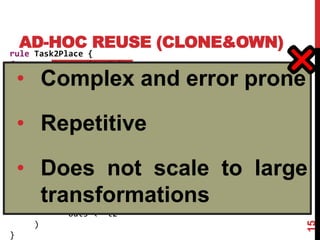
• Complex and error prone
• Repetitive
• Does not scale to large
transformations
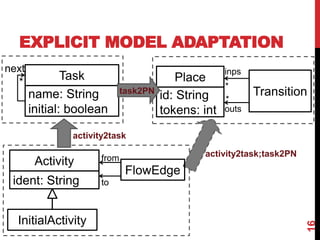
EXPLICIT MODEL ADAPTATION
1616
Task
name: String
initial: boolean
next
* Place
Transitionid: String
tokens: int
inps
outs
*
*
Activity
ident: String
InitialActivity
task2PN
FlowEdge
from
to
activity2task;task2PN
activity2task
MOTIVATION
17
rule Activity2Task {
from t : Activities!Activity
to p : Process!Task (
id <- t.ident,
initial <- t.oclIsKindOf(Activities!InitialActivity),
next <- Activities!FlowEdge.allInstances()->
select (e | e.from = t)->
collect(e | e.to )
)
}
t:
InitialActivity
ident=“a0”
p: Task
name=“a0”
initial=true
pl: Place
name=“a0”
tokens=1
activity2task task2PN
MOTIVATION
18
rule Activity2Task {
from t : Activities!Activity
to p : Process!Task (
name <- t.ident,
initial <- t.oclIsKindOf(Activities!InitialActivity),
next <- Activities!FlowEdge.allInstances()->
select (e | e.from = t)->
collect(e | e.to )
)
}
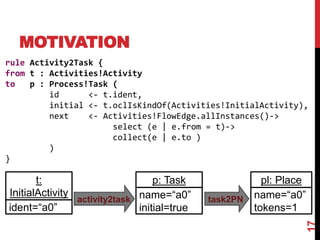
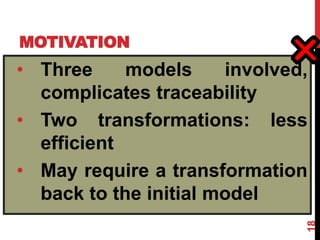
• Three models involved,
complicates traceability
• Two transformations: less
efficient
• May require a transformation
back to the initial model
19
Concept-
based
reuse
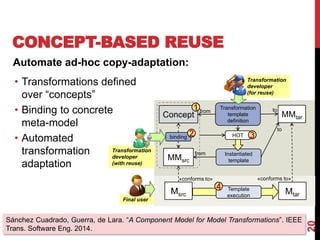
Automate ad-hoc copy-adaptation:
CONCEPT-BASED REUSE
20
Concept
Msrc Mtar
from to
«conforms to» «conforms to»
Template
execution
MMsrc
Instantiated
template
to
binding
MMtar
HOT
Transformation
template
definition
from
Final user
Transformation
developer
(with reuse)
Transformation
developer
(for reuse)
1
2 3
4
• Transformations defined
over “concepts”
• Binding to concrete
meta-model
• Automated
transformation
adaptation
Sánchez Cuadrado, Guerra, de Lara. “A Component Model for Model Transformations”. IEEE
Trans. Software Eng. 2014.
21
STRUCTURAL
CONCEPTS
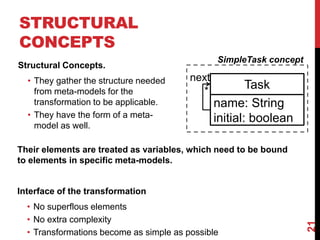
Structural Concepts.
• They gather the structure needed
from meta-models for the
transformation to be applicable.
• They have the form of a meta-
model as well.
SimpleTask concept
Task
name: String
initial: boolean
next
*
Their elements are treated as variables, which need to be bound
to elements in specific meta-models.
Interface of the transformation
• No superflous elements
• No extra complexity
• Transformations become as simple as possible
22
REUSABLE
TRANSFORMATIONS
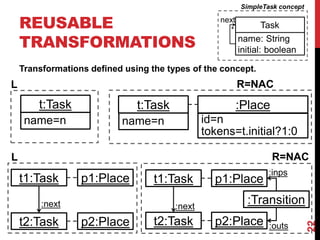
Transformations defined using the types of the concept.
L R=NAC
t:Task
name=n
t:Task
name=n
:Place
id=n
tokens=t.initial?1:0
t1:Task
t2:Task
:next
p1:Place
p2:Place
t1:Task
t2:Task
:next
p1:Place
p2:Place
:Transition
:inps
:outs
L R=NAC
23
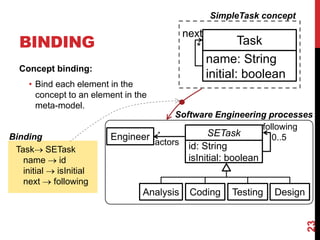
BINDING
Concept binding:
• Bind each element in the
concept to an element in the
meta-model.
Task SETask
name  id
initial  isInitial
next  following
Binding SETaskEngineer
Coding Testing
actors
*
Software Engineering processes
Design
SimpleTask concept
Task
name: String
initial: boolean
next
*
Analysis
id: String
isInitial: boolean
following
0..5
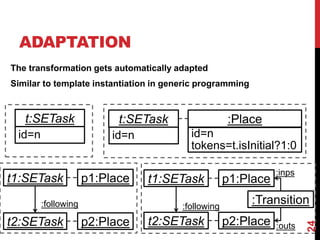
ADAPTATION
The transformation gets automatically adapted
Similar to template instantiation in generic programming
24
t:SETask
id=n
t:SETask
id=n
:Place
id=n
tokens=t.isInitial?1:0
t1:SETask
t2:SETask
:following
p1:Place
p2:Place
t1:SETask
t2:SETask
:following
p1:Place
p2:Place
:Transition
:inps
:outs
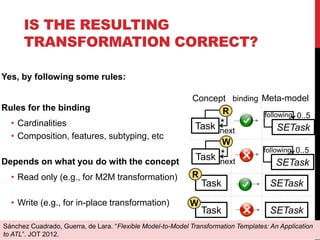
IS THE RESULTING
TRANSFORMATION CORRECT?
Yes, by following some rules:
Rules for the binding
• Cardinalities
• Composition, features, subtyping, etc
Depends on what you do with the concept
• Read only (e.g., for M2M transformation)
• Write (e.g., for in-place transformation)
25
SETaskTask
SETaskTask
Concept Meta-modelbinding
R
W
Sánchez Cuadrado, Guerra, de Lara. “Flexible Model-to-Model Transformation Templates: An Application
to ATL”. JOT 2012.
Task next
* SETask
R following 0..5
SETask
following 0..5
Task next
*
W
26
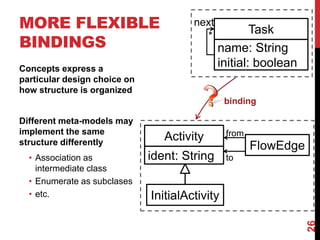
MORE FLEXIBLE
BINDINGS
Concepts express a
particular design choice on
how structure is organized
Different meta-models may
implement the same
structure differently
• Association as
intermediate class
• Enumerate as subclases
• etc.
binding
Task
name: String
initial: boolean
next
*
Activity
ident: String
InitialActivity
FlowEdge
from
to
27
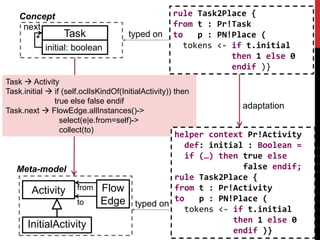
BINDING ADAPTERS
Elements in the concept are variables
• Allow binding them to expressions: adapters
Adapters resolve the heterogeneities between the concept and
the meta-model
They induce an adaptation of the transformation
Sánchez Cuadrado, Guerra, de Lara. “A Component Model for Model Transformations”. IEEE
Trans. Software Eng. 2014.
de Lara, Guerra. “Towards the flexible reuse of model transformations: A formal approach
based on graph transformation”. JLAMP 83(5-6). 427-458 (2014)
rule Task2Place {
from t : Pr!Task
to p : PN!Place (
tokens <- if t.initial
then 1 else 0
endif )}
28
Task
initial: boolean
next
*
Concept
Activity
InitialActivity
Flow
Edge
from
to
Task  Activity
Task.initial  if (self.oclIsKindOf(InitialActivity)) then
true else false endif
Task.next  FlowEdge.allInstances()->
select(e|e.from=self)->
collect(to)
Meta-model
typed on
helper context Pr!Activity
def: initial : Boolean =
if (…) then true else
false endif;
rule Task2Place {
from t : Pr!Activity
to p : PN!Place (
tokens <- if t.initial
then 1 else 0
endif )}
typed on
adaptation
ON THE ROLE OF
CONCEPTS…
Aren’t concepts characterizing a set of “suitable”
meta-models for the transformation?
Isn’t that exactly what meta-models do (for
models)?
Concepts as meta-meta-models
Rely on typing: no need to adapt the
transformation
29
30
Reuse
through multi-
level
modelling
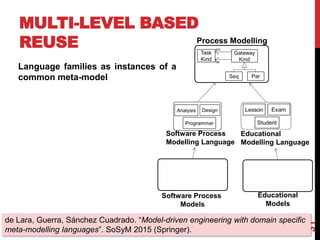
Language families as instances of a
common meta-model
MULTI-LEVEL BASED
REUSE
31
Process Modelling
Software Process
Modelling Language
Educational
Modelling Language
Software Process
Models
Educational
Models
de Lara, Guerra, Sánchez Cuadrado. “Model-driven engineering with domain specific
meta-modelling languages”. SoSyM 2015 (Springer).
32
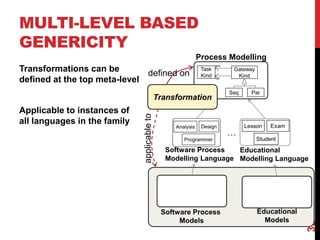
MULTI-LEVEL BASED
GENERICITY
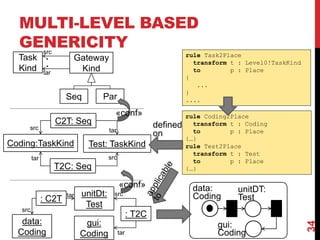
Transformations can be
defined at the top meta-level
Applicable to instances of
all languages in the family
Process Modelling
Software Process
Modelling Language
Educational
Modelling Language
Software Process
Models
Educational
Models
…
Transformation
defined on
applicableto
33
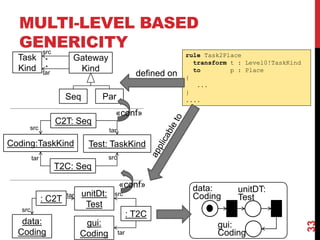
MULTI-LEVEL BASED
GENERICITY
Task
Kind
Gateway
Kind
Seq Par
src
tar
*
*
Test: TaskKindCoding:TaskKind
T2C: Seq
C2T: Seq
src tar
srctar
data:
Coding
unitDt:
Test
gui:
Coding
: C2T
src
tar
: T2C
tar
src
«conf»
«conf» data:
Coding
unitDT:
Test
gui:
Coding
rule Task2Place
transform t : Level0!TaskKind
to p : Place
{
...
}
....
defined on
rule Task2Place
transform t : Level0!TaskKind
to p : Place
{
...
}
....
34
MULTI-LEVEL BASED
GENERICITY
data:
Coding
unitDT:
Test
gui:
Coding
rule Coding2Place
transform t : Coding
to p : Place
{…}
rule Test2Place
transform t : Test
to p : Place
{…}
defined
on
data:
Coding
unitDt:
Test
gui:
Coding
: C2T
src
tar
: T2C
tar
src
«conf»
Task
Kind
Gateway
Kind
Seq Par
src
tar
*
*
Test: TaskKindCoding:TaskKind
T2C: Seq
C2T: Seq
src tar
srctar
«conf»
35
MULTI-LEVEL VS CONCEPT-
BASED GENERICITY
Concept-based Genericity
Multi-level-based Genericity
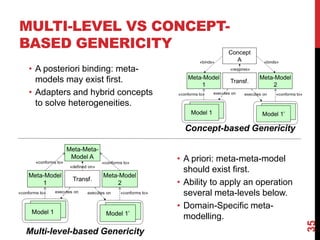
• A posteriori binding: meta-
models may exist first.
• Adapters and hybrid concepts
to solve heterogeneities.
• A priori: meta-meta-model
should exist first.
• Ability to apply an operation
several meta-levels below.
• Domain-Specific meta-
modelling.
36
CAN WE GET THE BEST OF
BOTH APPROACHES?
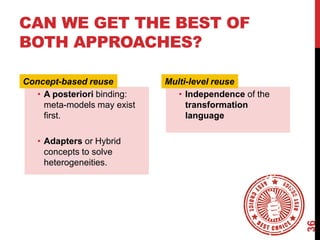
• A posteriori binding:
meta-models may exist
first.
• Adapters or Hybrid
concepts to solve
heterogeneities.
• Independence of the
transformation
language
Concept-based reuse Multi-level reuse
37
CAN WE GET THE BEST OF
BOTH APPROACHES?
• A posteriori binding:
meta-models may exist
first.
• Adapters to solve
heterogeneities.
• Independence of the
transformation
language
Concept-based reuse Multi-level reuse
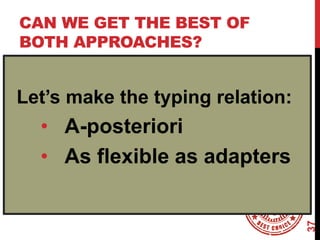
Let’s make the typing relation:
• A-posteriori
• As flexible as adapters
38
Reuse
through a-
posteriori
typing
A-POSTERIORI TYPING
39
A more flexible typing mechanism for MDE
Decouple instantiation from classification
• Interfaces in object-oriented programming
• Roles in role-based programming languages
Allow dynamic typing and multiple classifiers for objects
Type and instance-level reclassification specifications
de Lara, Guerra. A Posteriori Typing for Model-Driven Engineering: Concepts, Analysis, and
Applications. ACM Trans. Softw. Eng. Methodol. 25 (4) 31:1-31:60 (2017)
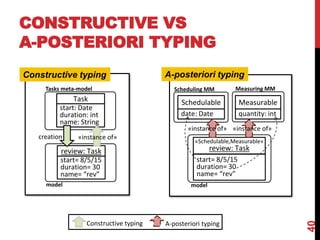
CONSTRUCTIVE VS
A-POSTERIORI TYPING
40
Task
start: Date
duration: int
name: String
review: Task
start= 8/5/15
duration= 30
name= “rev”
creation «instance of»
Measurable
quantity: int
Schedulable
date: Date
review: Task
Tasks meta-model
model
Scheduling MM Measuring MM
model
«instance of» «instance of»
start= 8/5/15
duration= 30
name= “rev”
«Schedulable,Measurable»
Constructive typing A-posteriori typing
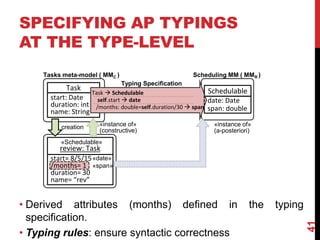
SPECIFYING AP TYPINGS
AT THE TYPE-LEVEL
41
Schedulable
date: Date
span: double
review: Task
Tasks meta-model ( MMC )
start= 8/5/15
/months= 1
duration= 30
name= “rev”
Scheduling MM ( MMR )
Task
start: Date
duration: int
name: String
Typing Specification
Task  Schedulable
self.start  date
/months: double=self.duration/30  span
«Schedulable»
«date»
«span»
creation «instance of»
(constructive)
«instance of»
(a-posteriori)
• Derived attributes (months) defined in the typing
specification.
• Typing rules: ensure syntactic correctness
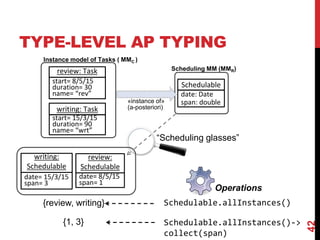
TYPE-LEVEL AP TYPING
42
date: Date
span: double
writing: Task
start= 15/3/15
duration= 90
name= “wrt”
review: Task
start= 8/5/15
duration= 30
name= “rev”
Schedulable
Scheduling MM (MMR)
Instance model of Tasks ( MMC )
«instance of»
(a-posteriori)
“Scheduling glasses”
Operations
review:
Schedulable
date= 8/5/15
span= 1
{review, writing}
{1, 3}
Schedulable.allInstances()
writing:
Schedulable
date= 15/3/15
span= 3
Schedulable.allInstances()->
collect(span)
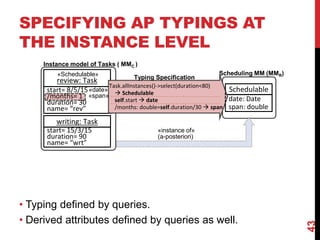
SPECIFYING AP TYPINGS AT
THE INSTANCE LEVEL
43
date: Date
span: double
writing: Task
start= 15/3/15
duration= 90
name= “wrt”
review: Task
start= 8/5/15
/months= 1
duration= 30
name= “rev”
«Schedulable»
«date»
«instance of»
(a-posteriori)
Schedulable
Scheduling MM (MMR)
Typing Specification
Task.allInstances()->select(duration<80)
 Schedulable
self.start  date
/months: double=self.duration/30  span
Instance model of Tasks ( MMC )
«span»
• Typing defined by queries.
• Derived attributes defined by queries as well.
INSTANCE-LEVEL AP TYPING
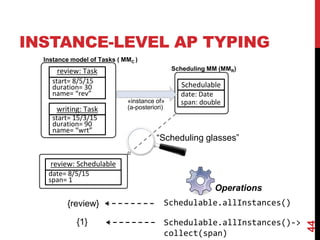
44
Operations
date: Date
span: double
writing: Task
start= 15/3/15
duration= 90
name= “wrt”
review: Task
start= 8/5/15
duration= 30
name= “rev”
Schedulable
Scheduling MM (MMR)
Instance model of Tasks ( MMC )
«instance of»
(a-posteriori)
review: Schedulable
date= 8/5/15
span= 1
Schedulable.allInstances()->
collect(span)
{review}
{1}
Schedulable.allInstances()
“Scheduling glasses”
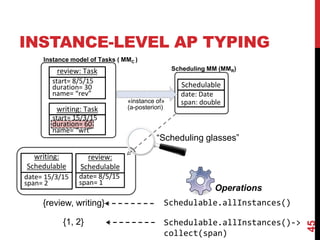
INSTANCE-LEVEL AP TYPING
45
Operations
date: Date
span: double
writing: Task
start= 15/3/15
duration= 60
name= “wrt”
review: Task
start= 8/5/15
duration= 30
name= “rev”
Schedulable
Scheduling MM (MMR)
Instance model of Tasks ( MMC )
«instance of»
(a-posteriori)
review:
Schedulable
date= 8/5/15
span= 1
Schedulable.allInstances()->
collect(span)
{review, writing}
{1, 2}
Schedulable.allInstances()
“Scheduling glasses”
writing:
Schedulable
date= 15/3/15
span= 2
Activity  Task
ident  name
/init : boolean =
self.oclsKindOf(InitialActivity)  initial
/follow: Task[*] = FlowEdge.allInstances()->
select(e|e.from=self)->
collect(e|e.to)  next
EXAMPLE
46
Task
name: String
initial: boolean
next
*
Activity
ident: String
InitialActivity
FlowEdge
from
to
A-POSTERIORI TYPING AS A
TRANSFORMATION
47
Task
name: String
initial: boolean
next
Place
Transitionid: String
tokens: int
inps
outs
*
*
task2PN
Task.allInstances()  Place
name  id
/toks : int = if (self.initial) then 1 else 0  tokens
Task.allInstances()->select(t|t.next.isDefined())  Transition
/prevs : Task[*] = Set{self}  inps
/nexts : Task[*] = Set{self.next}  outs
0..1
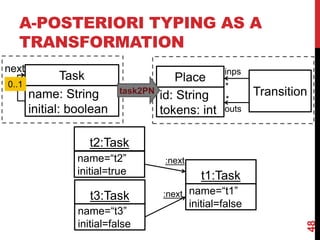
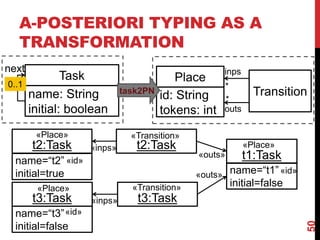
A-POSTERIORI TYPING AS A
TRANSFORMATION
48
Place
Transitionid: String
tokens: int
inps
outs
*
*
t1:Task
name=“t1”
initial=false
name=“t2”
initial=true
:next
name=“t3”
initial=false
:next
t2:Task
t3:Task
Task
name: String
initial: boolean
next
0..1
task2PN
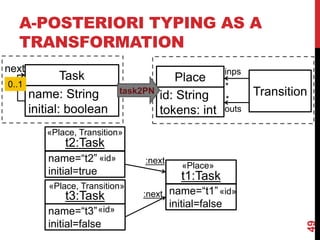
A-POSTERIORI TYPING AS A
TRANSFORMATION
49
Place
Transitionid: String
tokens: int
inps
outs
*
*
«Place»
«Place, Transition»
«Place, Transition»
«id»
«id»
«id»
Task
name: String
initial: boolean
next
0..1
task2PN
t1:Task
name=“t1”
initial=false
name=“t2”
initial=true
:next
name=“t3”
initial=false
:next
t2:Task
t3:Task
A-POSTERIORI TYPING AS A
TRANSFORMATION
50
Place
Transitionid: String
tokens: int
inps
outs
*
*
t2:Task
t3:Task
«Transition»
«Transition»
«outs»
«outs»
«inps»
«inps»
Task
name: String
initial: boolean
next
0..1
task2PN
«Place»
«Place»
«id»
«id»name=“t2”
initial=true
name=“t3”
initial=false
t2:Task
t3:Task
«Place»
«id»
t1:Task
name=“t1”
initial=false
T l
support
51
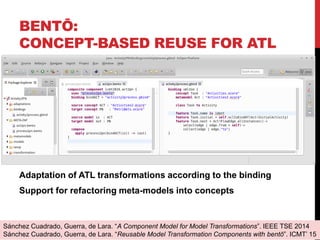
BENTŌ:
CONCEPT-BASED REUSE FOR ATL
Adaptation of ATL transformations according to the binding
Support for refactoring meta-models into concepts
52
Sánchez Cuadrado, Guerra, de Lara. “A Component Model for Model Transformations”. IEEE TSE 2014
Sánchez Cuadrado, Guerra, de Lara. “Reusable Model Transformation Components with bentō”. ICMT’ 15
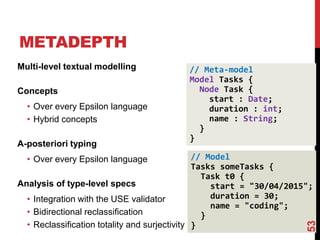
// Model
Tasks someTasks {
Task t0 {
start = "30/04/2015";
duration = 30;
name = "coding";
}
}
METADEPTH
53
Multi-level textual modelling
Concepts
• Over every Epsilon language
• Hybrid concepts
A-posteriori typing
• Over every Epsilon language
Analysis of type-level specs
• Integration with the USE validator
• Bidirectional reclassification
• Reclassification totality and surjectivity
// Meta-model
Model Tasks {
Node Task {
start : Date;
duration : int;
name : String;
}
}
CONCEPT-BASED
REUSE
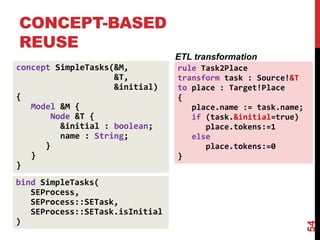
54
concept SimpleTasks(&M,
&T,
&initial)
{
Model &M {
Node &T {
&initial : boolean;
name : String;
}
}
}
bind SimpleTasks(
SEProcess,
SEProcess::SETask,
SEProcess::SETask.isInitial
)
<<some operation>>
rule Task2Place
transform task : Source!&T
to place : Target!Place
{
place.name := task.name;
if (task.&initial=true)
place.tokens:=1
else
place.tokens:=0
}
ETL transformation
55
Model ProcessModel@2 {
Node Task {
name@1 : String[0..1];
initial : boolean = false;
}
}
ProcessModel SoftwareProcess {
Task Analysis {
name = “reqs, analysis”;
}
}
SoftwareProcess aSoftProcess{
Analysis a {
initial = true;
}
}
@model(potency=0)
rule Task2Place
transform task : Source!Task
to place : Target!Place
{
place.name := task.name;
if (task.initial=true)
place.tokens:=1
else
place.tokens:=0
}
ETL transformation
MULTI-LEVEL BASED
REUSE
56
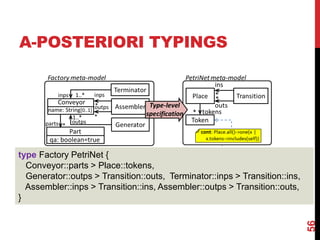
type Factory PetriNet {
Conveyor::parts > Place::tokens,
Generator::outps > Transition::outs, Terminator::inps > Transition::ins,
Assembler::inps > Transition::ins, Assembler::outps > Transition::outs,
}
A-POSTERIORI TYPINGS
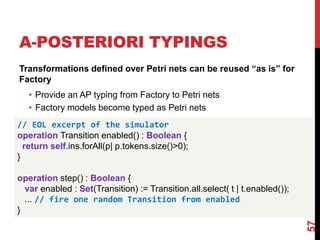
Transformations defined over Petri nets can be reused “as is” for
Factory
• Provide an AP typing from Factory to Petri nets
• Factory models become typed as Petri nets
57
// EOL excerpt of the simulator
operation Transition enabled() : Boolean {
return self.ins.forAll(p| p.tokens.size()>0);
}
operation step() : Boolean {
var enabled : Set(Transition) := Transition.all.select( t | t.enabled());
... // fire one random Transition from enabled
}
A-POSTERIORI TYPINGS
CONCLUSIONS
58
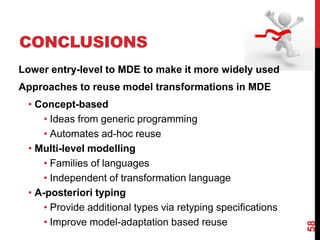
Lower entry-level to MDE to make it more widely used
Approaches to reuse model transformations in MDE
• Concept-based
• Ideas from generic programming
• Automates ad-hoc reuse
• Multi-level modelling
• Families of languages
• Independent of transformation language
• A-posteriori typing
• Provide additional types via retyping specifications
• Improve model-adaptation based reuse
FUTURE WORK
59
Product-Lines based reuse
• With Salay, Chechik (UoT)
• Analysis
Requirement models as the interface of transformations
• More powerful than concepts
Exploit a-posteriori typing in MDE
• Multiple typings for MDE
• Retypings as bx transformations
Unified approach?
THANKS!
Juan.deLara@uam.es
60
http://www.miso.es
joint work with
E. Guerra and J. Sánchez Cuadrado
@miso_uam

Model Transformation Reuse

  • 1.
    TRANSFORMATION REUSE IN MODEL-DRIVEN ENGINEERING McMasterCS Seminar. Jan 22 2018. Juan de Lara joint work with Esther Guerra and Jesús Sánchez Cuadrado Modelling&Software Engineering Research Group http://miso.es @miso_uam
  • 2.
    MODEL DRIVEN ENGINEERING (MDE) Increasethe level of abstraction in software development Models are actively used to • Describe the problem… • Simulate/verify/test… • Generate code for the final application Move from the solution space (code-centric) to the problem space • Higher levels of productivity and quality • Less accidental details 2
  • 3.
    MODEL DRIVEN ENGINEERING (MDE) Forspecific domains • Avoid coding the same solutions over and over • Families of applications Domain-Specific Modelling Languages (DSLs) Code Generator • Modelling, validation and automatic generation of telephony services 3
  • 4.
    BENEFITS OF MDE Increaseproductivity • Domain-Specific instead of General Purpose languages • Reported productivity increases in the order of 20-30% [WH14] Automation • Avoid repetitive tasks Higher level of abstraction • Domain models vs low-level coding • More intentional, easier to analyse • Less accidental details End-user development • By Domain-Specific Languages 4 Whittle, Hutchinson, Rouncefield. “The state of practice in model-driven engineering”. IEEE Software 31(3): 79-85 (2014)
  • 5.
    DRAWBACKS OF MDE Highinitial investment • Meta-models • Modelling environments • Transformations • Code generators • Simulators • Model-to-Model transformations 5 Model Code Modeli Modeli+1 Model Model’ Meta- model Meta- model Meta- models Meta- modelt«iOf» «iOf» «iOf» «iOf» «iOf» Code generation In-place transformation Model-to-model trasformation
  • 6.
    OUR GOAL 6 Make MDEmore widely applicable by reducing its required initial investment MDE artefacts (transformations, code generators, editors) are defined over specific meta-models • Difficult to reuse for other related meta-models How to avoid creating (essentially) the same transformation for different meta-models?
  • 7.
    IN THE RESTOF THIS TALK… 7 Current practice of “reuse” • Ad-hoc reuse (clone and own) • Explicit model adaptation Three different approaches to reuse • Concepts • Multi-level modelling • A-posteriori typing Tool support Conclusions and future work
  • 8.
    EXAMPLE: PROCESS MODELS TOPETRI NETS 8 Task name: String initial: boolean next * Place Transitionid: String tokens: int inps outs * *
  • 9.
    9 press wait cross start start press wait cross Task name: String initial: boolean next *Place Transitionid: String tokens: int inps outs * * EXAMPLE: PROCESS MODELS TO PETRI NETS task2PN
  • 10.
  • 11.
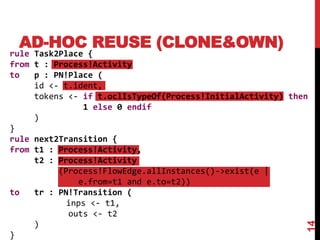
    11 TRANSFORMATION (ATL) rule Task2Place { fromt : Process!Task to p : PN!Place ( id <- t.name, tokens <- if t.initial then 1 else 0 endif ) } rule next2Transition { from t1 : Process!Task, t2 : Process!Task (t1.next->includes(t2)) to tr : PN!Transition ( inps <- t1, outs <- t2 ) } …
  • 12.
    REUSE FOR ANOTHER META-MODEL 12 Task name:String initial: boolean next * Place Transitionid: String tokens: int inps outs * * Activity ident: String InitialActivity task2PN FlowEdge from to
  • 13.
    13 rule Task2Place { fromt : Process!Task to p : PN!Place ( id <- t.name, tokens <- if t.initial then 1 else 0 endif ) } rule next2Transition { from t1 : Process!Task, t2 : Process!Task (t1.next->includes(t2)) to tr : PN!Transition ( inps <- t1, outs <- t2 ) } … AD-HOC REUSE (CLONE&OWN)
  • 14.
    AD-HOC REUSE (CLONE&OWN) 14 ruleTask2Place { from t : Process!Activity to p : PN!Place ( id <- t.ident, tokens <- if t.oclIsTypeOf(Process!InitialActivity) then 1 else 0 endif ) } rule next2Transition { from t1 : Process!Activity, t2 : Process!Activity (Process!FlowEdge.allInstances()->exist(e | e.from=t1 and e.to=t2)) to tr : PN!Transition ( inps <- t1, outs <- t2 ) }
  • 15.
    AD-HOC REUSE (CLONE&OWN) 15 ruleTask2Place { from t : Process!Activity to p : PN!Place ( name <- t.ident, tokens <- if t.oclIsTypeOf(Process!InitialActivity) then 1 else 0 endif ) } rule next2Transition { from t1 : Process!Activity, t2 : Process!Activity (Process!FlowEdge.allInstances()->exist(e | e.from=t1 and e.to=t2)) to tr : PN!Transition ( inps <- t1, outs <- t2 ) } • Complex and error prone • Repetitive • Does not scale to large transformations
  • 16.
    EXPLICIT MODEL ADAPTATION 1616 Task name:String initial: boolean next * Place Transitionid: String tokens: int inps outs * * Activity ident: String InitialActivity task2PN FlowEdge from to activity2task;task2PN activity2task
  • 17.
    MOTIVATION 17 rule Activity2Task { fromt : Activities!Activity to p : Process!Task ( id <- t.ident, initial <- t.oclIsKindOf(Activities!InitialActivity), next <- Activities!FlowEdge.allInstances()-> select (e | e.from = t)-> collect(e | e.to ) ) } t: InitialActivity ident=“a0” p: Task name=“a0” initial=true pl: Place name=“a0” tokens=1 activity2task task2PN
  • 18.
    MOTIVATION 18 rule Activity2Task { fromt : Activities!Activity to p : Process!Task ( name <- t.ident, initial <- t.oclIsKindOf(Activities!InitialActivity), next <- Activities!FlowEdge.allInstances()-> select (e | e.from = t)-> collect(e | e.to ) ) } • Three models involved, complicates traceability • Two transformations: less efficient • May require a transformation back to the initial model
  • 19.
  • 20.
    Automate ad-hoc copy-adaptation: CONCEPT-BASEDREUSE 20 Concept Msrc Mtar from to «conforms to» «conforms to» Template execution MMsrc Instantiated template to binding MMtar HOT Transformation template definition from Final user Transformation developer (with reuse) Transformation developer (for reuse) 1 2 3 4 • Transformations defined over “concepts” • Binding to concrete meta-model • Automated transformation adaptation Sánchez Cuadrado, Guerra, de Lara. “A Component Model for Model Transformations”. IEEE Trans. Software Eng. 2014.
  • 21.
    21 STRUCTURAL CONCEPTS Structural Concepts. • Theygather the structure needed from meta-models for the transformation to be applicable. • They have the form of a meta- model as well. SimpleTask concept Task name: String initial: boolean next * Their elements are treated as variables, which need to be bound to elements in specific meta-models. Interface of the transformation • No superflous elements • No extra complexity • Transformations become as simple as possible
  • 22.
    22 REUSABLE TRANSFORMATIONS Transformations defined usingthe types of the concept. L R=NAC t:Task name=n t:Task name=n :Place id=n tokens=t.initial?1:0 t1:Task t2:Task :next p1:Place p2:Place t1:Task t2:Task :next p1:Place p2:Place :Transition :inps :outs L R=NAC
  • 23.
    23 BINDING Concept binding: • Bindeach element in the concept to an element in the meta-model. Task SETask name  id initial  isInitial next  following Binding SETaskEngineer Coding Testing actors * Software Engineering processes Design SimpleTask concept Task name: String initial: boolean next * Analysis id: String isInitial: boolean following 0..5
  • 24.
    ADAPTATION The transformation getsautomatically adapted Similar to template instantiation in generic programming 24 t:SETask id=n t:SETask id=n :Place id=n tokens=t.isInitial?1:0 t1:SETask t2:SETask :following p1:Place p2:Place t1:SETask t2:SETask :following p1:Place p2:Place :Transition :inps :outs
  • 25.
    IS THE RESULTING TRANSFORMATIONCORRECT? Yes, by following some rules: Rules for the binding • Cardinalities • Composition, features, subtyping, etc Depends on what you do with the concept • Read only (e.g., for M2M transformation) • Write (e.g., for in-place transformation) 25 SETaskTask SETaskTask Concept Meta-modelbinding R W Sánchez Cuadrado, Guerra, de Lara. “Flexible Model-to-Model Transformation Templates: An Application to ATL”. JOT 2012. Task next * SETask R following 0..5 SETask following 0..5 Task next * W
  • 26.
    26 MORE FLEXIBLE BINDINGS Concepts expressa particular design choice on how structure is organized Different meta-models may implement the same structure differently • Association as intermediate class • Enumerate as subclases • etc. binding Task name: String initial: boolean next * Activity ident: String InitialActivity FlowEdge from to
  • 27.
    27 BINDING ADAPTERS Elements inthe concept are variables • Allow binding them to expressions: adapters Adapters resolve the heterogeneities between the concept and the meta-model They induce an adaptation of the transformation Sánchez Cuadrado, Guerra, de Lara. “A Component Model for Model Transformations”. IEEE Trans. Software Eng. 2014. de Lara, Guerra. “Towards the flexible reuse of model transformations: A formal approach based on graph transformation”. JLAMP 83(5-6). 427-458 (2014)
  • 28.
    rule Task2Place { fromt : Pr!Task to p : PN!Place ( tokens <- if t.initial then 1 else 0 endif )} 28 Task initial: boolean next * Concept Activity InitialActivity Flow Edge from to Task  Activity Task.initial  if (self.oclIsKindOf(InitialActivity)) then true else false endif Task.next  FlowEdge.allInstances()-> select(e|e.from=self)-> collect(to) Meta-model typed on helper context Pr!Activity def: initial : Boolean = if (…) then true else false endif; rule Task2Place { from t : Pr!Activity to p : PN!Place ( tokens <- if t.initial then 1 else 0 endif )} typed on adaptation
  • 29.
    ON THE ROLEOF CONCEPTS… Aren’t concepts characterizing a set of “suitable” meta-models for the transformation? Isn’t that exactly what meta-models do (for models)? Concepts as meta-meta-models Rely on typing: no need to adapt the transformation 29
  • 30.
  • 31.
    Language families asinstances of a common meta-model MULTI-LEVEL BASED REUSE 31 Process Modelling Software Process Modelling Language Educational Modelling Language Software Process Models Educational Models de Lara, Guerra, Sánchez Cuadrado. “Model-driven engineering with domain specific meta-modelling languages”. SoSyM 2015 (Springer).
  • 32.
    32 MULTI-LEVEL BASED GENERICITY Transformations canbe defined at the top meta-level Applicable to instances of all languages in the family Process Modelling Software Process Modelling Language Educational Modelling Language Software Process Models Educational Models … Transformation defined on applicableto
  • 33.
    33 MULTI-LEVEL BASED GENERICITY Task Kind Gateway Kind Seq Par src tar * * Test:TaskKindCoding:TaskKind T2C: Seq C2T: Seq src tar srctar data: Coding unitDt: Test gui: Coding : C2T src tar : T2C tar src «conf» «conf» data: Coding unitDT: Test gui: Coding rule Task2Place transform t : Level0!TaskKind to p : Place { ... } .... defined on
  • 34.
    rule Task2Place transform t: Level0!TaskKind to p : Place { ... } .... 34 MULTI-LEVEL BASED GENERICITY data: Coding unitDT: Test gui: Coding rule Coding2Place transform t : Coding to p : Place {…} rule Test2Place transform t : Test to p : Place {…} defined on data: Coding unitDt: Test gui: Coding : C2T src tar : T2C tar src «conf» Task Kind Gateway Kind Seq Par src tar * * Test: TaskKindCoding:TaskKind T2C: Seq C2T: Seq src tar srctar «conf»
  • 35.
    35 MULTI-LEVEL VS CONCEPT- BASEDGENERICITY Concept-based Genericity Multi-level-based Genericity • A posteriori binding: meta- models may exist first. • Adapters and hybrid concepts to solve heterogeneities. • A priori: meta-meta-model should exist first. • Ability to apply an operation several meta-levels below. • Domain-Specific meta- modelling.
  • 36.
    36 CAN WE GETTHE BEST OF BOTH APPROACHES? • A posteriori binding: meta-models may exist first. • Adapters or Hybrid concepts to solve heterogeneities. • Independence of the transformation language Concept-based reuse Multi-level reuse
  • 37.
    37 CAN WE GETTHE BEST OF BOTH APPROACHES? • A posteriori binding: meta-models may exist first. • Adapters to solve heterogeneities. • Independence of the transformation language Concept-based reuse Multi-level reuse Let’s make the typing relation: • A-posteriori • As flexible as adapters
  • 38.
  • 39.
    A-POSTERIORI TYPING 39 A moreflexible typing mechanism for MDE Decouple instantiation from classification • Interfaces in object-oriented programming • Roles in role-based programming languages Allow dynamic typing and multiple classifiers for objects Type and instance-level reclassification specifications de Lara, Guerra. A Posteriori Typing for Model-Driven Engineering: Concepts, Analysis, and Applications. ACM Trans. Softw. Eng. Methodol. 25 (4) 31:1-31:60 (2017)
  • 40.
    CONSTRUCTIVE VS A-POSTERIORI TYPING 40 Task start:Date duration: int name: String review: Task start= 8/5/15 duration= 30 name= “rev” creation «instance of» Measurable quantity: int Schedulable date: Date review: Task Tasks meta-model model Scheduling MM Measuring MM model «instance of» «instance of» start= 8/5/15 duration= 30 name= “rev” «Schedulable,Measurable» Constructive typing A-posteriori typing Constructive typing A-posteriori typing
  • 41.
    SPECIFYING AP TYPINGS ATTHE TYPE-LEVEL 41 Schedulable date: Date span: double review: Task Tasks meta-model ( MMC ) start= 8/5/15 /months= 1 duration= 30 name= “rev” Scheduling MM ( MMR ) Task start: Date duration: int name: String Typing Specification Task  Schedulable self.start  date /months: double=self.duration/30  span «Schedulable» «date» «span» creation «instance of» (constructive) «instance of» (a-posteriori) • Derived attributes (months) defined in the typing specification. • Typing rules: ensure syntactic correctness
  • 42.
    TYPE-LEVEL AP TYPING 42 date:Date span: double writing: Task start= 15/3/15 duration= 90 name= “wrt” review: Task start= 8/5/15 duration= 30 name= “rev” Schedulable Scheduling MM (MMR) Instance model of Tasks ( MMC ) «instance of» (a-posteriori) “Scheduling glasses” Operations review: Schedulable date= 8/5/15 span= 1 {review, writing} {1, 3} Schedulable.allInstances() writing: Schedulable date= 15/3/15 span= 3 Schedulable.allInstances()-> collect(span)
  • 43.
    SPECIFYING AP TYPINGSAT THE INSTANCE LEVEL 43 date: Date span: double writing: Task start= 15/3/15 duration= 90 name= “wrt” review: Task start= 8/5/15 /months= 1 duration= 30 name= “rev” «Schedulable» «date» «instance of» (a-posteriori) Schedulable Scheduling MM (MMR) Typing Specification Task.allInstances()->select(duration<80)  Schedulable self.start  date /months: double=self.duration/30  span Instance model of Tasks ( MMC ) «span» • Typing defined by queries. • Derived attributes defined by queries as well.
  • 44.
    INSTANCE-LEVEL AP TYPING 44 Operations date:Date span: double writing: Task start= 15/3/15 duration= 90 name= “wrt” review: Task start= 8/5/15 duration= 30 name= “rev” Schedulable Scheduling MM (MMR) Instance model of Tasks ( MMC ) «instance of» (a-posteriori) review: Schedulable date= 8/5/15 span= 1 Schedulable.allInstances()-> collect(span) {review} {1} Schedulable.allInstances() “Scheduling glasses”
  • 45.
    INSTANCE-LEVEL AP TYPING 45 Operations date:Date span: double writing: Task start= 15/3/15 duration= 60 name= “wrt” review: Task start= 8/5/15 duration= 30 name= “rev” Schedulable Scheduling MM (MMR) Instance model of Tasks ( MMC ) «instance of» (a-posteriori) review: Schedulable date= 8/5/15 span= 1 Schedulable.allInstances()-> collect(span) {review, writing} {1, 2} Schedulable.allInstances() “Scheduling glasses” writing: Schedulable date= 15/3/15 span= 2
  • 46.
    Activity  Task ident name /init : boolean = self.oclsKindOf(InitialActivity)  initial /follow: Task[*] = FlowEdge.allInstances()-> select(e|e.from=self)-> collect(e|e.to)  next EXAMPLE 46 Task name: String initial: boolean next * Activity ident: String InitialActivity FlowEdge from to
  • 47.
    A-POSTERIORI TYPING ASA TRANSFORMATION 47 Task name: String initial: boolean next Place Transitionid: String tokens: int inps outs * * task2PN Task.allInstances()  Place name  id /toks : int = if (self.initial) then 1 else 0  tokens Task.allInstances()->select(t|t.next.isDefined())  Transition /prevs : Task[*] = Set{self}  inps /nexts : Task[*] = Set{self.next}  outs 0..1
  • 48.
    A-POSTERIORI TYPING ASA TRANSFORMATION 48 Place Transitionid: String tokens: int inps outs * * t1:Task name=“t1” initial=false name=“t2” initial=true :next name=“t3” initial=false :next t2:Task t3:Task Task name: String initial: boolean next 0..1 task2PN
  • 49.
    A-POSTERIORI TYPING ASA TRANSFORMATION 49 Place Transitionid: String tokens: int inps outs * * «Place» «Place, Transition» «Place, Transition» «id» «id» «id» Task name: String initial: boolean next 0..1 task2PN t1:Task name=“t1” initial=false name=“t2” initial=true :next name=“t3” initial=false :next t2:Task t3:Task
  • 50.
    A-POSTERIORI TYPING ASA TRANSFORMATION 50 Place Transitionid: String tokens: int inps outs * * t2:Task t3:Task «Transition» «Transition» «outs» «outs» «inps» «inps» Task name: String initial: boolean next 0..1 task2PN «Place» «Place» «id» «id»name=“t2” initial=true name=“t3” initial=false t2:Task t3:Task «Place» «id» t1:Task name=“t1” initial=false
  • 51.
  • 52.
    BENTŌ: CONCEPT-BASED REUSE FORATL Adaptation of ATL transformations according to the binding Support for refactoring meta-models into concepts 52 Sánchez Cuadrado, Guerra, de Lara. “A Component Model for Model Transformations”. IEEE TSE 2014 Sánchez Cuadrado, Guerra, de Lara. “Reusable Model Transformation Components with bentō”. ICMT’ 15
  • 53.
    // Model Tasks someTasks{ Task t0 { start = "30/04/2015"; duration = 30; name = "coding"; } } METADEPTH 53 Multi-level textual modelling Concepts • Over every Epsilon language • Hybrid concepts A-posteriori typing • Over every Epsilon language Analysis of type-level specs • Integration with the USE validator • Bidirectional reclassification • Reclassification totality and surjectivity // Meta-model Model Tasks { Node Task { start : Date; duration : int; name : String; } }
  • 54.
    CONCEPT-BASED REUSE 54 concept SimpleTasks(&M, &T, &initial) { Model &M{ Node &T { &initial : boolean; name : String; } } } bind SimpleTasks( SEProcess, SEProcess::SETask, SEProcess::SETask.isInitial ) <<some operation>> rule Task2Place transform task : Source!&T to place : Target!Place { place.name := task.name; if (task.&initial=true) place.tokens:=1 else place.tokens:=0 } ETL transformation
  • 55.
    55 Model ProcessModel@2 { NodeTask { name@1 : String[0..1]; initial : boolean = false; } } ProcessModel SoftwareProcess { Task Analysis { name = “reqs, analysis”; } } SoftwareProcess aSoftProcess{ Analysis a { initial = true; } } @model(potency=0) rule Task2Place transform task : Source!Task to place : Target!Place { place.name := task.name; if (task.initial=true) place.tokens:=1 else place.tokens:=0 } ETL transformation MULTI-LEVEL BASED REUSE
  • 56.
    56 type Factory PetriNet{ Conveyor::parts > Place::tokens, Generator::outps > Transition::outs, Terminator::inps > Transition::ins, Assembler::inps > Transition::ins, Assembler::outps > Transition::outs, } A-POSTERIORI TYPINGS
  • 57.
    Transformations defined overPetri nets can be reused “as is” for Factory • Provide an AP typing from Factory to Petri nets • Factory models become typed as Petri nets 57 // EOL excerpt of the simulator operation Transition enabled() : Boolean { return self.ins.forAll(p| p.tokens.size()>0); } operation step() : Boolean { var enabled : Set(Transition) := Transition.all.select( t | t.enabled()); ... // fire one random Transition from enabled } A-POSTERIORI TYPINGS
  • 58.
    CONCLUSIONS 58 Lower entry-level toMDE to make it more widely used Approaches to reuse model transformations in MDE • Concept-based • Ideas from generic programming • Automates ad-hoc reuse • Multi-level modelling • Families of languages • Independent of transformation language • A-posteriori typing • Provide additional types via retyping specifications • Improve model-adaptation based reuse
  • 59.
    FUTURE WORK 59 Product-Lines basedreuse • With Salay, Chechik (UoT) • Analysis Requirement models as the interface of transformations • More powerful than concepts Exploit a-posteriori typing in MDE • Multiple typings for MDE • Retypings as bx transformations Unified approach?
  • 60.