Advanced C Language for Engineering © V De Florio
ATHENS CourseATHENS Course
Advanced C Language
for Engineering
Vincenzo De Florio
17 – 21 November 2003
V.ppt-1.1
2003-11-10
2
Advanced C Language for Engineering ( V De Florio)
Overall structureOverall structure
• An introduction to C
• The FILE methodology. Classes. Data hiding.
Examples (class assoc, objalloc, vf. . . )
• Literate programming. The cweb tools
• The GNU autotools
• Other classes for embedded systems (class tom,
the DepAuDE framework)
• Linguistic support using C, Lex and YACC.
Examples (the icgi interpreter, class FN, PvmLinda,
the Ariel language...)
• Exercise sessions, case studies, project works
3
Advanced C Language for Engineering ( V De Florio)
StructureStructure
• Introduction
• First examples
• Variables
• Fundamental data
types
• Loops
• Conditional statements
& other instructions
• The C preprocessor
• Functions
• Variables again
• Operators
• Standard I/O functions
• Derived types
• Pointers and arrays
• Use of pointers
• Type casts &
conversions
• Bitwise operators
• Standard streams, files
• Structures, bitfields,
unions
• LLP
• Data hiding
http://www.esat.kuleuven.ac.be/~deflorio/c/athens03.prn.gz
4
Advanced C Language for Engineering ( V De Florio)
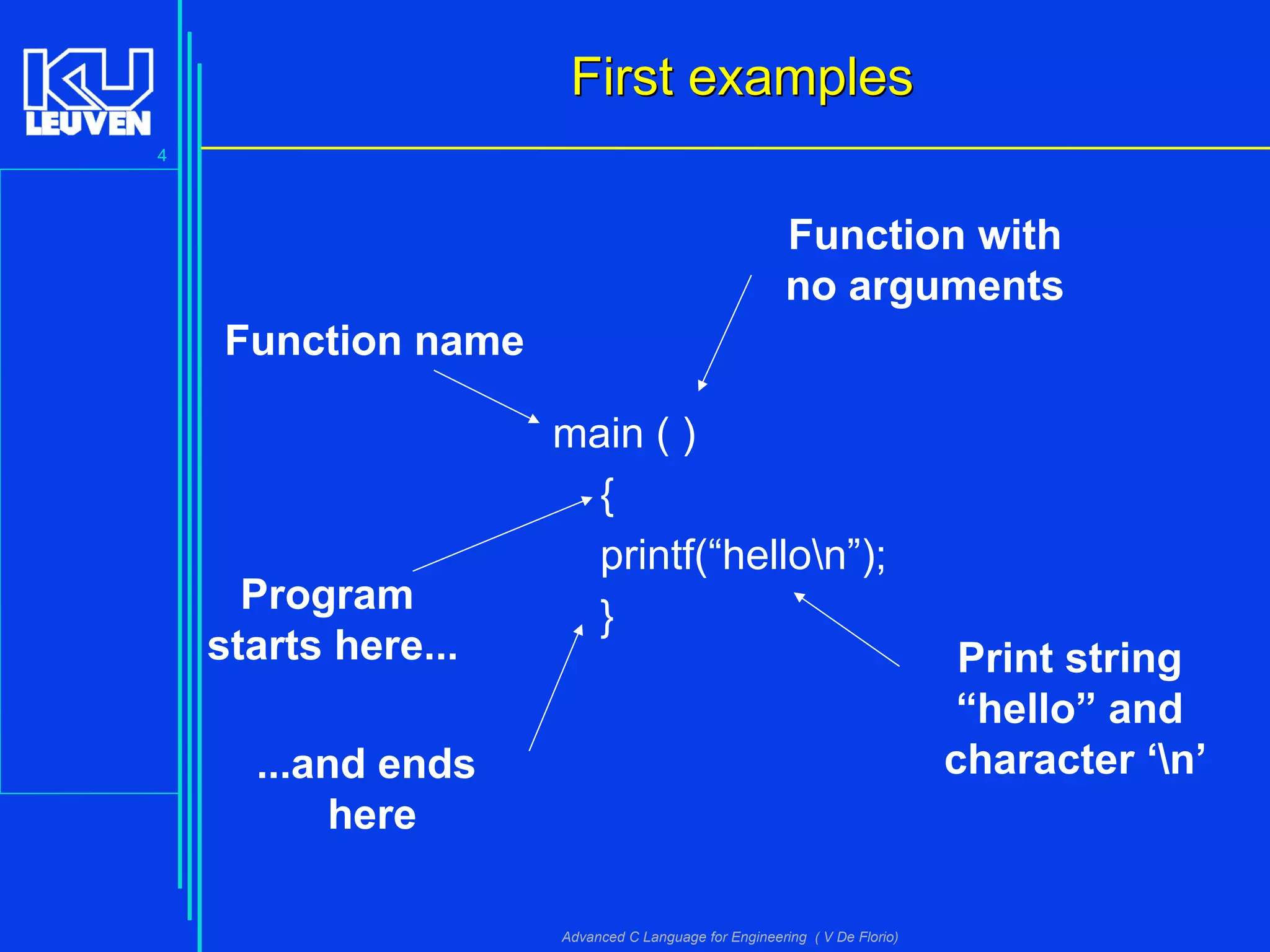
First examplesFirst examples
main ( )
{
printf(“hellon”);
}
Function name
Function with
no arguments
Program
starts here...
...and ends
here
Print string
“hello” and
character ‘n’
5
Advanced C Language for Engineering ( V De Florio)
First examplesFirst examples
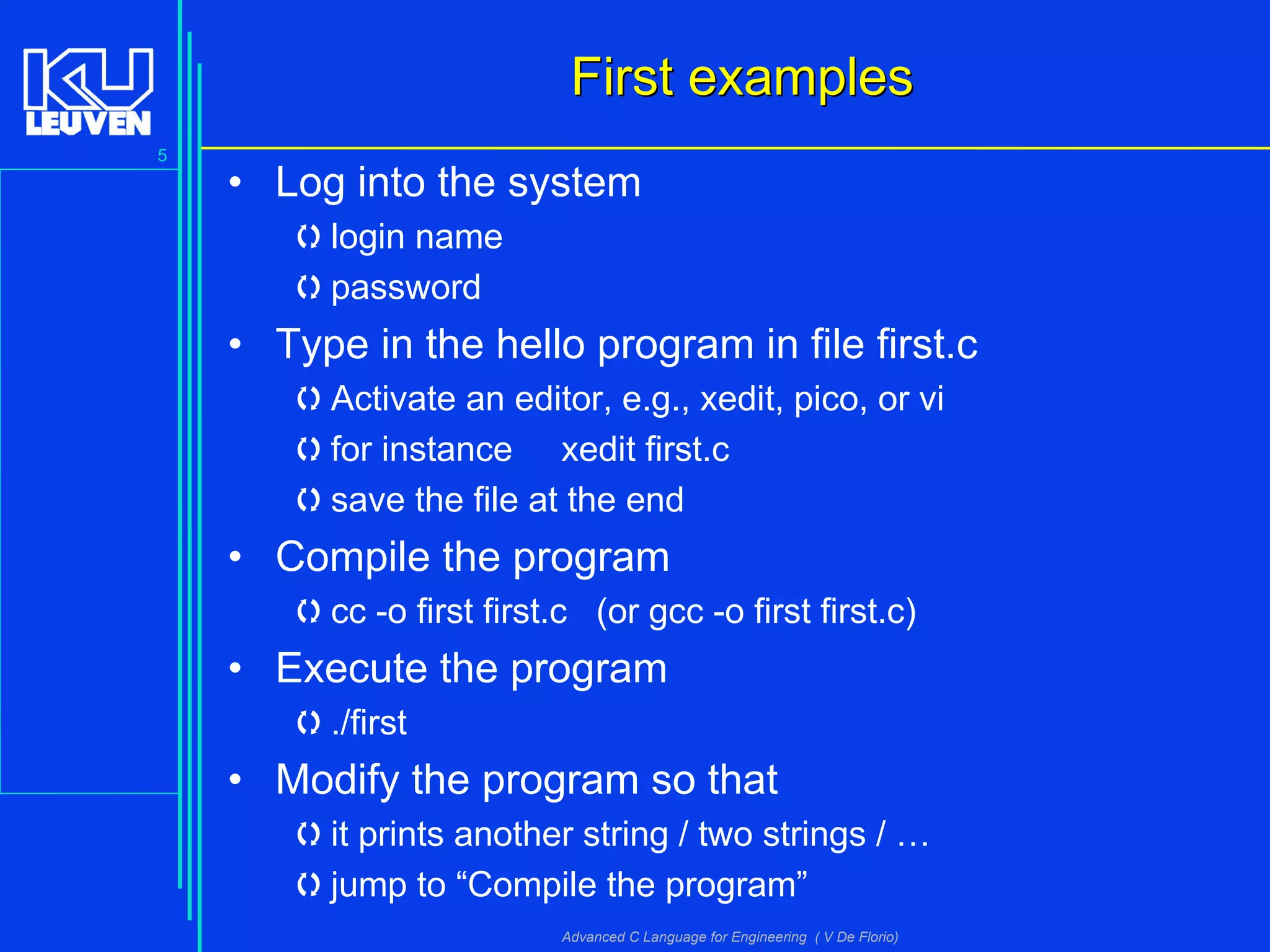
• Log into the system
login name
password
• Type in the hello program in file first.c
Activate an editor, e.g., xedit, pico, or vi
for instance xedit first.c
save the file at the end
• Compile the program
cc -o first first.c (or gcc -o first first.c)
• Execute the program
./first
• Modify the program so that
it prints another string / two strings / …
jump to “Compile the program”
6
Advanced C Language for Engineering ( V De Florio)
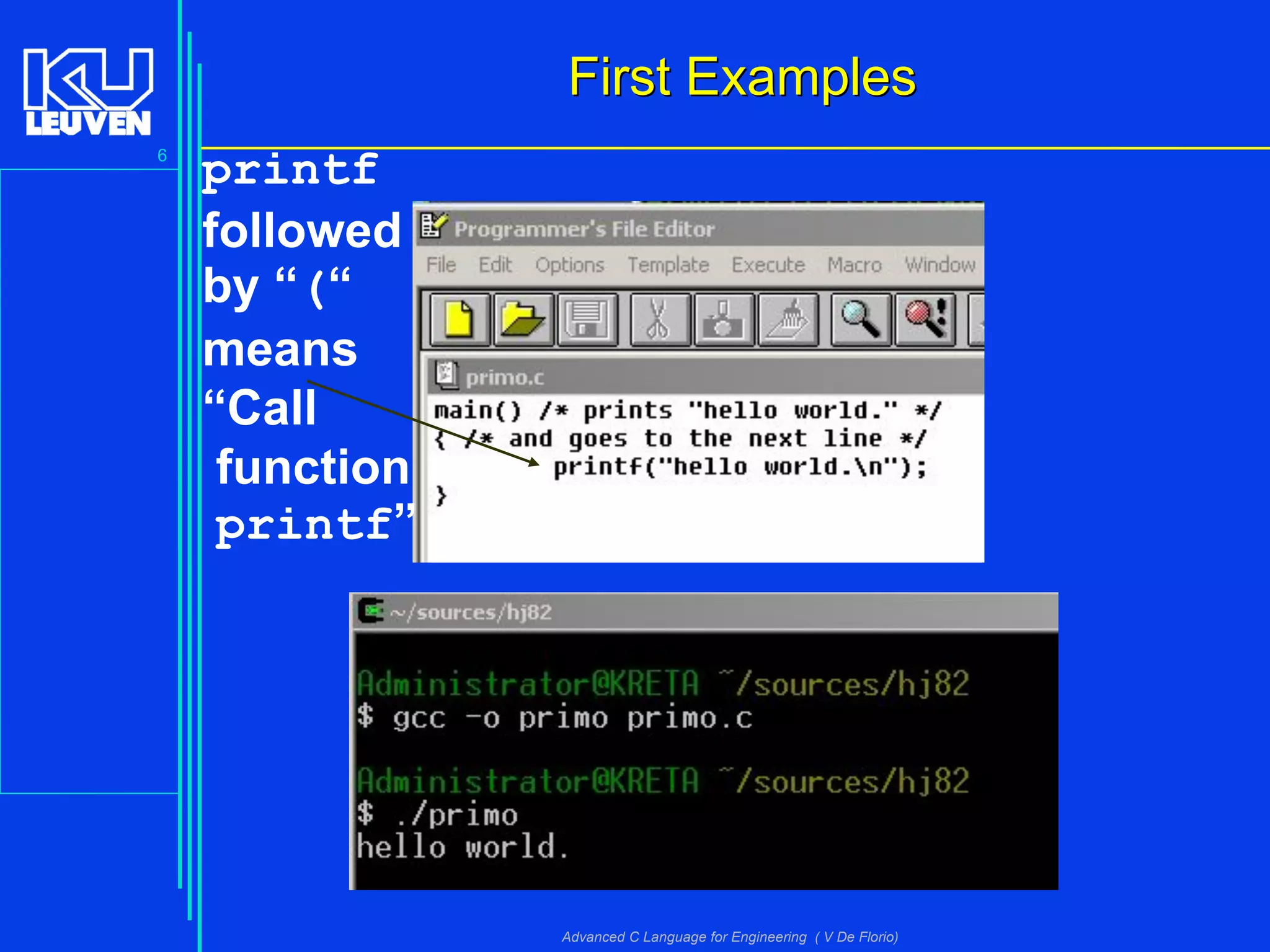
First ExamplesFirst Examples
printf
followed
by “(“
means
“Call
function
printf”
7
Advanced C Language for Engineering ( V De Florio)
First examplesFirst examples
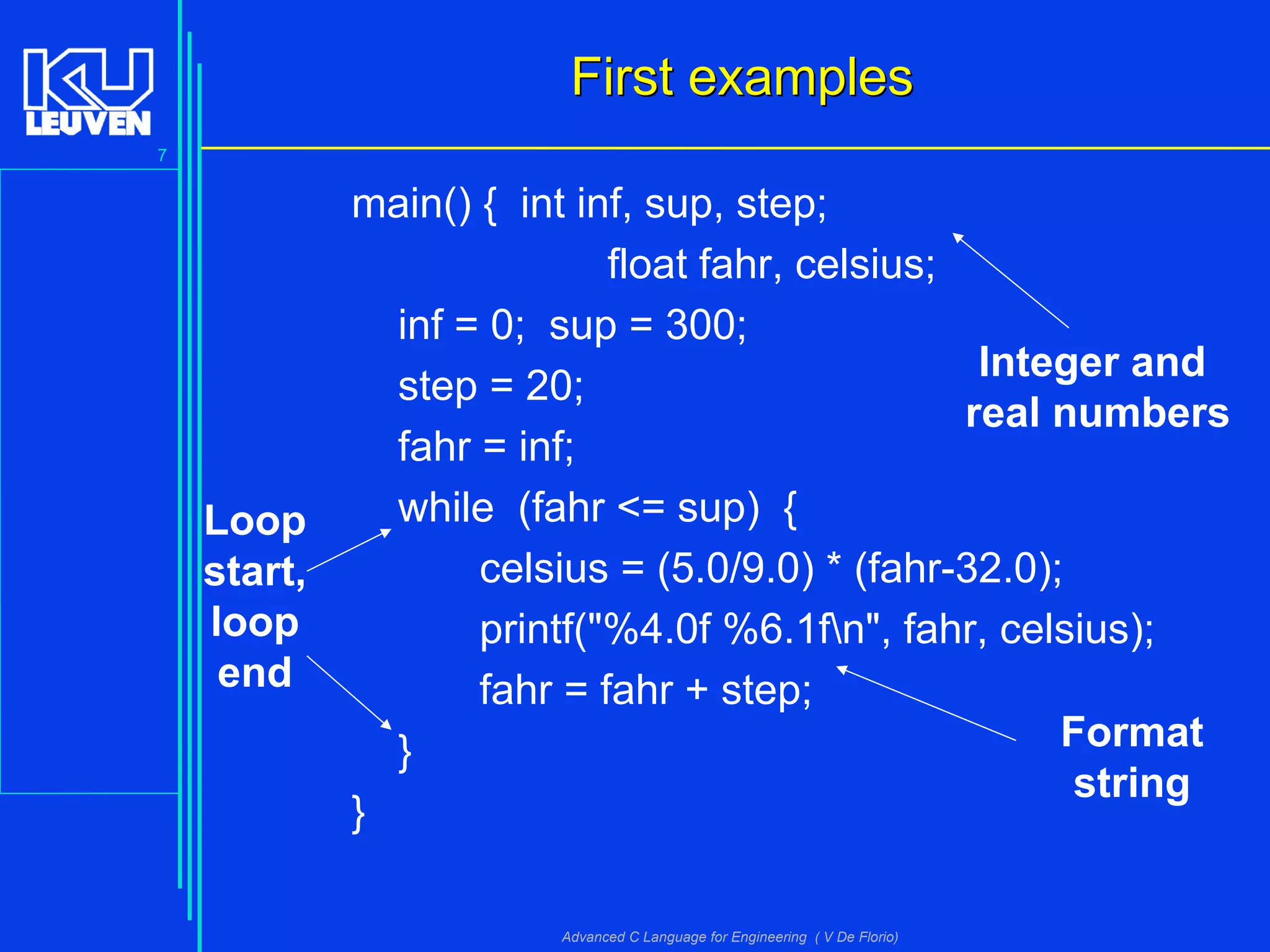
main() { int inf, sup, step;
float fahr, celsius;
inf = 0; sup = 300;
step = 20;
fahr = inf;
while (fahr <= sup) {
celsius = (5.0/9.0) * (fahr-32.0);
printf("%4.0f %6.1fn", fahr, celsius);
fahr = fahr + step;
}
}
Integer and
real numbers
Loop
start,
loop
end
Format
string
8
Advanced C Language for Engineering ( V De Florio)
First examplesFirst examples
9
Advanced C Language for Engineering ( V De Florio)
First examplesFirst examples
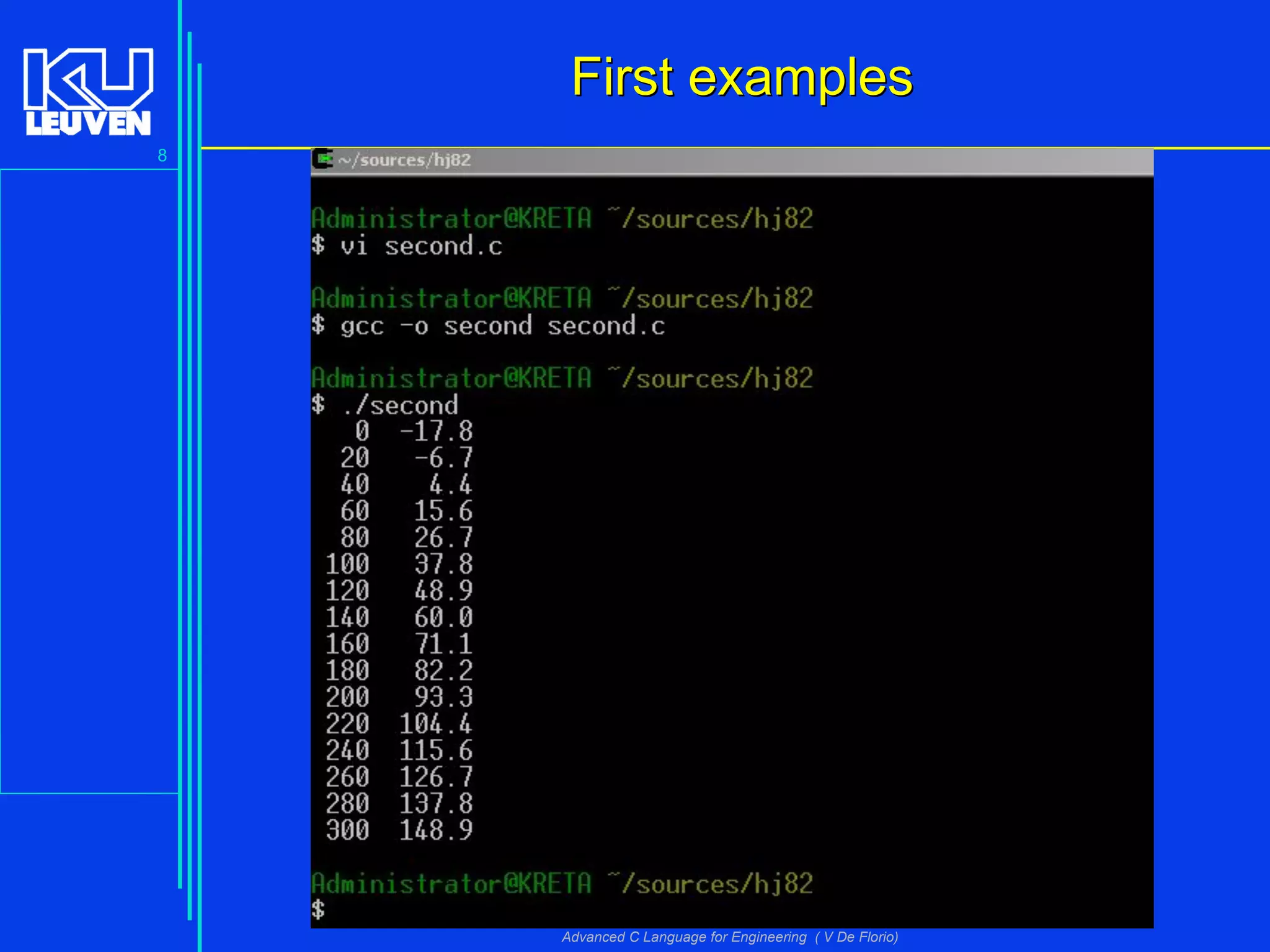
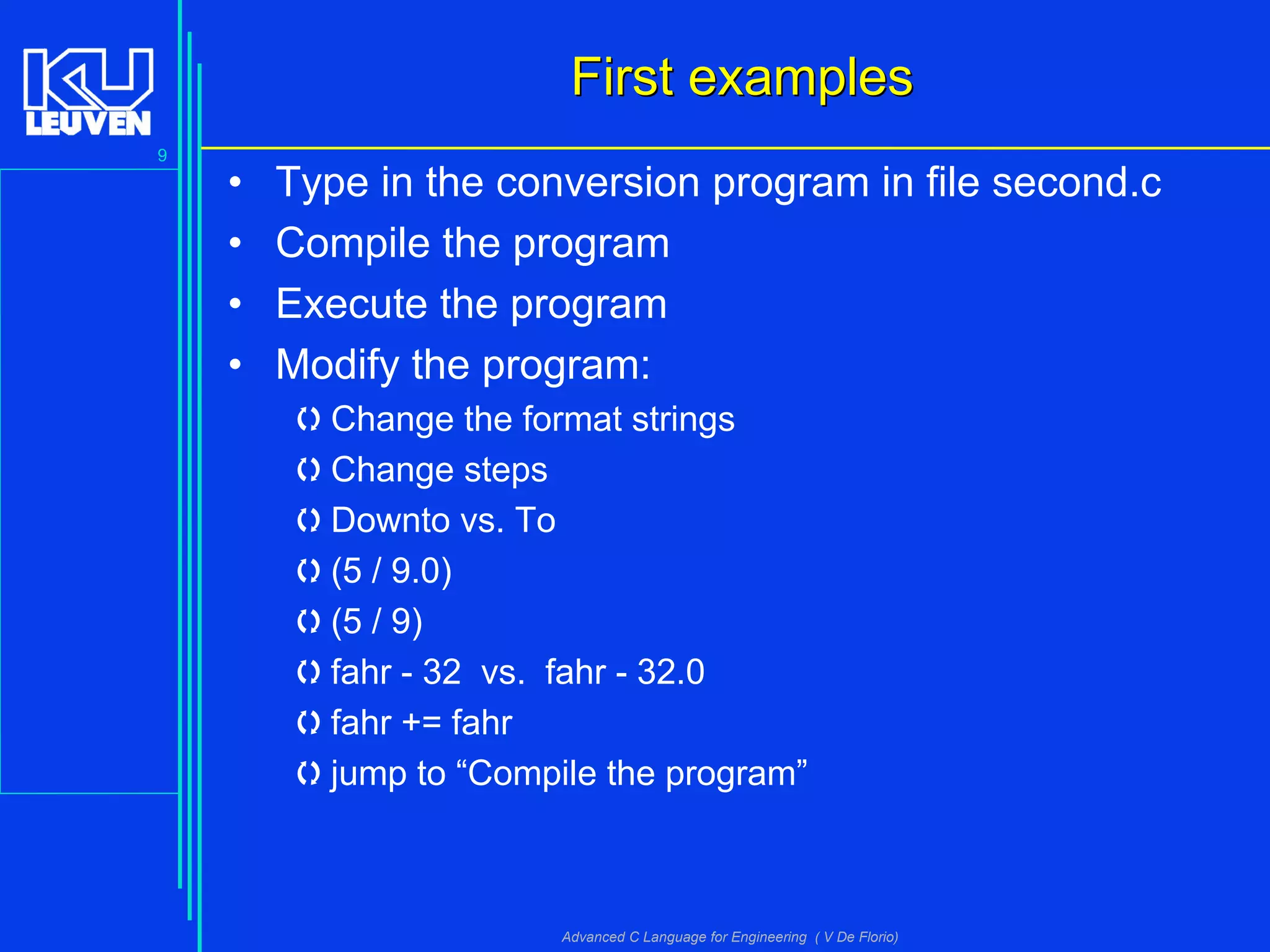
• Type in the conversion program in file second.c
• Compile the program
• Execute the program
• Modify the program:
Change the format strings
Change steps
Downto vs. To
(5 / 9.0)
(5 / 9)
fahr - 32 vs. fahr - 32.0
fahr += fahr
jump to “Compile the program”
10
Advanced C Language for Engineering ( V De Florio)
Definition of Variables (1)Definition of Variables (1)
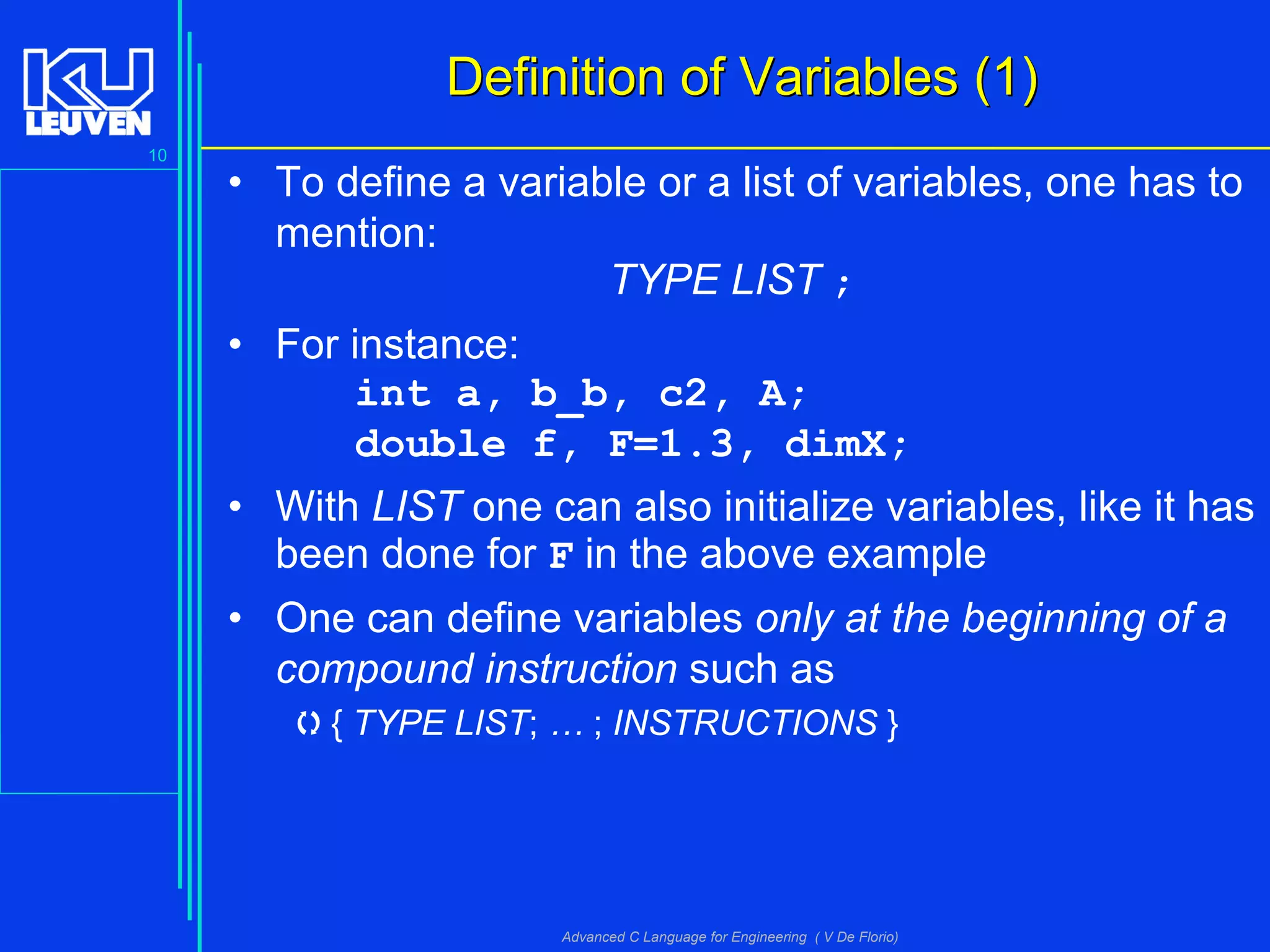
• To define a variable or a list of variables, one has to
mention:
TYPE LIST ;
• For instance:
int a, b_b, c2, A;
double f, F=1.3, dimX;
• With LIST one can also initialize variables, like it has
been done for F in the above example
• One can define variables only at the beginning of a
compound instruction such as
{ TYPE LIST; … ; INSTRUCTIONS }
11
Advanced C Language for Engineering ( V De Florio)
First examplesFirst examples
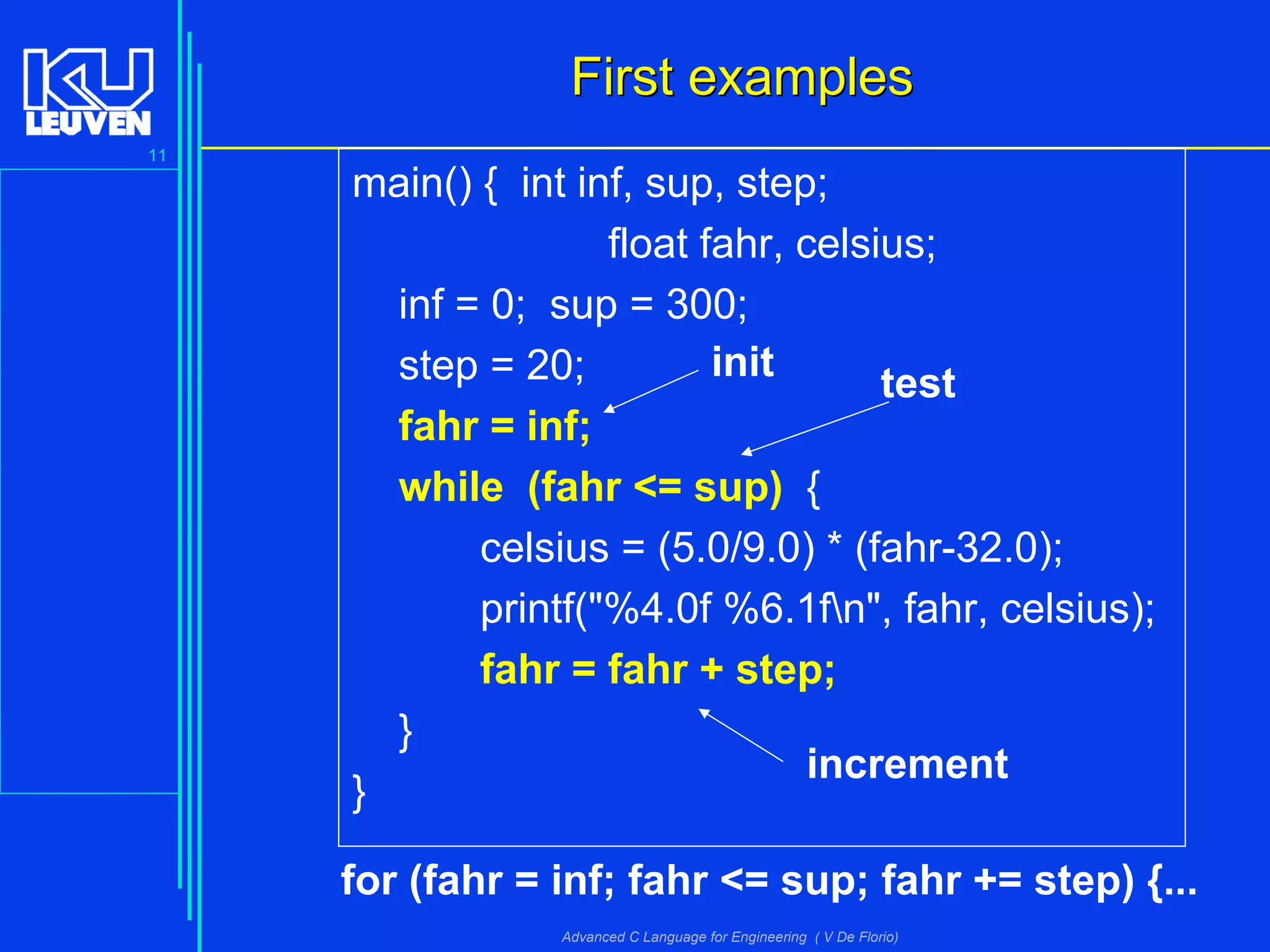
main() { int inf, sup, step;
float fahr, celsius;
inf = 0; sup = 300;
step = 20;
fahr = inf;
while (fahr <= sup) {
celsius = (5.0/9.0) * (fahr-32.0);
printf("%4.0f %6.1fn", fahr, celsius);
fahr = fahr + step;
}
}
init test
increment
for (fahr = inf; fahr <= sup; fahr += step) {...
12
Advanced C Language for Engineering ( V De Florio)
First examplesFirst examples
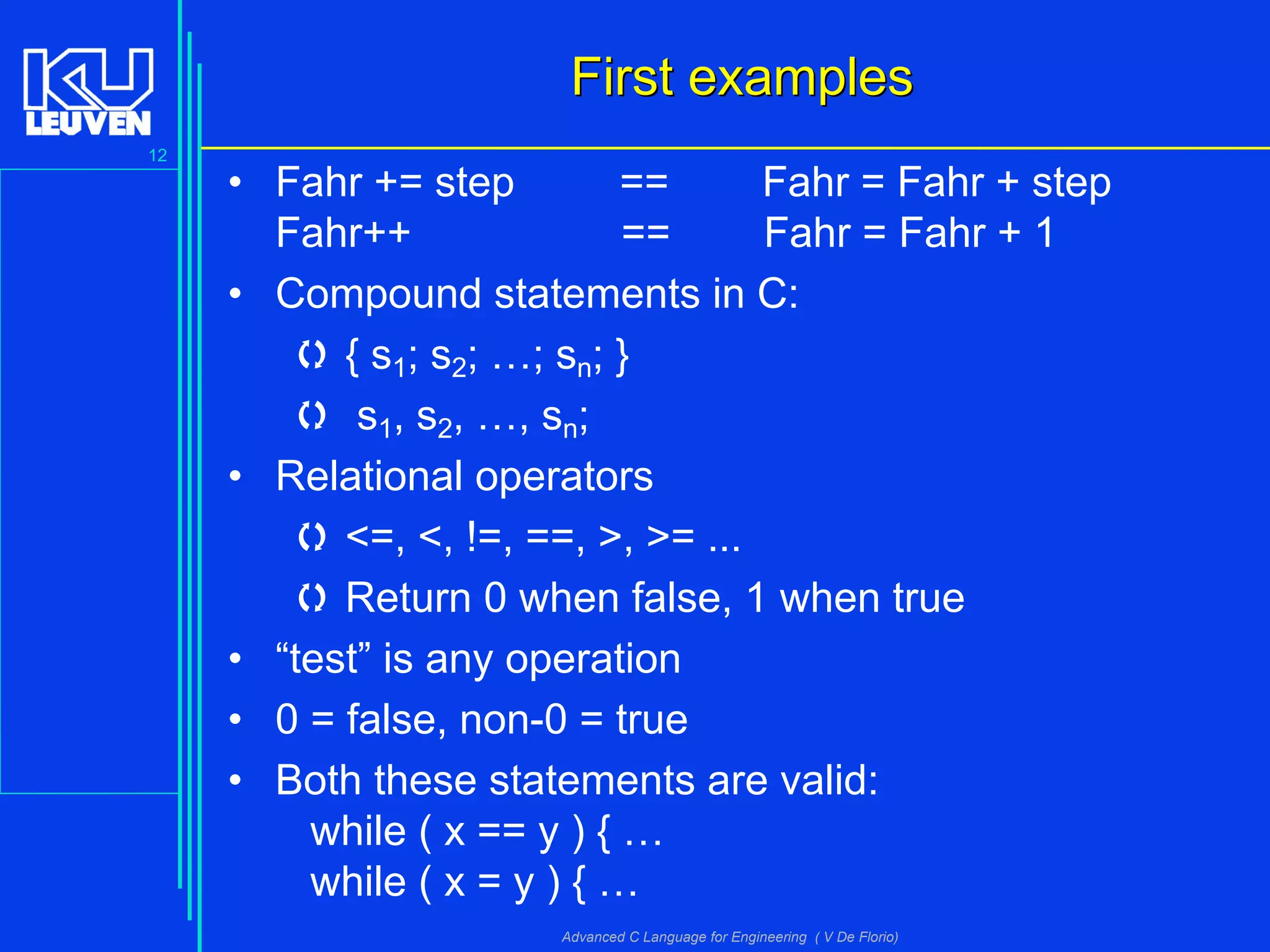
• Fahr += step == Fahr = Fahr + step
Fahr++ == Fahr = Fahr + 1
• Compound statements in C:
 { s1; s2; …; sn; }
 s1, s2, …, sn;
• Relational operators
 <=, <, !=, ==, >, >= ...
 Return 0 when false, 1 when true
• “test” is any operation
• 0 = false, non-0 = true
• Both these statements are valid:
while ( x == y ) { …
while ( x = y ) { …
13
Advanced C Language for Engineering ( V De Florio)
First examplesFirst examples
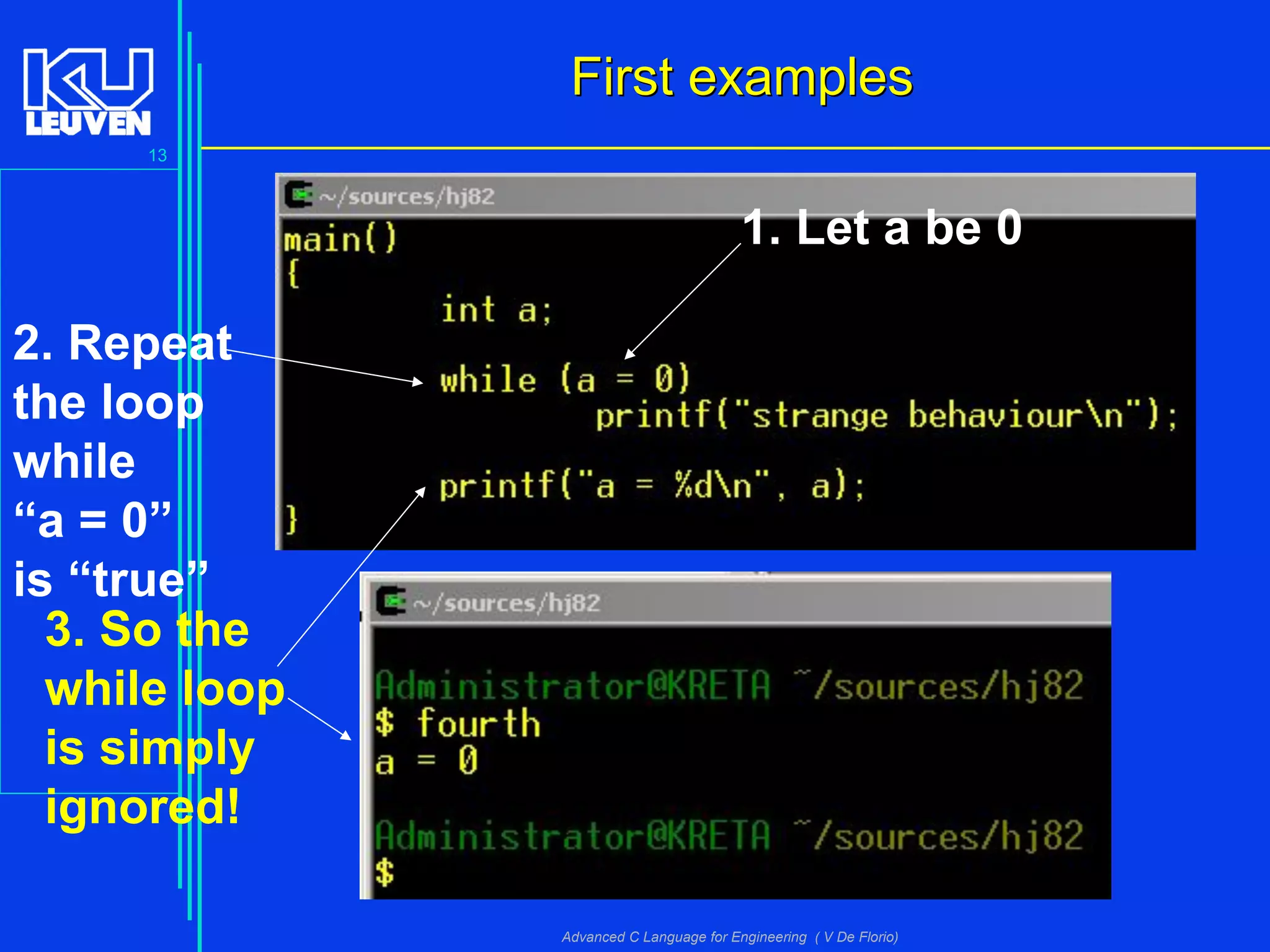
1. Let a be 0
2. Repeat
the loop
while
“a = 0”
is “true”
3. So the
while loop
is simply
ignored!
14
Advanced C Language for Engineering ( V De Florio)
First examplesFirst examples
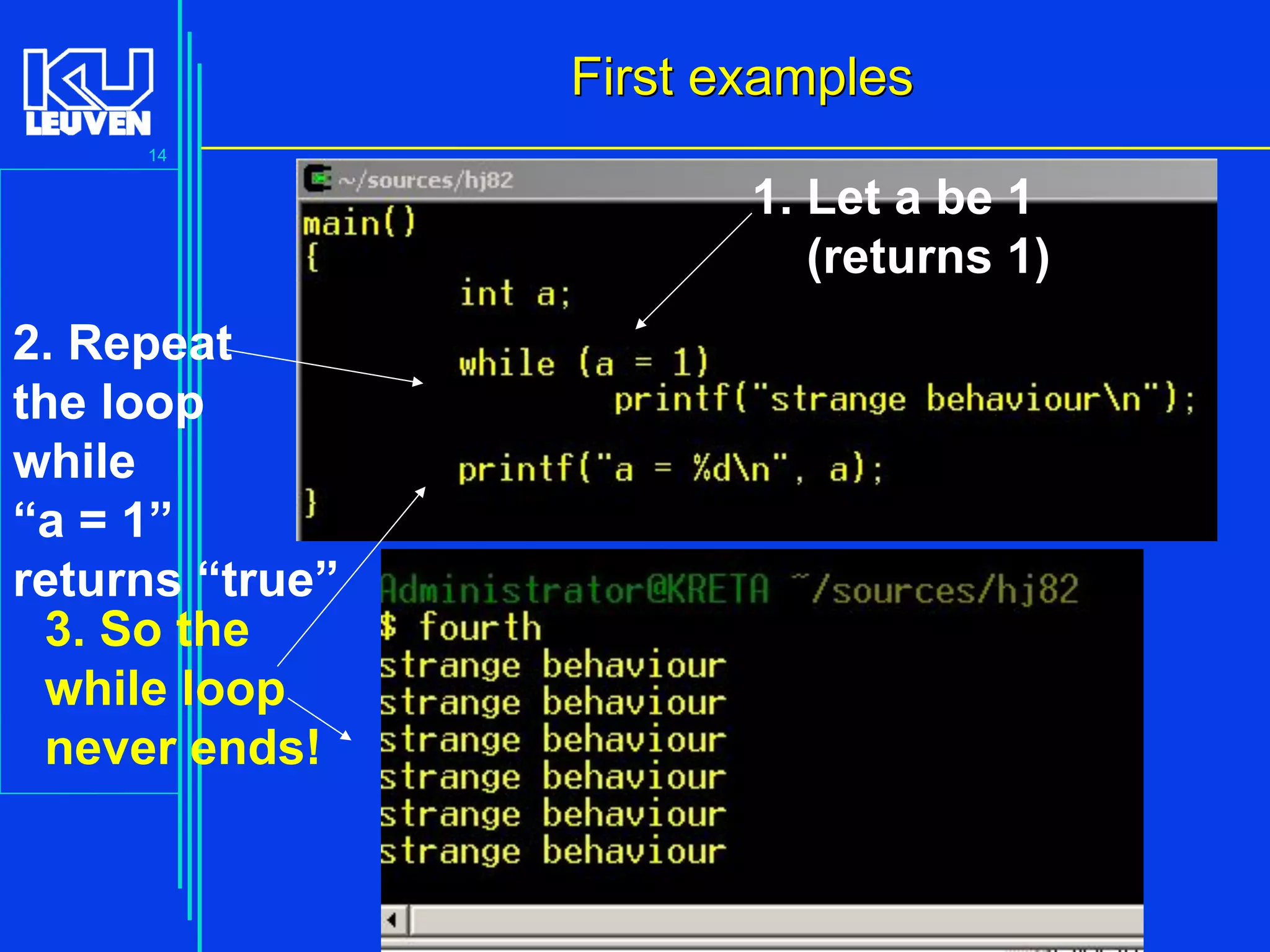
1. Let a be 1
(returns 1)
2. Repeat
the loop
while
“a = 1”
returns “true”
3. So the
while loop
never ends!
15
Advanced C Language for Engineering ( V De Florio)
First examplesFirst examples
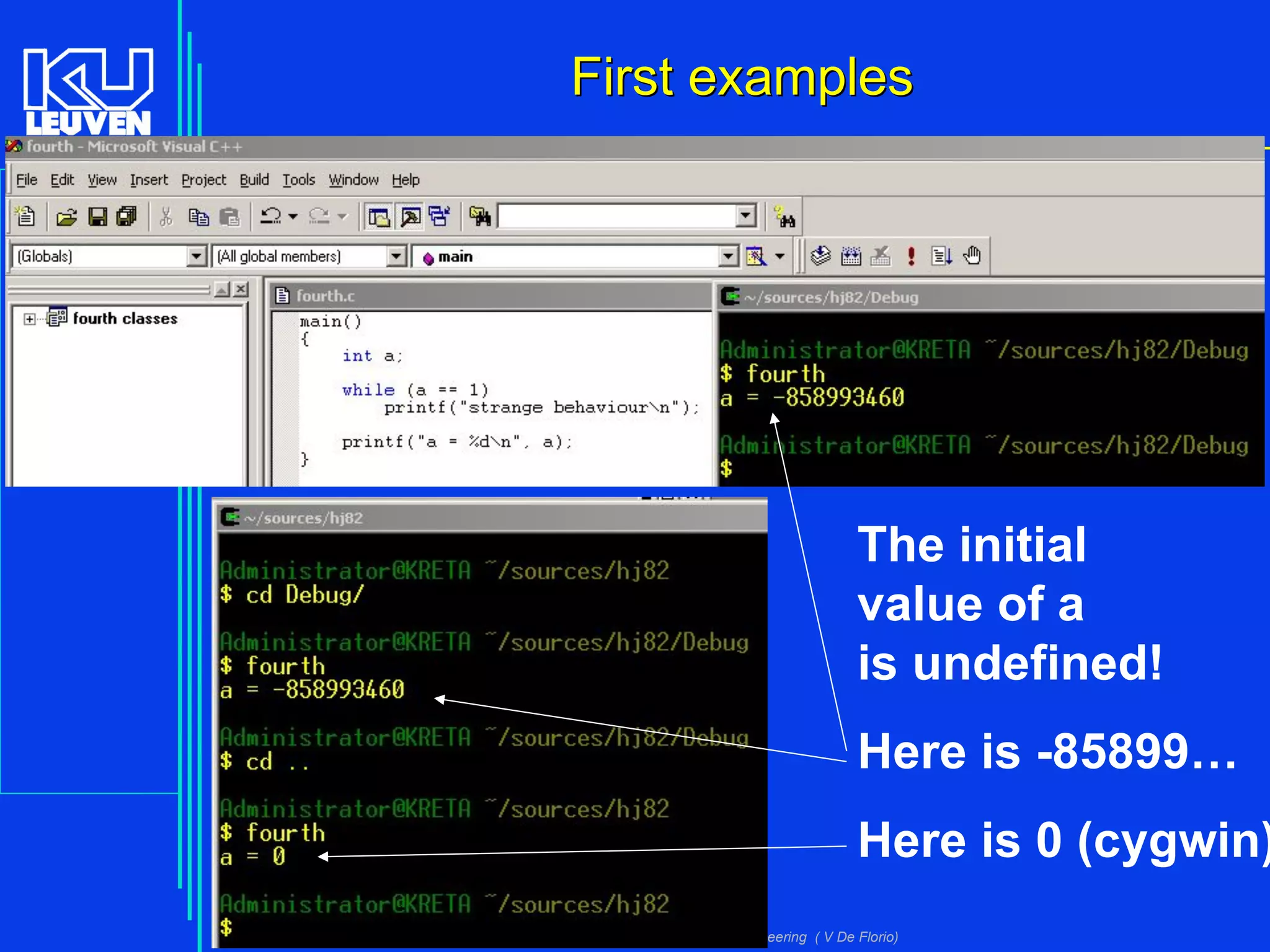
The initial
value of a
is undefined!
Here is -85899…
Here is 0 (cygwin)
16
Advanced C Language for Engineering ( V De Florio)
Fundamental data typesFundamental data types
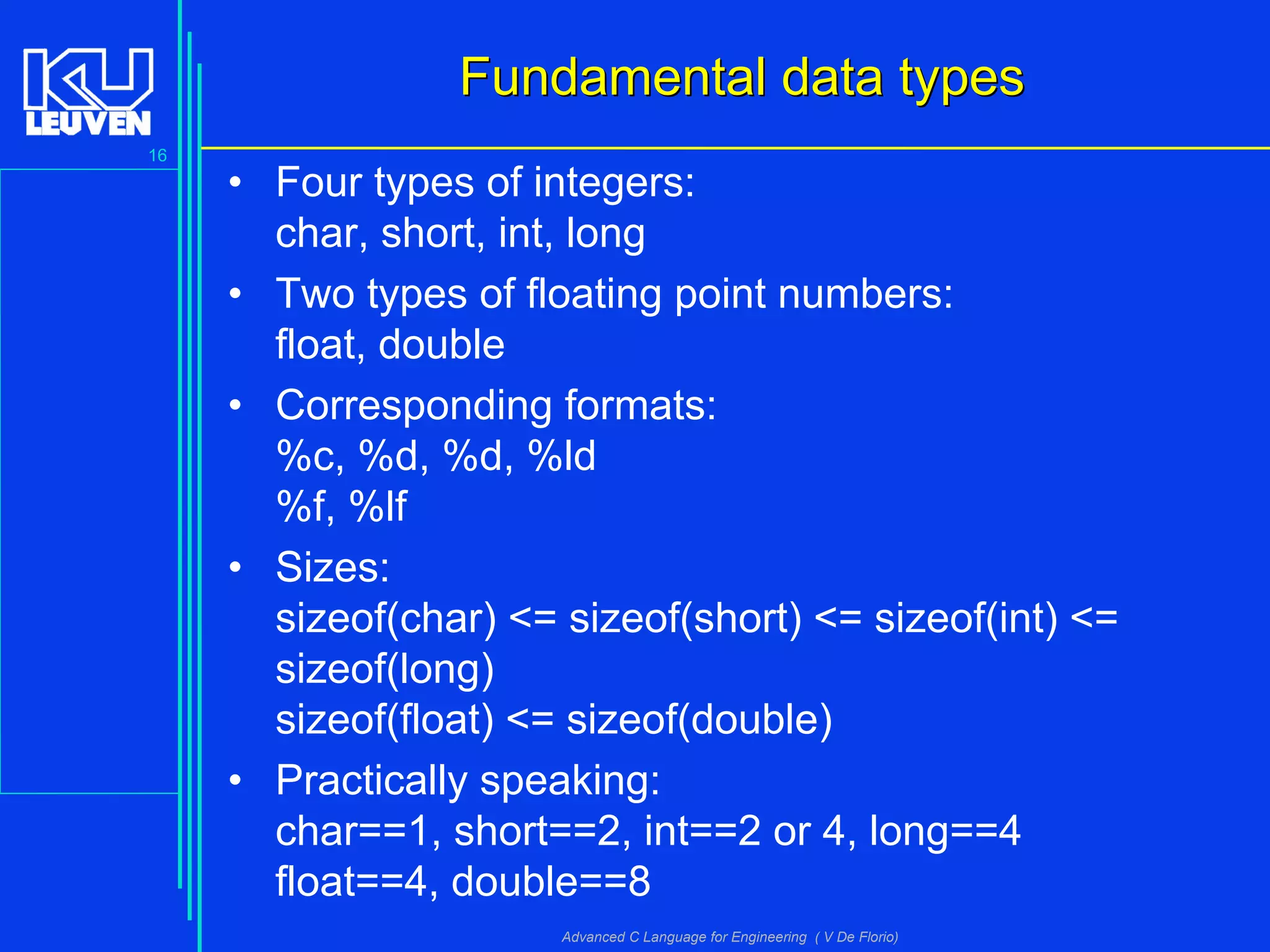
• Four types of integers:
char, short, int, long
• Two types of floating point numbers:
float, double
• Corresponding formats:
%c, %d, %d, %ld
%f, %lf
• Sizes:
sizeof(char) <= sizeof(short) <= sizeof(int) <=
sizeof(long)
sizeof(float) <= sizeof(double)
• Practically speaking:
char==1, short==2, int==2 or 4, long==4
float==4, double==8
17
Advanced C Language for Engineering ( V De Florio)
Fundamental data typesFundamental data types
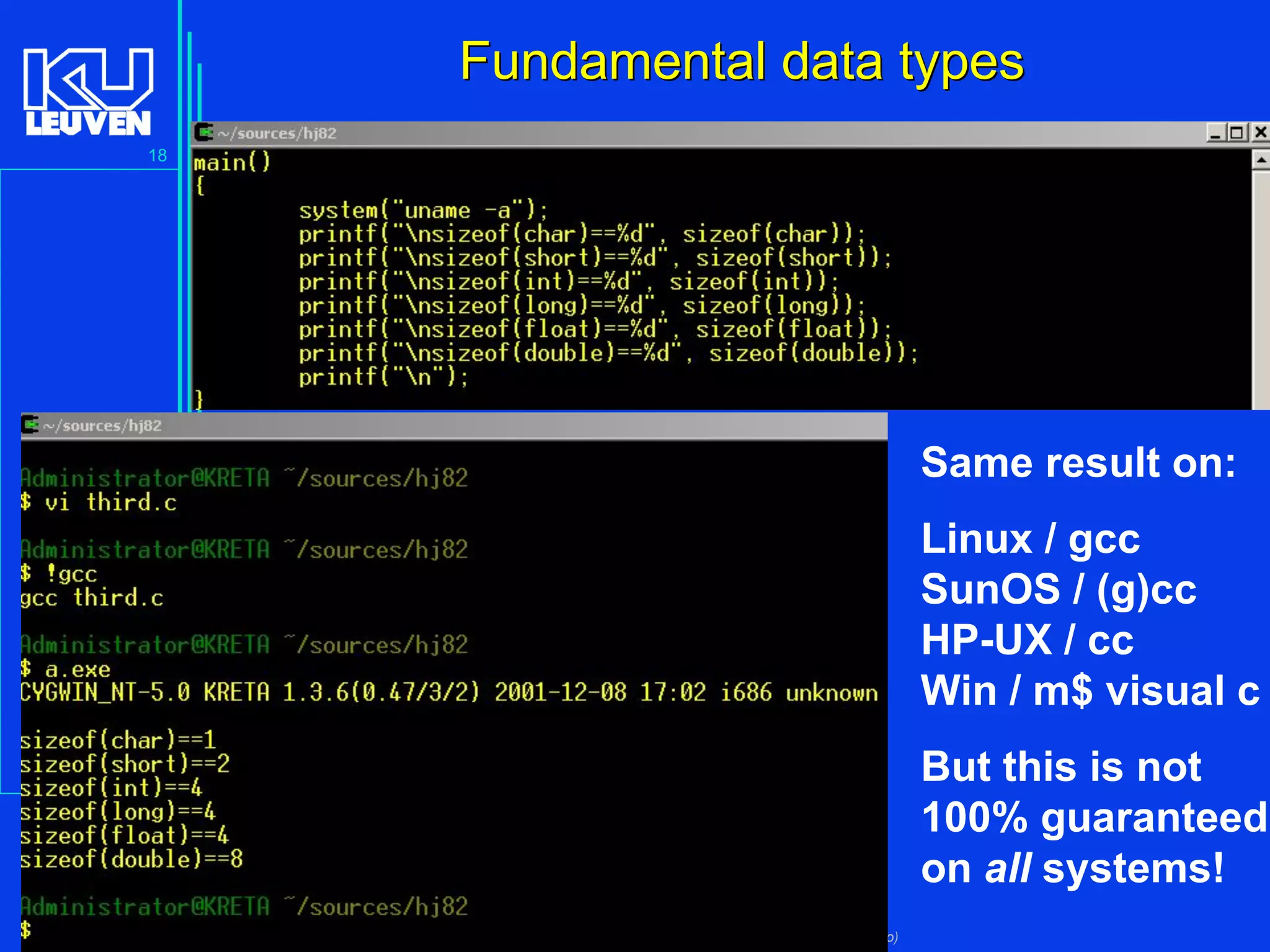
• Check the actual size of type on your workstations
with function sizeof()
18
Advanced C Language for Engineering ( V De Florio)
Fundamental data typesFundamental data types
Same result on:
Linux / gcc
SunOS / (g)cc
HP-UX / cc
Win / m$ visual c
But this is not
100% guaranteed
on all systems!
19
Advanced C Language for Engineering ( V De Florio)
TypeType ““charchar””
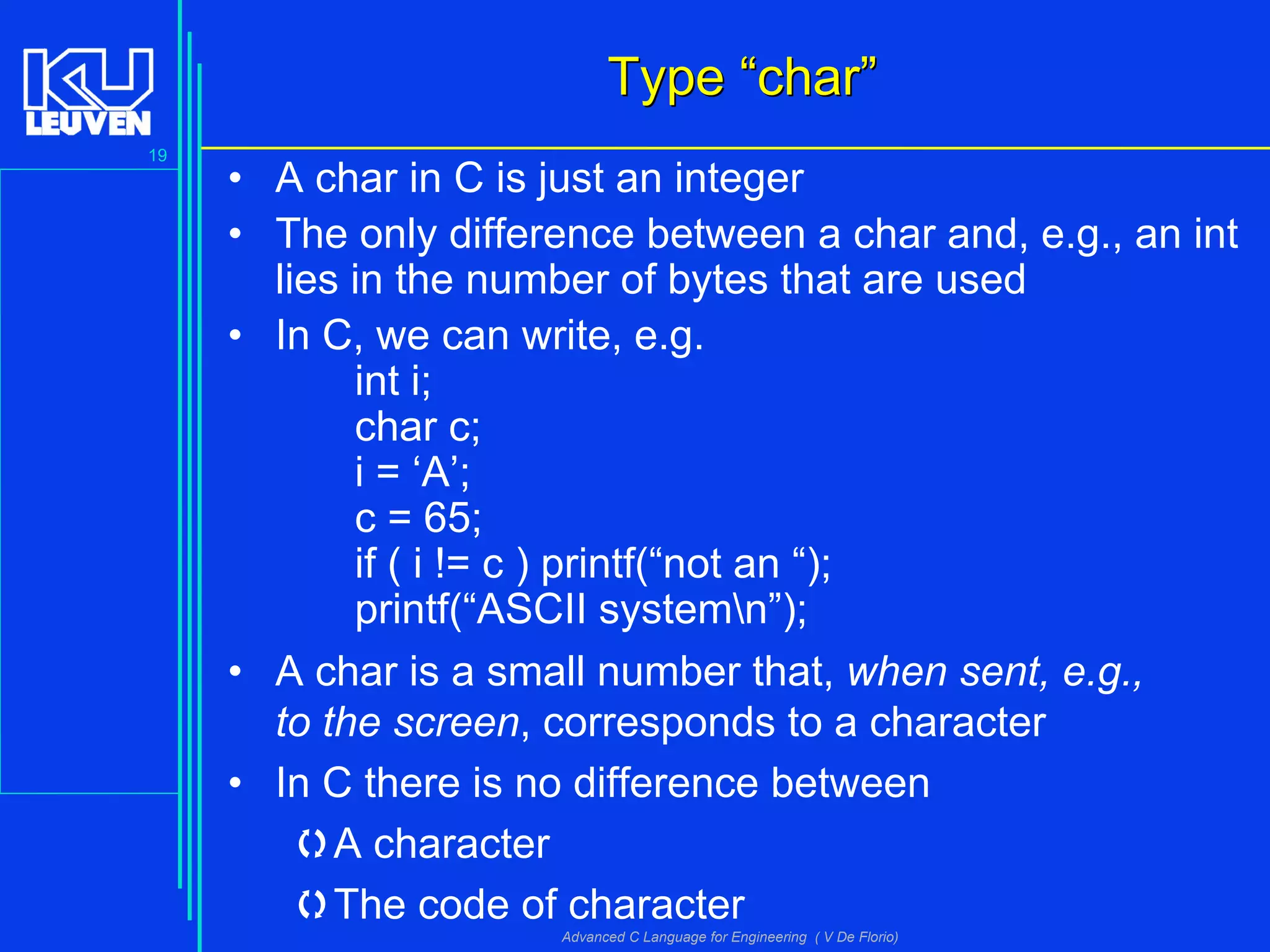
• A char in C is just an integer
• The only difference between a char and, e.g., an int
lies in the number of bytes that are used
• In C, we can write, e.g.
int i;
char c;
i = ‘A’;
c = 65;
if ( i != c ) printf(“not an “);
printf(“ASCII systemn”);
• A char is a small number that, when sent, e.g.,
to the screen, corresponds to a character
• In C there is no difference between
A character
The code of character
20
Advanced C Language for Engineering ( V De Florio)
TypeType ““charchar””
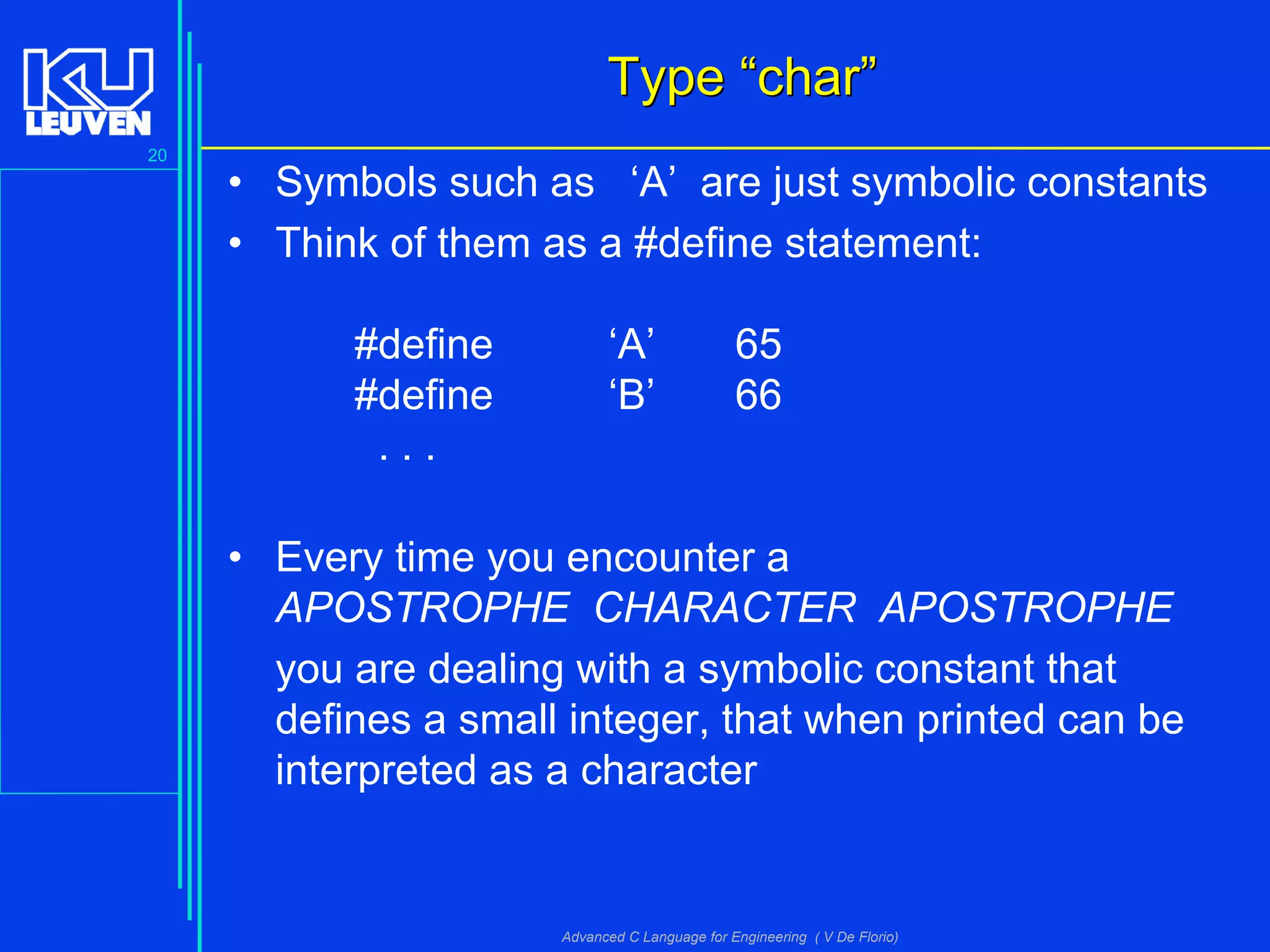
• Symbols such as ‘A’ are just symbolic constants
• Think of them as a #define statement:
#define ‘A’ 65
#define ‘B’ 66
. . .
• Every time you encounter a
APOSTROPHE CHARACTER APOSTROPHE
you are dealing with a symbolic constant that
defines a small integer, that when printed can be
interpreted as a character
21
Advanced C Language for Engineering ( V De Florio)
TypeType ““charchar””
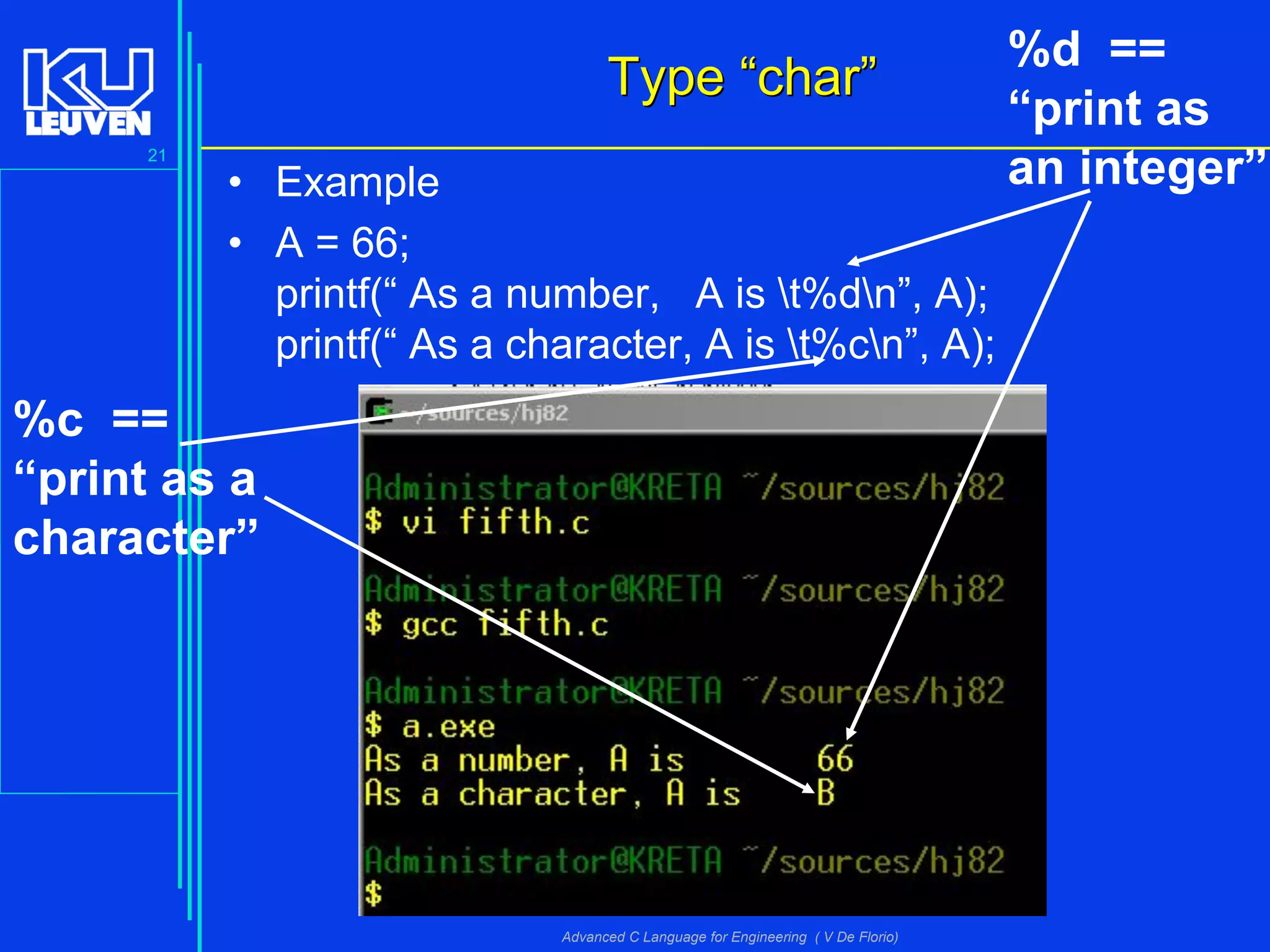
• Example
• A = 66;
printf(“ As a number, A is t%dn”, A);
printf(“ As a character, A is t%cn”, A);
%c ==
“print as a
character”
%d ==
“print as
an integer”
22
Advanced C Language for Engineering ( V De Florio)
Types: some formatting charactersTypes: some formatting characters
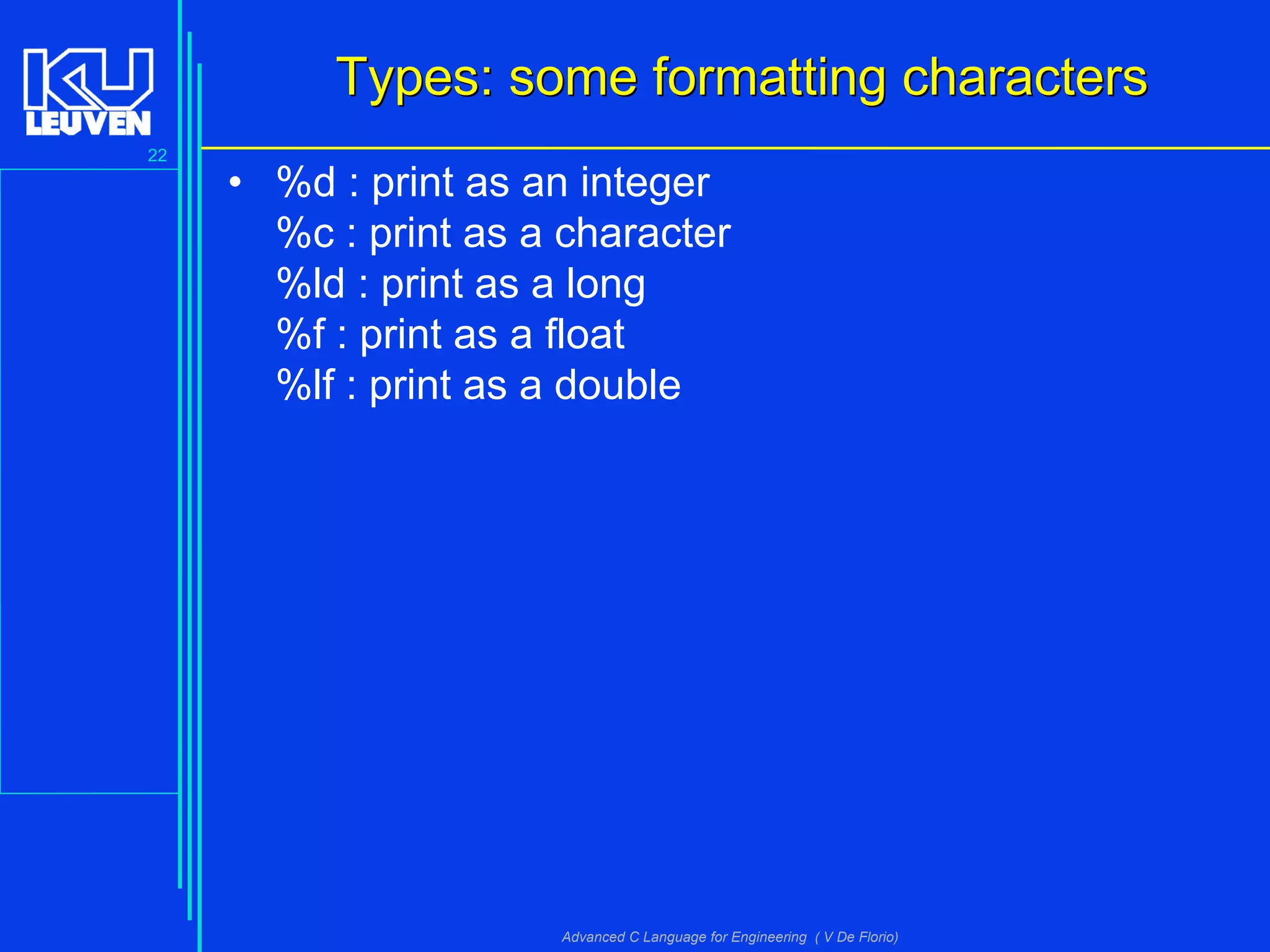
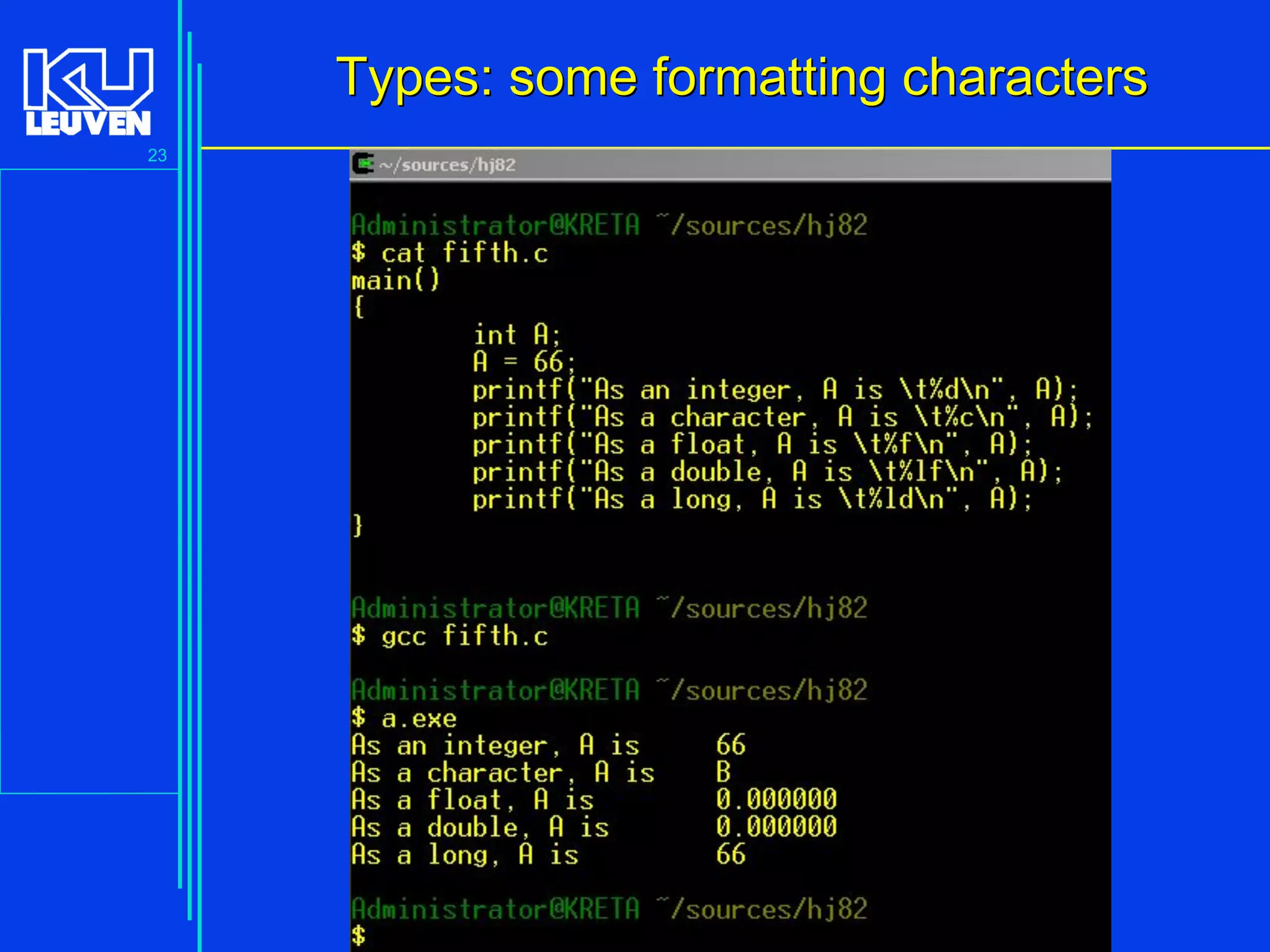
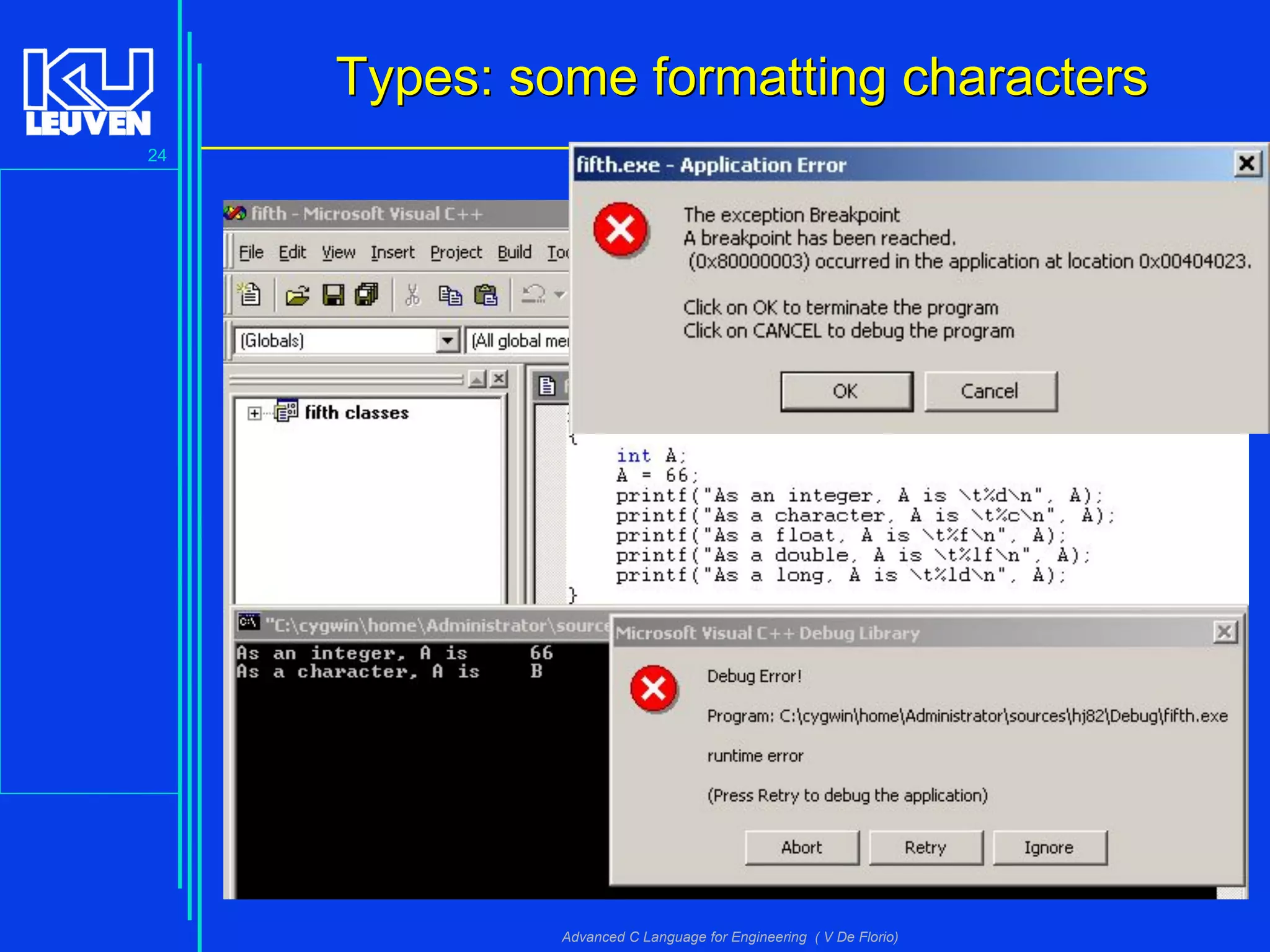
• %d : print as an integer
%c : print as a character
%ld : print as a long
%f : print as a float
%lf : print as a double
23
Advanced C Language for Engineering ( V De Florio)
Types: some formatting charactersTypes: some formatting characters
24
Advanced C Language for Engineering ( V De Florio)
Types: some formatting charactersTypes: some formatting characters
25
Advanced C Language for Engineering ( V De Florio)
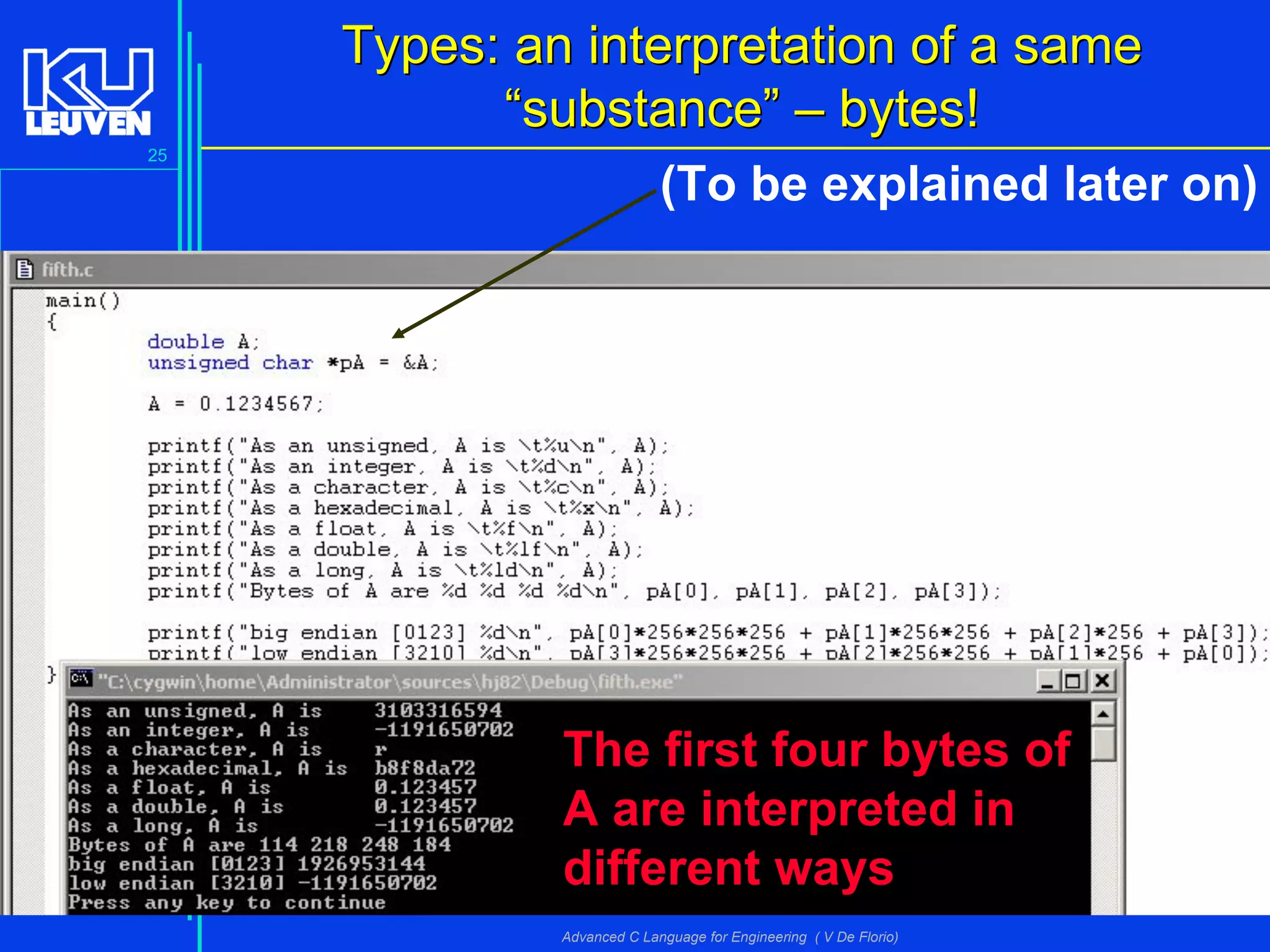
Types: an interpretation of a sameTypes: an interpretation of a same
““substancesubstance”” –– bytes!bytes!
(To be explained later on)
The first four bytes of
A are interpreted in
different ways
26
Advanced C Language for Engineering ( V De Florio)
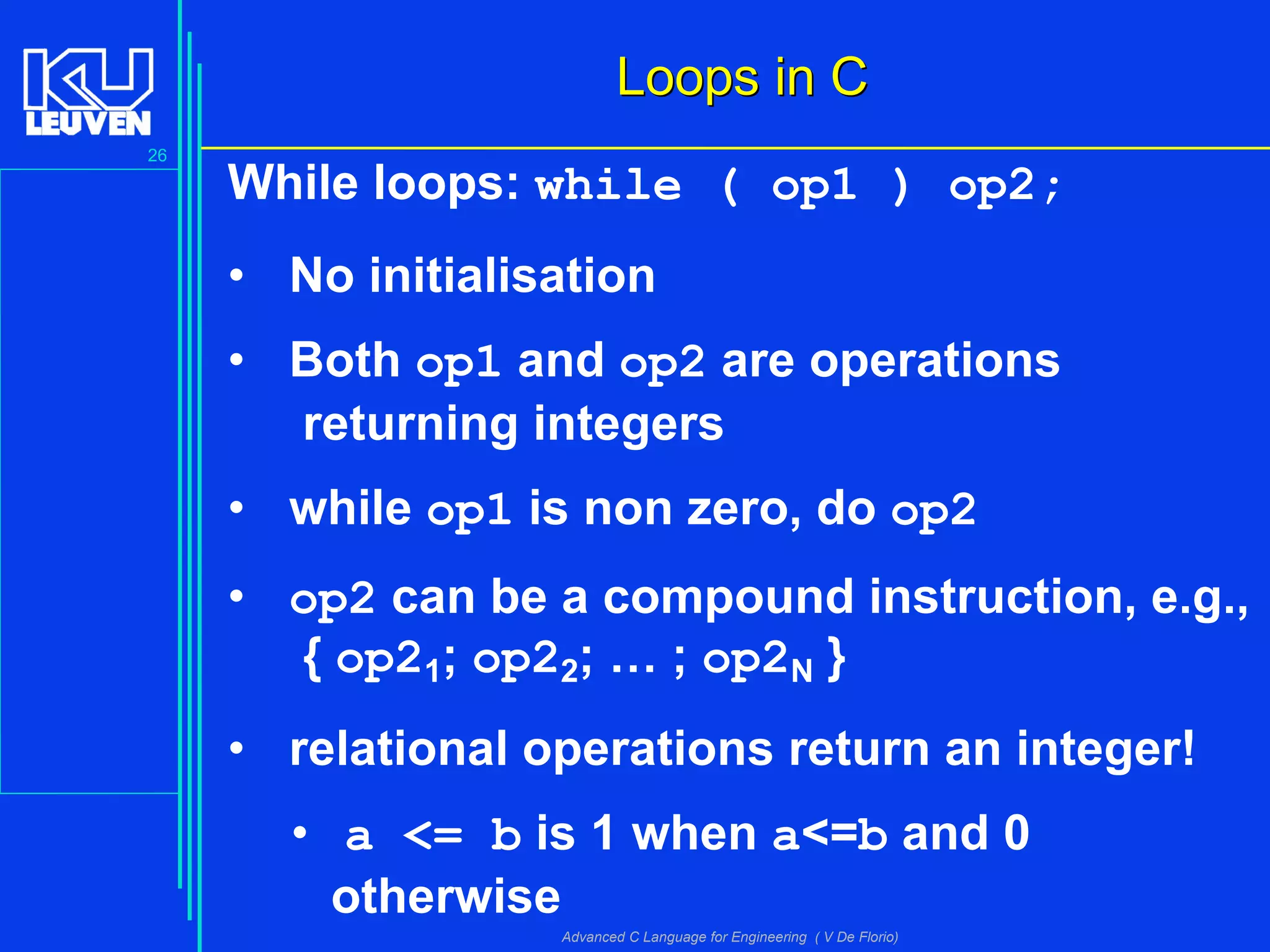
Loops in CLoops in C
While loops: while ( op1 ) op2;
• No initialisation
• Both op1 and op2 are operations
returning integers
• while op1 is non zero, do op2
• op2 can be a compound instruction, e.g.,
{ op21; op22; … ; op2N }
• relational operations return an integer!
• a <= b is 1 when a<=b and 0
otherwise
27
Advanced C Language for Engineering ( V De Florio)
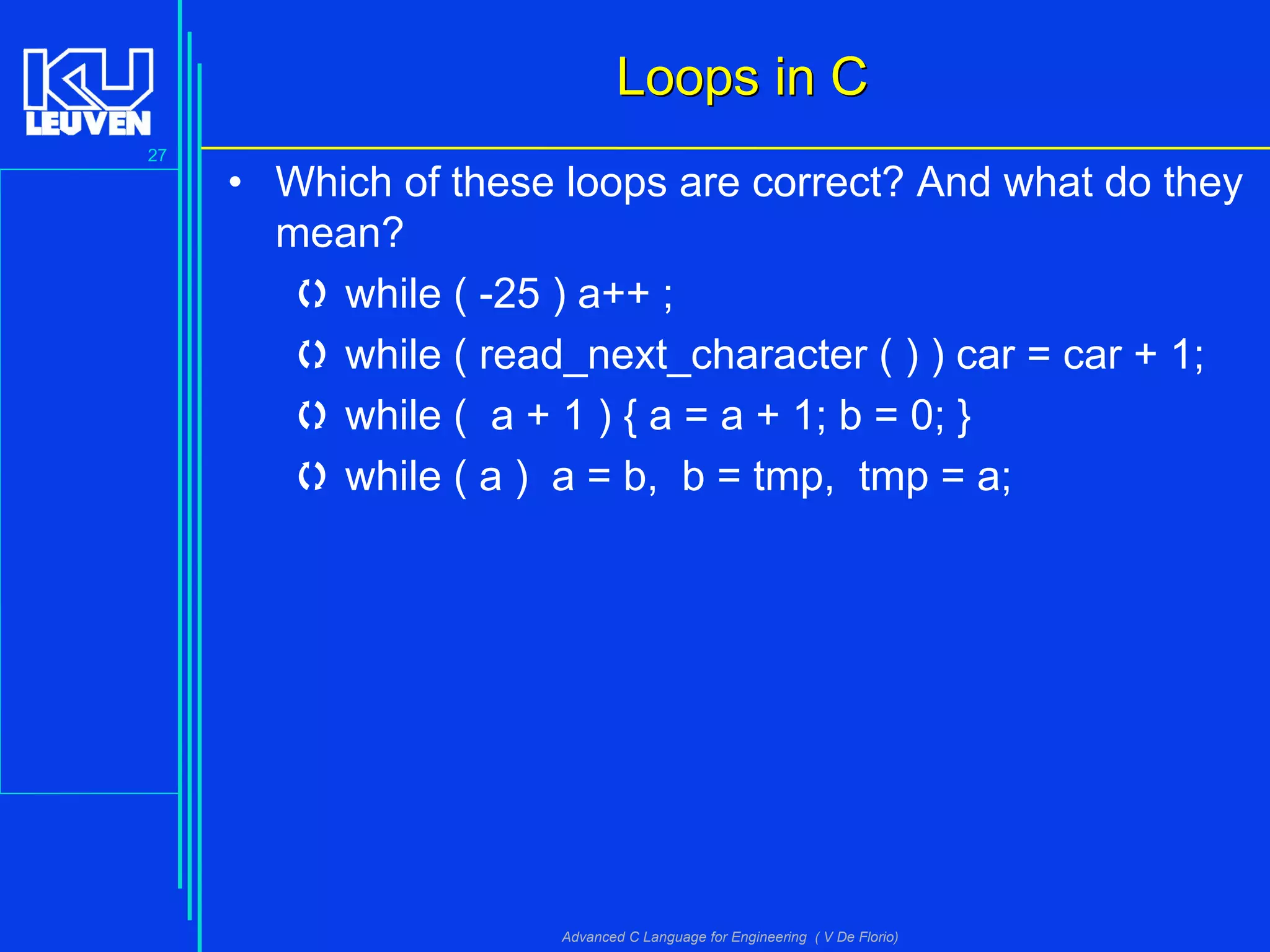
Loops in CLoops in C
• Which of these loops are correct? And what do they
mean?
 while ( -25 ) a++ ;
 while ( read_next_character ( ) ) car = car + 1;
 while ( a + 1 ) { a = a + 1; b = 0; }
 while ( a ) a = b, b = tmp, tmp = a;
28
Advanced C Language for Engineering ( V De Florio)
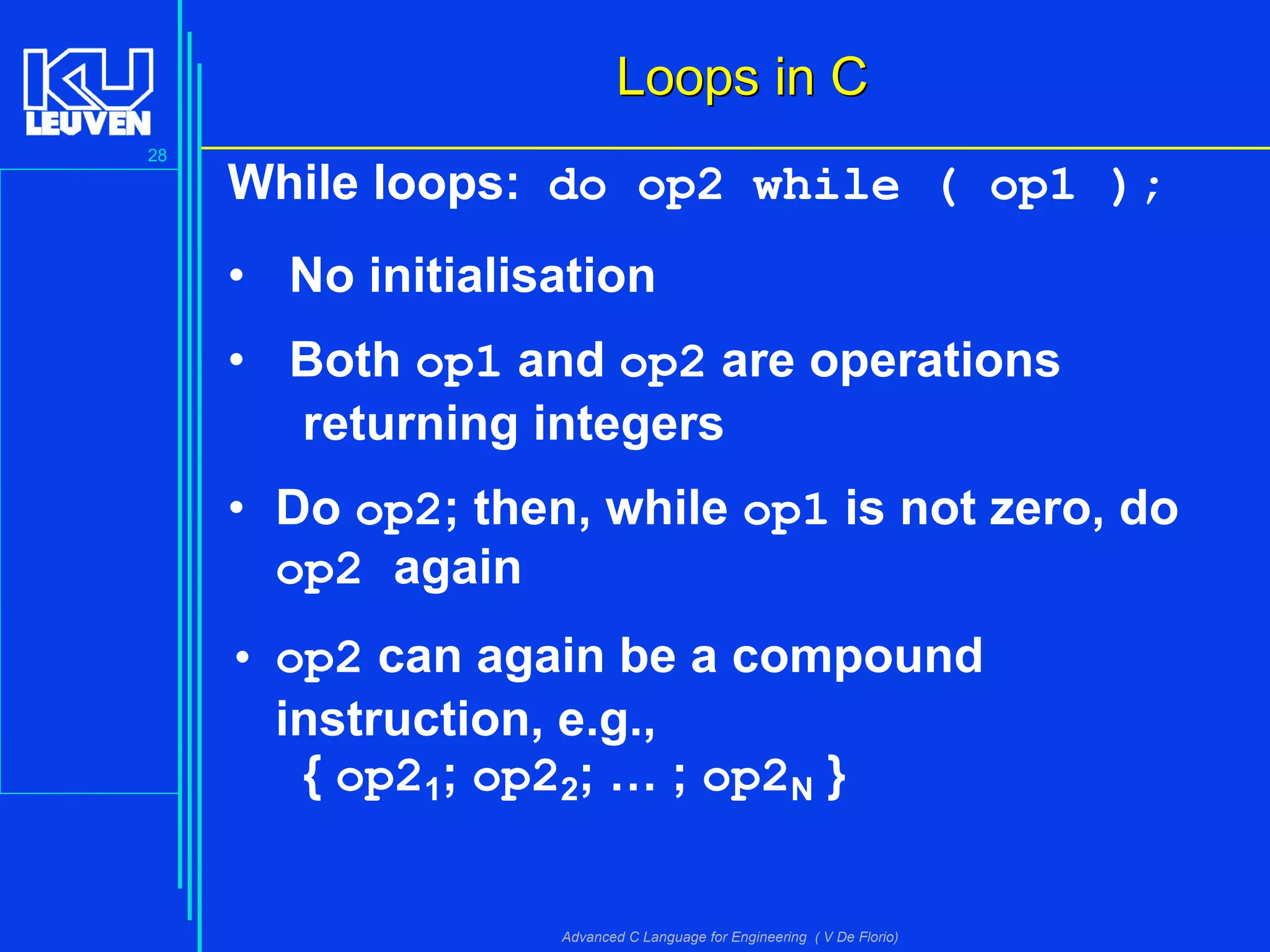
Loops in CLoops in C
While loops: do op2 while ( op1 );
• No initialisation
• Both op1 and op2 are operations
returning integers
• Do op2; then, while op1 is not zero, do
op2 again
• op2 can again be a compound
instruction, e.g.,
{ op21; op22; … ; op2N }
29
Advanced C Language for Engineering ( V De Florio)
Loops in CLoops in C
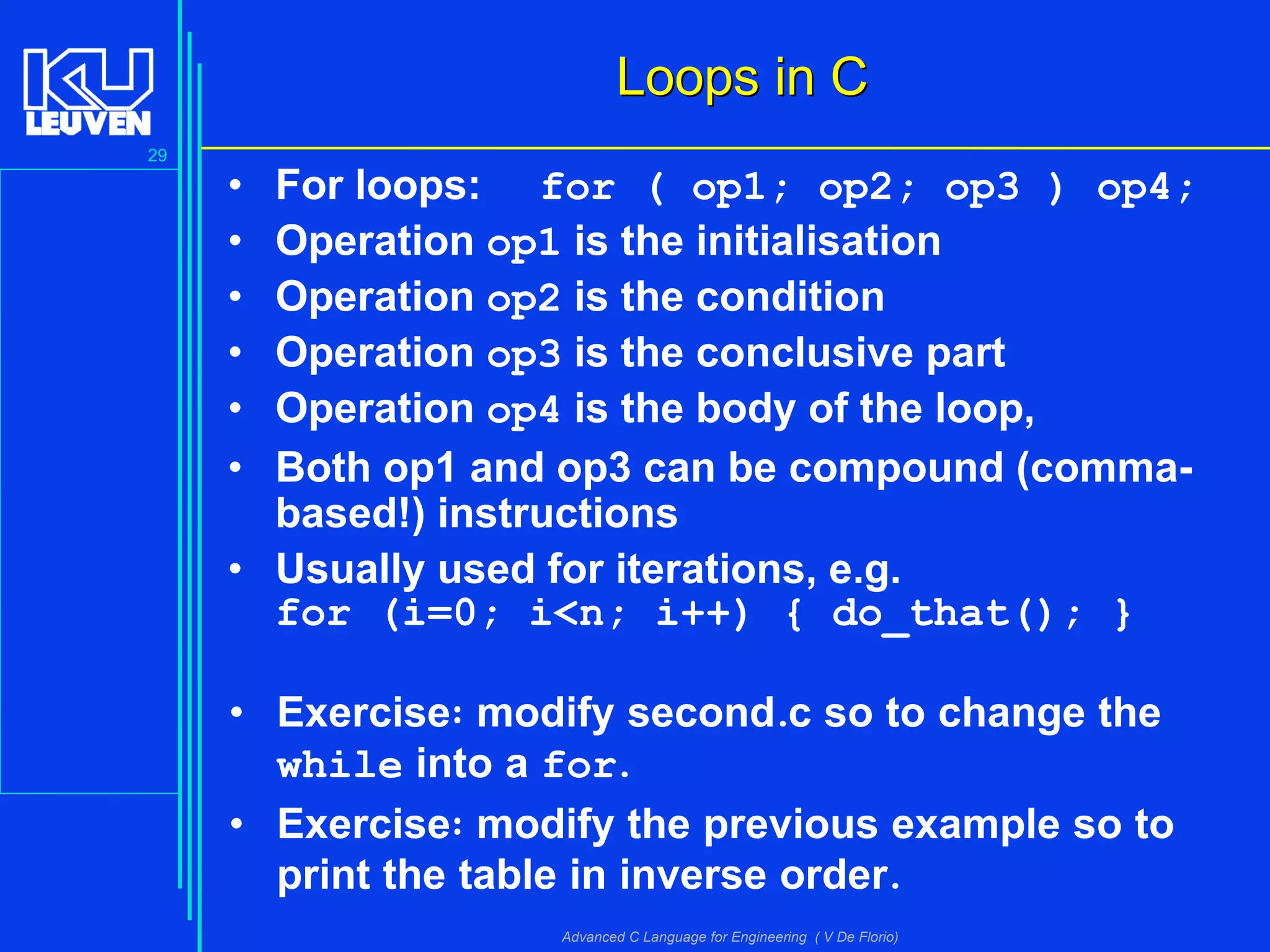
• For loops: for ( op1; op2; op3 ) op4;
• Operation op1 is the initialisation
• Operation op2 is the condition
• Operation op3 is the conclusive part
• Operation op4 is the body of the loop,
• Both op1 and op3 can be compound (comma-
based!) instructions
• Usually used for iterations, e.g.
for (i=0; i<n; i++) { do_that(); }
• Exercise: modify second.c so to change the
while into a for.
• Exercise: modify the previous example so to
print the table in inverse order.
30
Advanced C Language for Engineering ( V De Florio)
Loops in CLoops in C
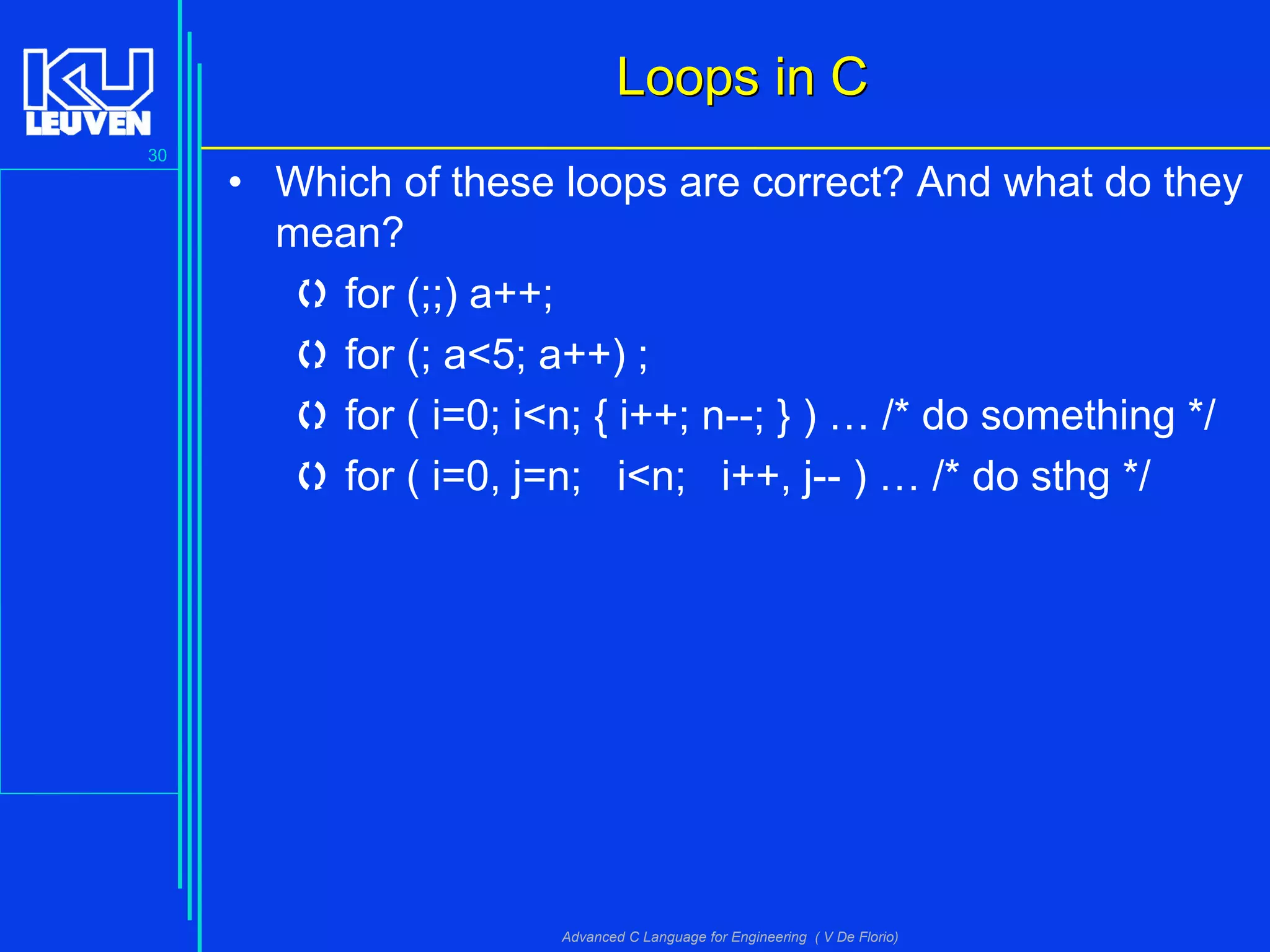
• Which of these loops are correct? And what do they
mean?
 for (;;) a++;
 for (; a<5; a++) ;
 for ( i=0; i<n; { i++; n--; } ) … /* do something */
 for ( i=0, j=n; i<n; i++, j-- ) … /* do sthg */
31
Advanced C Language for Engineering ( V De Florio)
Loops in CLoops in C
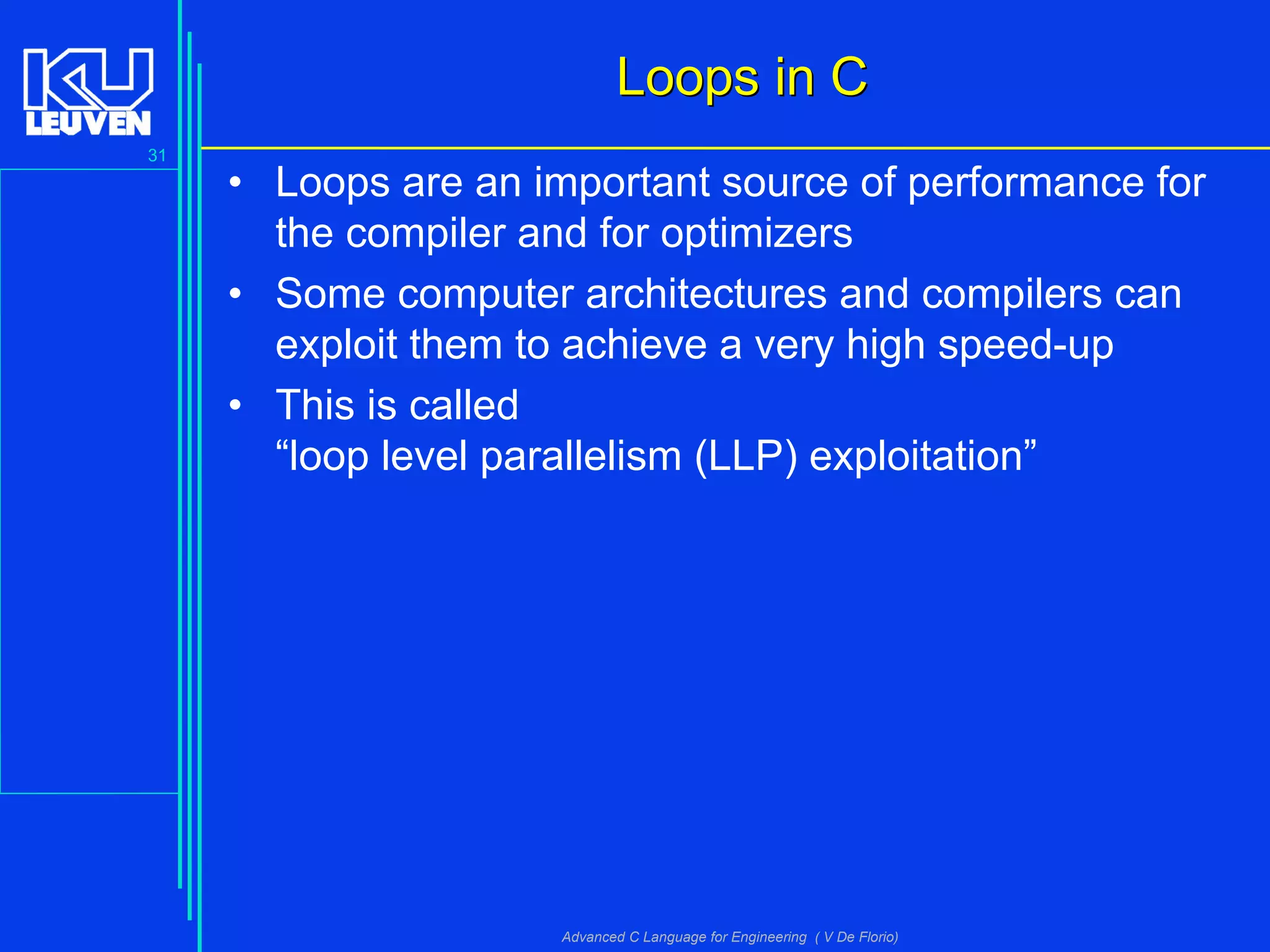
• Loops are an important source of performance for
the compiler and for optimizers
• Some computer architectures and compilers can
exploit them to achieve a very high speed-up
• This is called
“loop level parallelism (LLP) exploitation”
32
Advanced C Language for Engineering ( V De Florio)
ConditionalConditional statementsstatements
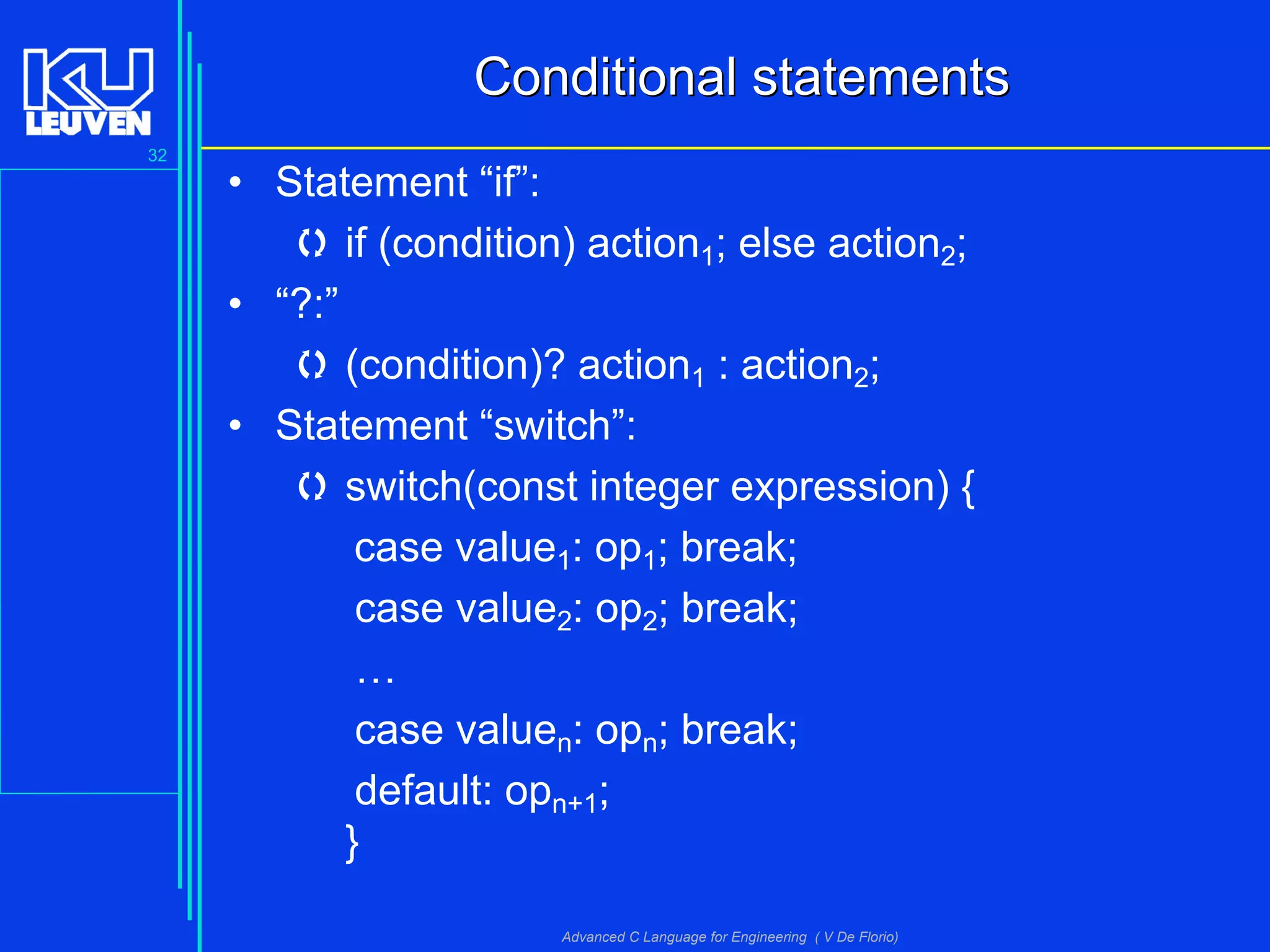
• Statement “if”:
 if (condition) action1; else action2;
• “?:”
 (condition)? action1 : action2;
• Statement “switch”:
 switch(const integer expression) {
case value1: op1; break;
case value2: op2; break;
…
case valuen: opn; break;
default: opn+1;
}
33
Advanced C Language for Engineering ( V De Florio)
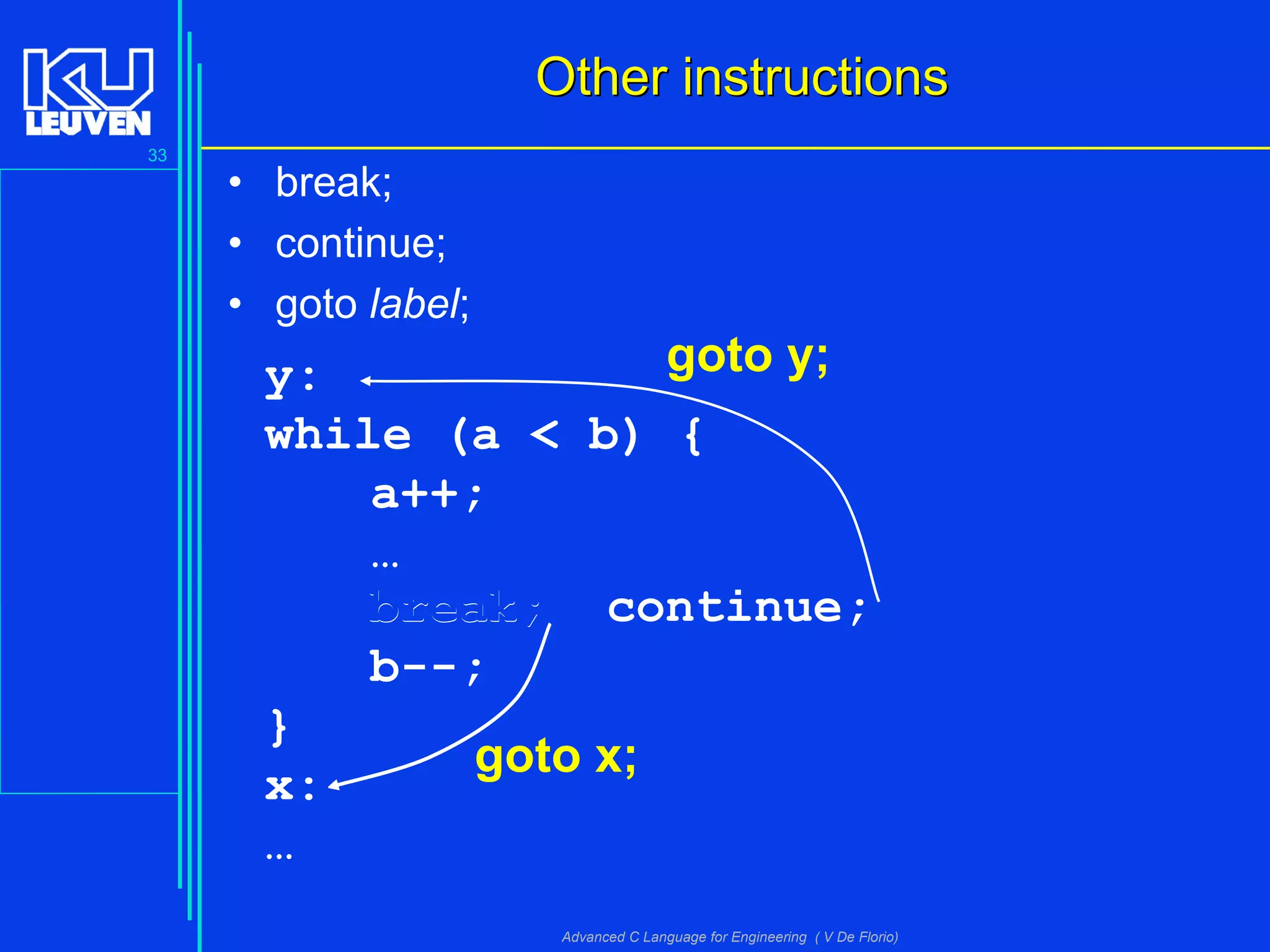
Other instructionsOther instructions
• break;
• continue;
• goto label;
y:
while (a < b) {
break;
b--;
}
x:
…
a++;
…
break; continue;
goto x;
goto y;
34
Advanced C Language for Engineering ( V De Florio)
The C PreprocessorThe C Preprocessor
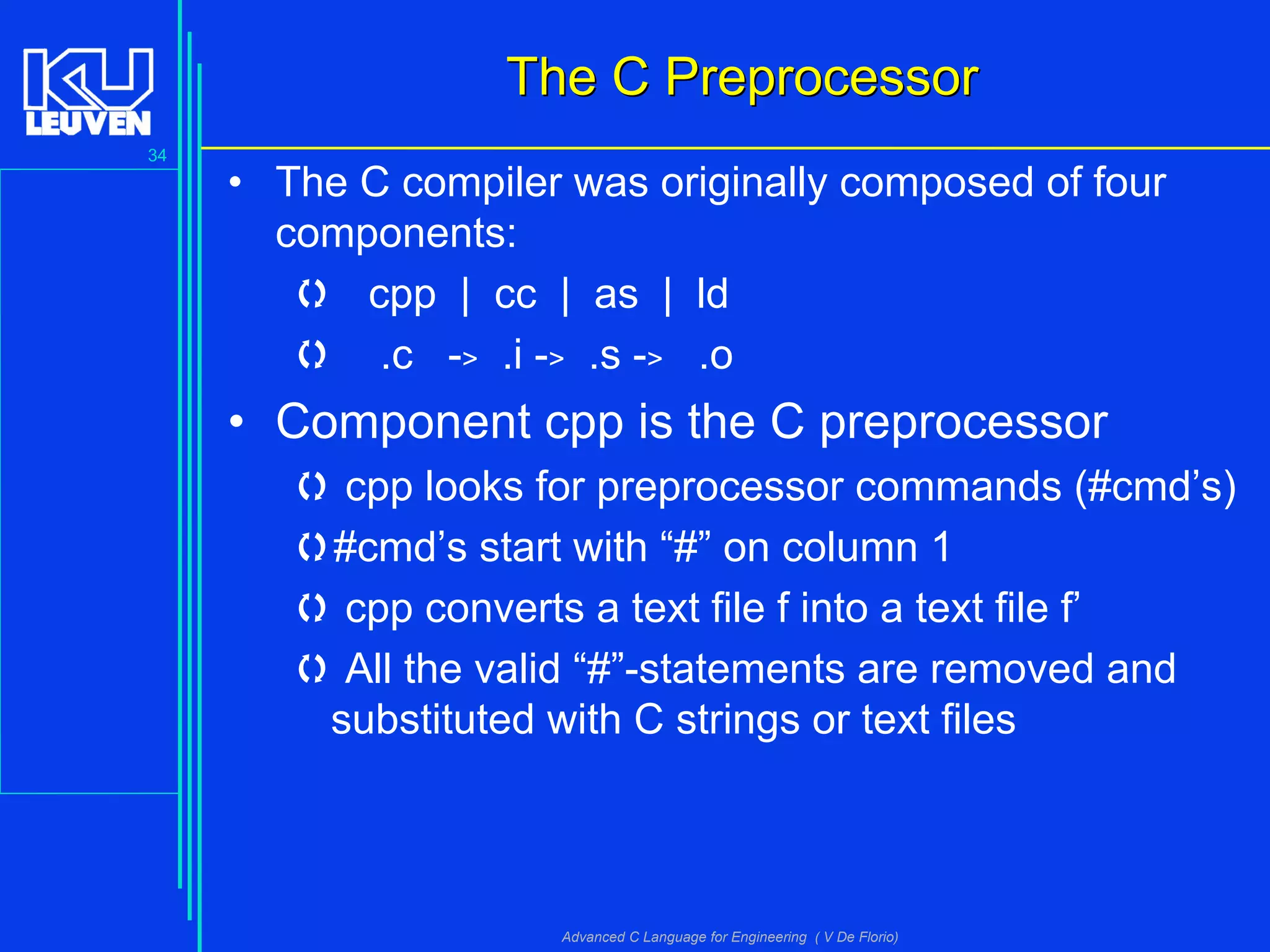
• The C compiler was originally composed of four
components:
 cpp | cc | as | ld
 .c -> .i -> .s -> .o
• Component cpp is the C preprocessor
 cpp looks for preprocessor commands (#cmd’s)
#cmd’s start with “#” on column 1
 cpp converts a text file f into a text file f’
 All the valid “#”-statements are removed and
substituted with C strings or text files
35
Advanced C Language for Engineering ( V De Florio)
The C PreprocessorThe C Preprocessor
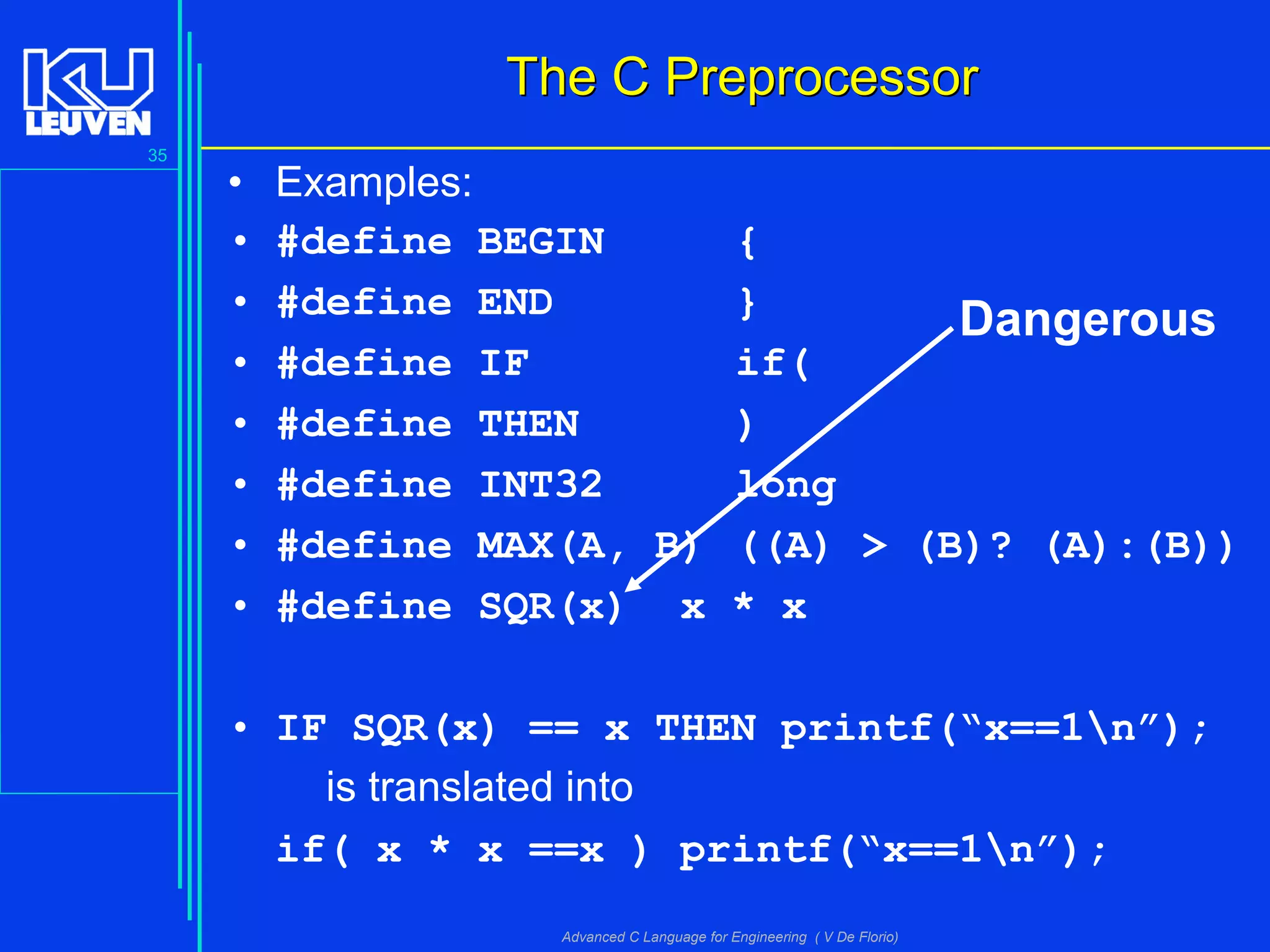
• Examples:
• #define BEGIN {
• #define END }
• #define IF if(
• #define THEN )
• #define INT32 long
• #define MAX(A, B) ((A) > (B)? (A):(B))
• #define SQR(x) x * x
• IF SQR(x) == x THEN printf(“x==1n”);
is translated into
if( x * x ==x ) printf(“x==1n”);
Dangerous
36
Advanced C Language for Engineering ( V De Florio)
The C PreprocessorThe C Preprocessor
• Inclusion of external files
1. #include <stdio.h>
2. #include “assoc.h”
• #ifdef … [ #else … ] #endif
• #ifndef … [ #else … ] #endif
• Differences between 1. and 2.
• Use of ifdef/ifndef.
37
Advanced C Language for Engineering ( V De Florio)
The C PreprocessorThe C Preprocessor
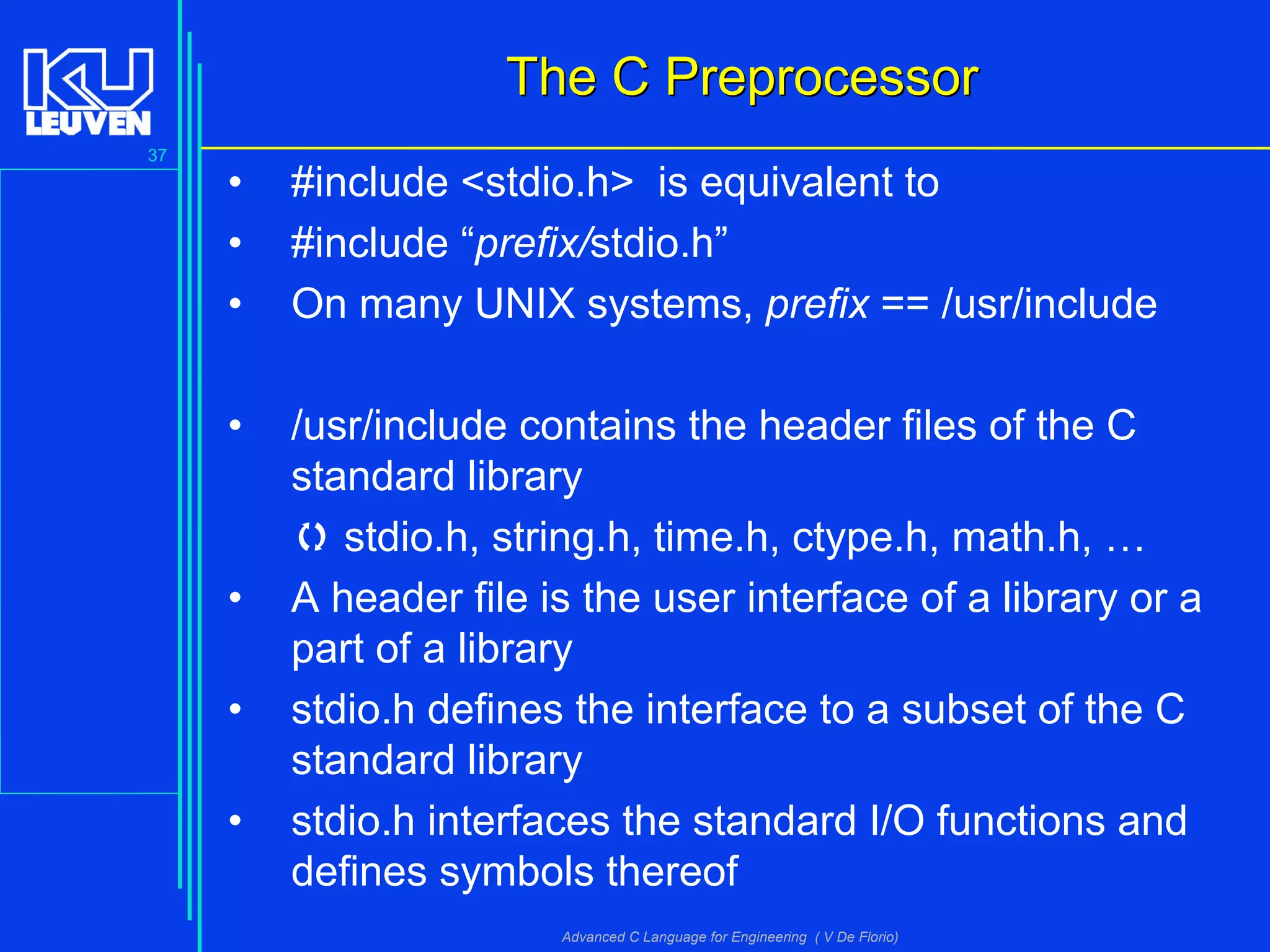
• #include <stdio.h> is equivalent to
• #include “prefix/stdio.h”
• On many UNIX systems, prefix == /usr/include
• /usr/include contains the header files of the C
standard library
 stdio.h, string.h, time.h, ctype.h, math.h, …
• A header file is the user interface of a library or a
part of a library
• stdio.h defines the interface to a subset of the C
standard library
• stdio.h interfaces the standard I/O functions and
defines symbols thereof
38
Advanced C Language for Engineering ( V De Florio)
FunctionsFunctions
• Functions are names that points to some memory
location where code has been stored by the
compiler
• They take arguments and return a value of some
type
E.g., double cos(double a);
This is a function prototype, with which we declare a
function, called cos, that expects and returns a double
• To call a function, we just name it and pass an
argument to it
cos (3.1415); /* cos (pi) */
39
Advanced C Language for Engineering ( V De Florio)
FunctionsFunctions
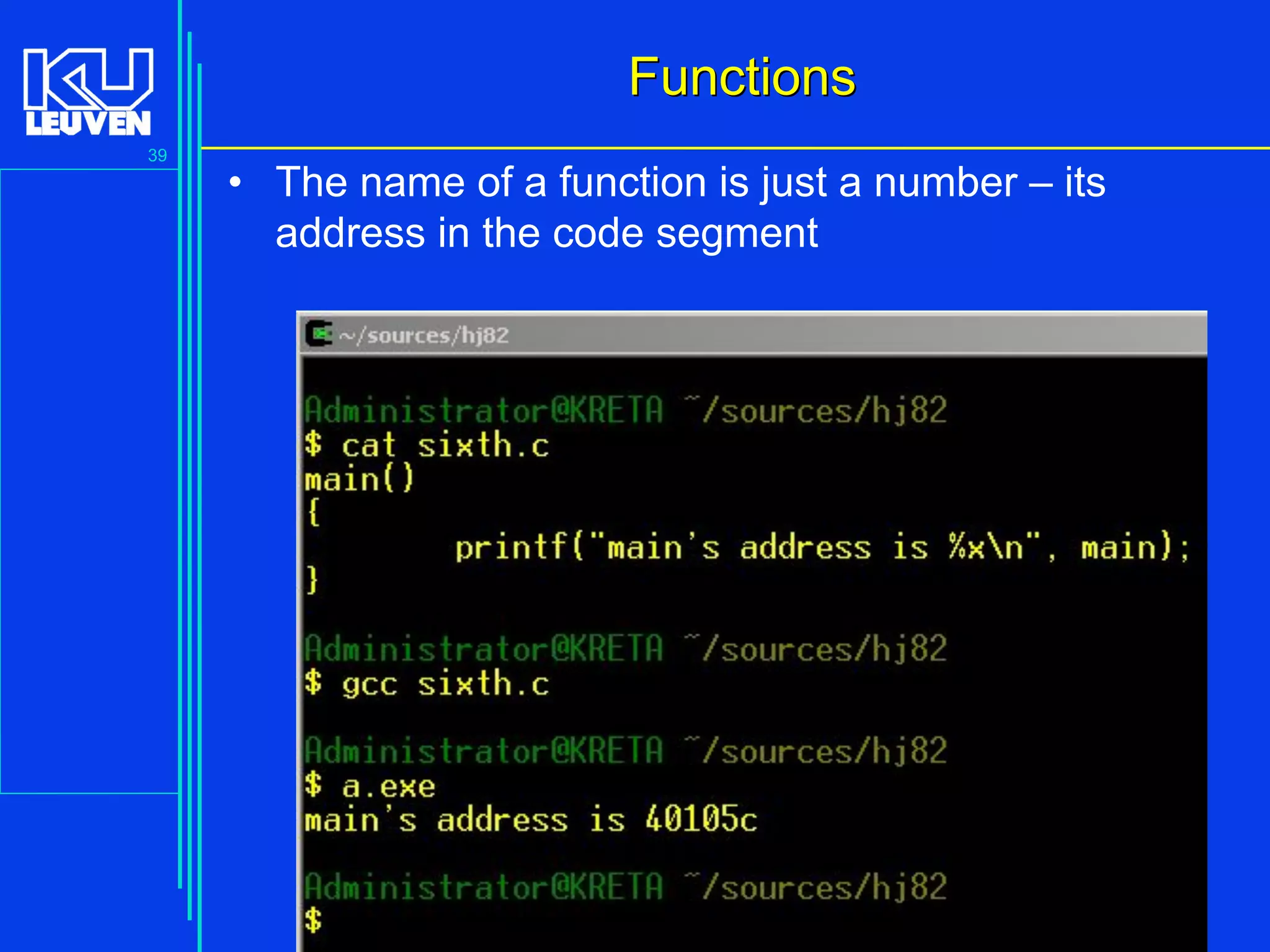
• The name of a function is just a number – its
address in the code segment
40
Advanced C Language for Engineering ( V De Florio)
FunctionsFunctions
• Functions can be
Declared
Defined
• A prototype declares a function
“There’s a function that looks like that and that…”
• Defining a function means specifying what the
function shall do
“The function does this and this…”
Memory is allocated in the code segment
41
Advanced C Language for Engineering ( V De Florio)
FunctionsFunctions
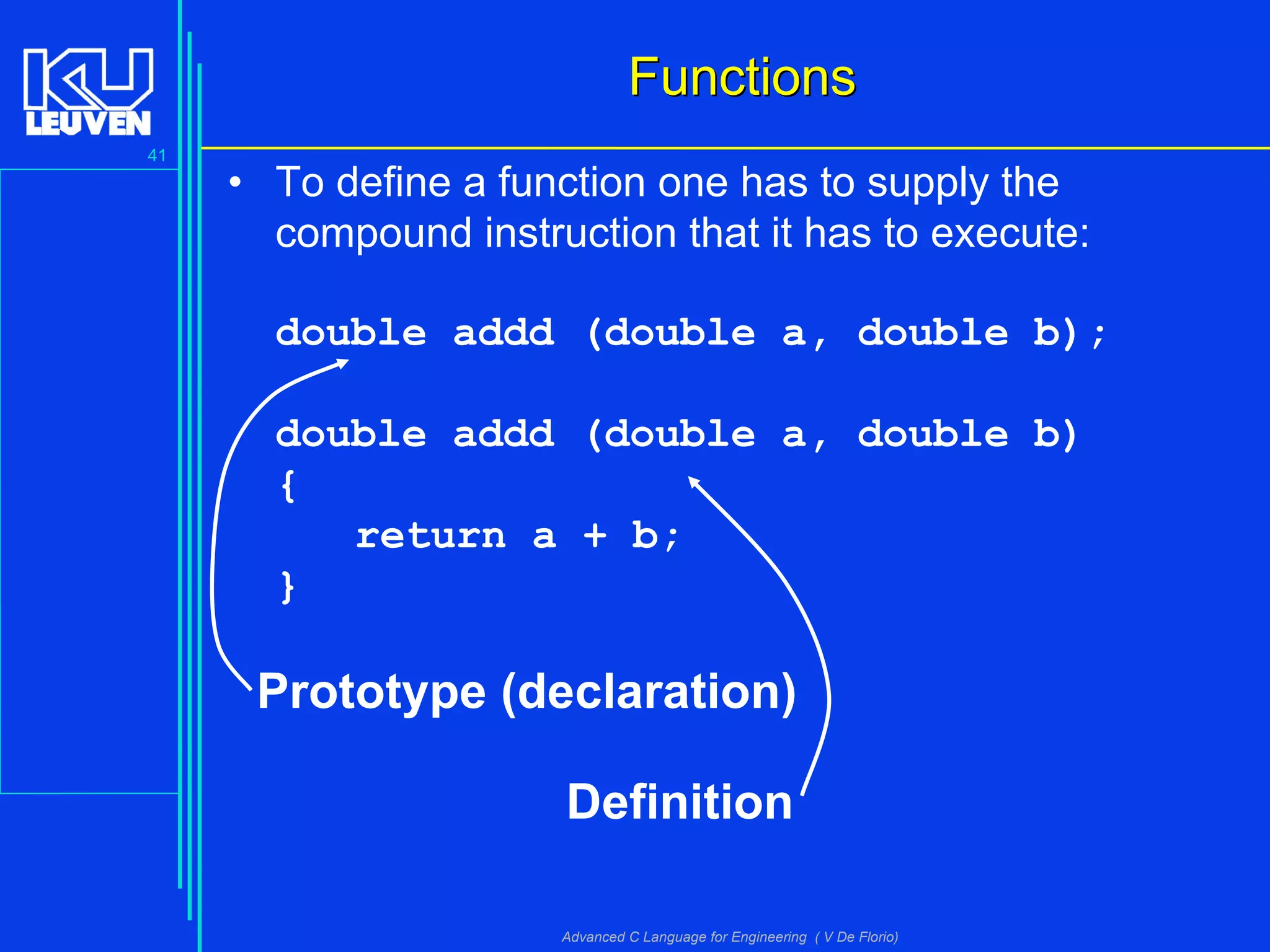
• To define a function one has to supply the
compound instruction that it has to execute:
double addd (double a, double b);
double addd (double a, double b)
{
return a + b;
}
Prototype (declaration)
Definition
42
Advanced C Language for Engineering ( V De Florio)
FunctionsFunctions
• Recursion is allowed
• C supports a single-level of functions that
can be compiled separately
43
Advanced C Language for Engineering ( V De Florio)
FunctionsFunctions
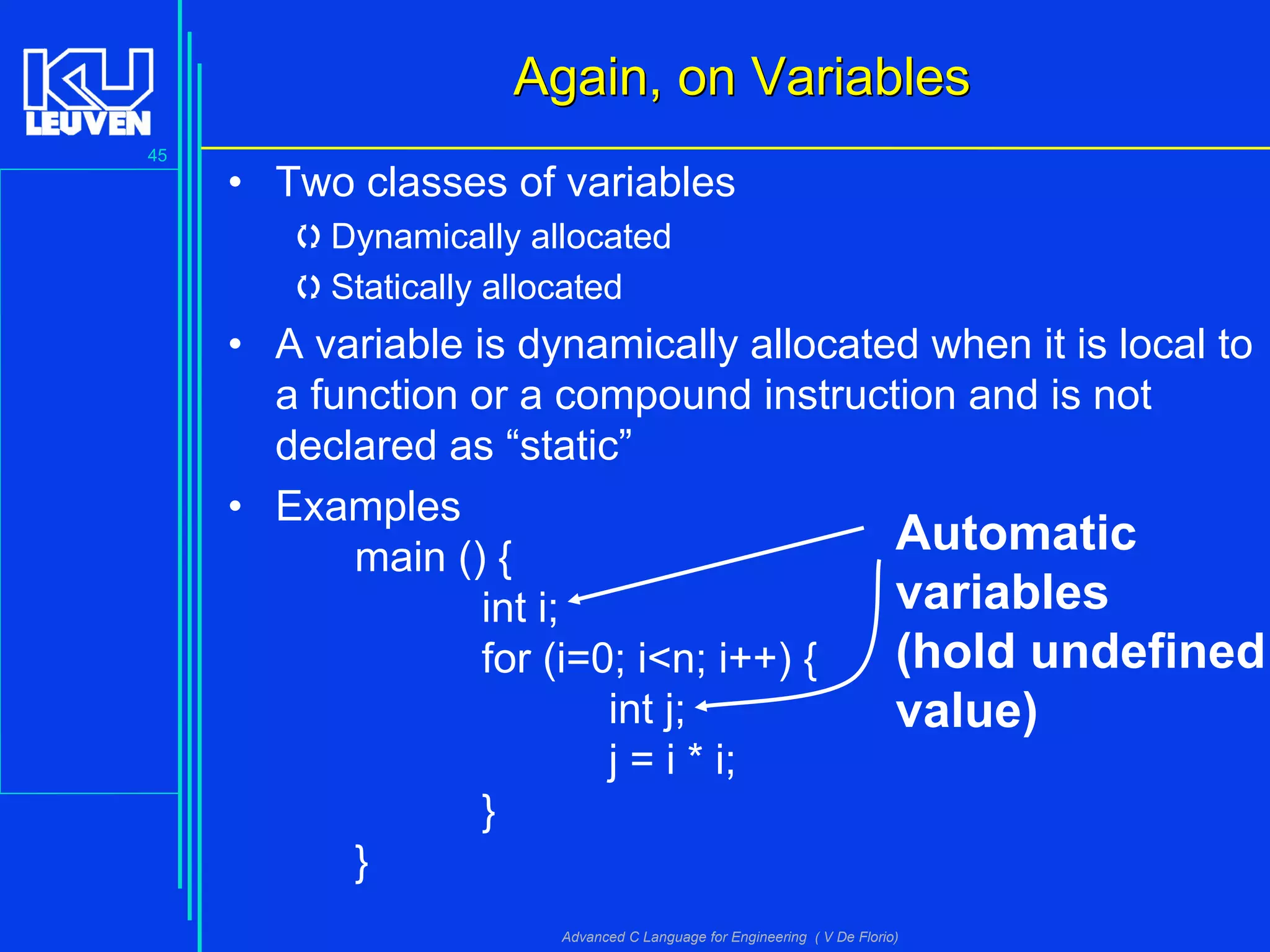
• return closes the function and returns an output
value (default: integer) to the caller.
• Arguments are passed by value: this means that the
arguments are copied in temporary variables.
• The only way to let a function modify an argument is
by passing the address of the object to be modified.
• Operator & returns the address of a variable.
44
Advanced C Language for Engineering ( V De Florio)
FunctionsFunctions
• Functions have the following structure:
• [ type ] name ( [ args ] ) {
[ declarations ] [ instructions ]
}
• int main() {
int i; int power (int, int);
for (i=0; i<10; ++i)
printf("%d %dn", i, power(2,i));
}
int power (int x, int n) { int i, p;
for (i = p = 1; i <= n; ++i)
p=p*x;
return (p);
}
45
Advanced C Language for Engineering ( V De Florio)
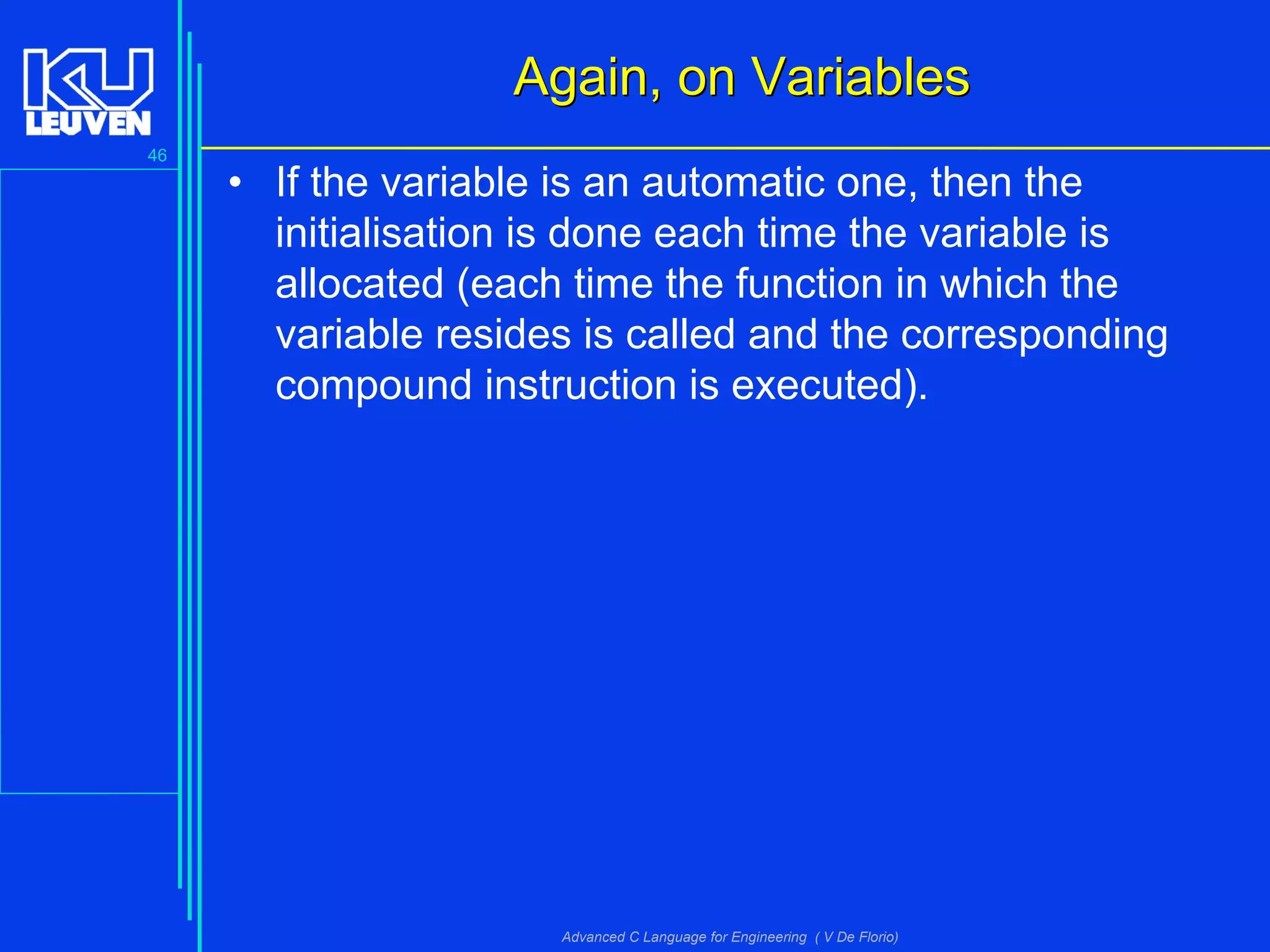
• Two classes of variables
Dynamically allocated
Statically allocated
• A variable is dynamically allocated when it is local to
a function or a compound instruction and is not
declared as “static”
• Examples
main () {
int i;
for (i=0; i<n; i++) {
int j;
j = i * i;
}
}
Again, on VariablesAgain, on Variables
Automatic
variables
(hold undefined
value)
46
Advanced C Language for Engineering ( V De Florio)
Again, on VariablesAgain, on Variables
• If the variable is an automatic one, then the
initialisation is done each time the variable is
allocated (each time the function in which the
variable resides is called and the corresponding
compound instruction is executed).
47
Advanced C Language for Engineering ( V De Florio)
Again, on VariablesAgain, on Variables
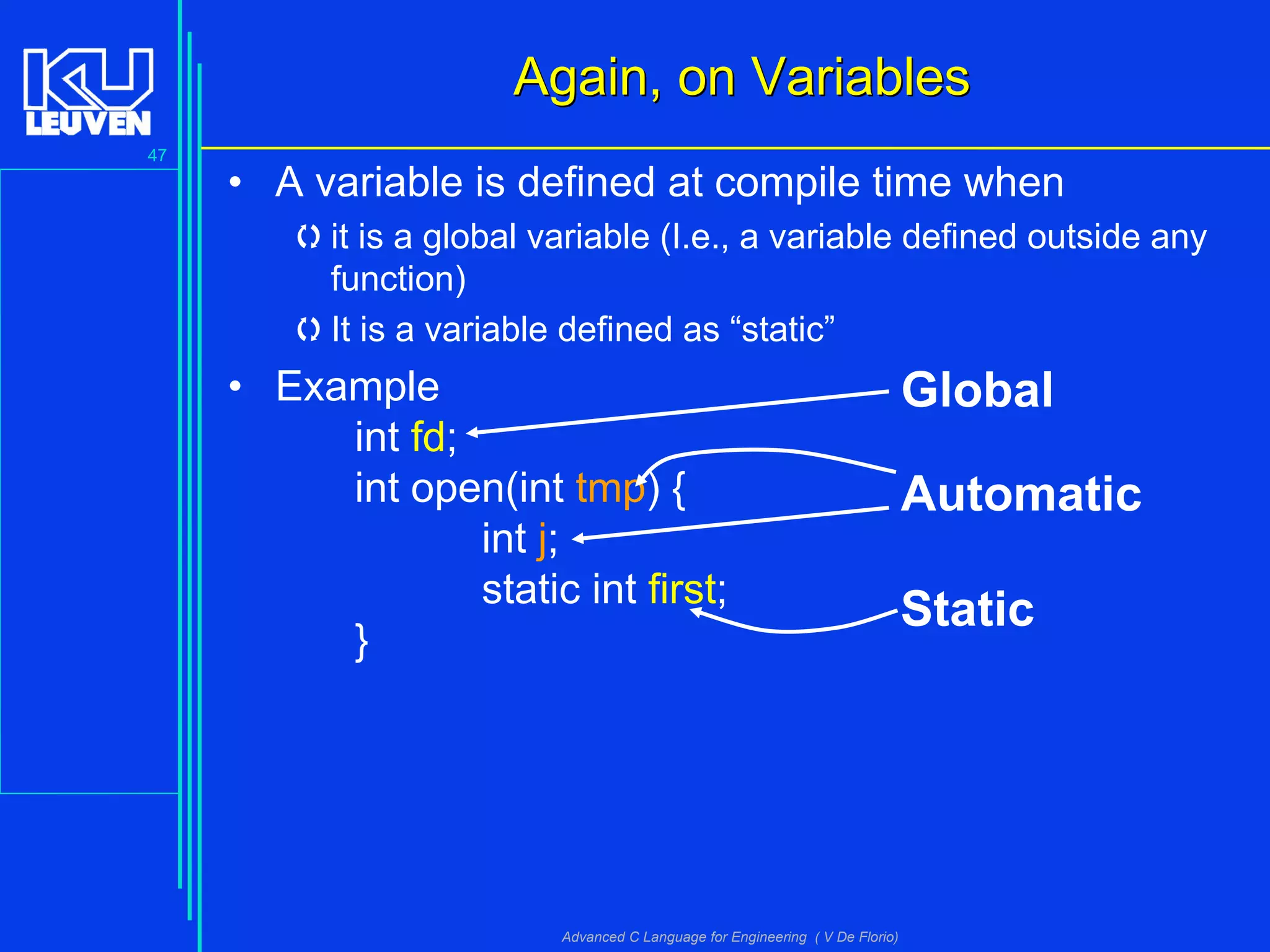
• A variable is defined at compile time when
it is a global variable (I.e., a variable defined outside any
function)
It is a variable defined as “static”
• Example
int fd;
int open(int tmp) {
int j;
static int first;
}
Global
Automatic
Static
48
Advanced C Language for Engineering ( V De Florio)
Again, on VariablesAgain, on Variables
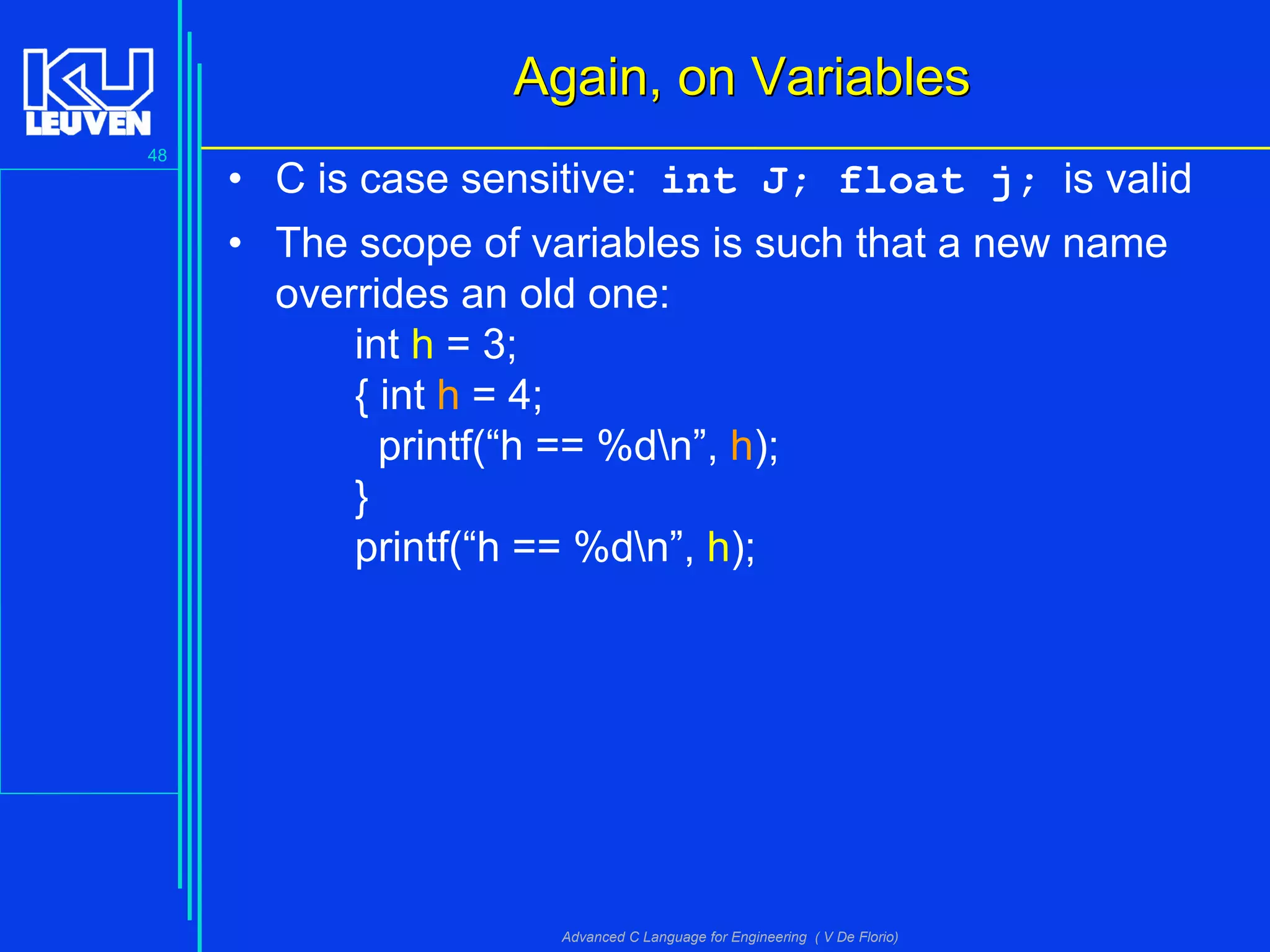
• C is case sensitive: int J; float j; is valid
• The scope of variables is such that a new name
overrides an old one:
int h = 3;
{ int h = 4;
printf(“h == %dn”, h);
}
printf(“h == %dn”, h);
49
Advanced C Language for Engineering ( V De Florio)
OperatorsOperators
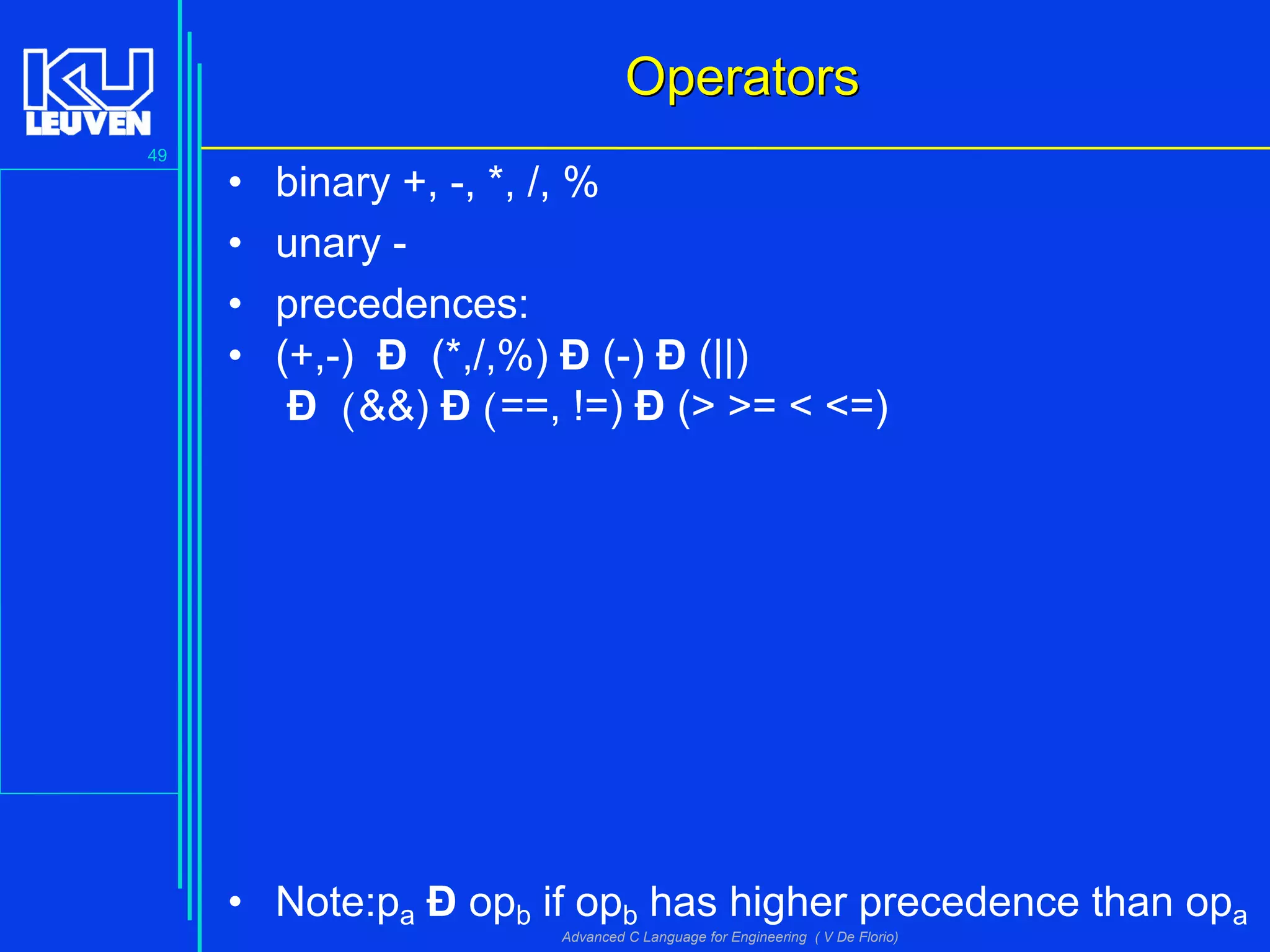
• binary +, -, *, /, %
• unary -
• precedences:
• (+,-) Ð (*,/,%) Ð (-) Ð (||)
Ð (&&) Ð (==, !=) Ð (> >= < <=)
• Note:pa Ð opb if opb has higher precedence than opa
50
Advanced C Language for Engineering ( V De Florio)
OperatorsOperators
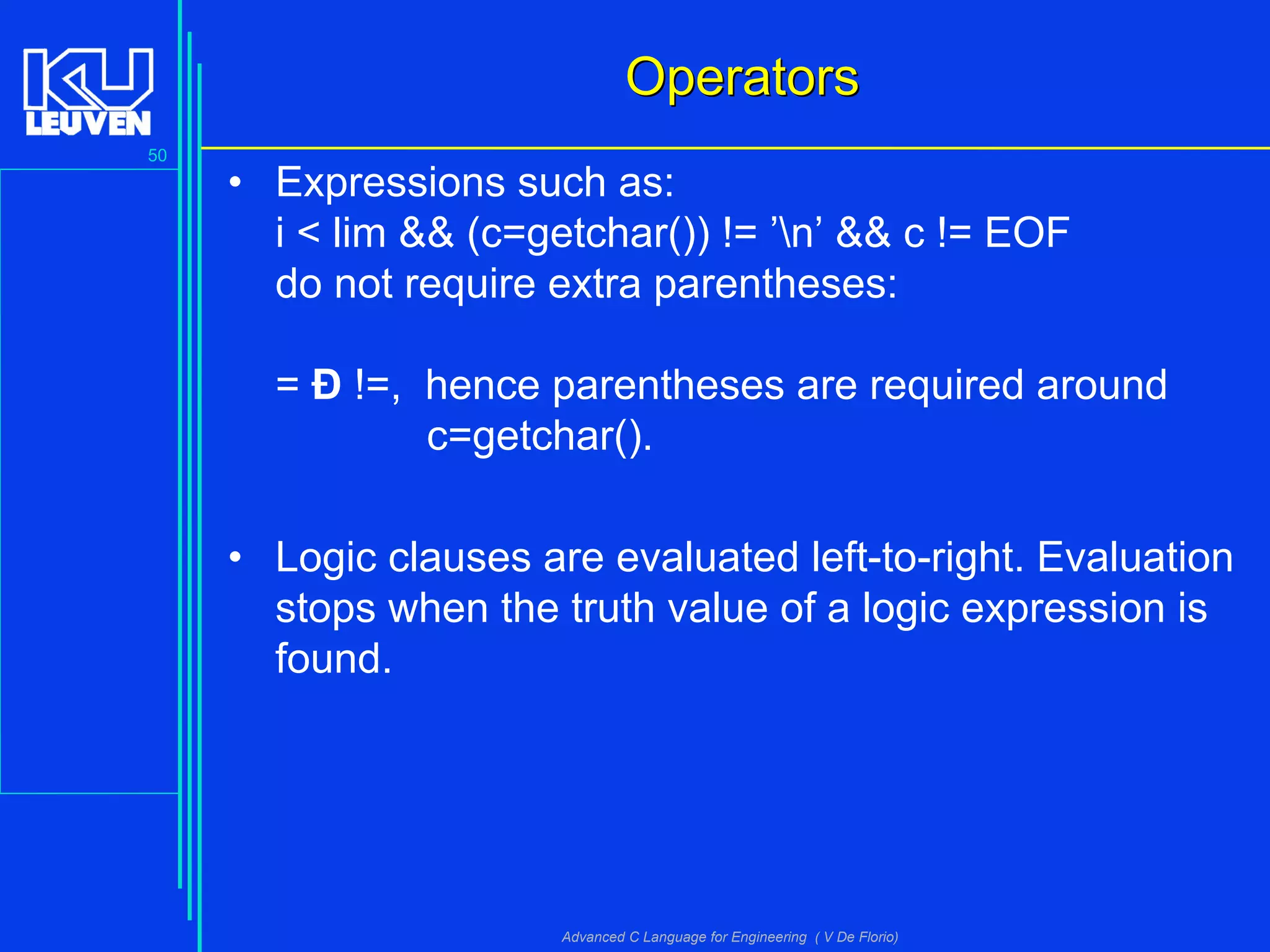
• Expressions such as:
i < lim && (c=getchar()) != ’n’ && c != EOF
do not require extra parentheses:
= Ð !=, hence parentheses are required around
c=getchar().
• Logic clauses are evaluated left-to-right. Evaluation
stops when the truth value of a logic expression is
found.
51
Advanced C Language for Engineering ( V De Florio)
Standard functions for input/outputStandard functions for input/output
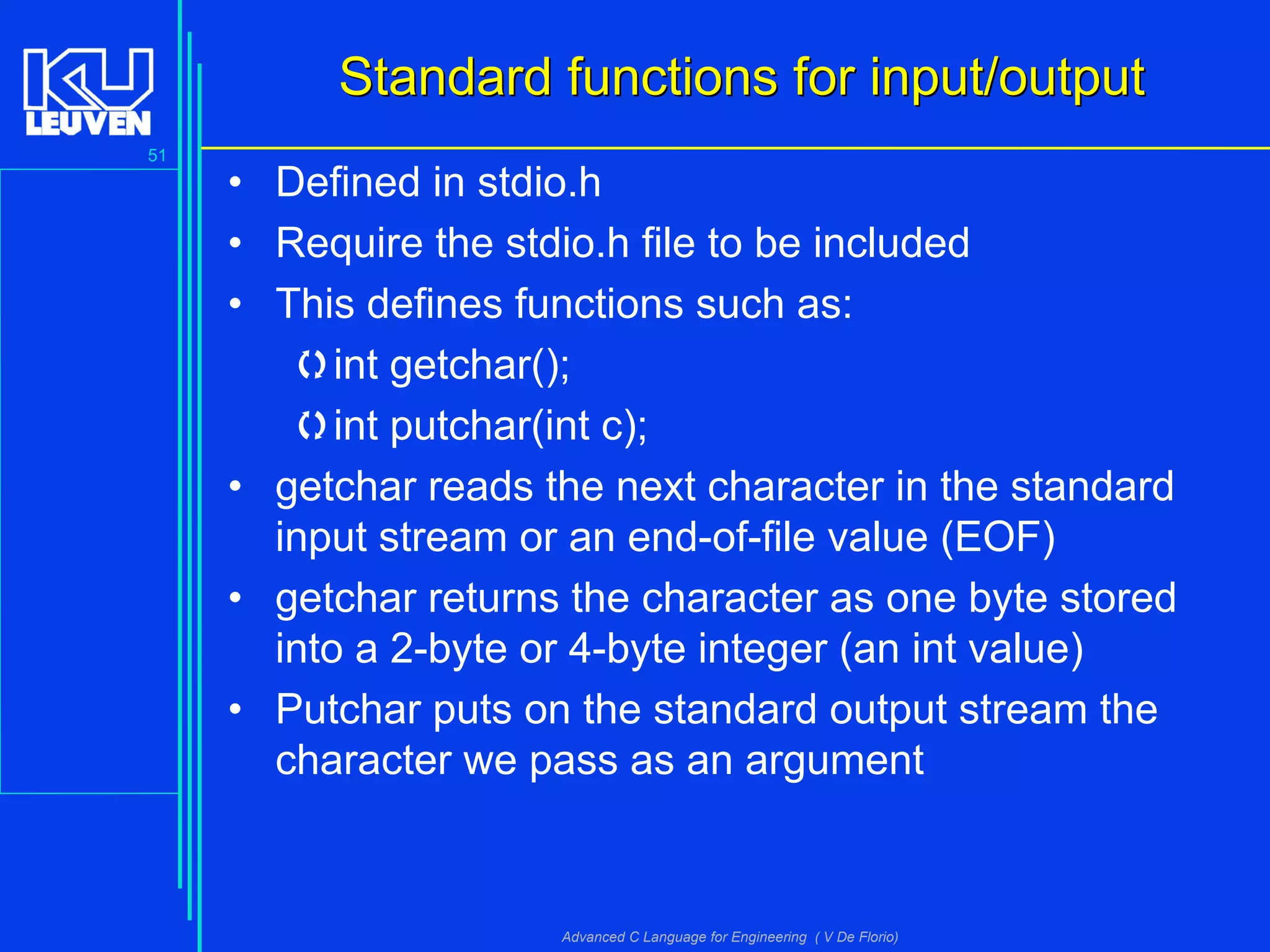
• Defined in stdio.h
• Require the stdio.h file to be included
• This defines functions such as:
int getchar();
int putchar(int c);
• getchar reads the next character in the standard
input stream or an end-of-file value (EOF)
• getchar returns the character as one byte stored
into a 2-byte or 4-byte integer (an int value)
• Putchar puts on the standard output stream the
character we pass as an argument
52
Advanced C Language for Engineering ( V De Florio)
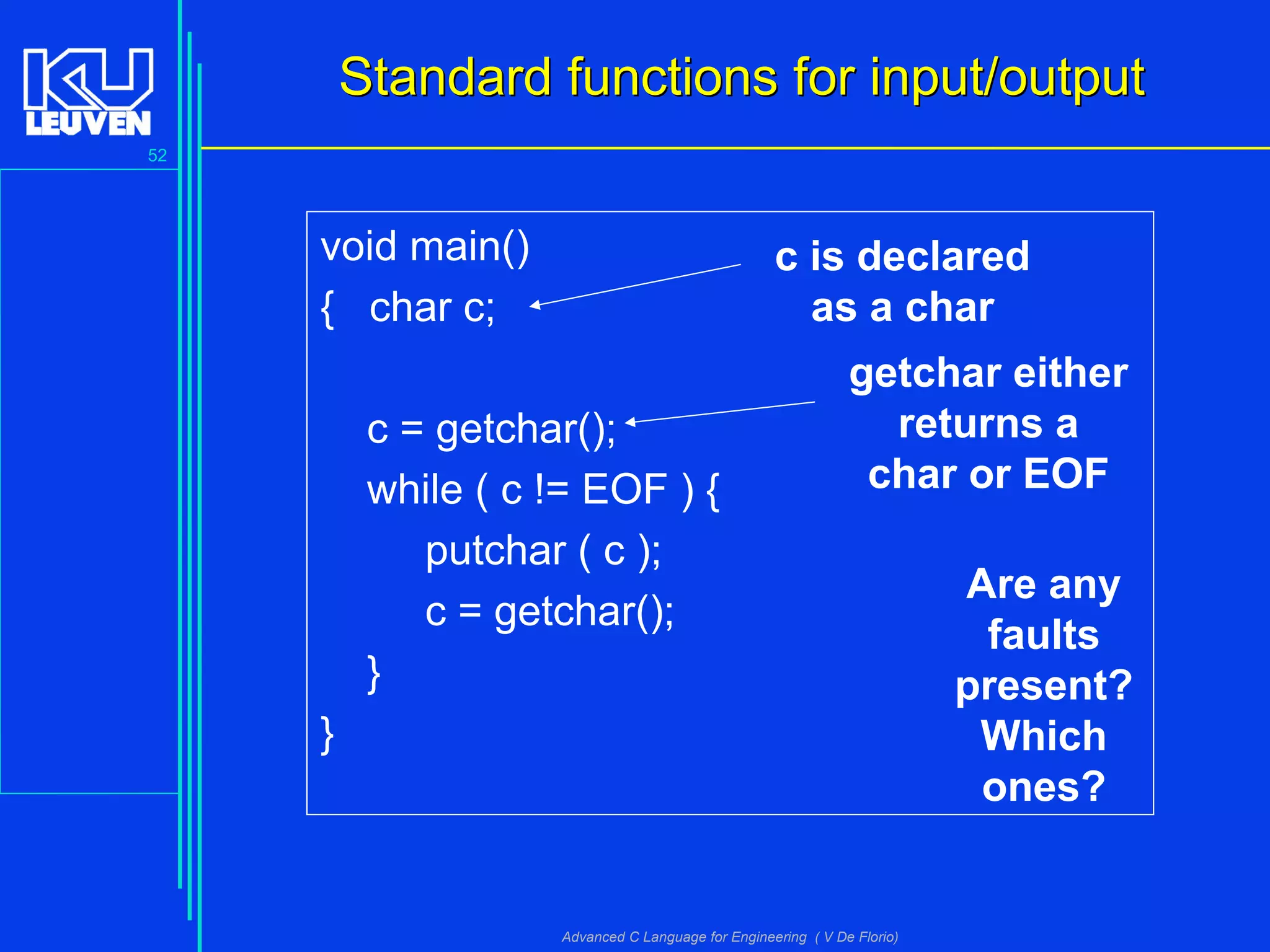
Standard functions for input/outputStandard functions for input/output
void main()
{ char c;
c = getchar();
while ( c != EOF ) {
putchar ( c );
c = getchar();
}
}
Are any
faults
present?
Which
ones?
c is declared
as a char
getchar either
returns a
char or EOF
53
Advanced C Language for Engineering ( V De Florio)
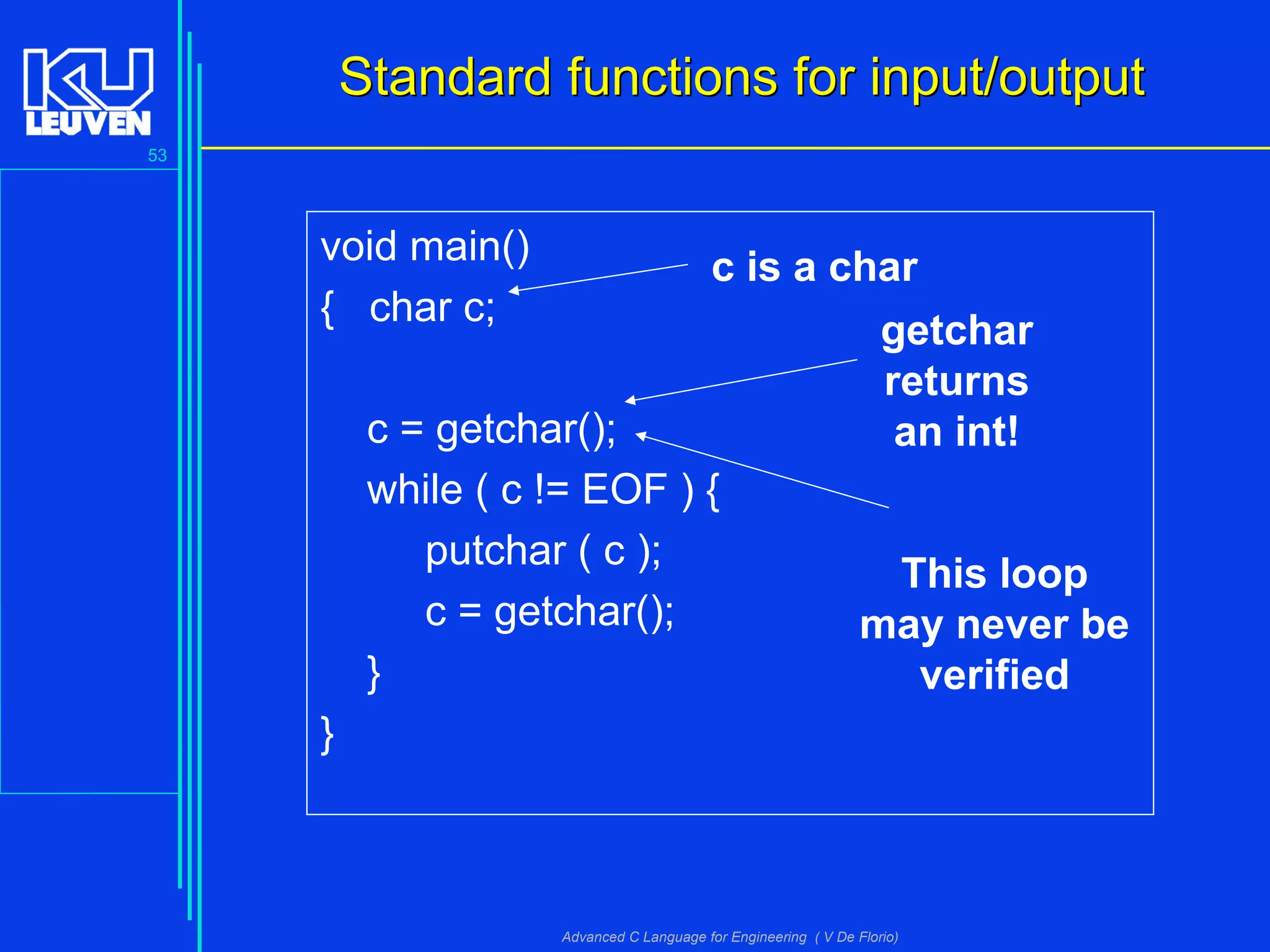
Standard functions for input/outputStandard functions for input/output
void main()
{ char c;
c = getchar();
while ( c != EOF ) {
putchar ( c );
c = getchar();
}
}
c is a char
getchar
returns
an int!
This loop
may never be
verified
54
Advanced C Language for Engineering ( V De Florio)
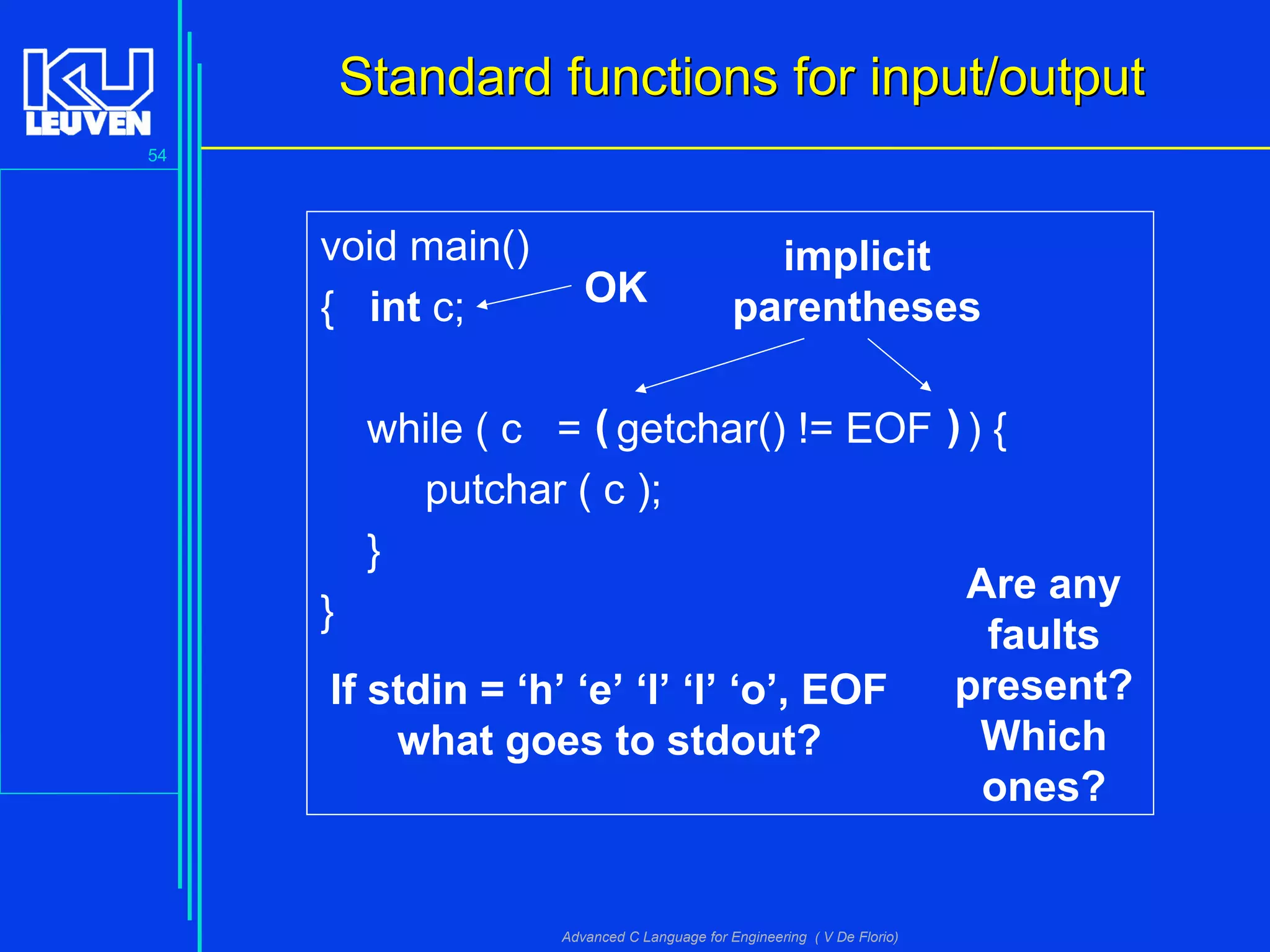
void main()
{ int c;
while ( c = getchar() != EOF ) {
putchar ( c );
}
}
Standard functions for input/outputStandard functions for input/output
Are any
faults
present?
Which
ones?
( )
implicit
parenthesesOK
If stdin = ‘h’ ‘e’ ‘l’ ‘l’ ‘o’, EOF
what goes to stdout?
55
Advanced C Language for Engineering ( V De Florio)
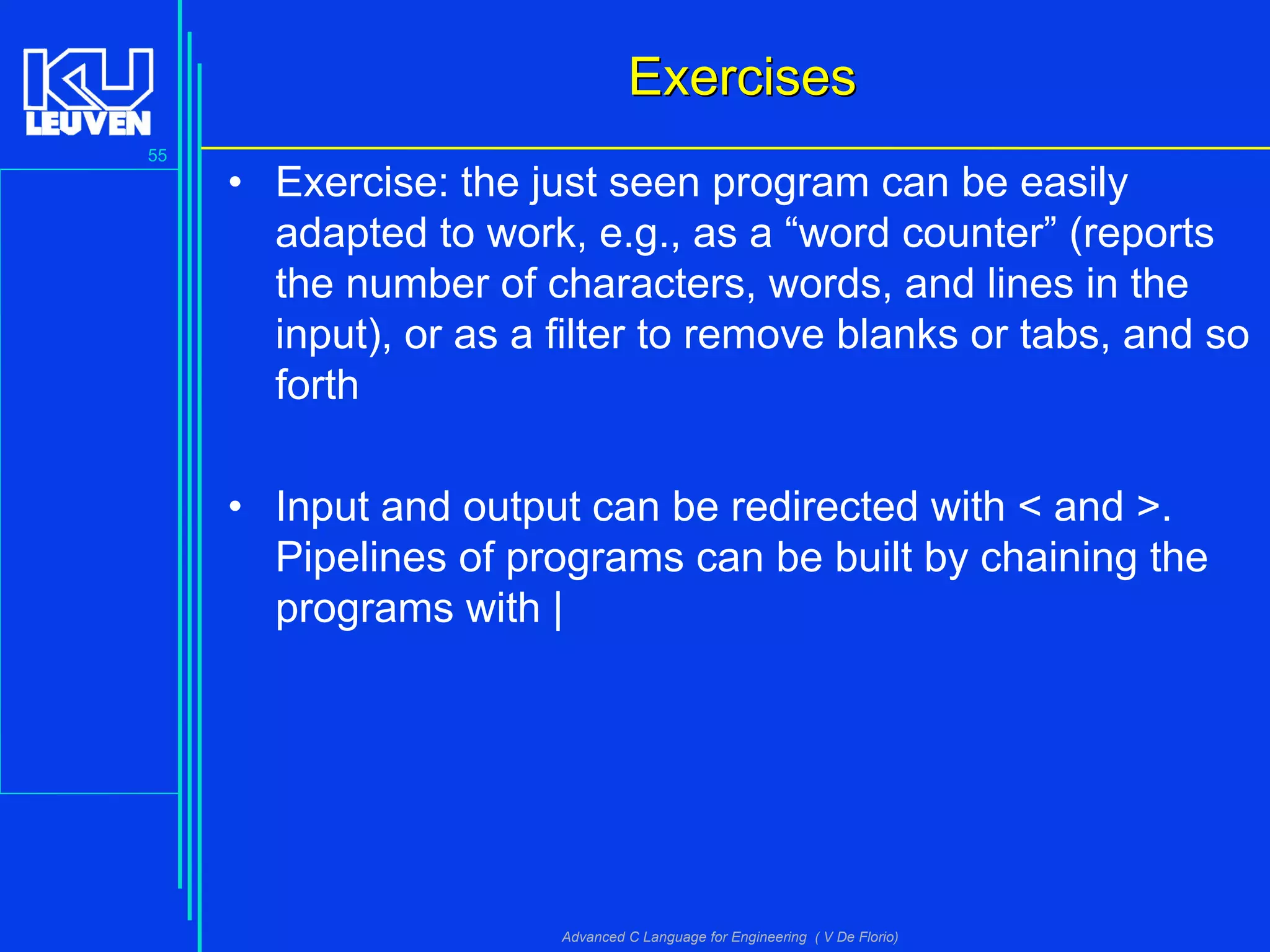
ExercisesExercises
• Exercise: the just seen program can be easily
adapted to work, e.g., as a “word counter” (reports
the number of characters, words, and lines in the
input), or as a filter to remove blanks or tabs, and so
forth
• Input and output can be redirected with < and >.
Pipelines of programs can be built by chaining the
programs with |
56
Advanced C Language for Engineering ( V De Florio)
Derived typesDerived types
• The following operators define complex types
derived from the basic types of C:
* operator pointer-to,
[] operator vector-of,
() operator function-pointer-to
57
Advanced C Language for Engineering ( V De Florio)
Derived typesDerived types
• char *p; : p is of type “pointer-to-chars”
• float v[10]; : v is a vector, i.e., a pointer to the
beginning of a memory area allocated by the system
and consisting of 10 floats, i.e., v[0], . . . , v[9].
• int getX(); : getX is a pointer to a function
returning an int.
58
Advanced C Language for Engineering ( V De Florio)
Derived typesDerived types
• Operator [] has higher priority with respect to
operator *. This means that
int *v[10]
declares v as a vector of ten pointers-to-int.
Parentheses are necessary to change the meaning:
int (*v)[10]
means that v is a pointer to a vector of ten integers
• What’s the difference in terms of sizes?
• What if short instead of int?
59
Advanced C Language for Engineering ( V De Florio)
Derived typesDerived types
1. int *pi; pointer to integer;
2. char **argv; pointer to pointer-to-char;
3. float *(fvp)[5]; pointer to vectors-of-5-floats
4. long (*fp)(int); pointer to function reading an
int and returning a long.
60
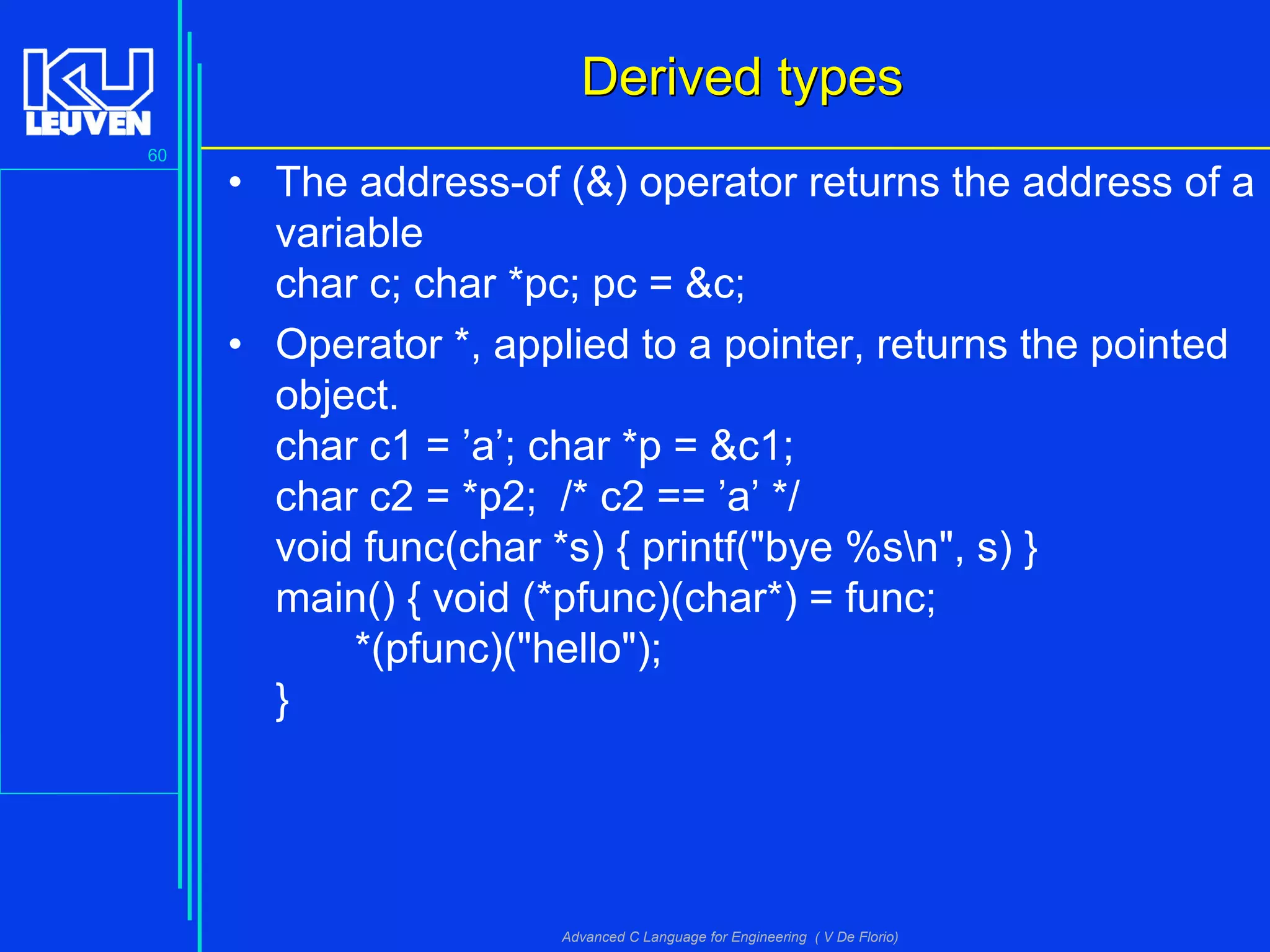
Advanced C Language for Engineering ( V De Florio)
Derived typesDerived types
• The address-of (&) operator returns the address of a
variable
char c; char *pc; pc = &c;
• Operator *, applied to a pointer, returns the pointed
object.
char c1 = ’a’; char *p = &c1;
char c2 = *p2; /* c2 == ’a’ */
void func(char *s) { printf("bye %sn", s) }
main() { void (*pfunc)(char*) = func;
*(pfunc)("hello");
}
61
Advanced C Language for Engineering ( V De Florio)
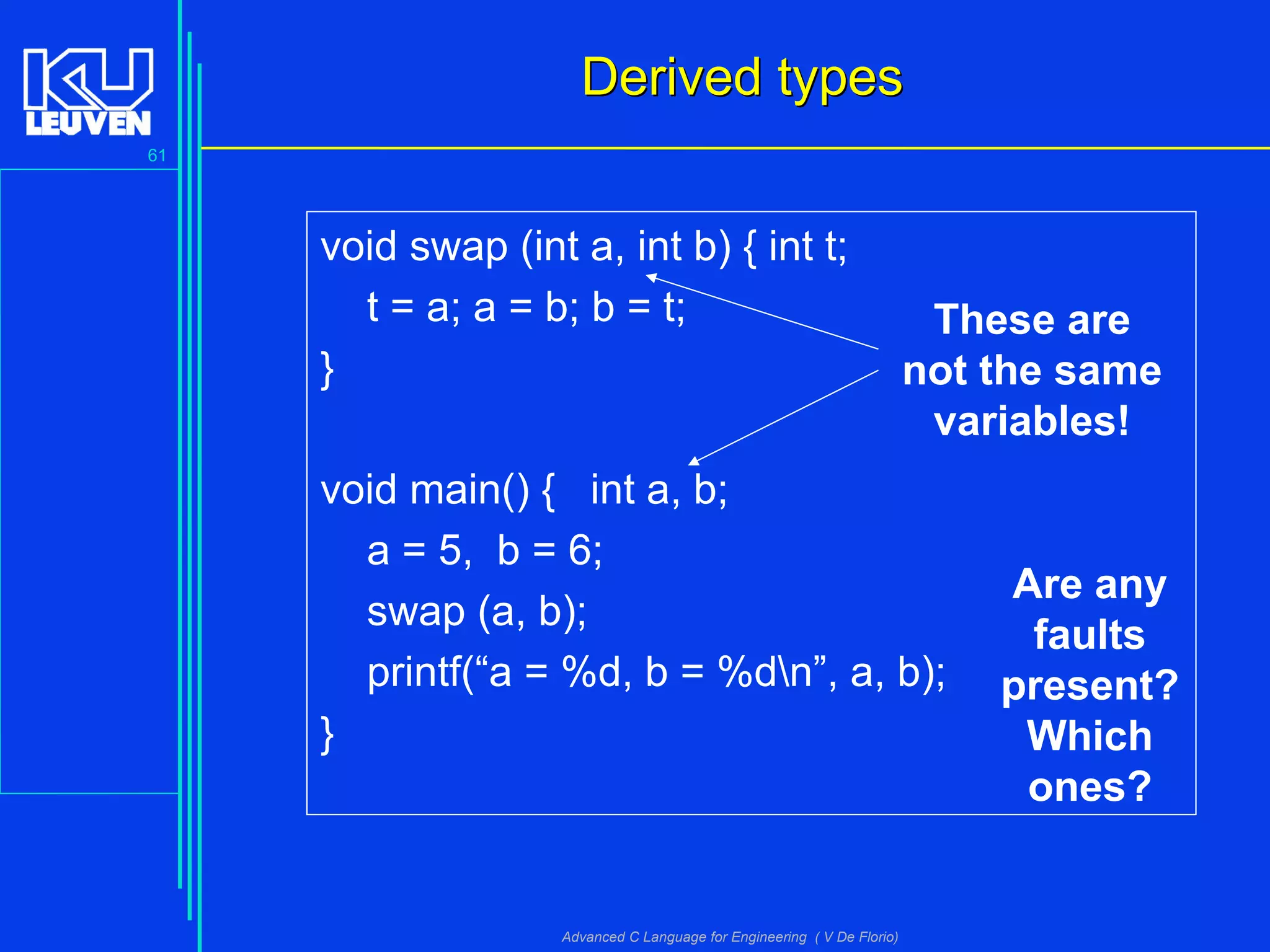
void swap (int a, int b) { int t;
t = a; a = b; b = t;
}
void main() { int a, b;
a = 5, b = 6;
swap (a, b);
printf(“a = %d, b = %dn”, a, b);
}
Derived typesDerived types
Are any
faults
present?
Which
ones?
These are
not the same
variables!
62
Advanced C Language for Engineering ( V De Florio)
Derived typesDerived types
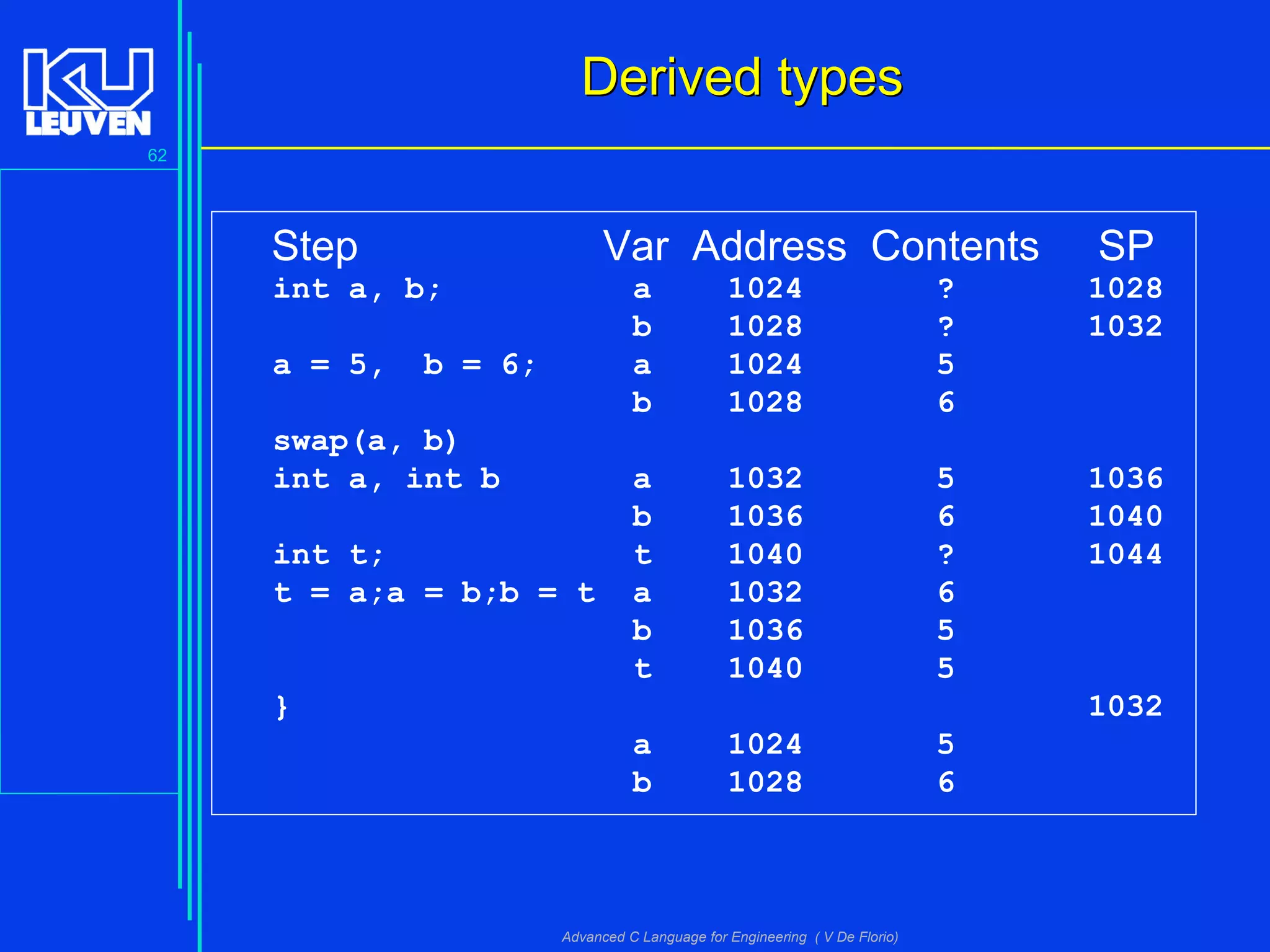
Step Var Address Contents SP
int a, b; a 1024 ? 1028
b 1028 ? 1032
a = 5, b = 6; a 1024 5
b 1028 6
swap(a, b)
int a, int b a 1032 5 1036
b 1036 6 1040
int t; t 1040 ? 1044
t = a;a = b;b = t a 1032 6
b 1036 5
t 1040 5
} 1032
a 1024 5
b 1028 6
63
Advanced C Language for Engineering ( V De Florio)
Derived typesDerived types
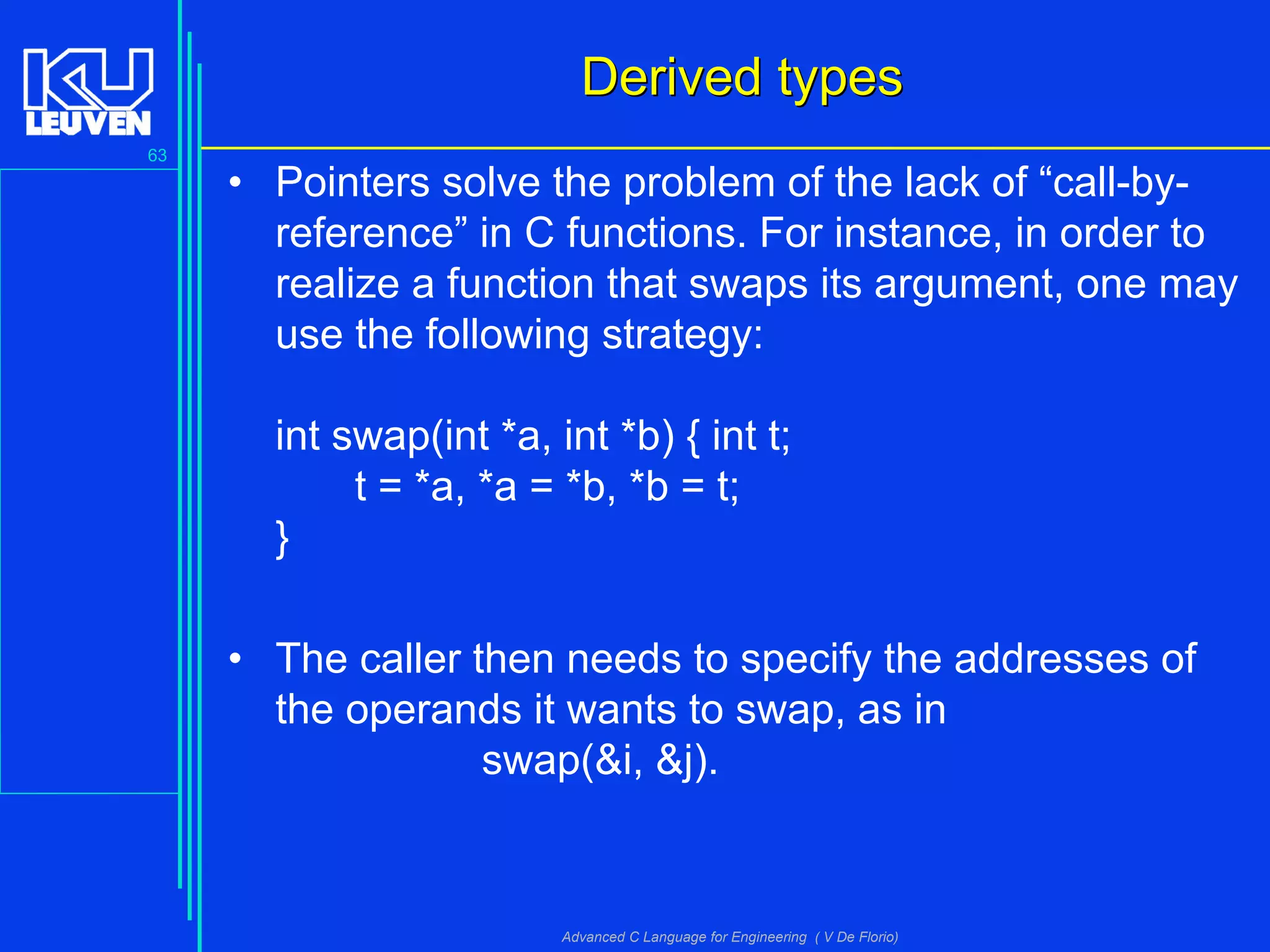
• Pointers solve the problem of the lack of “call-by-
reference” in C functions. For instance, in order to
realize a function that swaps its argument, one may
use the following strategy:
int swap(int *a, int *b) { int t;
t = *a, *a = *b, *b = t;
}
• The caller then needs to specify the addresses of
the operands it wants to swap, as in
swap(&i, &j).
64
Advanced C Language for Engineering ( V De Florio)
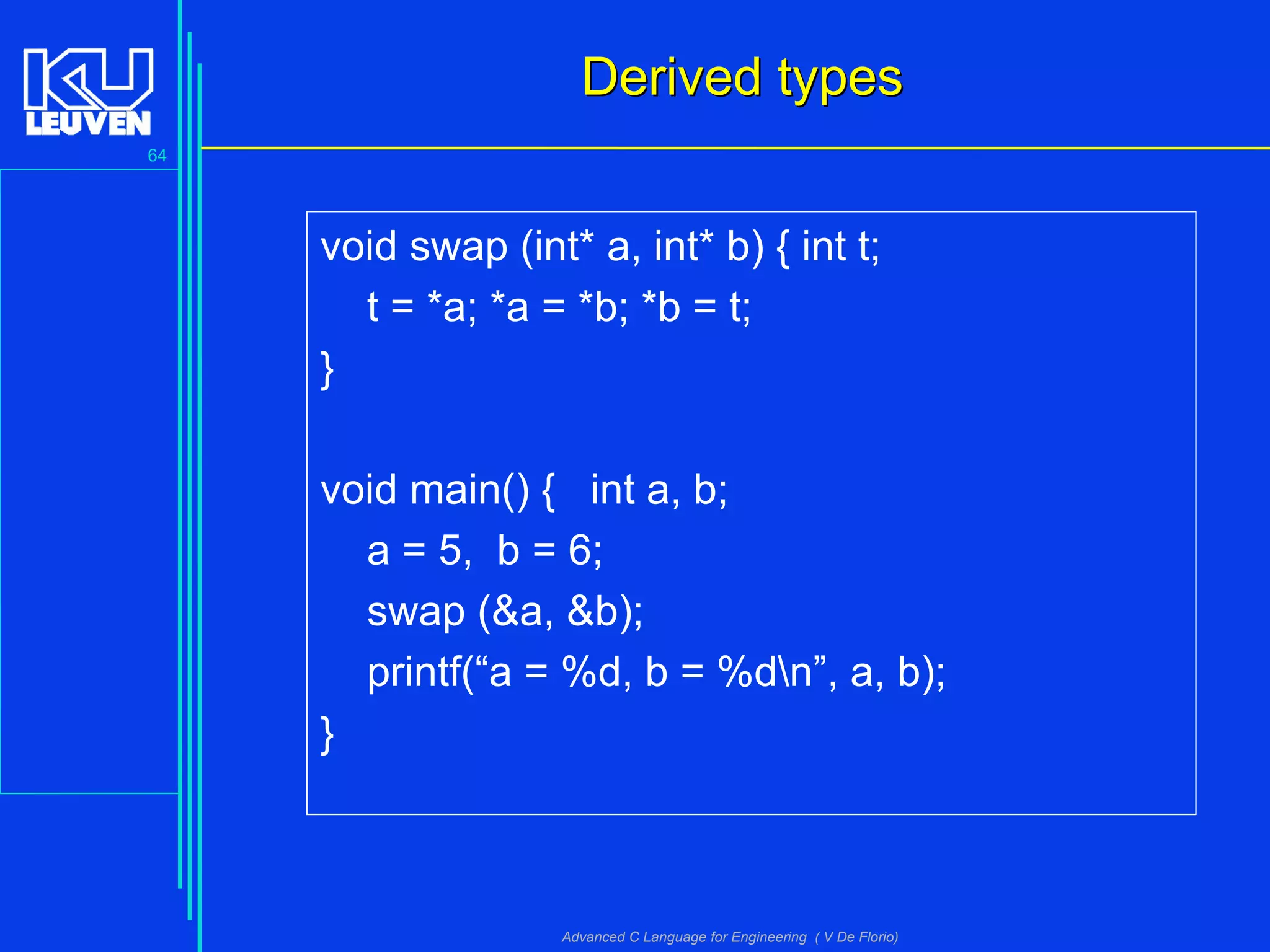
Derived typesDerived types
void swap (int* a, int* b) { int t;
t = *a; *a = *b; *b = t;
}
void main() { int a, b;
a = 5, b = 6;
swap (&a, &b);
printf(“a = %d, b = %dn”, a, b);
}
65
Advanced C Language for Engineering ( V De Florio)
Derived typesDerived types
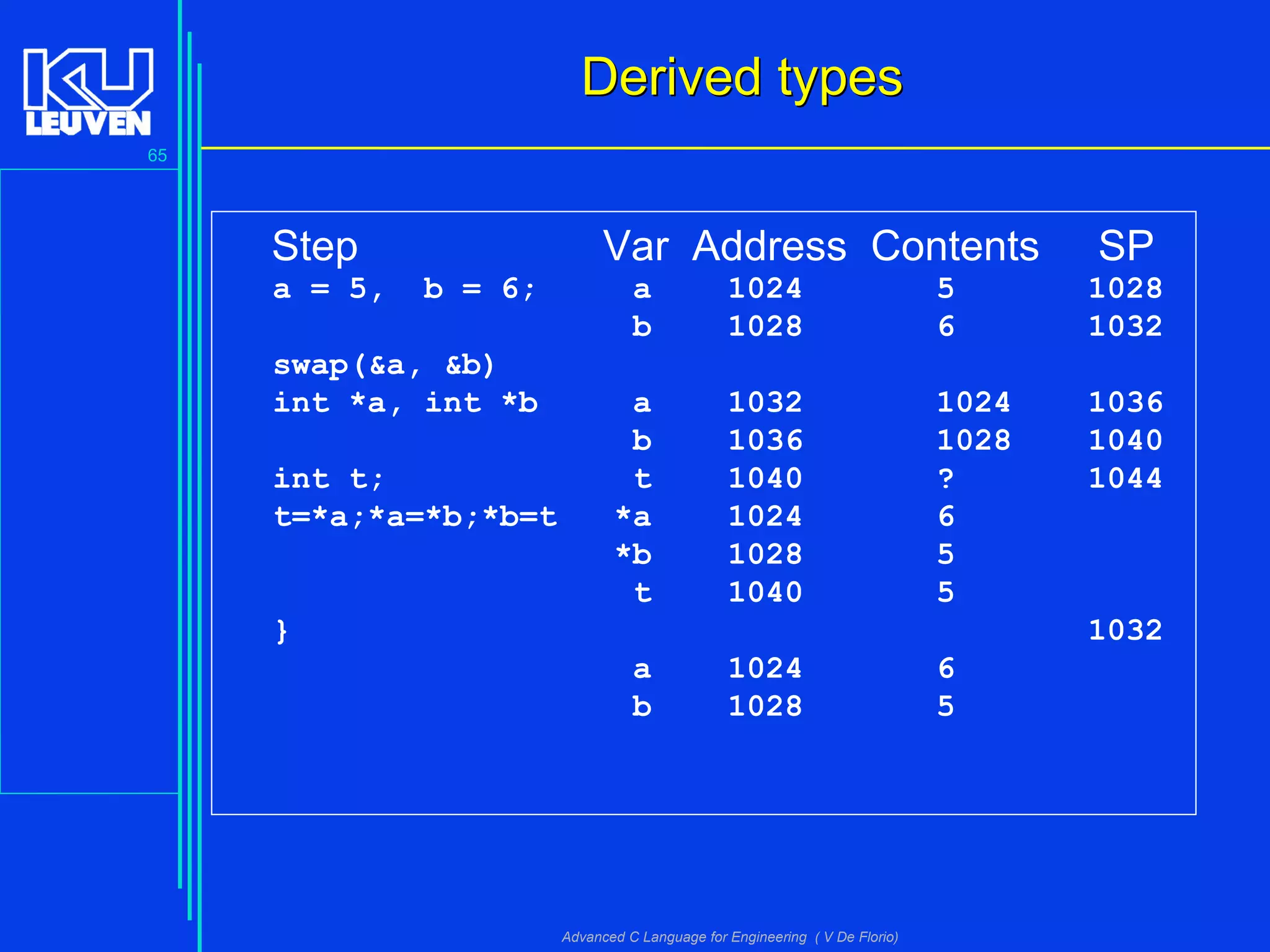
Step Var Address Contents SP
a = 5, b = 6; a 1024 5 1028
b 1028 6 1032
swap(&a, &b)
int *a, int *b a 1032 1024 1036
b 1036 1028 1040
int t; t 1040 ? 1044
t=*a;*a=*b;*b=t *a 1024 6
*b 1028 5
t 1040 5
} 1032
a 1024 6
b 1028 5
66
Advanced C Language for Engineering ( V De Florio)
Pointers and arraysPointers and arrays
• Note: declaring an array means
1. declaring a pointer
2. allocating memory for the pointed objects.
• The name of the array is indeed a pointer to the first
element of the array. In C lingo, this is
written as vect == &vect[0].
• Exercise: write a program, called report, that reports
the occurrences of each digit char in the input
stream. Use an array of ten elements corresponding
to the ten decimal digits. Produce a histogram at
end-of-input.
67
Advanced C Language for Engineering ( V De Florio)
Pointers and arraysPointers and arrays
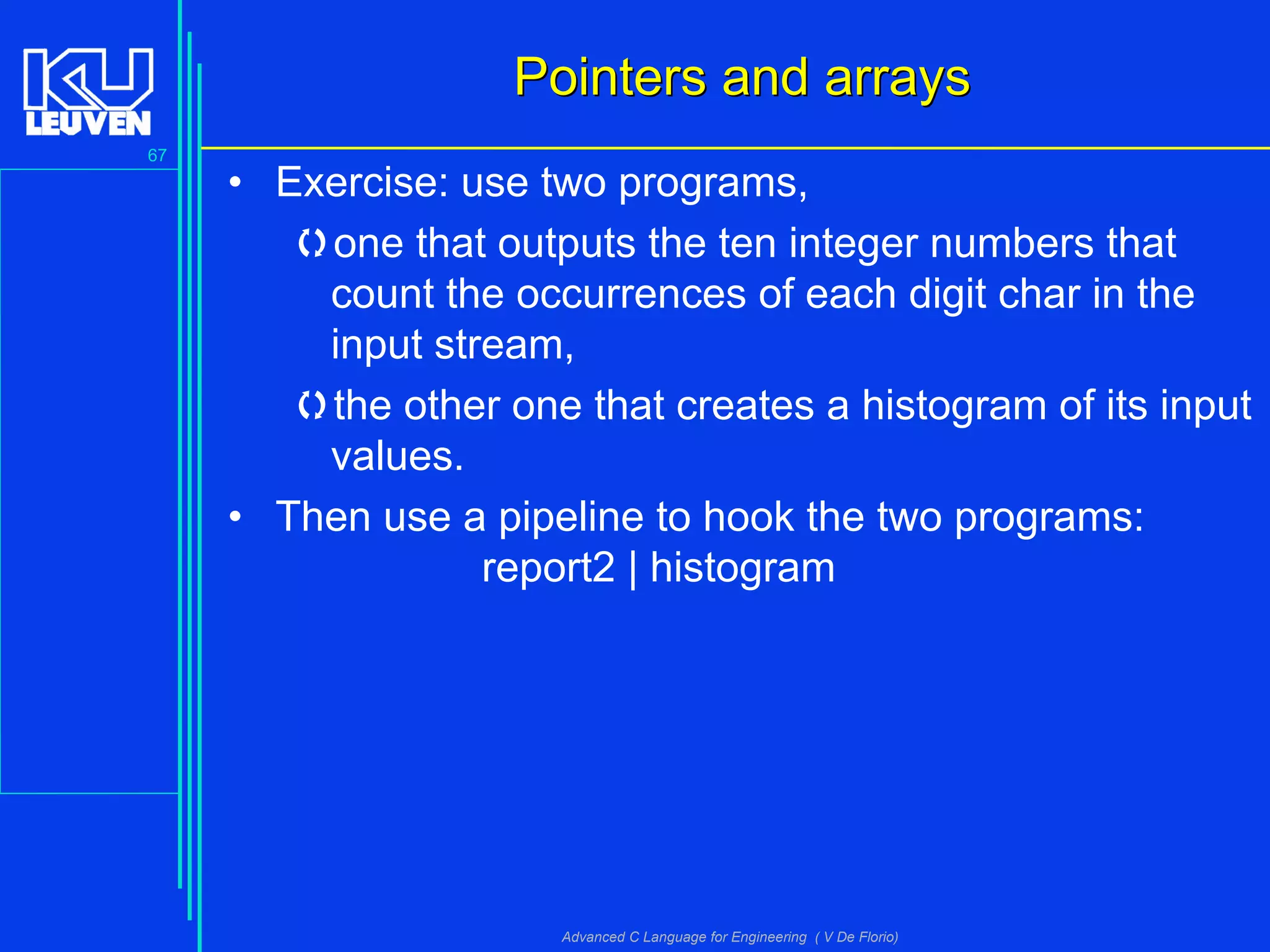
• Exercise: use two programs,
one that outputs the ten integer numbers that
count the occurrences of each digit char in the
input stream,
the other one that creates a histogram of its input
values.
• Then use a pipeline to hook the two programs:
report2 | histogram
68
Advanced C Language for Engineering ( V De Florio)
Pointers and arraysPointers and arrays
• Arrays and pointers are strictly related to each
other: In particular, if int a[10]; then
a == &a[0], a+1 == &a[1], … and so forth.
• In other words, *(a+i) == a[i]
• Any indexed array is equivalent to a pointer plus
some offset, and vice-versa
• Big difference: the array is a constant, i.e., it can
never appear on the left of the = sign, as in
a = pa;
or in
a ++;
69
Advanced C Language for Engineering ( V De Florio)
Pointers and arraysPointers and arrays
• When passing an array to a function we are indeed
passing the address of its first element; this address
is copied (call-by-value) in a temporary variable.
This variable may be a pointer.
• Example:
char s[7] = "hello!"; /* s is an array */
int i = strlen(s);
int strlen (char *x) { /* x is a pointer */
int n;
for (n=0; *x; x++) /* hence, can be modified */
n++;
return (n);
}
70
Advanced C Language for Engineering ( V De Florio)
Pointers and arraysPointers and arrays
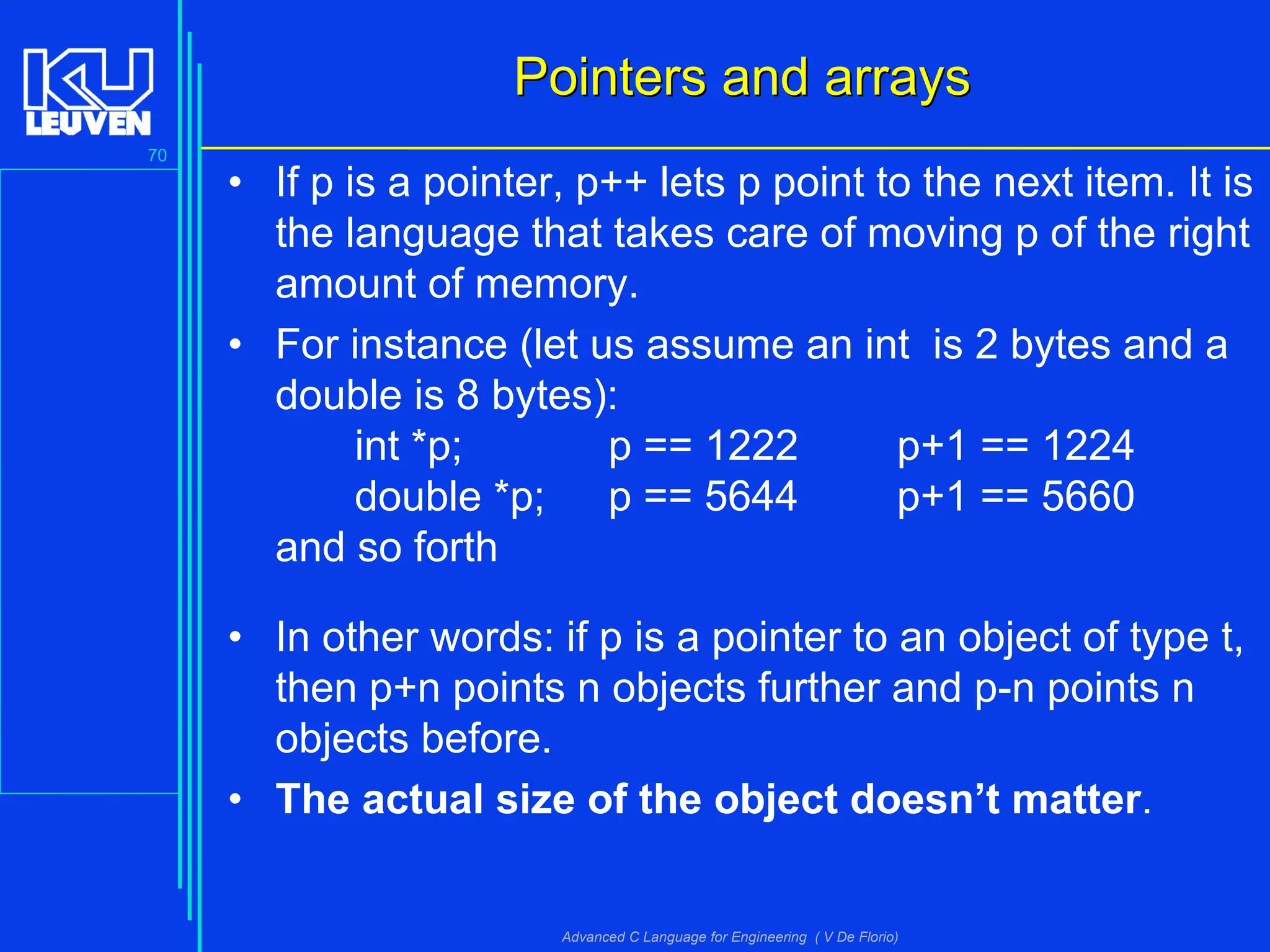
• If p is a pointer, p++ lets p point to the next item. It is
the language that takes care of moving p of the right
amount of memory.
• For instance (let us assume an int is 2 bytes and a
double is 8 bytes):
int *p; p == 1222 p+1 == 1224
double *p; p == 5644 p+1 == 5660
and so forth
• In other words: if p is a pointer to an object of type t,
then p+n points n objects further and p-n points n
objects before.
• The actual size of the object doesn’t matter.
71
Advanced C Language for Engineering ( V De Florio)
Pointers to charsPointers to chars
• Strings are available in C as arrays of characters.
Any sentence enclosed between two quotes (“) is an
array of characters ending with character ’0’
(NULL).
• For instance, "hello" means ’h’, ’e’, ’l’, ’l’, ’o’, 0
• A very common mistake in C:
char s1[10] = "Hello ";
char s2[10] = "World";
s1=s2; /* ERROR */
72
Advanced C Language for Engineering ( V De Florio)
Pointers to charsPointers to chars
• As strings are arrays, we can easily pass a string to
a function by passing its name, which points to its
characters:
char a[] = “Kennedy";
printf("Vote %s for president.n", a);
/* a = &a[0] */
• Variables defined within a function cannot be “seen”
from other functions.
73
Advanced C Language for Engineering ( V De Florio)
Pointers to functionsPointers to functions
• Exercise: write a program that uses an array of
pointers-to-function
Input char == number i -> call array[i ]
74
Advanced C Language for Engineering ( V De Florio)
Pointers and arrays (2)Pointers and arrays (2)
• Function strcpy(char *a, char *b);
• Assumption: NULL-terminated strings. Note that
NULL is (int)0, i.e., “false”
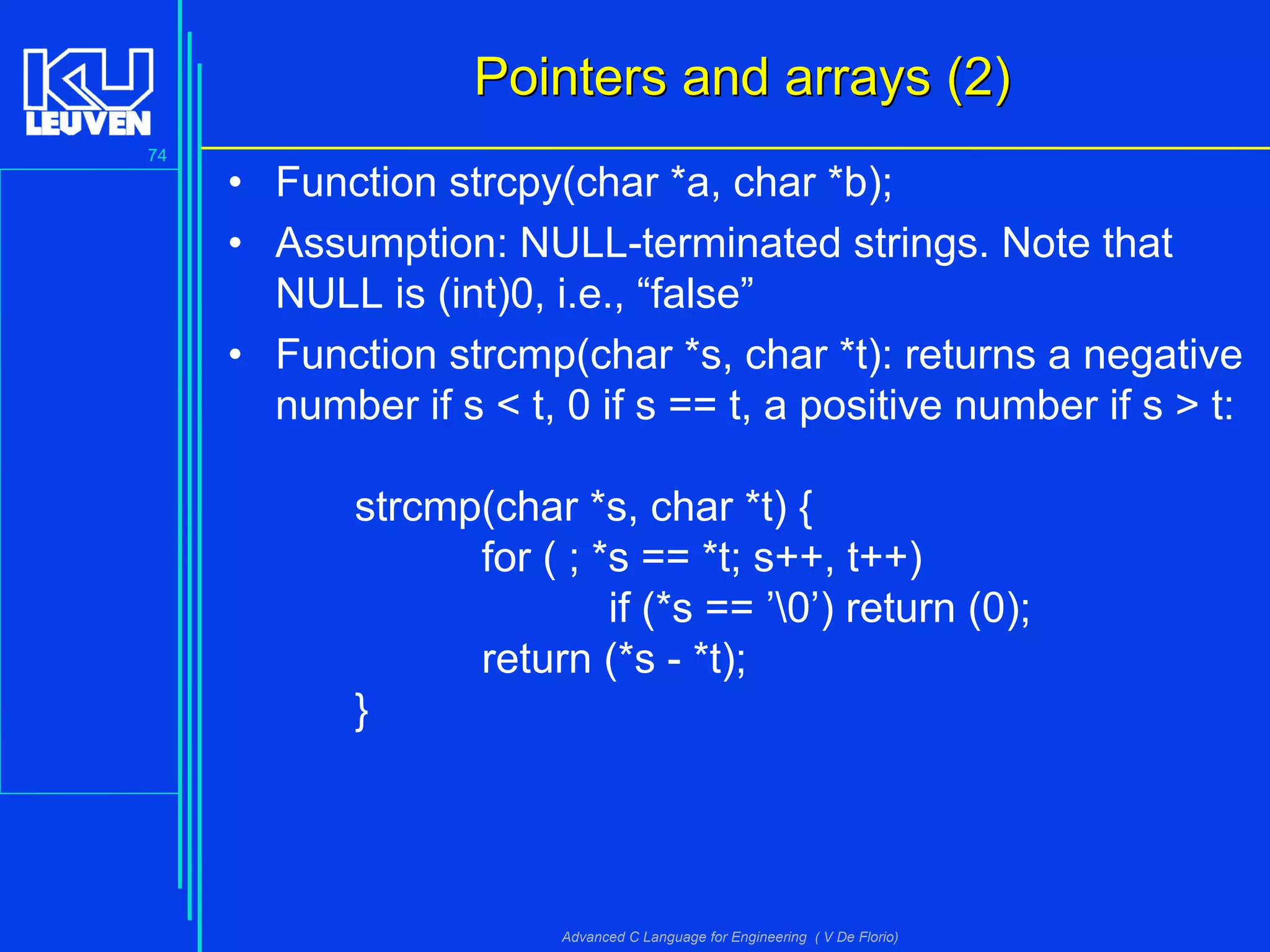
• Function strcmp(char *s, char *t): returns a negative
number if s < t, 0 if s == t, a positive number if s > t:
strcmp(char *s, char *t) {
for ( ; *s == *t; s++, t++)
if (*s == ’0’) return (0);
return (*s - *t);
}
75
Advanced C Language for Engineering ( V De Florio)
Pointers and arrays (2)Pointers and arrays (2)
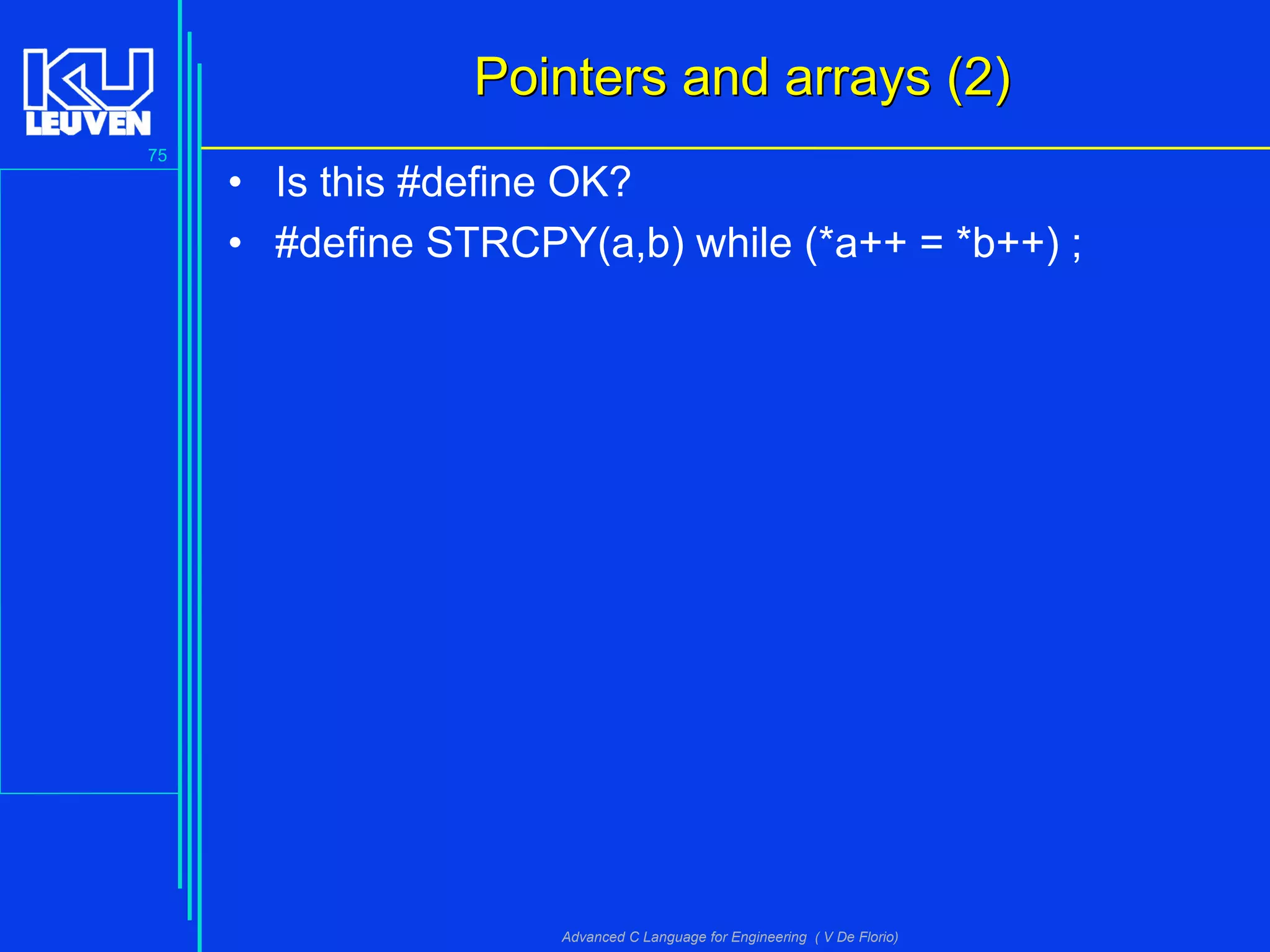
• Is this #define OK?
• #define STRCPY(a,b) while (*a++ = *b++) ;
76
Advanced C Language for Engineering ( V De Florio)
Pointers and arrays (2)Pointers and arrays (2)
• To declare multidimensional arrays one declares
arrays of arrays. For instance,
static int day_of_month[2][13] = {
{ 0, 31, 28, 31, 30, 31, 30, 31, 31, 30, 31, 30, 31},
{ 0, 31, 29, 31, 30, 31, 30, 31, 31, 30, 31, 30, 31}
};
int day_of_year(int day, int month, int year) {
int i, leap =
year%4 == 0 && year%100 != 0 || year%400 == 0;
for (i=1; i<month; i++)
day += day_in_month[leap][i];
return (day);
}
77
Advanced C Language for Engineering ( V De Florio)
Pointers and arrays (2)Pointers and arrays (2)
• int v[i][j] vs. int v[i,j]
• Entries are stored “by row”: the rightmost index is
the one that varies the most when entries are
referenced in the order they are stored.
• Initialisation: using curly brackets.
• When passing a bidimensional array to a function, it
is mandatory that the number of columns be
specified. For instance:
f(int day_in_month[2][13]), or
f(int day_in_month[][13]), or
f(int (*day_in_month)[13]),
• i.e., pointer to array-of-13 integer entries.
78
Advanced C Language for Engineering ( V De Florio)
Pointers and arrays (2)Pointers and arrays (2)
• “Entries are stored by rows” means that, e.g.,
int v[100][200];
• is allocated the same way as a
int v[100 × 200];
i.e., as if it were a mono-dimensional array of
20000 int’s.
79
Advanced C Language for Engineering ( V De Florio)
Pointers and arrays (2)Pointers and arrays (2)
• Fortran stores objects the opposite way with respect
to C:
for (i..) for (j..) a[i][j]
• is equivalent to
DO I.. DO J.. A(J,I)
• Accessing element (i, j) in a n × m matrix means
accessing element k = i × m + j in the associated
mono-dimensional array.
• The same applies for N-dimensional
matrices, N > 2.
80
Advanced C Language for Engineering ( V De Florio)
Pointers and arrays (2)Pointers and arrays (2)
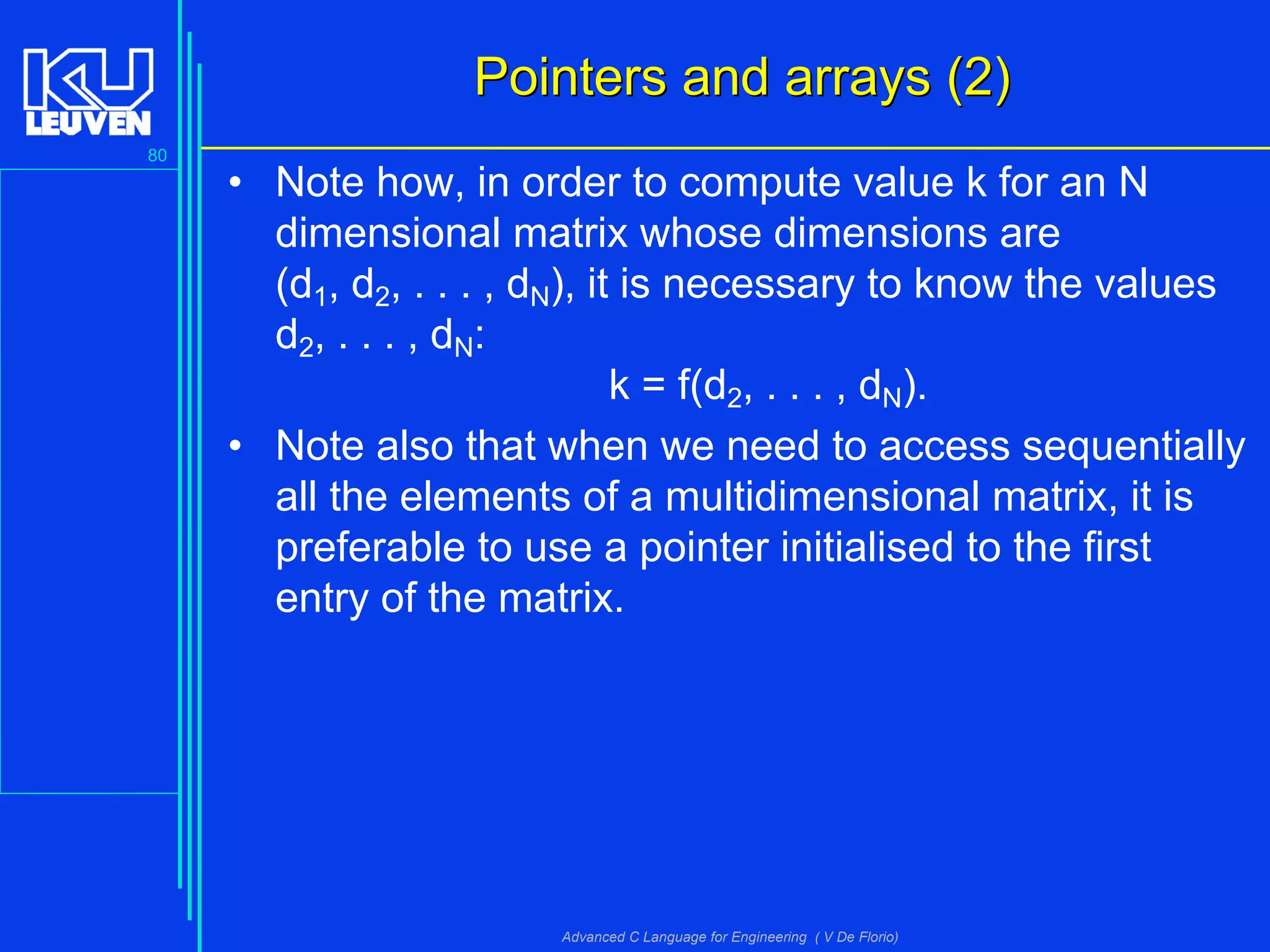
• Note how, in order to compute value k for an N
dimensional matrix whose dimensions are
(d1, d2, . . . , dN), it is necessary to know the values
d2, . . . , dN:
k = f(d2, . . . , dN).
• Note also that when we need to access sequentially
all the elements of a multidimensional matrix, it is
preferable to use a pointer initialised to the first
entry of the matrix.
81
Advanced C Language for Engineering ( V De Florio)
Pointers and arrays (2)Pointers and arrays (2)
• #define N 500
#define M 500
main() { int a[N][M];
int i, j, c;
int *pa = & (a[0][0]);
int *pl = & (a[N-1][M-1]);
while (pa < pl) { for (i=0; i<N; i++)
*pa = 0; for (j=0; j<M; j++)
c = *pa + 1; { a[i][j] = 0;
*pa = c; c = a[i][j] +1;
pa++; a[i][j] = c;
} }HP9K 0.7–0.8s 1.2–1.3 s
SUN3 1.1 s 2.4 s
82
Advanced C Language for Engineering ( V De Florio)
Pointers and arrays (2)Pointers and arrays (2)
• Even when the access is not sequential, it is
possible to exploit specific access patterns (e.g.,
constant stride access).
• An interesting alternative with respect to
multidimensional arrays is by using pointers. For
instance, the computational cost to access
entry (i, j) in a n × m matrix is the one for computing
multiplication (i * m) and addition (i * m + j).
83
Advanced C Language for Engineering ( V De Florio)
Pointers and arrays (2)Pointers and arrays (2)
• If we change from
int a[100][100];
to
int** a;
and if we properly allocate the 100 pointers in the
row and, for each of them, the memory required for
storing 100 int’s, then
accessing entry (i, j) means executing *((*(a+i)+j))
that has a computational cost of only two additions.
• Furthermore, no dimension information is required
anymore to access any element of the array.
84
Advanced C Language for Engineering ( V De Florio)
Pointers and arrays (2)Pointers and arrays (2)
• Array of pointers – an example
• char *name_of_month (int n) {
static char *names[] = {
"illegal",
"January",
"February",
. . .
"December“
};
return ((n < 1 || n > 12)? names[0] : names[n] ;
}
85
Advanced C Language for Engineering ( V De Florio)
Pointers and arrays (2)Pointers and arrays (2)
• Argc and argv: a mechanism that allows a program
to inspect the strings on the command
• line.
• For instance, command echo:
main(int argc, char *argv[]) {
while (--argc > 0)
printf("%s%c", *++argv, (argc>1)?’ ’:’n’ );
}
• Exercise: compute 2 3 4 + * (in inverse Polish
notation).
• Exercise: write a function that associates user
functions to the command options.
86
Advanced C Language for Engineering ( V De Florio)
Pointers and arrays (2)Pointers and arrays (2)
• Exercise: write a function that sorts the entries of an
array of integers. Modify the function so that it
requires a pointer-to-function,
int (*confr)(int,int),
to realize sortings in increasing vs. decreasing
order.
• Exercise: “opaque” function, working with pointers to
object of unknown size.
• Exercise (array of functions): design a scanner of a
simple grammar. Tokens must correspond to the
entries in an array of functions.
87
Advanced C Language for Engineering ( V De Florio)
Using pointersUsing pointers
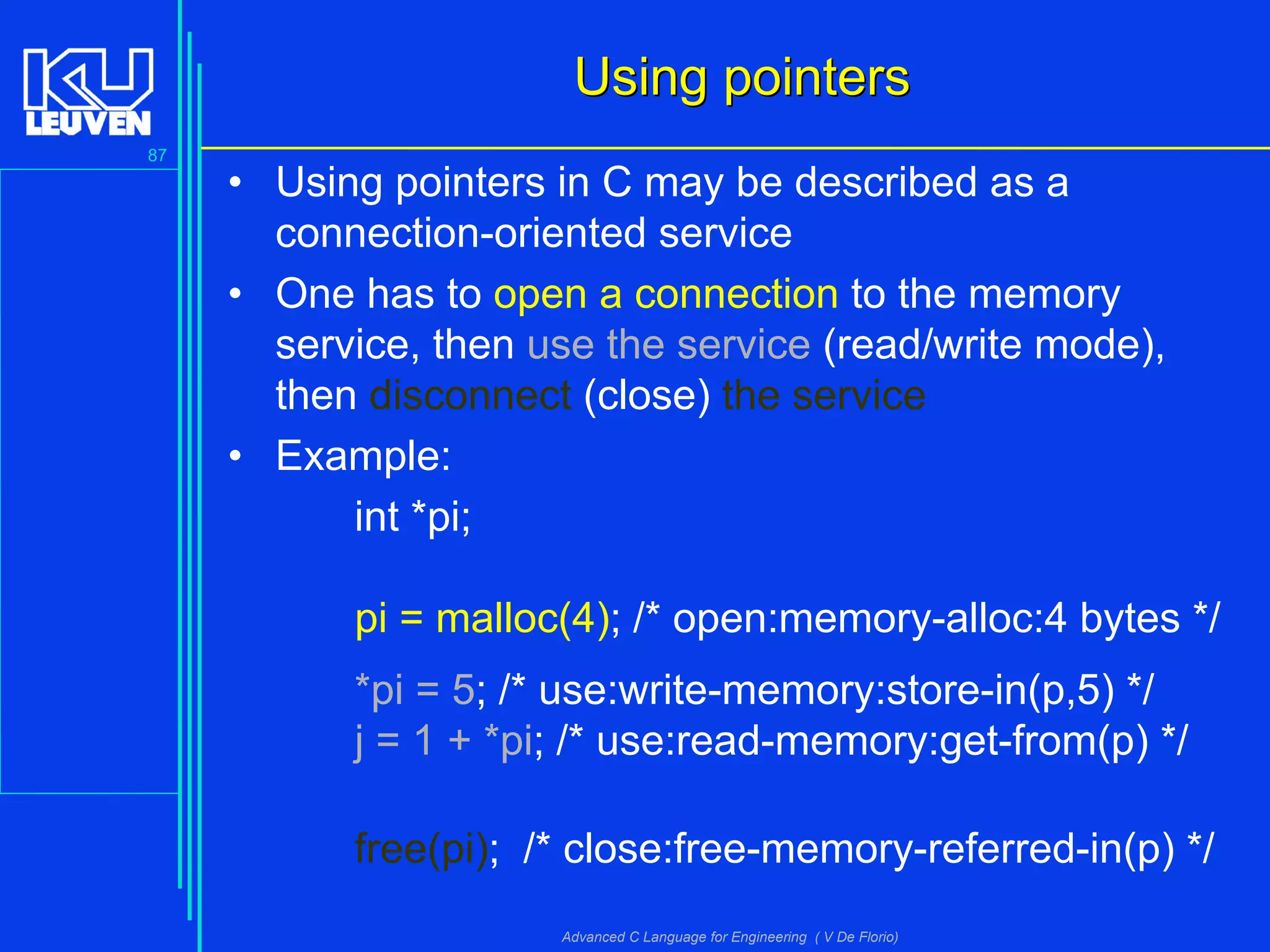
• Using pointers in C may be described as a
connection-oriented service
• One has to open a connection to the memory
service, then use the service (read/write mode),
then disconnect (close) the service
• Example:
int *pi;
pi = malloc(4); /* open:memory-alloc:4 bytes */
*pi = 5; /* use:write-memory:store-in(p,5) */
j = 1 + *pi; /* use:read-memory:get-from(p) */
free(pi); /* close:free-memory-referred-in(p) */
88
Advanced C Language for Engineering ( V De Florio)
Using pointersUsing pointers
1) Definition of a pointer
int *pi;
Note: by doing so, one allocates memory for the
pointer, not for the pointed
2) Memory allocation
pi = malloc(4); or better malloc(sizeof(int));
Note: this is a request for memory allocation.
malloc returns NULL (def:stdio.h) when the
request cannot be fulfilled, a value different from
NULL when the request can be fulfilled
3) Memory access
*pi = … or … = … *pi …
Note: the valid address returned by malloc points to
some memory location where the requested
memory resides
89
Advanced C Language for Engineering ( V De Florio)
Using pointersUsing pointers
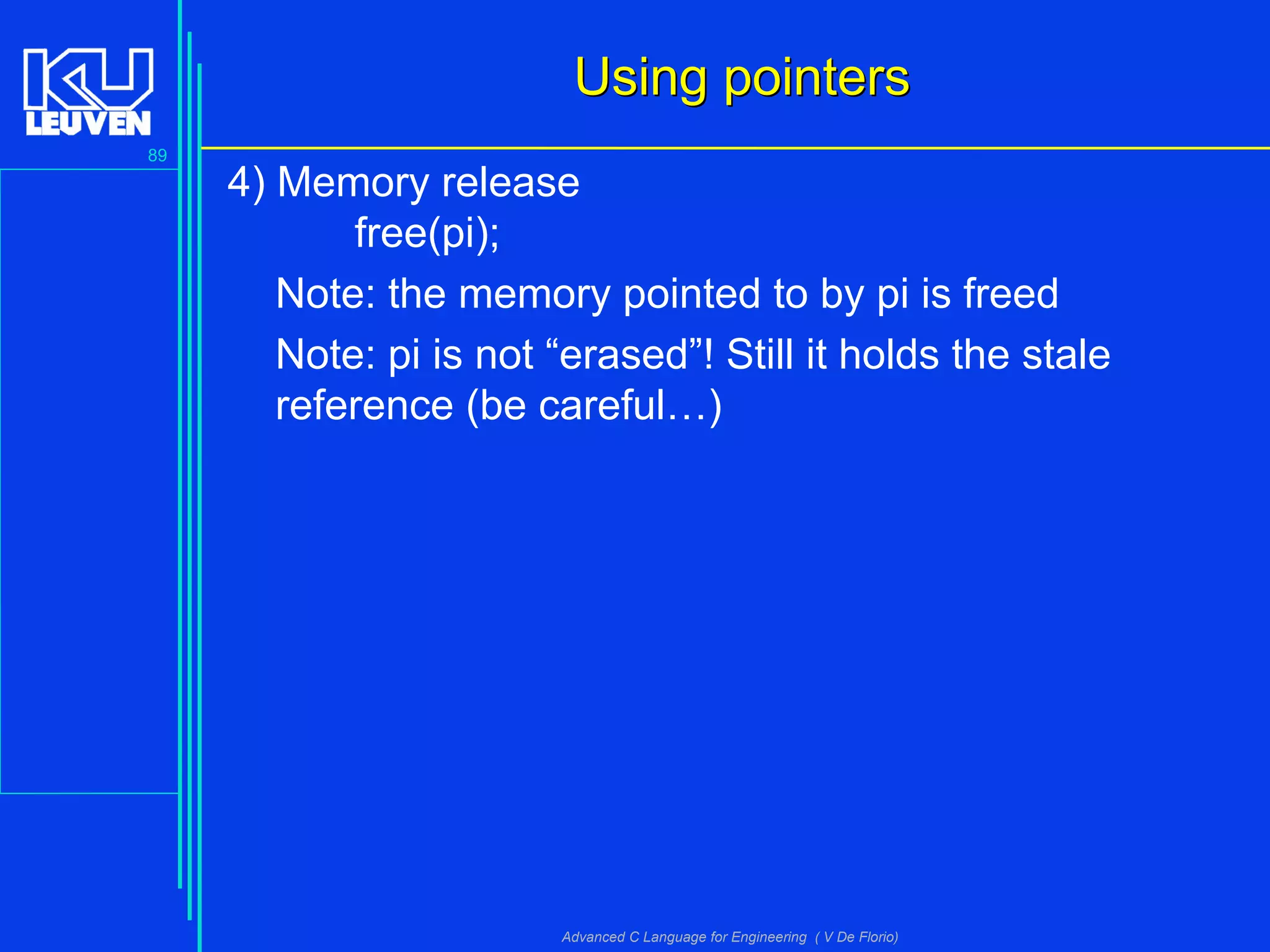
4) Memory release
free(pi);
Note: the memory pointed to by pi is freed
Note: pi is not “erased”! Still it holds the stale
reference (be careful…)
90
Advanced C Language for Engineering ( V De Florio)
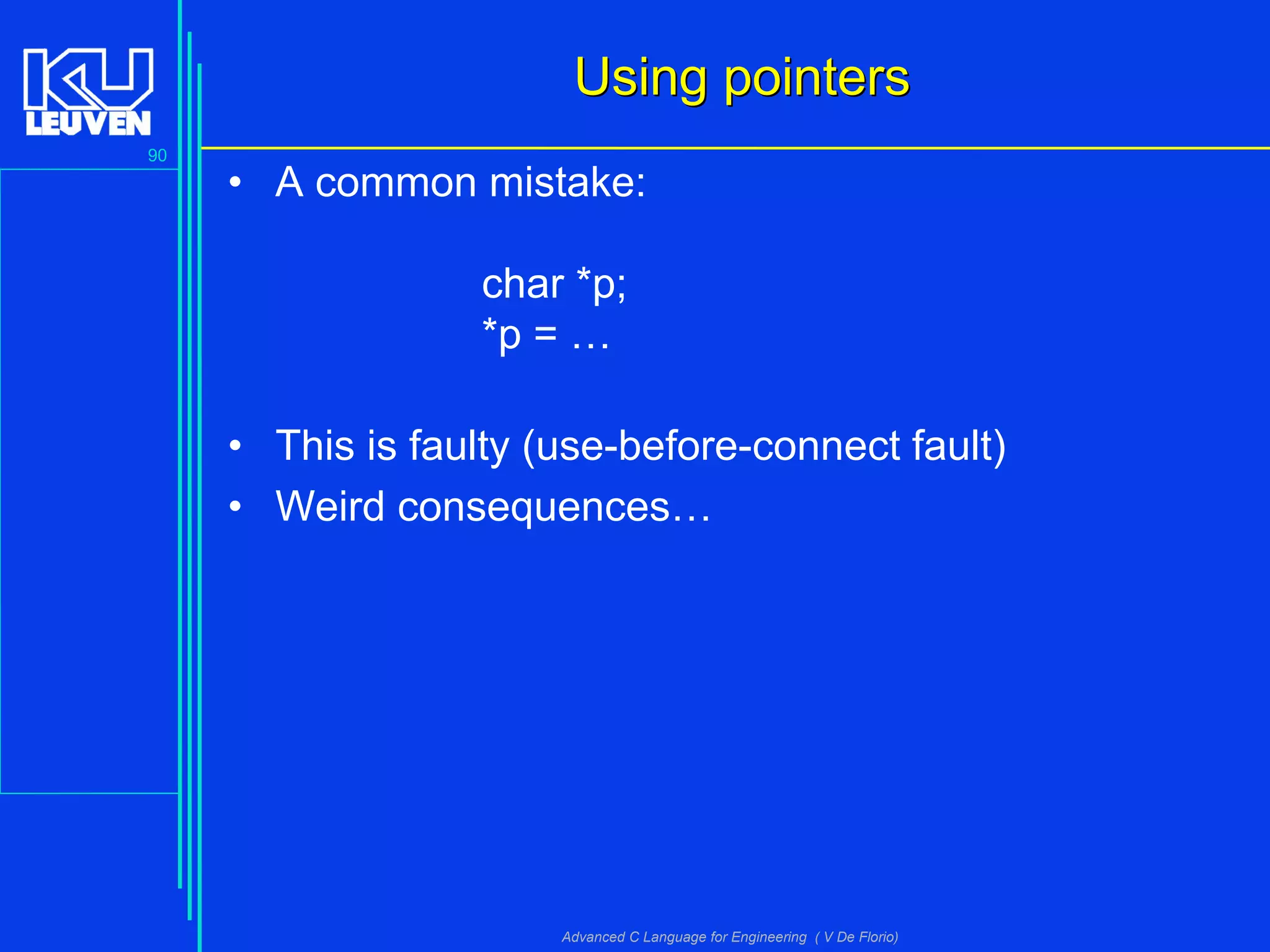
Using pointersUsing pointers
• A common mistake:
char *p;
*p = …
• This is faulty (use-before-connect fault)
• Weird consequences…
91
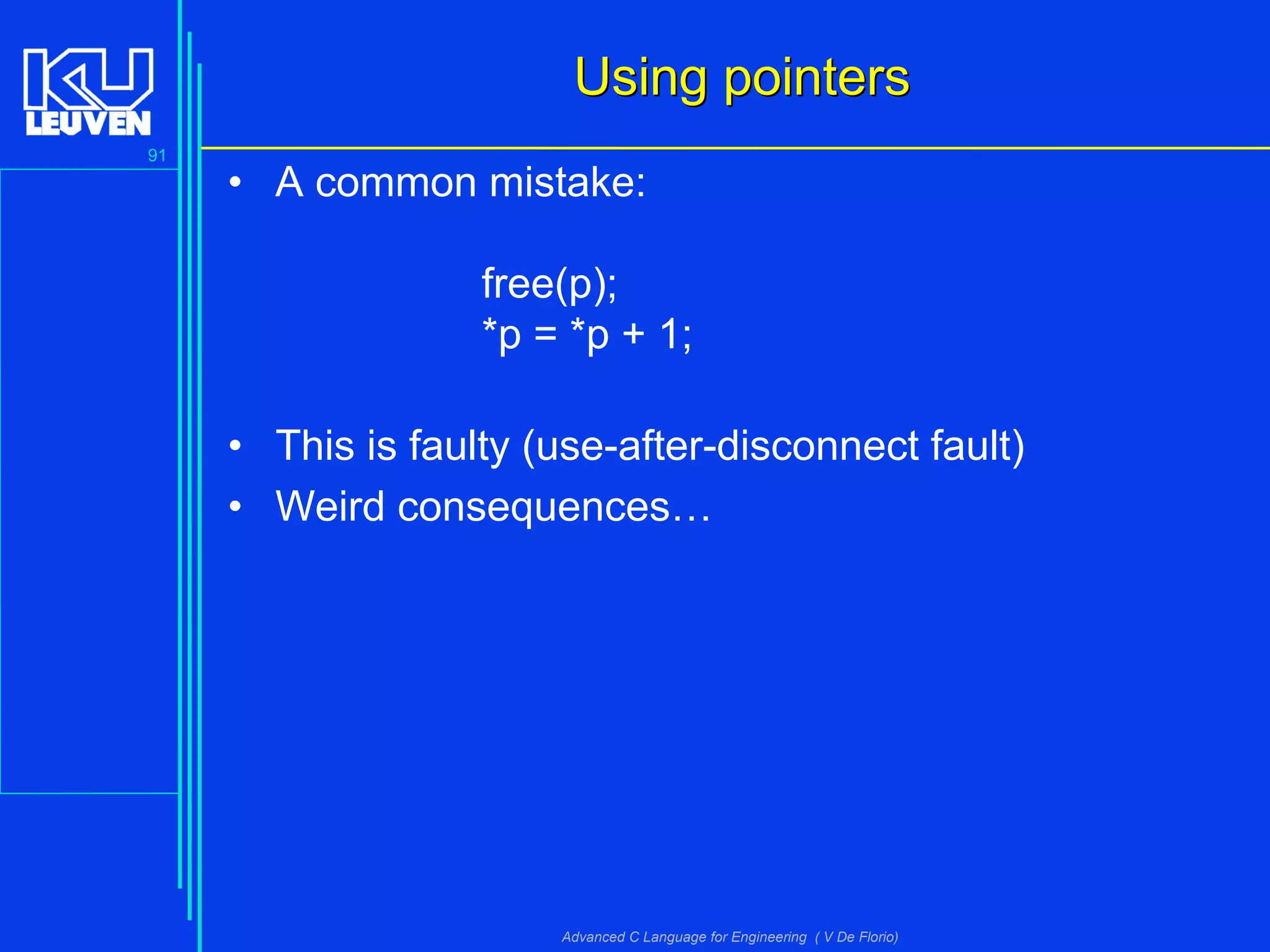
Advanced C Language for Engineering ( V De Florio)
Using pointersUsing pointers
• A common mistake:
free(p);
*p = *p + 1;
• This is faulty (use-after-disconnect fault)
• Weird consequences…
92
Advanced C Language for Engineering ( V De Florio)
void main() {
int *a, *b;
int c[10], d[10];
a = malloc(10*sizeof(int));
b = calloc(10, sizeof(int));
a = b;
a = c;
d = a;
}
Using pointersUsing pointers
No check
on return
values
The area
pointed by
a is lost
Illegal:
arrays are
const
93
Advanced C Language for Engineering ( V De Florio)
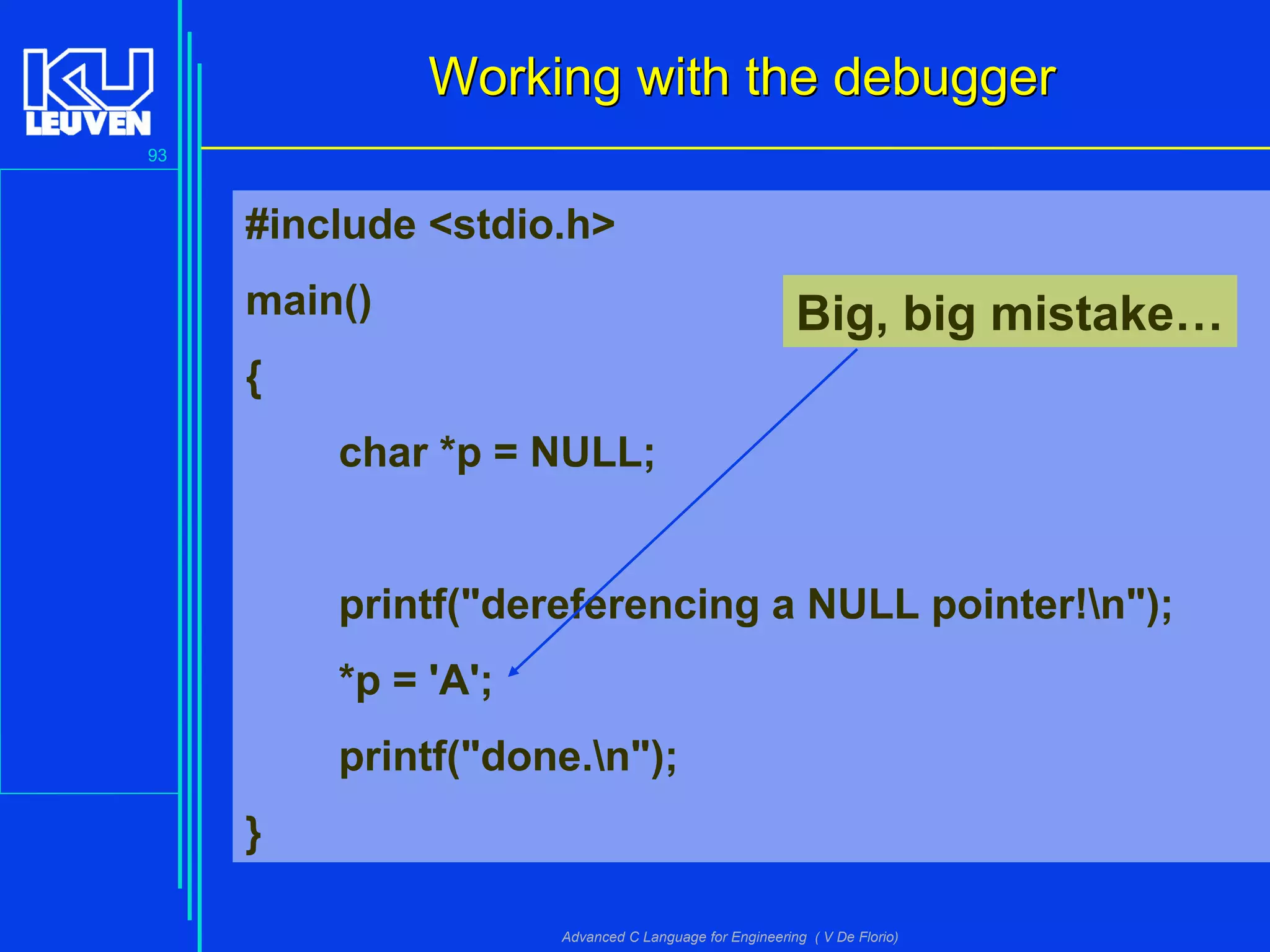
Working with the debuggerWorking with the debugger
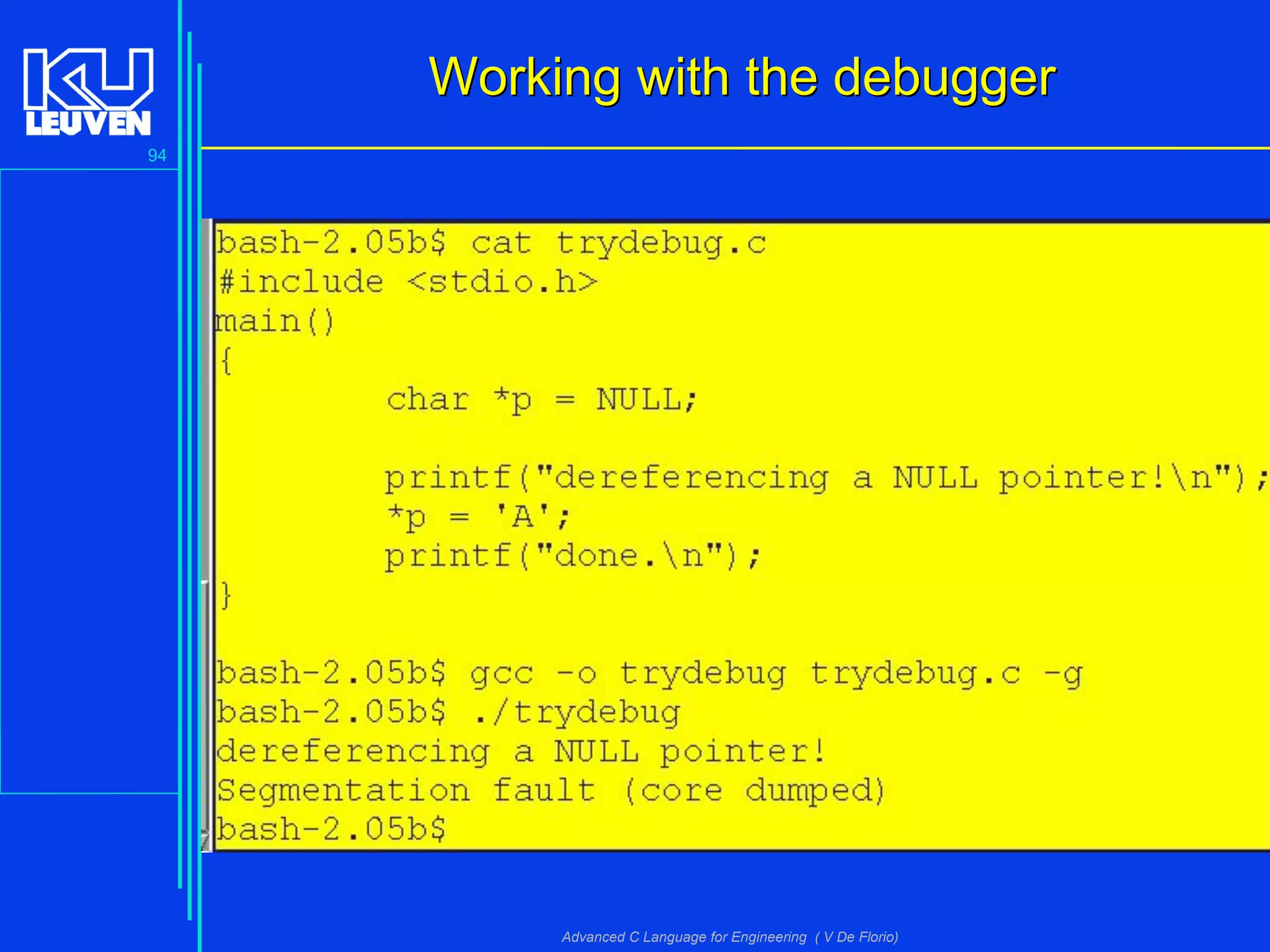
#include <stdio.h>
main()
{
char *p = NULL;
printf("dereferencing a NULL pointer!n");
*p = 'A';
printf("done.n");
}
Big, big mistake…
94
Advanced C Language for Engineering ( V De Florio)
Working with the debuggerWorking with the debugger
95
Advanced C Language for Engineering ( V De Florio)
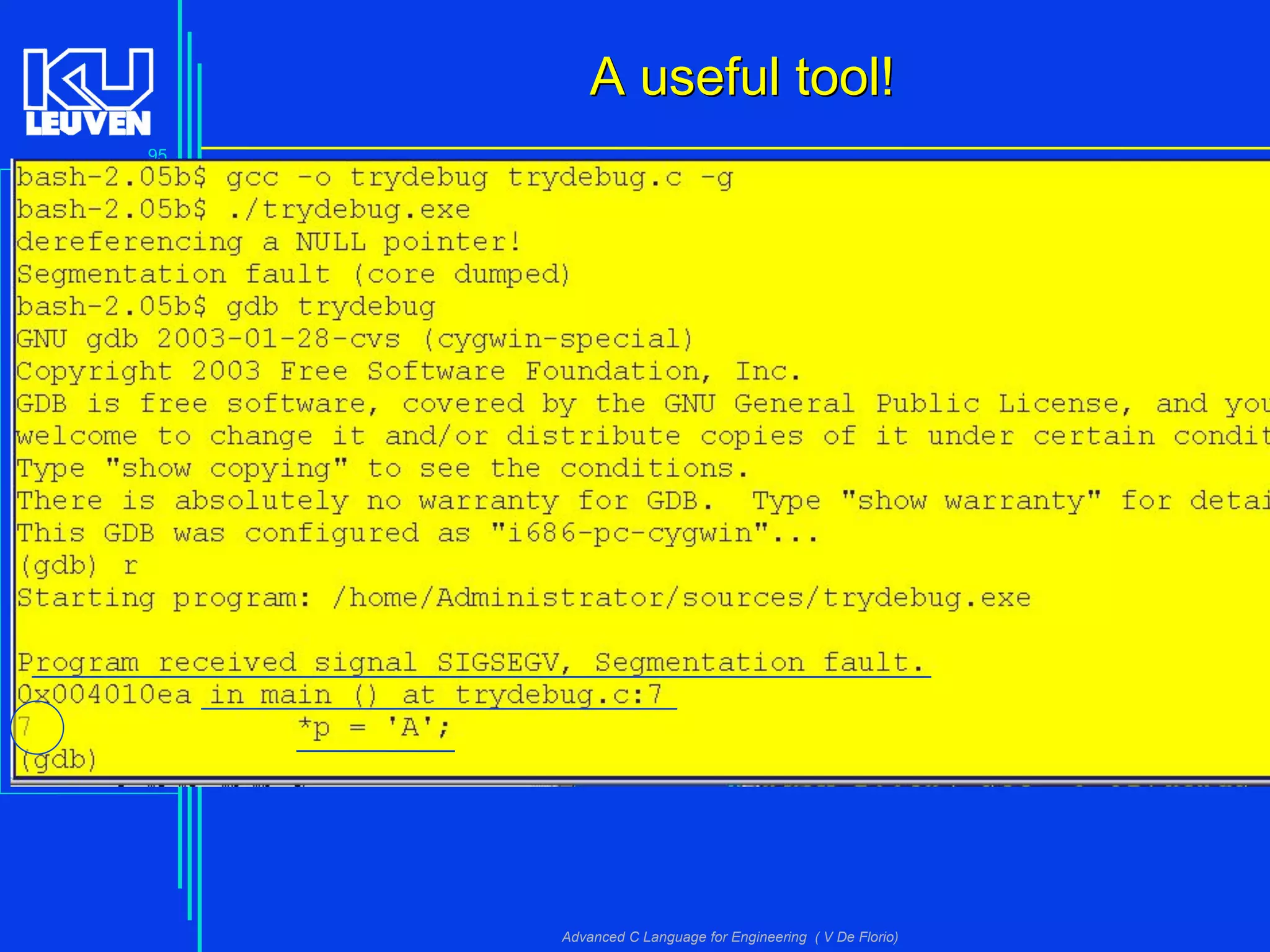
A useful tool!A useful tool!
96
Advanced C Language for Engineering ( V De Florio)
Working with the debuggerWorking with the debugger
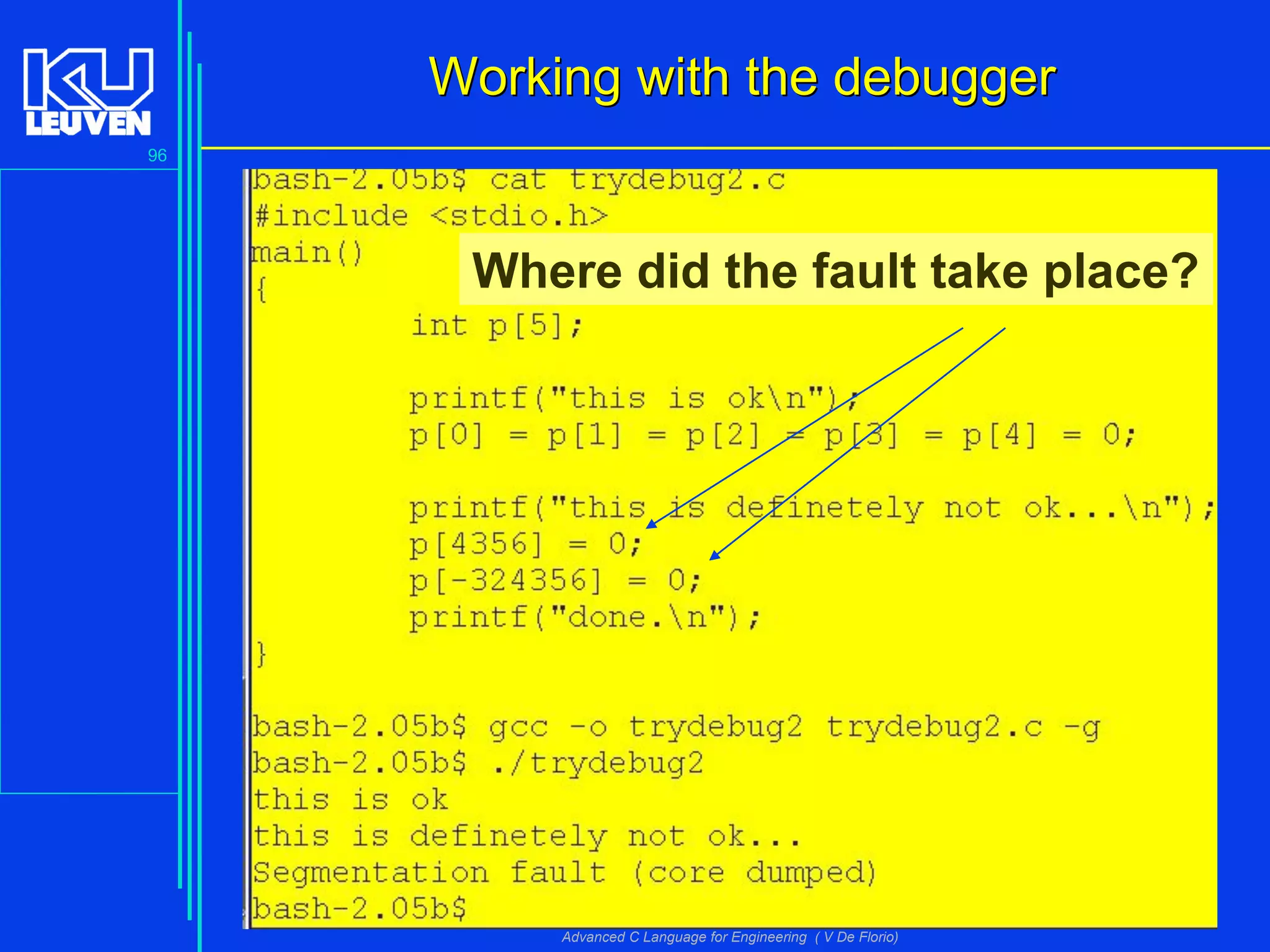
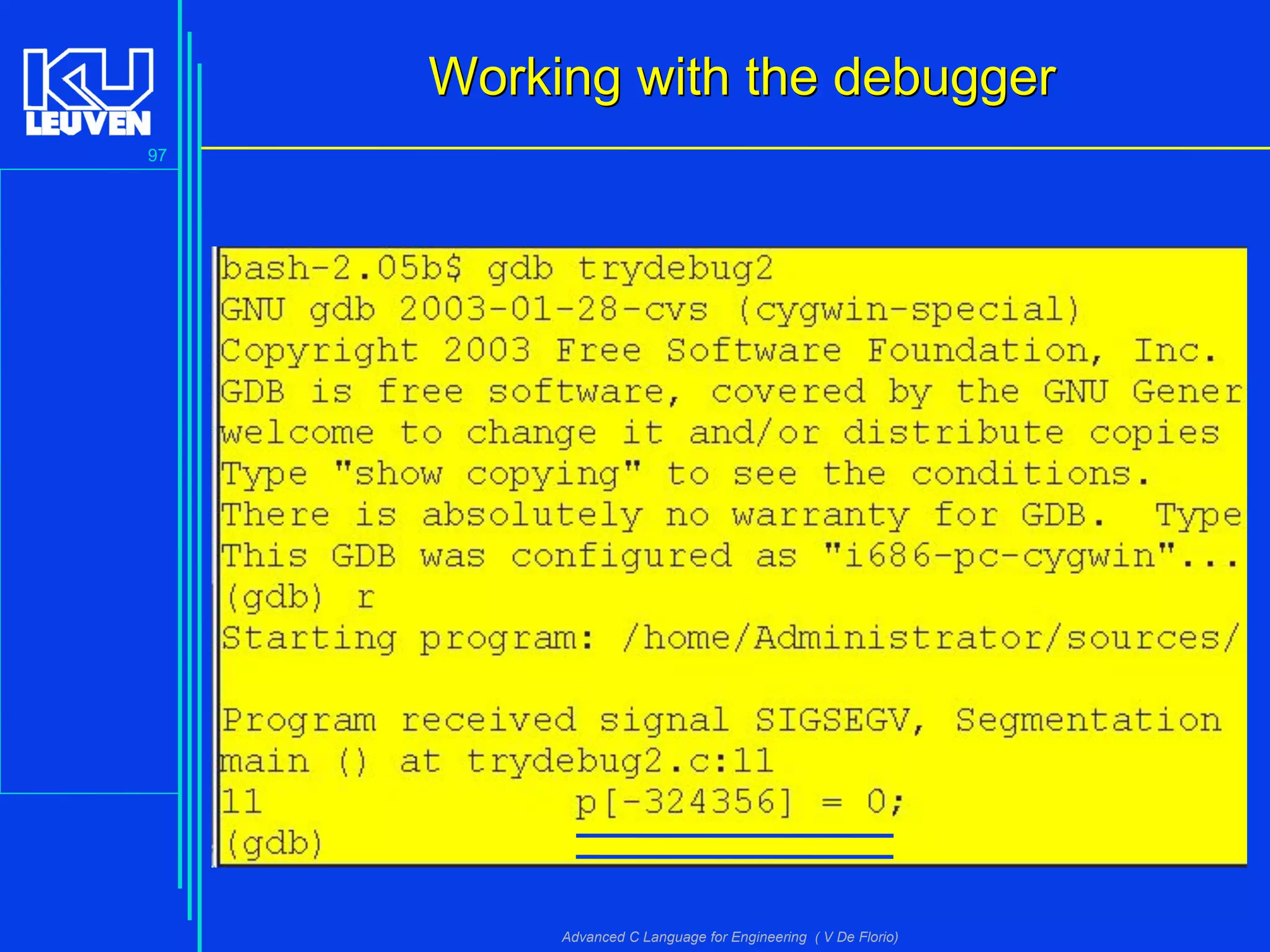
Where did the fault take place?
97
Advanced C Language for Engineering ( V De Florio)
Working with the debuggerWorking with the debugger
98
Advanced C Language for Engineering ( V De Florio)
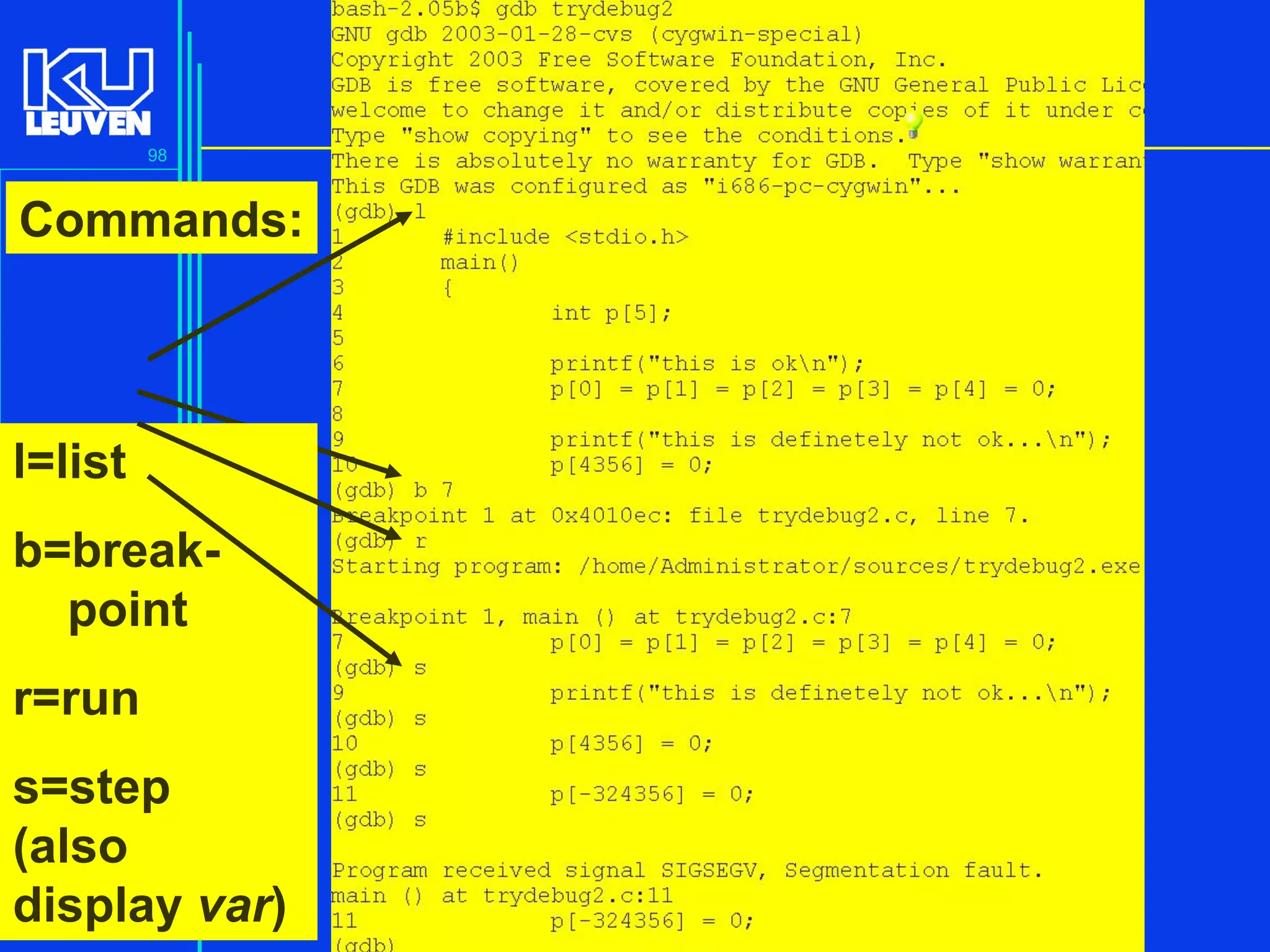
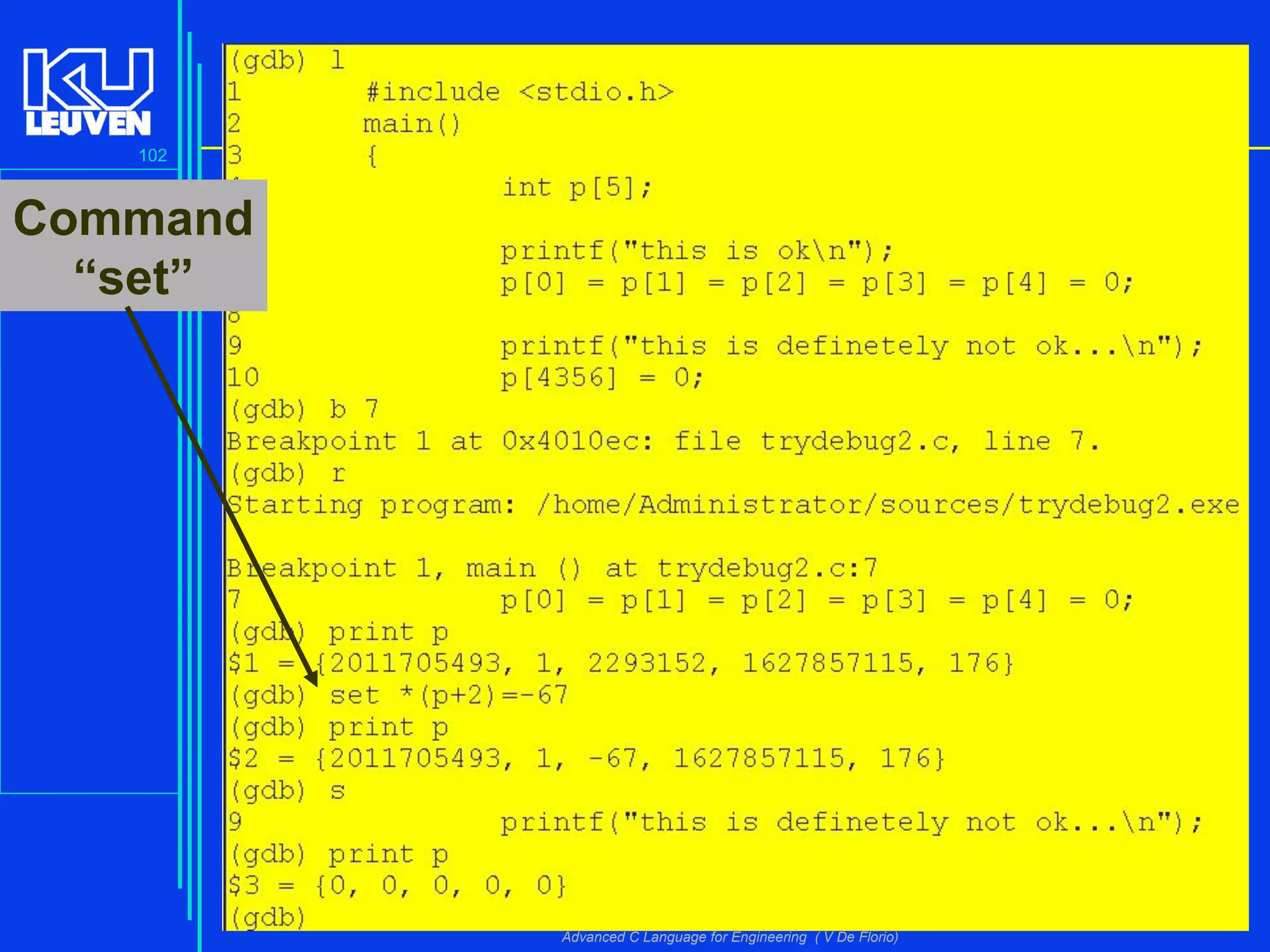
Commands:
l=list
b=break-
point
r=run
s=step
(also
display var)
99
Advanced C Language for Engineering ( V De Florio)
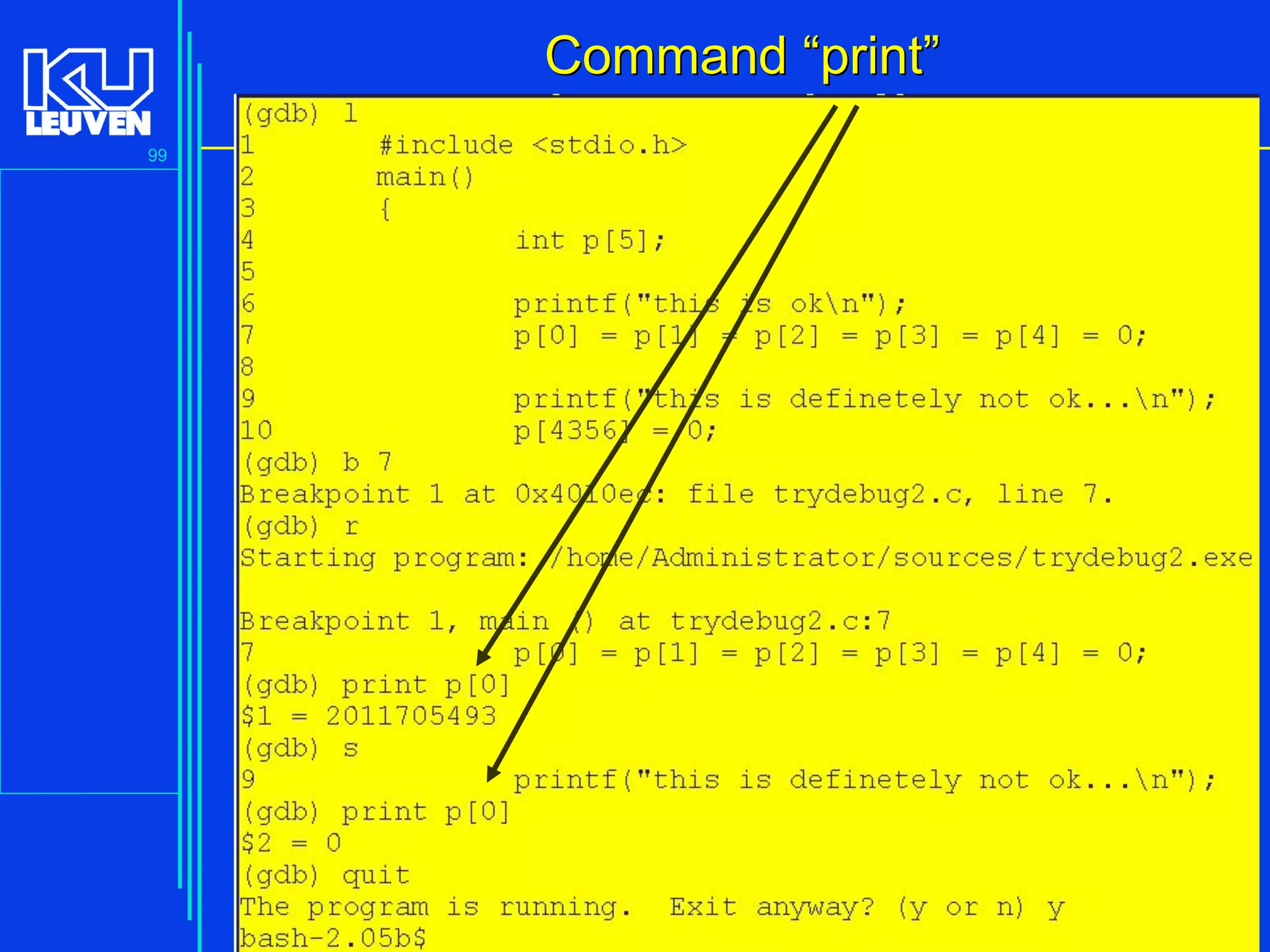
CommandCommand ““printprint””
100
Advanced C Language for Engineering ( V De Florio)
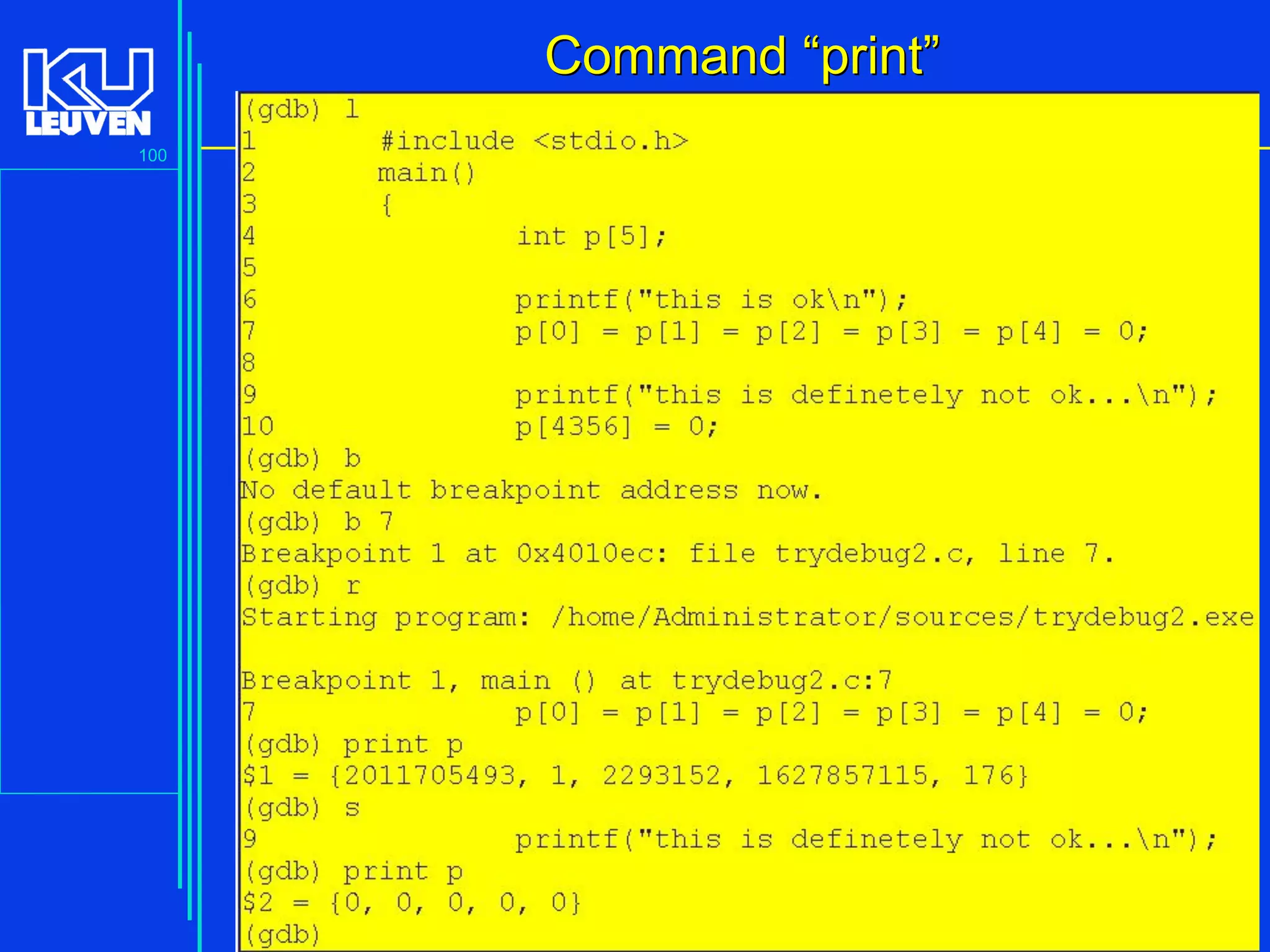
CommandCommand ““printprint””
101
Advanced C Language for Engineering ( V De Florio)
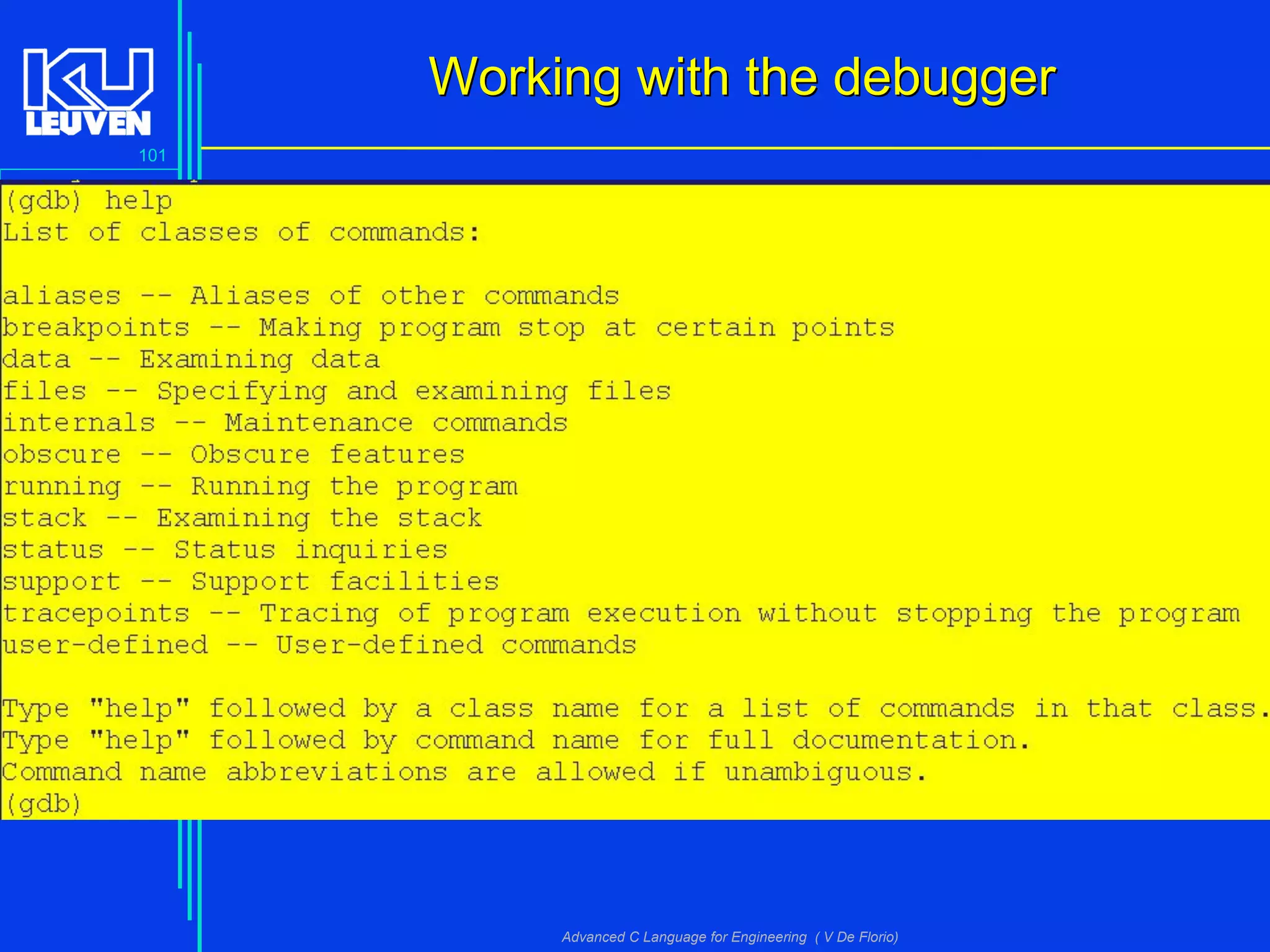
Working with the debuggerWorking with the debugger
102
Advanced C Language for Engineering ( V De Florio)
Command
“set”
103
Advanced C Language for Engineering ( V De Florio)
ConstantsConstants
• scientific notation, e.g., 1.5e3 -> double
• postfix notation, e.g., 145L -> long
• prefix notation:
’0x44’ -> unsigned int, hexadecimal,
’044’ -> unsigned int, octal
• constant char: ’x’ = character x -> char
• special constants, e.g., n, t, 0, , " -> char
• “bit patterns”: ddd, ddd being an octal number.
• string constants, e.g., "string" or "".
104
Advanced C Language for Engineering ( V De Florio)
Type casts and conversionsType casts and conversions
• Implicit type casts occur when, in expressions,
operands belong to different types.
• Conversions obey the following rules:
char and short Þ int , float Þ double
if an operand is double , the other becomes
double and the result is double
otherwise, if an operand is long , the other
becomes long and the result is a long
otherwise, if an operand is unsigned, the other
one becomes unsigned and the result is
unsigned.
otherwise, operands and result are int .
105
Advanced C Language for Engineering ( V De Florio)
Type casts and conversionsType casts and conversions
• Converting a string of digits into a number, and vice-
versa, requires specific support. Functions are
available for this, e.g., atoi():
int atoi(char s[]) { int i, n;
n = 0;
for (i=0; s[i]>=’0’ && s[i]<=’9’; ++i)
n=10*n + s[i] -’0’;
return (n);
}
• Note how expression s[i] - ’0’ converts numeric
character s[i] into the digit it represents.
106
Advanced C Language for Engineering ( V De Florio)
Type casts and conversionsType casts and conversions
• The following function can be used to convert an
uppercase character into its lowercase counterpart
int lower( int c)
{
if (c >=’A’ && c <= ’Z’)
return (c + ’a’ - ’A’);
else
return (c);
}
• Note: this program only works for code tables in
which ’a’ follows ’A’. This is true with ASCII and
false with, e.g., EBCDIC.
107
Advanced C Language for Engineering ( V De Florio)
Type casts and conversionsType casts and conversions
• Explicit cast:
• The cast operator changes the type of an object.
For instance, the following expression:
celsius = ( (double)5 /9) * (fahr-32.0);
is equivalent to
celsius = (5.0/9.0) * (fahr-32.0);
• Casting is invoked by specifying a type between
parentheses.
108
Advanced C Language for Engineering ( V De Florio)
IIncrement/decrement operatorsncrement/decrement operators
• IN C: int i = 0; in Assembly:
i++; DATA segment
i DB 0
. . .
INC i
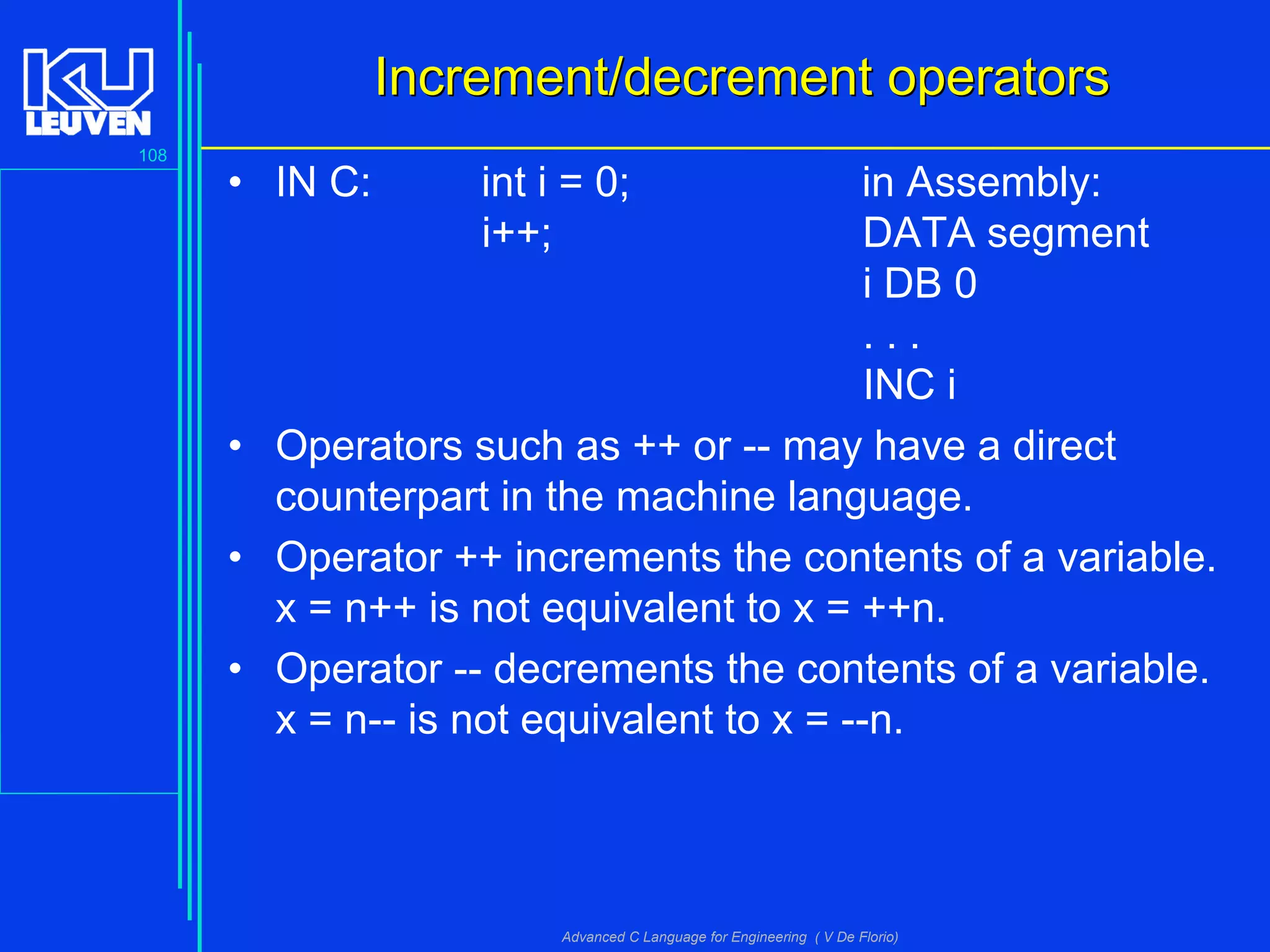
• Operators such as ++ or -- may have a direct
counterpart in the machine language.
• Operator ++ increments the contents of a variable.
x = n++ is not equivalent to x = ++n.
• Operator -- decrements the contents of a variable.
x = n-- is not equivalent to x = --n.
109
Advanced C Language for Engineering ( V De Florio)
ExercisesExercises
• Exercise: function purge(char s[], int c) removes all
occurrences of c from s[].
• Exercise: functions strcpy() and strcat().
110
Advanced C Language for Engineering ( V De Florio)
ExercisesExercises
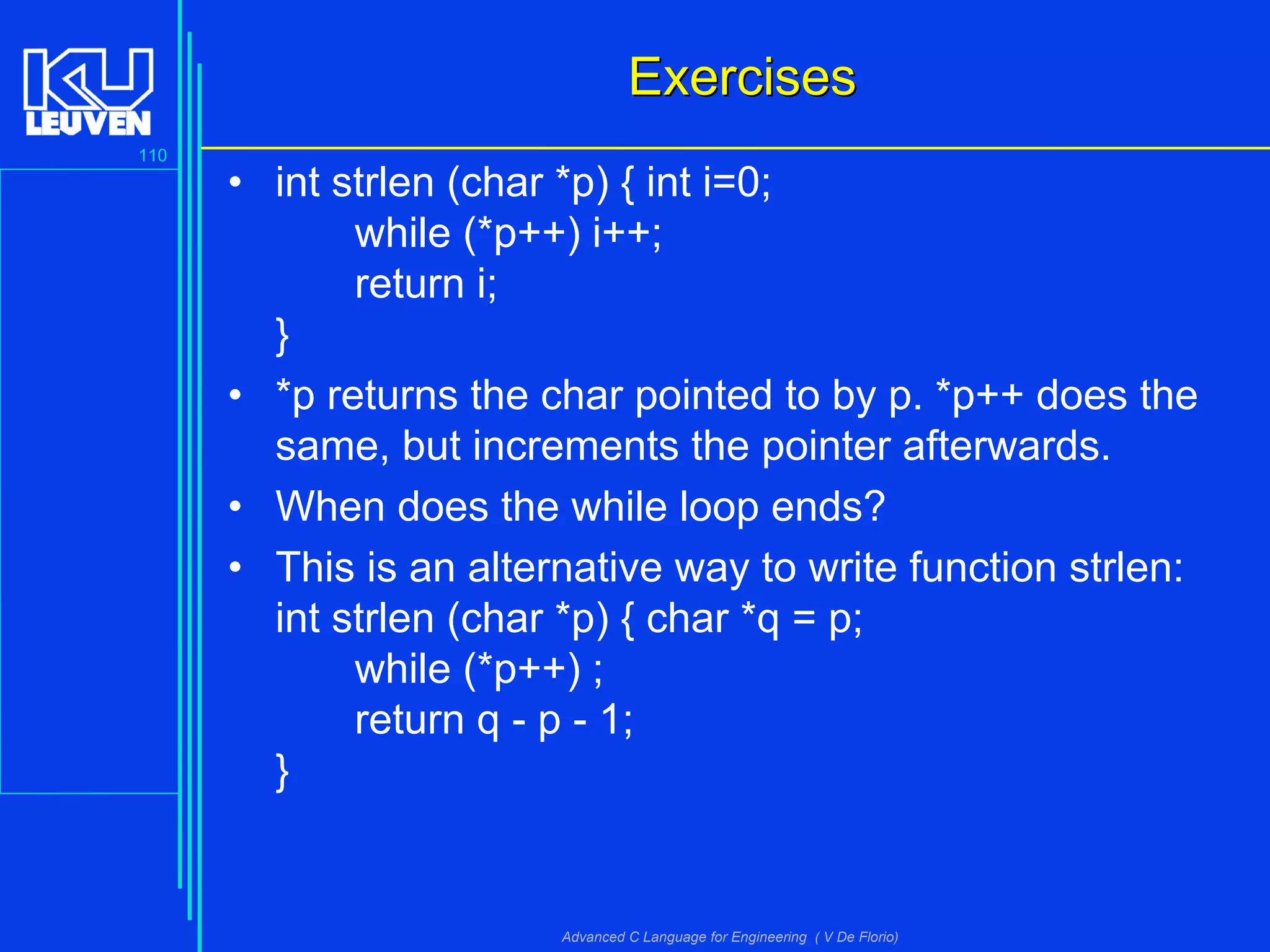
• int strlen (char *p) { int i=0;
while (*p++) i++;
return i;
}
• *p returns the char pointed to by p. *p++ does the
same, but increments the pointer afterwards.
• When does the while loop ends?
• This is an alternative way to write function strlen:
int strlen (char *p) { char *q = p;
while (*p++) ;
return q - p - 1;
}
111
Advanced C Language for Engineering ( V De Florio)
Bitwise operatorsBitwise operators
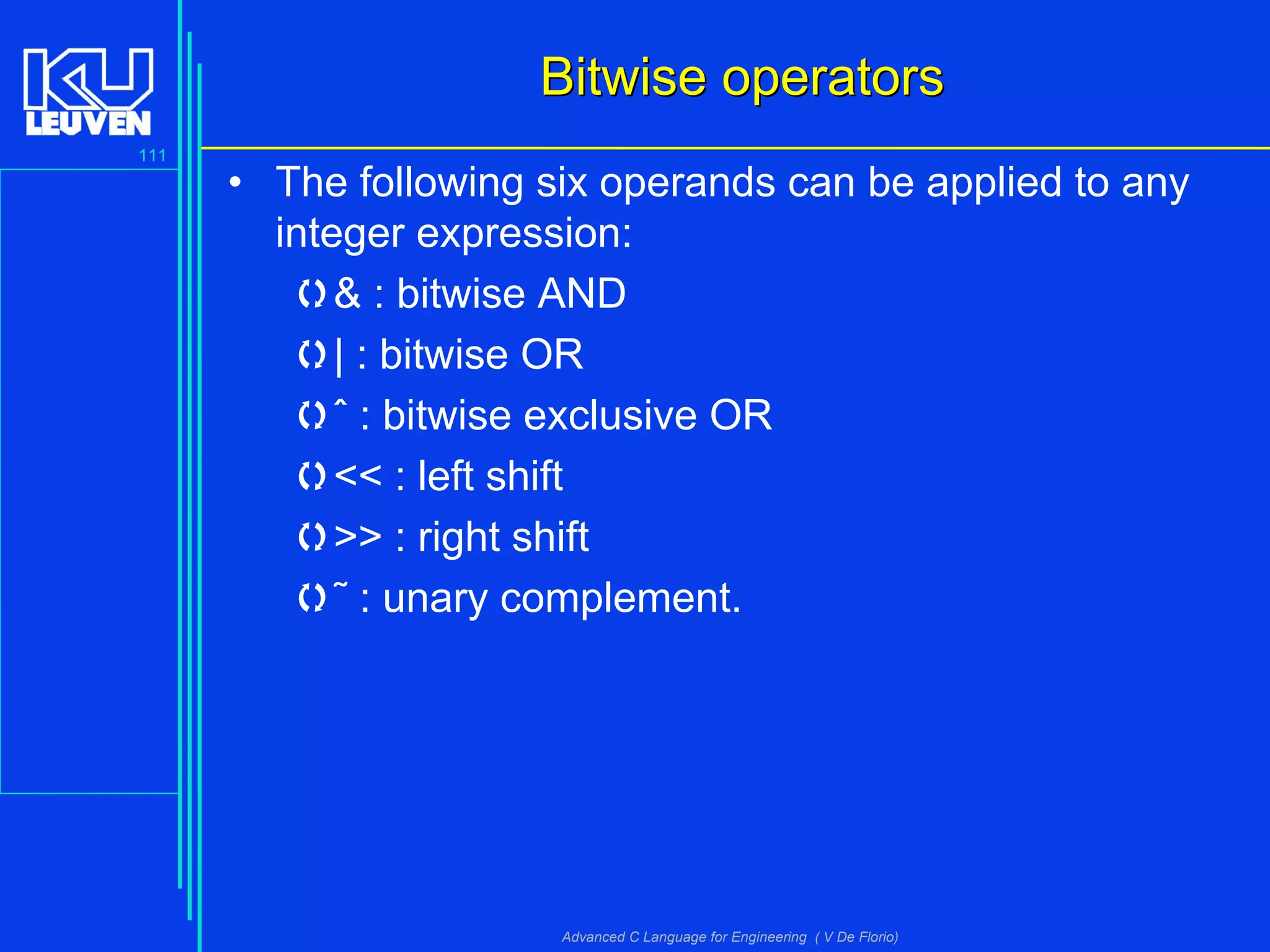
• The following six operands can be applied to any
integer expression:
& : bitwise AND
| : bitwise OR
ˆ : bitwise exclusive OR
<< : left shift
>> : right shift
˜ : unary complement.
112
Advanced C Language for Engineering ( V De Florio)
Bitwise operatorsBitwise operators
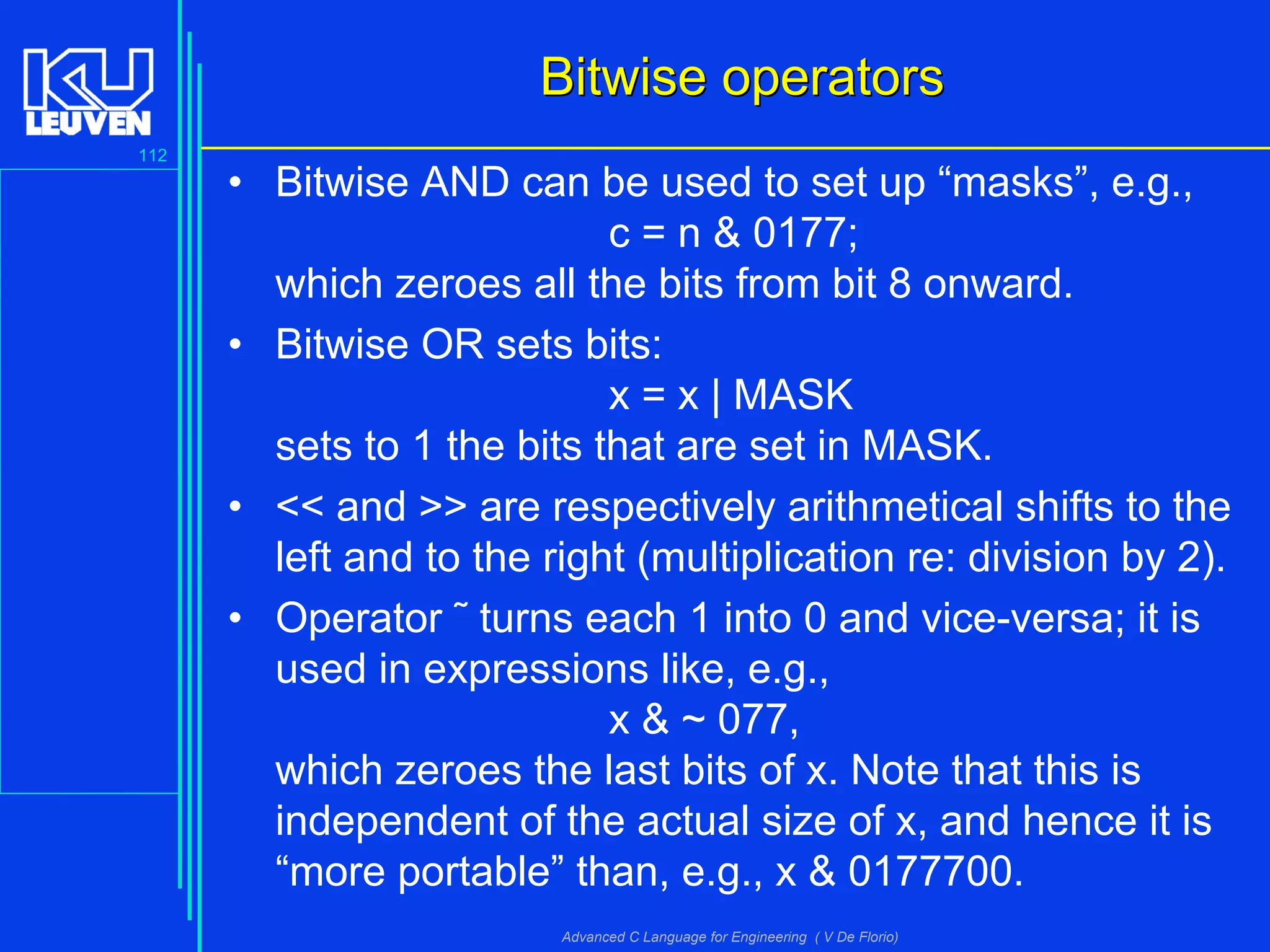
• Bitwise AND can be used to set up “masks”, e.g.,
c = n & 0177;
which zeroes all the bits from bit 8 onward.
• Bitwise OR sets bits:
x = x | MASK
sets to 1 the bits that are set in MASK.
• << and >> are respectively arithmetical shifts to the
left and to the right (multiplication re: division by 2).
• Operator ˜ turns each 1 into 0 and vice-versa; it is
used in expressions like, e.g.,
x & ~ 077,
which zeroes the last bits of x. Note that this is
independent of the actual size of x, and hence it is
“more portable” than, e.g., x & 0177700.
113
Advanced C Language for Engineering ( V De Florio)
Bitwise operatorsBitwise operators
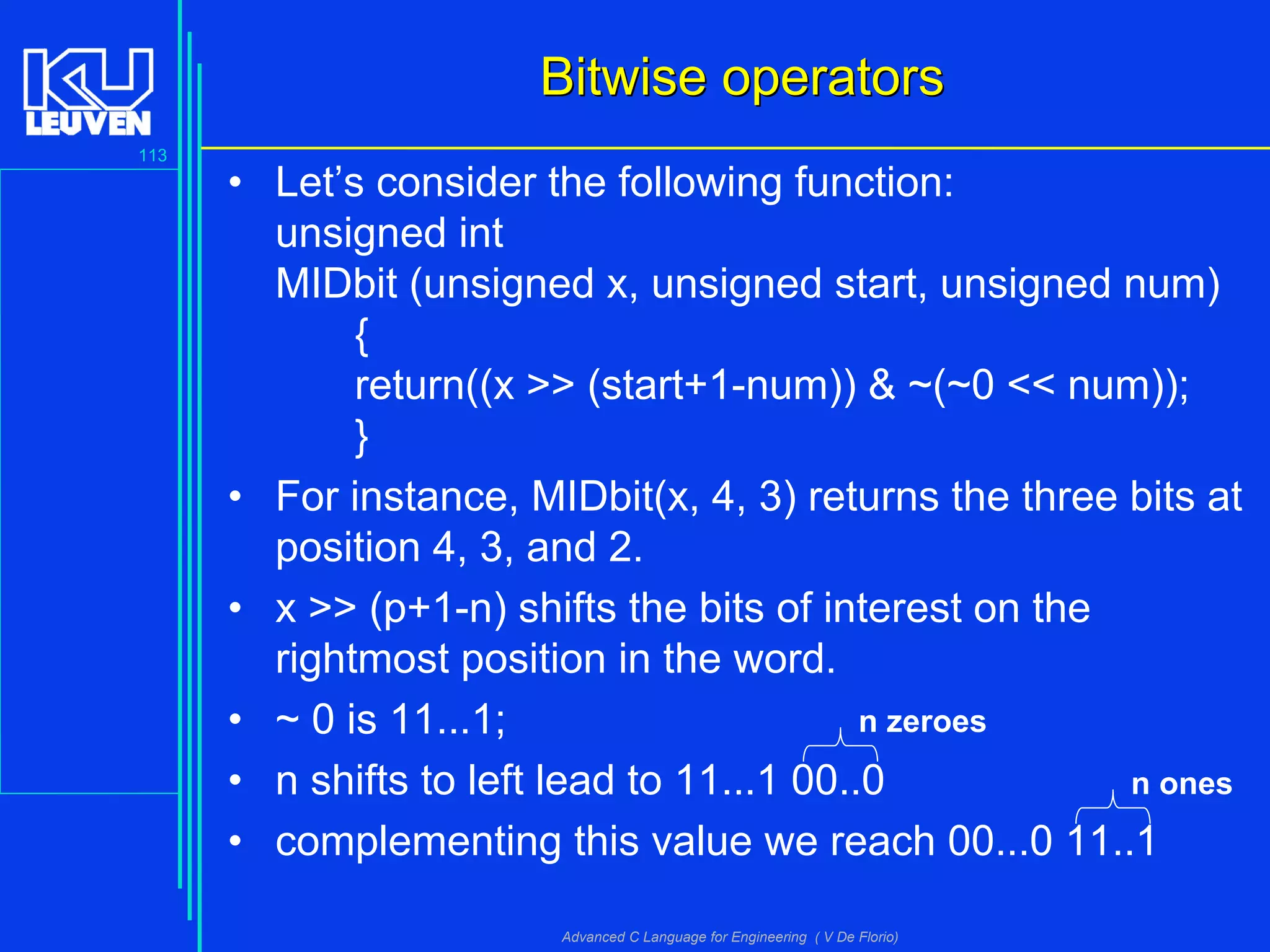
• Let’s consider the following function:
unsigned int
MIDbit (unsigned x, unsigned start, unsigned num)
{
return((x >> (start+1-num)) & ~(~0 << num));
}
• For instance, MIDbit(x, 4, 3) returns the three bits at
position 4, 3, and 2.
• x >> (p+1-n) shifts the bits of interest on the
rightmost position in the word.
• ~ 0 is 11...1;
• n shifts to left lead to 11...1 00..0
• complementing this value we reach 00...0 11..1
n zeroes
n ones
114
Advanced C Language for Engineering ( V De Florio)
Bitwise operatorsBitwise operators
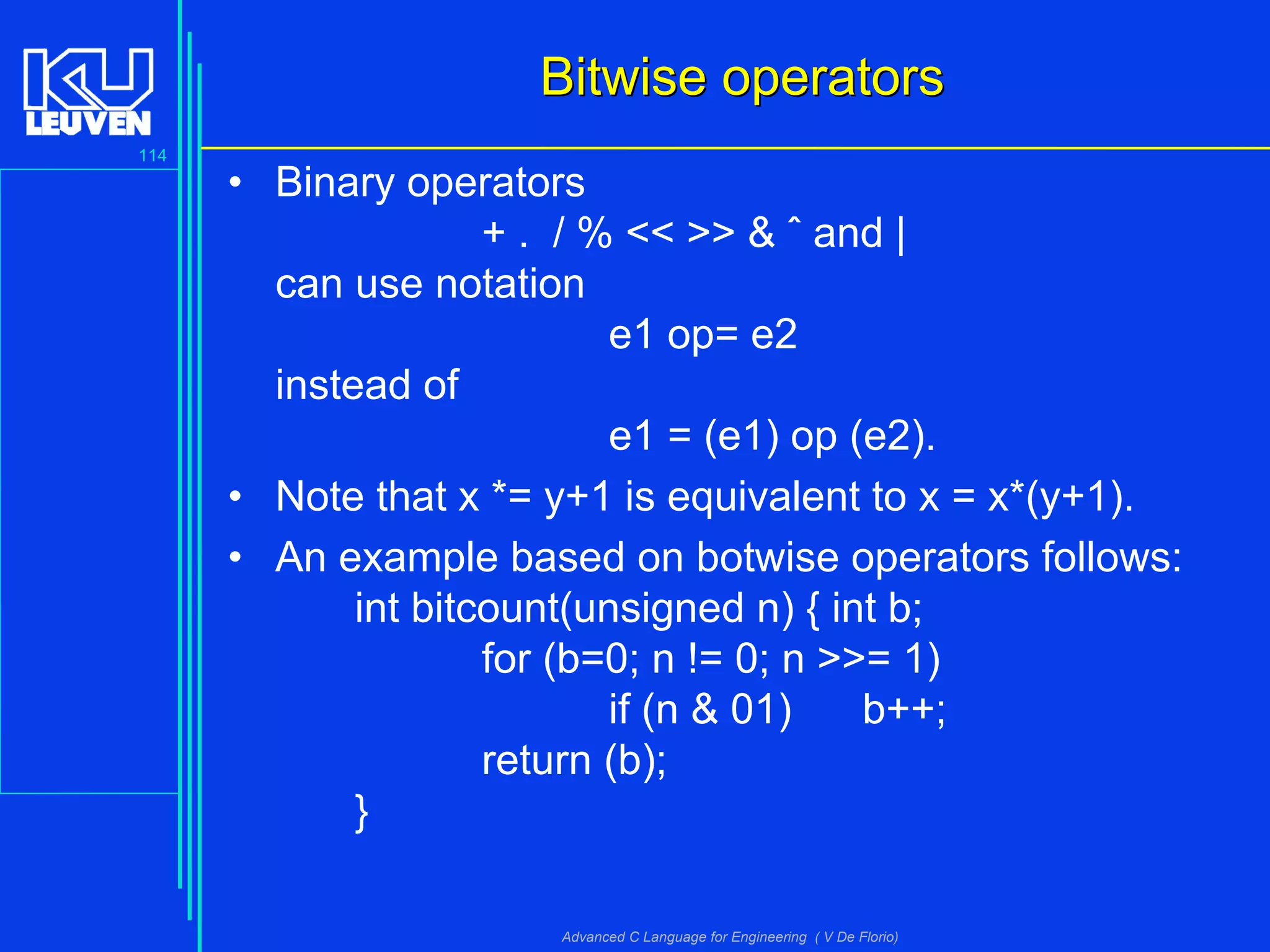
• Binary operators
+ . / % << >> & ˆ and |
can use notation
e1 op= e2
instead of
e1 = (e1) op (e2).
• Note that x *= y+1 is equivalent to x = x*(y+1).
• An example based on botwise operators follows:
int bitcount(unsigned n) { int b;
for (b=0; n != 0; n >>= 1)
if (n & 01) b++;
return (b);
}
115
Advanced C Language for Engineering ( V De Florio)
A curiosityA curiosity
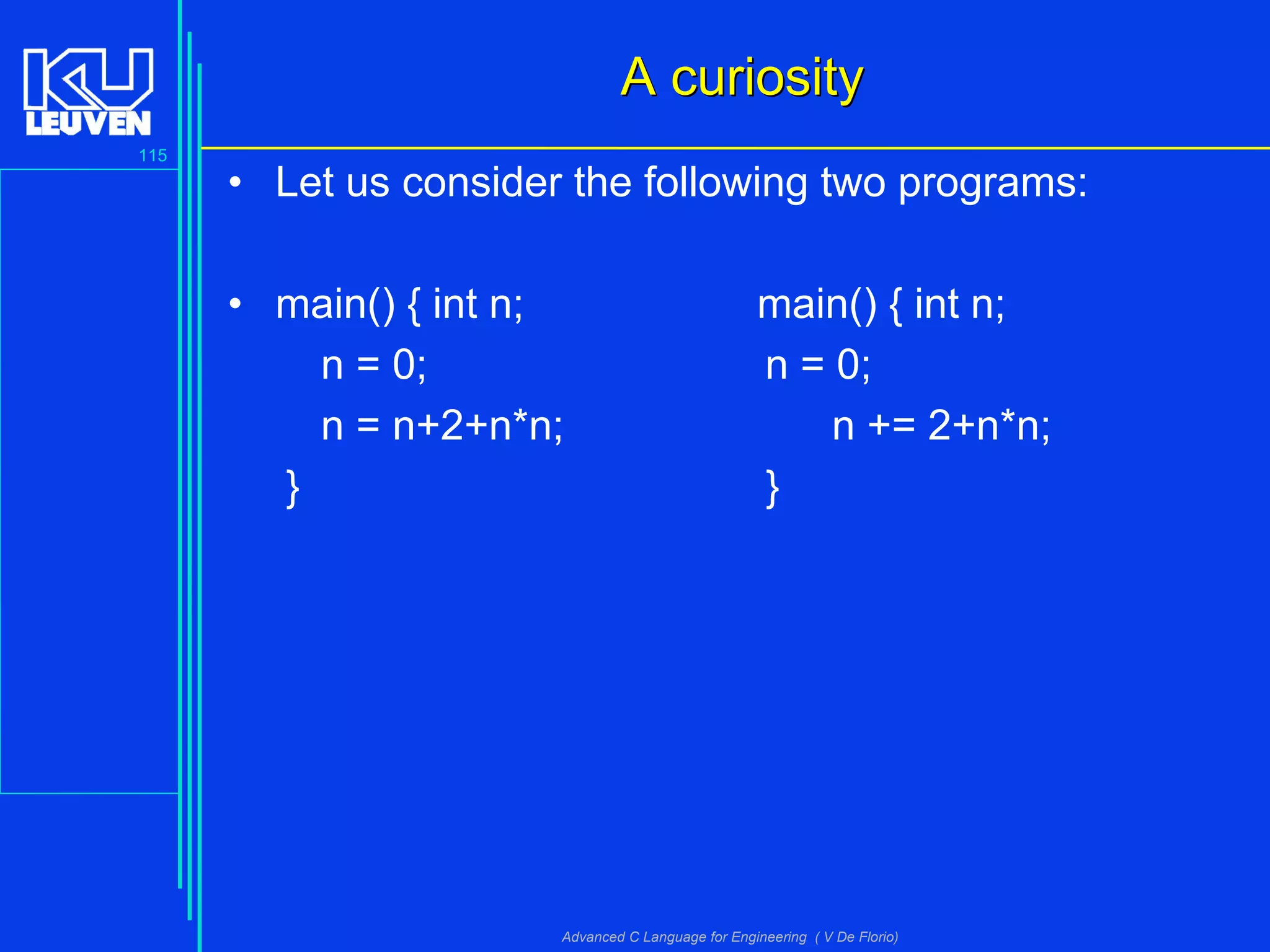
• Let us consider the following two programs:
• main() { int n; main() { int n;
n = 0; n = 0;
n = n+2+n*n; n += 2+n*n;
} }
116
Advanced C Language for Engineering ( V De Florio)
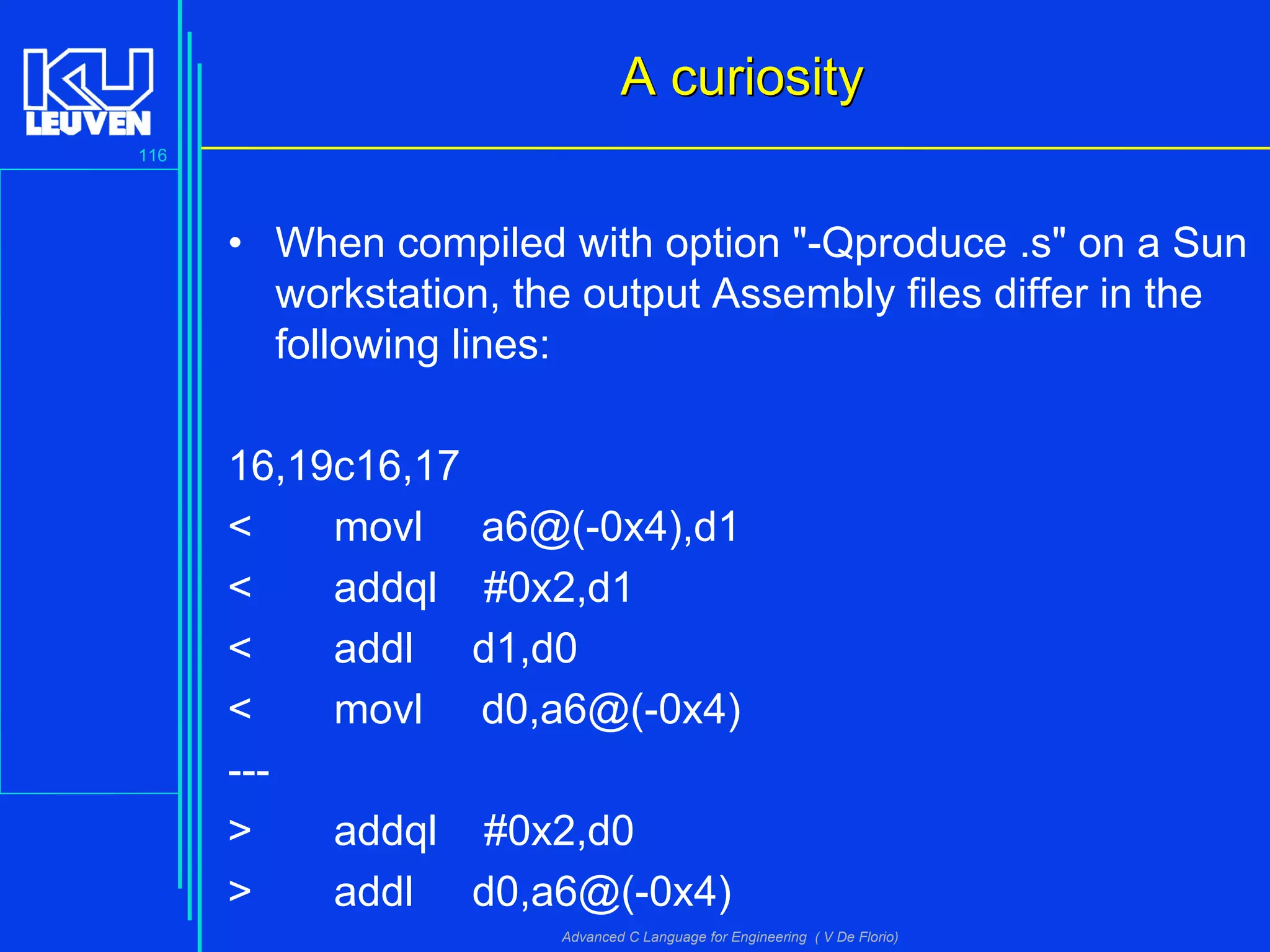
A curiosityA curiosity
• When compiled with option "-Qproduce .s" on a Sun
workstation, the output Assembly files differ in the
following lines:
16,19c16,17
< movl a6@(-0x4),d1
< addql #0x2,d1
< addl d1,d0
< movl d0,a6@(-0x4)
---
> addql #0x2,d0
> addl d0,a6@(-0x4)
117
Advanced C Language for Engineering ( V De Florio)
The FILE classThe FILE class
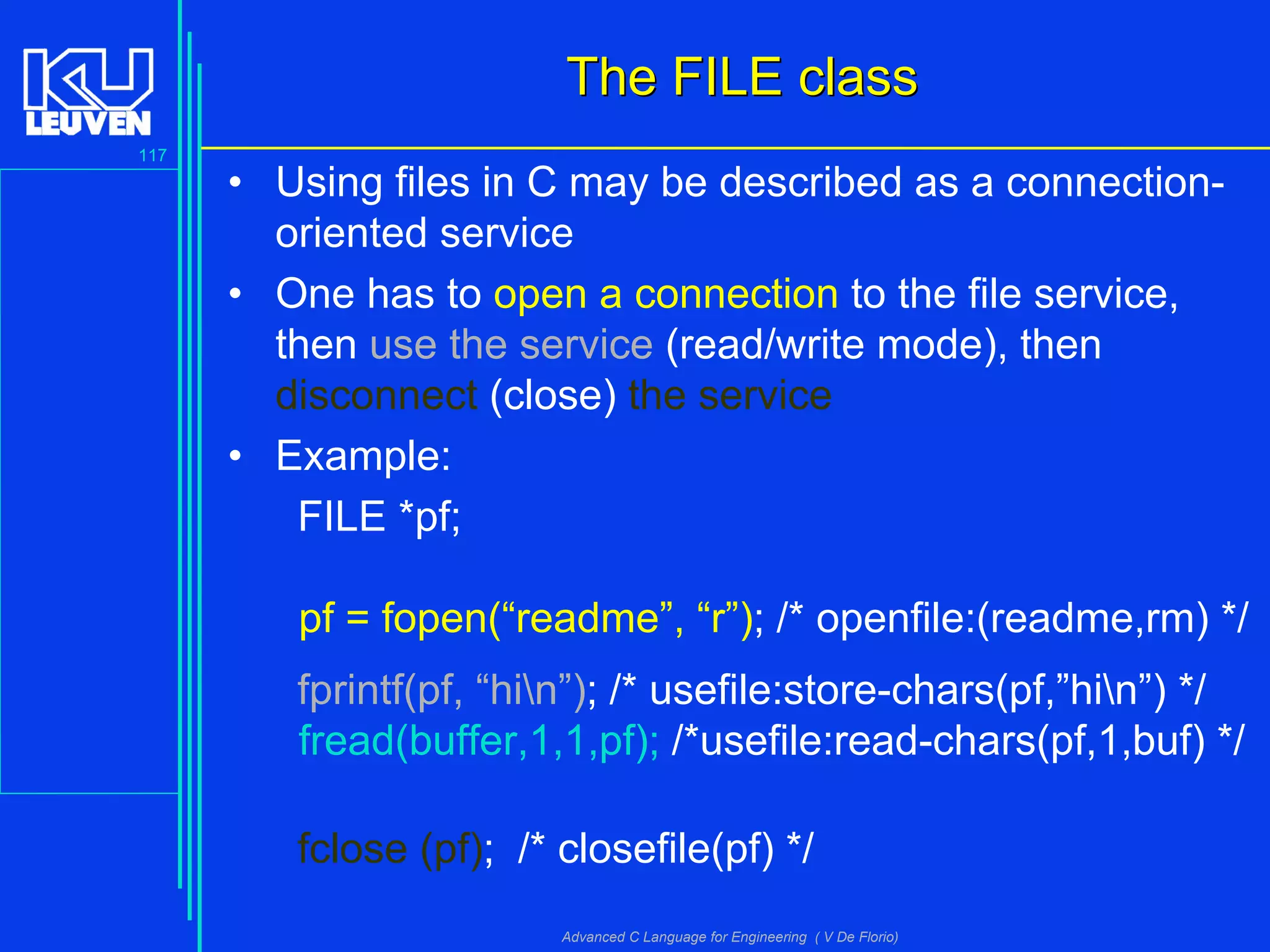
• Using files in C may be described as a connection-
oriented service
• One has to open a connection to the file service,
then use the service (read/write mode), then
disconnect (close) the service
• Example:
FILE *pf;
pf = fopen(“readme”, “r”); /* openfile:(readme,rm) */
fprintf(pf, “hin”); /* usefile:store-chars(pf,”hin”) */
fread(buffer,1,1,pf); /*usefile:read-chars(pf,1,buf) */
fclose (pf); /* closefile(pf) */
118
Advanced C Language for Engineering ( V De Florio)
StructuresStructures
• Keyword struct defines a “record.” An example
follows:
struct cd {
char author[30];
int year;
char producer[20];
};
• This is a declaration of a type: no element of this
type has been defined so far. No memory has been
allocated.
• It is now possible to declare objects of type struct cd
struct cd x, y, z;
119
Advanced C Language for Engineering ( V De Florio)
StructuresStructures
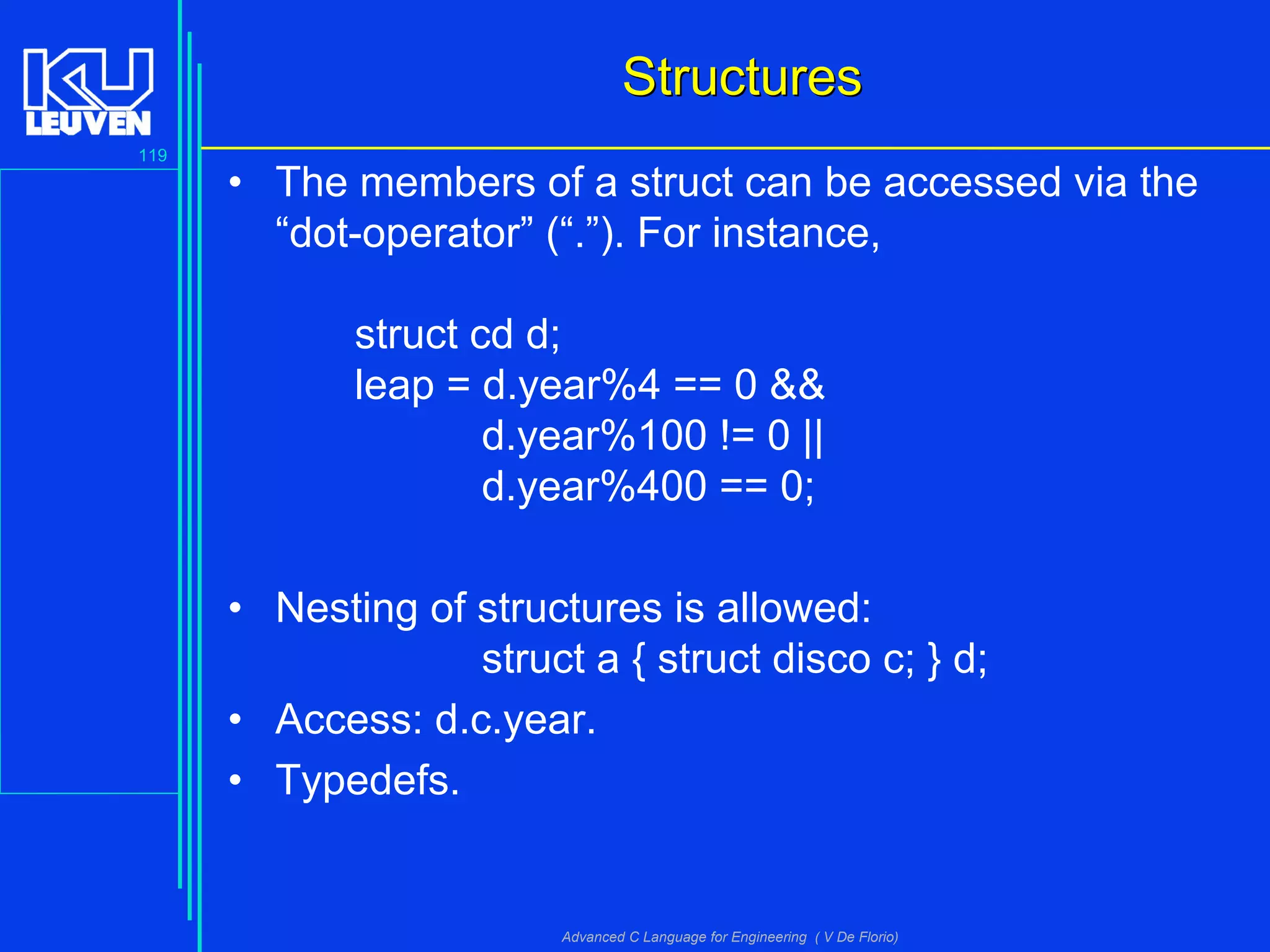
• The members of a struct can be accessed via the
“dot-operator” (“.”). For instance,
struct cd d;
leap = d.year%4 == 0 &&
d.year%100 != 0 ||
d.year%400 == 0;
• Nesting of structures is allowed:
struct a { struct disco c; } d;
• Access: d.c.year.
• Typedefs.
120
Advanced C Language for Engineering ( V De Florio)
StructuresStructures
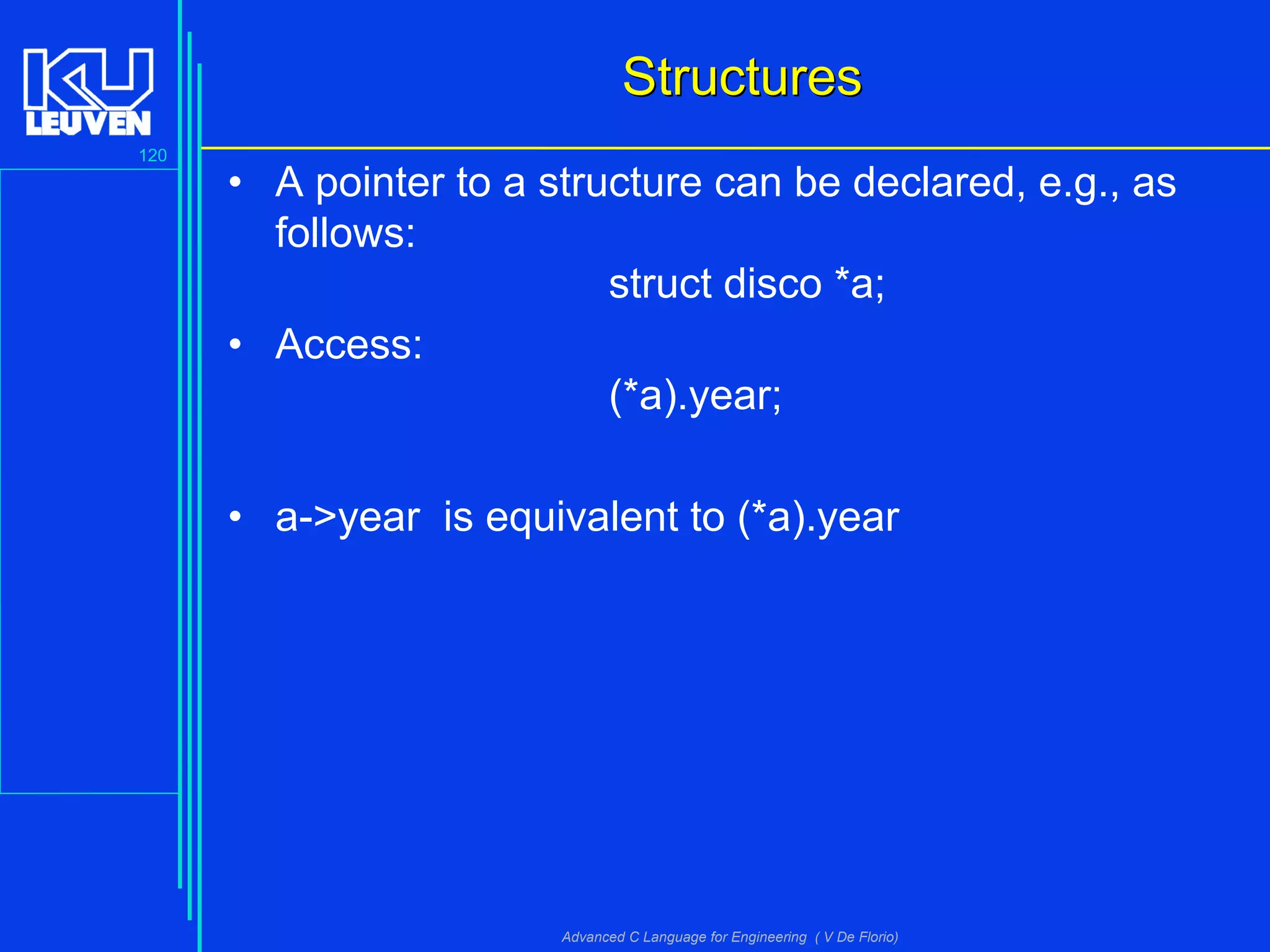
• A pointer to a structure can be declared, e.g., as
follows:
struct disco *a;
• Access:
(*a).year;
• a->year is equivalent to (*a).year
121
Advanced C Language for Engineering ( V De Florio)
TypedefTypedef
• What does, e.g., this statement do?
float complex[2];
• Consider now
typedef float complex[2];
• We have defined a new type
• Example:
complex a;
a[0] = 0.0, a[1] = 1.0;
122
Advanced C Language for Engineering ( V De Florio)
TypedefTypedef
• General rule:
consider the definition of a complex object, called x
write “typedef x”
Now x is no more an identifier. It’s a type
123
Advanced C Language for Engineering ( V De Florio)
TypedefTypedef
• Example:
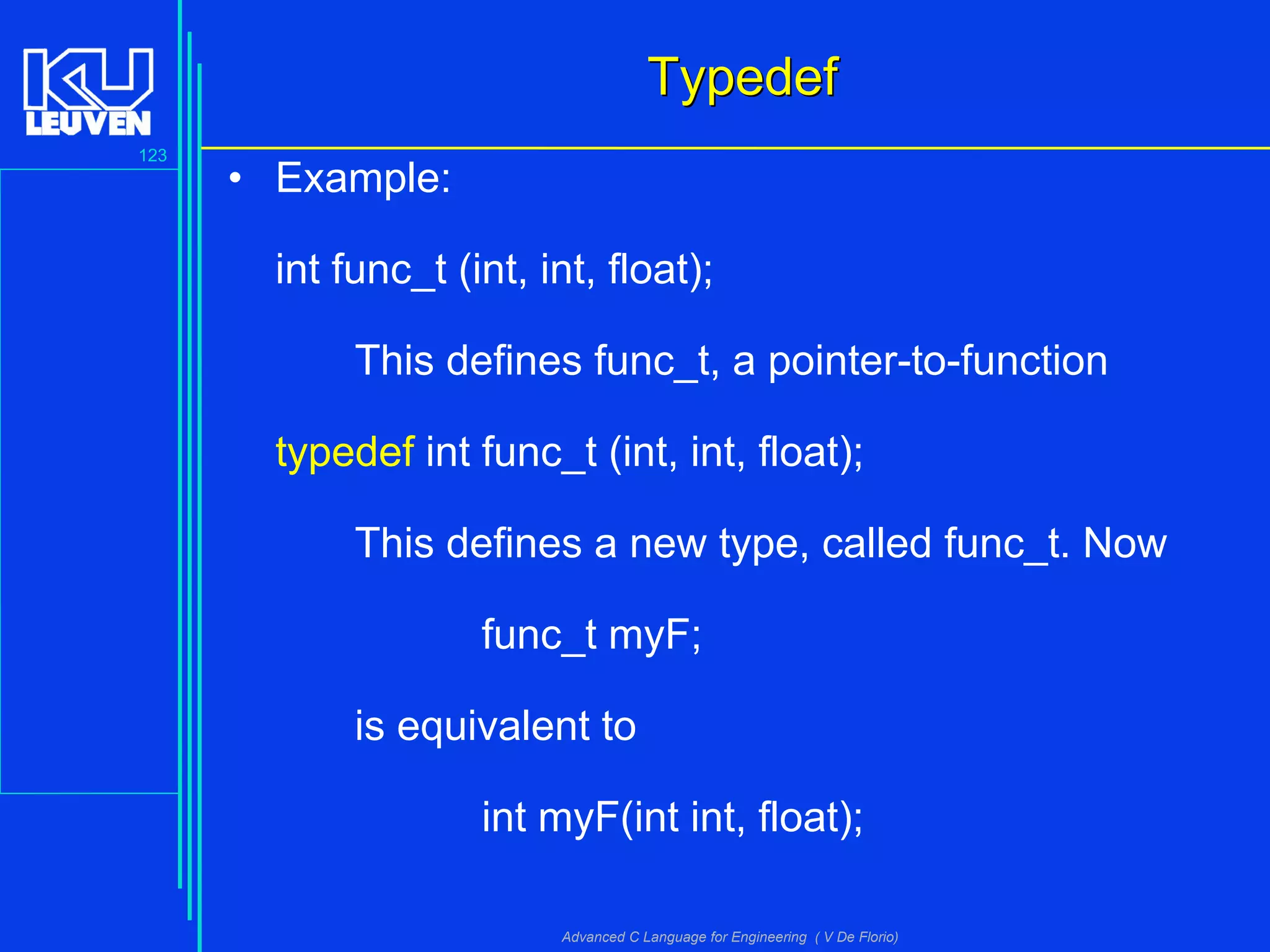
int func_t (int, int, float);
This defines func_t, a pointer-to-function
typedef int func_t (int, int, float);
This defines a new type, called func_t. Now
func_t myF;
is equivalent to
int myF(int int, float);
124
Advanced C Language for Engineering ( V De Florio)
TypedefTypedef
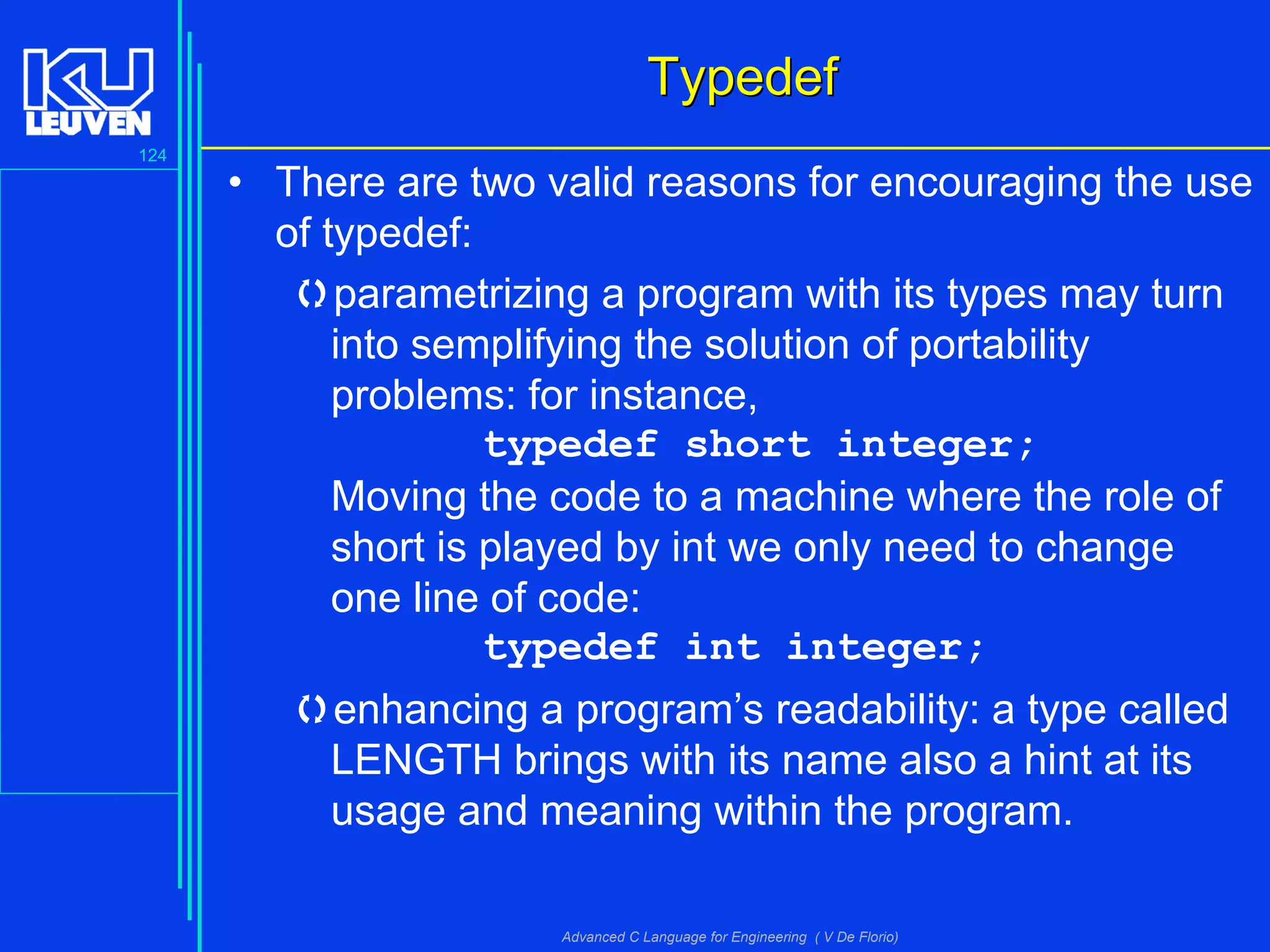
• There are two valid reasons for encouraging the use
of typedef:
parametrizing a program with its types may turn
into semplifying the solution of portability
problems: for instance,
typedef short integer;
Moving the code to a machine where the role of
short is played by int we only need to change
one line of code:
typedef int integer;
enhancing a program’s readability: a type called
LENGTH brings with its name also a hint at its
usage and meaning within the program.
125
Advanced C Language for Engineering ( V De Florio)
StructuresStructures
• Arrays of structures:
• struct key {
char *keyword;
int keycount;
} keytab[100];
• Or
typedef struct key { … } key_t;
and then
key_t keytab[100];
126
Advanced C Language for Engineering ( V De Florio)
StructuresStructures
• key_t keytab[100];
• Initialisation:
key_t Keywords[] = {
"break", 0,
"case", 0,
"char", 0,
…
"while", 0
};
• Exercise: Write a program that writes a static arrays
of struct’s to be used as look-up table for another
program.
127
Advanced C Language for Engineering ( V De Florio)
StructuresStructures
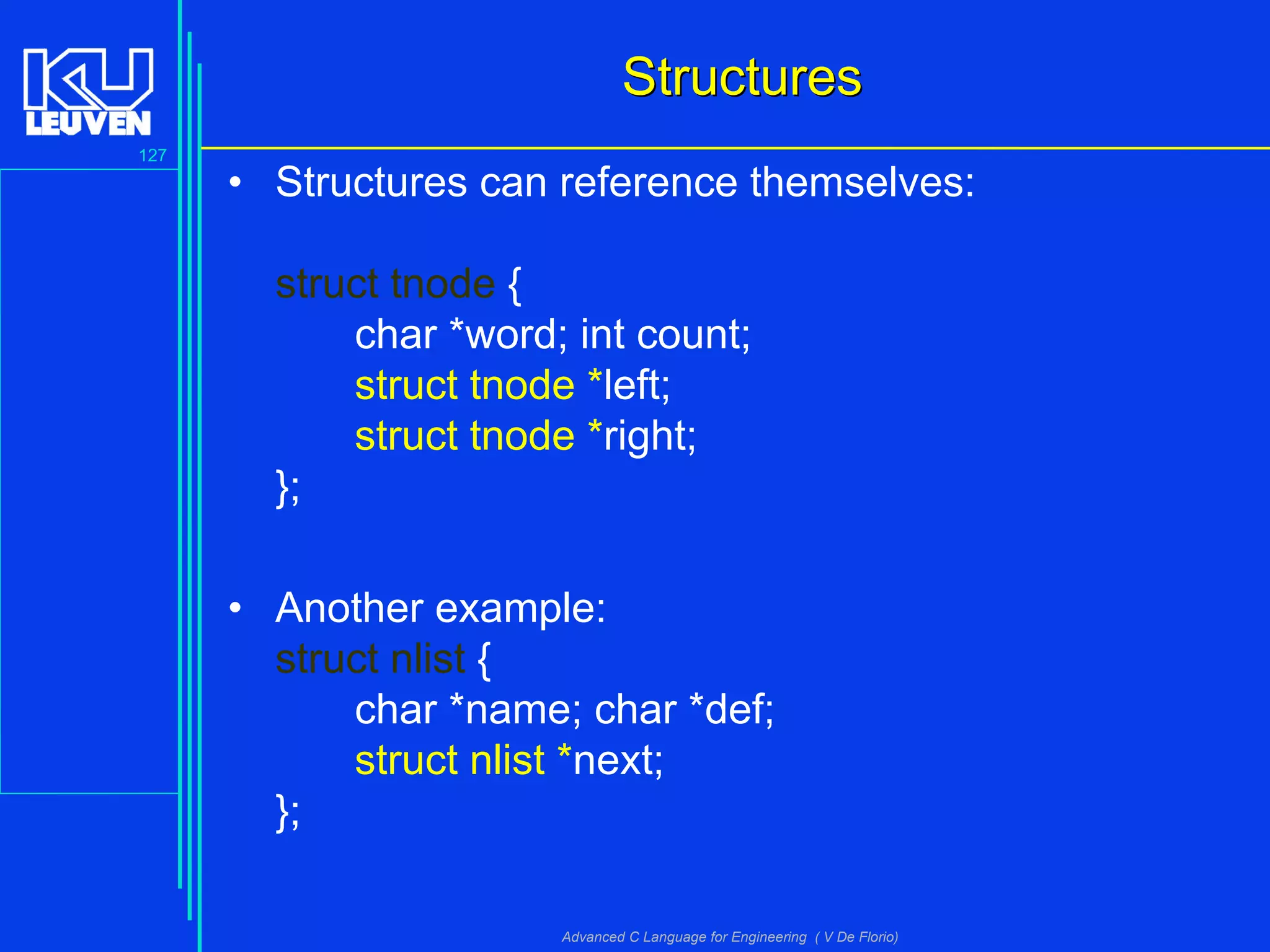
• Structures can reference themselves:
struct tnode {
char *word; int count;
struct tnode *left;
struct tnode *right;
};
• Another example:
struct nlist {
char *name; char *def;
struct nlist *next;
};
128
Advanced C Language for Engineering ( V De Florio)
StructuresStructures
• Exercise:
Write a set of functions dealing with linked lists
Structure the set of functions as a service
Open a connection to the file service, then use
the service (read/write/delete…), then disconnect
(close) the service
129
Advanced C Language for Engineering ( V De Florio)
Bitfield structuresBitfield structures
• Flag registers:
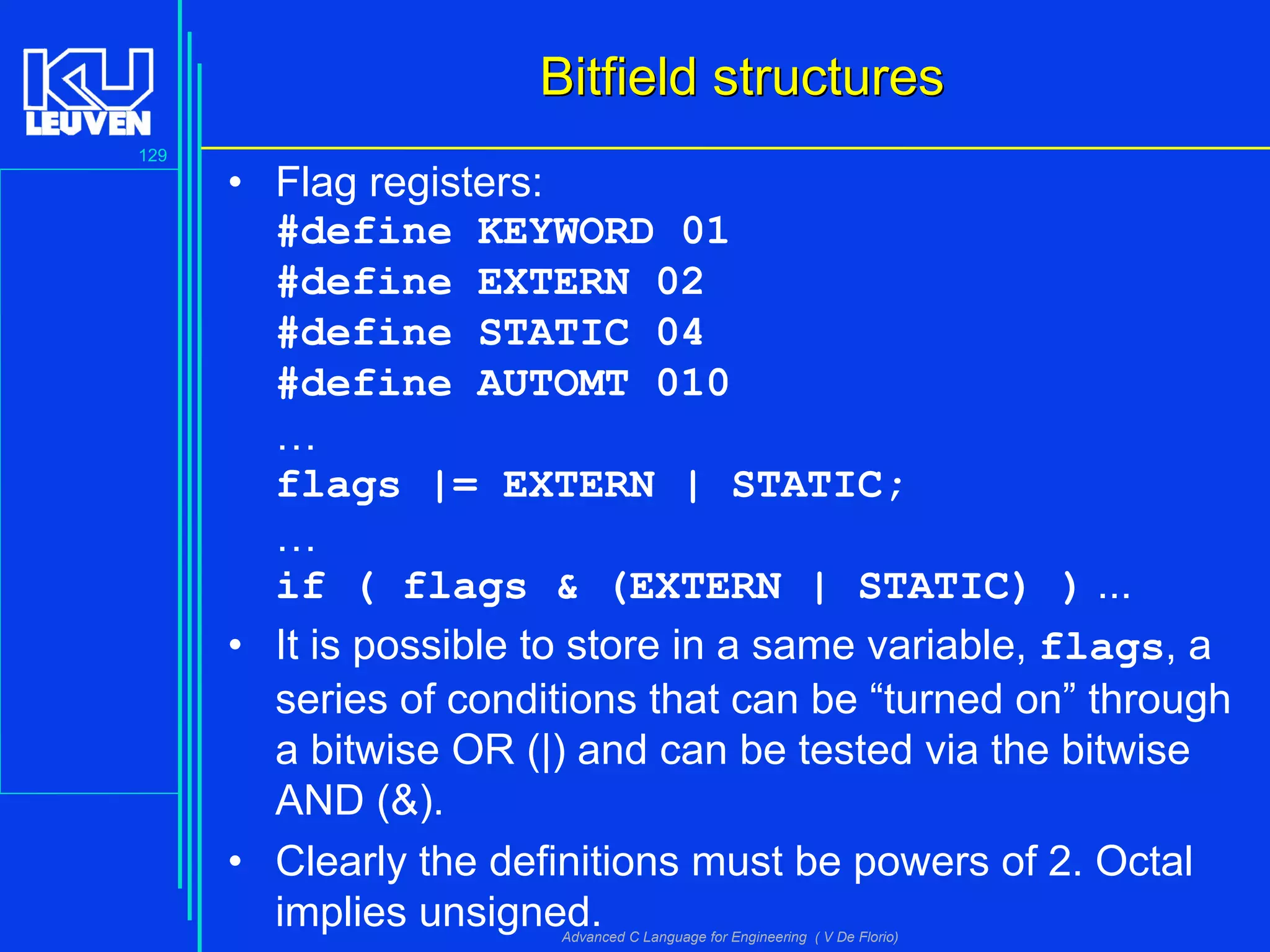
#define KEYWORD 01
#define EXTERN 02
#define STATIC 04
#define AUTOMT 010
…
flags |= EXTERN | STATIC;
…
if ( flags & (EXTERN | STATIC) ) ...
• It is possible to store in a same variable, flags, a
series of conditions that can be “turned on” through
a bitwise OR (|) and can be tested via the bitwise
AND (&).
• Clearly the definitions must be powers of 2. Octal
implies unsigned.
130
Advanced C Language for Engineering ( V De Florio)
Bitfield structuresBitfield structures
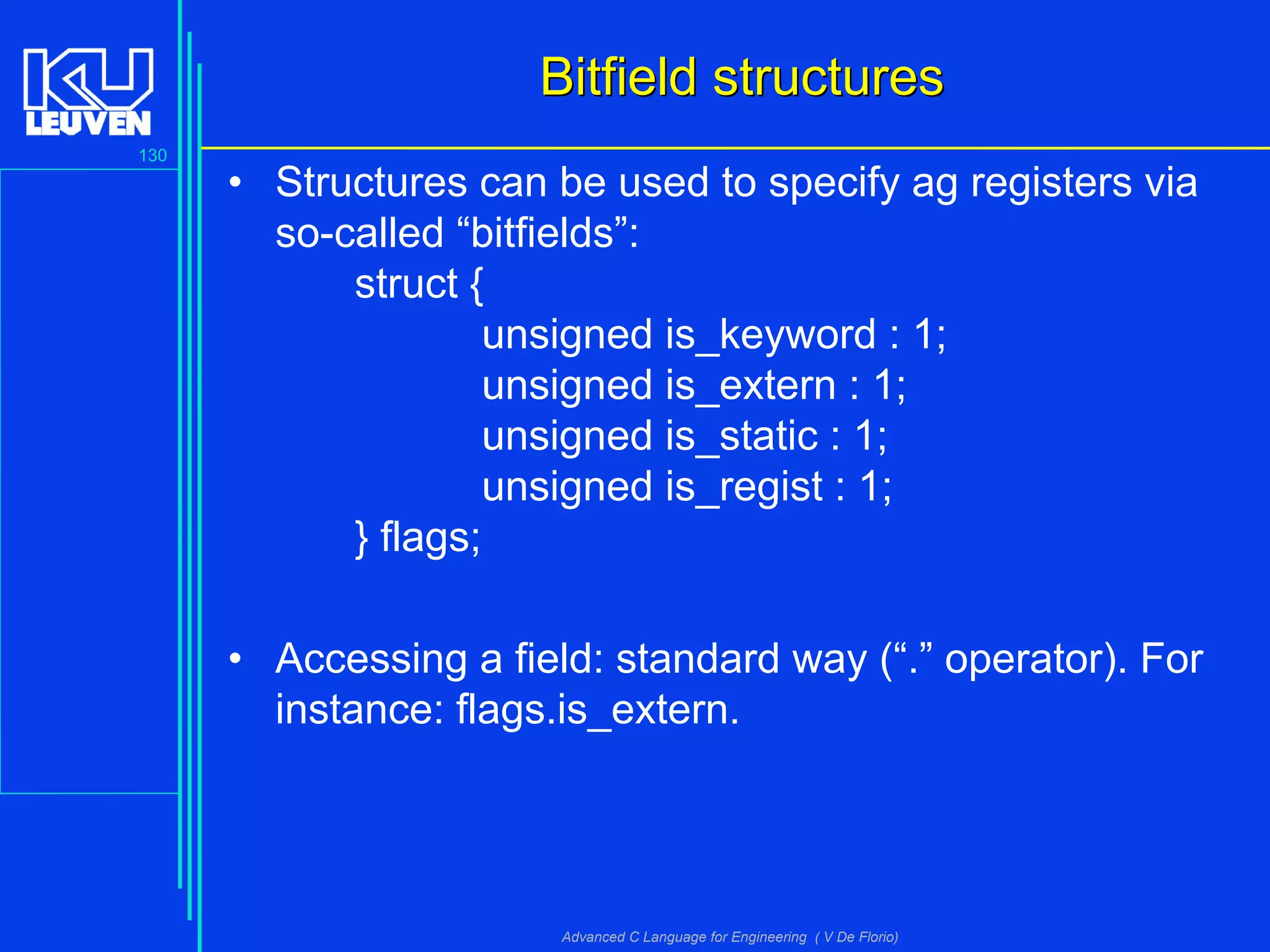
• Structures can be used to specify ag registers via
so-called “bitfields”:
struct {
unsigned is_keyword : 1;
unsigned is_extern : 1;
unsigned is_static : 1;
unsigned is_regist : 1;
} flags;
• Accessing a field: standard way (“.” operator). For
instance: flags.is_extern.
131
Advanced C Language for Engineering ( V De Florio)
Bitfield structuresBitfield structures
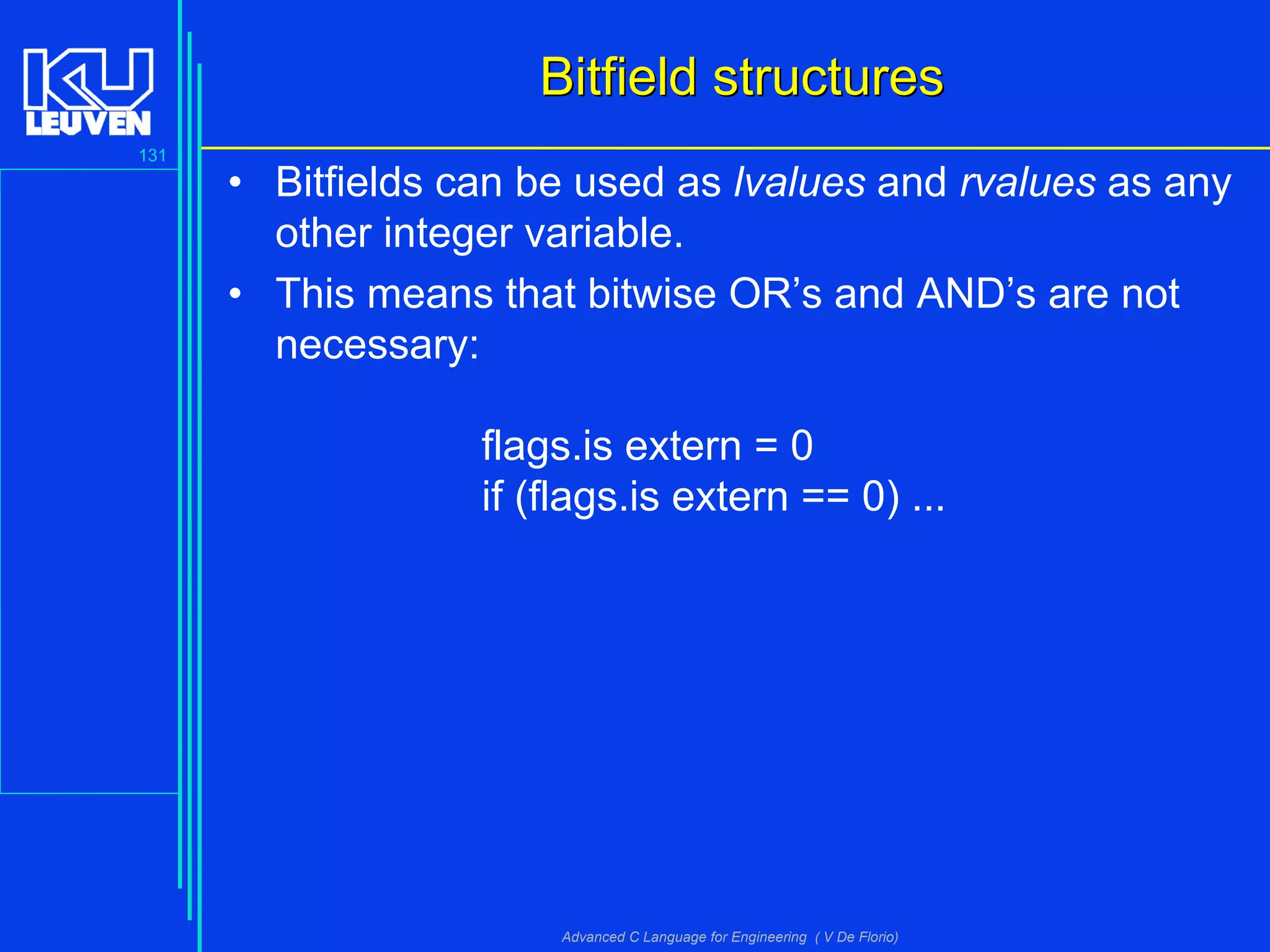
• Bitfields can be used as lvalues and rvalues as any
other integer variable.
• This means that bitwise OR’s and AND’s are not
necessary:
flags.is extern = 0
if (flags.is extern == 0) ...
132
Advanced C Language for Engineering ( V De Florio)
Bitfield structuresBitfield structures
• Bitfields can only be unsigned or int
• Asking the address of a bitfield is illegal
• Bitfields can also be “unnamed,” e.g., for padding
• The standard doesn’t specify if MSB-first or LSB-
first is used.
133
Advanced C Language for Engineering ( V De Florio)
UnionsUnions
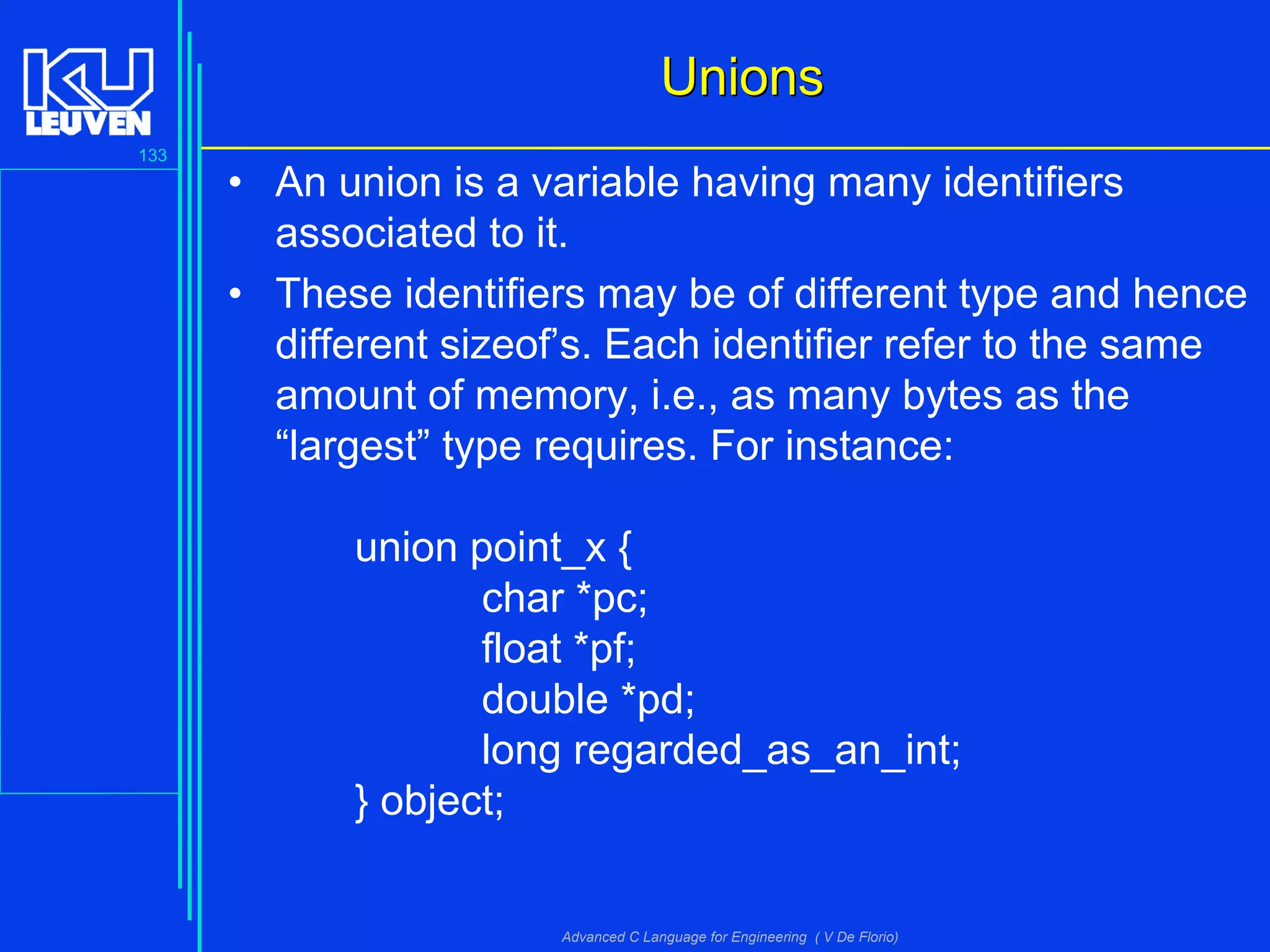
• An union is a variable having many identifiers
associated to it.
• These identifiers may be of different type and hence
different sizeof’s. Each identifier refer to the same
amount of memory, i.e., as many bytes as the
“largest” type requires. For instance:
union point_x {
char *pc;
float *pf;
double *pd;
long regarded_as_an_int;
} object;
134
Advanced C Language for Engineering ( V De Florio)
UnionsUnions
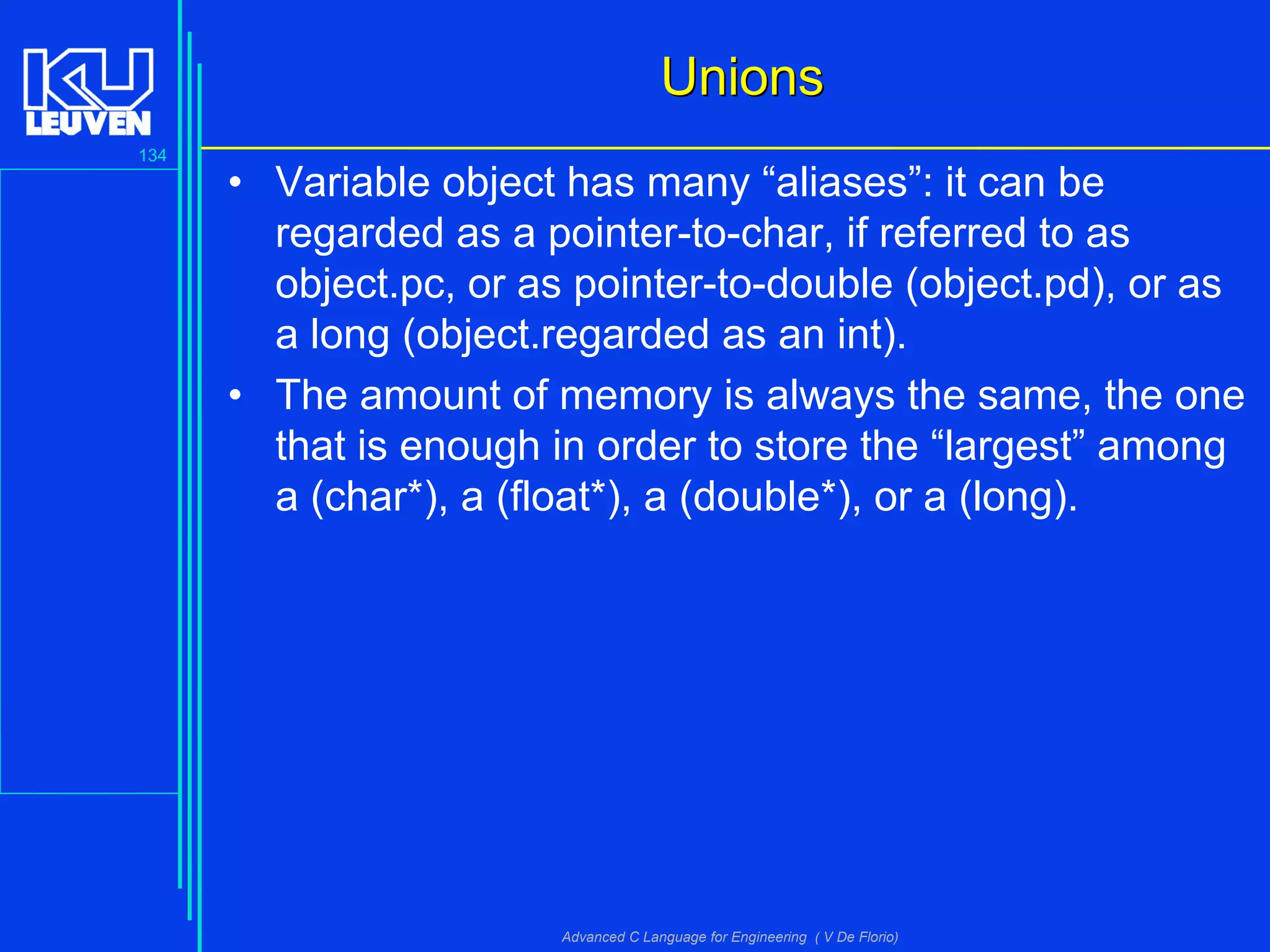
• Variable object has many “aliases”: it can be
regarded as a pointer-to-char, if referred to as
object.pc, or as pointer-to-double (object.pd), or as
a long (object.regarded as an int).
• The amount of memory is always the same, the one
that is enough in order to store the “largest” among
a (char*), a (float*), a (double*), or a (long).
135
Advanced C Language for Engineering ( V De Florio)
UnionsUnions
• Typical use of unions:
struct {
int its_type;
union {
int ival;
float fval;
char *pval;
} uval;
} symbol_table[500];
• If we store in symbol table[i].its type a code that
represents the type of object i, then we can set up,
e.g., arrays of objects of different types, or linked
lists of different objects, and so forth.
136
Advanced C Language for Engineering ( V De Florio)
UnionsUnions
• A switch on its type is the typical way to execute
diverse actions depending on the nature of the
current object, as it’s done in the following example:
for (i=0;i<500;++i)
switch(symbol_table[i].its_type) {
case ’i’: printf("%d",
symbol_table[i].uval.ival);
break;
…
}
137
Advanced C Language for Engineering ( V De Florio)
Standard librariesStandard libraries
• In C many functions are defined in the so-called
“standard library”, libc.a. A set of headers refer to
the functions and definitions in the standard library.
The header file stdio.h contains the basic functions
and definitions for I/O:
#include <stdio.h>
138
Advanced C Language for Engineering ( V De Florio)
Standard streamsStandard streams
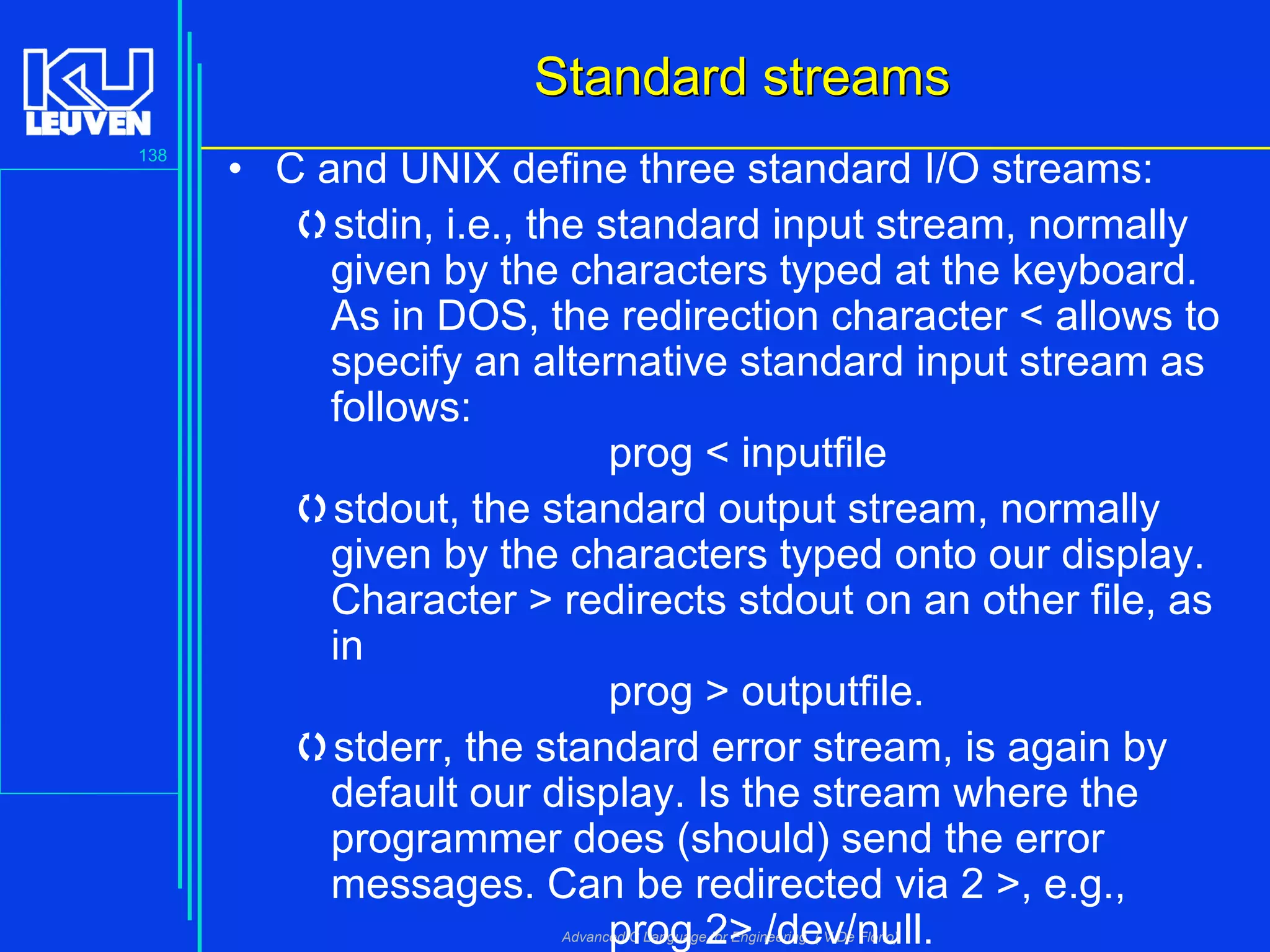
• C and UNIX define three standard I/O streams:
stdin, i.e., the standard input stream, normally
given by the characters typed at the keyboard.
As in DOS, the redirection character < allows to
specify an alternative standard input stream as
follows:
prog < inputfile
stdout, the standard output stream, normally
given by the characters typed onto our display.
Character > redirects stdout on an other file, as
in
prog > outputfile.
stderr, the standard error stream, is again by
default our display. Is the stream where the
programmer does (should) send the error
messages. Can be redirected via 2 >, e.g.,
prog 2> /dev/null.
139
Advanced C Language for Engineering ( V De Florio)
PipesPipes
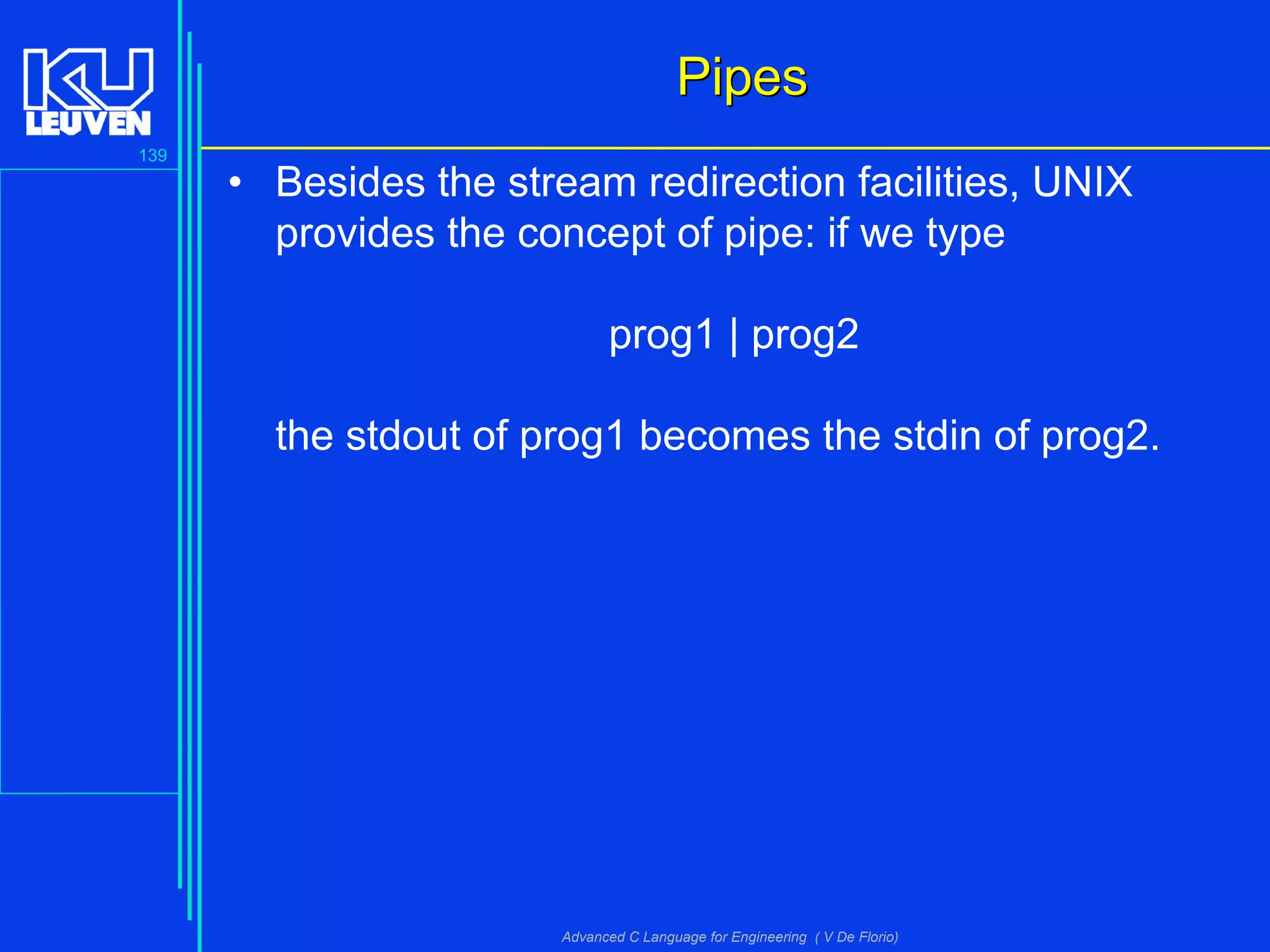
• Besides the stream redirection facilities, UNIX
provides the concept of pipe: if we type
prog1 | prog2
the stdout of prog1 becomes the stdin of prog2.
140
Advanced C Language for Engineering ( V De Florio)
PipesPipes
TASK 1 TASK 2
stdin stdoutstdin stdout
p
ipein pipe
out
int pipeline[2];
pipein = pipeline[STDIN], pipeout = pipeline[STDOUT];
pipe(pipeline);
• pipe() creates an I/O mechanism called “pipe” and returns
two file descriptors, fildes[0] and fildes[1]. The files
associated with fildes[0] and fildes[1] are streams and
are both opened for reading and writing.
• A read from pipeline[0] accesses the data written to
pipeline[1] and a read from pipeline[1] accesses the data
written to pipeline[0] (both on a FIFO basis.)
141
Advanced C Language for Engineering ( V De Florio)
PipesPipes
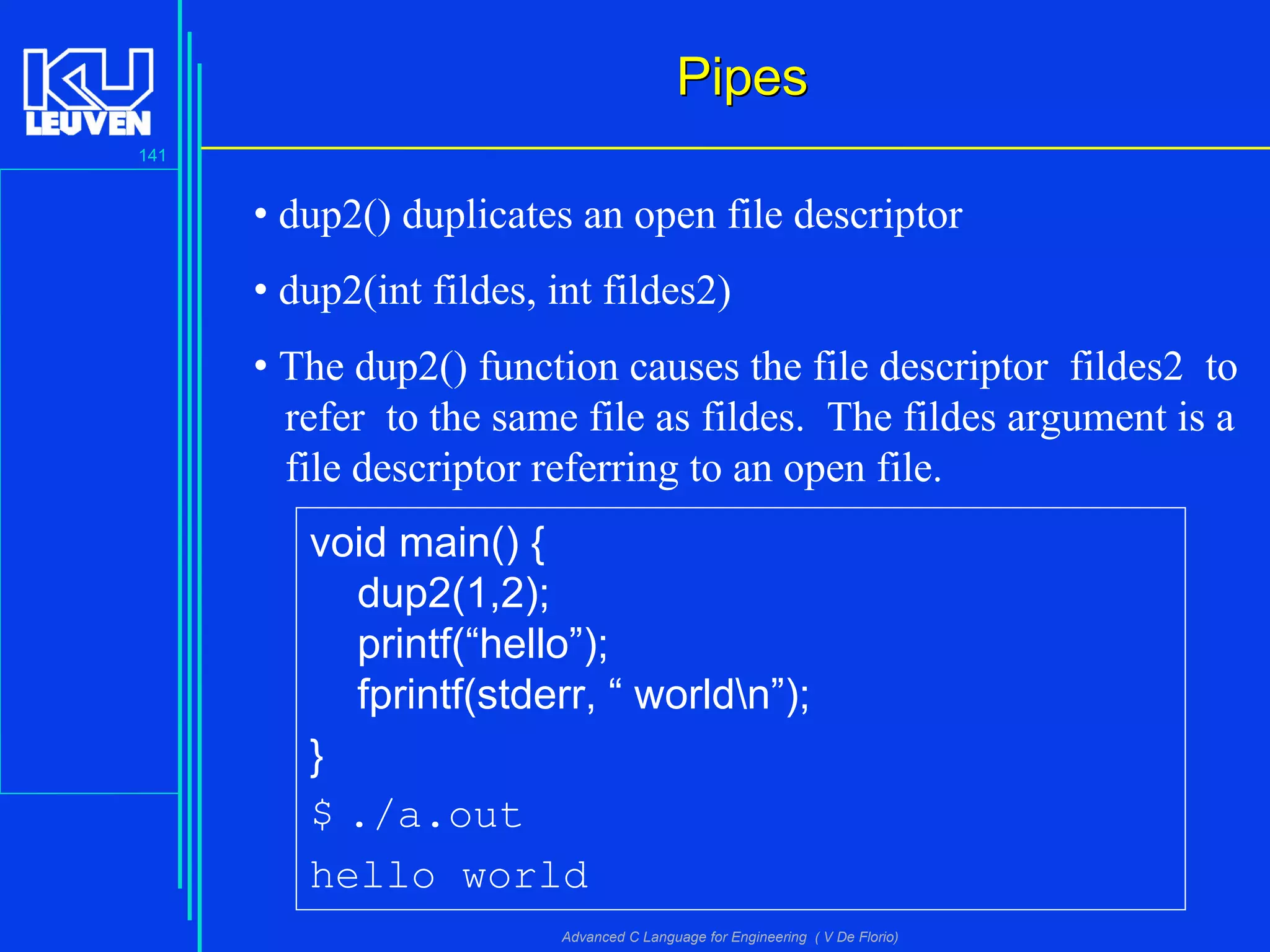
• dup2() duplicates an open file descriptor
• dup2(int fildes, int fildes2)
• The dup2() function causes the file descriptor fildes2 to
refer to the same file as fildes. The fildes argument is a
file descriptor referring to an open file.
void main() {
dup2(1,2);
printf(“hello”);
fprintf(stderr, “ worldn”);
}
$ ./a.out
hello world
142
Advanced C Language for Engineering ( V De Florio)
PipesPipes
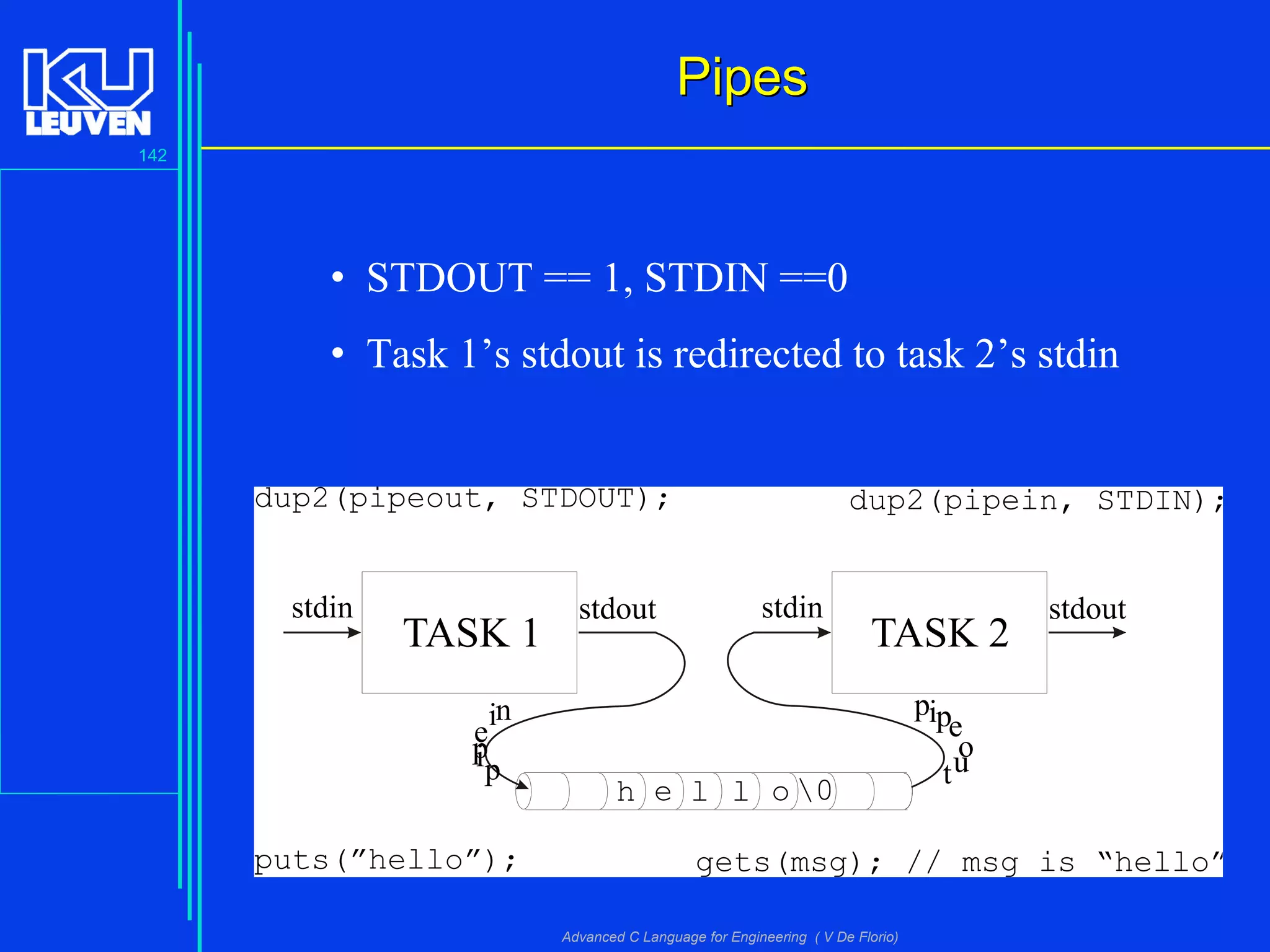
TASK 1 TASK 2
stdin stdoutstdin stdout
pip
e
in pipe
out
dup2(pipeout, STDOUT); dup2(pipein, STDIN);
puts(”hello”); gets(msg); // msg is “hello”
h e l l o 0
• STDOUT == 1, STDIN ==0
• Task 1’s stdout is redirected to task 2’s stdin
143
Advanced C Language for Engineering ( V De Florio)
PipesPipes
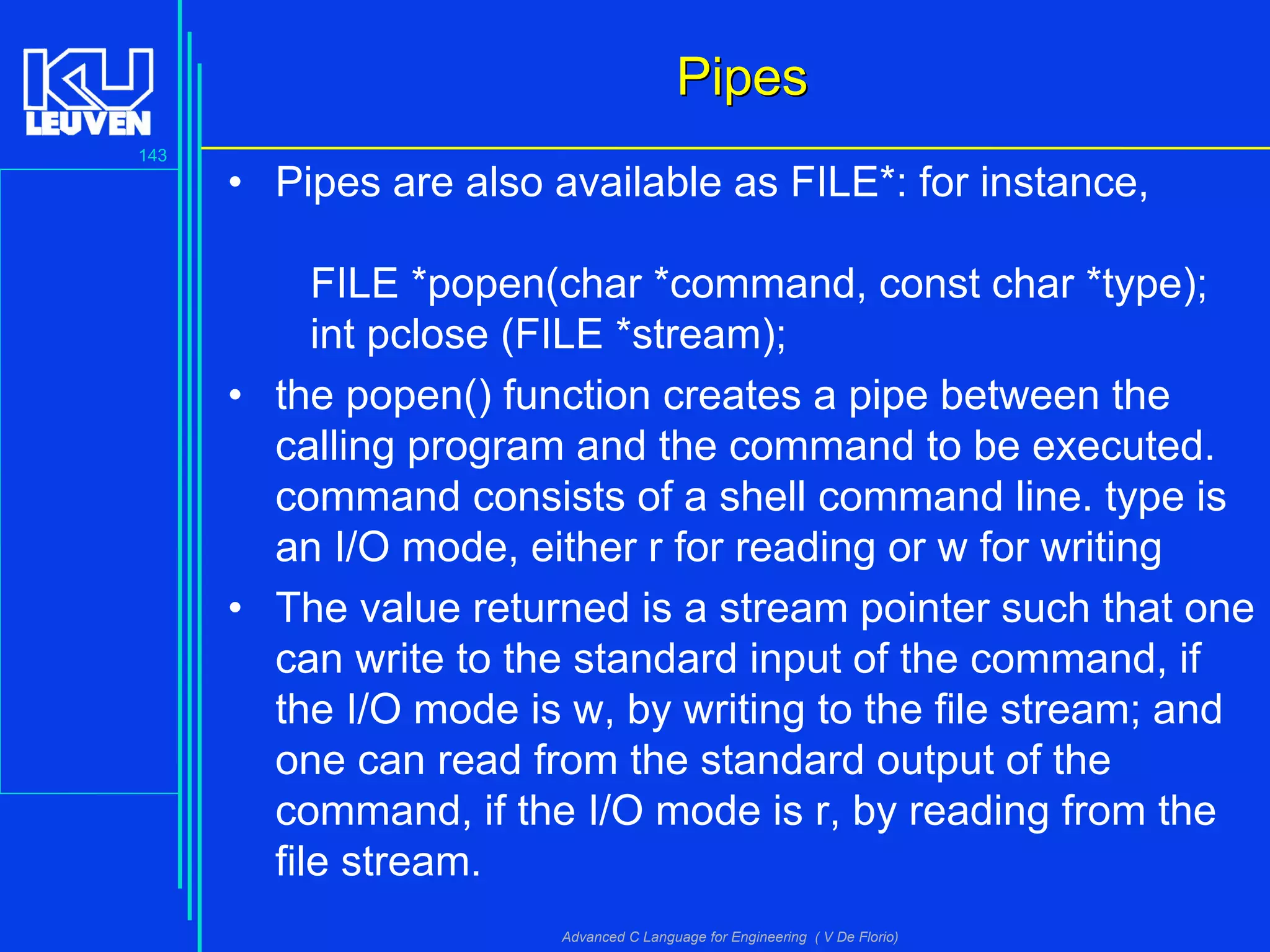
• Pipes are also available as FILE*: for instance,
FILE *popen(char *command, const char *type);
int pclose (FILE *stream);
• the popen() function creates a pipe between the
calling program and the command to be executed.
command consists of a shell command line. type is
an I/O mode, either r for reading or w for writing
• The value returned is a stream pointer such that one
can write to the standard input of the command, if
the I/O mode is w, by writing to the file stream; and
one can read from the standard output of the
command, if the I/O mode is r, by reading from the
file stream.
144
Advanced C Language for Engineering ( V De Florio)
PipesPipes
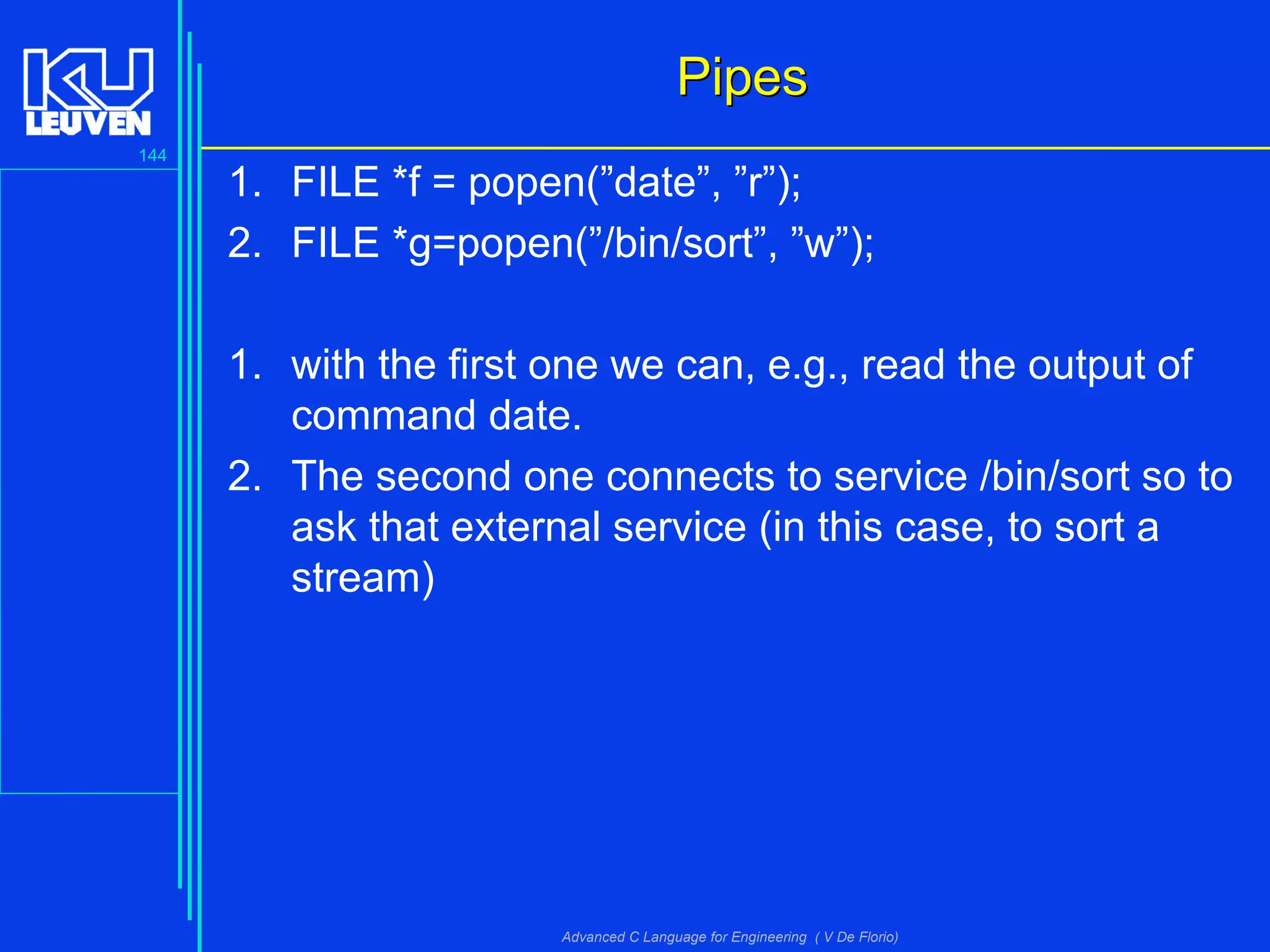
1. FILE *f = popen(”date”, ”r”);
2. FILE *g=popen(”/bin/sort”, ”w”);
1. with the first one we can, e.g., read the output of
command date.
2. The second one connects to service /bin/sort so to
ask that external service (in this case, to sort a
stream)
145
Advanced C Language for Engineering ( V De Florio)
The UNIX manThe UNIX man
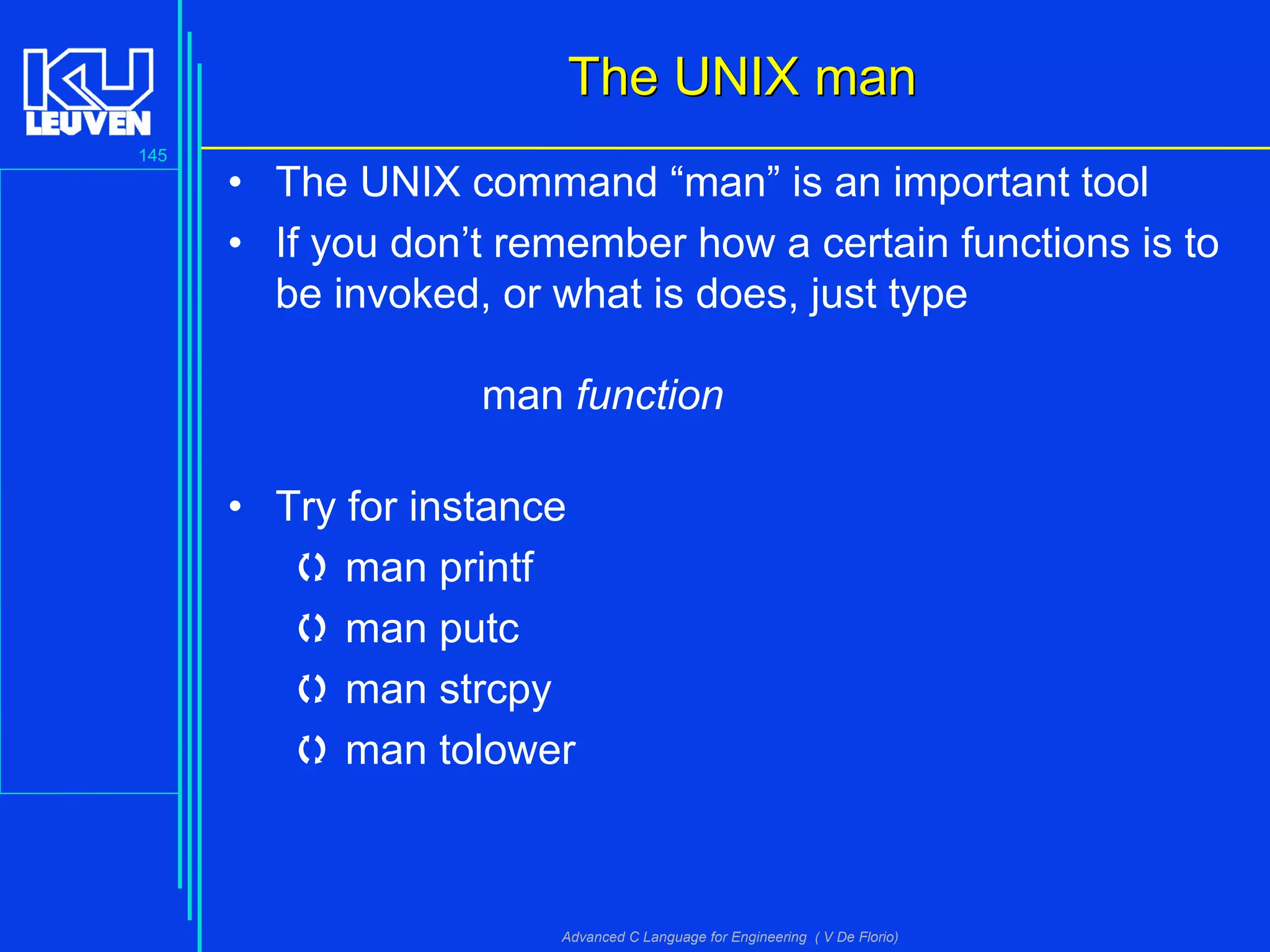
• The UNIX command “man” is an important tool
• If you don’t remember how a certain functions is to
be invoked, or what is does, just type
man function
• Try for instance
 man printf
 man putc
 man strcpy
 man tolower
146
Advanced C Language for Engineering ( V De Florio)
MakefilesMakefiles
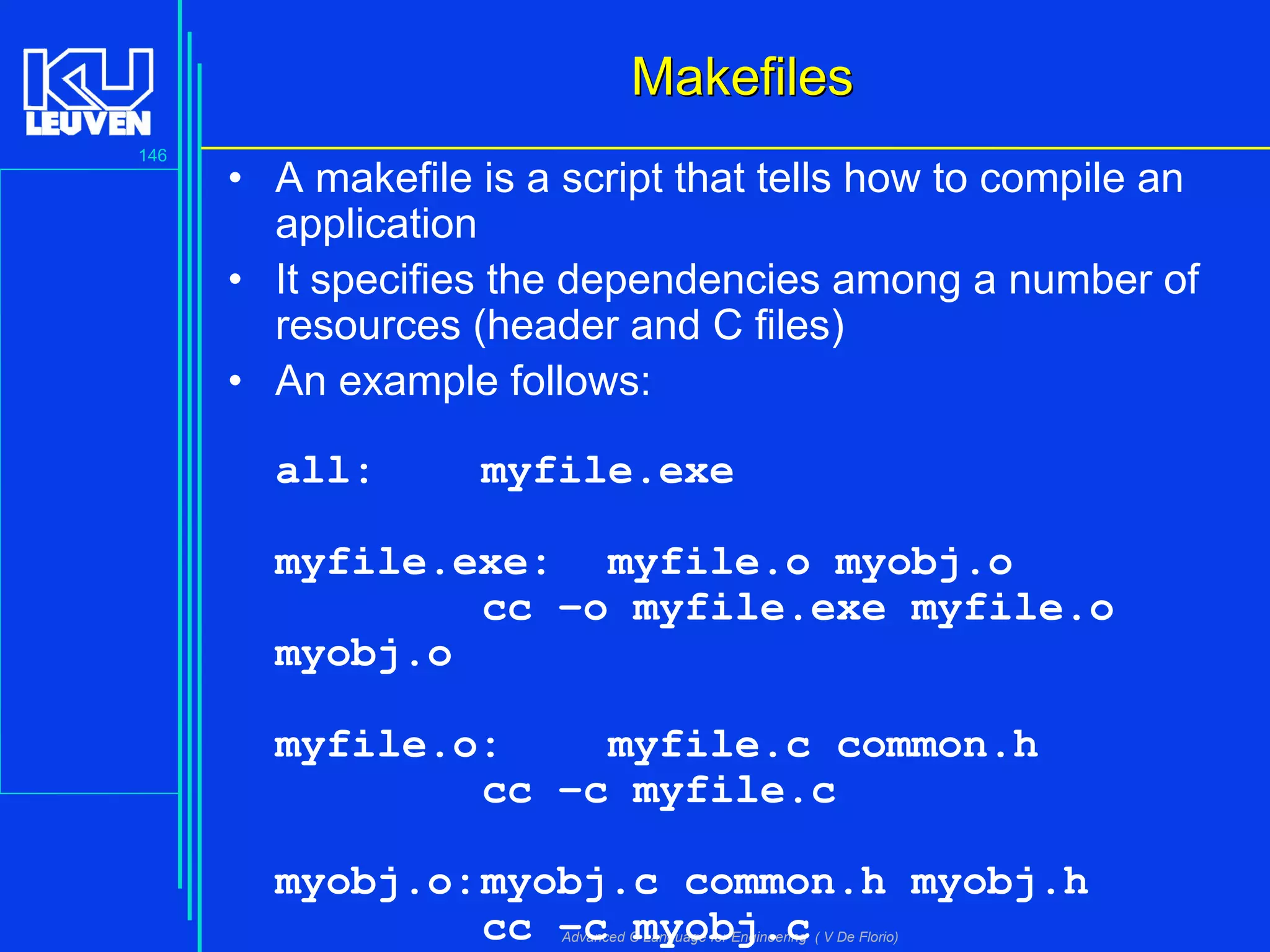
• A makefile is a script that tells how to compile an
application
• It specifies the dependencies among a number of
resources (header and C files)
• An example follows:
all: myfile.exe
myfile.exe: myfile.o myobj.o
cc –o myfile.exe myfile.o
myobj.o
myfile.o: myfile.c common.h
cc –c myfile.c
myobj.o:myobj.c common.h myobj.h
cc –c myobj.c
147
Advanced C Language for Engineering ( V De Florio)
Performance issuesPerformance issues
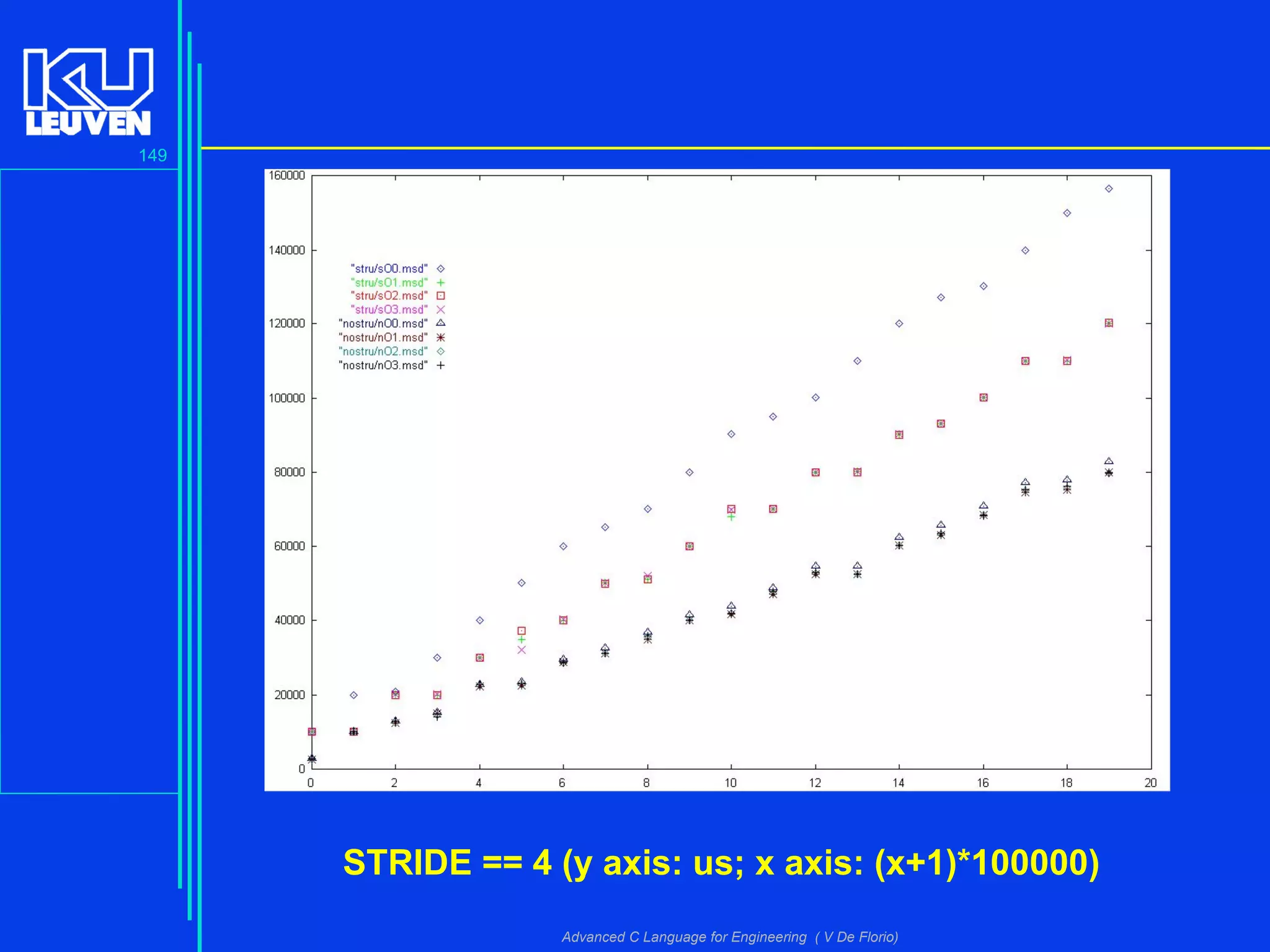
• How much can the choice of a data structure
influence a property such as locality in sequential
data accesses? In order to evaluate this we run a
simple experiment on a Win2000/Pentium3 PC
148
Advanced C Language for Engineering ( V De Florio)
Performance issuesPerformance issues
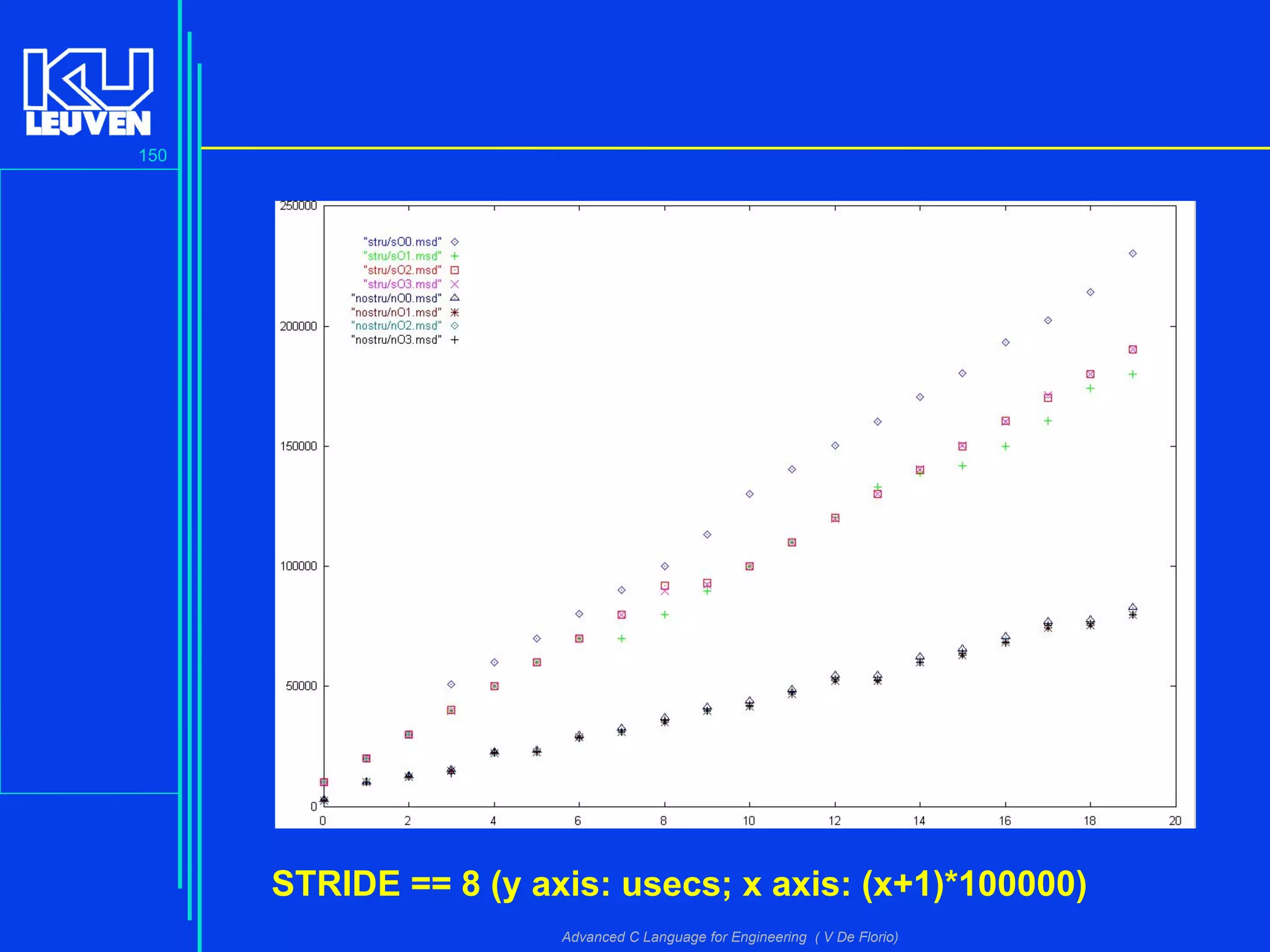
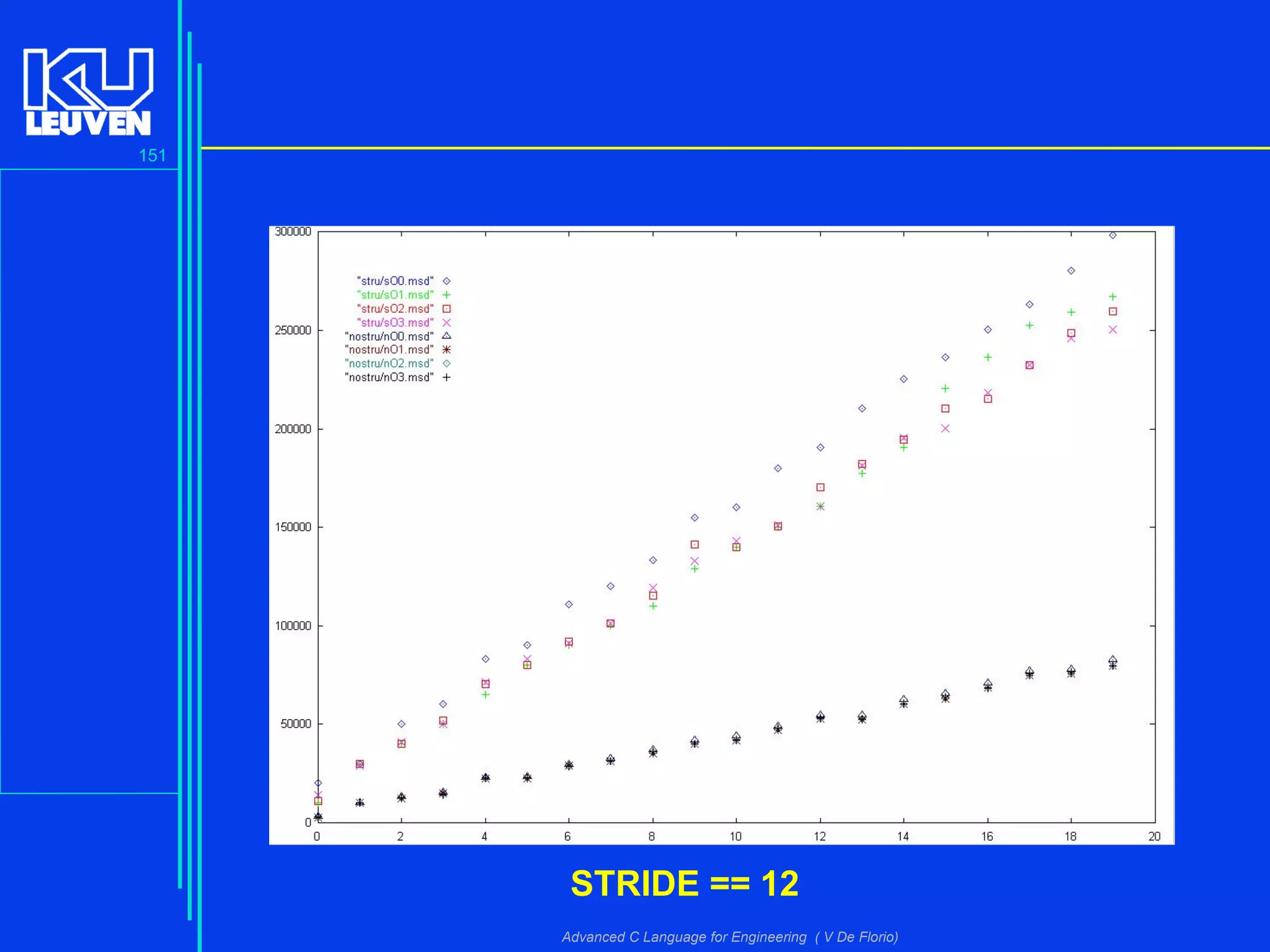
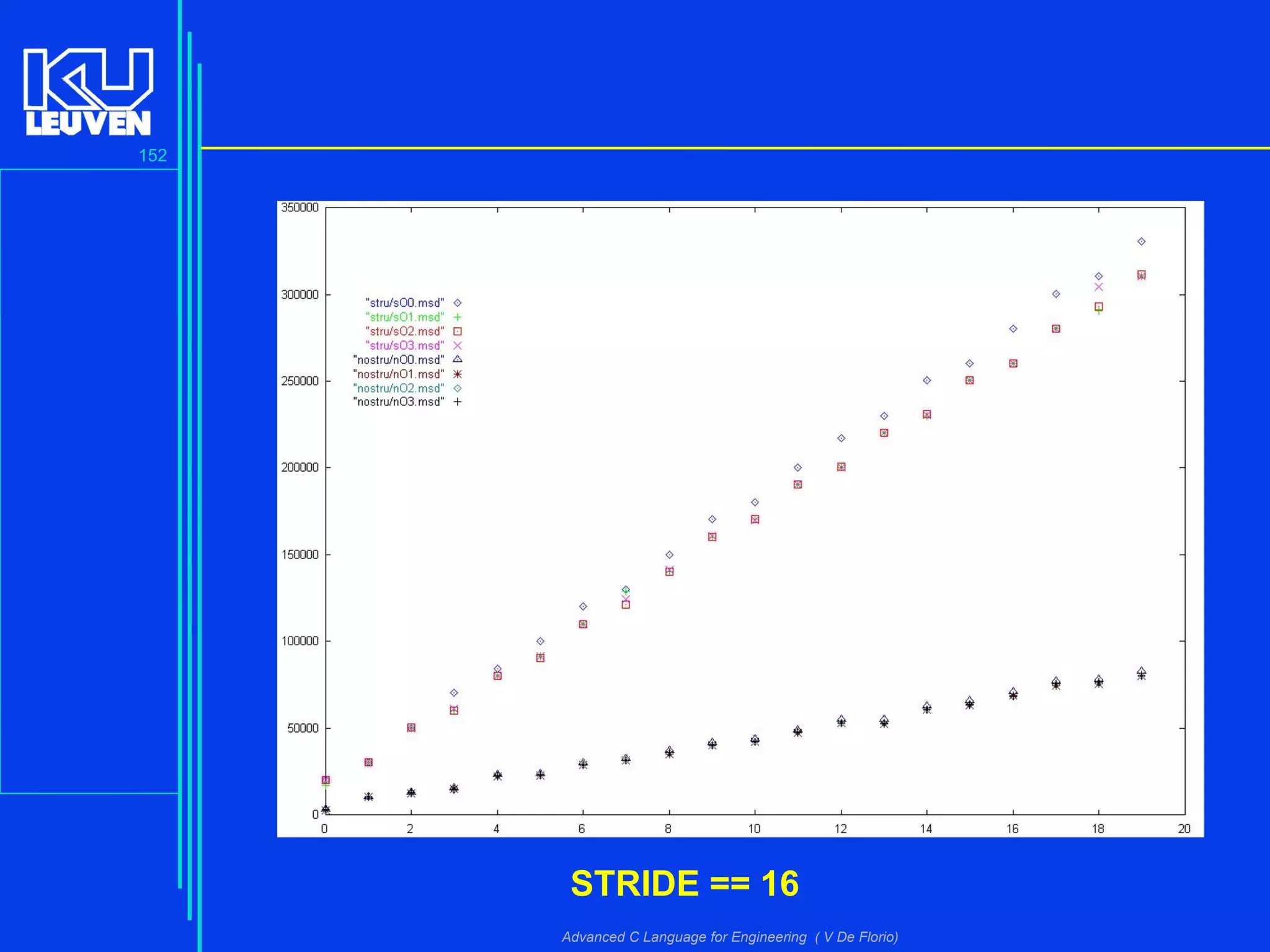
• Experiment: the following structure:
typedef struct { int a;
char b[STRIDE];
} stru_t;
and the following access scheme:
for (i=0; i<itera-1; i++)
v[i].a = v[i+1].a + 1;
are compared with the following two data structures:
typedef int stru_ta;
typedef char stru_tb[STRIDE];
and access scheme:
for (i=0; i<itera-1; i++)
a[i] = a[i+1] + 1;
149
Advanced C Language for Engineering ( V De Florio)
STRIDE == 4 (y axis: us; x axis: (x+1)*100000)
150
Advanced C Language for Engineering ( V De Florio)
STRIDE == 8 (y axis: usecs; x axis: (x+1)*100000)
151
Advanced C Language for Engineering ( V De Florio)
STRIDE == 12
152
Advanced C Language for Engineering ( V De Florio)
STRIDE == 16
153
Advanced C Language for Engineering ( V De Florio)
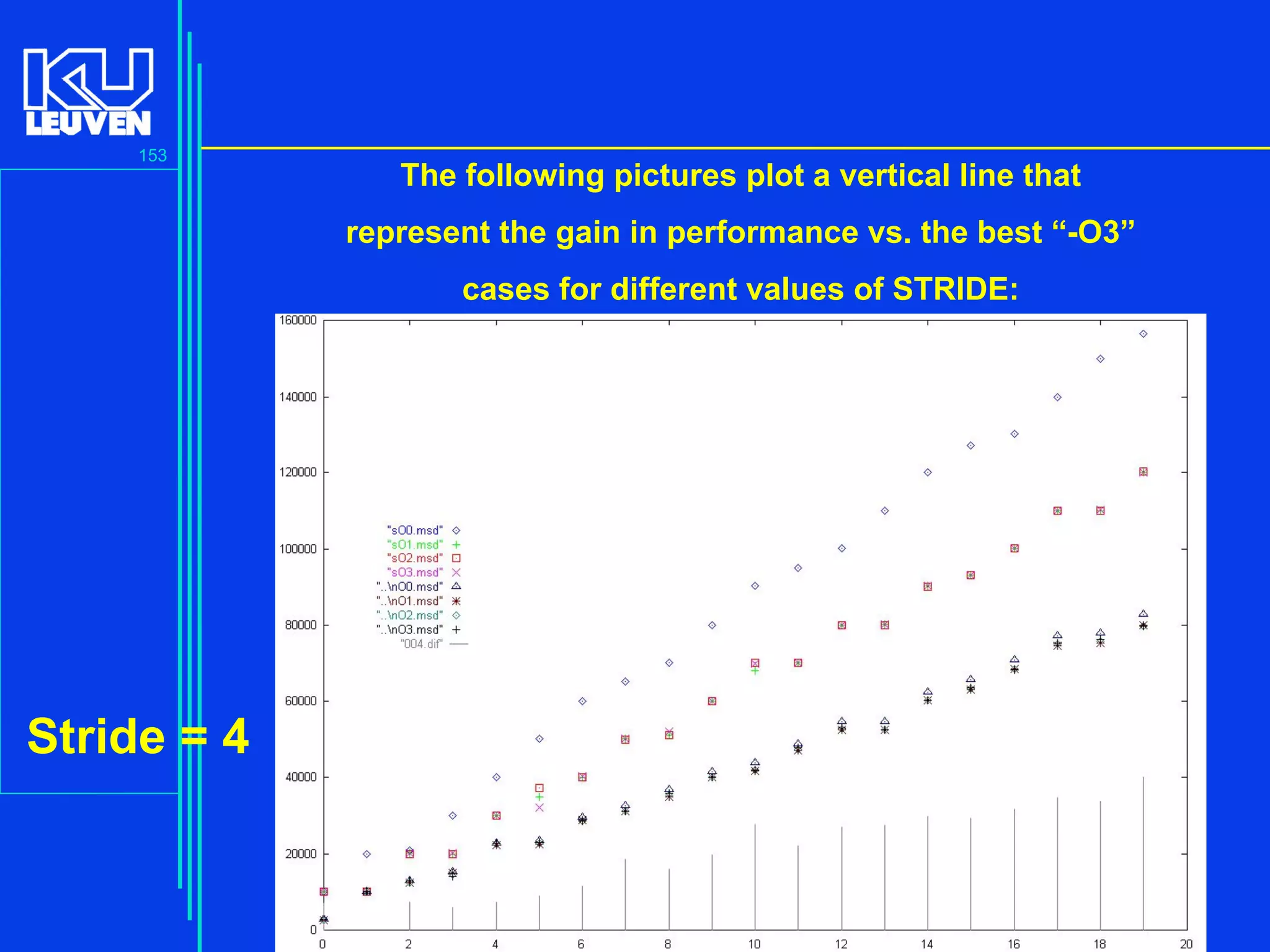
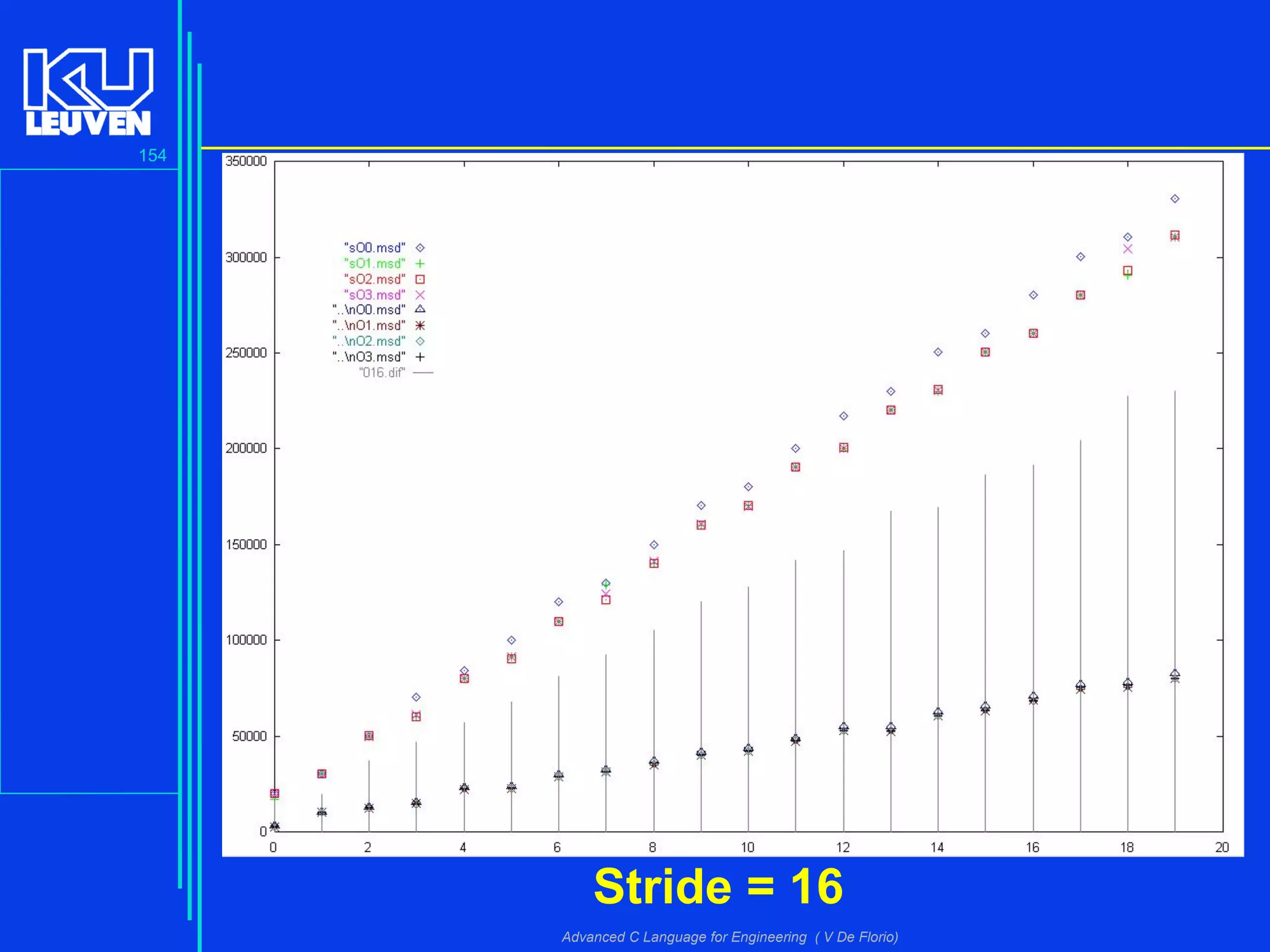
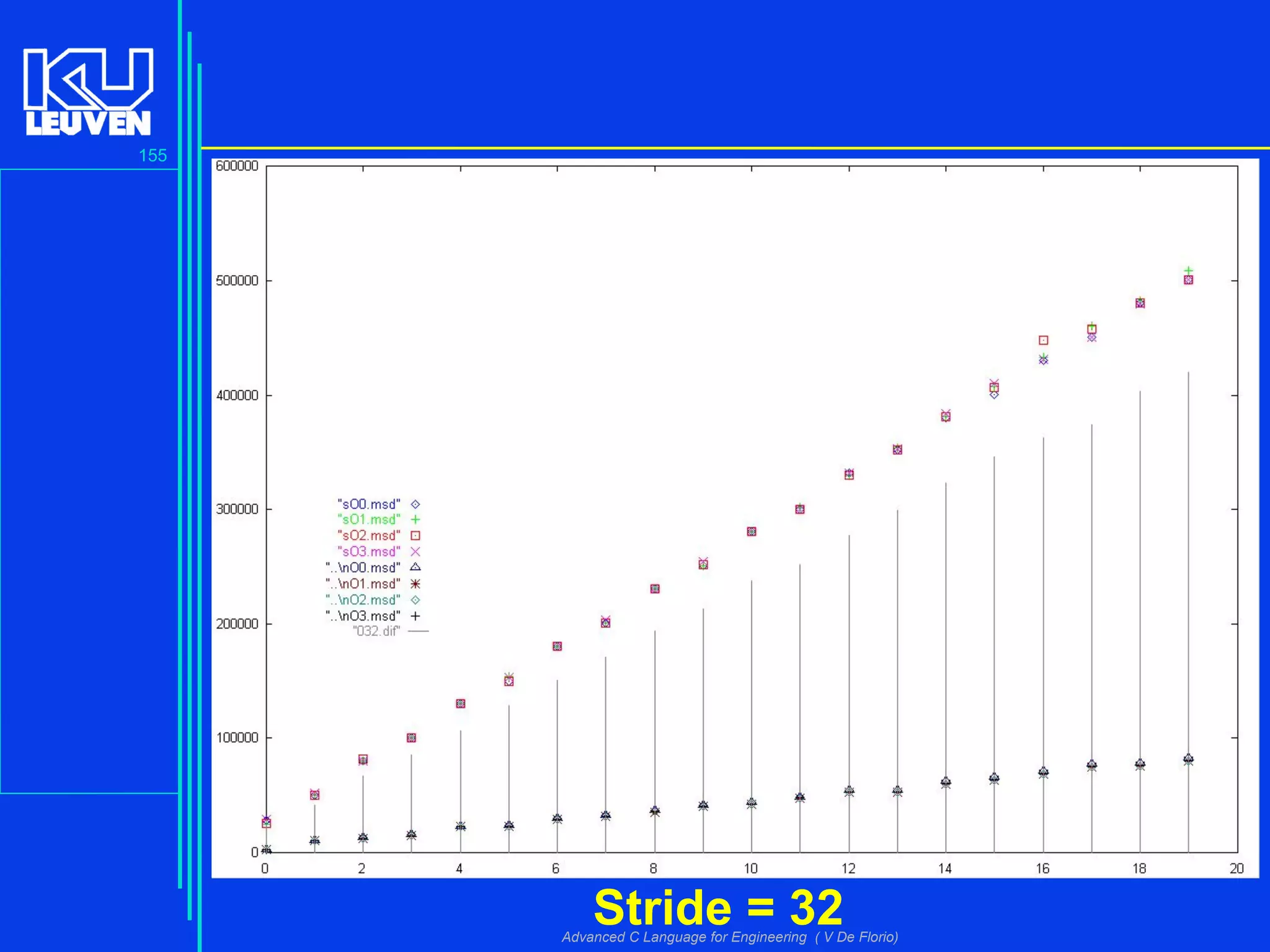
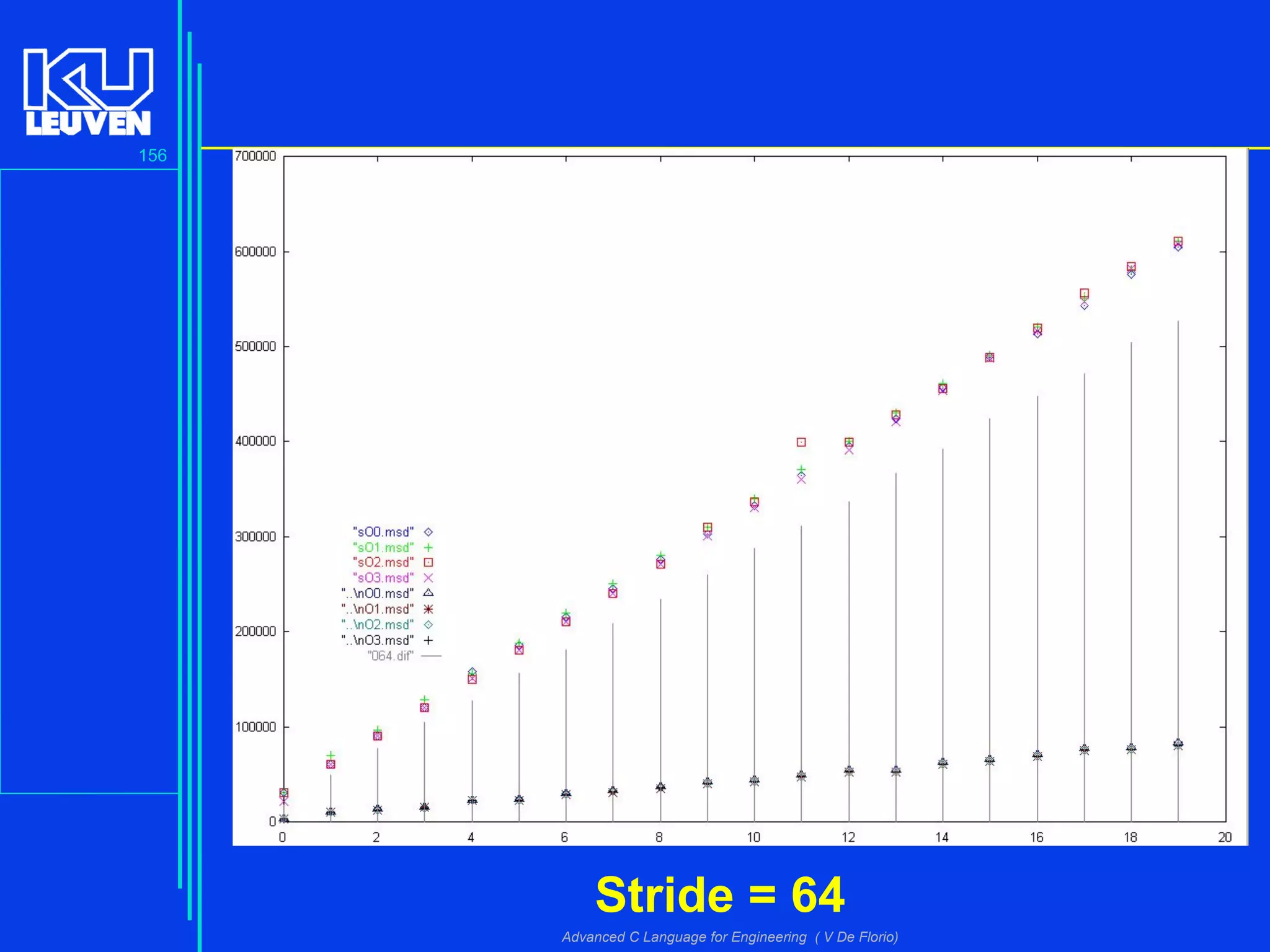
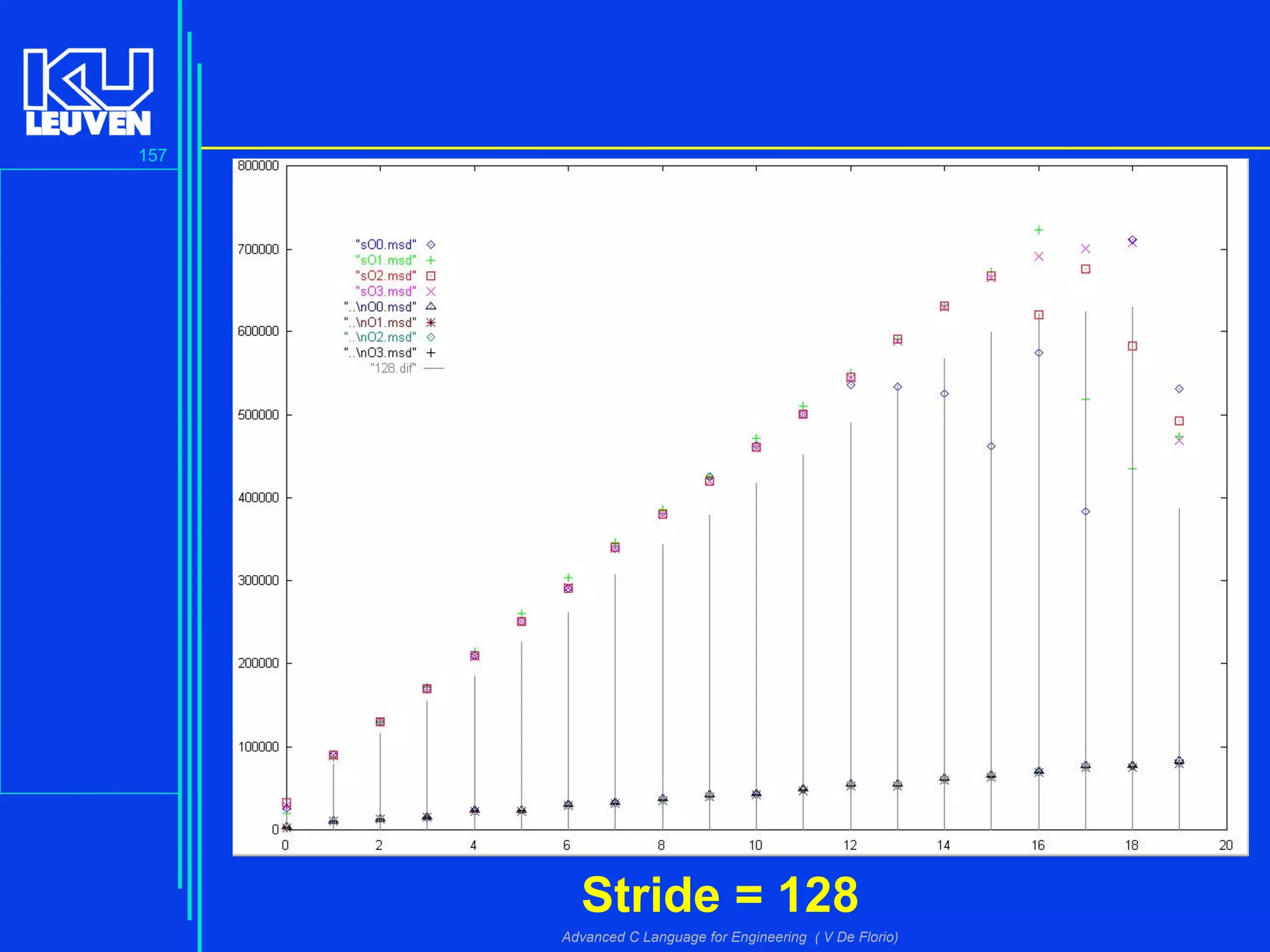
The following pictures plot a vertical line that
represent the gain in performance vs. the best “-O3”
cases for different values of STRIDE:
Stride = 4
154
Advanced C Language for Engineering ( V De Florio)
Stride = 16
155
Advanced C Language for Engineering ( V De Florio)
Stride = 32
156
Advanced C Language for Engineering ( V De Florio)
Stride = 64
157
Advanced C Language for Engineering ( V De Florio)
Stride = 128
158
Advanced C Language for Engineering ( V De Florio)
ReferencesReferences
• Kernighan & Ritchie,The C programming Language,
Addison-Wesley
159
Advanced C Language for Engineering ( V De Florio)
Optimisations in COptimisations in C
• Amdhal Law
• Applications in C: gprof
160
Advanced C Language for Engineering ( V De Florio)
ExerciseExercise
• Write a program that renames a set of files by
substituting all the occurrences of a given string with
another one in the filename
161
Advanced C Language for Engineering ( V De Florio)
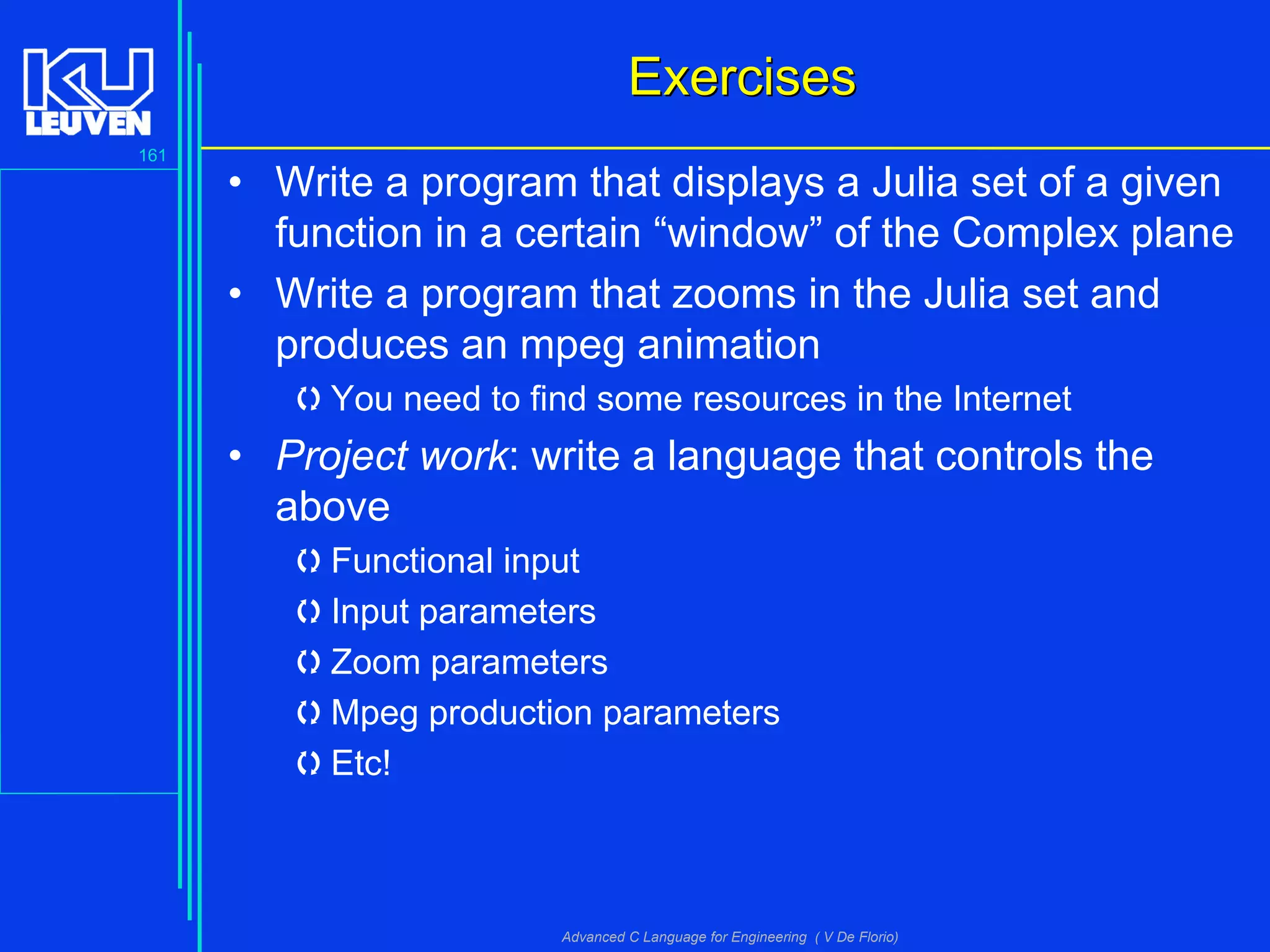
ExercisesExercises
• Write a program that displays a Julia set of a given
function in a certain “window” of the Complex plane
• Write a program that zooms in the Julia set and
produces an mpeg animation
You need to find some resources in the Internet
• Project work: write a language that controls the
above
Functional input
Input parameters
Zoom parameters
Mpeg production parameters
Etc!
162
Advanced C Language for Engineering ( V De Florio)
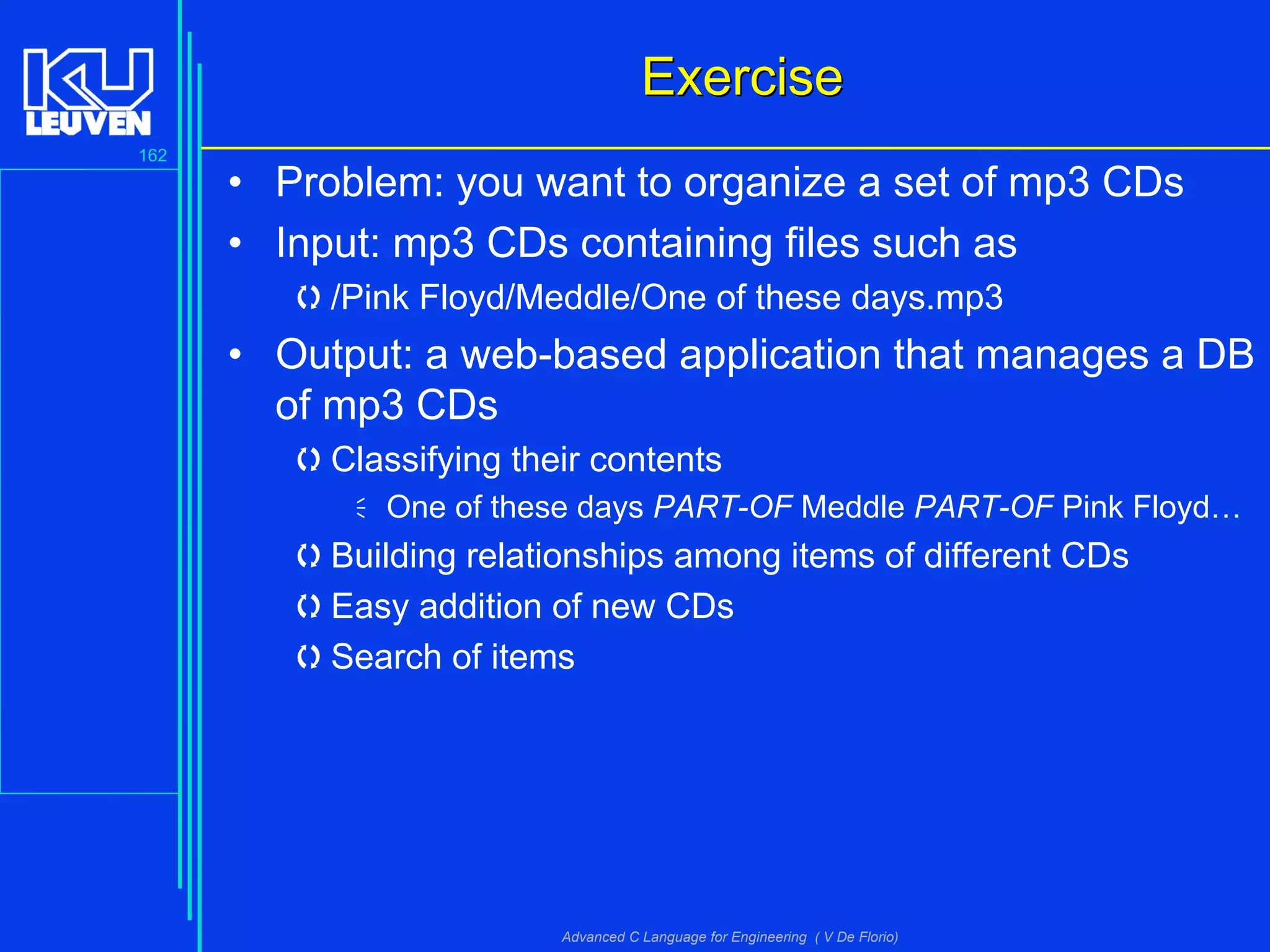
ExerciseExercise
• Problem: you want to organize a set of mp3 CDs
• Input: mp3 CDs containing files such as
/Pink Floyd/Meddle/One of these days.mp3
• Output: a web-based application that manages a DB
of mp3 CDs
Classifying their contents
One of these days PART-OF Meddle PART-OF Pink Floyd…
Building relationships among items of different CDs
Easy addition of new CDs
Search of items
Advanced C Language for Engineering ( V De Florio)
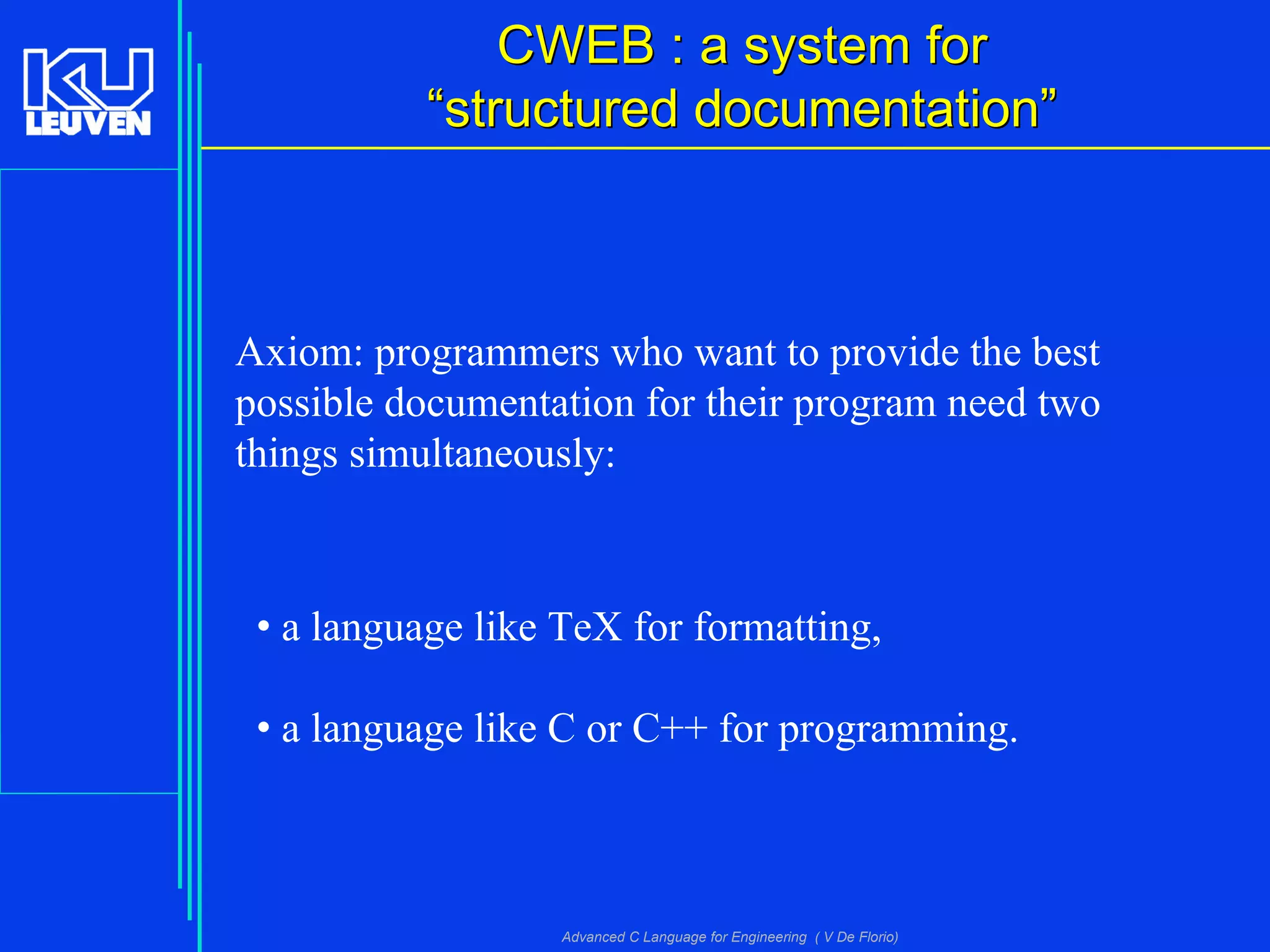
CWEB : a system forCWEB : a system for
““structured documentationstructured documentation””
Axiom: programmers who want to provide the best
possible documentation for their program need two
things simultaneously:
• a language like TeX for formatting,
• a language like C or C++ for programming.
Advanced C Language for Engineering ( V De Florio)
The ideaThe idea
A program can be thought of as a WEB that is made of
many interconnected pieces. CWEB makes the user able:
• to explain the local structure of each part,
• to explain how each entity relates to its neighbors,
• to attach documentation / code to each part.
Advanced C Language for Engineering ( V De Florio)
CWEBCWEB
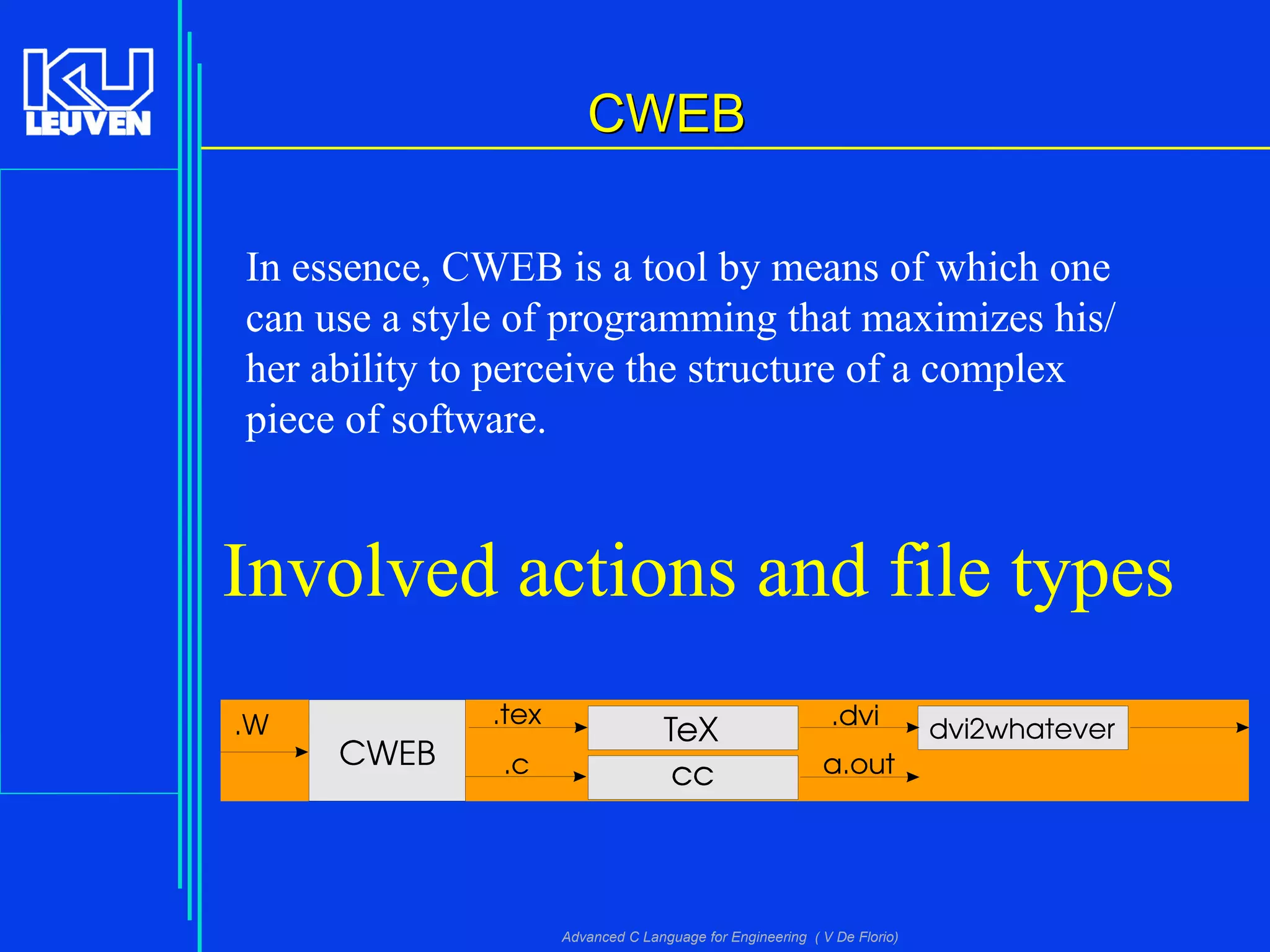
In essence, CWEB is a tool by means of which one
can use a style of programming that maximizes his/
her ability to perceive the structure of a complex
piece of software.
Involved actions and file types
Advanced C Language for Engineering ( V De Florio)
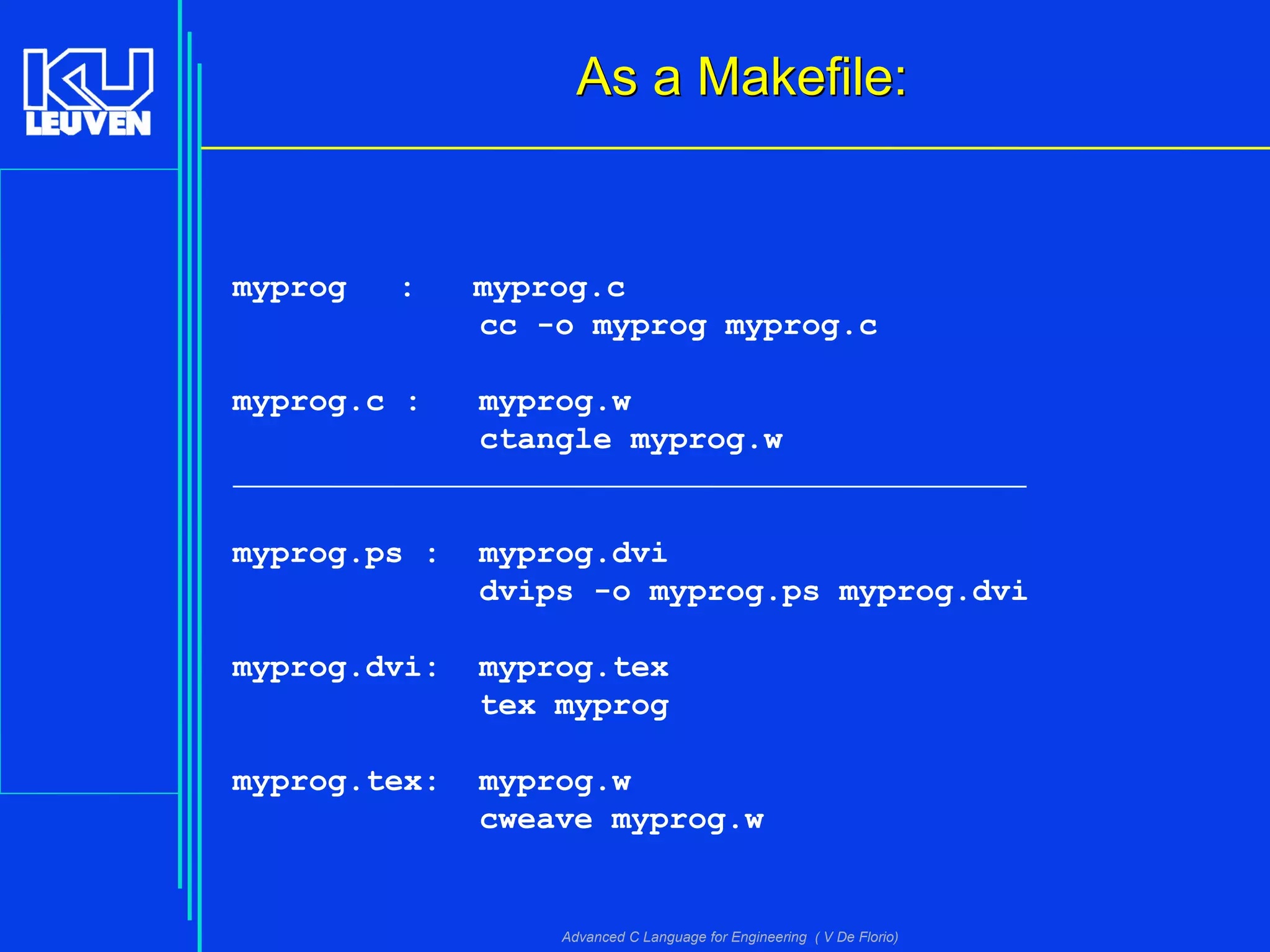
As a Makefile:As a Makefile:
myprog : myprog.c
cc -o myprog myprog.c
myprog.c : myprog.w
ctangle myprog.w
myprog.ps : myprog.dvi
dvips -o myprog.ps myprog.dvi
myprog.dvi: myprog.tex
tex myprog
myprog.tex: myprog.w
cweave myprog.w
Advanced C Language for Engineering ( V De Florio)
CWEB modulesCWEB modules
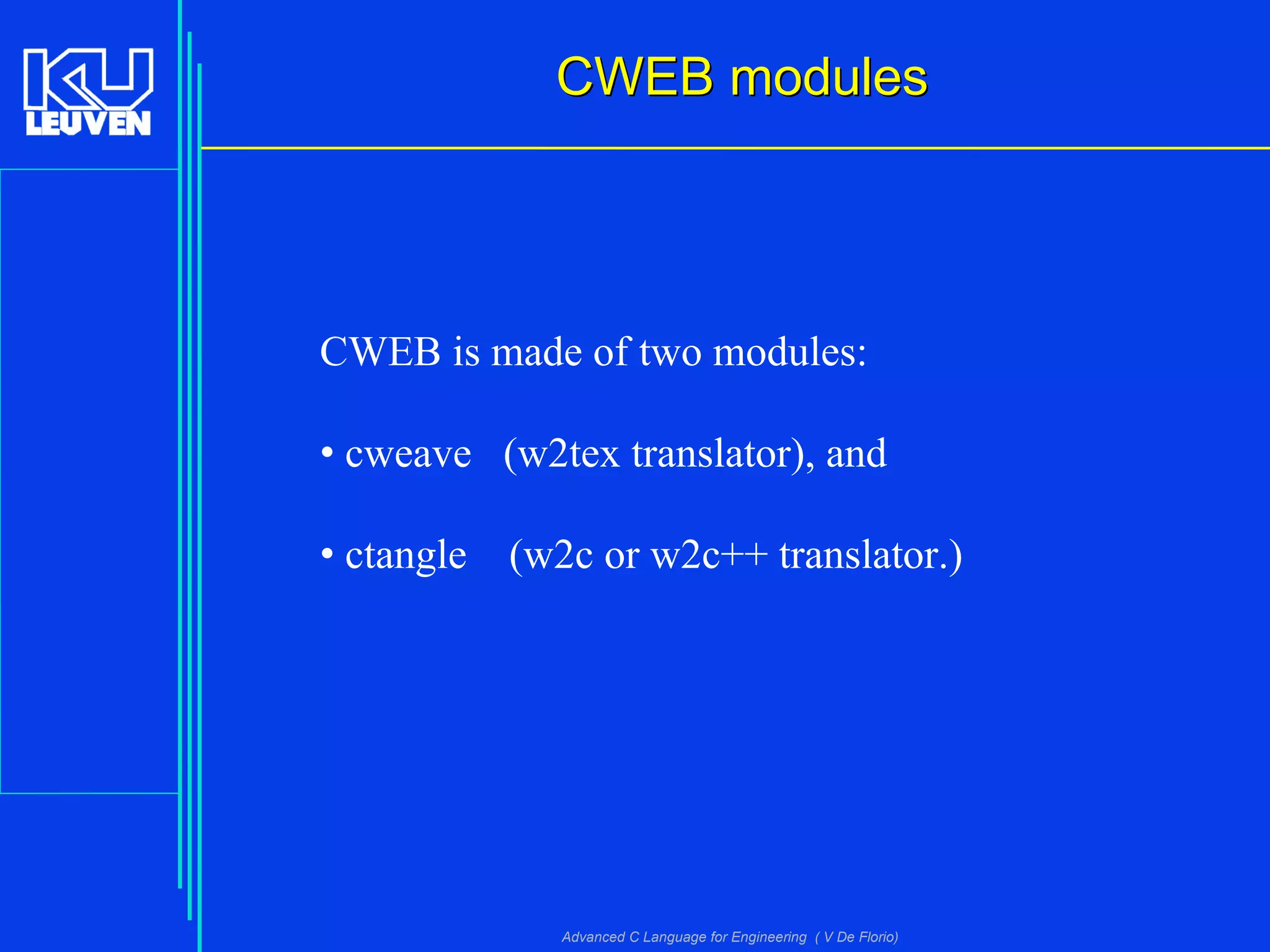
CWEB is made of two modules:
• cweave (w2tex translator), and
• ctangle (w2c or w2c++ translator.)
Advanced C Language for Engineering ( V De Florio)
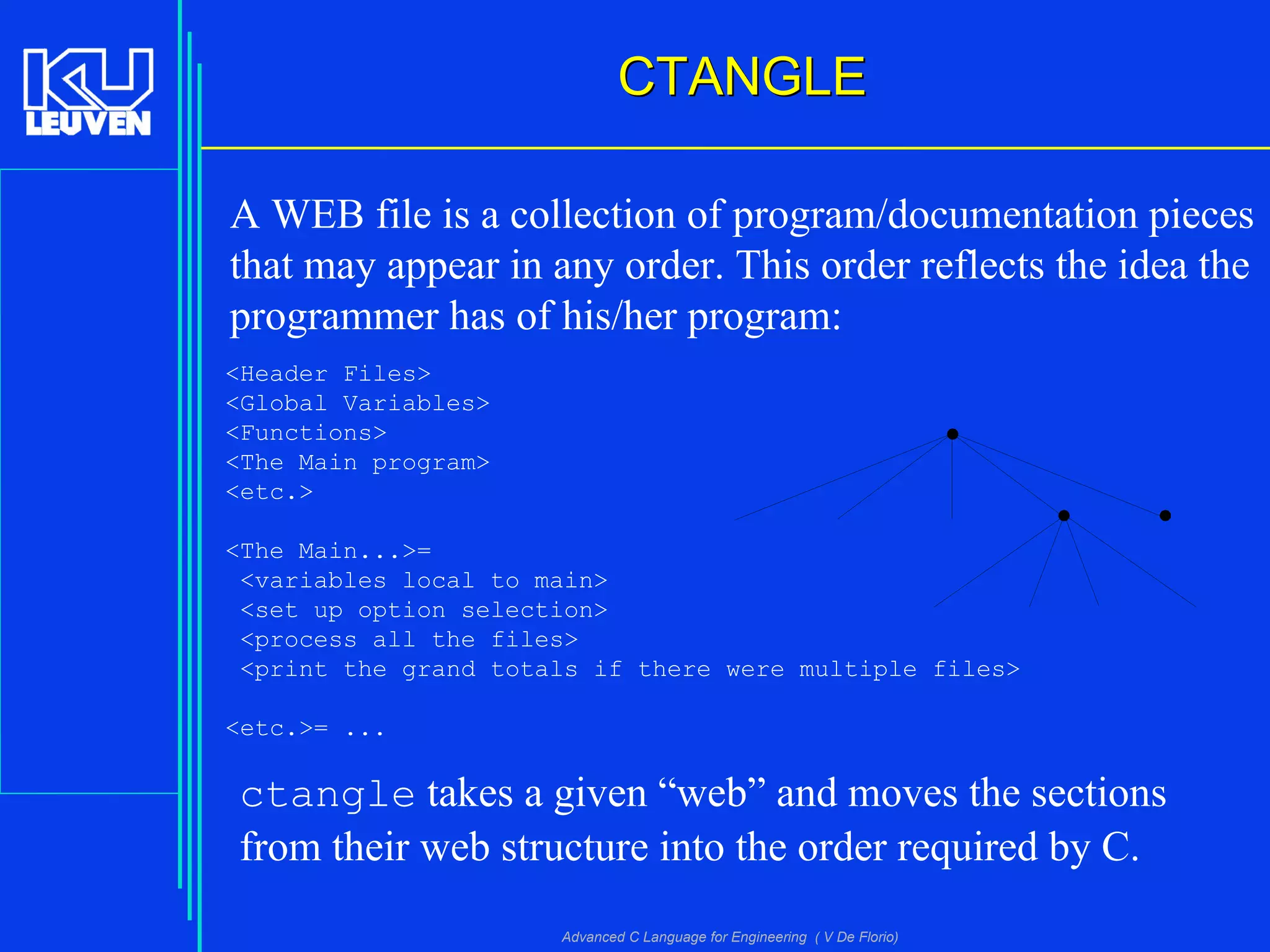
CTANGLECTANGLE
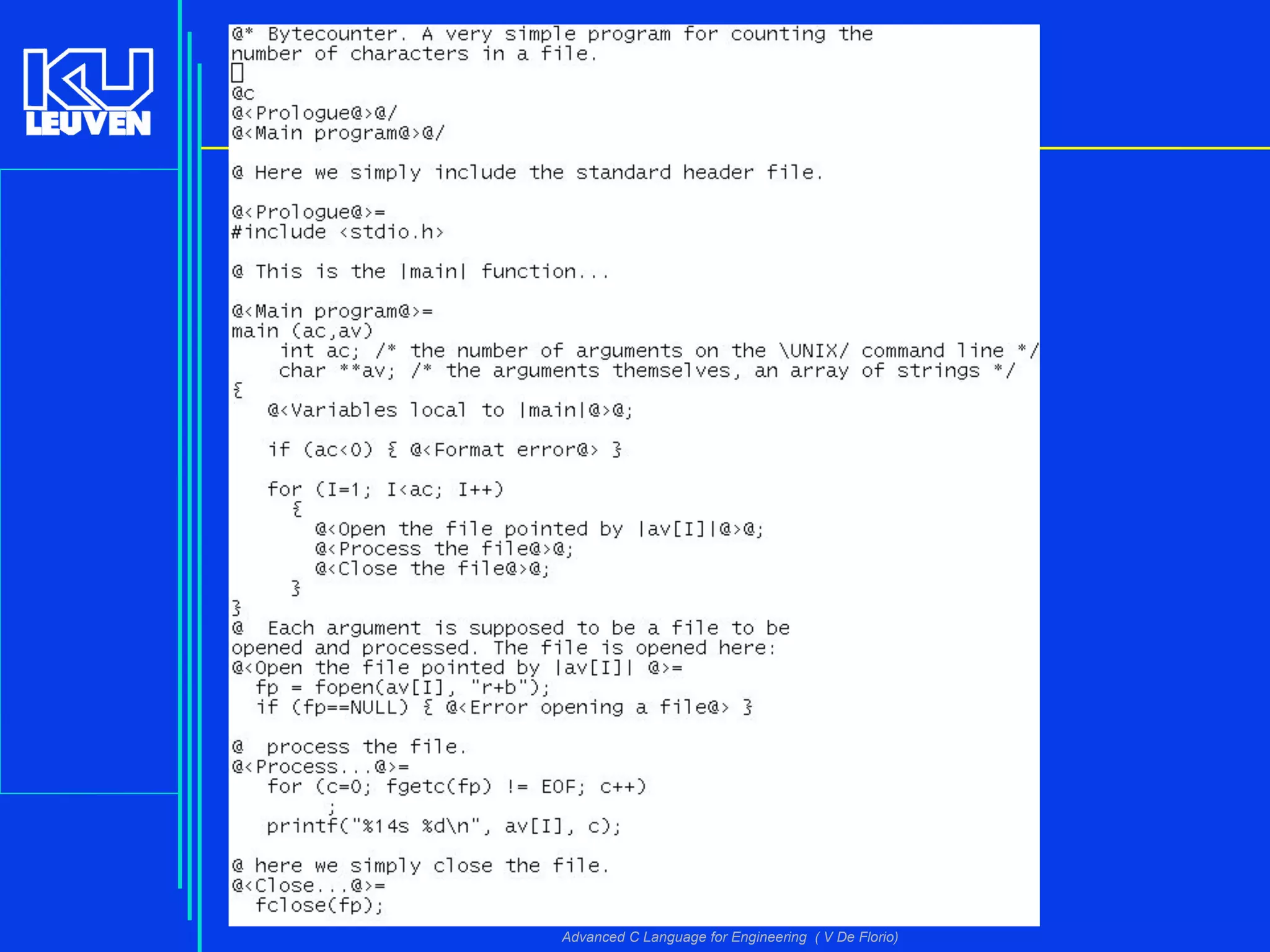
A WEB file is a collection of program/documentation pieces
that may appear in any order. This order reflects the idea the
programmer has of his/her program:
ctangle takes a given “web” and moves the sections
from their web structure into the order required by C.
<Header Files>
<Global Variables>
<Functions>
<The Main program>
<etc.>
<The Main...>=
<variables local to main>
<set up option selection>
<process all the files>
<print the grand totals if there were multiple files>
<etc.>= ...
Advanced C Language for Engineering ( V De Florio)
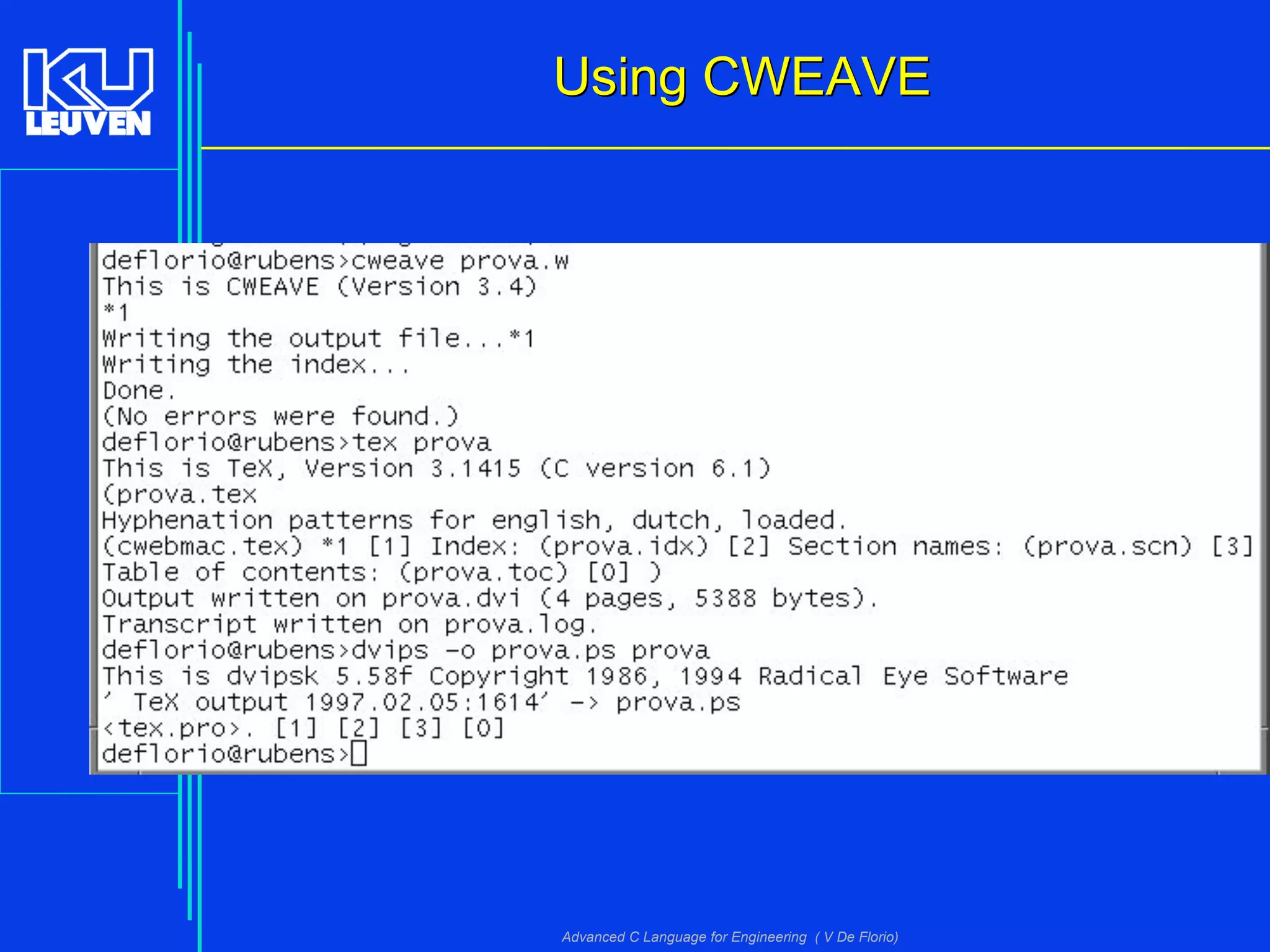
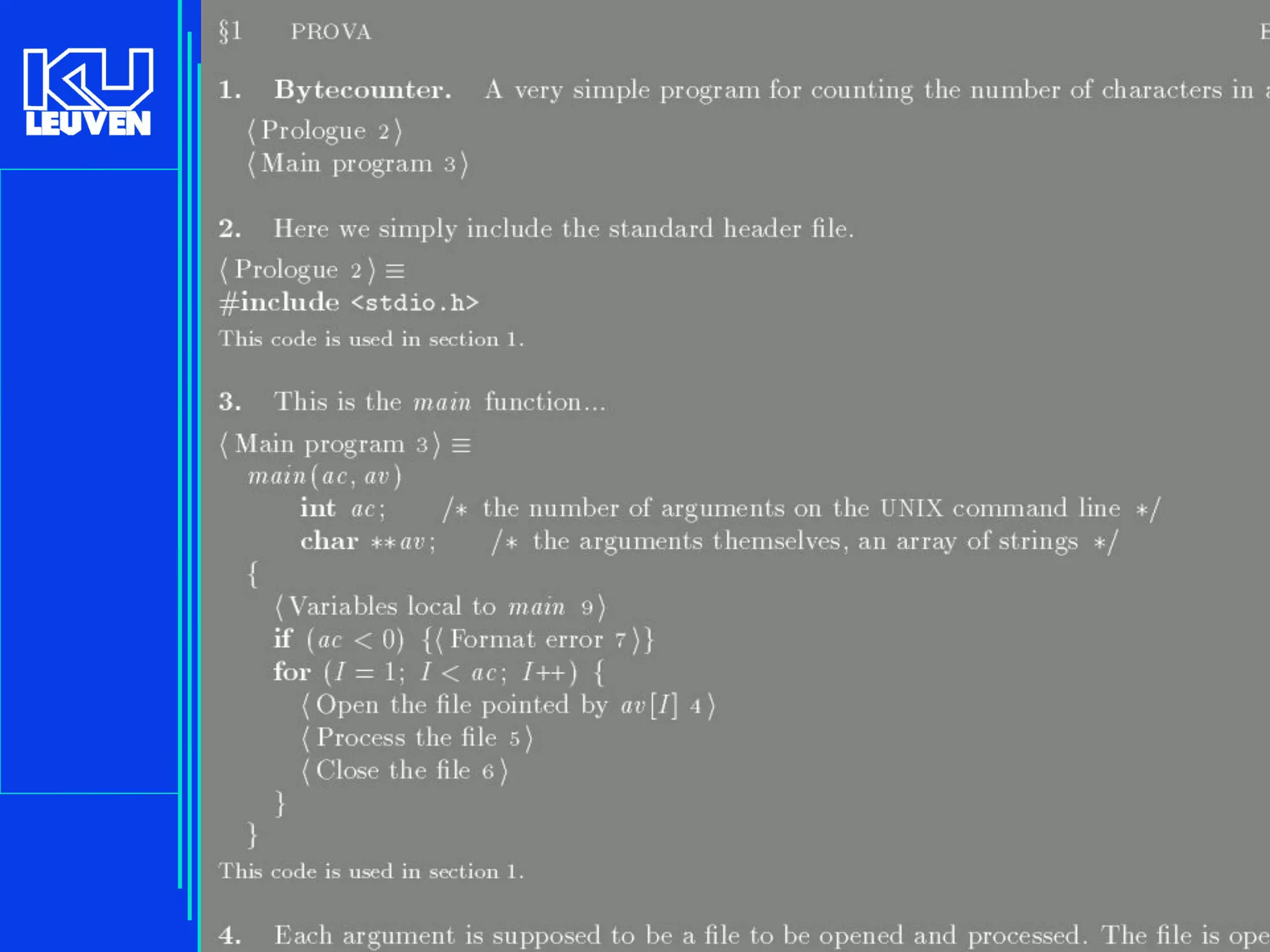
CWEAVECWEAVE
cweave takes a given “web” and creates a
structured TeX document in which:
• all sections are numbered,
• every relationship between sections are highlighted,
• all places where something is defined are highlighted,
• the C program is “beautified.”
Advanced C Language for Engineering ( V De Florio)
DrawbacksDrawbacks
• TeX is needed (a huge software system),
including fonts and tools like DVI viewers
and converters;
• some knowledge of TeX is needed!
Advanced C Language for Engineering ( V De Florio)
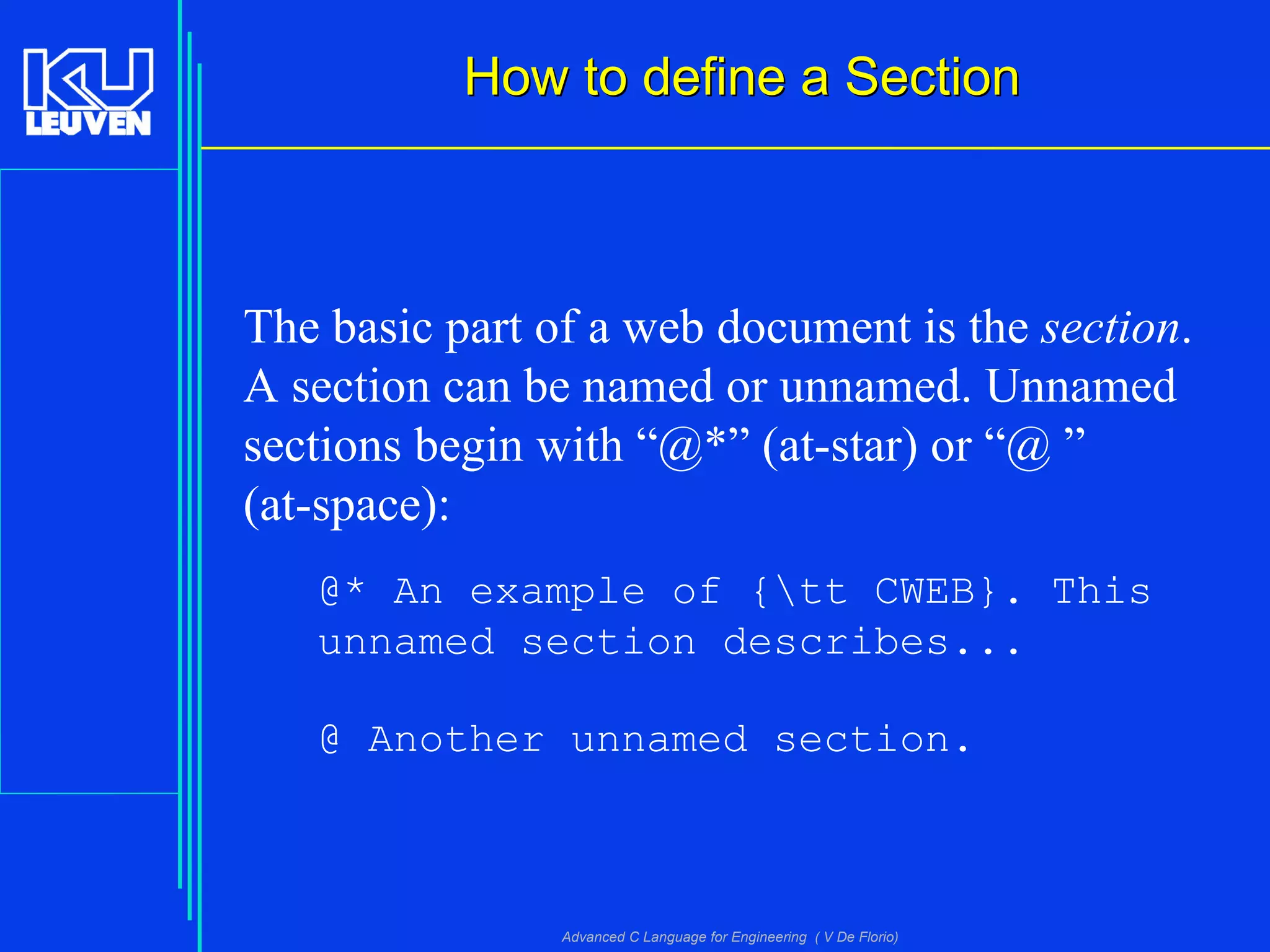
How to define a SectionHow to define a Section
The basic part of a web document is the section.
A section can be named or unnamed. Unnamed
sections begin with “@*” (at-star) or “@ ”
(at-space):
@* An example of {tt CWEB}. This
unnamed section describes...
@ Another unnamed section.
Advanced C Language for Engineering ( V De Florio)
How to define a Section (2)How to define a Section (2)
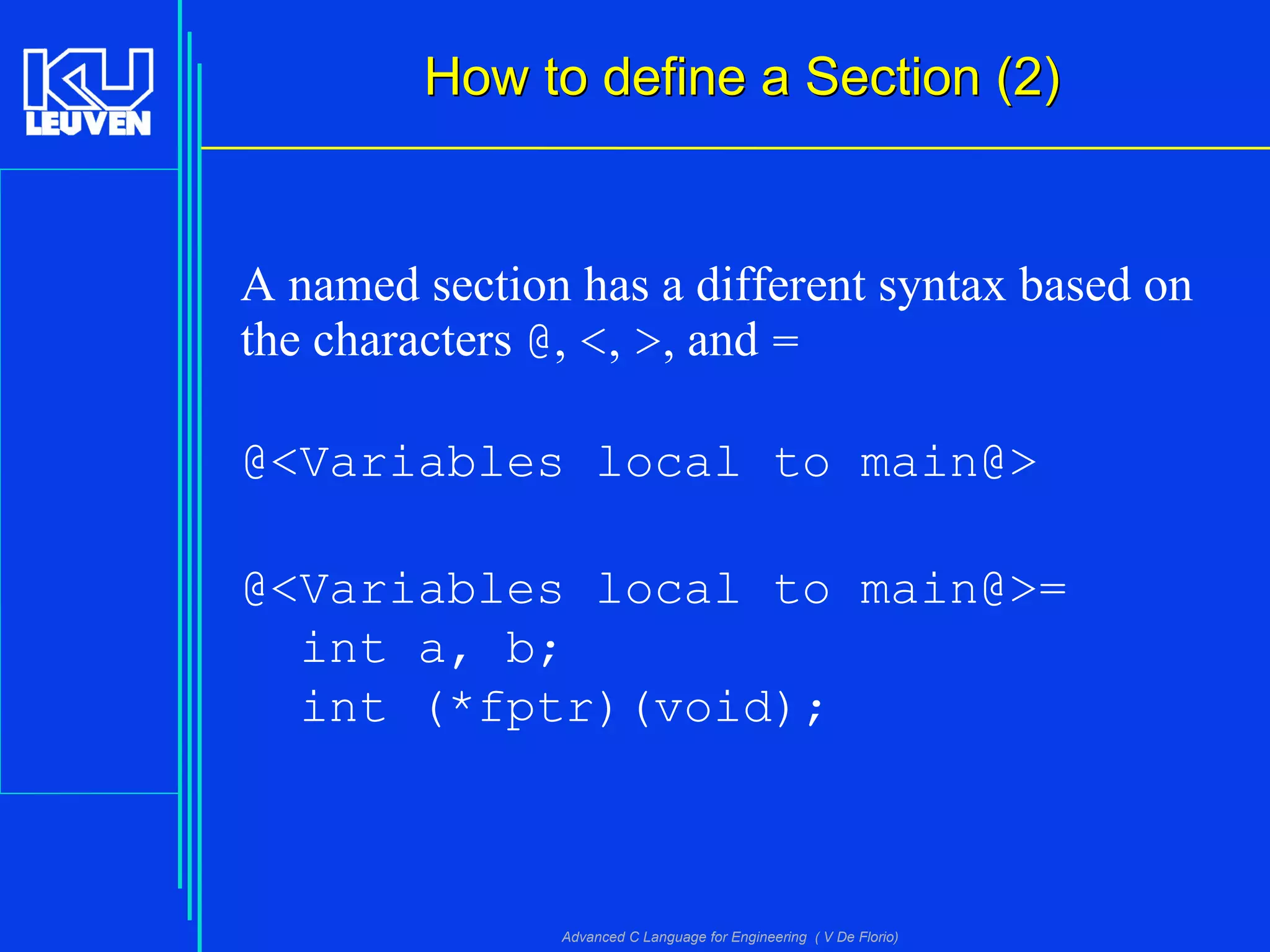
A named section has a different syntax based on
the characters @, <, >, and =
@<Variables local to main@>
@<Variables local to main@>=
int a, b;
int (*fptr)(void);
Advanced C Language for Engineering ( V De Florio)
Using CWEAVEUsing CWEAVE
Advanced C Language for Engineering ( V De Florio)
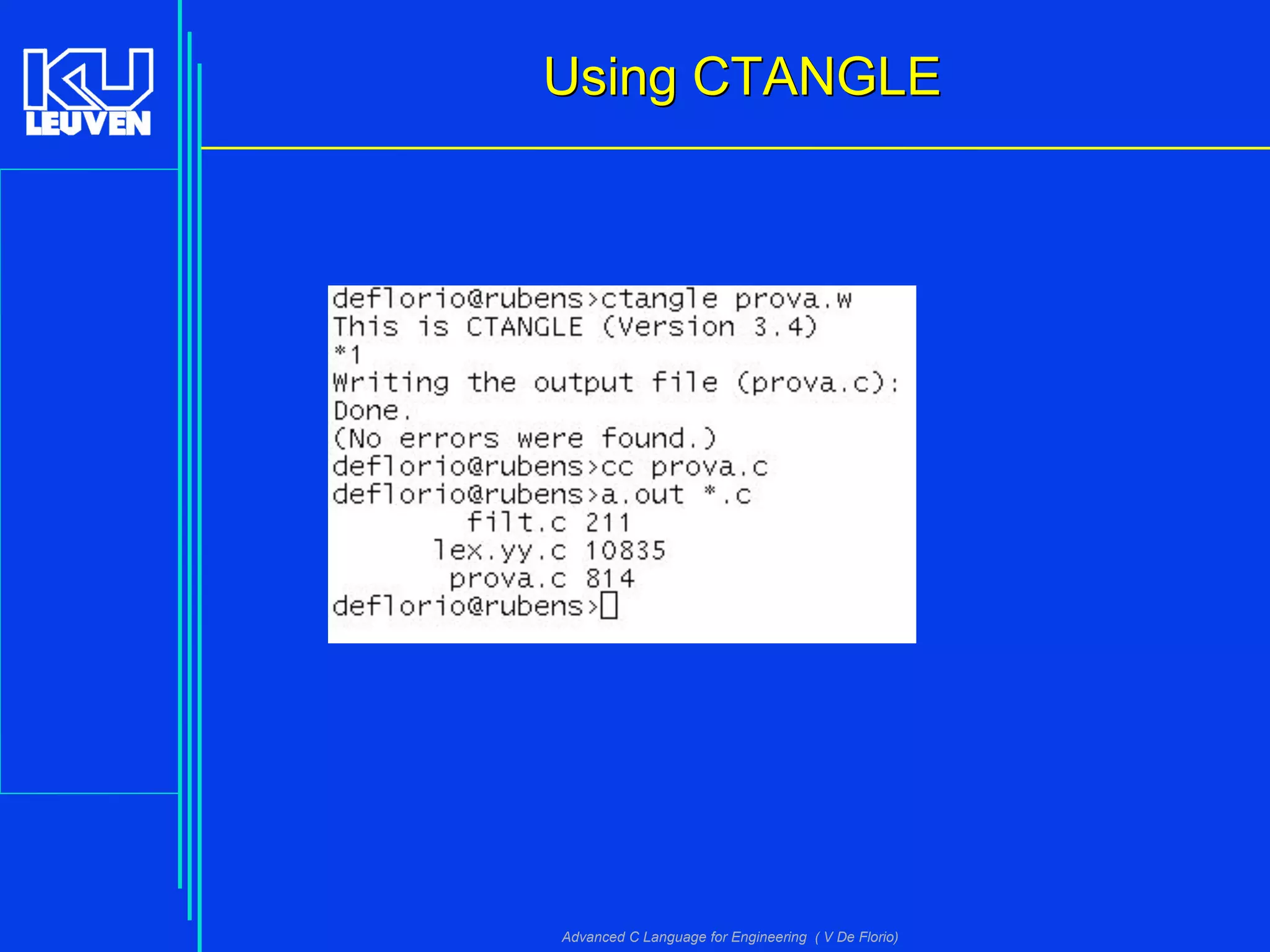
Using CTANGLEUsing CTANGLE
177
Advanced C Language for Engineering ( V De Florio)
Deepenings: the TIRAN frameworkDeepenings: the TIRAN framework
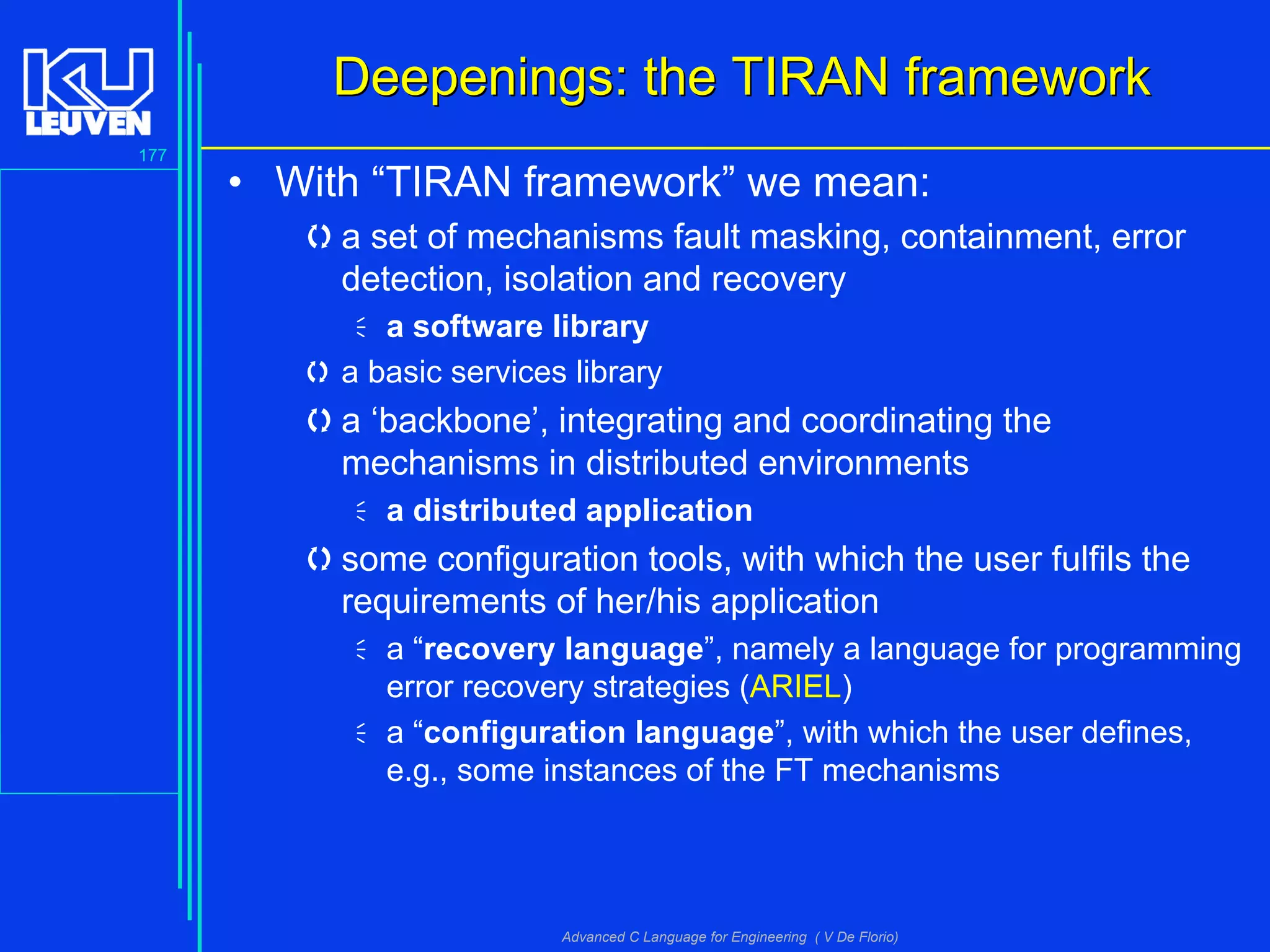
• With “TIRAN framework” we mean:
a set of mechanisms fault masking, containment, error
detection, isolation and recovery
a software library
 a basic services library
a ‘backbone’, integrating and coordinating the
mechanisms in distributed environments
a distributed application
some configuration tools, with which the user fulfils the
requirements of her/his application
a “recovery language”, namely a language for programming
error recovery strategies (ARIEL)
a “configuration language”, with which the user defines,
e.g., some instances of the FT mechanisms
178
Advanced C Language for Engineering ( V De Florio)
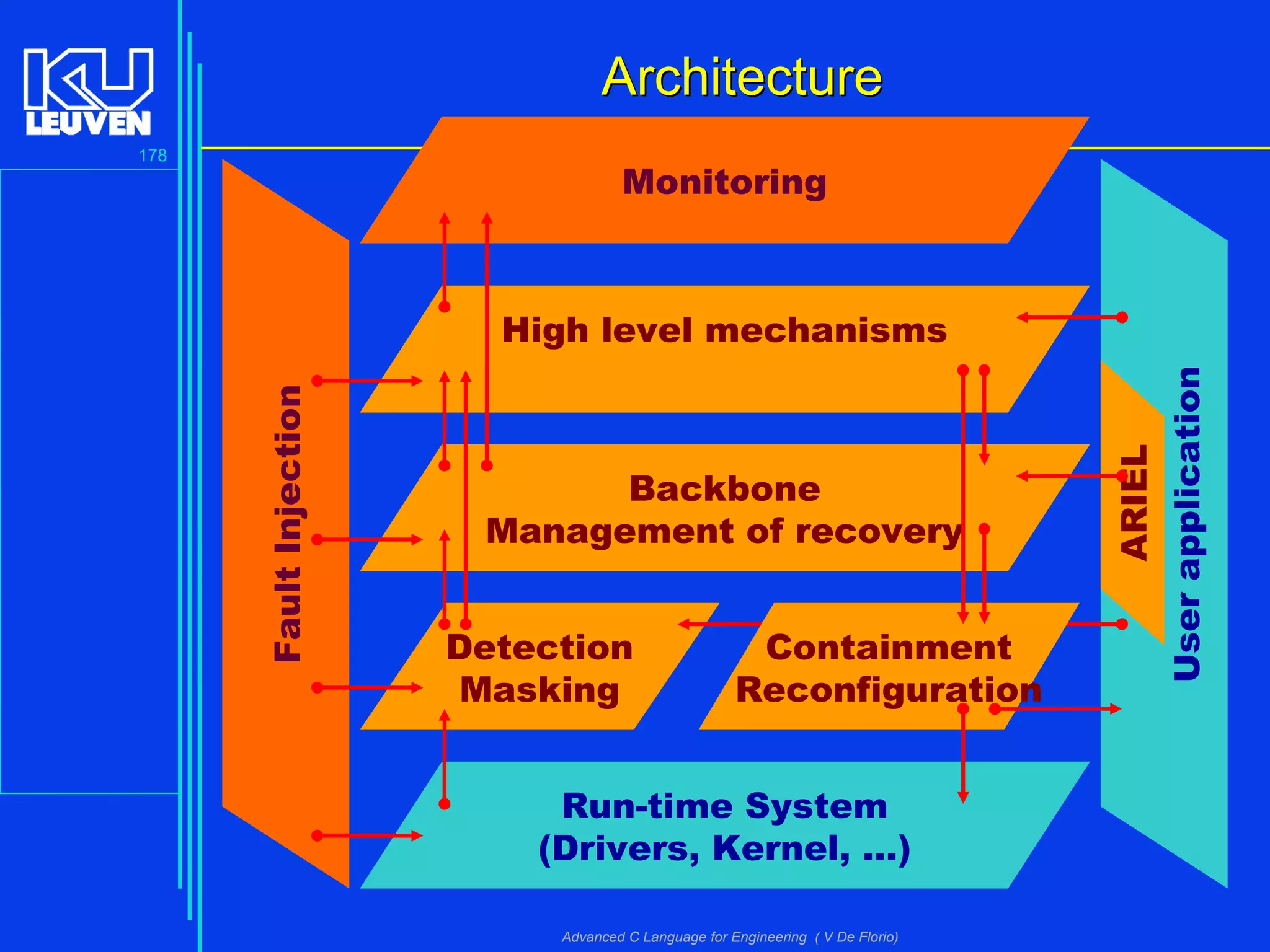
ArchitectureArchitecture
Run-time System
(Drivers, Kernel, …)
Userapplication
ARIEL
Detection
Masking
Backbone
Management of recovery
Containment
Reconfiguration
High level mechanisms
FaultInjection
Monitoring
179
Advanced C Language for Engineering ( V De Florio)
MechanismsMechanisms
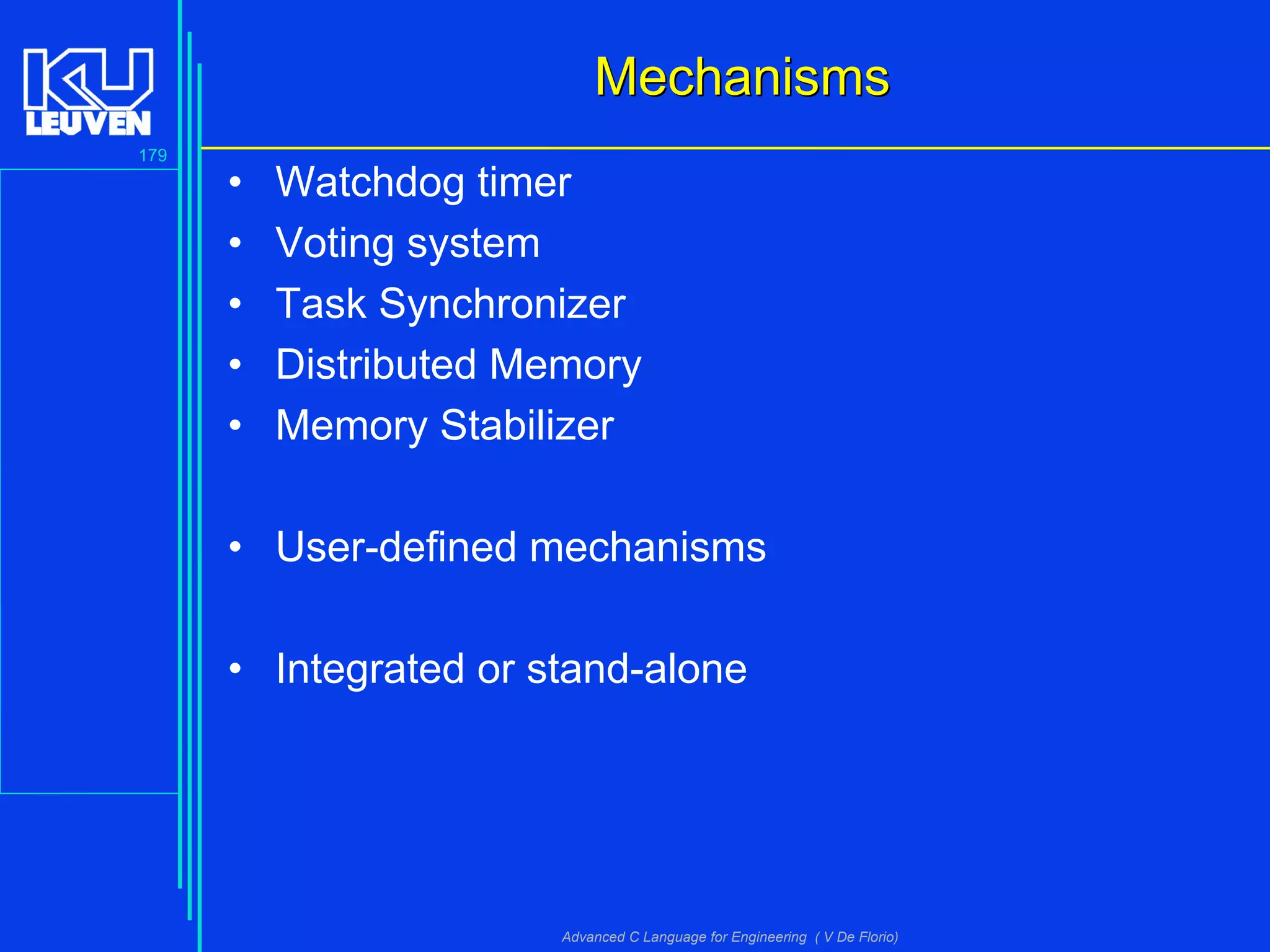
• Watchdog timer
• Voting system
• Task Synchronizer
• Distributed Memory
• Memory Stabilizer
• User-defined mechanisms
• Integrated or stand-alone
180
Advanced C Language for Engineering ( V De Florio)
Basic services libraryBasic services library
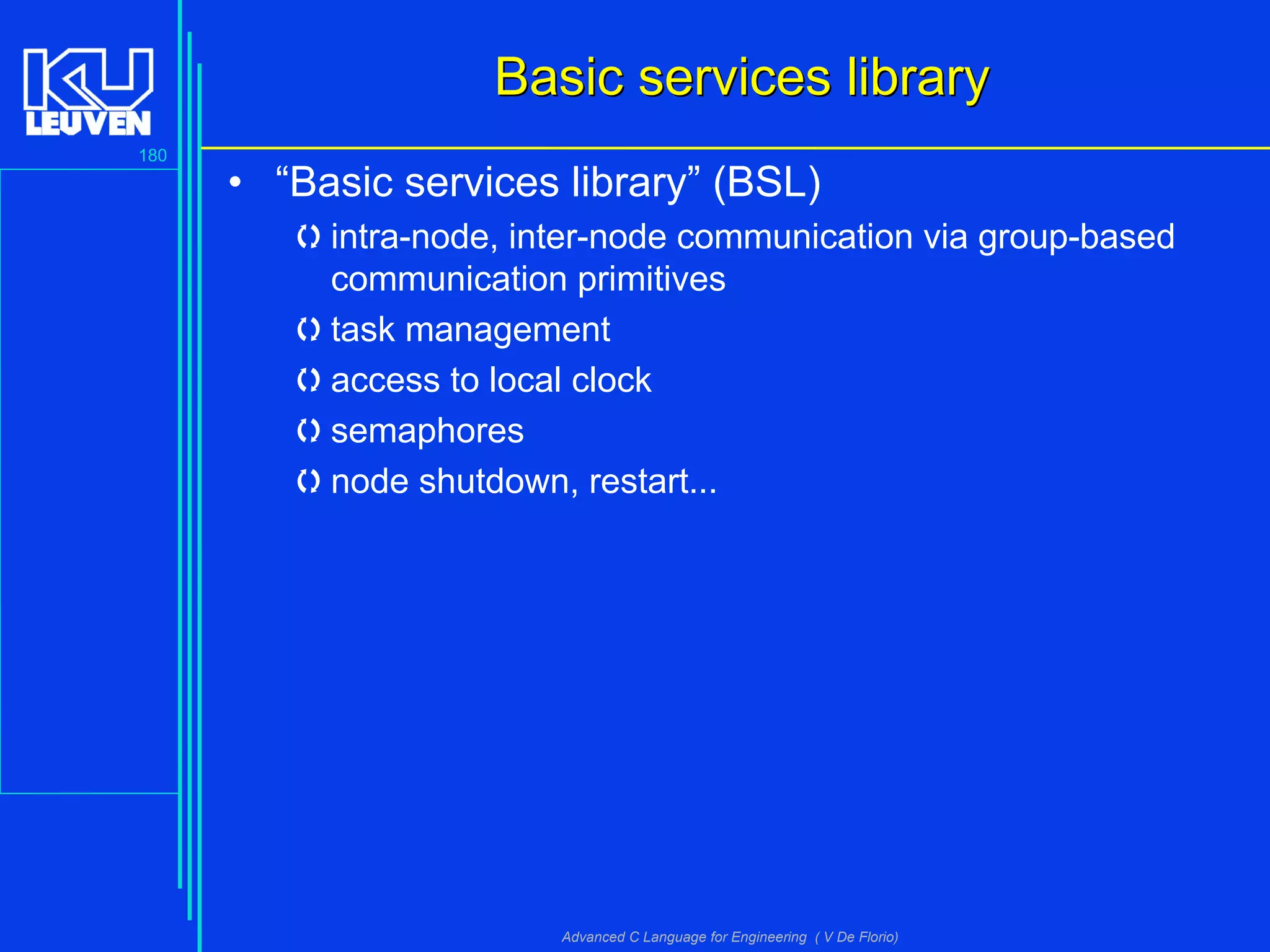
• “Basic services library” (BSL)
intra-node, inter-node communication via group-based
communication primitives
task management
access to local clock
semaphores
node shutdown, restart...
181
Advanced C Language for Engineering ( V De Florio)
BackboneBackbone
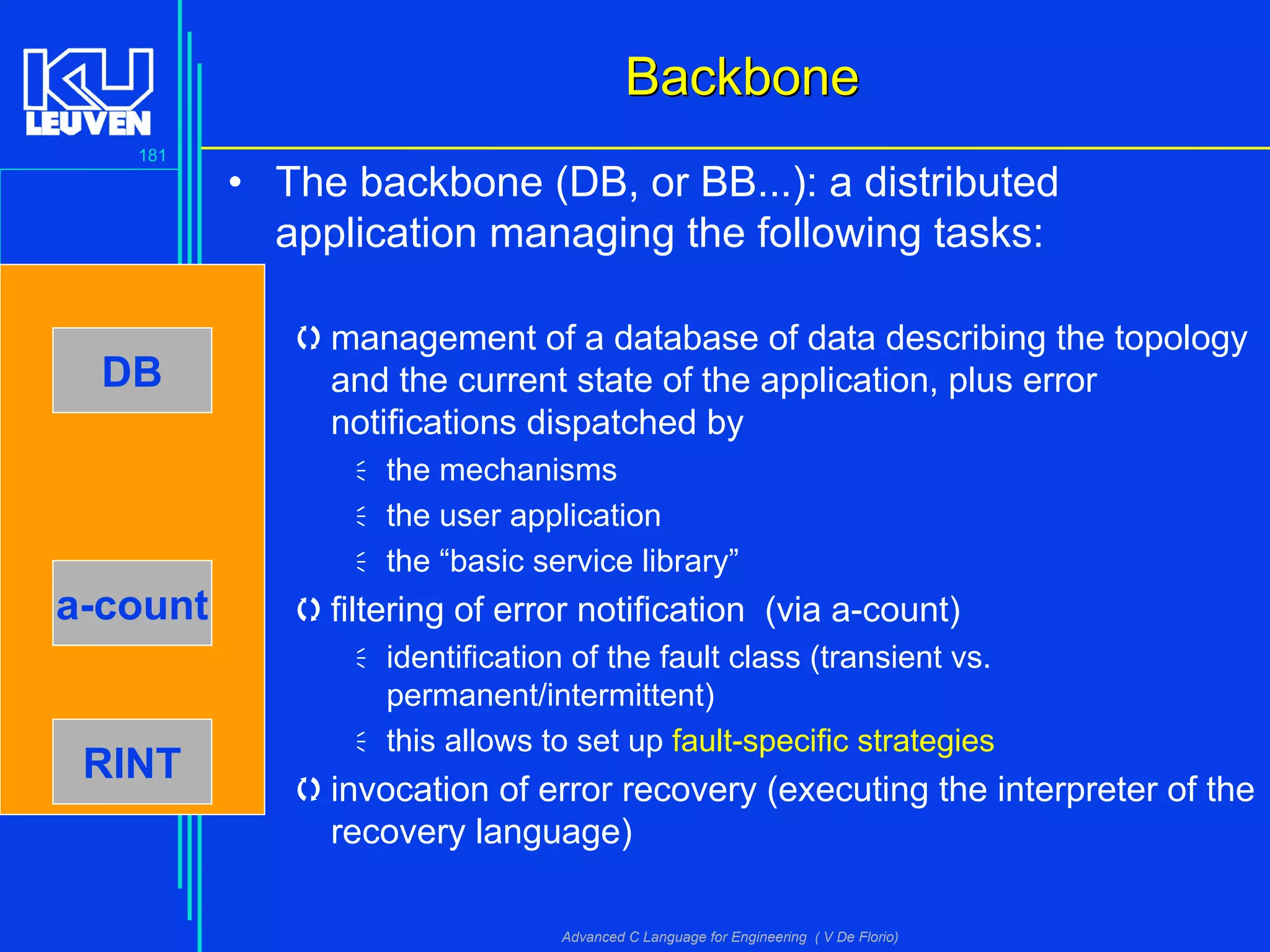
• The backbone (DB, or BB...): a distributed
application managing the following tasks:
management of a database of data describing the topology
and the current state of the application, plus error
notifications dispatched by
the mechanisms
the user application
the “basic service library”
filtering of error notification (via a-count)
identification of the fault class (transient vs.
permanent/intermittent)
this allows to set up fault-specific strategies
invocation of error recovery (executing the interpreter of the
recovery language)
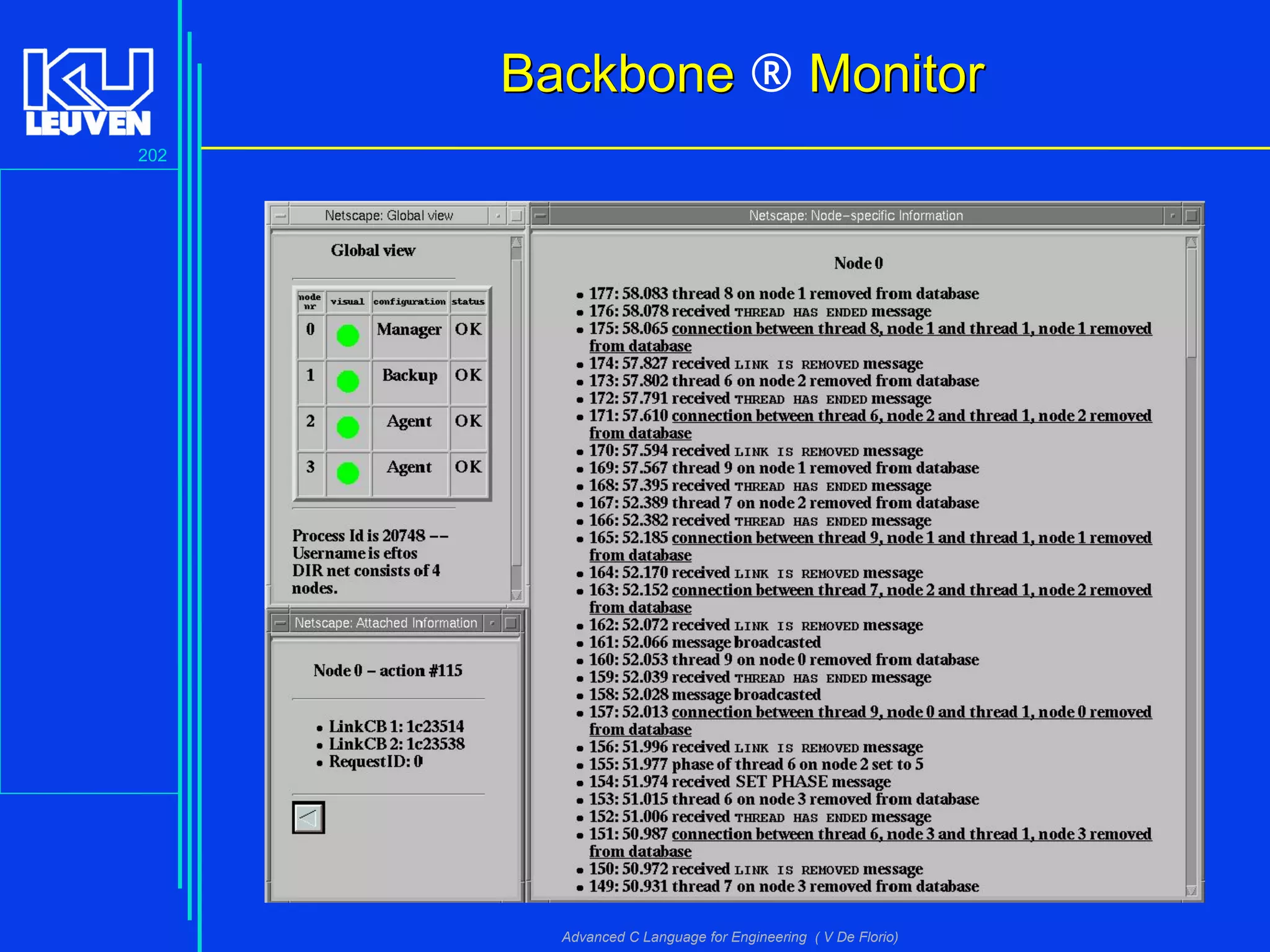
DB
a-count
RINT
182
Advanced C Language for Engineering ( V De Florio)
BackboneBackbone ® typical scenariotypical scenario
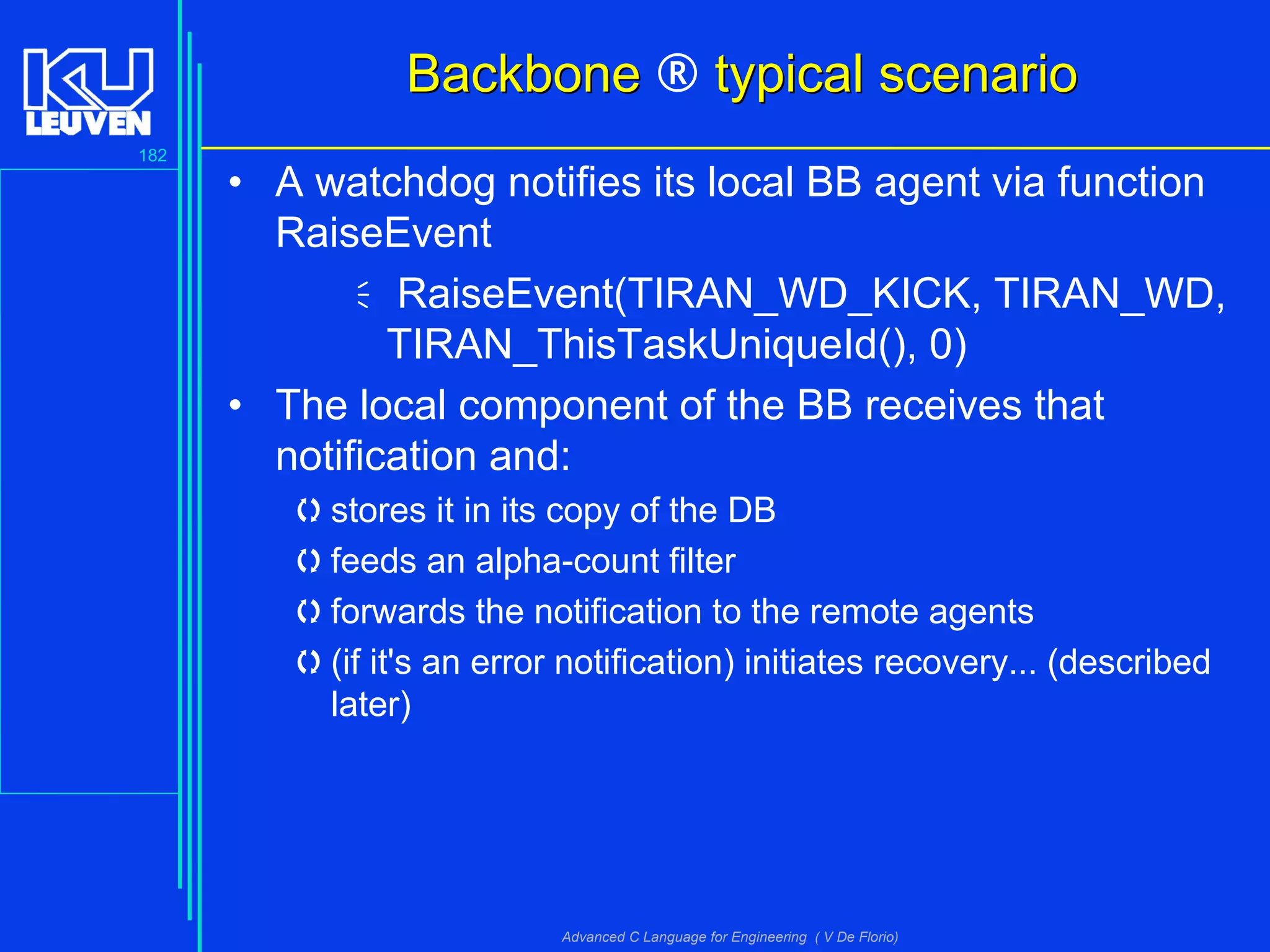
• A watchdog notifies its local BB agent via function
RaiseEvent
RaiseEvent(TIRAN_WD_KICK, TIRAN_WD,
TIRAN_ThisTaskUniqueId(), 0)
• The local component of the BB receives that
notification and:
stores it in its copy of the DB
feeds an alpha-count filter
forwards the notification to the remote agents
(if it's an error notification) initiates recovery... (described
later)
183
Advanced C Language for Engineering ( V De Florio)
BackboneBackbone
• Recovery may ask specific services to basic tools
for isolation or recovery
• Prototypal implementation in C and the BSL for NT
and C/EPX for Parsytec PowerXplorer
184
Advanced C Language for Engineering ( V De Florio)
BackboneBackbone
• Backbone: distributed application
made of “agents”: (task D, task I, task R)
" node i in { 0,..,n-1 } : D[i], I[i], R[i] run on node i.
D : database / a-count,
I: “I’m Alive” task (watchdog)
R: recovery interpreter
D-I-R => “DIR-net”
• Agents: one manager and a set of assistants in
hierarchical order
• Based on an algorithm for tolerating node and task
crashes
185
Advanced C Language for Engineering ( V De Florio)
BackboneBackbone
• BB is compliant to the timed-asynchronous
distributed system model (Cristian & Fetzer)
• In particular, BB tolerates system partitioning during
periods of instability
• Partitions are merged back at the end of a period of
instability
• As a special case, when a crashed node is
rebooted, it is re-entered in the BB
186
Advanced C Language for Engineering ( V De Florio)
BackboneBackbone
• These features are provided by a distributed
algorithm, called “algorithm of mutual suspicion”
because agents mutually question their state
• This algorithm has been designed by means of the
TOM class
187
Advanced C Language for Engineering ( V De Florio)
BackboneBackbone ® AMSAMS
• Twofold error detection strategy:
LOCAL PART: " i : task I[i] watches task D[i]
D[i] periodically clears an “I’m Alive” flag, I[i] periodically
checks and sets it.
If I[i] finds a set flag, it broadcasts a TEIF (“this entity is
faulty”)
REMOTE PART:
manager expects TAIA messages (“this assistant is alive”)
assistants expect MIA messages (“manager is alive”)
WHEN A MESSAGE DOES NOT COME IN WITHIN A
CERTAIN DEADLINE, A SUSPICION PERIOD IS ENTERED
• In absence of faults:
LOCAL PART: flag is set and cleared
REMOTE PART: MIA’s and TAIA’s are sent around resp.
by the manager and the assistants
188
Advanced C Language for Engineering ( V De Florio)
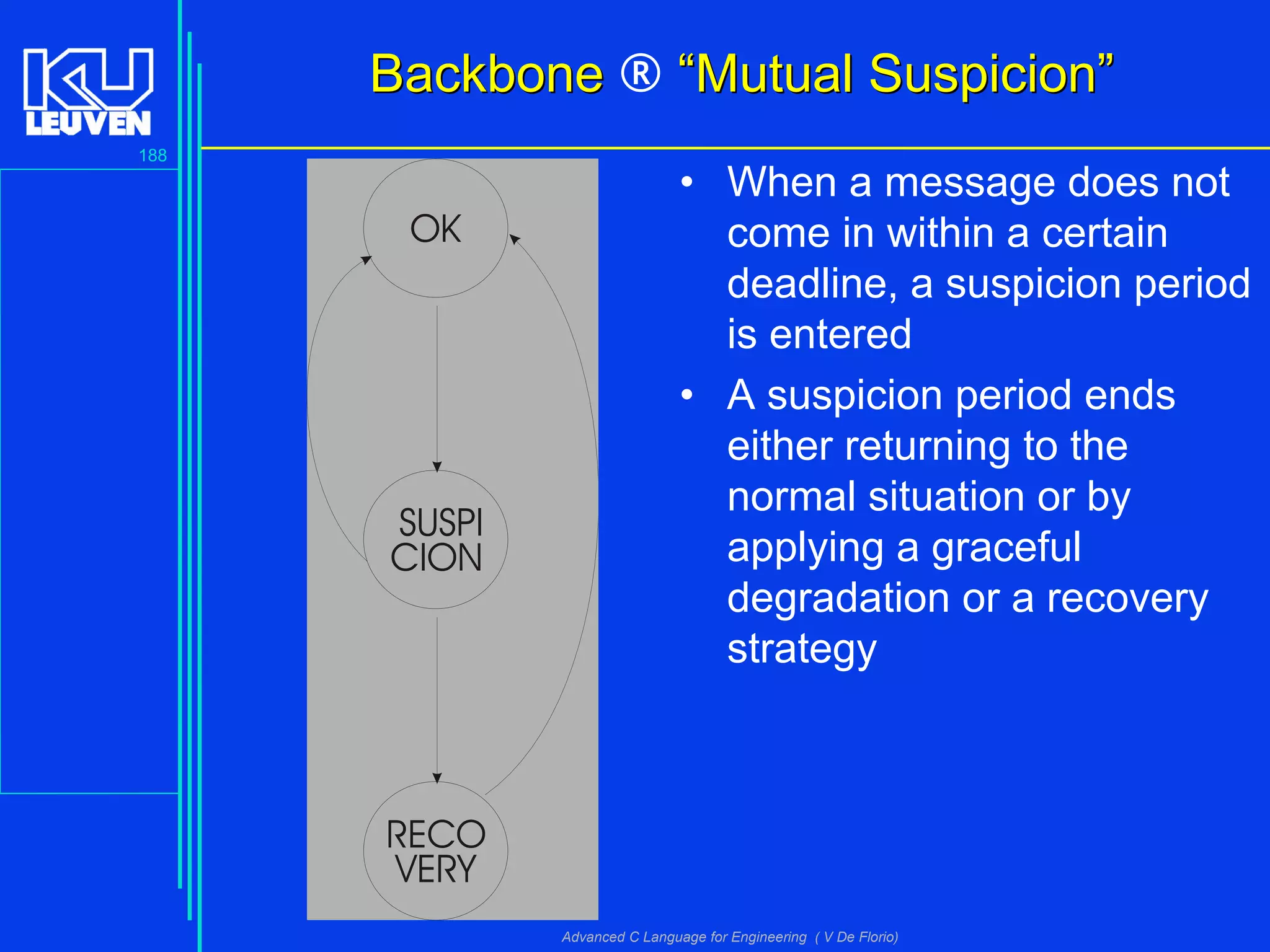
BackboneBackbone ® ““Mutual SuspicionMutual Suspicion””
• When a message does not
come in within a certain
deadline, a suspicion period
is entered
• A suspicion period ends
either returning to the
normal situation or by
applying a graceful
degradation or a recovery
strategy
189
Advanced C Language for Engineering ( V De Florio)
BackboneBackbone ® time-out managementtime-out management
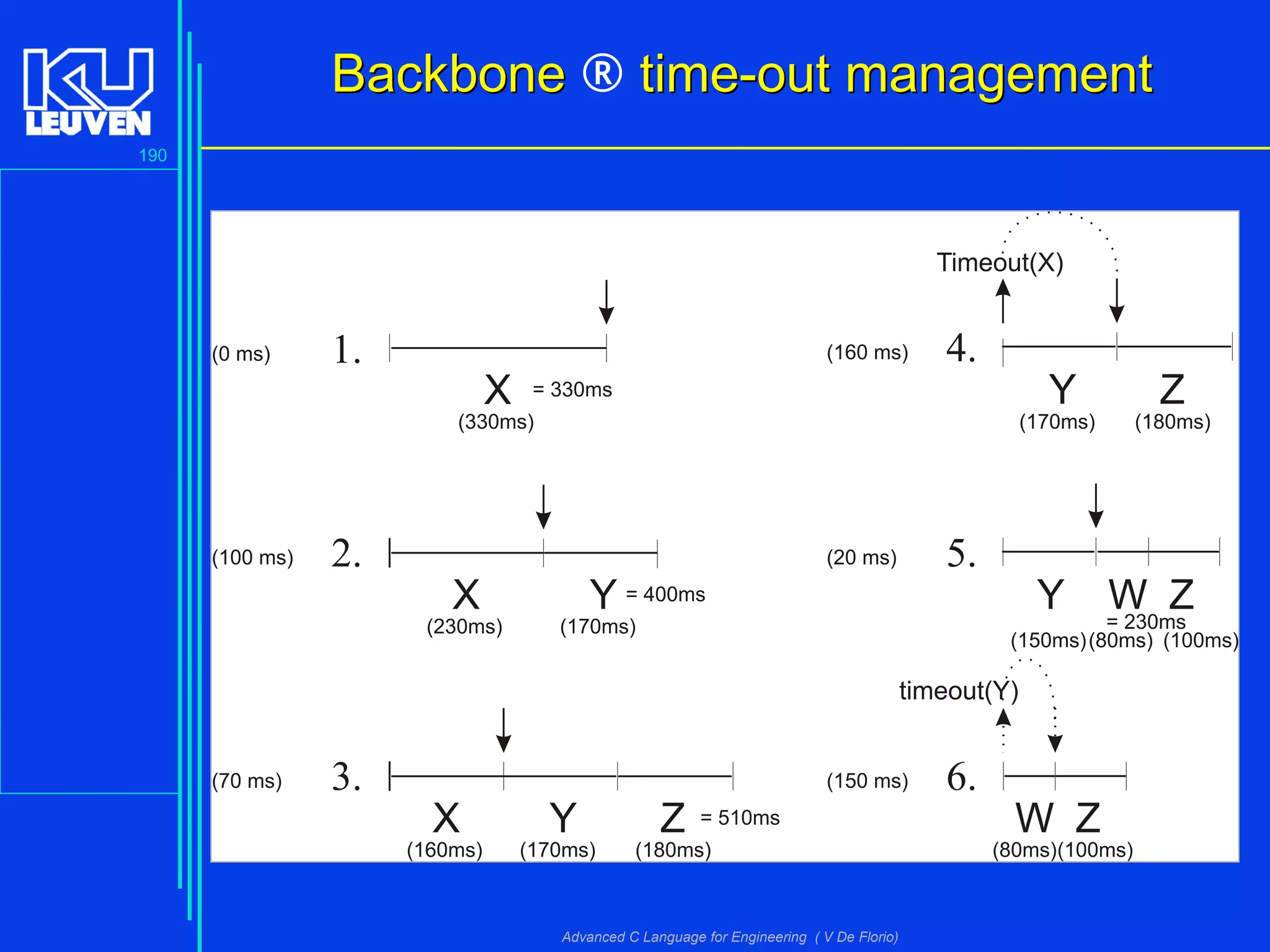
• Based on application-level time-outs
Objects that schedule an event (called alarm) a given
amount of seconds in the future
Cyclic or non-cyclic
In the BB, alarms send a message to task D with a
notification “a time-out has occurred”
So it turns time-related transitions into message arrivals
A special task, task A, runs on each node as time-out
manager
Task A just need to monitor the top entry in the time-out list
Class of C functions for NT and EPX
190
Advanced C Language for Engineering ( V De Florio)
BackboneBackbone ® time-out managementtime-out management
191
Advanced C Language for Engineering ( V De Florio)
BackboneBackbone ® AMSAMS
• Four classes of time-outs
IA_SET_TIMEOUT, IA_CLEAR_TIMEOUT
“It’s time to set/clear the I’m Alive flag!”
Alarm: send D[this node] message IA_SET or IA_CLEAR
MIA_SEND_TIMEOUT, MIA_RECV_TIMEOUT
“It’s time to send a MIA message / to check whether a MIA
message has come in”
Alarm: send D[this node] message MIA_SEND or
MIA_RECV
TAIA_SEND_TIMEOUT, TAIA_RECV_TIMEOUT
“Time to send a TAIA / to check whether a TAIA has come in”
Alarm: send D[this node] message TAIA_SEND or
TAIA_RECV
TEIF_TIMEOUT
“Time to check whether a TEIF message has come in”
Alarm: send D[this node] message TEIF_CHECK
192
Advanced C Language for Engineering ( V De Florio)
BackboneBackbone ® AMSAMS
MIA: Manager Is Alive: sent by the manager to all its
assistants
TAIA: This Assistant Is Alive: sent by each assistant to the
manager
TEIF: This Entity Is Faulty: sent by a task I to signal that its
task D is faulty
MIA_SEND, TAIA_RECV: sent from task A[m] to task D[m]
(the manager)
TAIA_SEND, MIA_RECV: sent from A[i] to D[i] (an
assistant)
TEIF_CHECK: sent from A[i] to D[i] (either the manager or
an assistant)
IA_SET (resp. IA_CLEAR): sent from A[i] to D[i] (resp. from
A[i] to I[i])
193
Advanced C Language for Engineering ( V De Florio)
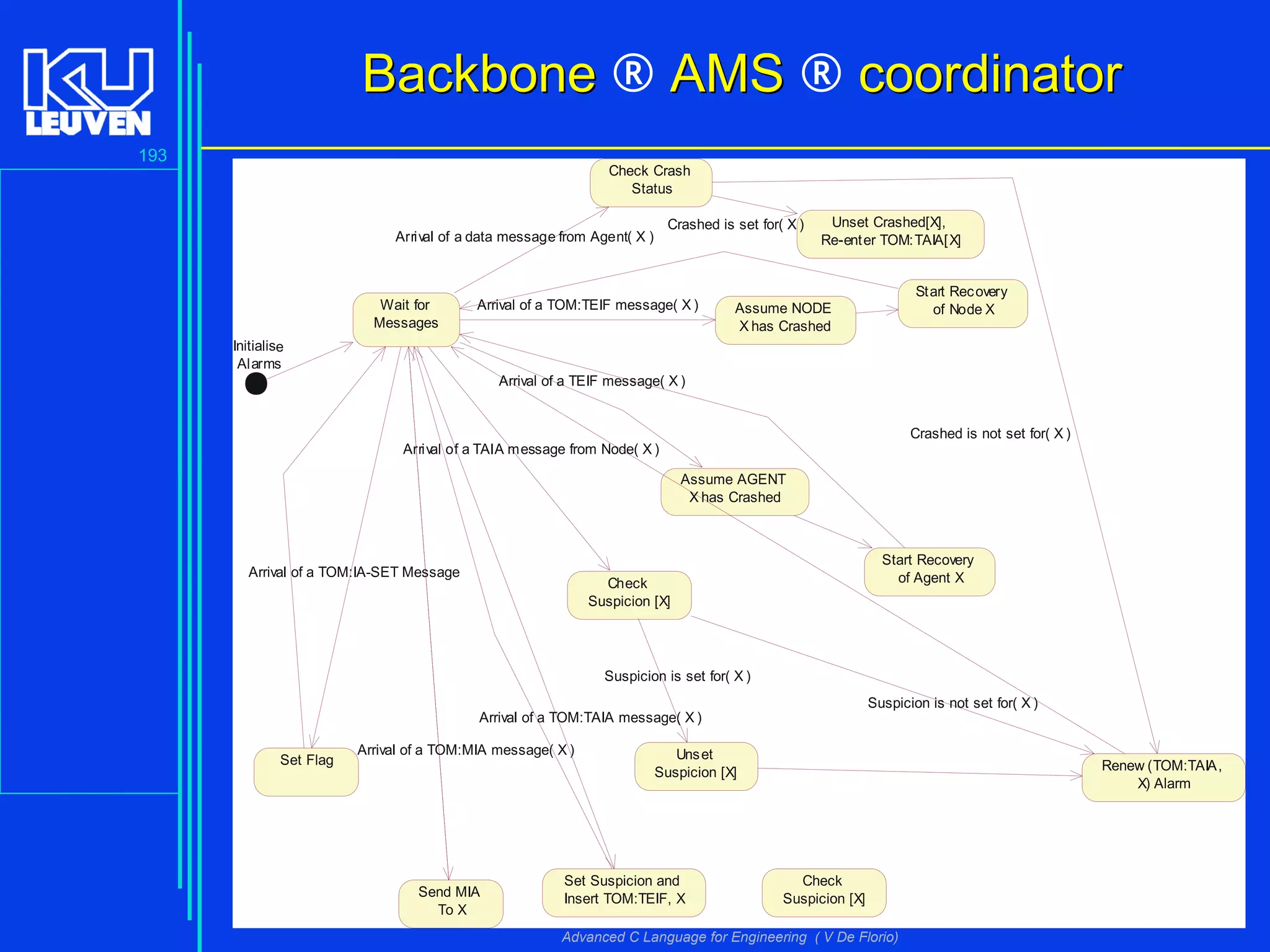
BackboneBackbone ® AMSAMS ® coordinatorcoordinator
194
Advanced C Language for Engineering ( V De Florio)
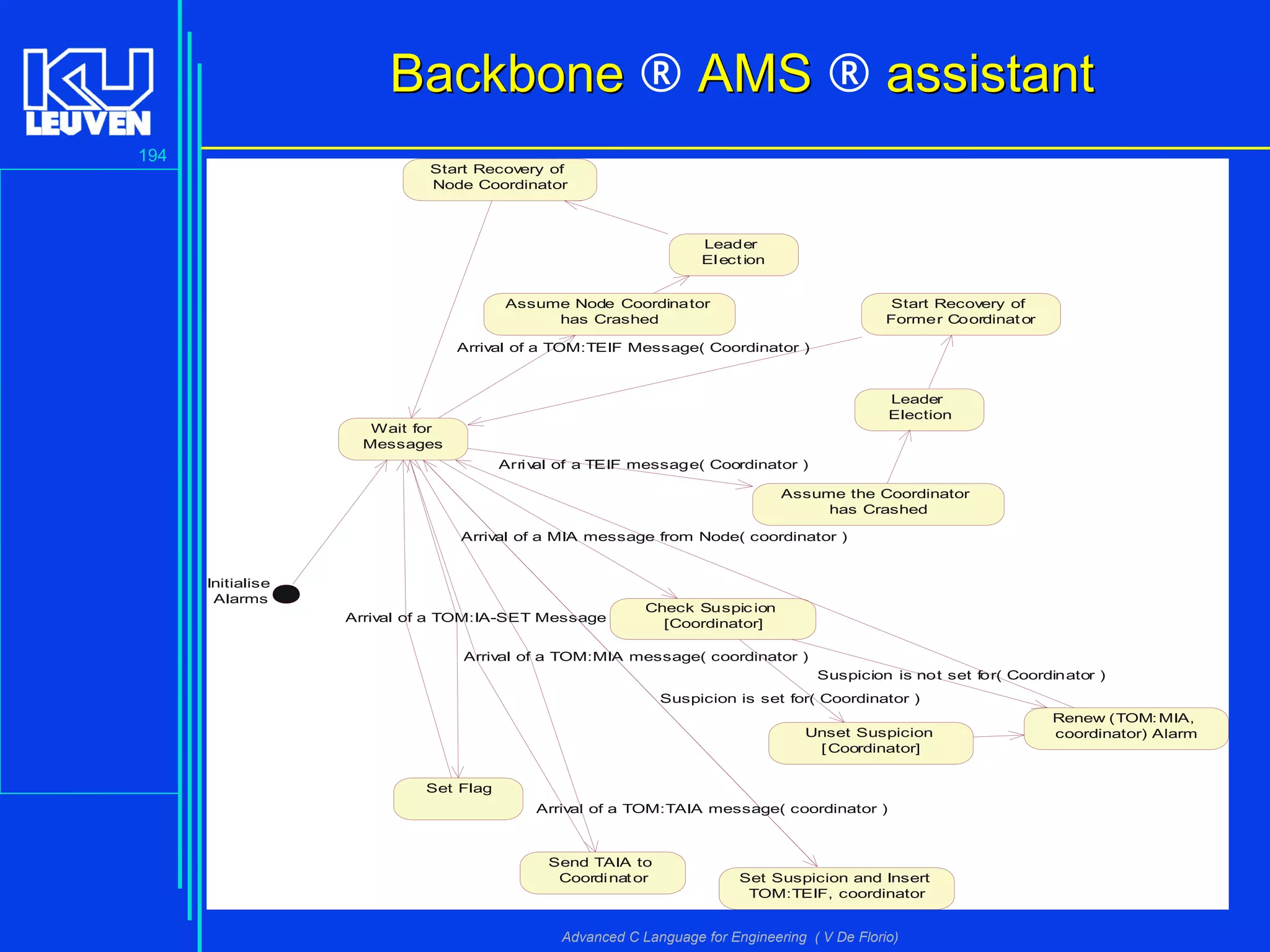
BackboneBackbone ® AMSAMS ® assistantassistant
195
Advanced C Language for Engineering ( V De Florio)
BackboneBackbone ® AMSAMS
• When a crash fault affects D[i]:
I[i] detects this as a set flag Þ broadcasts a TEIF
The others detect this as a lacking TAIA or MIA and a
coming TEIF
• When a crash fault affects node i:
The others detect this as a lacking TAIA or MIA and a
lacking TEIF
196
Advanced C Language for Engineering ( V De Florio)
Pseudo-code of the coordinatorPseudo-code of the coordinator
coordinator()
{
/* the alarm of these alarms simply sends a message of id
<alarm-type>, subid = <subid> to the coordinator
*/
insert alarms (IA-flag-alarm, MIA_SEND-alarms, TAIA_RECV-alarms)
clear all entries of sus[] /* suspicion periods are all off */
set IA-flag /* ``I'm alive'' flag */
activate IAT /* I'm Alive Task */
loop (wait for incoming messages)
{
switch (message.type)
{
/* time to set the IA-flag! */
case IA-flag-alarm:
set IA-flag,
break;
197
Advanced C Language for Engineering ( V De Florio)
Pseudo-code of the coordinatorPseudo-code of the coordinator
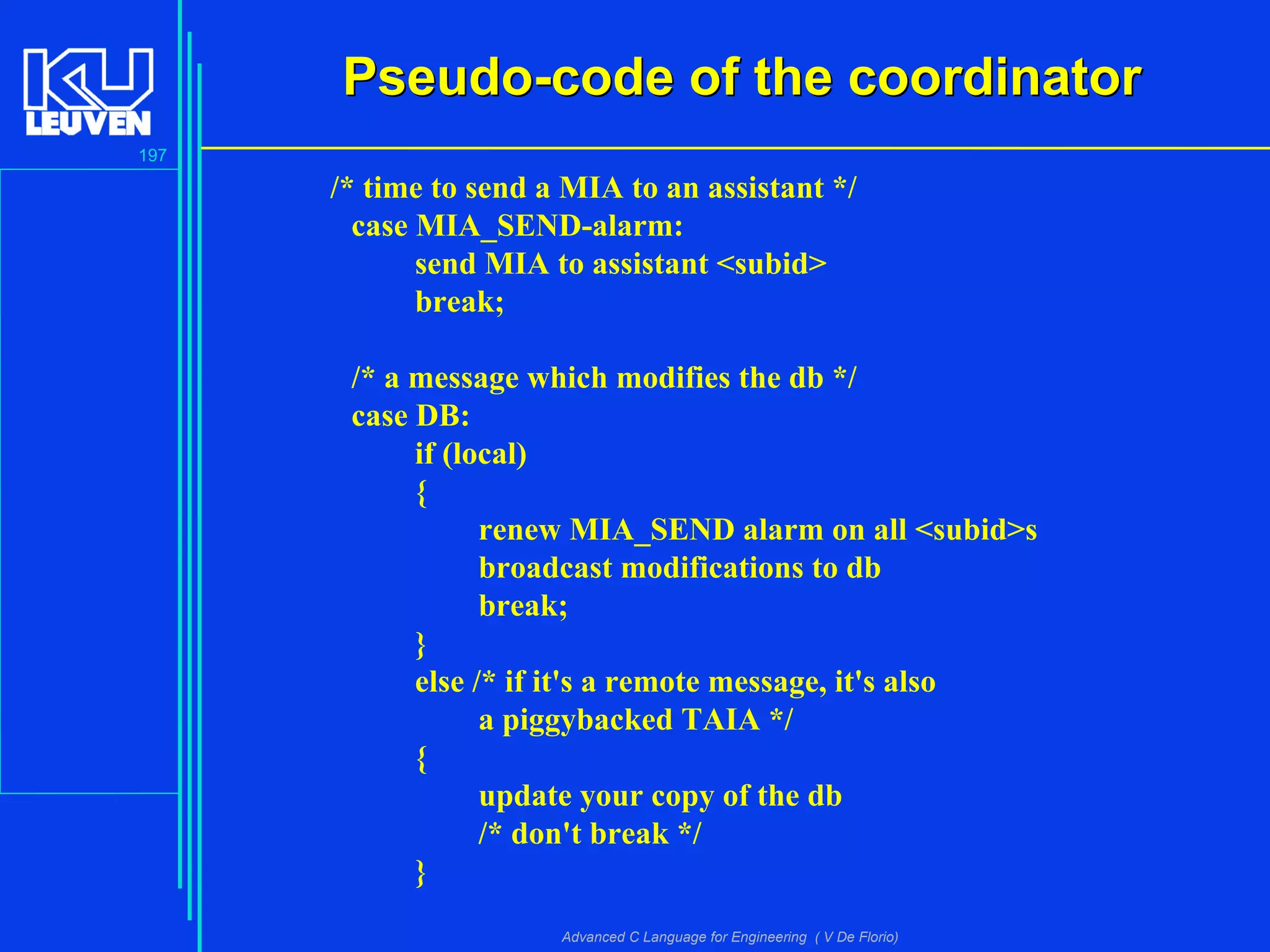
/* time to send a MIA to an assistant */
case MIA_SEND-alarm:
send MIA to assistant <subid>
break;
/* a message which modifies the db */
case DB:
if (local)
{
renew MIA_SEND alarm on all <subid>s
broadcast modifications to db
break;
}
else /* if it's a remote message, it's also
a piggybacked TAIA */
{
update your copy of the db
/* don't break */
}
198
Advanced C Language for Engineering ( V De Florio)
Pseudo-code of the coordinatorPseudo-code of the coordinator
/* if a TAIA comes in or a remote DB message comes in... */
case TAIA:
if ( ! ispresent(TAIA_RECV-alarm, <subid> ) {
insert TAIA_RECV-alarm, <subid>
broadcast NIUA /* node is up again! */
}
renew TAIA_RECV-alarm, <subid>
/* if you get a TAIA while expecting a TEIF, then
no problem, simply get out of the suspicion period */
if (sus[ <subid> ] == TRUE)
sus[ <subid> ] = FALSE;
break;
/* no heartbeat from a remote component... enter a suspicion period */
case TAIA_RECV-alarm:
sus[ <subid> ] = TRUE
insert alarm (TEIF_RECV-alarm, NON_CYCLIC,
IMALIVE_RECV_TIMEOUT, <subid>)
delete alarm (TAIA_RECV-alarm, <subid>);
break;
199
Advanced C Language for Engineering ( V De Florio)
Pseudo-code of the coordinatorPseudo-code of the coordinator
/* a TEIF message has been sent from a IAT: as its last action,
the IAT went to sleep */
case TEIF:
if (sus[ <subid> ] == TRUE) {
delete alarm (TEIF_RECV-alarm, <subid>)
sus[ <subid> ] = FALSE
/* agent recovery will spawn a clone of the
assistant <subid>. If no assistant clones
are available, the entire node will
be rebooted. */
Agent-Recovery( <subid> )
} else {
if (local) {
set IA-flag
enable IAT
} else send ENIA (i.e., ``ENable IAt'') to <subid>
}
break;
200
Advanced C Language for Engineering ( V De Florio)
Pseudo-code of the coordinatorPseudo-code of the coordinator
case TEIF_RECV-alarm:
if (sus[ <subid> ] == TRUE) {
delete alarm (TAIA_RECV-alarm, <subid>)
sus[ <subid> ] = FALSE
/* the entire node will be rebooted. */
Node-Recovery( <subid> )
}
break;
case ENIA:
set IA-flag
activate IAT
/* if an IAT gets an “activate” message while it's
active, the message is ignored */
break;
default: deal with other messages
} /* end switch (message.type) */
set IA-flag
renew IA-flag-alarm
} /* end loop */
} /* end coordinator */
201
Advanced C Language for Engineering ( V De Florio)
Rendering via a hypermedia monitorRendering via a hypermedia monitor
• Non-parsing header CGI script (written in C)
• Remotely controlled Netscape browser
202
Advanced C Language for Engineering ( V De Florio)
BackboneBackbone ® MonitorMonitor
203
Advanced C Language for Engineering ( V De Florio)
SimulationsSimulations
204
Advanced C Language for Engineering ( V De Florio)
Simulations (2)Simulations (2)
205
Advanced C Language for Engineering ( V De Florio)
Simulations (3)Simulations (3)
206
Advanced C Language for Engineering ( V De Florio)
Simulations (4)Simulations (4)
207
Advanced C Language for Engineering ( V De Florio)
Deepenings: RDeepenings: ReeL: adoption of aL: adoption of a
configuration languageconfiguration language
• A configuration language is a linguistic framework to
define system, middleware, and application parameters
define tasks, groups, nodes
configure the basic tools
configuration of parameters (e.g., for alpha-count)
208
Advanced C Language for Engineering ( V De Florio)
RReeLL ® ConfigConfig ® ExampleExample
# Defines are importable from C header
# files via the INCLUDE statement
INCLUDE "phases.h"
INCLUDE ”../backbone.h"
# Definitions
NPROCS = 4
Define 0 = MANAGER
Define 1-3 = ASSISTANTS
MIA_SEND_TIMEOUT = 800000 # Manager Is
# Alive -- manager side
TAIA_RECV_TIMEOUT = 1500000 # This
# Agent Is Alive timeout--manager side
209
Advanced C Language for Engineering ( V De Florio)
ReLReL ® ConfigConfig ® ExampleExample
TASK 1 = "Backbone0" IS NODE 1, TASKID
{BACKBONE_TASKID}
TASK 2 = "Backbone1" IS NODE 2, TASKID
{BACKBONE_TASKID}
TASK 3 = "Backbone2" IS NODE 3, TASKID
{BACKBONE_TASKID}
TASK 4 = "Backbone3" IS NODE 4, TASKID
{BACKBONE_TASKID}
LOGICAL 1 = "LBack0" IS TASK 1 END
LOGICAL 2 = "LBack1" IS TASK 2 END
LOGICAL {ALL} ="all" IS TASK 1,2,3,4 END
210
Advanced C Language for Engineering ( V De Florio)
ReLReL ® ConfigConfig ® ExampleExample
ALPHA-COUNT 1 IS threshold = 3.0,
factor = 0.4 END ALPHA-COUNT
# Tool Configuration
WATCHDOG TASK 13 WATCHES TASK 14
HEARTBEATS EVERY 100 MS
ON ERROR REBOOT # or WARN TASK x...
END WATCHDOG
output: a configured instance of a watchdog in file
TIRAN_Task10.c
211
Advanced C Language for Engineering ( V De Florio)
• A linguistic framework to
configure replicated tasks, retry blocks, multiple-version
software fault tolerance means (NVP, CRB, …)
using multicasts to replicate stdin
using pipelining and stream redirection for transparent
forward of the output values
using voting for de-multiplexing output values
ReLReL ® ConfigConfig
212
Advanced C Language for Engineering ( V De Florio)
ReLReL ® ConfigConfig ® ExampleExample
N-VERSION TASK 15
VERSION 1 IS TASK 16 TIMEOUT 100 ms
VERSION 2 IS TASK 17 TIMEOUT 100 ms
VERSION 3 IS TASK 18 TIMEOUT 100 ms
VOTING ALGORITHM IS MAJORITY
METRIC "task20_cmp"
ON SUCCESS TASK 19
ON ERROR TASK 20
END N-VERSION
• Output: source files TIRAN_Task1[678].c
213
Advanced C Language for Engineering ( V De Florio)
ReLReL ® ConfigConfig ® ExampleExample
#include "TIRAN.h"
/* Task 18 of NVersion Task 15
Version 3 / 3
*/
int TIRAN_task_18(void) {
TIRAN_Voting_t *dv;
size_t size;
double task20_cmp(const void*, const void*);
dv = TIRAN_VotingOpen(task20_cmp);
if (dv == NULL) {
TIRAN_exit(TIRAN_ERROR_VOTING_CANTOPEN);
} ...
214
Advanced C Language for Engineering ( V De Florio)
ReLReL ® ConfigConfig ® Support towards NVPSupport towards NVP
215
Advanced C Language for Engineering ( V De Florio)
ReLReL ® ConfigConfig ® Pipelines+redirectionPipelines+redirection
TASK 1 TASK 2
stdin stdoutstdin stdout
p
ipein pipe
out
int pipeline[2];
pipein = pipeline[STDIN], pipeout = pipeline[STDOUT];
pipe(pipeline);
TASK 1 TASK 2
stdin stdoutstdin stdout
pip
e
in pipe
out
dup2(pipeout, STDOUT); dup2(pipein, STDIN);
puts(”hello”); gets(msg); // msg is “hello”
h e l l o 0
216
Advanced C Language for Engineering ( V De Florio)
ReLReL ® ConfigConfig
bash-2.02$ art -s -i .ariel
Ariel translator, v2.0f 03-Mar-2000, (c)
K.U.Leuven 1998, 1999, 2000.
Parsing file .ariel...
...done
Output written in file .rcode.
Watchdogs configured.
N-version tasks configured.
Logicals written in file LogicalTable.csv.
Tasks written in file TaskTable.csv.
Preloaded r-codes written in file trl.h.
Time-outs written in file timeouts.h.
Identifiers written in file identifiers.h.
Alpha-count parameters written in file
../alphacount.h.
217
Advanced C Language for Engineering ( V De Florio)
ReLReL ® ConfigConfig
• Translator written in C and Lex & YACC
• Still work to be done
C output files
Proper syntax
Testing…
Þ DepAuDE
218
Advanced C Language for Engineering ( V De Florio)
ReLReL ® RecoveryRecovery ® ExampleExample
INCLUDE "my_definitions.h"
TASK {VOTER1} IS NODE {NODE1}, TASKID {VOTER1}
TASK {VOTER2} IS NODE {NODE2}, TASKID {VOTER2}
TASK {VOTER3} IS NODE {NODE3}, TASKID {VOTER3}
TASK {SPARE} IS NODE {NODE4}, TASKID {SPARE}
IF [ PHASE (T{VOTER1}) == {HAS_FAILED} ]
THEN
STOP T{VOTER1}
SEND {WAKEUP} T{SPARE}
SEND {VOTER1} T{SPARE}
SEND {SPARE} T{VOTER2}
SEND {SPARE} T{VOTER3}
FI
219
Advanced C Language for Engineering ( V De Florio)
ReLReL ® RecoveryRecovery ® ExampleExample
rcode_t rcodes[] = { /* HEADER FILE PRODUCED BY THE ARIEL TRANSLATOR */
• /*line#*/ /* opcode */ /* operand 1 */ /* operand 2 */
• /*0*/ { R_SET_ROLE, 1, 2000 },
• /*1*/ { R_SET_ROLE, 2, 2000 },
• /*2*/ { R_SET_ROLE, 3, 2000 },
• /*3*/ { R_SET_ROLE, 1, 3000 },
• /*4*/ { R_SET_DEF_ACT, 666, -1 },
• /*5*/ { R_INC_NEST, -1, -1 },
• /*6*/ { R_STRPHASE, 0, -1 },
• /*7*/ { R_COMPARE, 1, 9999 },
• /*8*/ { R_FALSE, 10, -1 },
• /*9*/ { R_KILL, 18, 0 },
• /*10*/ { R_PUSH, 18, -1 },
• /*11*/ { R_SEND, 18, 3 },
• /*12*/ { R_PUSH, 0, -1 },
• /*13*/ { R_SEND, 18, 3 },
• /*14*/ { R_PUSH, 3, -1 },
• /*15*/ { R_SEND, 18, 1 },
• /*16*/ { R_PUSH, 3, -1 },
• /*17*/ { R_SEND, 18, 2 },
• /*18*/ { R_DEC_NEST, -1, -1 },
220
Advanced C Language for Engineering ( V De Florio)
ReLReL ® RecoveryRecovery ® ExampleExample
Art translated Ariel strategy file: .... prova
into rcode object file : ............... .rcode
line rcode opn1 opn2
-----------------------------------------------
00000 SET_ROLE 1 Assistant
00001 SET_ROLE 2 Assistant
00002 SET_ROLE 3 Assistant
00003 SET_ROLE 1 Manager
00004 SET_DEFAULT_ACTION 666
00005 IF
00006 STORE_PHASE... Thread 0
00007 ...COMPARE == 9999
00008 FALSE 10
00009 KILL Thread 0
00010 PUSH... 18
00011 ...SEND Thread 3
00012 PUSH... 0
00013 ...SEND Thread 3
00014 PUSH... 3
00015 ...SEND Thread 1
00016 PUSH... 3
00017 ...SEND Thread 2
00018 FI
221
Advanced C Language for Engineering ( V De Florio)
ReLReL ® RecoveryRecovery ® GuardsGuards
status : FAULTY |RUNNING | REBOOTED
| STARTED | ISOLATED
| RESTARTED | TRANSIENT ;
entity : GROUP | NODE | TASK ;
expr : status entity
|'(' expr ')'
|expr AND expr
|expr OR expr
|NOT expr
|ERRN '(' entity ')' comp NUMBER
|ERRT '(' entity ')' comp NUMBER
|PHASE '(' entity ')' comp NUMBER
;
comp :EQ | NEQ | GT | GE | LT | LE ;
222
Advanced C Language for Engineering ( V De Florio)
ReLReL ® RecoveryRecovery ® ActionsActions
actions :
| actions action ;
action :
| section
| recovery_action ;
recovery_action
: STOP entity
| ISOLATE entity
| START entity
| REBOOT entity
| RESTART entity
| ENABLE entity
| SEND NUMBER TASK
| SEND NUMBER GROUP
;
223
Advanced C Language for Engineering ( V De Florio)
ReLReL ® RecoveryRecovery ® Run-timeRun-time
• The backbone awakes a recovery interpreter (RINT)
• Virtual machine executing r-codes
• Stack machine
• Currently, r-codes are read either from a file or from
memory (static version, rcodes[] array)
while ( ! End of r-codes )
{
get next r-code;
goto? Skip r-codes;
does it deal with backbone?
Push( query (backbone) );
execute generic r-code;
}
224
Advanced C Language for Engineering ( V De Florio)
ExampleExample
• NVP + spares + fault-specific recovery
• IF [ FAULTY TASK10 ]
THEN IF [ TRANSIENT TASK 10 ]
THEN RESTART TASK 10 …
ELSE … reconfiguration
ENDIF
ENDIF
225
Advanced C Language for Engineering ( V De Florio)
ExampleExample
226
Advanced C Language for Engineering ( V De Florio)
ExampleExample
227
Advanced C Language for Engineering ( V De Florio)
ExampleExample
228
Advanced C Language for Engineering ( V De Florio)
ResultsResults ® Time to detect a crash failureTime to detect a crash failure
229
Advanced C Language for Engineering ( V De Florio)
ResultsResults ® recovery timesrecovery times
230
Advanced C Language for Engineering ( V De Florio)
Deepening: the redundant watchdogDeepening: the redundant watchdog
• Past: automation solutions for electricity were based
on
Hardware FT tools and approaches
Ad-hoc developed platforms and architectures
• Today: need for higher flexibility
flexible FT solutions
portable
based on standard architectures and heterogeneous
platforms
• TIRAN addressed this problem
231
Advanced C Language for Engineering ( V De Florio)
IntroductionIntroduction
• Example domain: electrical substation automations
• Auto-exclusion functionality
requirement: in case of a failure, one must guarantee that
the equipment be left in an “acceptable” state, e.g., forcing
a “safe” output value, alerting the operators and so forth
(for instance: traffic light in safe mode)
The auto-exclusion functionality must guarantee high
availability and high integrity
• Typical solution: watchdog timer
232
Advanced C Language for Engineering ( V De Florio)
WatchdogsWatchdogs
• Aim: watching a user task
• The user task is requested to send periodically
a “sign of life” (a heartbeat msg) to the watchdog
• The watchdog resets a counter each time a
heartbeat is received
• The counter is incremented linearly with time
• When the counter reaches a threshold, an alarm
is issued
watchdogUser task
HB
clear
HB
clear
Alarm!
233
Advanced C Language for Engineering ( V De Florio)
Redundant watchdogRedundant watchdog
• Traditional solution: hardware watchdog
detects crash/performance failures
typical availability and integrity of hardware systems
low degree of flexibility
often a non-standard, non-portable solution
• TIRAN solution: software, though redundant,
watchdog
replication of tasks on several nodes
user-defined replication level
higher flexibility
exploiting the inherent redundancy of standard distributed
architectures (e.g., nodes in a cluster of workstations)
higher portability
234
Advanced C Language for Engineering ( V De Florio)
Redundant watchdogRedundant watchdog
• ReL strategy and the ariel language to specify the
involved parameters:
frequency of sending heartbeat messages
parameters of the a-count filter
number of nodes to use
task-to-node mapping
recovery strategy
235
Advanced C Language for Engineering ( V De Florio)
The TIRAN redundant watchdogThe TIRAN redundant watchdog
• TIRAN tools that we have used:
TIRAN framework
Library of mechanisms (WD)
The backbone
ariel and the ReL methodology
Basic services library (communication,
management of tasks, synchronization…)
In particular:
configuration of a mechanism (WD)
composition of a sophisticated mechanisms
through the use of a simpler one
236
Advanced C Language for Engineering ( V De Florio)
The RThe ReeL methodology in TIRANL methodology in TIRAN
Recovery
pseudo-code
Application
description
System
description
D-tool
description
Configuration code
Recovery
description
Recovery code
Configured
instances
Application
source code
Application executable Backbone/RINT
ariel ariel
art art
cc cc
237
Advanced C Language for Engineering ( V De Florio)
Problem: how to improve the availabilityProblem: how to improve the availability
and integrity of the TIRAN watchdogand integrity of the TIRAN watchdog
Watchdog
User task
Controller
alarm!
Watchdog
User task
Controller
no alarm
• Problem: what if a WD “forgets” to fire?
• Solution: redundant WD with voting in ariel
238
Advanced C Language for Engineering ( V De Florio)
Redundant watchdogRedundant watchdog
• Problem: what if a WD fires without reason?
Watchdog
User task
Controller
alarm!
• Solution: redundant WD and voting in ariel
Watchdog
ControllerWatchdog
Watchdog
239
Advanced C Language for Engineering ( V De Florio)
Demo: redundant watchdogDemo: redundant watchdog
• Aim of the demo: showing how to use
the TIRAN framework
the recovery language approach
in order to realize, at low costs, a prototype of a
redundant watchdog characterized by
Þ either a higher availability
Þ or a higher integrity
240
Advanced C Language for Engineering ( V De Florio)
RWD: Demo: step 1RWD: Demo: step 1
• Configuration
System composed of 3 “nodes” (node 1, 2 and 3)
A client process connects to “watchdog W”
W is indeed a “logical”: W = { W1, W2, W3 }
The cyclic heartbeat is sent to W in multicast mode
For each task t in W:
if the heartbeat does not show up in time, t fires
RaiseEvent(… FIRED!…)
The source codes of W1, W2 e W3 are created by the ariel
translator (TIRAN_task_16.c, TIRAN_task17.c, …18.c)
These source codes are automatically imported in the C++
user workspace
241
Advanced C Language for Engineering ( V De Florio)
242
Advanced C Language for Engineering ( V De Florio)
Demo: step 2Demo: step 2
• Compiling
• W1, W2 and W3 are compiled
• Three executables are produced: watchdog16.exe,
watchdog17.exe and watchdog18.exe
243
Advanced C Language for Engineering ( V De Florio)
244
Advanced C Language for Engineering ( V De Florio)
Demo: step 3Demo: step 3
• Execution
The TIRAN backbone, the user client and the three
watchdogs are launched
The three watchdogs wait for an activation message, after
which they expect heartbeats
As soon as a heartbeat is not received =>
RaiseEvent(… FIRED…)
that is, the alarm condition is triggered
245
Advanced C Language for Engineering ( V De Florio)
The RThe ReeL methodology in TIRANL methodology in TIRAN
Recovery
pseudo-code
Application
description
System
description
D-tool
description
Configuration code
Recovery
description
Recovery code
Configured
instances
Application
source code
Application executable Backbone/RINT
ariel ariel
art art
cc cc
246
Advanced C Language for Engineering ( V De Florio)
Scheme of execution of the recoveryScheme of execution of the recovery
actionsactions
DBUser application
Recovery
application
Error
Detection
Store
Recovery starts
Query
Skip/execute
actions
Result
Recovery endsOK
247
Advanced C Language for Engineering ( V De Florio)
Demo: recovery strategiesDemo: recovery strategies
• In our demo, error recovery is the execution of a
system-level alarm
• This alarm is triggered when a certain condition
occurs:
• Possible strategies:
OR strategy:
IF [ FIRED W1 OR FIRED W2 OR FIRED W3 ]
The alarm triggers when any of the watchdogs fires
This compensates up to two watchdog crashes
It lowers the probability that a crashed task goes undetected
because its WD had failed (enhances error detection
coverage)
in other words: increases INTEGRITY
248
Advanced C Language for Engineering ( V De Florio)
Demo: recovery strategiesDemo: recovery strategies
• AND strategy
IF [ FIRED W1 AND FIRED W2 AND FIRED W3 ]
The system alarm triggers when all the WD’s agree
Tolerates up to two faulty WD’s
Lowers the probability that the system alarm is raised
without a very good reason (client still OK)
Useful to reduce the probability that the system be
erroneously stopped due to faulty watchdog
Þ Better availability
249
Advanced C Language for Engineering ( V De Florio)
W1
W2
W3
BB
client
activation
watchdogFIRE!
Recovery interpretation
System alarm is raised
250
Advanced C Language for Engineering ( V De Florio)
Redundant watchdog: lessons learned andRedundant watchdog: lessons learned and
conclusionsconclusions
• AND Þ higher availability
• OR Þ higher integrity
• 2-out-of-3 : trade-off
• The development is simplified
• Aspects related to error recovery are specified
outside the user application
• Aspects related to the configuration of the error
detection provisions (in this case, WDs) are
specified outside the user application

Advanced C Language for Engineering

  • 1.
    Advanced C Languagefor Engineering © V De Florio ATHENS CourseATHENS Course Advanced C Language for Engineering Vincenzo De Florio 17 – 21 November 2003 V.ppt-1.1 2003-11-10
  • 2.
    2 Advanced C Languagefor Engineering ( V De Florio) Overall structureOverall structure • An introduction to C • The FILE methodology. Classes. Data hiding. Examples (class assoc, objalloc, vf. . . ) • Literate programming. The cweb tools • The GNU autotools • Other classes for embedded systems (class tom, the DepAuDE framework) • Linguistic support using C, Lex and YACC. Examples (the icgi interpreter, class FN, PvmLinda, the Ariel language...) • Exercise sessions, case studies, project works
  • 3.
    3 Advanced C Languagefor Engineering ( V De Florio) StructureStructure • Introduction • First examples • Variables • Fundamental data types • Loops • Conditional statements & other instructions • The C preprocessor • Functions • Variables again • Operators • Standard I/O functions • Derived types • Pointers and arrays • Use of pointers • Type casts & conversions • Bitwise operators • Standard streams, files • Structures, bitfields, unions • LLP • Data hiding http://www.esat.kuleuven.ac.be/~deflorio/c/athens03.prn.gz
  • 4.
    4 Advanced C Languagefor Engineering ( V De Florio) First examplesFirst examples main ( ) { printf(“hellon”); } Function name Function with no arguments Program starts here... ...and ends here Print string “hello” and character ‘n’
  • 5.
    5 Advanced C Languagefor Engineering ( V De Florio) First examplesFirst examples • Log into the system login name password • Type in the hello program in file first.c Activate an editor, e.g., xedit, pico, or vi for instance xedit first.c save the file at the end • Compile the program cc -o first first.c (or gcc -o first first.c) • Execute the program ./first • Modify the program so that it prints another string / two strings / … jump to “Compile the program”
  • 6.
    6 Advanced C Languagefor Engineering ( V De Florio) First ExamplesFirst Examples printf followed by “(“ means “Call function printf”
  • 7.
    7 Advanced C Languagefor Engineering ( V De Florio) First examplesFirst examples main() { int inf, sup, step; float fahr, celsius; inf = 0; sup = 300; step = 20; fahr = inf; while (fahr <= sup) { celsius = (5.0/9.0) * (fahr-32.0); printf("%4.0f %6.1fn", fahr, celsius); fahr = fahr + step; } } Integer and real numbers Loop start, loop end Format string
  • 8.
    8 Advanced C Languagefor Engineering ( V De Florio) First examplesFirst examples
  • 9.
    9 Advanced C Languagefor Engineering ( V De Florio) First examplesFirst examples • Type in the conversion program in file second.c • Compile the program • Execute the program • Modify the program: Change the format strings Change steps Downto vs. To (5 / 9.0) (5 / 9) fahr - 32 vs. fahr - 32.0 fahr += fahr jump to “Compile the program”
  • 10.
    10 Advanced C Languagefor Engineering ( V De Florio) Definition of Variables (1)Definition of Variables (1) • To define a variable or a list of variables, one has to mention: TYPE LIST ; • For instance: int a, b_b, c2, A; double f, F=1.3, dimX; • With LIST one can also initialize variables, like it has been done for F in the above example • One can define variables only at the beginning of a compound instruction such as { TYPE LIST; … ; INSTRUCTIONS }
  • 11.
    11 Advanced C Languagefor Engineering ( V De Florio) First examplesFirst examples main() { int inf, sup, step; float fahr, celsius; inf = 0; sup = 300; step = 20; fahr = inf; while (fahr <= sup) { celsius = (5.0/9.0) * (fahr-32.0); printf("%4.0f %6.1fn", fahr, celsius); fahr = fahr + step; } } init test increment for (fahr = inf; fahr <= sup; fahr += step) {...
  • 12.
    12 Advanced C Languagefor Engineering ( V De Florio) First examplesFirst examples • Fahr += step == Fahr = Fahr + step Fahr++ == Fahr = Fahr + 1 • Compound statements in C:  { s1; s2; …; sn; }  s1, s2, …, sn; • Relational operators  <=, <, !=, ==, >, >= ...  Return 0 when false, 1 when true • “test” is any operation • 0 = false, non-0 = true • Both these statements are valid: while ( x == y ) { … while ( x = y ) { …
  • 13.
    13 Advanced C Languagefor Engineering ( V De Florio) First examplesFirst examples 1. Let a be 0 2. Repeat the loop while “a = 0” is “true” 3. So the while loop is simply ignored!
  • 14.
    14 Advanced C Languagefor Engineering ( V De Florio) First examplesFirst examples 1. Let a be 1 (returns 1) 2. Repeat the loop while “a = 1” returns “true” 3. So the while loop never ends!
  • 15.
    15 Advanced C Languagefor Engineering ( V De Florio) First examplesFirst examples The initial value of a is undefined! Here is -85899… Here is 0 (cygwin)
  • 16.
    16 Advanced C Languagefor Engineering ( V De Florio) Fundamental data typesFundamental data types • Four types of integers: char, short, int, long • Two types of floating point numbers: float, double • Corresponding formats: %c, %d, %d, %ld %f, %lf • Sizes: sizeof(char) <= sizeof(short) <= sizeof(int) <= sizeof(long) sizeof(float) <= sizeof(double) • Practically speaking: char==1, short==2, int==2 or 4, long==4 float==4, double==8
  • 17.
    17 Advanced C Languagefor Engineering ( V De Florio) Fundamental data typesFundamental data types • Check the actual size of type on your workstations with function sizeof()
  • 18.
    18 Advanced C Languagefor Engineering ( V De Florio) Fundamental data typesFundamental data types Same result on: Linux / gcc SunOS / (g)cc HP-UX / cc Win / m$ visual c But this is not 100% guaranteed on all systems!
  • 19.
    19 Advanced C Languagefor Engineering ( V De Florio) TypeType ““charchar”” • A char in C is just an integer • The only difference between a char and, e.g., an int lies in the number of bytes that are used • In C, we can write, e.g. int i; char c; i = ‘A’; c = 65; if ( i != c ) printf(“not an “); printf(“ASCII systemn”); • A char is a small number that, when sent, e.g., to the screen, corresponds to a character • In C there is no difference between A character The code of character
  • 20.
    20 Advanced C Languagefor Engineering ( V De Florio) TypeType ““charchar”” • Symbols such as ‘A’ are just symbolic constants • Think of them as a #define statement: #define ‘A’ 65 #define ‘B’ 66 . . . • Every time you encounter a APOSTROPHE CHARACTER APOSTROPHE you are dealing with a symbolic constant that defines a small integer, that when printed can be interpreted as a character
  • 21.
    21 Advanced C Languagefor Engineering ( V De Florio) TypeType ““charchar”” • Example • A = 66; printf(“ As a number, A is t%dn”, A); printf(“ As a character, A is t%cn”, A); %c == “print as a character” %d == “print as an integer”
  • 22.
    22 Advanced C Languagefor Engineering ( V De Florio) Types: some formatting charactersTypes: some formatting characters • %d : print as an integer %c : print as a character %ld : print as a long %f : print as a float %lf : print as a double
  • 23.
    23 Advanced C Languagefor Engineering ( V De Florio) Types: some formatting charactersTypes: some formatting characters
  • 24.
    24 Advanced C Languagefor Engineering ( V De Florio) Types: some formatting charactersTypes: some formatting characters
  • 25.
    25 Advanced C Languagefor Engineering ( V De Florio) Types: an interpretation of a sameTypes: an interpretation of a same ““substancesubstance”” –– bytes!bytes! (To be explained later on) The first four bytes of A are interpreted in different ways
  • 26.
    26 Advanced C Languagefor Engineering ( V De Florio) Loops in CLoops in C While loops: while ( op1 ) op2; • No initialisation • Both op1 and op2 are operations returning integers • while op1 is non zero, do op2 • op2 can be a compound instruction, e.g., { op21; op22; … ; op2N } • relational operations return an integer! • a <= b is 1 when a<=b and 0 otherwise
  • 27.
    27 Advanced C Languagefor Engineering ( V De Florio) Loops in CLoops in C • Which of these loops are correct? And what do they mean?  while ( -25 ) a++ ;  while ( read_next_character ( ) ) car = car + 1;  while ( a + 1 ) { a = a + 1; b = 0; }  while ( a ) a = b, b = tmp, tmp = a;
  • 28.
    28 Advanced C Languagefor Engineering ( V De Florio) Loops in CLoops in C While loops: do op2 while ( op1 ); • No initialisation • Both op1 and op2 are operations returning integers • Do op2; then, while op1 is not zero, do op2 again • op2 can again be a compound instruction, e.g., { op21; op22; … ; op2N }
  • 29.
    29 Advanced C Languagefor Engineering ( V De Florio) Loops in CLoops in C • For loops: for ( op1; op2; op3 ) op4; • Operation op1 is the initialisation • Operation op2 is the condition • Operation op3 is the conclusive part • Operation op4 is the body of the loop, • Both op1 and op3 can be compound (comma- based!) instructions • Usually used for iterations, e.g. for (i=0; i<n; i++) { do_that(); } • Exercise: modify second.c so to change the while into a for. • Exercise: modify the previous example so to print the table in inverse order.
  • 30.
    30 Advanced C Languagefor Engineering ( V De Florio) Loops in CLoops in C • Which of these loops are correct? And what do they mean?  for (;;) a++;  for (; a<5; a++) ;  for ( i=0; i<n; { i++; n--; } ) … /* do something */  for ( i=0, j=n; i<n; i++, j-- ) … /* do sthg */
  • 31.
    31 Advanced C Languagefor Engineering ( V De Florio) Loops in CLoops in C • Loops are an important source of performance for the compiler and for optimizers • Some computer architectures and compilers can exploit them to achieve a very high speed-up • This is called “loop level parallelism (LLP) exploitation”
  • 32.
    32 Advanced C Languagefor Engineering ( V De Florio) ConditionalConditional statementsstatements • Statement “if”:  if (condition) action1; else action2; • “?:”  (condition)? action1 : action2; • Statement “switch”:  switch(const integer expression) { case value1: op1; break; case value2: op2; break; … case valuen: opn; break; default: opn+1; }
  • 33.
    33 Advanced C Languagefor Engineering ( V De Florio) Other instructionsOther instructions • break; • continue; • goto label; y: while (a < b) { break; b--; } x: … a++; … break; continue; goto x; goto y;
  • 34.
    34 Advanced C Languagefor Engineering ( V De Florio) The C PreprocessorThe C Preprocessor • The C compiler was originally composed of four components:  cpp | cc | as | ld  .c -> .i -> .s -> .o • Component cpp is the C preprocessor  cpp looks for preprocessor commands (#cmd’s) #cmd’s start with “#” on column 1  cpp converts a text file f into a text file f’  All the valid “#”-statements are removed and substituted with C strings or text files
  • 35.
    35 Advanced C Languagefor Engineering ( V De Florio) The C PreprocessorThe C Preprocessor • Examples: • #define BEGIN { • #define END } • #define IF if( • #define THEN ) • #define INT32 long • #define MAX(A, B) ((A) > (B)? (A):(B)) • #define SQR(x) x * x • IF SQR(x) == x THEN printf(“x==1n”); is translated into if( x * x ==x ) printf(“x==1n”); Dangerous
  • 36.
    36 Advanced C Languagefor Engineering ( V De Florio) The C PreprocessorThe C Preprocessor • Inclusion of external files 1. #include <stdio.h> 2. #include “assoc.h” • #ifdef … [ #else … ] #endif • #ifndef … [ #else … ] #endif • Differences between 1. and 2. • Use of ifdef/ifndef.
  • 37.
    37 Advanced C Languagefor Engineering ( V De Florio) The C PreprocessorThe C Preprocessor • #include <stdio.h> is equivalent to • #include “prefix/stdio.h” • On many UNIX systems, prefix == /usr/include • /usr/include contains the header files of the C standard library  stdio.h, string.h, time.h, ctype.h, math.h, … • A header file is the user interface of a library or a part of a library • stdio.h defines the interface to a subset of the C standard library • stdio.h interfaces the standard I/O functions and defines symbols thereof
  • 38.
    38 Advanced C Languagefor Engineering ( V De Florio) FunctionsFunctions • Functions are names that points to some memory location where code has been stored by the compiler • They take arguments and return a value of some type E.g., double cos(double a); This is a function prototype, with which we declare a function, called cos, that expects and returns a double • To call a function, we just name it and pass an argument to it cos (3.1415); /* cos (pi) */
  • 39.
    39 Advanced C Languagefor Engineering ( V De Florio) FunctionsFunctions • The name of a function is just a number – its address in the code segment
  • 40.
    40 Advanced C Languagefor Engineering ( V De Florio) FunctionsFunctions • Functions can be Declared Defined • A prototype declares a function “There’s a function that looks like that and that…” • Defining a function means specifying what the function shall do “The function does this and this…” Memory is allocated in the code segment
  • 41.
    41 Advanced C Languagefor Engineering ( V De Florio) FunctionsFunctions • To define a function one has to supply the compound instruction that it has to execute: double addd (double a, double b); double addd (double a, double b) { return a + b; } Prototype (declaration) Definition
  • 42.
    42 Advanced C Languagefor Engineering ( V De Florio) FunctionsFunctions • Recursion is allowed • C supports a single-level of functions that can be compiled separately
  • 43.
    43 Advanced C Languagefor Engineering ( V De Florio) FunctionsFunctions • return closes the function and returns an output value (default: integer) to the caller. • Arguments are passed by value: this means that the arguments are copied in temporary variables. • The only way to let a function modify an argument is by passing the address of the object to be modified. • Operator & returns the address of a variable.
  • 44.
    44 Advanced C Languagefor Engineering ( V De Florio) FunctionsFunctions • Functions have the following structure: • [ type ] name ( [ args ] ) { [ declarations ] [ instructions ] } • int main() { int i; int power (int, int); for (i=0; i<10; ++i) printf("%d %dn", i, power(2,i)); } int power (int x, int n) { int i, p; for (i = p = 1; i <= n; ++i) p=p*x; return (p); }
  • 45.
    45 Advanced C Languagefor Engineering ( V De Florio) • Two classes of variables Dynamically allocated Statically allocated • A variable is dynamically allocated when it is local to a function or a compound instruction and is not declared as “static” • Examples main () { int i; for (i=0; i<n; i++) { int j; j = i * i; } } Again, on VariablesAgain, on Variables Automatic variables (hold undefined value)
  • 46.
    46 Advanced C Languagefor Engineering ( V De Florio) Again, on VariablesAgain, on Variables • If the variable is an automatic one, then the initialisation is done each time the variable is allocated (each time the function in which the variable resides is called and the corresponding compound instruction is executed).
  • 47.
    47 Advanced C Languagefor Engineering ( V De Florio) Again, on VariablesAgain, on Variables • A variable is defined at compile time when it is a global variable (I.e., a variable defined outside any function) It is a variable defined as “static” • Example int fd; int open(int tmp) { int j; static int first; } Global Automatic Static
  • 48.
    48 Advanced C Languagefor Engineering ( V De Florio) Again, on VariablesAgain, on Variables • C is case sensitive: int J; float j; is valid • The scope of variables is such that a new name overrides an old one: int h = 3; { int h = 4; printf(“h == %dn”, h); } printf(“h == %dn”, h);
  • 49.
    49 Advanced C Languagefor Engineering ( V De Florio) OperatorsOperators • binary +, -, *, /, % • unary - • precedences: • (+,-) Ð (*,/,%) Ð (-) Ð (||) Ð (&&) Ð (==, !=) Ð (> >= < <=) • Note:pa Ð opb if opb has higher precedence than opa
  • 50.
    50 Advanced C Languagefor Engineering ( V De Florio) OperatorsOperators • Expressions such as: i < lim && (c=getchar()) != ’n’ && c != EOF do not require extra parentheses: = Ð !=, hence parentheses are required around c=getchar(). • Logic clauses are evaluated left-to-right. Evaluation stops when the truth value of a logic expression is found.
  • 51.
    51 Advanced C Languagefor Engineering ( V De Florio) Standard functions for input/outputStandard functions for input/output • Defined in stdio.h • Require the stdio.h file to be included • This defines functions such as: int getchar(); int putchar(int c); • getchar reads the next character in the standard input stream or an end-of-file value (EOF) • getchar returns the character as one byte stored into a 2-byte or 4-byte integer (an int value) • Putchar puts on the standard output stream the character we pass as an argument
  • 52.
    52 Advanced C Languagefor Engineering ( V De Florio) Standard functions for input/outputStandard functions for input/output void main() { char c; c = getchar(); while ( c != EOF ) { putchar ( c ); c = getchar(); } } Are any faults present? Which ones? c is declared as a char getchar either returns a char or EOF
  • 53.
    53 Advanced C Languagefor Engineering ( V De Florio) Standard functions for input/outputStandard functions for input/output void main() { char c; c = getchar(); while ( c != EOF ) { putchar ( c ); c = getchar(); } } c is a char getchar returns an int! This loop may never be verified
  • 54.
    54 Advanced C Languagefor Engineering ( V De Florio) void main() { int c; while ( c = getchar() != EOF ) { putchar ( c ); } } Standard functions for input/outputStandard functions for input/output Are any faults present? Which ones? ( ) implicit parenthesesOK If stdin = ‘h’ ‘e’ ‘l’ ‘l’ ‘o’, EOF what goes to stdout?
  • 55.
    55 Advanced C Languagefor Engineering ( V De Florio) ExercisesExercises • Exercise: the just seen program can be easily adapted to work, e.g., as a “word counter” (reports the number of characters, words, and lines in the input), or as a filter to remove blanks or tabs, and so forth • Input and output can be redirected with < and >. Pipelines of programs can be built by chaining the programs with |
  • 56.
    56 Advanced C Languagefor Engineering ( V De Florio) Derived typesDerived types • The following operators define complex types derived from the basic types of C: * operator pointer-to, [] operator vector-of, () operator function-pointer-to
  • 57.
    57 Advanced C Languagefor Engineering ( V De Florio) Derived typesDerived types • char *p; : p is of type “pointer-to-chars” • float v[10]; : v is a vector, i.e., a pointer to the beginning of a memory area allocated by the system and consisting of 10 floats, i.e., v[0], . . . , v[9]. • int getX(); : getX is a pointer to a function returning an int.
  • 58.
    58 Advanced C Languagefor Engineering ( V De Florio) Derived typesDerived types • Operator [] has higher priority with respect to operator *. This means that int *v[10] declares v as a vector of ten pointers-to-int. Parentheses are necessary to change the meaning: int (*v)[10] means that v is a pointer to a vector of ten integers • What’s the difference in terms of sizes? • What if short instead of int?
  • 59.
    59 Advanced C Languagefor Engineering ( V De Florio) Derived typesDerived types 1. int *pi; pointer to integer; 2. char **argv; pointer to pointer-to-char; 3. float *(fvp)[5]; pointer to vectors-of-5-floats 4. long (*fp)(int); pointer to function reading an int and returning a long.
  • 60.
    60 Advanced C Languagefor Engineering ( V De Florio) Derived typesDerived types • The address-of (&) operator returns the address of a variable char c; char *pc; pc = &c; • Operator *, applied to a pointer, returns the pointed object. char c1 = ’a’; char *p = &c1; char c2 = *p2; /* c2 == ’a’ */ void func(char *s) { printf("bye %sn", s) } main() { void (*pfunc)(char*) = func; *(pfunc)("hello"); }
  • 61.
    61 Advanced C Languagefor Engineering ( V De Florio) void swap (int a, int b) { int t; t = a; a = b; b = t; } void main() { int a, b; a = 5, b = 6; swap (a, b); printf(“a = %d, b = %dn”, a, b); } Derived typesDerived types Are any faults present? Which ones? These are not the same variables!
  • 62.
    62 Advanced C Languagefor Engineering ( V De Florio) Derived typesDerived types Step Var Address Contents SP int a, b; a 1024 ? 1028 b 1028 ? 1032 a = 5, b = 6; a 1024 5 b 1028 6 swap(a, b) int a, int b a 1032 5 1036 b 1036 6 1040 int t; t 1040 ? 1044 t = a;a = b;b = t a 1032 6 b 1036 5 t 1040 5 } 1032 a 1024 5 b 1028 6
  • 63.
    63 Advanced C Languagefor Engineering ( V De Florio) Derived typesDerived types • Pointers solve the problem of the lack of “call-by- reference” in C functions. For instance, in order to realize a function that swaps its argument, one may use the following strategy: int swap(int *a, int *b) { int t; t = *a, *a = *b, *b = t; } • The caller then needs to specify the addresses of the operands it wants to swap, as in swap(&i, &j).
  • 64.
    64 Advanced C Languagefor Engineering ( V De Florio) Derived typesDerived types void swap (int* a, int* b) { int t; t = *a; *a = *b; *b = t; } void main() { int a, b; a = 5, b = 6; swap (&a, &b); printf(“a = %d, b = %dn”, a, b); }
  • 65.
    65 Advanced C Languagefor Engineering ( V De Florio) Derived typesDerived types Step Var Address Contents SP a = 5, b = 6; a 1024 5 1028 b 1028 6 1032 swap(&a, &b) int *a, int *b a 1032 1024 1036 b 1036 1028 1040 int t; t 1040 ? 1044 t=*a;*a=*b;*b=t *a 1024 6 *b 1028 5 t 1040 5 } 1032 a 1024 6 b 1028 5
  • 66.
    66 Advanced C Languagefor Engineering ( V De Florio) Pointers and arraysPointers and arrays • Note: declaring an array means 1. declaring a pointer 2. allocating memory for the pointed objects. • The name of the array is indeed a pointer to the first element of the array. In C lingo, this is written as vect == &vect[0]. • Exercise: write a program, called report, that reports the occurrences of each digit char in the input stream. Use an array of ten elements corresponding to the ten decimal digits. Produce a histogram at end-of-input.
  • 67.
    67 Advanced C Languagefor Engineering ( V De Florio) Pointers and arraysPointers and arrays • Exercise: use two programs, one that outputs the ten integer numbers that count the occurrences of each digit char in the input stream, the other one that creates a histogram of its input values. • Then use a pipeline to hook the two programs: report2 | histogram
  • 68.
    68 Advanced C Languagefor Engineering ( V De Florio) Pointers and arraysPointers and arrays • Arrays and pointers are strictly related to each other: In particular, if int a[10]; then a == &a[0], a+1 == &a[1], … and so forth. • In other words, *(a+i) == a[i] • Any indexed array is equivalent to a pointer plus some offset, and vice-versa • Big difference: the array is a constant, i.e., it can never appear on the left of the = sign, as in a = pa; or in a ++;
  • 69.
    69 Advanced C Languagefor Engineering ( V De Florio) Pointers and arraysPointers and arrays • When passing an array to a function we are indeed passing the address of its first element; this address is copied (call-by-value) in a temporary variable. This variable may be a pointer. • Example: char s[7] = "hello!"; /* s is an array */ int i = strlen(s); int strlen (char *x) { /* x is a pointer */ int n; for (n=0; *x; x++) /* hence, can be modified */ n++; return (n); }
  • 70.
    70 Advanced C Languagefor Engineering ( V De Florio) Pointers and arraysPointers and arrays • If p is a pointer, p++ lets p point to the next item. It is the language that takes care of moving p of the right amount of memory. • For instance (let us assume an int is 2 bytes and a double is 8 bytes): int *p; p == 1222 p+1 == 1224 double *p; p == 5644 p+1 == 5660 and so forth • In other words: if p is a pointer to an object of type t, then p+n points n objects further and p-n points n objects before. • The actual size of the object doesn’t matter.
  • 71.
    71 Advanced C Languagefor Engineering ( V De Florio) Pointers to charsPointers to chars • Strings are available in C as arrays of characters. Any sentence enclosed between two quotes (“) is an array of characters ending with character ’0’ (NULL). • For instance, "hello" means ’h’, ’e’, ’l’, ’l’, ’o’, 0 • A very common mistake in C: char s1[10] = "Hello "; char s2[10] = "World"; s1=s2; /* ERROR */
  • 72.
    72 Advanced C Languagefor Engineering ( V De Florio) Pointers to charsPointers to chars • As strings are arrays, we can easily pass a string to a function by passing its name, which points to its characters: char a[] = “Kennedy"; printf("Vote %s for president.n", a); /* a = &a[0] */ • Variables defined within a function cannot be “seen” from other functions.
  • 73.
    73 Advanced C Languagefor Engineering ( V De Florio) Pointers to functionsPointers to functions • Exercise: write a program that uses an array of pointers-to-function Input char == number i -> call array[i ]
  • 74.
    74 Advanced C Languagefor Engineering ( V De Florio) Pointers and arrays (2)Pointers and arrays (2) • Function strcpy(char *a, char *b); • Assumption: NULL-terminated strings. Note that NULL is (int)0, i.e., “false” • Function strcmp(char *s, char *t): returns a negative number if s < t, 0 if s == t, a positive number if s > t: strcmp(char *s, char *t) { for ( ; *s == *t; s++, t++) if (*s == ’0’) return (0); return (*s - *t); }
  • 75.
    75 Advanced C Languagefor Engineering ( V De Florio) Pointers and arrays (2)Pointers and arrays (2) • Is this #define OK? • #define STRCPY(a,b) while (*a++ = *b++) ;
  • 76.
    76 Advanced C Languagefor Engineering ( V De Florio) Pointers and arrays (2)Pointers and arrays (2) • To declare multidimensional arrays one declares arrays of arrays. For instance, static int day_of_month[2][13] = { { 0, 31, 28, 31, 30, 31, 30, 31, 31, 30, 31, 30, 31}, { 0, 31, 29, 31, 30, 31, 30, 31, 31, 30, 31, 30, 31} }; int day_of_year(int day, int month, int year) { int i, leap = year%4 == 0 && year%100 != 0 || year%400 == 0; for (i=1; i<month; i++) day += day_in_month[leap][i]; return (day); }
  • 77.
    77 Advanced C Languagefor Engineering ( V De Florio) Pointers and arrays (2)Pointers and arrays (2) • int v[i][j] vs. int v[i,j] • Entries are stored “by row”: the rightmost index is the one that varies the most when entries are referenced in the order they are stored. • Initialisation: using curly brackets. • When passing a bidimensional array to a function, it is mandatory that the number of columns be specified. For instance: f(int day_in_month[2][13]), or f(int day_in_month[][13]), or f(int (*day_in_month)[13]), • i.e., pointer to array-of-13 integer entries.
  • 78.
    78 Advanced C Languagefor Engineering ( V De Florio) Pointers and arrays (2)Pointers and arrays (2) • “Entries are stored by rows” means that, e.g., int v[100][200]; • is allocated the same way as a int v[100 × 200]; i.e., as if it were a mono-dimensional array of 20000 int’s.
  • 79.
    79 Advanced C Languagefor Engineering ( V De Florio) Pointers and arrays (2)Pointers and arrays (2) • Fortran stores objects the opposite way with respect to C: for (i..) for (j..) a[i][j] • is equivalent to DO I.. DO J.. A(J,I) • Accessing element (i, j) in a n × m matrix means accessing element k = i × m + j in the associated mono-dimensional array. • The same applies for N-dimensional matrices, N > 2.
  • 80.
    80 Advanced C Languagefor Engineering ( V De Florio) Pointers and arrays (2)Pointers and arrays (2) • Note how, in order to compute value k for an N dimensional matrix whose dimensions are (d1, d2, . . . , dN), it is necessary to know the values d2, . . . , dN: k = f(d2, . . . , dN). • Note also that when we need to access sequentially all the elements of a multidimensional matrix, it is preferable to use a pointer initialised to the first entry of the matrix.
  • 81.
    81 Advanced C Languagefor Engineering ( V De Florio) Pointers and arrays (2)Pointers and arrays (2) • #define N 500 #define M 500 main() { int a[N][M]; int i, j, c; int *pa = & (a[0][0]); int *pl = & (a[N-1][M-1]); while (pa < pl) { for (i=0; i<N; i++) *pa = 0; for (j=0; j<M; j++) c = *pa + 1; { a[i][j] = 0; *pa = c; c = a[i][j] +1; pa++; a[i][j] = c; } }HP9K 0.7–0.8s 1.2–1.3 s SUN3 1.1 s 2.4 s
  • 82.
    82 Advanced C Languagefor Engineering ( V De Florio) Pointers and arrays (2)Pointers and arrays (2) • Even when the access is not sequential, it is possible to exploit specific access patterns (e.g., constant stride access). • An interesting alternative with respect to multidimensional arrays is by using pointers. For instance, the computational cost to access entry (i, j) in a n × m matrix is the one for computing multiplication (i * m) and addition (i * m + j).
  • 83.
    83 Advanced C Languagefor Engineering ( V De Florio) Pointers and arrays (2)Pointers and arrays (2) • If we change from int a[100][100]; to int** a; and if we properly allocate the 100 pointers in the row and, for each of them, the memory required for storing 100 int’s, then accessing entry (i, j) means executing *((*(a+i)+j)) that has a computational cost of only two additions. • Furthermore, no dimension information is required anymore to access any element of the array.
  • 84.
    84 Advanced C Languagefor Engineering ( V De Florio) Pointers and arrays (2)Pointers and arrays (2) • Array of pointers – an example • char *name_of_month (int n) { static char *names[] = { "illegal", "January", "February", . . . "December“ }; return ((n < 1 || n > 12)? names[0] : names[n] ; }
  • 85.
    85 Advanced C Languagefor Engineering ( V De Florio) Pointers and arrays (2)Pointers and arrays (2) • Argc and argv: a mechanism that allows a program to inspect the strings on the command • line. • For instance, command echo: main(int argc, char *argv[]) { while (--argc > 0) printf("%s%c", *++argv, (argc>1)?’ ’:’n’ ); } • Exercise: compute 2 3 4 + * (in inverse Polish notation). • Exercise: write a function that associates user functions to the command options.
  • 86.
    86 Advanced C Languagefor Engineering ( V De Florio) Pointers and arrays (2)Pointers and arrays (2) • Exercise: write a function that sorts the entries of an array of integers. Modify the function so that it requires a pointer-to-function, int (*confr)(int,int), to realize sortings in increasing vs. decreasing order. • Exercise: “opaque” function, working with pointers to object of unknown size. • Exercise (array of functions): design a scanner of a simple grammar. Tokens must correspond to the entries in an array of functions.
  • 87.
    87 Advanced C Languagefor Engineering ( V De Florio) Using pointersUsing pointers • Using pointers in C may be described as a connection-oriented service • One has to open a connection to the memory service, then use the service (read/write mode), then disconnect (close) the service • Example: int *pi; pi = malloc(4); /* open:memory-alloc:4 bytes */ *pi = 5; /* use:write-memory:store-in(p,5) */ j = 1 + *pi; /* use:read-memory:get-from(p) */ free(pi); /* close:free-memory-referred-in(p) */
  • 88.
    88 Advanced C Languagefor Engineering ( V De Florio) Using pointersUsing pointers 1) Definition of a pointer int *pi; Note: by doing so, one allocates memory for the pointer, not for the pointed 2) Memory allocation pi = malloc(4); or better malloc(sizeof(int)); Note: this is a request for memory allocation. malloc returns NULL (def:stdio.h) when the request cannot be fulfilled, a value different from NULL when the request can be fulfilled 3) Memory access *pi = … or … = … *pi … Note: the valid address returned by malloc points to some memory location where the requested memory resides
  • 89.
    89 Advanced C Languagefor Engineering ( V De Florio) Using pointersUsing pointers 4) Memory release free(pi); Note: the memory pointed to by pi is freed Note: pi is not “erased”! Still it holds the stale reference (be careful…)
  • 90.
    90 Advanced C Languagefor Engineering ( V De Florio) Using pointersUsing pointers • A common mistake: char *p; *p = … • This is faulty (use-before-connect fault) • Weird consequences…
  • 91.
    91 Advanced C Languagefor Engineering ( V De Florio) Using pointersUsing pointers • A common mistake: free(p); *p = *p + 1; • This is faulty (use-after-disconnect fault) • Weird consequences…
  • 92.
    92 Advanced C Languagefor Engineering ( V De Florio) void main() { int *a, *b; int c[10], d[10]; a = malloc(10*sizeof(int)); b = calloc(10, sizeof(int)); a = b; a = c; d = a; } Using pointersUsing pointers No check on return values The area pointed by a is lost Illegal: arrays are const
  • 93.
    93 Advanced C Languagefor Engineering ( V De Florio) Working with the debuggerWorking with the debugger #include <stdio.h> main() { char *p = NULL; printf("dereferencing a NULL pointer!n"); *p = 'A'; printf("done.n"); } Big, big mistake…
  • 94.
    94 Advanced C Languagefor Engineering ( V De Florio) Working with the debuggerWorking with the debugger
  • 95.
    95 Advanced C Languagefor Engineering ( V De Florio) A useful tool!A useful tool!
  • 96.
    96 Advanced C Languagefor Engineering ( V De Florio) Working with the debuggerWorking with the debugger Where did the fault take place?
  • 97.
    97 Advanced C Languagefor Engineering ( V De Florio) Working with the debuggerWorking with the debugger
  • 98.
    98 Advanced C Languagefor Engineering ( V De Florio) Commands: l=list b=break- point r=run s=step (also display var)
  • 99.
    99 Advanced C Languagefor Engineering ( V De Florio) CommandCommand ““printprint””
  • 100.
    100 Advanced C Languagefor Engineering ( V De Florio) CommandCommand ““printprint””
  • 101.
    101 Advanced C Languagefor Engineering ( V De Florio) Working with the debuggerWorking with the debugger
  • 102.
    102 Advanced C Languagefor Engineering ( V De Florio) Command “set”
  • 103.
    103 Advanced C Languagefor Engineering ( V De Florio) ConstantsConstants • scientific notation, e.g., 1.5e3 -> double • postfix notation, e.g., 145L -> long • prefix notation: ’0x44’ -> unsigned int, hexadecimal, ’044’ -> unsigned int, octal • constant char: ’x’ = character x -> char • special constants, e.g., n, t, 0, , " -> char • “bit patterns”: ddd, ddd being an octal number. • string constants, e.g., "string" or "".
  • 104.
    104 Advanced C Languagefor Engineering ( V De Florio) Type casts and conversionsType casts and conversions • Implicit type casts occur when, in expressions, operands belong to different types. • Conversions obey the following rules: char and short Þ int , float Þ double if an operand is double , the other becomes double and the result is double otherwise, if an operand is long , the other becomes long and the result is a long otherwise, if an operand is unsigned, the other one becomes unsigned and the result is unsigned. otherwise, operands and result are int .
  • 105.
    105 Advanced C Languagefor Engineering ( V De Florio) Type casts and conversionsType casts and conversions • Converting a string of digits into a number, and vice- versa, requires specific support. Functions are available for this, e.g., atoi(): int atoi(char s[]) { int i, n; n = 0; for (i=0; s[i]>=’0’ && s[i]<=’9’; ++i) n=10*n + s[i] -’0’; return (n); } • Note how expression s[i] - ’0’ converts numeric character s[i] into the digit it represents.
  • 106.
    106 Advanced C Languagefor Engineering ( V De Florio) Type casts and conversionsType casts and conversions • The following function can be used to convert an uppercase character into its lowercase counterpart int lower( int c) { if (c >=’A’ && c <= ’Z’) return (c + ’a’ - ’A’); else return (c); } • Note: this program only works for code tables in which ’a’ follows ’A’. This is true with ASCII and false with, e.g., EBCDIC.
  • 107.
    107 Advanced C Languagefor Engineering ( V De Florio) Type casts and conversionsType casts and conversions • Explicit cast: • The cast operator changes the type of an object. For instance, the following expression: celsius = ( (double)5 /9) * (fahr-32.0); is equivalent to celsius = (5.0/9.0) * (fahr-32.0); • Casting is invoked by specifying a type between parentheses.
  • 108.
    108 Advanced C Languagefor Engineering ( V De Florio) IIncrement/decrement operatorsncrement/decrement operators • IN C: int i = 0; in Assembly: i++; DATA segment i DB 0 . . . INC i • Operators such as ++ or -- may have a direct counterpart in the machine language. • Operator ++ increments the contents of a variable. x = n++ is not equivalent to x = ++n. • Operator -- decrements the contents of a variable. x = n-- is not equivalent to x = --n.
  • 109.
    109 Advanced C Languagefor Engineering ( V De Florio) ExercisesExercises • Exercise: function purge(char s[], int c) removes all occurrences of c from s[]. • Exercise: functions strcpy() and strcat().
  • 110.
    110 Advanced C Languagefor Engineering ( V De Florio) ExercisesExercises • int strlen (char *p) { int i=0; while (*p++) i++; return i; } • *p returns the char pointed to by p. *p++ does the same, but increments the pointer afterwards. • When does the while loop ends? • This is an alternative way to write function strlen: int strlen (char *p) { char *q = p; while (*p++) ; return q - p - 1; }
  • 111.
    111 Advanced C Languagefor Engineering ( V De Florio) Bitwise operatorsBitwise operators • The following six operands can be applied to any integer expression: & : bitwise AND | : bitwise OR ˆ : bitwise exclusive OR << : left shift >> : right shift ˜ : unary complement.
  • 112.
    112 Advanced C Languagefor Engineering ( V De Florio) Bitwise operatorsBitwise operators • Bitwise AND can be used to set up “masks”, e.g., c = n & 0177; which zeroes all the bits from bit 8 onward. • Bitwise OR sets bits: x = x | MASK sets to 1 the bits that are set in MASK. • << and >> are respectively arithmetical shifts to the left and to the right (multiplication re: division by 2). • Operator ˜ turns each 1 into 0 and vice-versa; it is used in expressions like, e.g., x & ~ 077, which zeroes the last bits of x. Note that this is independent of the actual size of x, and hence it is “more portable” than, e.g., x & 0177700.
  • 113.
    113 Advanced C Languagefor Engineering ( V De Florio) Bitwise operatorsBitwise operators • Let’s consider the following function: unsigned int MIDbit (unsigned x, unsigned start, unsigned num) { return((x >> (start+1-num)) & ~(~0 << num)); } • For instance, MIDbit(x, 4, 3) returns the three bits at position 4, 3, and 2. • x >> (p+1-n) shifts the bits of interest on the rightmost position in the word. • ~ 0 is 11...1; • n shifts to left lead to 11...1 00..0 • complementing this value we reach 00...0 11..1 n zeroes n ones
  • 114.
    114 Advanced C Languagefor Engineering ( V De Florio) Bitwise operatorsBitwise operators • Binary operators + . / % << >> & ˆ and | can use notation e1 op= e2 instead of e1 = (e1) op (e2). • Note that x *= y+1 is equivalent to x = x*(y+1). • An example based on botwise operators follows: int bitcount(unsigned n) { int b; for (b=0; n != 0; n >>= 1) if (n & 01) b++; return (b); }
  • 115.
    115 Advanced C Languagefor Engineering ( V De Florio) A curiosityA curiosity • Let us consider the following two programs: • main() { int n; main() { int n; n = 0; n = 0; n = n+2+n*n; n += 2+n*n; } }
  • 116.
    116 Advanced C Languagefor Engineering ( V De Florio) A curiosityA curiosity • When compiled with option "-Qproduce .s" on a Sun workstation, the output Assembly files differ in the following lines: 16,19c16,17 < movl a6@(-0x4),d1 < addql #0x2,d1 < addl d1,d0 < movl d0,a6@(-0x4) --- > addql #0x2,d0 > addl d0,a6@(-0x4)
  • 117.
    117 Advanced C Languagefor Engineering ( V De Florio) The FILE classThe FILE class • Using files in C may be described as a connection- oriented service • One has to open a connection to the file service, then use the service (read/write mode), then disconnect (close) the service • Example: FILE *pf; pf = fopen(“readme”, “r”); /* openfile:(readme,rm) */ fprintf(pf, “hin”); /* usefile:store-chars(pf,”hin”) */ fread(buffer,1,1,pf); /*usefile:read-chars(pf,1,buf) */ fclose (pf); /* closefile(pf) */
  • 118.
    118 Advanced C Languagefor Engineering ( V De Florio) StructuresStructures • Keyword struct defines a “record.” An example follows: struct cd { char author[30]; int year; char producer[20]; }; • This is a declaration of a type: no element of this type has been defined so far. No memory has been allocated. • It is now possible to declare objects of type struct cd struct cd x, y, z;
  • 119.
    119 Advanced C Languagefor Engineering ( V De Florio) StructuresStructures • The members of a struct can be accessed via the “dot-operator” (“.”). For instance, struct cd d; leap = d.year%4 == 0 && d.year%100 != 0 || d.year%400 == 0; • Nesting of structures is allowed: struct a { struct disco c; } d; • Access: d.c.year. • Typedefs.
  • 120.
    120 Advanced C Languagefor Engineering ( V De Florio) StructuresStructures • A pointer to a structure can be declared, e.g., as follows: struct disco *a; • Access: (*a).year; • a->year is equivalent to (*a).year
  • 121.
    121 Advanced C Languagefor Engineering ( V De Florio) TypedefTypedef • What does, e.g., this statement do? float complex[2]; • Consider now typedef float complex[2]; • We have defined a new type • Example: complex a; a[0] = 0.0, a[1] = 1.0;
  • 122.
    122 Advanced C Languagefor Engineering ( V De Florio) TypedefTypedef • General rule: consider the definition of a complex object, called x write “typedef x” Now x is no more an identifier. It’s a type
  • 123.
    123 Advanced C Languagefor Engineering ( V De Florio) TypedefTypedef • Example: int func_t (int, int, float); This defines func_t, a pointer-to-function typedef int func_t (int, int, float); This defines a new type, called func_t. Now func_t myF; is equivalent to int myF(int int, float);
  • 124.
    124 Advanced C Languagefor Engineering ( V De Florio) TypedefTypedef • There are two valid reasons for encouraging the use of typedef: parametrizing a program with its types may turn into semplifying the solution of portability problems: for instance, typedef short integer; Moving the code to a machine where the role of short is played by int we only need to change one line of code: typedef int integer; enhancing a program’s readability: a type called LENGTH brings with its name also a hint at its usage and meaning within the program.
  • 125.
    125 Advanced C Languagefor Engineering ( V De Florio) StructuresStructures • Arrays of structures: • struct key { char *keyword; int keycount; } keytab[100]; • Or typedef struct key { … } key_t; and then key_t keytab[100];
  • 126.
    126 Advanced C Languagefor Engineering ( V De Florio) StructuresStructures • key_t keytab[100]; • Initialisation: key_t Keywords[] = { "break", 0, "case", 0, "char", 0, … "while", 0 }; • Exercise: Write a program that writes a static arrays of struct’s to be used as look-up table for another program.
  • 127.
    127 Advanced C Languagefor Engineering ( V De Florio) StructuresStructures • Structures can reference themselves: struct tnode { char *word; int count; struct tnode *left; struct tnode *right; }; • Another example: struct nlist { char *name; char *def; struct nlist *next; };
  • 128.
    128 Advanced C Languagefor Engineering ( V De Florio) StructuresStructures • Exercise: Write a set of functions dealing with linked lists Structure the set of functions as a service Open a connection to the file service, then use the service (read/write/delete…), then disconnect (close) the service
  • 129.
    129 Advanced C Languagefor Engineering ( V De Florio) Bitfield structuresBitfield structures • Flag registers: #define KEYWORD 01 #define EXTERN 02 #define STATIC 04 #define AUTOMT 010 … flags |= EXTERN | STATIC; … if ( flags & (EXTERN | STATIC) ) ... • It is possible to store in a same variable, flags, a series of conditions that can be “turned on” through a bitwise OR (|) and can be tested via the bitwise AND (&). • Clearly the definitions must be powers of 2. Octal implies unsigned.
  • 130.
    130 Advanced C Languagefor Engineering ( V De Florio) Bitfield structuresBitfield structures • Structures can be used to specify ag registers via so-called “bitfields”: struct { unsigned is_keyword : 1; unsigned is_extern : 1; unsigned is_static : 1; unsigned is_regist : 1; } flags; • Accessing a field: standard way (“.” operator). For instance: flags.is_extern.
  • 131.
    131 Advanced C Languagefor Engineering ( V De Florio) Bitfield structuresBitfield structures • Bitfields can be used as lvalues and rvalues as any other integer variable. • This means that bitwise OR’s and AND’s are not necessary: flags.is extern = 0 if (flags.is extern == 0) ...
  • 132.
    132 Advanced C Languagefor Engineering ( V De Florio) Bitfield structuresBitfield structures • Bitfields can only be unsigned or int • Asking the address of a bitfield is illegal • Bitfields can also be “unnamed,” e.g., for padding • The standard doesn’t specify if MSB-first or LSB- first is used.
  • 133.
    133 Advanced C Languagefor Engineering ( V De Florio) UnionsUnions • An union is a variable having many identifiers associated to it. • These identifiers may be of different type and hence different sizeof’s. Each identifier refer to the same amount of memory, i.e., as many bytes as the “largest” type requires. For instance: union point_x { char *pc; float *pf; double *pd; long regarded_as_an_int; } object;
  • 134.
    134 Advanced C Languagefor Engineering ( V De Florio) UnionsUnions • Variable object has many “aliases”: it can be regarded as a pointer-to-char, if referred to as object.pc, or as pointer-to-double (object.pd), or as a long (object.regarded as an int). • The amount of memory is always the same, the one that is enough in order to store the “largest” among a (char*), a (float*), a (double*), or a (long).
  • 135.
    135 Advanced C Languagefor Engineering ( V De Florio) UnionsUnions • Typical use of unions: struct { int its_type; union { int ival; float fval; char *pval; } uval; } symbol_table[500]; • If we store in symbol table[i].its type a code that represents the type of object i, then we can set up, e.g., arrays of objects of different types, or linked lists of different objects, and so forth.
  • 136.
    136 Advanced C Languagefor Engineering ( V De Florio) UnionsUnions • A switch on its type is the typical way to execute diverse actions depending on the nature of the current object, as it’s done in the following example: for (i=0;i<500;++i) switch(symbol_table[i].its_type) { case ’i’: printf("%d", symbol_table[i].uval.ival); break; … }
  • 137.
    137 Advanced C Languagefor Engineering ( V De Florio) Standard librariesStandard libraries • In C many functions are defined in the so-called “standard library”, libc.a. A set of headers refer to the functions and definitions in the standard library. The header file stdio.h contains the basic functions and definitions for I/O: #include <stdio.h>
  • 138.
    138 Advanced C Languagefor Engineering ( V De Florio) Standard streamsStandard streams • C and UNIX define three standard I/O streams: stdin, i.e., the standard input stream, normally given by the characters typed at the keyboard. As in DOS, the redirection character < allows to specify an alternative standard input stream as follows: prog < inputfile stdout, the standard output stream, normally given by the characters typed onto our display. Character > redirects stdout on an other file, as in prog > outputfile. stderr, the standard error stream, is again by default our display. Is the stream where the programmer does (should) send the error messages. Can be redirected via 2 >, e.g., prog 2> /dev/null.
  • 139.
    139 Advanced C Languagefor Engineering ( V De Florio) PipesPipes • Besides the stream redirection facilities, UNIX provides the concept of pipe: if we type prog1 | prog2 the stdout of prog1 becomes the stdin of prog2.
  • 140.
    140 Advanced C Languagefor Engineering ( V De Florio) PipesPipes TASK 1 TASK 2 stdin stdoutstdin stdout p ipein pipe out int pipeline[2]; pipein = pipeline[STDIN], pipeout = pipeline[STDOUT]; pipe(pipeline); • pipe() creates an I/O mechanism called “pipe” and returns two file descriptors, fildes[0] and fildes[1]. The files associated with fildes[0] and fildes[1] are streams and are both opened for reading and writing. • A read from pipeline[0] accesses the data written to pipeline[1] and a read from pipeline[1] accesses the data written to pipeline[0] (both on a FIFO basis.)
  • 141.
    141 Advanced C Languagefor Engineering ( V De Florio) PipesPipes • dup2() duplicates an open file descriptor • dup2(int fildes, int fildes2) • The dup2() function causes the file descriptor fildes2 to refer to the same file as fildes. The fildes argument is a file descriptor referring to an open file. void main() { dup2(1,2); printf(“hello”); fprintf(stderr, “ worldn”); } $ ./a.out hello world
  • 142.
    142 Advanced C Languagefor Engineering ( V De Florio) PipesPipes TASK 1 TASK 2 stdin stdoutstdin stdout pip e in pipe out dup2(pipeout, STDOUT); dup2(pipein, STDIN); puts(”hello”); gets(msg); // msg is “hello” h e l l o 0 • STDOUT == 1, STDIN ==0 • Task 1’s stdout is redirected to task 2’s stdin
  • 143.
    143 Advanced C Languagefor Engineering ( V De Florio) PipesPipes • Pipes are also available as FILE*: for instance, FILE *popen(char *command, const char *type); int pclose (FILE *stream); • the popen() function creates a pipe between the calling program and the command to be executed. command consists of a shell command line. type is an I/O mode, either r for reading or w for writing • The value returned is a stream pointer such that one can write to the standard input of the command, if the I/O mode is w, by writing to the file stream; and one can read from the standard output of the command, if the I/O mode is r, by reading from the file stream.
  • 144.
    144 Advanced C Languagefor Engineering ( V De Florio) PipesPipes 1. FILE *f = popen(”date”, ”r”); 2. FILE *g=popen(”/bin/sort”, ”w”); 1. with the first one we can, e.g., read the output of command date. 2. The second one connects to service /bin/sort so to ask that external service (in this case, to sort a stream)
  • 145.
    145 Advanced C Languagefor Engineering ( V De Florio) The UNIX manThe UNIX man • The UNIX command “man” is an important tool • If you don’t remember how a certain functions is to be invoked, or what is does, just type man function • Try for instance  man printf  man putc  man strcpy  man tolower
  • 146.
    146 Advanced C Languagefor Engineering ( V De Florio) MakefilesMakefiles • A makefile is a script that tells how to compile an application • It specifies the dependencies among a number of resources (header and C files) • An example follows: all: myfile.exe myfile.exe: myfile.o myobj.o cc –o myfile.exe myfile.o myobj.o myfile.o: myfile.c common.h cc –c myfile.c myobj.o:myobj.c common.h myobj.h cc –c myobj.c
  • 147.
    147 Advanced C Languagefor Engineering ( V De Florio) Performance issuesPerformance issues • How much can the choice of a data structure influence a property such as locality in sequential data accesses? In order to evaluate this we run a simple experiment on a Win2000/Pentium3 PC
  • 148.
    148 Advanced C Languagefor Engineering ( V De Florio) Performance issuesPerformance issues • Experiment: the following structure: typedef struct { int a; char b[STRIDE]; } stru_t; and the following access scheme: for (i=0; i<itera-1; i++) v[i].a = v[i+1].a + 1; are compared with the following two data structures: typedef int stru_ta; typedef char stru_tb[STRIDE]; and access scheme: for (i=0; i<itera-1; i++) a[i] = a[i+1] + 1;
  • 149.
    149 Advanced C Languagefor Engineering ( V De Florio) STRIDE == 4 (y axis: us; x axis: (x+1)*100000)
  • 150.
    150 Advanced C Languagefor Engineering ( V De Florio) STRIDE == 8 (y axis: usecs; x axis: (x+1)*100000)
  • 151.
    151 Advanced C Languagefor Engineering ( V De Florio) STRIDE == 12
  • 152.
    152 Advanced C Languagefor Engineering ( V De Florio) STRIDE == 16
  • 153.
    153 Advanced C Languagefor Engineering ( V De Florio) The following pictures plot a vertical line that represent the gain in performance vs. the best “-O3” cases for different values of STRIDE: Stride = 4
  • 154.
    154 Advanced C Languagefor Engineering ( V De Florio) Stride = 16
  • 155.
    155 Advanced C Languagefor Engineering ( V De Florio) Stride = 32
  • 156.
    156 Advanced C Languagefor Engineering ( V De Florio) Stride = 64
  • 157.
    157 Advanced C Languagefor Engineering ( V De Florio) Stride = 128
  • 158.
    158 Advanced C Languagefor Engineering ( V De Florio) ReferencesReferences • Kernighan & Ritchie,The C programming Language, Addison-Wesley
  • 159.
    159 Advanced C Languagefor Engineering ( V De Florio) Optimisations in COptimisations in C • Amdhal Law • Applications in C: gprof
  • 160.
    160 Advanced C Languagefor Engineering ( V De Florio) ExerciseExercise • Write a program that renames a set of files by substituting all the occurrences of a given string with another one in the filename
  • 161.
    161 Advanced C Languagefor Engineering ( V De Florio) ExercisesExercises • Write a program that displays a Julia set of a given function in a certain “window” of the Complex plane • Write a program that zooms in the Julia set and produces an mpeg animation You need to find some resources in the Internet • Project work: write a language that controls the above Functional input Input parameters Zoom parameters Mpeg production parameters Etc!
  • 162.
    162 Advanced C Languagefor Engineering ( V De Florio) ExerciseExercise • Problem: you want to organize a set of mp3 CDs • Input: mp3 CDs containing files such as /Pink Floyd/Meddle/One of these days.mp3 • Output: a web-based application that manages a DB of mp3 CDs Classifying their contents One of these days PART-OF Meddle PART-OF Pink Floyd… Building relationships among items of different CDs Easy addition of new CDs Search of items
  • 163.
    Advanced C Languagefor Engineering ( V De Florio) CWEB : a system forCWEB : a system for ““structured documentationstructured documentation”” Axiom: programmers who want to provide the best possible documentation for their program need two things simultaneously: • a language like TeX for formatting, • a language like C or C++ for programming.
  • 164.
    Advanced C Languagefor Engineering ( V De Florio) The ideaThe idea A program can be thought of as a WEB that is made of many interconnected pieces. CWEB makes the user able: • to explain the local structure of each part, • to explain how each entity relates to its neighbors, • to attach documentation / code to each part.
  • 165.
    Advanced C Languagefor Engineering ( V De Florio) CWEBCWEB In essence, CWEB is a tool by means of which one can use a style of programming that maximizes his/ her ability to perceive the structure of a complex piece of software. Involved actions and file types
  • 166.
    Advanced C Languagefor Engineering ( V De Florio) As a Makefile:As a Makefile: myprog : myprog.c cc -o myprog myprog.c myprog.c : myprog.w ctangle myprog.w myprog.ps : myprog.dvi dvips -o myprog.ps myprog.dvi myprog.dvi: myprog.tex tex myprog myprog.tex: myprog.w cweave myprog.w
  • 167.
    Advanced C Languagefor Engineering ( V De Florio) CWEB modulesCWEB modules CWEB is made of two modules: • cweave (w2tex translator), and • ctangle (w2c or w2c++ translator.)
  • 168.
    Advanced C Languagefor Engineering ( V De Florio) CTANGLECTANGLE A WEB file is a collection of program/documentation pieces that may appear in any order. This order reflects the idea the programmer has of his/her program: ctangle takes a given “web” and moves the sections from their web structure into the order required by C. <Header Files> <Global Variables> <Functions> <The Main program> <etc.> <The Main...>= <variables local to main> <set up option selection> <process all the files> <print the grand totals if there were multiple files> <etc.>= ...
  • 169.
    Advanced C Languagefor Engineering ( V De Florio) CWEAVECWEAVE cweave takes a given “web” and creates a structured TeX document in which: • all sections are numbered, • every relationship between sections are highlighted, • all places where something is defined are highlighted, • the C program is “beautified.”
  • 170.
    Advanced C Languagefor Engineering ( V De Florio) DrawbacksDrawbacks • TeX is needed (a huge software system), including fonts and tools like DVI viewers and converters; • some knowledge of TeX is needed!
  • 171.
    Advanced C Languagefor Engineering ( V De Florio) How to define a SectionHow to define a Section The basic part of a web document is the section. A section can be named or unnamed. Unnamed sections begin with “@*” (at-star) or “@ ” (at-space): @* An example of {tt CWEB}. This unnamed section describes... @ Another unnamed section.
  • 172.
    Advanced C Languagefor Engineering ( V De Florio) How to define a Section (2)How to define a Section (2) A named section has a different syntax based on the characters @, <, >, and = @<Variables local to main@> @<Variables local to main@>= int a, b; int (*fptr)(void);
  • 173.
    Advanced C Languagefor Engineering ( V De Florio)
  • 174.
    Advanced C Languagefor Engineering ( V De Florio) Using CWEAVEUsing CWEAVE
  • 175.
    Advanced C Languagefor Engineering ( V De Florio)
  • 176.
    Advanced C Languagefor Engineering ( V De Florio) Using CTANGLEUsing CTANGLE
  • 177.
    177 Advanced C Languagefor Engineering ( V De Florio) Deepenings: the TIRAN frameworkDeepenings: the TIRAN framework • With “TIRAN framework” we mean: a set of mechanisms fault masking, containment, error detection, isolation and recovery a software library  a basic services library a ‘backbone’, integrating and coordinating the mechanisms in distributed environments a distributed application some configuration tools, with which the user fulfils the requirements of her/his application a “recovery language”, namely a language for programming error recovery strategies (ARIEL) a “configuration language”, with which the user defines, e.g., some instances of the FT mechanisms
  • 178.
    178 Advanced C Languagefor Engineering ( V De Florio) ArchitectureArchitecture Run-time System (Drivers, Kernel, …) Userapplication ARIEL Detection Masking Backbone Management of recovery Containment Reconfiguration High level mechanisms FaultInjection Monitoring
  • 179.
    179 Advanced C Languagefor Engineering ( V De Florio) MechanismsMechanisms • Watchdog timer • Voting system • Task Synchronizer • Distributed Memory • Memory Stabilizer • User-defined mechanisms • Integrated or stand-alone
  • 180.
    180 Advanced C Languagefor Engineering ( V De Florio) Basic services libraryBasic services library • “Basic services library” (BSL) intra-node, inter-node communication via group-based communication primitives task management access to local clock semaphores node shutdown, restart...
  • 181.
    181 Advanced C Languagefor Engineering ( V De Florio) BackboneBackbone • The backbone (DB, or BB...): a distributed application managing the following tasks: management of a database of data describing the topology and the current state of the application, plus error notifications dispatched by the mechanisms the user application the “basic service library” filtering of error notification (via a-count) identification of the fault class (transient vs. permanent/intermittent) this allows to set up fault-specific strategies invocation of error recovery (executing the interpreter of the recovery language) DB a-count RINT
  • 182.
    182 Advanced C Languagefor Engineering ( V De Florio) BackboneBackbone ® typical scenariotypical scenario • A watchdog notifies its local BB agent via function RaiseEvent RaiseEvent(TIRAN_WD_KICK, TIRAN_WD, TIRAN_ThisTaskUniqueId(), 0) • The local component of the BB receives that notification and: stores it in its copy of the DB feeds an alpha-count filter forwards the notification to the remote agents (if it's an error notification) initiates recovery... (described later)
  • 183.
    183 Advanced C Languagefor Engineering ( V De Florio) BackboneBackbone • Recovery may ask specific services to basic tools for isolation or recovery • Prototypal implementation in C and the BSL for NT and C/EPX for Parsytec PowerXplorer
  • 184.
    184 Advanced C Languagefor Engineering ( V De Florio) BackboneBackbone • Backbone: distributed application made of “agents”: (task D, task I, task R) " node i in { 0,..,n-1 } : D[i], I[i], R[i] run on node i. D : database / a-count, I: “I’m Alive” task (watchdog) R: recovery interpreter D-I-R => “DIR-net” • Agents: one manager and a set of assistants in hierarchical order • Based on an algorithm for tolerating node and task crashes
  • 185.
    185 Advanced C Languagefor Engineering ( V De Florio) BackboneBackbone • BB is compliant to the timed-asynchronous distributed system model (Cristian & Fetzer) • In particular, BB tolerates system partitioning during periods of instability • Partitions are merged back at the end of a period of instability • As a special case, when a crashed node is rebooted, it is re-entered in the BB
  • 186.
    186 Advanced C Languagefor Engineering ( V De Florio) BackboneBackbone • These features are provided by a distributed algorithm, called “algorithm of mutual suspicion” because agents mutually question their state • This algorithm has been designed by means of the TOM class
  • 187.
    187 Advanced C Languagefor Engineering ( V De Florio) BackboneBackbone ® AMSAMS • Twofold error detection strategy: LOCAL PART: " i : task I[i] watches task D[i] D[i] periodically clears an “I’m Alive” flag, I[i] periodically checks and sets it. If I[i] finds a set flag, it broadcasts a TEIF (“this entity is faulty”) REMOTE PART: manager expects TAIA messages (“this assistant is alive”) assistants expect MIA messages (“manager is alive”) WHEN A MESSAGE DOES NOT COME IN WITHIN A CERTAIN DEADLINE, A SUSPICION PERIOD IS ENTERED • In absence of faults: LOCAL PART: flag is set and cleared REMOTE PART: MIA’s and TAIA’s are sent around resp. by the manager and the assistants
  • 188.
    188 Advanced C Languagefor Engineering ( V De Florio) BackboneBackbone ® ““Mutual SuspicionMutual Suspicion”” • When a message does not come in within a certain deadline, a suspicion period is entered • A suspicion period ends either returning to the normal situation or by applying a graceful degradation or a recovery strategy
  • 189.
    189 Advanced C Languagefor Engineering ( V De Florio) BackboneBackbone ® time-out managementtime-out management • Based on application-level time-outs Objects that schedule an event (called alarm) a given amount of seconds in the future Cyclic or non-cyclic In the BB, alarms send a message to task D with a notification “a time-out has occurred” So it turns time-related transitions into message arrivals A special task, task A, runs on each node as time-out manager Task A just need to monitor the top entry in the time-out list Class of C functions for NT and EPX
  • 190.
    190 Advanced C Languagefor Engineering ( V De Florio) BackboneBackbone ® time-out managementtime-out management
  • 191.
    191 Advanced C Languagefor Engineering ( V De Florio) BackboneBackbone ® AMSAMS • Four classes of time-outs IA_SET_TIMEOUT, IA_CLEAR_TIMEOUT “It’s time to set/clear the I’m Alive flag!” Alarm: send D[this node] message IA_SET or IA_CLEAR MIA_SEND_TIMEOUT, MIA_RECV_TIMEOUT “It’s time to send a MIA message / to check whether a MIA message has come in” Alarm: send D[this node] message MIA_SEND or MIA_RECV TAIA_SEND_TIMEOUT, TAIA_RECV_TIMEOUT “Time to send a TAIA / to check whether a TAIA has come in” Alarm: send D[this node] message TAIA_SEND or TAIA_RECV TEIF_TIMEOUT “Time to check whether a TEIF message has come in” Alarm: send D[this node] message TEIF_CHECK
  • 192.
    192 Advanced C Languagefor Engineering ( V De Florio) BackboneBackbone ® AMSAMS MIA: Manager Is Alive: sent by the manager to all its assistants TAIA: This Assistant Is Alive: sent by each assistant to the manager TEIF: This Entity Is Faulty: sent by a task I to signal that its task D is faulty MIA_SEND, TAIA_RECV: sent from task A[m] to task D[m] (the manager) TAIA_SEND, MIA_RECV: sent from A[i] to D[i] (an assistant) TEIF_CHECK: sent from A[i] to D[i] (either the manager or an assistant) IA_SET (resp. IA_CLEAR): sent from A[i] to D[i] (resp. from A[i] to I[i])
  • 193.
    193 Advanced C Languagefor Engineering ( V De Florio) BackboneBackbone ® AMSAMS ® coordinatorcoordinator
  • 194.
    194 Advanced C Languagefor Engineering ( V De Florio) BackboneBackbone ® AMSAMS ® assistantassistant
  • 195.
    195 Advanced C Languagefor Engineering ( V De Florio) BackboneBackbone ® AMSAMS • When a crash fault affects D[i]: I[i] detects this as a set flag Þ broadcasts a TEIF The others detect this as a lacking TAIA or MIA and a coming TEIF • When a crash fault affects node i: The others detect this as a lacking TAIA or MIA and a lacking TEIF
  • 196.
    196 Advanced C Languagefor Engineering ( V De Florio) Pseudo-code of the coordinatorPseudo-code of the coordinator coordinator() { /* the alarm of these alarms simply sends a message of id <alarm-type>, subid = <subid> to the coordinator */ insert alarms (IA-flag-alarm, MIA_SEND-alarms, TAIA_RECV-alarms) clear all entries of sus[] /* suspicion periods are all off */ set IA-flag /* ``I'm alive'' flag */ activate IAT /* I'm Alive Task */ loop (wait for incoming messages) { switch (message.type) { /* time to set the IA-flag! */ case IA-flag-alarm: set IA-flag, break;
  • 197.
    197 Advanced C Languagefor Engineering ( V De Florio) Pseudo-code of the coordinatorPseudo-code of the coordinator /* time to send a MIA to an assistant */ case MIA_SEND-alarm: send MIA to assistant <subid> break; /* a message which modifies the db */ case DB: if (local) { renew MIA_SEND alarm on all <subid>s broadcast modifications to db break; } else /* if it's a remote message, it's also a piggybacked TAIA */ { update your copy of the db /* don't break */ }
  • 198.
    198 Advanced C Languagefor Engineering ( V De Florio) Pseudo-code of the coordinatorPseudo-code of the coordinator /* if a TAIA comes in or a remote DB message comes in... */ case TAIA: if ( ! ispresent(TAIA_RECV-alarm, <subid> ) { insert TAIA_RECV-alarm, <subid> broadcast NIUA /* node is up again! */ } renew TAIA_RECV-alarm, <subid> /* if you get a TAIA while expecting a TEIF, then no problem, simply get out of the suspicion period */ if (sus[ <subid> ] == TRUE) sus[ <subid> ] = FALSE; break; /* no heartbeat from a remote component... enter a suspicion period */ case TAIA_RECV-alarm: sus[ <subid> ] = TRUE insert alarm (TEIF_RECV-alarm, NON_CYCLIC, IMALIVE_RECV_TIMEOUT, <subid>) delete alarm (TAIA_RECV-alarm, <subid>); break;
  • 199.
    199 Advanced C Languagefor Engineering ( V De Florio) Pseudo-code of the coordinatorPseudo-code of the coordinator /* a TEIF message has been sent from a IAT: as its last action, the IAT went to sleep */ case TEIF: if (sus[ <subid> ] == TRUE) { delete alarm (TEIF_RECV-alarm, <subid>) sus[ <subid> ] = FALSE /* agent recovery will spawn a clone of the assistant <subid>. If no assistant clones are available, the entire node will be rebooted. */ Agent-Recovery( <subid> ) } else { if (local) { set IA-flag enable IAT } else send ENIA (i.e., ``ENable IAt'') to <subid> } break;
  • 200.
    200 Advanced C Languagefor Engineering ( V De Florio) Pseudo-code of the coordinatorPseudo-code of the coordinator case TEIF_RECV-alarm: if (sus[ <subid> ] == TRUE) { delete alarm (TAIA_RECV-alarm, <subid>) sus[ <subid> ] = FALSE /* the entire node will be rebooted. */ Node-Recovery( <subid> ) } break; case ENIA: set IA-flag activate IAT /* if an IAT gets an “activate” message while it's active, the message is ignored */ break; default: deal with other messages } /* end switch (message.type) */ set IA-flag renew IA-flag-alarm } /* end loop */ } /* end coordinator */
  • 201.
    201 Advanced C Languagefor Engineering ( V De Florio) Rendering via a hypermedia monitorRendering via a hypermedia monitor • Non-parsing header CGI script (written in C) • Remotely controlled Netscape browser
  • 202.
    202 Advanced C Languagefor Engineering ( V De Florio) BackboneBackbone ® MonitorMonitor
  • 203.
    203 Advanced C Languagefor Engineering ( V De Florio) SimulationsSimulations
  • 204.
    204 Advanced C Languagefor Engineering ( V De Florio) Simulations (2)Simulations (2)
  • 205.
    205 Advanced C Languagefor Engineering ( V De Florio) Simulations (3)Simulations (3)
  • 206.
    206 Advanced C Languagefor Engineering ( V De Florio) Simulations (4)Simulations (4)
  • 207.
    207 Advanced C Languagefor Engineering ( V De Florio) Deepenings: RDeepenings: ReeL: adoption of aL: adoption of a configuration languageconfiguration language • A configuration language is a linguistic framework to define system, middleware, and application parameters define tasks, groups, nodes configure the basic tools configuration of parameters (e.g., for alpha-count)
  • 208.
    208 Advanced C Languagefor Engineering ( V De Florio) RReeLL ® ConfigConfig ® ExampleExample # Defines are importable from C header # files via the INCLUDE statement INCLUDE "phases.h" INCLUDE ”../backbone.h" # Definitions NPROCS = 4 Define 0 = MANAGER Define 1-3 = ASSISTANTS MIA_SEND_TIMEOUT = 800000 # Manager Is # Alive -- manager side TAIA_RECV_TIMEOUT = 1500000 # This # Agent Is Alive timeout--manager side
  • 209.
    209 Advanced C Languagefor Engineering ( V De Florio) ReLReL ® ConfigConfig ® ExampleExample TASK 1 = "Backbone0" IS NODE 1, TASKID {BACKBONE_TASKID} TASK 2 = "Backbone1" IS NODE 2, TASKID {BACKBONE_TASKID} TASK 3 = "Backbone2" IS NODE 3, TASKID {BACKBONE_TASKID} TASK 4 = "Backbone3" IS NODE 4, TASKID {BACKBONE_TASKID} LOGICAL 1 = "LBack0" IS TASK 1 END LOGICAL 2 = "LBack1" IS TASK 2 END LOGICAL {ALL} ="all" IS TASK 1,2,3,4 END
  • 210.
    210 Advanced C Languagefor Engineering ( V De Florio) ReLReL ® ConfigConfig ® ExampleExample ALPHA-COUNT 1 IS threshold = 3.0, factor = 0.4 END ALPHA-COUNT # Tool Configuration WATCHDOG TASK 13 WATCHES TASK 14 HEARTBEATS EVERY 100 MS ON ERROR REBOOT # or WARN TASK x... END WATCHDOG output: a configured instance of a watchdog in file TIRAN_Task10.c
  • 211.
    211 Advanced C Languagefor Engineering ( V De Florio) • A linguistic framework to configure replicated tasks, retry blocks, multiple-version software fault tolerance means (NVP, CRB, …) using multicasts to replicate stdin using pipelining and stream redirection for transparent forward of the output values using voting for de-multiplexing output values ReLReL ® ConfigConfig
  • 212.
    212 Advanced C Languagefor Engineering ( V De Florio) ReLReL ® ConfigConfig ® ExampleExample N-VERSION TASK 15 VERSION 1 IS TASK 16 TIMEOUT 100 ms VERSION 2 IS TASK 17 TIMEOUT 100 ms VERSION 3 IS TASK 18 TIMEOUT 100 ms VOTING ALGORITHM IS MAJORITY METRIC "task20_cmp" ON SUCCESS TASK 19 ON ERROR TASK 20 END N-VERSION • Output: source files TIRAN_Task1[678].c
  • 213.
    213 Advanced C Languagefor Engineering ( V De Florio) ReLReL ® ConfigConfig ® ExampleExample #include "TIRAN.h" /* Task 18 of NVersion Task 15 Version 3 / 3 */ int TIRAN_task_18(void) { TIRAN_Voting_t *dv; size_t size; double task20_cmp(const void*, const void*); dv = TIRAN_VotingOpen(task20_cmp); if (dv == NULL) { TIRAN_exit(TIRAN_ERROR_VOTING_CANTOPEN); } ...
  • 214.
    214 Advanced C Languagefor Engineering ( V De Florio) ReLReL ® ConfigConfig ® Support towards NVPSupport towards NVP
  • 215.
    215 Advanced C Languagefor Engineering ( V De Florio) ReLReL ® ConfigConfig ® Pipelines+redirectionPipelines+redirection TASK 1 TASK 2 stdin stdoutstdin stdout p ipein pipe out int pipeline[2]; pipein = pipeline[STDIN], pipeout = pipeline[STDOUT]; pipe(pipeline); TASK 1 TASK 2 stdin stdoutstdin stdout pip e in pipe out dup2(pipeout, STDOUT); dup2(pipein, STDIN); puts(”hello”); gets(msg); // msg is “hello” h e l l o 0
  • 216.
    216 Advanced C Languagefor Engineering ( V De Florio) ReLReL ® ConfigConfig bash-2.02$ art -s -i .ariel Ariel translator, v2.0f 03-Mar-2000, (c) K.U.Leuven 1998, 1999, 2000. Parsing file .ariel... ...done Output written in file .rcode. Watchdogs configured. N-version tasks configured. Logicals written in file LogicalTable.csv. Tasks written in file TaskTable.csv. Preloaded r-codes written in file trl.h. Time-outs written in file timeouts.h. Identifiers written in file identifiers.h. Alpha-count parameters written in file ../alphacount.h.
  • 217.
    217 Advanced C Languagefor Engineering ( V De Florio) ReLReL ® ConfigConfig • Translator written in C and Lex & YACC • Still work to be done C output files Proper syntax Testing… Þ DepAuDE
  • 218.
    218 Advanced C Languagefor Engineering ( V De Florio) ReLReL ® RecoveryRecovery ® ExampleExample INCLUDE "my_definitions.h" TASK {VOTER1} IS NODE {NODE1}, TASKID {VOTER1} TASK {VOTER2} IS NODE {NODE2}, TASKID {VOTER2} TASK {VOTER3} IS NODE {NODE3}, TASKID {VOTER3} TASK {SPARE} IS NODE {NODE4}, TASKID {SPARE} IF [ PHASE (T{VOTER1}) == {HAS_FAILED} ] THEN STOP T{VOTER1} SEND {WAKEUP} T{SPARE} SEND {VOTER1} T{SPARE} SEND {SPARE} T{VOTER2} SEND {SPARE} T{VOTER3} FI
  • 219.
    219 Advanced C Languagefor Engineering ( V De Florio) ReLReL ® RecoveryRecovery ® ExampleExample rcode_t rcodes[] = { /* HEADER FILE PRODUCED BY THE ARIEL TRANSLATOR */ • /*line#*/ /* opcode */ /* operand 1 */ /* operand 2 */ • /*0*/ { R_SET_ROLE, 1, 2000 }, • /*1*/ { R_SET_ROLE, 2, 2000 }, • /*2*/ { R_SET_ROLE, 3, 2000 }, • /*3*/ { R_SET_ROLE, 1, 3000 }, • /*4*/ { R_SET_DEF_ACT, 666, -1 }, • /*5*/ { R_INC_NEST, -1, -1 }, • /*6*/ { R_STRPHASE, 0, -1 }, • /*7*/ { R_COMPARE, 1, 9999 }, • /*8*/ { R_FALSE, 10, -1 }, • /*9*/ { R_KILL, 18, 0 }, • /*10*/ { R_PUSH, 18, -1 }, • /*11*/ { R_SEND, 18, 3 }, • /*12*/ { R_PUSH, 0, -1 }, • /*13*/ { R_SEND, 18, 3 }, • /*14*/ { R_PUSH, 3, -1 }, • /*15*/ { R_SEND, 18, 1 }, • /*16*/ { R_PUSH, 3, -1 }, • /*17*/ { R_SEND, 18, 2 }, • /*18*/ { R_DEC_NEST, -1, -1 },
  • 220.
    220 Advanced C Languagefor Engineering ( V De Florio) ReLReL ® RecoveryRecovery ® ExampleExample Art translated Ariel strategy file: .... prova into rcode object file : ............... .rcode line rcode opn1 opn2 ----------------------------------------------- 00000 SET_ROLE 1 Assistant 00001 SET_ROLE 2 Assistant 00002 SET_ROLE 3 Assistant 00003 SET_ROLE 1 Manager 00004 SET_DEFAULT_ACTION 666 00005 IF 00006 STORE_PHASE... Thread 0 00007 ...COMPARE == 9999 00008 FALSE 10 00009 KILL Thread 0 00010 PUSH... 18 00011 ...SEND Thread 3 00012 PUSH... 0 00013 ...SEND Thread 3 00014 PUSH... 3 00015 ...SEND Thread 1 00016 PUSH... 3 00017 ...SEND Thread 2 00018 FI
  • 221.
    221 Advanced C Languagefor Engineering ( V De Florio) ReLReL ® RecoveryRecovery ® GuardsGuards status : FAULTY |RUNNING | REBOOTED | STARTED | ISOLATED | RESTARTED | TRANSIENT ; entity : GROUP | NODE | TASK ; expr : status entity |'(' expr ')' |expr AND expr |expr OR expr |NOT expr |ERRN '(' entity ')' comp NUMBER |ERRT '(' entity ')' comp NUMBER |PHASE '(' entity ')' comp NUMBER ; comp :EQ | NEQ | GT | GE | LT | LE ;
  • 222.
    222 Advanced C Languagefor Engineering ( V De Florio) ReLReL ® RecoveryRecovery ® ActionsActions actions : | actions action ; action : | section | recovery_action ; recovery_action : STOP entity | ISOLATE entity | START entity | REBOOT entity | RESTART entity | ENABLE entity | SEND NUMBER TASK | SEND NUMBER GROUP ;
  • 223.
    223 Advanced C Languagefor Engineering ( V De Florio) ReLReL ® RecoveryRecovery ® Run-timeRun-time • The backbone awakes a recovery interpreter (RINT) • Virtual machine executing r-codes • Stack machine • Currently, r-codes are read either from a file or from memory (static version, rcodes[] array) while ( ! End of r-codes ) { get next r-code; goto? Skip r-codes; does it deal with backbone? Push( query (backbone) ); execute generic r-code; }
  • 224.
    224 Advanced C Languagefor Engineering ( V De Florio) ExampleExample • NVP + spares + fault-specific recovery • IF [ FAULTY TASK10 ] THEN IF [ TRANSIENT TASK 10 ] THEN RESTART TASK 10 … ELSE … reconfiguration ENDIF ENDIF
  • 225.
    225 Advanced C Languagefor Engineering ( V De Florio) ExampleExample
  • 226.
    226 Advanced C Languagefor Engineering ( V De Florio) ExampleExample
  • 227.
    227 Advanced C Languagefor Engineering ( V De Florio) ExampleExample
  • 228.
    228 Advanced C Languagefor Engineering ( V De Florio) ResultsResults ® Time to detect a crash failureTime to detect a crash failure
  • 229.
    229 Advanced C Languagefor Engineering ( V De Florio) ResultsResults ® recovery timesrecovery times
  • 230.
    230 Advanced C Languagefor Engineering ( V De Florio) Deepening: the redundant watchdogDeepening: the redundant watchdog • Past: automation solutions for electricity were based on Hardware FT tools and approaches Ad-hoc developed platforms and architectures • Today: need for higher flexibility flexible FT solutions portable based on standard architectures and heterogeneous platforms • TIRAN addressed this problem
  • 231.
    231 Advanced C Languagefor Engineering ( V De Florio) IntroductionIntroduction • Example domain: electrical substation automations • Auto-exclusion functionality requirement: in case of a failure, one must guarantee that the equipment be left in an “acceptable” state, e.g., forcing a “safe” output value, alerting the operators and so forth (for instance: traffic light in safe mode) The auto-exclusion functionality must guarantee high availability and high integrity • Typical solution: watchdog timer
  • 232.
    232 Advanced C Languagefor Engineering ( V De Florio) WatchdogsWatchdogs • Aim: watching a user task • The user task is requested to send periodically a “sign of life” (a heartbeat msg) to the watchdog • The watchdog resets a counter each time a heartbeat is received • The counter is incremented linearly with time • When the counter reaches a threshold, an alarm is issued watchdogUser task HB clear HB clear Alarm!
  • 233.
    233 Advanced C Languagefor Engineering ( V De Florio) Redundant watchdogRedundant watchdog • Traditional solution: hardware watchdog detects crash/performance failures typical availability and integrity of hardware systems low degree of flexibility often a non-standard, non-portable solution • TIRAN solution: software, though redundant, watchdog replication of tasks on several nodes user-defined replication level higher flexibility exploiting the inherent redundancy of standard distributed architectures (e.g., nodes in a cluster of workstations) higher portability
  • 234.
    234 Advanced C Languagefor Engineering ( V De Florio) Redundant watchdogRedundant watchdog • ReL strategy and the ariel language to specify the involved parameters: frequency of sending heartbeat messages parameters of the a-count filter number of nodes to use task-to-node mapping recovery strategy
  • 235.
    235 Advanced C Languagefor Engineering ( V De Florio) The TIRAN redundant watchdogThe TIRAN redundant watchdog • TIRAN tools that we have used: TIRAN framework Library of mechanisms (WD) The backbone ariel and the ReL methodology Basic services library (communication, management of tasks, synchronization…) In particular: configuration of a mechanism (WD) composition of a sophisticated mechanisms through the use of a simpler one
  • 236.
    236 Advanced C Languagefor Engineering ( V De Florio) The RThe ReeL methodology in TIRANL methodology in TIRAN Recovery pseudo-code Application description System description D-tool description Configuration code Recovery description Recovery code Configured instances Application source code Application executable Backbone/RINT ariel ariel art art cc cc
  • 237.
    237 Advanced C Languagefor Engineering ( V De Florio) Problem: how to improve the availabilityProblem: how to improve the availability and integrity of the TIRAN watchdogand integrity of the TIRAN watchdog Watchdog User task Controller alarm! Watchdog User task Controller no alarm • Problem: what if a WD “forgets” to fire? • Solution: redundant WD with voting in ariel
  • 238.
    238 Advanced C Languagefor Engineering ( V De Florio) Redundant watchdogRedundant watchdog • Problem: what if a WD fires without reason? Watchdog User task Controller alarm! • Solution: redundant WD and voting in ariel Watchdog ControllerWatchdog Watchdog
  • 239.
    239 Advanced C Languagefor Engineering ( V De Florio) Demo: redundant watchdogDemo: redundant watchdog • Aim of the demo: showing how to use the TIRAN framework the recovery language approach in order to realize, at low costs, a prototype of a redundant watchdog characterized by Þ either a higher availability Þ or a higher integrity
  • 240.
    240 Advanced C Languagefor Engineering ( V De Florio) RWD: Demo: step 1RWD: Demo: step 1 • Configuration System composed of 3 “nodes” (node 1, 2 and 3) A client process connects to “watchdog W” W is indeed a “logical”: W = { W1, W2, W3 } The cyclic heartbeat is sent to W in multicast mode For each task t in W: if the heartbeat does not show up in time, t fires RaiseEvent(… FIRED!…) The source codes of W1, W2 e W3 are created by the ariel translator (TIRAN_task_16.c, TIRAN_task17.c, …18.c) These source codes are automatically imported in the C++ user workspace
  • 241.
    241 Advanced C Languagefor Engineering ( V De Florio)
  • 242.
    242 Advanced C Languagefor Engineering ( V De Florio) Demo: step 2Demo: step 2 • Compiling • W1, W2 and W3 are compiled • Three executables are produced: watchdog16.exe, watchdog17.exe and watchdog18.exe
  • 243.
    243 Advanced C Languagefor Engineering ( V De Florio)
  • 244.
    244 Advanced C Languagefor Engineering ( V De Florio) Demo: step 3Demo: step 3 • Execution The TIRAN backbone, the user client and the three watchdogs are launched The three watchdogs wait for an activation message, after which they expect heartbeats As soon as a heartbeat is not received => RaiseEvent(… FIRED…) that is, the alarm condition is triggered
  • 245.
    245 Advanced C Languagefor Engineering ( V De Florio) The RThe ReeL methodology in TIRANL methodology in TIRAN Recovery pseudo-code Application description System description D-tool description Configuration code Recovery description Recovery code Configured instances Application source code Application executable Backbone/RINT ariel ariel art art cc cc
  • 246.
    246 Advanced C Languagefor Engineering ( V De Florio) Scheme of execution of the recoveryScheme of execution of the recovery actionsactions DBUser application Recovery application Error Detection Store Recovery starts Query Skip/execute actions Result Recovery endsOK
  • 247.
    247 Advanced C Languagefor Engineering ( V De Florio) Demo: recovery strategiesDemo: recovery strategies • In our demo, error recovery is the execution of a system-level alarm • This alarm is triggered when a certain condition occurs: • Possible strategies: OR strategy: IF [ FIRED W1 OR FIRED W2 OR FIRED W3 ] The alarm triggers when any of the watchdogs fires This compensates up to two watchdog crashes It lowers the probability that a crashed task goes undetected because its WD had failed (enhances error detection coverage) in other words: increases INTEGRITY
  • 248.
    248 Advanced C Languagefor Engineering ( V De Florio) Demo: recovery strategiesDemo: recovery strategies • AND strategy IF [ FIRED W1 AND FIRED W2 AND FIRED W3 ] The system alarm triggers when all the WD’s agree Tolerates up to two faulty WD’s Lowers the probability that the system alarm is raised without a very good reason (client still OK) Useful to reduce the probability that the system be erroneously stopped due to faulty watchdog Þ Better availability
  • 249.
    249 Advanced C Languagefor Engineering ( V De Florio) W1 W2 W3 BB client activation watchdogFIRE! Recovery interpretation System alarm is raised
  • 250.
    250 Advanced C Languagefor Engineering ( V De Florio) Redundant watchdog: lessons learned andRedundant watchdog: lessons learned and conclusionsconclusions • AND Þ higher availability • OR Þ higher integrity • 2-out-of-3 : trade-off • The development is simplified • Aspects related to error recovery are specified outside the user application • Aspects related to the configuration of the error detection provisions (in this case, WDs) are specified outside the user application